Showing posts with label Taigi. Show all posts

Wednesday, November 6, 2019

Carpe Diem #1776 arranging the plum-flowers (Taigi)


Dear Haijin, visitors and travelers,

If you are a long time participant here, you will remember that special feature "Revise That Haiku", in which I challenged you to "revise" a given haiku by one of the classical haiku poets. Today I love to bring a "reprise" of one of the episodes of "Revise That Haiku".

For this episode I have chosen a haiku written by Taigi (1709-1771 ?), a contemporary and friend of Buson. I will first give the haiku (including the Japanese Romaji) and then I will give the description of the moment which led to the haiku.


Plum Blossom (Chinese painting)
umi ikete tsuki to mo wabin tomoshikage

arranging the plum-flowers,
I would enjoy them in the light of the lamp,
as if in the moonlight

© Taigi (1709-1771 ?)

The brevity of haiku is not something differnt from, but a part of the peotical life; it is not only a form of expression but a mode of living more immediately, more closely to life as may be illustrated in the above haiku by Taigi.

The original of the above haiku is even more difficult, literally: "arranging the plum, as if the moon, I would savour, lamp-light" (Wabiru translated 'enjoy', 'means' to live a life of poetry in poverty). The poet has arranged the flowers in a vase, and wishes to see them in the light of the moon, but there being no moon, he lights the lamp instead, and adds its light to the poetry and the beauty of the flowers.
The whole of the poet's life is shown in this action and the essence of the verse in wabin. This poverty, this asceticism of life and form in haiku, this absence of luxury and decoration finds its philosophical and transcendental expression in Emanuel Swedenborg's (a Swedish philosopher who lived from 1688 until 1772) "Heaven and Hell" (paragraph 178); after he has described the garments of the angels, some of which glow with flame, some of which shine with light, he adds:

"But the angels of the inmost heaven are not clothed".

Well ... with the desciption of the moment I think you can revise that haiku ... so ... "break a leg", have fun, be inspired and share your revised Taigi-haiku with us at Caroe Diem Haiku Kai.


Plum Blossom

This episode is NOW OPEN for your submissions and will remain open until November 13th at noon (CET). I will try to publish our new episode later on.


Friday, October 11, 2019

Carpe Diem Weekend Meditation #106 Turn Back Time (2) Revise That Haiku by Taigi


!! Open for your submissions next Sunday October 13th at 7:00 PM (CEST) !!

Dear Haijin, visitors and travelers,

Welcome at a new weekend meditation here at our wonderful Haiku Kai were we are celebrating our 7th birthday. Last weekend I introduced a special feature for this festive month "Turn Back Time". In this special feature I will take you back in time ... or in other words "I will turn back time" into our amazing CDHK history.


This week I love to "turn back time" to another wonderful special feature we have had here at our wonderful Haiku Kai. In October 2013 I started our special feature "Revise That Haiku" with a haiku by Taigi (1709-1771). Taigi was a contemporary and friend of Buson. I will first give the haiku (including the Japanese Romaji) and then I will give the description of the moment which led to the haiku.

umi ikete tsuki to mo wabin tomoshikage

arranging the plum-flowers,
I would enjoy them in the light of the lamp,
as if in the moonlight

© Taigi (1709-1771)

The brevity of haiku is not something differnt from, but a part of the poetical life; it is not only a form of expression but a mode of living more immediately, more closely to life as may be illustrated in the above haiku by Taigi.

Flourishing Plum Blossoms in the Moonlight

The original of the above haiku is even more difficult, literally: "arranging the plum, as if the moon, I would savour, lamp-light" (Wabiru translated 'enjoy', 'means' to live a life of poetry in poverty). The poet has arranged the flowers in a vase, and wishes to see them in the light of the moon, but there being no moon, he lights the lamp instead, and adds its light to the poetry and the beauty of the flowers.
The whole of the poet's life is shown in this action and the essence of the verse in wabin. This poverty, this asceticism of life and form in haiku, this absence of luxury and decoration finds its philosophical and transcendental expression in Emanuel Swedenborg's (a Swedish philosopher who lived from 1688 until 1772) "Heaven and Hell" (paragraph 178); after he has described the garments of the angels, some of which glow with flame, some of which shine with light, he adds:

"But the angels of the inmost heaven are not clothed".

Well ... with the desciption of the moment I think you can revise that haiku ... so ... "break a leg", have fun, be inspired and share your revised Taigi-haiku with us at Carpe Diem Haiku Kai.

Ofcourse I than gave it a try, so here is the "revised" haiku by Taigi created by me, your host:

shadow on the wall
flourishing plum blossom
in the moon light

© Chèvrefeuille (October 2013)

Enjoy your weekend. This weekend meditation is open for your submissions next Sunday October 13th at 7:00 PM (CEST) and will remain open until October 20th at noon (CEST). Have fun!

Thursday, November 27, 2014

Carpe Diem "Little Creatures" #13, "The Whirligig "


Dear Haijin, visitors and travelers,

As you know I have change some things at our Haiku Kai. One of those changes is the bi-weekly special feature in which "Little Creatures" and "Sparkling Stars" will appear in turns. So this week it's an episode of Little Creatures. And I have found a nice haiku written by Tan Taigi (1709 -1771).He became famous through Masaoka Shiki, who took up his haiku. Taigi was a haiku poet who lived in the mid Edo-period. At the age of 40 he became a priest at the temple Daitoku-Ji  in Kyoto. Later in his life, he stayed in a hermitage called Fuya-An (Hermitage with no night) in the precincts of the courtesan pleasure quarters Shimabara  in 1748 and lived as a friend of Yosa Buson. He liked to socialize and drink sake and used to say

 “When praying to Buddha I write haiku,  when praying to the Shinto gods I write haiku”.
Because of his heavy drinking he suffered a brain hemorrhage and died in the Year Meiwa 8. He is burried at the temple Korin-ji in Kyoto.

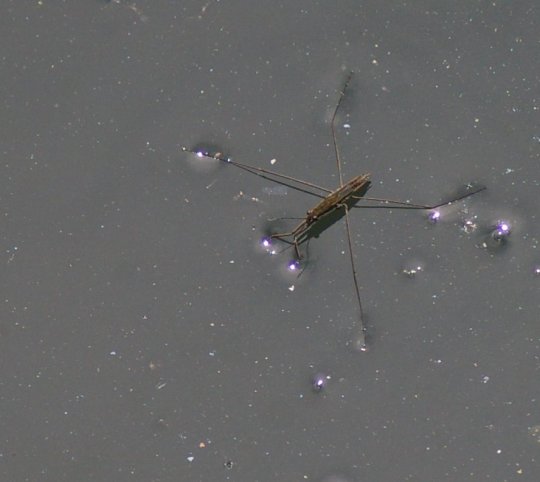
shizumareba nagaruru ashi ya mizusumashi

the whirligig;
when it stops skating,
the legs float away


© Taigi


Credits: Whirligig or pond-skater

The amembo, the pond-skater, seen skating in summer, has a long slender body, long legs, and wings at certain times. When for a moment it ceases its perpetual gyrating and figure-skating, the current pulls his legs along and the whole posture of the insect becomes assymmetrical. This is all there is in this haiku, but we feel in and through it just as much of the power of nature, law, inevitability, as in the rising of the sun or the procession of the seasons.

It's a very nice and fragile insect this Whirligig (pond-skater) we see it very often here in The Netherlands and it's a sign that the waters (ponds, rivers and so on) are clean, because to skate upon water the surface of that water has to have a certain tension. That tension is only seen in very clean water (with a lot of oxygen).

The goal of this "Little Creatures" feature is to look closer to our surroundings and try to write/compose a haiku in the classical way (5-7-5; seasonword; cuttingword; a short moment; in a way a spiritual or deeper layer and the first and third line have to be interchangable). So here is my attempt to write a haiku inspired on this one by Taigi (by the way I am not that familiar with Taigi).

This episode is open for your submissions at noon (CET) and will remain open until next Thursday December 4th at noon (CET). Have fun!

Monday, March 17, 2014

Carpe Diem #424, Unpen-ji (temple 66)


Dear O-Henro ... Haijin, visitors and travelers,

Here we are at Unpenji, temple 66, being back in Tokushima Prefecture (the first Prefecture we entered) were we started. It's just for today that we are back at the beginning of our Shikoku Pilgrimage. Another day has passed away and it's time to explore another theme of the Stata of Zen of Haiku.
Today we will explore non-morality. Zen is non-moral. About morality as such, pure morality, there is something hard and mechanical and dead often makes us wish to do without it. So-called 'good' actions are, as far as the morality of them is concerned, cold, and move us to a merely cold admiration. It is in this manner, rather than then the action or its results, the manner of the person who does it, that the value lies.
At bottom, this 'manner' is the poetry of the action. It has nothing to do with the morality of it. An example written by Oshima Ryota (1718-1787), a not so well-known haiku-poet:

angry and offended,
I came back:
the willow tree in the garden

Willow Tree Bonsai

What a wonderful haiku don't you think too. I can picture the scene. Ryota is offended by someone and is angry about that, but as he returns home and sees the willow tree in his garden, his anger dissapeared like snow in the sun.

Buddha taught that by fulfilment of the moral laws a man may enter into Nirvana. He never suggested that any other means was possible. The teaching of Christ is exactly the same.

Another haiku-example, this time by Taigi (1709-1771), a contemporary of Ryota:

not a single stone
to throw at the dog, -
the wintry moon

Wintry Moon

Taigi was angry on a dog who was barking the whole night through and he sought for a stone to throw at it, but then he saw the wintery moon, and his anger vanished.
This is poetry, howerver inhumane it may also be. The point lies in the fact that e.g. Christ was not hindered by his morality from doing the will of God. It is not a merely superficial view which considers this something which is above morality and destructive. Life is only possible through death, but the positive side of the matter is in life itself. The strange thing is that, because of, or in spite of, or irrespective of morality, all things work together for good, all that we behold is full of blessings.
It is in this sense that we say, Zen is non-moral. It lives a deeper life than morality as such, not cast down by sin or elated by virtuos action, a life of painful joy without ceasing.
For this episode I gratefully used the Haiku-series written by R.H.Blyth.

Unpen-ji (temple 66)

Today we visit Unpen-ji (temple 66) situated in Myoshi, Tokushima Prefecture, devoted to Senju Kannon, a Buddha which we have met earlier on our pilgrimage.The city's flower is a beautiful flower from the family of orchids.

Habenaria Radiata, the flower of Myoshi

scent of orchids
overwhelms me as I enter
Unpen-ji temple

(c) Chèvrefeuille

boiling of anger
after the quarrel with her -
Honeysuckle perfume

(c) Chèvrefeuille

It is not easy to catch non-morality in a haiku, so I tried it with the second haiku above, but ... I am not satisfied with it.

Well ... it was a joy to write this post and I hope you all did like it. This episode will be open for your submissions tonight at 7.00 PM (CET) and will remain open until March 20th 11.59 AM (CET). I hope to post our new episode, Daiko-ji (temple 67), later on today.


Saturday, October 12, 2013

Carpe Diem's Revise that haiku #1, a haiku by Taigi (1709-1771)


Dear Haijin, visitors and travelers,

I love to introduce an all new challenging feature to you all. This new feature I have called "Revise That Haiku". And as the title says it's the goal to REVISE a given haiku. How does this new feature go?

In every, monthly, episode I will share a haiku written by a classical (or a non-classical, modern) haiku poet. I will describe the moment which inspired the haiku poet to compose that specific haiku. To REVISE that haiku you read the description of the moment and let it inspire you to write a revised version of that haiku. You may revise it in a classical or non-classical way, but it has to be different from the given haiku.

For this first episode of "Revise That Haiku" I have chosen a haiku written by Taigi (1709-1771 ?), a contemporary and friend of Buson. I will first give the haiku (including the Japanese Romaji) and then I will give the description of the moment which led to the haiku.

Plum flowers

umi ikete tsuki to mo wabin tomoshikage

arranging the plum-flowers,
I would enjoy them in the light of the lamp,
as if in the moonlight

(c) Taigi (1709-1771 ?)

The brevity of haiku is not something differnt from, but a part of the peotical life; it is not only a form of expression but a mode of living more immediately, more closely to life as may be illustrated in the above haiku by Taigi.

The original of the above haiku is even more difficult, literally: "arranging the plum, as if the moon, I would savour, lamp-light" (Wabiru translated 'enjoy', 'means' to live a life of poetry in poverty). The poet has arranged the flowers in a vase, and wishes to see them in the light of the moon, but there being no moon, he lights the lamp instead, and adds its light to the poetry and the beauty of the flowers.
The whole of the poet's life is shown in this action and the essence of the verse in wabin. This poverty, this asceticism of life and form in haiku, this absence of luxury and decoration finds its philosophical and transcendental expression in Emanuel Swedenborg's (a Swedish philosopher who lived from 1688 until 1772) "Heaven and Hell" (paragraph 178); after he has described the garments of the angels, some of which glow with flame, some of which shine with light, he adds:

"But the angels of the inmost heaven are not clothed".

Well ... with the desciption of the moment I think you can revise that haiku ... so ... "break a leg", have fun, be inspired and share your revised Taigi-haiku with us at Caroe Diem Haiku Kai.

Flourishing Plum Flowers in the Moonlight

I have given it also a try, here is my 'revised' Taigi-haiku:

shadow on the wall
flourishing plum blossom
in the moon light

(c) Chèvrefeuille, your host

Not a bad revised Taigi-haiku I think, but that's not up to me to decide.

This first episode of Carpe Diem's Revise That Haiku will stay on 'till November 15th 11.59 AM (CET) and I will (try) to post a new episode of this new feature later on that day.
!! Revise That Haiku #1 is now open for your submissions !!


Sunday, March 10, 2013

Carpe Diem #142, Uraraka (serene)


Dear Haijin, visitors and travelers,

'Till now we had 'early Spring kigo', so now we are entering 'mid-Spring'. For the next, say, ten days we are sharing haiku on classical Mid-Spring Japanese kigo. Yesterday we started mid-Spring with Kiji (pheasant) and now we have Uraraka (serene). In this kigo serene can easily been seen as tranquility, calmness and peacefulness. There are several haiku poets who have written haiku with tranquility, calmness and peacefulness in it. For example this one by Taigi:

calm days
the swift years
forgotten


Or this one by Issa (maybe you remember it from our second Carpe Diem month in which Issa was our haiku master):

a calm sunny day
the monk of a mountain temple
peeps through a part of the fence


Or what do you say of this one on tranquility by Shiki:

tranquility
the first torii (*) in the middle
of the barley field


(*) A Torii is the sacred archway of a Shinto shrine. Every Shinto shrine had three of these Torii, which weren't direct in front of the shrine, but quite in a distant. This Torii in Shiki's haiku was the first and stood in the middle of a barley field. It's a wonderful imagery of the tranquility of Spring.

Credits: Tranquility

What a serene Japanese Garden. This old pond feature in this garden is called a 'tranquility pond'. I thought this picture is wonderful to inspire you, dear friends.

Japanese garden
streaming water of life -
tranquility


serene Spring
cherry blossoms trembling
in the breeze


I hope you enjoyed this episode and that you all are inspired to write new haiku on this prompt for today.
This prompt will stay on 'till March 12th 11.59 AM (CET) and I will post our new episode of Carpe Diem later on today around 10.00 PM (CET). That will be our second Carpe Diem Special by Onitsura.

Our inspirational haiku by Onitsura is the following:

mizu irete hachi ni uketaru tsubaki kana

putting in the water
the vase received
the camellia