Showing posts with label choka. Show all posts

Monday, February 10, 2020

Carpe Diem #1809 Wedding Bells


Dear Haijin, visitors and travelers,

Welcome at a new episode of our wonderful Kai. Yesterday I challenged you to create an Acrostic Dodoitsu, a nice Japanese poetry form, but also a short poem. So today I love to challenge you with a Long Japanese Poetry form, the Choka. Let me tell you a little bit more about the Choka.

The choka can be of almost any length, because its form depends on alternating phrases (or lines) containing either seven of five sound units (onji). The end of the poem is signaled by two lines of seven sounds. So the form is five/seven, five/seven, five seven, .... , seven/seven.
This was the most popular form of poetry in the 9th century as indicated by the large number of works in the celebrated anthology Man'yoshu (The Collection of Ten Thousand Leaves). This anthology of anthologies contained 260 choka and 4200 tanka.


Page from The Man'yoshu

The poet Kakinomoto no Hitomaro, who composed most of his work in the last decade of the 7th century, took the choka to its highest lyrical point with his finesse in the use of ritual language.
The connection to tanka is evidenced by the envoy or hanka - a tanka-like poem attached at the end of the choka. Occasionally more than one envoy will close the choka. There have been a few efforts to revivie the form over the intervening centuries, but the form has failed to gain any popularity in Japan, and even less has been accomplished in English. (Based on Jane Reichhold's "Writing and Enjoying Haiku")

Here is an example of a choka from the Man'yoshu (no. 802):

The briefest chōka documented is Man'yōshū no. 802, which is of a pattern 5-7 5-7 5-7 5-7-7. It was composed in the Nara period and goes:

When I eat melons
My children come to my mind;
When I eat chestnuts
The longing is even worse.
Where do they come from,
Flickering before my eyes.
Making me helpless
Endlessly night after night.
Not letting me sleep in peace?

(envoy or hanka)

What are they to me,
Silver, or gold, or jewels?
How could they ever
Equal the greater treasure
That is a child? They cannot.

© Yamanoue no Okura (Tr. Edwin Cranston)

Choka ... a wonderful Japanese poetry form ... Today I love to challenge you to create a Choka in which Love is the main theme.

This episode is NOW OPEN for your submissions and will remain open until February 17th at noon (CET). Have fun!


Saturday, August 17, 2019

Carpe Diem Weekend Meditation #98 Choka ... the long Japanese poem


!! Open for your submissions tomorrow Sunday 18th at 7:00 PM (CEST) !!

Dear Haijin, visitors and travelers,

Welcome at this delayed weekend meditation. My apologies (again) for being late I hadn't time enough to publish this weekend meditation earlier.

This weekend I love to challenge you to create a Japanese long poem, or Choka. Let me tell you a little bit more about the Choka.
The choka can be of almost any length, because its form depends on alternating phrases (or lines) containing either seven of five sound units (onji). The end of the poem is signaled by two lines of seven sounds. So the form is five/seven, five/seven, five seven, .... , seven/seven.
This was the most popular form of poetry in the 9th century as indicated by the large number of works in the celebrated anthology Man'yoshu (The Collection of Ten Thousand Leaves). This anthology of anthologies contained 260 choka and 4200 tanka.

Kakinomoto no Hitomaru

The poet Kakinomoto no Hitomaro, who composed most of his work in the last decade of the 7th century, took the choka to its highest lyrical point with his finesse in the use of ritual language.
The connection to tanka is evidenced by the envoy or hanka - a tanka-like poem attached at the end of the choka. Occasionally more than one envoy will close the choka. There have been a few efforts to revivie the form over the intervening centuries, but the form has failed to gain any popularity in Japan, and even less has been accomplished in English. (Based on Jane Reichhold's "Writing and Enjoying Haiku")

Here is an example of a choka from the Man'yoshu (no. 802):

The briefest chōka documented is Man'yōshū no. 802, which is of a pattern 5-7 5-7 5-7 5-7-7. It was composed in the Nara period and goes:

When I eat melons
My children come to my mind;
When I eat chestnuts
The longing is even worse.
Where do they come from,
Flickering before my eyes.
Making me helpless
Endlessly night after night.
Not letting me sleep in peace?

(envoy or hanka)

What are they to me,
Silver, or gold, or jewels?
How could they ever
Equal the greater treasure
That is a child? They cannot.

© Yamanoue no Okura (Tr. Edwin Cranston)


My personal weblog: Chèvrefeuille's Haikublog

I once wrote a choka (and published it on my personal weblog), but it isn't really my "cup of tea", but I love to share it here with you all:

the cooing of pigeons
resonates through the gray streets –
ah! that summer rain
refreshes the dried out earth
filling its scars
the perfume of earth tickles
my nostrils
after the hot summer days
I dance in the rain
naked on the top of the hills
I feel free at last
nature around me comes to life
field flowers bloom
I see their beautiful colors
the perfume of Honeysuckle

ah! that summer rain
the perfume of the moist soil
tickles my senses
I lay down, naked in her arms
surrounded by Honeysuckle

© Chèvrefeuille

It's a very nice form of Japanese poetry, but as I said above not "my cup of tea", but maybe it'is your "cup of tea". 

PS. You can choose your own theme.

This weekend meditation is open for your submissions next Sunday August 18th at 7:00 PM (CEST) and will remain open until August 25th at noon (CEST). Have a wonderful weekend ... or maybe I have to say "have a wonderful Sunday".

Saturday, February 24, 2018

Carpe Diem Weekend-Meditation #21 Out Of The Box #3 Chōka and Sedōka (Winter / Summer)


!!! Open for your submissions next Sunday February 25th at 7:00 PM (CET) !!!

Dear Haijin, visitors and travelers,

Welcome at a new Weekend-Meditation. This weekend I have chosen for another nice "Out Of The Box" episode. In this "Out Of The Box" feature I share other poetry forms, mostly Japanese forms, but also other modern forms.

This weekend I love to challenge you to create a Chōka or a Sedōka. I will tell you a little bit more about it hereafter. This "Out Of The Box" episode I have also chosen a task for you. That task is to create a Winter poem and a Summer poem, but you have to use the Chōka or the Sedōka form.


The chōka, “long poem,” is of indefinite length, formed of alternating lines of five and seven syllables, ending with an extra seven-syllable line. Many chōka have been lost; the shortest of those extant are 7 lines long, the longest have 150 lines. They may be followed by one or more envoys (hanka). The amplitude of the chōka permitted the poets to treat themes impossible within the compass of the tanka.


The sedōka, or “head-repeated poem,” consists of two tercets of five, seven, and seven syllables each. An uncommon form, it was sometimes used for dialogues. Kakinomoto Hitomaro’s sedōka are noteworthy. Chōka and sedōka were seldom written after the 8th century.
An example of a Sedoka:

in the backyard -
a rainbow of chrysanthemums
finally autumn has arrived

monks chanting mantras
while sweeping the garden
being one with the universe

© Chèvrefeuille

This weekend meditation is open for your submissions and next Sunday February 25th at 7:00 PM (CET) and will remain open until Sunday March 4th at noon (CET). Have a wonderful weekend.


Wednesday, December 23, 2015

Carpe Diem Special #188 Georgia's 4th, another choka


Dear Haijin, visitors and travelers,

Here is our belated fourth CD-Special by Georgia, winner of the "peace of mind" kukai. As you maybe know Georgia has re-discovered the choka (Japanese long poem) and she is, in my opinion, the queen of choka. She has written a lot of choka through the years and she also has experimented with this beautiful Japanese long poem.
For this episode I have chosen an experimental choka which rhymes ... I hope you all like this experimental choka and maybe it triggers you to experiment too with this form, or with one of the other Japanese poetry forms.

Meditation

Bastet’s Choka Experiment: Meditation – Rhyming Choka : 7-6-7-6-5 repeated 3 times…rhymes in couplets until the last line.

Meditation

reflecting, meditating
my thoughts contemplating,
watching the leaves blow around
without hearing a sound
relativity
looked at in simplicity
observing the east and west
there I began my day’s quest
thus I discovered death
with a baby’s breath!
I think babies born today
have just finished dying
from the world that they knew well
living that awful hell
we call being born
then, I saw death everywhere
for which I have no care
leaves and insects, passing days
a simple passing phase
why then should I fear

© Georgia (a.k.a. Bastet, 2013)


This CD-Special is NOW OPEN for your submissions and will remain open until December 26th at noon (CET).

Thursday, December 10, 2015

Carpe Diem Special #186 Georgia's 2nd "days of Christmas" (choka)


Dear Haijin, visitors and travelers,

What a joy to read how much you all appreciate Georgia's CDHK e-book "old bamboo wind chimes", she is indeed a great poetess and very gifted. Together with her son she created her e-book and I made the final publication complete by adding a foreword to it. I have read "old bamboo wind chimes" several times and every time again I find new ideas and feelings. It's really an awesome e-book. And I am proud to present to you Georgia's second CD-Special. For this episode I have chosen to bring a choka written by her.

I had never heard of choka until I read several choka at Georgia's weblog and I must say ... Georgia is one of the most gifted choka peotesses I know. She gave me the guts to write a choka myself, which I will share here too later on, but first I love to share a choka Georgia wrote in response on one of the themes of last years "seven days to Christmas" feature.

candles burn bright
Christmas trees twinkle
symbols of rebirth
in dark days of winter
school children home
play in snow-covered lawns
an old beggar stands
alone homeless and cold
angels smile sweetly
on a street corner at dawn
in newspapers
words of peaceful harmony
on the radio
sweet carols play day and night

Christmas card scenes
melt under the heat of hate
we know too well
the children are being good
anxiously awaiting gifts

© Georgia (a.k.a. Bastet, 2014)


Credits: Christmas
The goal of this CD-Special is to write an all new haiku, tanka or in this case an all new choka, inspired on the given one by Georgia.

As I told you above ... Georgia inspired me once to try choka and this was my very first choka ever: It's not themed Christmas, but I love to share that choka here with you, which was earlier published at my personal haiku blog.

the cooing of pigeons
resonates through the gray streets –
ah! that summer rain
refreshes the dried out earth
filling its scars
the perfume of earth tickles
my nostrils
after the hot summer days
I dance in the rain
naked on the top of the hills
I feel free at last
nature around me comes to life
field flowers bloom
I see their beautiful colors
the perfume of Honeysuckle

ah! that summer rain
the perfume of the moist soil
tickles my senses
I lay down, naked in her arms
surrounded by Honeysuckle

© Chèvrefeuille


Credits: Chèvrefeuille (my penname meaning Honeysuckle)
And now it's up to you my dear Haijin to write an all new haiku, tanka or choka (if you want too) and share it here with us all at our Haiku Kai.

This episode is open for your submissions tonight at 7.00 PM (CET) and will remain open until December 13th at noon (CET). I will try to publish our next episode, making the coolness; crawling out, later on. For now .... have fun!

Tuesday, August 11, 2015

Carpe Diem Tokubetsudesu #56 Choka (or Nagauta), Japanese "long poem"


Dear haijin, visitors and travelers,

I didn't get the job. I was first disappointed, but after hearing the reasons I was, in a way, happy that I didn't get it, because to this new job there was a study included in a city far from the city were I live. My employer has given me an opportunity to follow another study and maybe in the near future I will get the job after all. Thank you all for your love, thoughts and prayers. And now ... let's go do some haiku-ing or in the case "choka-ing".

As I promised you all few weeks ago I will do a few episodes of Tokubetsudesu about other Japanese poetry-forms. In this episode I love to tell you a little bit more about the Japanese "long poem", the Choka (or Nagauta).

The choka can be of almost any length, because its form depends on alternating phrases (or lines) containing either seven of five sound units (onji). The end of the poem is signaled by two lines of seven sounds. So the form is five/seven, five/seven, five seven, .... , seven/seven.
This was the most popular form of poetry in the 9th century as indicated by the large number of works in the celebrated anthology Man'yoshu (The Collection of Ten Thousand Leaves). This anthology of anthologies contained 260 chok and 4200 tanka.

Credits: Kakinomoto no Hitomaro

The poet Kakinomoto no Hitomaro, who composed most of his work in the last decade of the 7th century, took the choka to its highest lyrical point with his finesse in the use of ritual language.
The connection to tanka is evidenced by the envoy or hanka - a tanka-like poem attached at the end of the choka. Occasionally more than one envoy will close the choka. There have been a few efforts to revivie the form over the intervening centuries, but the form has failed to gain any popularity in Japan, and even less has been accomplished in English. (Based on Jane Reichhold's "Writing and Enjoying Haiku")

Here is an example of a choka from the Man'yoshu (no. 802):

The briefest chōka documented is Man'yōshū no. 802, which is of a pattern 5-7 5-7 5-7 5-7-7. It was composed in the Nara period and goes:

When I eat melons
My children come to my mind;
When I eat chestnuts
The longing is even worse.
Where do they come from,
Flickering before my eyes.
Making me helpless
Endlessly night after night.
Not letting me sleep in peace?

(envoy or hanka)

What are they to me,
Silver, or gold, or jewels?
How could they ever
Equal the greater treasure
That is a child? They cannot.

© Yamanoue no Okura (Tr. Edwin Cranston)

Credits: Harvest Moon

I remember that Georgia of Bastet and Sekhmet's Library wrote, a while ago, an episode of our former Ghost Writer post, about the choka. She is, as far as I know, the only CDHK family member who writes choka. Here is one of her choka:

The Last Harvest Moon

as the breeze picks up,
canes rattle in harmony
red scattered leaves
fall in the river and drown
a monk bent with age
walks along the road thinking
his secular thoughts
the splendor of youth now gone
he gathers courage
to face another winter
his arthritis plain
his skin yellow and brittle
then a finch warbles
a cat rubs against his legs
he smiles down sweetly
then continues his journey

(envoy or hanka)


the last harvest moon
outlines the withered bent stalks
he walks and gazes
gathering the cold omens
whispered in the winter wind

 ©  Georgia (2014)

I love this "long poem", but it's not really my "cup of tea". I remeber that I had a while ago the iidea to create a weblog about choka, but I never did that and maybe that's something not to worry about, because recently we decided as Haiku Kai to make it possible to respond with other Japanese poetry forms than haiku or tanka. So ... choka ... is also part of that decision.

This episode is NOW OPEN for your submissions and will remain open until August 14th at noon (CET). I will try to publish our new episode, a cd special with the third haiku by Lolly, later on.

Tuesday, December 23, 2014

Carpe Diem Ghost Writer post #39,


!! I publish this GW-post earlier, because I am in the nightshift !!

Dear Haijin, visitors and travelers,

It's my pleasure to present you an all new episode of our Ghost Writer feature. This week I have a nice article about Choka written by Georgia of Bastet and Sekhmet's Library ...
I am not that familiar with Choka, but I love to know more about it ... Choka is a Japanese long poem with also a kind of syllables rule, just like our haiku.
So have fun reading this article and maybe you will compose your first 'Choka'.

+++++++++++++++++++++++++++++++++++++++++++++++++++++++++
+++++++++++++++++++++++++++++++++++++++++++++++++++++++++


Hello Haijin:

I thought today I’d try to introduce the choka.  It’s a form that fascinates me the more I try to understand it.  Choka were long, commemorative poems (in fact choka means the long poem) and the longest ran sometimes over 100 lines!  They were usually sung.  There were about 400 choka copied in the 8th century anthology of waka entitled Man'yoshu (Collection of Ten Thousand Leaves).

The classical choka is formed by writing 5-7 syllables couplets for as many lines  as you like ending however with an extra 7 syllable line. There have been variations over the years as to how to write a choka including modern attempts to revive the genre. Many modern English language writers are now using the choka to create longer poems with Japanese flavour.  You can see how that’s done clicking the link to The Poet’s Garret below.

Now days when the form is used (and interestingly it is often used by English language haiku poets) it is used to tell a story, not necessarily an epic or commemorative tale – just a story.  Sometimes people use it just to write an impression – something link a longish tanka.

Here’s one of my choka which I wrote not long ago to use as an example of how it can be done:


The Last Harvest Moon

as the breeze picks up,
canes rattle in harmony
red scattered leaves
fall in the river and drown
a monk bent with age
walks along the road thinking
his secular thoughts
the splendor of youth now gone
he gathers courage
to face another winter
his arthritis plain
his skin yellow and brittle
then a finch warbles
a cat rubs against his legs
he smiles down sweetly
then continues his journey

the last harvest moon
outlines the withered bent stalks
he walks and gazes
gathering the cold omens
whispered in the winter wind
 

©  G.s.k. ’14

As you can see, I wrote 16 lines of 5-7 syllables ... from the 17th I created a  5 line conclusion, a kind of general summary of the poem in  5-7-5-7-7.  

There's no need to rhyme but you can and the syllable count is open to discussion if you follow the modern school of haiku and do "the short line - long line - short line" version of haiku, which compensates for the problem of not being able to superimpose the on (Japanese sounds) to our language, using syllables we create haiku that are third longer than Japanese poetry.  I preferred the 5-7 couplets with a conclusive tanka for my choka. 

I found it interesting that the author of the blog Kujaku Poetry and Ships points out that often the last closing lines of a choka were used to give a sort of summary of the whole poem.  When the poet did this, the last lines were often more emotional and less detailed.  Sometimes these closing fragments could stand alone and eventually they were gathered together in an anthology under the name tanka, (short poem) or waka (though waka generally refers to Japanese Poetry as a whole) and so the independent genre tanka was born.

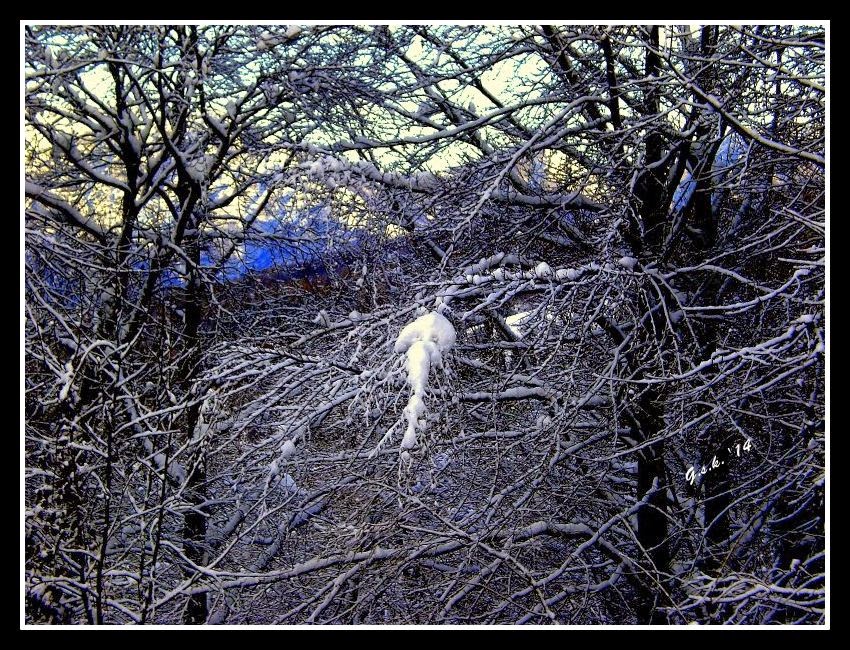
I would like to suggest that you write a choka and here is a winter scene that might help you:


Thanks for reading!  Hope you have fun, Georgia (Bastet)

For further reading:

Origins of Japanese Poetry – Kujaku Poetry & Ships – a brief history of choka

Japanese Poetry Forms – The Poet’s Garret – a brief explanation of katauta and choka with examples of ways the choka can be used.

+++++++++++++++++++++++++++++++++++++++++++++++++++++++++++++++++++++++
+++++++++++++++++++++++++++++++++++++++++++++++++++++++++++++++++++++++
 
Well ... I hope you did like this Ghost Writer post and I hope you are inspired to write Choka ... Have fun!

This GW-post is open for your submissions tonight at 7.00 PM (CET) and will remain open until December 26th at noon (CET). I will try to post our next episode, Christmastree, later on ... for now have fun!