Carpe Diem Haiku Kai is the place to be if you like to write and share Japanese poetry forms like haiku and tanka. It’s a warmhearted family of haiku poets created by Chèvrefeuille, a Dutch haiku poet. Japanese poetry is the poetry of nature and it gives an impression of a moment as short as the sound of a pebble thrown into water. ++ ALL WORKS PUBLISHED ARE COPYRIGHTED AND THE RIGHTS BELONG TO THE AUTHORS ++ !!! Anonymous comments will be seen as SPAM !!!
Pages
- Home
- Carpe Diem Lecture 1
- Carpe Diem Lecture 2
- Carpe Diem's Library
- Carpe Diem's Kukai ...
- All My Years a tribute CDHK E-book for Jane Reichhold
- TROIKU, A new form of haiku
- Preview CDHK E-book "Flamingo Clouds" Troiku
- Tan Renga the short linked chain of two stanza
- Preview "Chained Together" an anthology of Tan Ren...
- Prompt Suggestions
Showing posts with label An Act Of Devotion. Show all posts
Sunday, September 29, 2019
Carpe Diem #1754 "An Act Of Devotion" ... the pilgrimage ends
Dear Haijin, visitors and travelers,
Wow what a wonderful month September was. We traveled around the world and walked several pilgrimages ... a pilgrimage is "an act of devotion" as we all have seen this month and therefore I have chosen to end our pilgrimage=month with our theme "an act of devotion".
You can use it like you want ... feel free to give words and meaning to your feeling of "an act of devotion".
Tomorrow I hope to publish our first episode of our celebration month October. We will celebrate our 7th anniversary together with all prompts of "little ones". Ofcourse "little ones" is not only small insects, but also small birds and animals and even small people. I think this celebration will become awesome and I hope you all will celebrate it with me ... Carpe Diem Haiku Kai is a wonderful community of lovers of Japanese poetry and I am grateful for all your love and participation.
This last episode of September is NOW OPEN for your submissions and will remain open until October 6th at noon (CEST). I will try to publish our first episode of our anniversary month later on. For now ... have fun ... our "act of devotion" has ended .... time to relax.
Thursday, September 26, 2019
Carpe Diem #1753 Trail of Saints, Krakow, Poland
Dear Haijin, visitors and travelers,
Yesterday we were in Maastricht, The Netherlands, a beautiful city in which Saint Servatius is very important. It was a real joy to tell you a little bit more about my country, but now it's time to go on again on "an act of devotion", or pilgrimage-routes around the world.
Today I will tell you a little bit about the so called "Trail of Saints", it's a city pilgrimage in the city of Krakow, Poland. Poland has a very rich history on Catholic belief and in Krakow you can find a lot of Catholic churches and cathedrals ... these are the main goal on the "Trail of Saints".
Let me tell you a little bit more about the "Trailof Saints":
There is no other city in this part of Europe with so many graves of people recognised as saint or blessed by the Catholic Church. It was not without a reason that Jan Mucante, master of the ceremony in the delegation of Papal Legate Cardinal Gaetano, wrote in 1596: "If there was no Rome, Krakow would be Rome." Currently, the local churches hold the earthly remains of nine saints, seven blessed and a similar number of Servants of God who died in an aura of sanctity.
![]() |
| Church of Our Lady of the Snows and the Convent of Dominican Nuns |
The prayer at the graves of people recognised as saints has been practised in Christianity for two thousand (and in Krakow for almost nine hundred) years. Individual centuries witnessed the lives of great characters enjoying special veneration and attracting thousands of tourists who wanted to pray at their graves. Such persons included St Stanislaus, St Hyacinth, and recently - St Mary Faustine Kowalska.
Krakow owes its genius loci above all to the people that used to live here. The graves of some of them, located in nineteen beautiful churches in Krakow, compose the "Krakow Trail of Saints" and invite tourists to contemplate not only the magnificent architecture of the city, but also its spiritual history marked by the lives of saint bishops, missionaries, preachers, kings and princes, humble priests, ordained sisters and brothers, as well as the so-called lay people. The trail also includes three martyrs of the Second World War, whose graves can be found neither in Krakow's not in other sanctuaries. These people are still remembered in Krakow's churches in which they lived and worked. (Source)
This episode is NOW OPEN for your submissions and will remain open until October 3rd at noon (CEST). I will try to publish our new weekend meditation later on. For now .... have fun!
Wednesday, September 25, 2019
Carpe Diem #1752 Pilgrimage of the Relics, Maastricht (The Netherlands)
Dear Haijin, visitors and travelers,
Welcome at a new episode in our "an act of devotion" month in which we are traveling around the world to visit (and walk) pilgrimage routes. This day I have chosen a very special pilgrimage.
As you all know I live in the Netherlands and maybe you know that the Netherlands were once an exclusive Catholic country under the Spanish rulers. So in my conutry, now multi-religious, I have chosen a pilgrimage route I never had heard of ... The Pilgrimage of the Relics (or Maastricht Septennial Pilgrimage). Let me tell you a little bit more about this pilgrimage route.
![]() |
| Basilica of Saint Servatius (Maastricht, The Netherlands) |
The Basilica of Saint Servatius is a historical church dedicated to Saint Servatius, an Armenian missionary who died and was buried in Maastricht in 384. The grave of the saint, as well as the many relics in the church treasury made the basilica a popular pilgrimage site. Heiligdomsvaart, is a pilgrimage tradition that occurs once in seven years and which started in the 14th century.
![]() |
| Saint Servatius |
The Legend of St. Servatius:
The first stone churches in Maastricht were built after the arrival of Saint Servatius in the fourth century AD. After his death, Maastricht became a popular destination for pilgrims. According to the legend, Saint Servatius was the first bishop of Maastricht and a small chapel was build on the spot where he was buried. In the centuries that followed, this chapel grew into the St. Servatius Church.
The Treasury:
The mortal remains of Servaas are kept in a box, which is on display in the Treasury of Saint Servatius Church.
The Pilgrimage of the Relics goes to the Saint Servatius Basilica and is a pilgrimage that is only done once in the seven years.
This episode is NOW OPEN for your submissions and will remain open until October 2nd at noon (CEST). I will try to publish our new episode later on. For now ... be inspired and have fun!
Monday, September 23, 2019
Carpe Diem #1751 Lough Derg, Donegal (Ireland)
Dear Haijin, visitors and travelers,
This month we are following our spiritual path through walking several different pilgrim's routes around the world. Yesterday we were in Peru and today we are back in Europe, in Ireland. Ireland, that beautiful small country next to the UK. Ireland is known for it's deep mystic history ... but there are also several pilgrim's routes in Ireland. Just like in Australia, these pilgrim's routes are young.
In 2013 a group of people started to create pilgrim's routes through Ireland and one of those routes we will walk today ... Lough Derg, Donegal. Let me tell you a little bit more about this pilgrimage.
The Lough Derg pilgrimage route from Station Island Visitor Centre to Saints Island, Co. Donegal is a timeless pilgrim route that is far removed from roads, houses and other signs of modern day living. It has many echoes of its early Christian past along the 12 Km (7 miles) long path. The old pilgrimage road to Lough Derg follows in the footsteps of the medieval pilgrims — not to Station Island where pilgrims normally go today, but to the threshold of the larger Saints Island, which acted as its gateway several hundred years ago. The focus of the legendary St Patrick’s Purgatory, Station Island, was a deep pit in which those who spent a day and a night would allegedly be purged of their sins, experiencing both the torments of the damned and the delights of the blessed. The walk starts at the visitor centre near the pier where boats bring pilgrims across to Station Island. Information about the pilgrimage may be obtained at the centre.
![]() |
| Lough Derg, Donegal |
At about 1.15km, there is a wooden fingerpost pointing down to the right along a stepped path to St Brigid’s Chair, a naturally weathered boulder of banded gneiss. A little further along the route, another sign points to St Daveoc’s Chair. Associated with a local hermit, the ‘chair’ is partially natural, but seems to have had one or two large blocks added to it, hinting that it may once have been a Bronze Age burial place. This is the point where the modern route joins the old pilgrimage road that would have brought the medieval pilgrims from Templecarne.
At 1.75km, a fingerpost points down to St Brigid’s Well, marked by a modern metal cross which is festooned — like the bush above it — with pilgrims’ votive rags. The goal of the pilgrimage is the edge of the lake opposite Saints Island where one can still see the stones that formed the foundation of the wooden bridge that would have brought medieval pilgrims across to Station Island. The path continues full circle to the visitor centre where the walk began.
deep silence
heart and soul bound together
Lough Derg
© Chèvrefeuille
I hope you did like this small pilgrimage ... and I hope it will inspire you to create Japanese poetry. This "an act of devotion" month is running towards its end ... soon we will celebrate our 7th birthday and I hope you all will celebrate this anniversary with me.
By the way, as I told you last week, next Wednesday we will not have a regular episode, because of the fact that I am celebrating my summer vacation.
This episode is NOW OPEN for your submissions and will remain open until September 30th at noon (CEST). I will publish our next episode (for Thursday) later on. For now ... be inspired and have fun!
Sunday, September 22, 2019
Carpe Diem #1750 Señor de Huanca, Peru
Dear Haijin, visitors and travelers,
I hope you all have had a wonderful weekend full of inspiration. Today we are going on with our "act of devotion", pilgrimages around the world. Today I have chosen a not so well known pilgrimage route in Peru.
Every year thousands of pilgrims from all over South America visit the Chapel of Señor de Huanca, near Cusco, high above the Sacred Valley of the Incas. Its two water sources are believed to have miraculous healing powers. On September 14, the most important day of pilgrimage, a traditional hike is made overnight starting from just outside Cusco and taking around six hours.
![]() |
| Chapel of Señor de Huanca (Cusco, Peru) |
A wonderful idea to read about this pilgrimage high in the mountains of Peru were once the Inca ruled.
This episode is NOW OPEN for your submissions and will remain open until September 29th at noon (CEST). I will try to publish our new episode later on. For now ... have fun!
Thursday, September 19, 2019
Carpe Diem #1749 Aussie Camino
Dear Haijin, visitors and travelers,
Did you know that Australia hadn't a pilgrimage route until 2013? I didn't know that. I thought that Australia, with its rich history of Aboriginals would have a pilgrimage, but ... well there was no pilgrimage route until 2013.
This young pilgrimage is called "Aussie Camino" after the most famous pilgrimage to Santiago de Compostela. Let me tell you a little bit more about this young pilgrimage route in Australia:
The Aussie Camino is a pilgrimage route running from Portland in Victoria to Penola in South Australia, inspired by the life and journeys of Australia’s Saint Mary of the Cross MacKillop and her mentor Fr Julian Tenison Woods. Based on the traditions of the Camino de Santiago de Compostela, pilgrims receive a guidebook, passport, scallop shell and stay in the local towns along the way.
![]() |
| Aussie Camino |
But there is more ... the Aussie Camino is (I think) the youngest pilgrimage route on Earth. Ofcourse there is a story behind the Aussie Camino. Let me tell you a little background:
In April 2013, three workmates set out on a pilgrimage they called the ‘Aussie Camino’. On the way they discussed the history, customs and traditions of the ancient pilgrim trails and asked ‘Why are there only caminos in Europe and the Holy Land? Why can’t we have one here? Now that we have a saint of our own, St Mary MacKillop. Where would it begin and end?’
Mary MacKillop was a traveller. Her work took her all over Australia and New Zealand. It was decided it should be from Portland to Penola. Mary MacKillop traveled widely but her last teaching post as a lay teacher was in Portland. From there, she was called by her mentor and co-founder priest Fr Julian Tenison-Woods back to Penola, where they had met a few years before. Penola is widely accepted as the birthplace of St Mary MacKillop’s order, the Sisters of St Joseph. A town with a population of only 1300, it is 383 kilometres from Adelaide and 412 kilometres from Melbourne. It was when Mary was called from Portland to Penola on 19 March 1866 that she wore her black habit for the first time and declared herself Sr Mary. (More about St. Mary MacKillop)
![]() |
| St. Mary MacKillop |
What a wonderful story this is ... I hope you did enjoy the read.
Aborignal country
finally their own pilgrimage
Aussie Camino
© Chèvrefeuille
This episode is NOW OPEN for your submissions and will remain open until September 26th at noon (CEST). I will try to publish our new weekend meditation later on. For now ... enjoy your Aussie Camino.
Wednesday, September 18, 2019
Carpe Diem #1748 Via Francigena, Umbria, Italy
Dear Haijin, visitors and travelers,
This month we are on pilgrimage routes all around the world themed "an act of devotion". Pilgrimages are walking routes for believers of all kind ... it's a walk to a place that's important for them. We have seen several routes already and today I have another wonderful one for you. The pilgrimage we walk today is the "Via Francigena". It is believed that Francis of Assisi walked this route from Spoleto (Italy) to Farfa to offer his order of Franciscanes to the Pope.
Let me tell you a little bit more about this pilgrimage:
This is a seven-night pilgrimage down the spine of Italy that starts from Spoleto, just south of Assisi, and ends at the Abbey of Farfa from where the dome of Saint Peter’s in Rome, 40 miles away, is usually visible. The route follows long stretches of the Via Francigena with its many churches and shrines dedicated to St Francis including Greccio, where he is believed to have invented the first Christmas crib, and his cell near Cortona.
![]() |
| Spoleto Cathedral |
I remember that I once made a series about Francis of Assisi with quotes by him back in 2014. I recall the following quote:
[...] "Remember that when you leave this earth you can taken nothing of what you have received, but only what you have a given: a full heart, enriched by honest service, love, sacrifice, and courage". [...]
And here is the haiku I created inspired on this quote:
on her deathbed
she looks back on her life -
lotus flower blooms
© Chèvrefeuille
This episode is NOW OPEN for your submissions and will remain open until September 25th at noon (CEST). I will try to publish our new episode later on.
Monday, September 16, 2019
Carpe Diem #1747 Medieval Notthinghamshire pilgrimage
Dear Haijin, visitors and travelers,
We are on "an act of devotion" or pilgrimage around the world. Today I have chosen to take a trip back in time ... this day I will tell you a little bit more about the pilgrimages in medieval Notthinghamshire (UK).
The records of the pilgrimage activity of pre-reformation Nottinghashire is an interesting area of discussion and themes clearly arise.
Understandably the most common destination for the medieval pilgrim or palmer was Jerusalem or Hierusalem as it is written in the medieval records. However there is evidence of a wide range of pilgrimage locations ranging from the shrine of St James of Compostella in Northern Spain to more great English shrines such as St. William of York to more local sites such as Our Lady of Doncaster.
![]() |
| Our Lady Of Doncaster (UK) |
It is clear that to all able bodied and sometimes less able seeking a cure, Medieval Christians, were obliged to go on pilgrimage. Sometimes, this was enshrined in law. In 1325, Archbishop Melton’s register records that a Sir Peter de Mauley was penalised for adultery having not to fast every Friday in Lent, Ember Days and Advent for seven years on bread, water and small beer and on Good Friday and the Vigils of All Saints on bread and water only and to make pilgrimages to the shrines of St. William at York, St Thomas at Hereford and the Blessed Virgin at Southwell and St. John of Beverley and St. Wilfrid at Ripon.
without permission
sparrows enter the chapel
visiting Their Lady
© Chèvrefeuille
I wasn't aware of the existence of pilgrimages for Christians, I always thought that only Catholics went on pilgrimages, but in the medieval times it was common for Christians to go on a pilgrimage too.
This episode is NOW OPEN for your submissions and will remain open until September 23rd at noon (CEST). I will try to publish our new episode later on. For now ... your "act of devotion" is to create Japanese poetry inspired on these medieval pilgrimages.
Sunday, September 15, 2019
Carpe Diem #1746 Shikoku Island ... the Path of Enlightenment
Dear Haijin, visitors and travelers,
I hope you all have had a wonderful weekend full of inspiration ... and peace of the soul and heart. I hope you are all okay and into a new week of CDHK. This month we are pilgrims, our theme "an act of devotion" describes what pilgrims feel when they are on a pilgrimage.
A few days ago I told you a little bit about the "Hajj", the once in a lifetime pilgrimage to Mecca for our muslim neighbors. A same once in a lifetime pilgrimage is the Shikoku pilgrimage, a pilgrimage on the Island Shikoku along 88 temples. This is a once in a lifetime pilgrimage for Buddhists.
Maybe you can remember that we walked this pilgrimage together back in February and March 2014 and it was really a wonderful (digital) pilgrimage.
![]() |
| Logo Shikoku Pilgrimage 2014 |
The Shikoku Pilgrimage or Shikoku Junrei is a multi-site pilgrimage of 88 temples associated with the Buddhist monk Kūkai (Kōbō Daishi) on the island of Shikoku, Japan. A popular and distinctive feature of the island's cultural landscape, and with a long history, large numbers of pilgrims (known as henro still undertake the journey for a variety of ascetic, pious, and tourism-related purposes.
In addition to the 88 "official" temples of the pilgrimage, there are over 200 bangai — temples not considered part of the official 88. To complete the pilgrimage, it is not necessary to visit the temples in order; in some cases it is even considered lucky to travel in reverse order. The pilgrimage is traditionally completed on foot, but modern pilgrims use cars, taxis, buses, bicycles, or motorcycles. The walking course is approximately 1,200 km long and can take anywhere from 30 to 60 days to complete. "Henro" is the Japanese word for pilgrim, and the inhabitants of Shikoku call the pilgrims o-henro-san, the o being an honorific and the san a title similar to "Mr." or "Mrs.". They are often recognizable by their white clothing, sedge hats, and kongō-tsue or walking sticks. Alms or osettai are frequently given. Many pilgrims begin and complete the journey by visiting Mount Kōya in Wakayama Prefecture, which was settled by Kūkai and remains the headquarters of the Shingon sect of Buddhism. The 21 km walking trail up to Koya-san still exists, but most pilgrims use the train.
pilgrims chanting
the Heart Sutra to honor Kukai -
cry of a Vulture
breaks through the serene temple -
pilgrims chanting
© Chèvrefeuille
mysterious Island
dedicated to the Path of Enlightenment
four countries as one
© Chèvrefeuille
(note: Shikoku means "four countries")
This episode is NOW OPEN for your submissions and will remain open until September 22nd at noon (CEST). I will try to publish our new episode later on. For now ... have fun!
Friday, September 13, 2019
Carpe Diem #1745 Kumbh Mela (Hindu pilgrimage India)
Dear Haijin, visitors and travelers,
Today we are continuing our "act of devotion" with a Hindu pilgrimage, Kumbh Mela. Let me tell you a little background on this Hindu pilgrimage.
Kumbh Mela is a mass Hindu pilgrimage of faith in which Hindus gather to bathe in a sacred or holy river. Traditionally, four fairs are widely recognized as the Kumbh Melas: the Prayagraj Kumbh Mela, Haridwar Kumbh Mela, the Nashik-Trimbakeshwar Simhastha, and Ujjain Simhastha. These four fairs are held periodically at one of the following places by rotation: Allahabad (Prayagraj), Haridwar, Nashik district (Nashik and Trimbak), and Ujjain. The main festival site is located on the banks of a river: the Ganges (Ganga) at Haridwar; the confluence (Sangam) of the Ganges and Yamuna and the invisible Sarasvati at Allahabad; the Godavari at Nashik; and the Shipra at Ujjain. Bathing in these rivers is thought to cleanse a person of all their sins.
![]() |
| Kumbh Mela at Haridwar |
At any given place, the Kumbh Mela is held every 12 years. There is a difference of around 3 years between the Kumbh Melas at Haridwar and Nashik; the fairs at Nashik and Ujjain are celebrated in the same year or one year apart. The exact date is determined, following the Vikram Samvat calendar and the principles of Jyotisha, according to a combination of zodiac positions of Jupiter, the Sun and the Moon. At Nashik and Ujjain, the Mela may be held while a planet is in Leo (Simha in Hindu astrology); in this case, it is also known as Simhastha. At Haridwar and Allahabad, a Maha ("Great") Kumbh Mela is held every 12 years, with an Ardha ("Half") Kumbh Mela six years later. The priests at other places consider their local fairs to be Kumbh Melas; for example, the Mahamaham festival at Kumbakonam, held every 12 years, is described as a Kumbh Mela. Other places where fairs have been called Kumbh Mela include Kurukshetra and Sonipat.
The exact age of the festival is uncertain. According to medieval Hinduism, Lord Vishnu spilled drops of Amrita (the drink of immortality) at four places, while transporting it in a kumbha (pot). These four places are identified as the present-day sites of the Kumbh Mela.
![]() |
| Kumbh Mela in Prayagraj (postal stamp, India) |
The festival is the largest peaceful gathering in the world, and considered as the "world's largest congregation of religious pilgrims". There is no precise method of ascertaining the number of pilgrims, and the estimates of the number of pilgrims bathing on the most auspicious day may vary. An estimated 120 million people visited Maha Kumbh Mela in 2013 in Allahabad over a two-month period. (Source: Wikipedia)
Wow ... what a wonderful pilgrimage this must be.
evening prayers
while cleansing the sinners
the sound of water
while cleansing the sinners
the sound of water
© Chèvrefeuille
This episode is NOW OPEN for your submissions and will remain open until September 19th at noon (CEST). I will try to publish our new weekend meditation later on. For now ... take a nice bath, say your prayers and feel connected with the Kumbh Mela ... have fun!
Thursday, September 12, 2019
Carpe Diem #1744 Pilgrimage to the Great Shrine of Ise (Japan): "There is nothing to see; and they won't let you see it."
Dear Haijin, visitors and travelers,
Welcome at a new episode in our wonderful "an act of devotion" month in whicj we are exploring pilgrimages around the world. Today I have chosen to bring an episode about the Great Ise Shrine, a Shinto traditional pilgrimage, that even once was walked by Basho. He wrote a short haibun about this pilgrimage. And maybe you remember Yozakura, our Unknown Haiku Poet, whom we have met in our story "Wandering Spirit", was once a monk in the Great Ise Shrine.
![]() |
| Grand Shrine of Ise (Shinto-religion) |
While I was doing research for this episode I ran into a wonderful piece of prose about the Grand Ise Shrine written by Percival Lowell, I love to share a piece of this prose here to give you some inspiration.
[...] "My first meeting with the gods, upon the top of Ontaké, had been strangely unexpected; my last sign from them was destined to be no less so. It took place in an utterly dissimilar yet even more improbable place—the Shrines of Ise.
If, when buds first stir with dreams of blossom amid the forbidding April of our New England year, a man could quietly be spirited away from doubt, delay, and disappointment to a certain province of what is still old Japan, he would find himself in what he would take for fairyland. Over the whole countryside and far up its background of hills glow cloud-like masses of pink-white bloom, while upon all the country roads carnival crowds of men, women, and children journey gayly along, chanting as they go, beneath the canopy of blossom. It is the great Shintō pilgrimage to the Shrines of Ise that he is gazing on, made every spring by three hundred thousand folk at the time when the cherries blow.
Up the winding street of the town of Yamada, the house-eaves on either hand one long line of fluttering pilgrim flags, the gay throng wends its rollicking way, and, crossing a curved parapeted bridge, enters a strangely neat park in the centre of a little valley shut in by thickly wooded slopes. At the farther end of the open an odd sort of skeleton arch makes portal to a carefully kept primeval forest. Through this ghost of a gateway the pilgrims pass by a broad gravelly path into a natural nave of cryptomeria, the huge trunks straight as columns and so tall that distance itself seems to taper them to where their tops touch in arch far overhead. Down aisles of half light on the sides show here and there the shapes of plain unpainted buildings, with roofs feetdeep in thatch, and curiously curved projecting rafters; while under the great still trees the path winds solemnly on through a second portal, and then a third, to the foot of a flight of broad stone steps, up which it ascends to a gateway in the centre of one side of a plain wooden palisade. The gateway's doors stand open, but a white curtain, hanging from the lintel in their stead, hides all view beyond.
In front of the curtain lies a mat sprinkled with pennies. Before it each pilgrim pauses, lays aside his staff, takes off his travel robes, and tossing his mite to lie there beside its fellows, claps his hands, and bows his head in prayer. Then, his adoration done, he slowly turns, takes up again his robe and staff, and goes the way he came. For this is the goal to his long pilgrimage.
That curtain marks his bourne. Beyond the veil none but the Mikado and the special priests may ever go. Yet every now and then a gracious breeze gently wafts the curtain a little to one side, and for an instant gives the faithful glimpse of a pebbly court, a second gateway, and, screened by pale within pale of palisades, more plain wooden buildings with strangely raftered roofs, reputed counterparts of the primeval dwellings of the race. And this is all that man may ever see of the great Shrines of Ise, chief Mecca of the Shintō faith.
If with the mind's eye the pilgrim penetrate no farther than his feet may pass, he may well say with the disappointed tourist whom Chamberlain quotes in the guidebook, in warning to such as would visit these shrines: "There is nothing to see; and they won't let you see it." [...] (Source: Occult Japan)
![]() |
| Uji Bridge to go over to Ise Grand Shrine |
Wouldn't it be wonderful to visit the Grand Ise Shrine in Spring? Look at the beautiful cherry blossoms ... and be silent ...
cherry blossoms bloom
fragile beauty goes with the gods
walking Uji bridge
© Chèvrefeuille
I hope you all did like this episode. It was really a joy to create it, because it's about a wonderful pilgrimage in the land of the Rising Sun, the Mother Land of Haiku, Japan.
This episode is NOW OPEN for your submissions and will remain open until September 18th at noon (CEST). I will try to publish our new episode later on. For now ... be inspired and enjoy!
Tuesday, September 10, 2019
Carpe Diem #1743 Lourdes
Dear Haijin, visitors and travelers,
I hope you all like the theme, an act of devotion, for this month. As I was preparing this month I was pleasantly surprised to see how many pilgrimages there are around the world. And today I have chosen a pilgrimage that's renown around the world I think ... Lourdes (France, Europe). What is the story behind Lourdes?
![]() |
| Our Lady of Lourdes (photo © Dennis Jarvis) |
In the evening of February 11, 1858, a young Roman Catholic girl,. Bernadette, went to fetch some firewood with her sister and another companion when a Lady who was indescribably beautiful appeared to her at the Massabielle grotto. Although the Lady did not tell Bernadette her name when asked at first, she told her to return to the grotto. On subsequent visits, the Lady revealed herself to be the "Immaculate Conception". This was a reference to the dogma of the Immaculate Conception which had been defined only four years earlier in 1854 by Pope Pius IX, stating that the Virgin Mary herself had been conceived without sin. Bernadette, having only a rudimentary knowledge of the Catholic faith, did not understand what this meant but she reported it to her parish priest, Father Peyremale. He, though initially very skeptical of Bernadette's claims, became convinced when he heard this because he knew the young girl had no knowledge of the doctrine. The Lady also told Bernadette to dig in the ground at a certain spot and to drink from the small spring of water that began to bubble up. Almost immediately cures were reported from drinking the water. And yet the water has been shown through repeated testing not to have any special curative properties. Today thousands of gallons of water gush from the source of the spring, and pilgrims are able to bathe in it. Countless purported miracle cures have been documented there, from the healing of nervous disorders and cancers to cases of paralysis and even of blindness. During the Apparitions, Bernadette Soubirous prayed the Rosary. Pope John Paul II wrote: "The Rosary of the Virgin Mary [is] a prayer of great significance, destined to bring forth a harvest of holiness". (Source: wikipedia)
Holy water
sunlight scattered on the wall
Ave Maria
© Chèvrefeuille
This episode is NOW OPEN for your submissions and will remain open until September 17th at noon (CEST). I will try to publish our new episode later on.
Sunday, September 8, 2019
Carpe Diem #1741 Santiago de Compostela
Dear Haijin, visitors and travelers,
I hope you all have had a wonderful weekend. I have had a nice weekend, relaxed and going with the flow. It was a weekend with a lot of activities, but I enjoyed it. This month our theme is "an act of devotion" and all the prompts are pilgrimages all around the world and today I have chosen for that one pilgrimage that we have done several times here at CDHK ... Santiago de Compostela.
Santiago de Compostela is the capital of northwest Spain’s Galicia region. It’s known as the culmination of the Camino de Santiago pilgrimage route, and the alleged burial site of the Biblical apostle St. James. His remains reputedly lie within the Catedral de Santiago de Compostela, consecrated in 1211, whose elaborately carved stone facades open onto grand plazas within the medieval walls of the old town.
![]() |
| Pilgrims on their way to Santiago de Compostela |
We walked this pilgrims route back in 2014 (January / February) while we were visiting Shikoku Island, another pilgrims route we have walked together, and that will return this month too.
a whispered prayer -
pilgrims on their way to Santiago
walking the Path of God
reaching out to their deepest thoughts
seeking the Light
seeking the Light
while chanting psalms or mantras
pilgrims on their way
enjoying Mother Earth's beauty -
a whispered prayer
© Chèvrefeuille
This episode is NOW OPEN for your submissions and will remain open until September 15th at noon (CEST). I will try to publish our new episode later on. For now ... be inspired and have fun!
Thursday, September 5, 2019
Carpe Diem #1740 Munchner Jakobsweg
Dear Haijin, visitors and travelers,
Yesterday I told you that I hadn't time to create our new episode, so here it is. By the way I will not catch up the delayed post, but will give you this episode instead. (This week we have four regular episodes).
This month we are traveling around the world searching for pilgrimage-routes as an act of devotion. We have seen already a few beauties and today I hope to inspire you through a not so well know short pilgrims-route in Germany. Today we will take our walk on the so called "Munchner Jakobsweg".
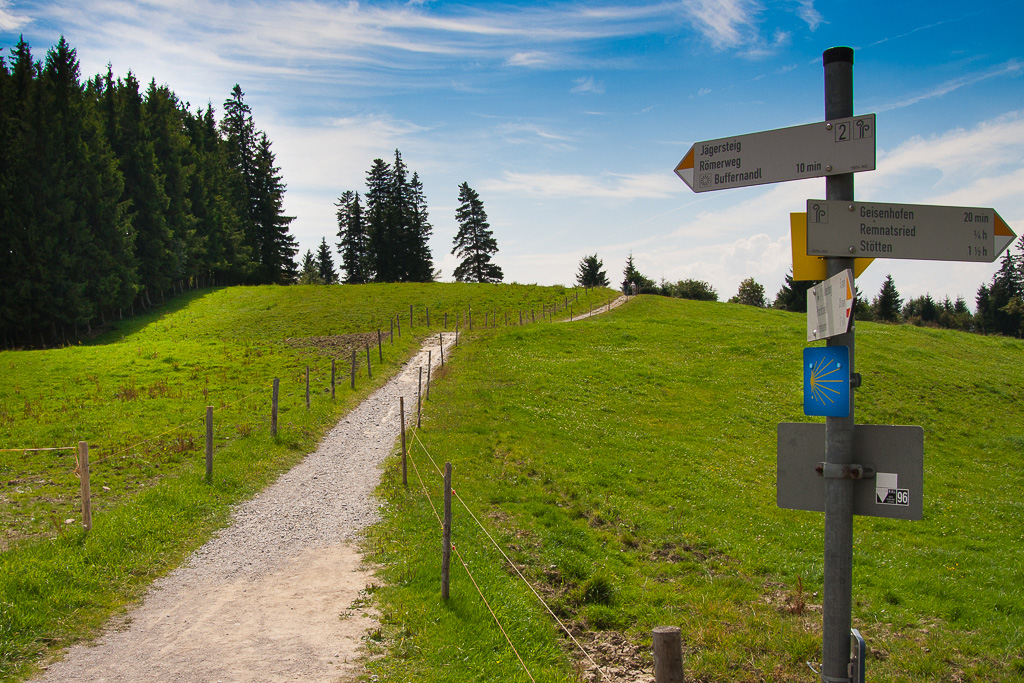
The "Munchner Jakobsweg" is not just one route, but there are several, all starting in another place. The "real" "Munchner Jakobsweg however starts in Munchen (or if traveled back) from Lindau. The "Munchner Jakobsweg" is the german start to wander to Santiago De Compostela. Along the Munchner Jakobsweg you will also see the signs with St. Jakobs Shells as we (maybe) know from our pilgrimage to Santiago earlier here at CDHK.
![]() |
| Direction Sign somewhere along Munchner Jakobsweg |
Thousands of travelers from the east of Europe had to travel through Germany to reach Spain. There are many “feeder” routes heading west through the country to get you towards France and Switzerland, then on to your final stop.
Unlike some other scenic routes in Germany, the St. James’ Way doesn’t follow one single but several routes taken by St. James. Legend tells that his remains were brought by ship and buried in Northern Spain — so, this route more follows the “followers.”
One of the most famous (and beautiful) routes travels through South Germany, through Swabia in Bavaria, ending at Lake Constance at the Swiss border (then continuing on through Austria, Swiss, and France).
Along this portion of the Way of St. James, you’ll find abbeys, monasteries, churches, castles, festivals, gorgeous natural countryside, other scenic routes, and the friendliest people. Jakobus, as he’s also called in German, would have been proud to travel along such a route; and you’re going to love it.
Sounds like a wonderful pilgrims route to me.
again on my way
walking to Santiago
to find myself
© Chèvrefeuille
This episode is NOW OPEN for your submissions and will remain open until September 12th at noon (CEST). I hope to publish our new weekend-meditation later on. For now ... be inspired and have fun!
Tuesday, September 3, 2019
Carpe Diem #1739 St Cuthbert's Way (Scotland)
Dear Haijin, visitors and travelers,
Welcome at a new episode in this month full of the diversity of pilgrimages around the world. Today I have chosen a pilgrimage in Scotland. This pilgrimage route was established in the late nineties.
St. Chuthbert's Way (Scotland):
Bridging the national border between Scotland and England, this inspiring 100km (62.5 miles) cross-border route links Melrose in the Scottish Borders, where St. Cuthbert started his religious life in 650AD, with Holy Island off the Northumberland Coast, his eventual resting place and his original pilgrimage shrine. Although inspired by St. Cuthbert, this is far more than a pilgrimage route.
![]() |
| St. Cuthbert's Way (Scotland) |
Look at the above photo made somewhere along St. Cuthbert's Way ... isn't it wonderful? St. Cuthbert's Way ends on "Holy Island" and I remember that we have had a prompt about "Holy Island" at my personal weblog "Chèvrefeuille's Haiku blog". So I revisited that episode to share a redone cascading haiku into tanka:
painted on rocks
the devote Buddhist monk
Holy Isle
the Kagyan Tradition
painted on rocks
© Chèvrefeuille (2012)
Maybe a little bit strange but on "Holy Island" you can find a Buddhistic Monastery. To read the post on my personal weblog you can click HERE or HERE.
This episode is NOW OPEN and will remain open until September 10th at noon (CEST). I will try to publish our new episode later on. For now ... be inspired and have fun!
Monday, September 2, 2019
Carpe Diem #1738 Camino de Fatima (Portugal)
Dear Haijin, visitors and travelers,
We are on our way ... a full month of all kinds of pilgrimages all around the world ... an act of devotion ...
A pilgrimage is a journey or search of moral or spiritual significance. Typically, it is a journey to a shrine or other location of importance to a person's beliefs and faith, although sometimes it can be a metaphorical journey into someone's own beliefs.
Many religions attach spiritual importance to particular places: the place of birth or death of founders or saints, or to the place of their "calling" or spiritual awakening, or of their connection (visual or verbal) with the divine, to locations where miracles were performed or witnessed, or locations where a deity is said to live or be "housed", or any site that is seen to have special spiritual powers. Such sites may be commemorated with shrines or temples that devotees are encouraged to visit for their own spiritual benefit: to be healed or have questions answered or to achieve some other spiritual benefit. (source)
![]() |
| Camino de Fatima (Portugal) |
Today I have a not so well known pilgrimage ... Camino de Fatima, Portugal. The story has been told often, but I wasn't aware that there was also a pilgrimage named "Camino de Fatima". Let me tell you a little back ground on the story of Fatima.
The story of a famous miracle in Fátima, Portugal, began in May 1917, when three children (ages 7, 9, and 10) claimed to have encountered the Virgin Mary on their way home from tending a flock of sheep. The oldest girl, Lucia, was the only one to speak to her, and Mary told the children that she would reappear to them on the thirteenth day of the next six months. She then vanished.
The children soon told their parents, and while some in the village didn't believe their tale, others did — and told more people. As the weeks and months passed, more and more of the faithful made pilgrimages to Fátima, where the children claimed to receive Mary's visits. Still no one else saw the Virgin Mary; instead, the gathered adults would stand riveted as Lucia took the lead and began to describe her visions.
![]() |
| Camino de Fatima (Portugal) |
It was Mary's final appearance, on Oct. 13, 1917, that became the most famous. In his book "Looking for a Miracle," Joe Nickell states that "an estimated 70,000 people were in attendance at the site, anticipating the Virgin's final visit and with many fully expecting that she would work a great miracle. As before, the figure appeared, and again only to the children. Identifying herself as 'the Lady of the Rosary,' she urged repentance and the building of a chapel at the site. After predicting an end to [World War I] and giving the children certain undisclosed visions, the lady lifted her hands to the sky. Thereupon Lucia exclaimed, 'The sun!' As everyone gazed upward, and saw that a silvery disc had emerged from behind clouds, they experienced what is known [as] a 'sun miracle'."
Not everyone reported the same thing; some present claimed they saw the sun dance around the heavens; others said the sun zoomed toward Earth in a zigzag motion that caused them to fear that it might collide with our planet (or, more likely, burn it up). Some people reported seeing brilliant colors spin out of the sun in a psychedelic, pinwheel pattern, and thousands of others present didn't see anything unusual at all.
This story was the mean reason that the Camino de Fatima was introduced to the world.
wonder, o wonder
Mother Mary shows her face
the sun rises
© Chèvrefeuille
This episode is NOW OPEN for your submissions and will remain open until September 9th at noon (CEST). I will try to publish our new episode later on. For now ... be inspired and have fun!
Sunday, September 1, 2019
Carpe Diem #1737 Introduction to a month full of devotion ... Adam's Peak -- Sri Lanka
![]() |
| Adam’s Peak viewed from a distaance. Photograph by Rehman Abubakr, |
Dear Haijin, visitors and travelers,
I hope you all have had a wonderful inspirational weekend. I had a busy weekend, because I had to work, but that didn't withhold me from creating this new episode, the first of September 2019.
A new month full of wonderful prompts titled "An Act Of Devotion" ... this title points towards the theme I have chosen for this month ... pilgrimages ... Here at CDHK we have walked several pilgramges and this month we will go on new pilgrimages ... not always long once but also short ones, like the pilgrimage of today: Adam's Peak -- Sri Lanka. (Our new logo shows Adam's Peak)
Pilgrimage is act of devotion. In many religions, these sacred walks are prescribed, even considered a must in one’s lifetime, and followers from all of world’s major faiths make holy pilgrimages.
For most, non-believers are accepted or even welcome. Pilgrimage travel can be a meaningful, moving experience in which travelers can enrich their understanding of a local culture and broaden their understanding of the wide range of spiritual beliefs in our beautiful world.
![]() |
| Adam's Peak -- Sri Lanka |
Let me tell you a little bit more about Adam's Peak:
The 2243m conical mountain of Adam’s Peak, in Sri Lanka, is also known as Sri Pada, which translates as ‘Sacred Foot’. It has been a pilgrimage site for over 1000 years.
This name, and the mountain’s religious significance, derives from the foot shaped rock formation situated near the summit. Buddhists believe it’s the footprint of Buddha; Hindus that it’s the footprint of Shiva; Muslims and Christians that it’s the footprint of Adam (of Adam and Eve) as he descended to Earth from the Garden of Eden.
The route is beautiful, passing temples, shrines and monuments along the way, all the while walking through lush forest, with waterfalls cascading down mountain faces around you. The solitude of the experience adds a poignancy to it. The steps beneath your feet are worn from the footsteps of a thousand years of religious devotion; it is hard to ignore the spiritual significance of this fact. (source)
Adam's footprint
brings the Creator towards the Earth
Buddha as His companion
© Chèvrefeuille
This episode is NOW OPEN for your submissions and will remain open until September 8th at noon (CEST). I will try to publish our new episode later on. For now .... have fun!
Subscribe to:
Posts (Atom)