Showing posts with label Narrow Road to the Deep North. Show all posts

Wednesday, October 16, 2019

Carpe Diem Tan Renga Wednesday #1 wedded rocks


Dear Haijin, visitors and travelers,

It's my pleasure to bring back a weekly feature about Tan Renga. This new feature I have titled "Tan Renga Wednesday" and as the title already says, this feature will return every Wednesday, so a new weekly feature has been born.

As you all know Tan Renga is a short renga of two stanza, similar with the Tanka, but instead of been written by one poet, the Tan Renga is written by two poets. The first stanza has three lines (approx. 5-7-5 syllables) and the second stanza has two lines (approx. 7-7 syllables). The goal is to create the second stanza by associating on the scenes and images in the first stanza.

In this new weekly feature Tan Renga Wednesday, I will give you the starting verse, or "hokku", your task is to create the second stanza. Ofcourse sometimes I will create a "hineri" version, in that version I will give you the second stanza and than you have to create the first stanza, but for starters ... this time I will give you the first stanza.


Oku No Hosomichi (Narrow Road Into The Deep North)

In the logo of this new feature you see a Japanese Woodblock Print of the so called "Wedded Rocks", a Shinto religious place. The first haiku to work with in this new weekly feature is a haiku by my master, my sensei, Matsuo Basho:

hamaguri no   futami ni wakare   yuku aki zo

a clam
torn from its shell
departing autumn

This is the last verse in Basho's 'Oku no Hosomichi' 'The Narrow Road to the Far North'. Because there are several word plays at work here, the Japanese maintain that there is no way for the poem to be rendered into another language. So here goes: hama (beach); hamaguri (a clam) however 'guri' is also (a chestnut) or (a pebble). And that is only the first line! 'Futami' (place name of the port where the famous Wedded Rocks (two large rocks considered to 'married' which are considered to be sacred) are such an attraction) is made up of the words 'futa' (lid, cover, shell) and 'mu' (body, meat, fruit, nut, berry, seed, substance, contents). The word 'wakare' can be either (to part or to split) or (to leave). Added to the last line (departing autumn) 'wakare' can mean either that it is autumn which is leaving or a person who is departing. In Ogaki, Basho was met by many of his disciples, including Sora who rejoined him, for the end of the trip back to Tokyo. This verse, and the second one in 'Oku no Hosomichi' are considered the 'book-ends' of the work with partings of Spring and Autumn.

This haiku is in my opinion a masterpiece. Re-read all those different words and their different meanings again above and let them guide you to your second stanza.

This episode is NOW OPEN for your submissions and will remain open until October 22nd at noon (CEST). I will try to publish our new episode later on. For now ... have fun!


Friday, September 27, 2019

Carpe Diem Weekend Meditation #104 Photo-shopping Haiku "Camellia" (Yosa Buson)


!! Open for your submissions next Sunday September 29th at 7:00 PM (CEST) !!

Dear Haijin, visitors and travelers,

Welcome at a new weekend meditation here at our wonderful Haiku Kai. This weekend I have chosen for an episode of our so called "Photo-shopping Haiku", that wonderful special feature in which I challenge you to "photo-shop" a renown haiku to make it (maybe) better.

For this "photo-shopping" episode I have chosen a (not so) renown haiku by Buson (1716-1784). Buson is one of the so called big five (next to him we have Basho, Issa, Shiki and Chiyo-ni) and he has written wonderful haiku. He was also an awesome haiga painter and he illustrated the first official print of Basho"s "Small Road Into The Deep North".

Illustrated version of Basho's "Narrow Road Into The Deep North" with haiga by Buson

What a wonderful haiga Buson created for this printed version of Basho's "Narrow Road Into The Deep North", but the haiku to photo-shop is not taken from this haibun by Basho, but a haiku by Buson.

Here is the haiku to "photo-shop":

tama-suri-no zayu ni hiraku tsubaki kana

Unfolding at the
hand of the glass polisher:
a camellia!

© Buson (1716-1784)

More about "photo-shopping haiku".

Well .... a nice challenge I think. This weekend-meditation is open for your submissions next Sunday September 29th at 7:00 PM (CEST) and will remain open until October 6th at noon (CEST). Have a wonderful weekend full of inspiration and joy.


Tuesday, June 4, 2019

Carpe Diem #1674 Troiku Month (3) chestnuts by the eaves


Dear Haijin, visitors and travelers,

Welcome ... a new episode in our Troiku month and I will keep it short, because of lack of time. Today I will give you only the haiku from which you have to create your Troiku.

For today I have chosen a haiku by Matsuo Basho (1644-1694), whom I see as my sensei. It's one of the 50 haiku he used in his wonderful haibun "The Small Road Into The Deep North" (Oku-no-Hosomichi).

Here is the haiku to work with:

people in the world
hardly notice these blossoms
chestnuts by the eaves

© Basho (Tr. Tim Chilcott


Chestnut Tree in full bloom

This episode is NOW OPEN for your submissions and will remain open until June 11th at noon (CEST). I will try to publish our new episode later on.


Wednesday, March 6, 2019

Carpe Diem #1621 Kumano Kodo ... Nakahechi Route: Tsugizakura-oji to Kumano Hongu Taisha


Dear Haijin, visitors and travelers,

Here at CDHK we are always on route as you all know. Every month again I try to give you a challenging route for your inspiration. We have been on several pilgrimages here already and this month we will add another beautiful pilgrimage ... the Kumano Kodo ("ancient road") once traveled by only monks and emperors, but nowadays we all can walk this ancient road ... enjoying the beauty of nature.

Yesterday we started with a part of the Nakahechi Route and today we will go on further on this route. The Nakahechi Route is one of the five routes that make the Kumano Kodo Pilgrimage ... it brings us through the wonderful Kii peninsula and I bet you all will be amazed by the beauty of the Kii peninsula.


This full-day walk is on pavement to Kobiro-toge Pass and then on unpaved mountain trail to Hosshinmon-oji. From Hosshinmon-oji to Kumano Hongu Taisha, the trail switches between forest trail and paved road through settled areas.

As I started this month on the Kumano Kodo Pilgrimage the first thing that cam in mind was Basho's own "pilgrimage" as caught in his "Narrow Road Into The Deep North" and I think this KUmano Kodo needs also a bit of Basho.

[...] "When Basho was on his 'Narrow Road to the Deep North' he visited several Temples and other great places on the Northern Island of Japan.

In summer 1689 he visited the Gyoja-do of Komyoji Temple and saw the picture of the legendary priest En no Goja wearing wooden clogs. He is believed to have started a sect of Buddhism around mountain worship in the 7th century. The saint was very strong in climbing up and down the mountains so Basho, at the beginning of his journey prays to the clogs, not the saint, to help him climb the mountain.

Komyoji Temple

The mountain stands for finding Enlightenment and Basho was strongly seeking for that. Enlightenment is his goal when he starts his Narrow Road. I think in his Narrow Road we can read his transformation to an enlightend person. His Narrow Road was tough and full of disappointment, but also full of joy and spirituality.

In his Spirit I wrote my own Narrow Road, my quest for Enlightenment. My Narrow Road is still going on, but with the International recognition I have been given in 2011, that Enlightenment is nearer than I could ever dream of."[...] (Source: Basho Revisited)


The next haiku Basho wrote when he was in the Komyoji Temple as mentioned above.

natsu yama ni   ashida o ogamu   kadode kana

a summer mountain
I pray to the wooden clogs
at departure

© Basho (Tr. Jane Reichhold)

And back to my own Narrow Road, my search for Enlightenment. Basho's haiku is such a nice one and in that haiku he is so ... particularly present. Can I write a haiku in the same Spirit?

searching wisdom
I pray to Mother Earth
before leaving

© Chèvrefeuille

I hope you did like this episode on our Kumano Kodo Pilgrimage and I hope you appreciated my angle with Basho's "Narrow Road".

This episode is NOW OPEN for your submissions and will remain open until March 13th at noon (CET). I will try to publish our new episode later on. For now ... have fun!


Monday, June 25, 2018

Carpe Diem #1461 waterfall (taki)


Dear Haijin, visitors and travelers,

Today another nice classical summer kigo. Our kigo for today we have seen here very often, but I think that this kigo has so much hidden it that we can use it often here at our wonderful Kai.

I found a nice haiku by Basho with this kigo in it, I don't know who was the translator of this haiku, so my apologies for that.

overhanging pine…
adding its mite of needles
to the waterfall

© Basho (Tr. unknown)

Urami no taki; the waterfall seen from behind; woodblock print by Kobayashi Kiyochika, 1896

Our classical kigo you will find in the last line of this haiku. Today's classical kigo is waterfall (taki) and Basho has written several haiku with this kigo. In his Oku no Hosomichi (The Small Road Into the Deep North) he wrote about a waterfall that had a cave behind it's surface:

[...] "After climbing two hundred yards or so from the shrine, I came to a waterfall, which came pouring out of a hollow in the ridge and tumbled down into a dark green pool below in a huge leap of several hundred feet. The rocks of the waterfall were so carved out that we could see it from behind, though hidden ourselves in a craggy cave. Hence its nickname, See-from-behind (Urami-no-taki). [...]

for a while
secluded behind the waterfall
summer retreat begins


© Basho (Tr. Jane Reichhold, 'Basho, the complete haiku')

I think you already have noticed that our classical kigo is waterfall (taki) and I think it's a wonderful kigo to create haiku or tanka with.

Here is one of my haiku from the archives:

the waterfall
ah! that sound ...
mesmerizing

© Chèvrefeuille

And of course I had to create a new one also:

in awe
the sound of falling water
nightingale's song


© Chèvrefeuille

This episode is open for your submissions tonight at 7:00 PM (CEST) and will remain open until July 2nd at noon (CEST). I will try to publish our new episode later on.
For our friends on the Southern Hemisphere I have a nice classical kigo for winter: fireplace (ro)


Thursday, July 13, 2017

Carpe Diem Time Travel #4 Basho's shadow diary


!! Open for your submissions next Sunday July 16th at 7.00 PM (CET) !!

Dear Haijin, visitors and travelers,

Welcome at a new episode of our "weekend-meditation" feature, "Carpe Diem's Time Travel, Ancient Japanese Poetry To Inspire You". This week I love to challenge you with one of the most famous haibun written "Oku no Hosomichi", "The Narrow Road Into The Deep North", by my master Matsuo Basho (1644-1694). At Carpe Diem Haiku Kai we have been on this journey with Basho, but recently I discovered that Basho had written a lot of haiku during this journey, but from all those haiku he wrote, he only selected 50 to include in "Oku no Hosomichi". I became very happy as I discovered that his travel companion, Sora (1649 - 1710), had taken notes while on his journey with Basho and noted the haiku that Basho decided not to use in "Oku no Hosomichi". By the way it took Basho five years to create and re-create his famous haibun.


For this new episode of our "weekend-meditation" feature "Carpe Diem's Time Travel", I love to share a few haiku which were not included in "Oku No Hosomichi" and were noted by Sora.

iriai no kane mo kikoe zu hare no kure

a bell at sunset
also was not heard
a spring evening


© Basho (Tr. Jane Reichhold)

hototogisu Urami no Taki* no ura omote

cuckoo
seen from behind the waterfall
bot sides


© Basho (Tr. Jane Reichhold)

* "waterfall to be seen from the back"

tsuru naku ya sono koe ni Basho yare nu beshi*

a crane calls
its voice couldn't tear
a banana leaf


© Basho (Tr. Jane Reichhold)

* Inspired on a painting of a banana tree with a crane which Basho looked at

samidare wa taki furi uzumu mikasa kana

early summer rains
falling so heavily they cover up
the waterfall


© Basho (Tr. Jane Reichhold)

Castanea sativa 

And a last one to inspire you:

This haiku is the original of a haiku that was included in "Oku no Hosomichi" in a revised version. It was, in its original form, the starting verse of a renga:

kakurega ya medatanu hana o noki no kuri

hide-a-way
unseen flowers on the chestnut
near the eaves


© Basho (Tr. Jane Reichhold)

A wonderful series of (not included) haiku of "Oku no Hosomichi" and I hope these will inspire you to create your own beauties.

You can find a complete version of "Oku no Hosomichi" HERE.

This episode is open for your submissions next Sunday July 16th at 7.00 PM (CET) and will remain open until July 21st at noon (CET). Have a great weekend!


Monday, February 8, 2016

Carpe Diem Special #196 Hamish Gunn's 2nd "on the street corner"


Dear Haijin, visitors and travelers,

It's my pleasure to bring you an all new CD Special with haiku written by Hamish Managua Gunn, the winner of our "winter"- kukai. Hamish emailed me a series of haiku to choose from and the haiku which I love to share here did remind me at our "Narrow Road"-month last December and it brought a haiku in mind by Basho. This haiku is very known, because of a certain controversy in it.

The haiku by Basho is from his haibun "Narrow Road", so I will also share the prose around it here with you:

The voices of two young women whispering in the next room, however, came creeping into my ears. They were talking to an elderly man, and I gathered from their whispers that they were concubines from Niigata in the province of Echigo, and that the old man, having accompanied them on their way to the Ise Shrine, was going home the next day with their messages to their relatives and friends.  


Ise Shrine

I sympathized with them, for as they said themselves among their whispers, their life was such that they had to drift along even as the white froth of waters that beat on the shore, and having been forced to find a new companion each night, they had to renew their pledge of love at every turn, thus proving each time the fatal sinfulness of their nature. I listened to their whispers till fatigue lulled me to sleep. When, on the following morning, I stepped into the road, I met these women again. They approached me and said with some tears in their eyes, 'We are forlorn travelers, complete strangers on this road. Will you be kind enough at least to let us follow you? If you are a priest as your black robe tells us, have mercy on us and help us to learn the great love of our Savior.' 'I am greatly touched by your words,' I said in reply after a moment's thought, 'but we have so many places to stop at on the way that we cannot help you. Go as other travelers go. If you have trust in the Savior, you will never lack His divine protection.' As I stepped away from them, however, my heart was filled with persisting pity.

in the same house
prostitutes, too, slept:
bush clover and moon

© Basho (Tr. David Landis Barnhill)


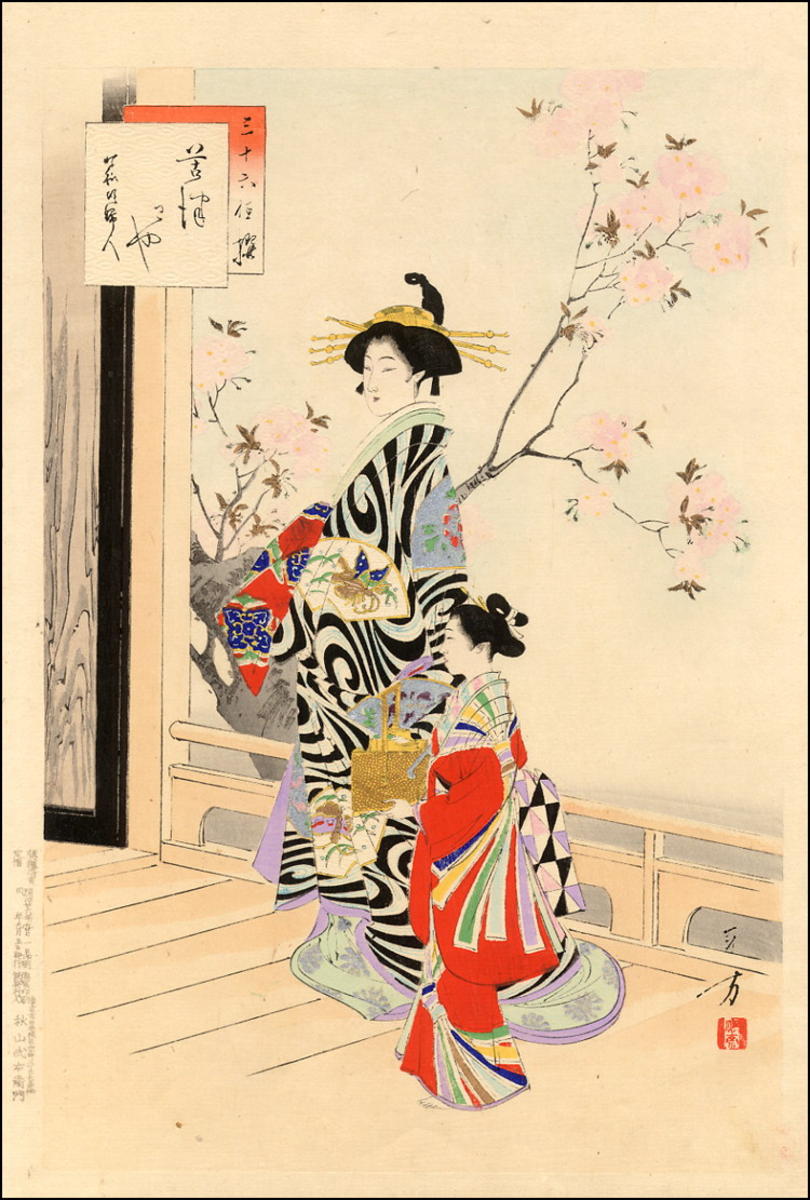
Courtesan and her maid

Hamish emailed me a few haiku in which the theme (or leading character) is a prostitute and his haiku are very nice and real beauties.


the prostitute
on the street corner
never looks at the stars

the lonely prostitute
makes dolls
for the street children


for a while
the prostitute blows bubbles
a little girl again

© Hamish Managua Gunn

These haiku describe the prostitute in three very different scenes.  

As I was preparing this episode I ran into another translation of the haiku by Basho ...

hitotsuya ni yuujo mo netari hagi to tsuki

courtesan and monk,
sleeping  under one roof together,
moon in a field of clover

© Basho (Tr. Chèvrefeuille)


Red Light District
Here is another haiku created by me some time ago and maybe you know this one from our weekly haiku meme Haiku Shuukan.

the day has gone
the night belongs to them -
red light district

© Chèvrefeuille

Well .... enough inspiration I would say.

This CD-Special is NOW OPEN for your submissions and will remain open until February 11th at noon (CET). I will (try to) publish our next episode, a new Tokubetsudesu episode, later on. For now ... have fun!


Thursday, December 31, 2015

Carpe Diem #887 Returning home: between the waves, a clam


!! our new promptlist is ready you can find it in the menu !!

Dear Haijin, visitors and travelers,

Well ... this is it ... our last episode of 2015 and the last stage of our "Narrow Road". We have had a wonderful journey together with Basho and Sora, but now it is time to return home. We are returning home today ... we can look back on a joyful journey ... and we can look back on a wonderful 2015 in which we celebrated our third anniversary and discovered wonderful places, haiku writing techniques and a lot more. We have found each other in a warm embrace all with just one goal ... writing and sharing haiku, tanka and other Japanese poetry forms.


a little verse
brought together a family of love -
Carpe Diem Haiku Kai

© Chèvrefeuille
++++++++++++++++++++++++++++++++++++++++++
++++++++++++++++++++++++++++++++++++++++++


between the waves
small shells mingle with
bits of bush clover


 © Basho (Tr. Jane Reichhold)

I asked Tosai to make a summary of the day's happenings and leave it at the temple as a souvenir.

As I returned to Tsuruga, Rotsu met me and accompanied me to the province of Mino. When we entered the city of Ogaki on horseback, Sora joined us again, having arrived from the province of Ise; Etsujin, too, came hurrying on horseback, and we all went to the house of Joko, where I enjoyed reunion with Zensen, Keiko, and his sons and many other old friends of mine who came to see me by day or by night. Everybody was overjoyed to see me as if I had returned unexpectedly from the dead. On September the sixth, however, I left for the Ise Shrine, though the fatigue of the long journey was still with me, for I wanted to see a dedication of a new shrine there. As I stepped into the boat, I wrote:

a clam
torn from its shell
departing autumn


©Basho (Tr. Jane Reichhold)

With this haiku ends the journey into the deep north. In the first printed publication of “Narrow Road” the publisher wrote a postscript, which you can read hereafter:

In this little book of travel is included everything under the sky - not only that which is hoary and dry but also that which is young and colorful, not only that which is strong and imposing but also that which is feeble and ephemeral. As we turn every corner of the Narrow Road to the Deep North, we sometimes stand up unawares to applaud and we sometimes fall flat to resist the agonizing pains we feel in the depths of our hearts.* There are also times when we feel like taking to the road ourselves, seizing the raincoat lying nearby, or times when we feel like sitting down till our legs take root, enjoying the scene we picture before our eyes. Such is the beauty of this little book that it can be compared to the pearls which are said to be made by the weeping mermaids in the far off sea. What a travel it is indeed that is recorded in this book, and what a man he is who experienced it. The only thing to be regretted is that the author of this book, great man as he is, has in recent years grown old and infirm with hoary frost upon his eyebrows.

Early summer of the seventh year of Genroku (1694), Soryu.

++++++++++++++++++++++++++++++++++++++++++++++
++++++++++++++++++++++++++++++++++++++++++++++

Well ... I hope you all did like this gorgeous journey straight into the deep north of Honshu (the Southern Island of Japan) and that it has brought you what you hoped. I have tried to make it a journey full of joy and I think in a way I have succeeded, but that's not up to me to decide, but up to you.
I really enjoyed this journey and it has brought me even more closer to Basho than I already was. Did I grow? I don't know, but I feel that there as been a kind of transformation ... maybe next year this will be more clear ... I don't know.

To close this month and this year I wish you all a wonderful, healthy and inspirational New Year and I hope to see you all again here at Carpe Diem Haiku Kai.


This episode is NOW OPEN for your submissions and will remain open until January 3rd at noon (CET). I hope to publish our first episode of 2016 later on. I have the promptlist ready you can find it HERE.

Monday, December 28, 2015

Carpe Diem #886 the journey continues: writing something, the moon clear, harvest moon, loneliness


Dear Haijin, visitors and travelers,

I hope you all have had a wonderful Christmas and that you all are ready for the last days of this year. The "Narrow Road" continues and we are walking together with Basho towards the end of the "Narrow Road".


++++++++++++++++++++++++++++++++++++++++++++


I went to the Tenryuji Temple in the town of Matsuoka, for the head priest of the temple was an old friend of mine. A poet named Hokushi had accompanied me here from Kanazawa, though he had never dreamed of coming this far when he had taken to the road. Now at last he made up his mind to go home, having composed a number of beautiful poems on the views we had enjoyed together. As I said good-bye to him, I wrote:

writing something
pulling apart the fan
missing someone


© Basho (Tr. Jane Reichhold)

Making a detour of about a mile and a half from the town of Matsuoka, I went to the Eiheiji Temple. I thought it was nothing short of a miracle that the priest Dogen had chosen such a secluded place for the site of the temple.

The distance to the city of Fukui was only three miles. Leaving the temple after supper, however, I had to walk along the darkening road with uncertain steps. There was in this city a poet named Tosai whom I had seen in Edo some ten years before. Not knowing whether he was already dead or still keeping his bare skin and bones, I went to see him, directed by a man whom I happened to meet on the road. When I came upon a humble cottage in a back street, separated from other houses by a screen of moon-flowers and creeping gourds and a thicket of cockscomb and goosefoot left to grow in front, I knew it was my friend's house. As I knocked at the door, a sad looking woman peeped out and asked me whether I was a priest and where I had come from. She then told me that the master of the house had gone to a certain place in town, and that I had better see him there if I wanted to talk to him. By the look of this woman, I took her to be my friend's wife, and I felt not a little tickled, remembering a similar house and a similar story in an old book of tales. Finding my friend at last, I spent two nights with him. I left his house, however, on the third day, for I wanted to see the full moon of autumn at the port town of Tsuruga. Tosai decided to accompany me, and walked into the road in high spirits, with the tails of his kimono tucked up in a somewhat strange way. 
 
Credits: Mount Shirane

The white peak of Mount Shirane went out of sight at long last and the imposing figure of Mount Hina came in its stead. I crossed the bridge of Asamuzu and saw the famous reeds of Tamae, already coming into flower. Through the barrier-gate of Uguisu and the pass of Yuno, I came to the castle of Hiuchi, and hearing the cries of the early geese at the hill named Homecoming, I entered the port of Tsuruga on the night of the fourteenth. The sky was clear and the moon was unusually bright. I said to the host of my inn, 'I hope it will be like this again tomorrow when the full moon rises.' He answered, however, 'The weather of these northern districts is so changeable that, even with my experience, it is impossible to foretell the sky of tomorrow.' After a pleasant conversation with him over a bottle of wine, we went to the Myojin Shrine of Kei, built to honor the soul of the Emperor Chuai. The air of the shrine was hushed in the silence of the night, and the moon through the dark needles of the pine shone brilliantly upon the white sand in front of the altar, so the ground seemed to have been covered with early frost. The host told me it was the Bishop of Yugyo II who had first cut the grass, brought the sand and stones, and then dried the marshes around the shrine, the ritual being known as the sand-carrying ceremony of Yugyo.

the moon clear
on sand carried over here
by a saint


© Basho (Tr. Jane Reichhold)

It rained on the night of the fifteenth, just as the host of my inn had predicted.

Harvest moon
weather in the northern areas
is unsettled


© Basho (Tr. Jane Reichhold)
 

It was fine again on the sixteenth. I went to the Colored Beach to pick up some pink shells. I sailed the distance of seven miles in a boat and arrived at the beach in no time, aided by a favorable wind. A man by the name of Tenya accompanied me, with servants, food, drinks and everything else he could think of that we might need for our excursion. The beach was dotted with a number of fisherman's cottages and a tiny temple. As I sat in the temple drinking warm tea and sake, I was overwhelmed by the loneliness of the evening scene.
loneliness
clarity is only out done
by an autumn beach


© Basho (Tr. Jane Reichhold)


+++++++++++++++++++++++++++++++++++++++++++


I wonder ... how would Basho have felt as he was on his journey? Was he happy? Sometimes sad? Anxious to explore this part of his wonderful country?

As I read "Narrow Road" again ... than I can almost sense how much he loved being on the road looking for the beauty of nature, the beauty of his country, the beauty of the religions and so on. And than I feel almost one with him ... really awesome.


Water Bearer

For this episode I love to share a haiku which I have published several years ago:

The next haiku is based on the Hawaiian mythology and astrology. The Hawaiians thought that when the moon was in its first quarter in January and February that the moon was a bowl in which the Gods gathered rain water for spring. In that period of the year the Hawaiians can see what they call the Water Bearer (a constellation) the name of the moon in that same period is Kulua.

dripping wet moon
the Water Bearer spills
water from the bowl


© Chèvrefeuille
This episode is NOW OPEN for your submissions and it will remain open until  December 31st at noon (CET). I will (try to) publish our next episode, the last CD-Special by Georgia, our featured haiku poetess, later on.

Friday, December 25, 2015

Carpe Diem #885 without you: Stone Mountain, at Yamanaka, from this day on


!! double episode !!

Dear Haijin, visitors and travelers,

During the holidays I will bring a few prompts together in one post, because this time of year is very dear to me and my family. We love to have time together and that makes that I have decided to bring another "double episode" today. Of course you all are part my family of haiku loving people and I just had to make this episode for you all.


++++++++++++++++++++++++++++++++++++++++++


On my way to Yamanaka hot spring, the white peak of Mount Shirane overlooked me all the time from behind. At last I came to the spot where there was a temple hard by a mountain on the left. According to the legend, this temple was built to enshrine Kannon, the great goddess of mercy, by the Emperor Kazan, when he had finished his round of the so-called Thirty- three Sacred Temples, and its name Nata was compounded of Nachi and Tanigumi, the first and last of these temples respectively. There were beautiful rocks and old pines in the garden, and the goddess was placed in a thatched house built on a rock. Indeed, the entire place was filled with strange sights.

Stone Mountain
whiter than its stones
autumn wind


© Basho (Tr. Jane Reichhold)


Credits: Yamanaka Hot Springs

I enjoyed a bath in the hot spring whose marvelous properties had a reputation of being second to none, except the hot spring of Ariake.

at Yamanaka
it’s not necessary to pluck chrysanthemums
hot spring fragrance


© Basho (Tr. Jane Reichhold)

The host of the inn was a young man named Kumenosuke. His father was a poet and there was an interesting story about him: one day, when Teishitsu (later a famous poet in Kyoto but a young man then) came to this place, he met this man and suffered a terrible humiliation because of his ignorance of poetry, and so upon his return to Kyoto, he became a student of Teitoku and never abandoned his studies in poetry till he had established himself as an independent poet. It was generally believed that Teishitsu gave instruction in poetry free of charge to anyone from this village throughout his life. It must be admitted, however, that this is already a story of long ago.

My companion, Sora, was seized by an incurable pain in his stomach. So he decided to hurry, all by himself, to his relatives in the village of Nagashima in the province of Ise. As he said good-bye he wrote:

no matter where I fall
I will be buried between
flowering bush-clovers


© Sora (Tr. Chèvrefeuille)

I felt deeply in my heart both the sorrow of one that goes and the grief of one that remains, just as a solitary bird separated from his flock in dark clouds, and wrote in answer:

from this day on
dew will erase the writing
on my hat


© Basho (Tr. Jane Reichhold)

(Note: Basho refers to “a party of two”, which he wrote on his hat as he and Sora started their “Narrow Road”)


Credits: Zenshoji Temple near the castle of Daishoji

I stopped overnight at the Zenshoji Temple near the castle of Daishoji, still in the province of Kaga. Sora, too, had stayed here the night before and left behind a poem.
Sora and I were separated by the distance of a single night, but it was just the same as being separated by a thousand miles. I, too, went to bed amidst the howling of the autumn wind and woke up early the next morning amid the chanting of the priests, which was soon followed by the noise of the gong calling us to breakfast. As I was anxious to cross over to the province of Echizen in the course of the day, I left the temple without lingering, but when I reached the foot of the long approach to the temple, a young priest came running down the steps with a brush and ink and asked me to leave a poem behind. As I happened to notice some leaves of willow scattered in the garden, I wrote impromptu,

sweeping the garden
I want to leave in the temple
scattered willow leaves


© Basho (Tr. Jane Reichhold)

and left the temple without even taking time to refasten my straw sandals.


Credits: Pine tree (woodblock print Ogata Gekko)

Hiring a boat at the port of Yoshizaki on the border of the province of Echizen, I went to see the famous pine of Shiogoshi. The entire beauty of this place, I thought, was best expressed in the following poem by Saigyo.

inviting the wind to carry
salt waves of the sea,
the pine tree of Shiogoshi
trickles all night long
shiny drops of moonlight.


© Saigyo (Tr. Nobuyuki Yuasa)

Should anyone ever dare to write another poem on this pine tree it would be like trying to add a sixth finger to his hand.


++++++++++++++++++++++++++++++++++++++++++


What a sad story. Basho and Sora have been on this journey so long together and now Basho has to say goodbye to his travel companion, because of illness. It's "double sad", because Basho wasn't healthy himself, he had a chronic diseases of the intestines. He once has said "I will die on one of my travels as a result of my illness", and now Sora had to leave him because of an illness.

How sad it is to look around you and see how people are alone or lonely without family or friends ... no one has to be alone with Christmas ... but ... well we all know that there are a lot people alone and lonely now. Let us think a while of them ... and than look at ourselves.


underneath the bridge
warming their hands at a fire basket
those ... lost and alone


© Chèvrefeuille

I hadn't planned to create a wonderful episode and leave you all with such a sad toned haiku ... but that's our reality, our world is lost and alone ... but there is a power, a great power, to overcome that ... unconditional love.

Merry Christmas

This episode is open for your submissions tonight at 7.00 PM (CET) and it will remain open until December 28th at noon (CET). I will (try to) post our next episode, 
writing something; the moon clear; harvest moon; loneliness, next Sunday.


Monday, December 21, 2015

Carpe Diem #884 on our way home: the scent of early rice, the tomb also shakes, autumn coolness, red more red, a lovely name, how pitiful


!! triple episode !!

Dear Haijin, visitors and travelers,

First I have an announcement to make: this will be a "triple episode", because I hadn't time to create our episode of today, so I decided to bring you two episodes in one. This can mean that this episode will be a little bit longer than I usually do, but than we will be "back on track".
Second: Thank you all for your kind words and prayers for my dad. Just a few hours ago I heard that he will be released from the hospital. This afternoon we will have a conversation with his cardiologist.
Third: It's almost Christmas and the end of 2015 is almost there. I love to ask you all something. Please share with me, with us, with our Haiku Kai your thoughts about 2015. Which were the highlights, which prompts did you like and maybe you have ideas for new prompts or making our Haiku Kai even better than it is already.

Okay ... let's go to our "triple episode" of our "Narrow Road" which we are walking together with Basho and his companion Sora. Have fun!


+++++++++++++++++++++++++++++++++++++++++++


the scent of early rice
coming in from the right
the Ariso Sea


© Basho (Tr. Jane Reichhold)

Across the mountains of Unohana-yama and the valleys of Kurikara- dani, I entered the city of Kanazawa on July the fifteenth, where I met a merchant from Osaka named Kasho who invited me to stay at his inn.

Unohana-yama

There was in this city a man named Issho whose unusual love of poetry had gained him a lasting reputation among the verse writers of the day. I was told, however, that he had died unexpectedly in the winter of the past year. I attended the memorial service held for him by his brother.

the tomb also shakes
my weeping voice is
the autumn wind


© Basho (Tr. Jane Reichhold)

A visit to a certain hermitage, were I was invited to attend a rengaparty. I wrote the following greeting verse, which we used to start the renga with:

autumn coolness
each peeling with our hands
melons and eggplant


© Basho (Tr. Jane Reichhold)

red more red
in spite of the indifferent sun
an autumn breeze


© Basho (Tr. Jane Reichhold)

(note: normally the autumn wind was thought of as white)


Credits: Hiyoshi Shrine (Little Pines)
At a place called Little Pines:

a lovely name
at Little Pines blows
bush clover and thatch reeds


© Basho (Tr. Jane Reichhold)

(note: As you all know (I think) Basho was a very important and famous renga-master in his time. He attended a lot of renga parties and was often the haiku poet who wrote the hokku. The above haiku was the starting verse of a so called “yoyoshi”, a renga of forty-four links. This haiku which was used as the hokku, was the greeting verse to the host of this “yoyoshi”, Kosen, the chief priest of the Hiyoshi Shrine at Komatsue (which means “little pines”).

I went to the Tada Shrine located in the vicinity, where I saw Lord Sanemori's helmet and a piece of brocaded cloth that he had worn under his armor. According to the legends, these were given him by Lord Yoshitomo while he was still in the service of the Minamotos. The helmet was certainly an extraordinary one, with an arabesque of gold chrysanthemums covering the visor and the ear plate, a fiery dragon resting proudly on the crest, and two curved horns pointing to the sky. The chronicle of the shrine gave a vivid account of how, upon the heroic death of Lord Sanemori, Kiso no Yoshinaka had sent his important retainer Higuchi no Jiro to the shrine to dedicate the helmet with a letter of prayer.

how pitiful
under the armored helmet
a cricket


© Basho (Tr. Jane Reichhold)


Credits: Tada Shrine
An awesome part of the "Narrow Road" and while we are leaving Tada Shrine ... we also leave Carpe Diem Haiku Kai for today.


+++++++++++++++++++++++++++++++++++++++++


I have sought all over the Internet for an example of the poetry by Issho as mentioned in the above episode and finally I only found one haiku written by Issho. Issho was a very famous haiku poet in his own region, but he died in 1688. Basho loved to visit him, but the only thing he finds is the grave of Issho, who passed away a year before Basho arrived at the village were Issho lived.


Here is the only haiku which I could find written by Kasugi Issho. I have tried to translate it and honor Issho with that translation.

mi tsukushita me wa shirgiku ni  modori keri

seen with my eyes
white chrysanthemums
again I saw them


© Kasugi Issho (1652-1688)

A wonderful haiku I think, but Issho was more famous for his love poems, however I haven't sought the Internet for his love poems ...


Tulips

finally spring
one tulip after another blooms
rainbow garden


© Chèvrefeuille

What a joy it was to create this episode. I hope you did like it and ... I hope it inspires you to write an all new haiku, tanka or other Japanese poetry form.

This episode is NOW OPEN for your submissions and will remain open until December 24th at noon (CET). I hope to publish our new episode, a new episode of our Haiku Writing Techniques and the fourth CD special by Georgia, later on. For now .... have fun, be inspired and share.


Sunday, December 20, 2015

Carpe Diem #883 journey through the rough north of Honshu: a rough sea; in one house


Dear Haijin, visitors and travelers,

Again I am to late with publishing this episode, I really hadn't time. First I am in the nightshift and my dad is in hospital after a heart attack, so I have not a lot of time. Today I had planned a nice wellknown haiku by Basho which I have used earlier here at CDHK. We will see ....


++++++++++++++++++++++++++++++++++++++++++++


the rough sea
flowing toward Sado Isle (*)

the River of Heaven

© Basho (Tr. Chèvrefeuille)

 (*) When direct control from mainland Japan started around the 8th century, the island's remoteness meant that it soon became a place of banishment for difficult or inconvenient Japanese figures. Exile was a very serious punishment, second only to the death penalty, and people weren't expected to return.

Exhausted by the labor of crossing many dangerous places by the sea with such horrible names as Children-desert-parents or Parents- desert-children, Dog-denying or Horse-repelling, I went to bed early when I reached the barrier-gate of Ichiburi. The voices of two young women whispering in the next room, however, came creeping into my ears. They were talking to an elderly man, and I gathered from their whispers that they were concubines from Niigata in the province of Echigo, and that the old man, having accompanied them on their way to the IseShrine, was going home the next day with their messages to their relatives and friends.   
Credits: Ise Shrine

I sympathized with them, for as they said themselves among their whispers, their life was such that they had to drift along even as the white froth of waters that beat on the shore, and having been forced to find a new companion each night, they had to renew their pledge of love at every turn, thus proving each time the fatal sinfulness of their nature. I listened to their whispers till fatigue lulled me to sleep. When, on the following morning, I stepped into the road, I met these women again. They approached me and said with some tears in their eyes, 'We are forlorn travelers, complete strangers on this road. Will you be kind enough at least to let us follow you? If you are a priest as your black robe tells us, have mercy on us and help us to learn the great love of our Savior.' 'I am greatly touched by your words,' I said in reply after a moment's thought, 'but we have so many places to stop at on the way that we cannot help you. Go as other travelers go. If you have trust in the Savior, you will never lack His divine protection.' As I stepped away from them, however, my heart was filled with persisting pity.

in the same house
prostitutes, too, slept:
bush clover and moon


© Basho (Tr. David Landis Barnhill)

As I recited this poem to Sora, he immediately put it down on his notebook.

Credits: One of the forty-eight rapids of the Kurobe River

Crossing the so-called forty-eight rapids of the Kurobe River and countless other streams, I came to the village of Nago, where I inquired after the famous wisteria vines of Tako, for I wanted to see them in their early autumn colors though their flowering season was spring. The villagers answered me, however, that they were beyond the mountain in the distance about five miles away along the coastline, completely isolated from human abode, so that not a single fisherman's hut was likely to be found to give me a night's lodging. Terrified by these words, I walked straight into the province of Kaga.
 
++++++++++++++++++++++++++++++++++++++++++++++++
 
As I read this part of Basho's "Narrow Road" I almost feel like I am there at that same moment. As I look at that photo of the Kurobe River than I can hear the sound of the thundering rapids ... awesome. Isn't it awesome that Basho wrote this haibun with such a lot of feeling that the reader can feel the presence of the surroundings where Basho is walking ... that's his strenght of Basho.

I really am a big fan and admirer of Basho and I always like to bring posts about him using his wonderful haiku here at our Haiku Kai.
It will not be an easy task to compose an all new haiku inspired on this part of "Narrow Road", but I have  to give it a try. 
Credits: Sado Island

But first I like to share a haiku by Yozakura (our unknown haiku poet) which he composed inspired on the first haiku of this episode "the rough sea":

an outcast I am
day dreaming along the seashore;
Sado Isle beckons

© Yozakura

dark clouds drifting
waves become higher
a rough sea


© Chèvrefeuille


As I look at this haiku above than I notice a "double entendre" in it, which I hadn't seen earlier as I composed this haiku back in 2012 (short after the start of our Haiku Kai) or even a divine deeper meaning as we have discussed in our HWT episodes.

"Double Entendre": This haiku can mean that there are circumstances which lead to a depression or strong sadness.

"Finding the divine in the common": This haiku can mean that there will Always be a greater power, spirit or God who will care for you notwithstanding the circumstances or situation in which you are.

Isn't that awesome? A haiku which I wrote several years ago ... now looks so different after a few episodes of CD-HWT.
And I just had to share another haiku which I once have written inspired on the "bushclover and moon"- haiku. I think I wrote it as one of the haiku at Haiku Shuukan, but I can't remember that, but this was the haiku, in which you can find also the "double entendre" technique:


courtesan smiles


courtesan smiles
as she walks over the nude beach
Morning Glories awake

© Chèvrefeuille

It was again a joy to create this episode for you all and I am glad that you all are such gifted poets that every prompt can inspire you.

This episode is NOW OPEN for your submissions and will remain open until December 23rd at noon (CET). I will try to publish our next episode, the scent of early rice; the tomb also shakes, later on.