Showing posts with label Creation. Show all posts

Monday, March 5, 2018

Carpe Diem #1382 Adam and Eve


Dear Haijin, visitors and travelers,

Peace be with you. What does it mean to say that? Well ... I think it's a wonderful greeting, because I wish you all peace of heart, mind and soul. This was what made me doubt if I should do a whole CDHK month about the Quran, the Holy Book of Islam. I love everyone unconditional and therefore I also love muslim, but as you all know the last years Islam became a feared religion through IS and that made me sad and doubtful. After thinking it over and over again I decided to create this month full of the wisdom from the Quran. Of course it's not my goal to convert you to Islam, but the Quran is a wonderful Book full of wisdom. Given to the world, especially for muslim, but there are also wonderful words in the Quran that can give peace of mind to everyone, not only muslim.

This month I love to share with you the wonders and beauties of the wisdom in the Quran and of course I will, without losing respect for the Quran, try to find similarities between the religious books we all know. (By the way as you have noticed maybe, I don't use Allah, but God, in our episodes. Not to be disrespectful, but because my philosophy is stated on the idea "All Gods Are One God".


Today I have chosen a verse from Surah 4: Ayah 1 (an-Nisa' or "women"). In this verse we can easily see the story of Adam and Eve as we know it from the Bible. Let me give you first the mentioned verse:

[...] "O people! Fear your Lord, who created you from a single soul, and created from it its mate, and propagated from them many men and women. And revere God whom you ask about, and the parents. Surely, God is Watchful over you." [...] (Surah 4: Ayah 1)

And this is what the Bible says about this:

[...] "So the Lord God caused the man to fall into a deep sleep; and while he was sleeping, he took one of the man’s ribs and then closed up the place with flesh. Then the Lord God made a woman from the rib he had taken out of the man, and he brought her to the man.

The man said,

“This is now bone of my bones
    and flesh of my flesh;
she shall be called ‘woman,’
    for she was taken out of man.”

That is why a man leaves his father and mother and is united to his wife, and they become one flesh." [...] (Genesis 2: 21-24 NIV)

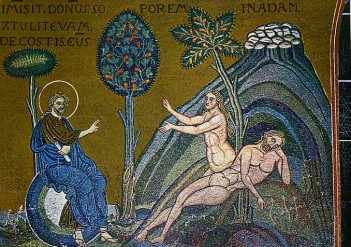
ADAM AND EVE . This mosaic from the Cathedral of Monreale, Sicily, depicts the creation of woman in the Bible. Eve is shown emerging from Adam’s side. Most translations of the Adam and Eve story say that Eve was created from Adam’s rib, but Ziony Zevit contends that she was created from a very different part of Adam’s body.

The creation of mankind is in both scriptures the same, the only thing is the use of the words, but in it's origin the stories are alike.

As I said in earlier posts, Islam is a young religion and there are a lot of similarities with other religions. I however respect the idea that the Quran was given to Muhammed. Is it possible without being disrespectfull to look at this somewhat closer?

In my opinion, without being disrespectfull, I think that Muhammed was a very wise man seeking for inner peace and was wandering around the world to find peace of mind. Than he ran into all the different beautiful religions and philosophies and wrote it down? But isn't that the same statement I have made about the Bible? Because if we look at e.g. Jesus Christ, it sounds like Krishna. Hinduism is in my opinion the oldest religion on earth, except of course the religion of nature.

Isn't that wonderful in this short episode I said "All Gods Are One God" and if we look closer to all the different kinds of religions and analyze them we always arrive at the idea of only one God.

new life rises
after the cold winter
daffodils bloom
taken from her man's body
she was created by God's hand

© Chèvrefeuille

What a story this is ... and what a joy to read this in both the Quran and the Bible. God works in mysterious ways.

Hinduism

I also love to share how man and woman were created according to Hinduism, just to give you an idea, that there are similarities between all the religions:

[...] "He (Yājñavalkya) was not at all happy. Therefore people (still) are not happy when alone. He desired a mate. He became as big as man and wife embracing each other. He parted this very body into two. From that came husband and wife. Therefore, said Yājñavalkya, this (body) is one-half of oneself, like one of the two hálves of a split pea. Therefore this space is indeed filled by the wife. He was united with her. From that men were born." [...] (Brihadaranyaka Upanishad 1.4)

This episode is open for your submissions tonight at 7:00 PM (CET) and will remain open until March 12th at noon (CET). I will try to publish our new episode later on. For now ... have fun, be inspired and share your Japanese poetry with us all.


Saturday, May 24, 2014

Carpe Diem #476, Popol-Vuh (Mayan Mythology, Creation story)


Dear Haijin, visitors and travelers,

We are leaving Down Under and are sailing to the East were we will arrive at the Middle- and South American continent. here we will discover the ancient stories, myths, legends and saga of e.g. the Mayan culture. Our first prompt of this part of May is Popol-Vuh.
Every ancient culture has its own Creation-story as we saw e.g. in the Aboriginal culture last days and at the start of this month in Europe. In this part of the world, were we are the coming days, there are also Creation stories and we start with the Creation story of the Mayan culture.

Credits: Mayan Culture
The Maya is a Mesoamerican civilization, noted for the only known fully developed written language of the pre-Columbian Americas, as well as for its art, architecture, and mathematical and astronomical systems. Initially established during the Pre-Classic period (c. 2000 BC to AD 250), according to the Mesoamerican chronology, many Maya cities reached their highest state of development during the Classic period (c. AD 250 to 900), and continued throughout the Post-Classic period until the arrival of the Spanish.
The Maya civilization shares many features with other Mesoamerican civilizations due to the high degree of interaction and cultural diffusion that characterized the region. Advances such as writing, epigraphy, and the calendar did not originate with the Maya; however, their civilization fully developed them. Maya influence can be detected in Honduras, Belize, Guatemala, and western El Salvador to as far away as central Mexico, more than 1,000 km (620 mi) from the central Maya area. The many outside influences found in Maya art and architecture are thought to have resulted from trade and cultural exchange rather than direct external conquest.
The Maya peoples survived the Classic period collapse and the arrival of the Spanish conquistadores and sixteenth-century Spanish colonization of the Americas. Today, the Maya and their descendants form sizable populations throughout the Maya area; they maintain a distinctive set of traditions and beliefs resulting from the merger of pre-Columbian and post-Conquest ideas and cultures. Millions of people speak Mayan languages today.
Credits: Popol-Vuh (1)

The Popol-Vuh is a manuscript in which the Creation and other Mayan Mythology stories are described. This episode of Carpe Diem Haiku Kai is about the Creation according to the Popol Vuh.

Creation myth (described in the chapters 1 to 3 of the Popol-Vuh)

There are four deities, three in a celestial realm collectively called Tepeu and Heart of Heaven and another on the terrestrial plane called Gucumatz.

"This is the first account, the first narrative. There was neither man, nor animal, birds, fishes, crabs, trees, stones, caves, ravines, grasses, nor forests; there was only the sky. The surface of the earth had not appeared. There was only the calm sea and the great expanse of the sky. There was nothing brought together, nothing which could make a noise, nor anything which might move, or tremble, or could make noise in the sky. There was nothing standing; only the calm water, the placid sea, alone and tranquil. Nothing existed. There was only immobility and silence in the darkness, in the night. Only the creator, the Maker, Tepeu, Gucumatz, the Forefathers, were in the water surrounded with light. [...] Then Tepeu and Gucumatz came together; then they conferred about life and light, what they would do so that there would be light and dawn, who it would be who would provide food and sustenance. Thus let it be done! Let the emptiness be filled! Let the water recede and make a void, let the earth appear and become solid; let it be done. Thus they spoke. Let there be light, let there be dawn in the sky and on the earth! There shall be neither glory nor grandeur in our creation and formation until the human being is made, man is formed. [...] First the earth was formed, the mountains and the valleys; the currents of water were divided, the rivulets were running freely between the hills, and the water was separated when the high mountains appeared. Thus was the earth created, when it was formed by the Heart of Heaven, the Heart of Earth, as they are called who first made it fruitful, when the sky was in suspense, and the earth was submerged in the water." 

Credits: Popol-Vuh (2)

Together, gods attempted to create living beings so that they may be praised and venerated by their creation. Their first attempts (animals, mud man, and wooden man) proved unsuccessful because they lacked speech, souls, and intellect.

"This the Forefathers did, Tepeu and Gucumatz, as they were called. After that they began to talk about the creation and the making of our first mother and father; of yellow corn and of white corn they made their flesh; of cornmeal dough they made the arms and the legs of man. Only dough of corn meal went into the flesh of our first fathers, the four men, who were created. [...] And as they had the appearance of men, they were men; they talked, conversed, saw and heard, walked, grasped things; they were good and handsome men, and their figure was the figure of a man."

Women were created later while the first four men slept. (Source: Wikipedia)

Credits: Popol Vuh (3)
What a wonderful story ... in a way similar with our Western thoughts about Creation, but in a way also very different. I liked this story and the Popol Vuh is for sure worth reading completely.

gods of the sun
creating a world to rule over -
sunflowers reach for the sky

© Chèvrefeuille

Well ... I hope that you are inspired by this post and that it will help you to compose haiku ... Have fun! This episode is open for your submissions tonight at 7.00 PM (CET) and will remain open until May 29th at noon. I will try to post our new episode, hunting, later on today.