Showing posts with label Manyoshu. Show all posts

Thursday, July 27, 2017

Carpe Diem Time Travel #5


!! Open for your submissions next Sunday July 30th at 7:00 pm (CET) !!

Dear Haijin, visitors and travelers,

Welcome at a new "weekend-meditation" here at CDHK. This week our "weekend-meditation" is an episode of Carpe Diem's Time Travel, Ancient Japanese poetry to inspire you. And this week I love to inspire you through a few poems from the Man'yoshu, an anthology of myriad poems. For this episode I have chosen a few poems from the 20th book of the Man'yoshu, here is the first by Wakayamatobe no Mimaro of Aratama District, a man of serviceable age in the service of the Registrar’s Office. :

wa ga tuma pa
itaku kopirasi
nomu midu ni
kagö sapë miete
yö ni wasurarezu

My wife
Loves me dearly, it seems
For in my drinking water
Her form appears
In life, I never can forget her.

It's a sad poem in which you can feel the loss of the poet. His wife died, but in everything, even the most simple things like water, he sees and senses his wife. A strong poem full of love, unconditional love.

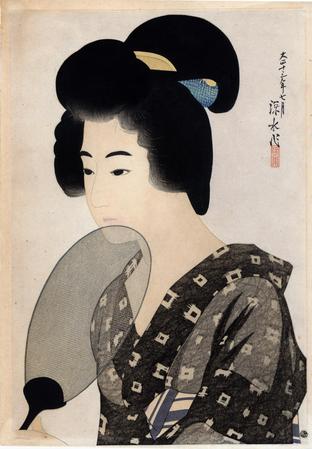
Japanese woman

Here is another poem with the seem tone and feeling. This poem is by Mononobe no Komaro of Lower Naga District:

wa ga tuma mo
e ni kaki toramu
iduma mo ga,
tabi yuku are pa
mitutu sinöbamu

My wife
In a picture I’d draw,
Had I but the time,
Then on my journey
Would I gaze at it, remembering her.

It seems like this 20th book of the Man'yoshu is filled with this kind of sad poems, so here is another one to inspire you:

sasa ga pa nö
sayagu simo yo ni
nana pe karu
körömo ni maseru
körö ga pada pa mo

The leaves of bamboo grass
Rustle on this frosty night;
Wearing sevenfold
Garments cannot compare
To my darling’s skin.

© poet's name unknown

And with this third poem I return back to the goal of the "waka", "uta" or "tanka" ... these poetry forms are meant for love and all that has to do with it. In this last poem I sense the deep love of the poet for his / her darling and in this poem he / she describes that in a wonderful way ... longing for the one you love ... that's unconditional love.


And for closure a tanka I created last year, but this one fits the idea of the above poems, so I share itr here again:

deep dark forest
seeking for nature’s mysteries –
a new day rises
after a hot and steamy night
she departs … without a kiss

© Chèvrefeuille

I hope you all will have a wonderful weekend and I am looking forward to all of your responses on this Time Travel episode in which we explored a few poems from the 20th book of the Man'yoshu.

This episode is open for your submissions next Sunday July 30th at 7:00 PM (CET) and will remain open until August 3rd at noon (CET). Have a great weekend ...


Thursday, June 1, 2017

Carpe Diem's Time Travel, Ancient Japanese Poetry To Inspire You #1 little I should grieve


!!! Open for your submissions next Sunday June 4th 7:00 PM (CET) !!!

Dear Haijin, visitors and travelers,

Welcome at a completely new feature for our "weekend-meditation". As you maybe remember, last month I announced to end the "Universal Jane" feature, not to forget her, but to create space for a new feature. Of course I will create another special feature to honor Jane Reichhold here at Carpe Diem Haiku Kai.

This new feature for our "weekend meditation" I have titled "Time Travel, Ancient Japanese Poetry To Inspire You" and in this new feature I will take you on a trip back into time, a time in which poetry was only an art for the higher classes of Japan. A lot of those poems were gathered in several anthologies like the Kokinshu (or Kokin Wakashu - 920 AD) or the Man'yoshu (Collection of Ten Thousand Leaves - 745 AD). In these anthologies the "editors" have gathered long poems (like Choka) and short poems (like Waka).

In this new feature I will try to tell you a little bit background on these anthologies and will give you a few examples. Than I will introduce the poem which you have to use for your inspiration.

For this first episode of "Time Travel" I have made a nice choice from the Man'yoshu, but let me first tell you a little bit about the background.

The Man'yoshu or 'Collection of Ten Thousand Leaves' is an anthology of ancient Japanese poems compiled c. 759 CE during the Nara Period but including many earlier works. The most likely person to have assembled the collection is Otomo no Yakamochi, himself a prolific poet who included nearly 500 of his own works in the Man'yoshu. The Man'yoshu is regarded as a literary classic and high point of Japanese poetry.

Otomo no Yakamochi

Many scholars consider the Man’yoshu to have been compiled by the poet Otomo no Yakamochi (c. 718-785 CE)

On an evening when the spring mists
Trail over the wide sea,
And sad is the voice of the crane,
I think of my far-off home.

© Otomo no Yakamochi

The Man'yoshu collection contains poems which were all written in the Japanese of that time, i.e. using Chinese characters phonetically. The work consists of 4,496 poems organized into 20 books, the vast majority being in the waka (aka waku) style, that is each poem has precisely 31 syllables in five lines (5+7+5+7+7). 262 poems, in contrast, are written in the longer nagauta style, which can have up to 200 lines. There are also 62 sedoka poems (six-line poems of 38 syllables) and four poems written in Chinese. The poems come in three broad thematic categories; zoka (miscellaneous), somon (mutual inquiries or love poems), and banka (elegies). The poems cover a period of four centuries and it is likely they were intended to be sung.

A few examples of the poems in the Man’yoshu:

Countless are the mountains
in Yamato,
but perfect is
the heavenly hill of Kagu:
When I climb it
and survey my realm,
Over the wide plain
the smoke wreaths rise and rise,
over the wide sea
the gulls are on the wing;
a beautiful land it is,
Akitsushima,
the Land of Yamato.

© Emperor Jomei 

Cherry Blossoms (image found on WP)

There I found you, poor man! - 
Outstretched on the beach,
On this rough bed of stones,
Amid the busy voices of the waves.
If I but knew where was your home,
I would go and tell;
If your wife but knew,
She would come to tend you.
She, not knowing the way hither,
Must wait, must ever wait, 
Restlessly hoping for your return -
Your dear wife - alas!

© Kakinomoto Hitomaro 

Two wonderful poems from this very ancient anthology of Japanese poetry. All poems I have read so far are even more beautiful as if they were selected to overrule each other ...


For this first episode of "Time Travel, Ancient Japanese Poetry To Inspire You" I have chosen a "waka" written by Princess Kagami (7th century):

Even a breeze may fail me
When I desire it.
Little I should grieve,
If only, sure of its coming,
I could await even a breeze.

© Princess Kagami

This "waka" was written in response on a sedoka written by her younger sister Princess Nukada, the most famous female poet of her time.

Well ... I hope you did like this new feature and I hope I have inspired you to create your haiku, tanka or other Japanese poetry form inspired on that sad sounding "waka" by Princess Kagami.

Here is my attempt to create a haiku inspired on this "waka":

through tears
cherry blossoms scattered
by the breeze

© Chèvrefeuille

This "weekend-meditation" is open for your submissions next Sunday June 4th at 7:00 PM (CET) and will remain open until June 9th at noon (CET). Have fun! I will try to publish our new episode, Om Mane Padme Hum, later on. Have a great weekend!

PS. The Solution to our Haiku Puzzler of May 2017 you can find HERE


Tuesday, August 11, 2015

Carpe Diem Tokubetsudesu #56 Choka (or Nagauta), Japanese "long poem"


Dear haijin, visitors and travelers,

I didn't get the job. I was first disappointed, but after hearing the reasons I was, in a way, happy that I didn't get it, because to this new job there was a study included in a city far from the city were I live. My employer has given me an opportunity to follow another study and maybe in the near future I will get the job after all. Thank you all for your love, thoughts and prayers. And now ... let's go do some haiku-ing or in the case "choka-ing".

As I promised you all few weeks ago I will do a few episodes of Tokubetsudesu about other Japanese poetry-forms. In this episode I love to tell you a little bit more about the Japanese "long poem", the Choka (or Nagauta).

The choka can be of almost any length, because its form depends on alternating phrases (or lines) containing either seven of five sound units (onji). The end of the poem is signaled by two lines of seven sounds. So the form is five/seven, five/seven, five seven, .... , seven/seven.
This was the most popular form of poetry in the 9th century as indicated by the large number of works in the celebrated anthology Man'yoshu (The Collection of Ten Thousand Leaves). This anthology of anthologies contained 260 chok and 4200 tanka.

Credits: Kakinomoto no Hitomaro

The poet Kakinomoto no Hitomaro, who composed most of his work in the last decade of the 7th century, took the choka to its highest lyrical point with his finesse in the use of ritual language.
The connection to tanka is evidenced by the envoy or hanka - a tanka-like poem attached at the end of the choka. Occasionally more than one envoy will close the choka. There have been a few efforts to revivie the form over the intervening centuries, but the form has failed to gain any popularity in Japan, and even less has been accomplished in English. (Based on Jane Reichhold's "Writing and Enjoying Haiku")

Here is an example of a choka from the Man'yoshu (no. 802):

The briefest chōka documented is Man'yōshū no. 802, which is of a pattern 5-7 5-7 5-7 5-7-7. It was composed in the Nara period and goes:

When I eat melons
My children come to my mind;
When I eat chestnuts
The longing is even worse.
Where do they come from,
Flickering before my eyes.
Making me helpless
Endlessly night after night.
Not letting me sleep in peace?

(envoy or hanka)

What are they to me,
Silver, or gold, or jewels?
How could they ever
Equal the greater treasure
That is a child? They cannot.

© Yamanoue no Okura (Tr. Edwin Cranston)

Credits: Harvest Moon

I remember that Georgia of Bastet and Sekhmet's Library wrote, a while ago, an episode of our former Ghost Writer post, about the choka. She is, as far as I know, the only CDHK family member who writes choka. Here is one of her choka:

The Last Harvest Moon

as the breeze picks up,
canes rattle in harmony
red scattered leaves
fall in the river and drown
a monk bent with age
walks along the road thinking
his secular thoughts
the splendor of youth now gone
he gathers courage
to face another winter
his arthritis plain
his skin yellow and brittle
then a finch warbles
a cat rubs against his legs
he smiles down sweetly
then continues his journey

(envoy or hanka)


the last harvest moon
outlines the withered bent stalks
he walks and gazes
gathering the cold omens
whispered in the winter wind

 ©  Georgia (2014)

I love this "long poem", but it's not really my "cup of tea". I remeber that I had a while ago the iidea to create a weblog about choka, but I never did that and maybe that's something not to worry about, because recently we decided as Haiku Kai to make it possible to respond with other Japanese poetry forms than haiku or tanka. So ... choka ... is also part of that decision.

This episode is NOW OPEN for your submissions and will remain open until August 14th at noon (CET). I will try to publish our new episode, a cd special with the third haiku by Lolly, later on.

Monday, August 26, 2013

Carpe Diem's Distillation #1, A poem by Otomo Miyuki (Manyoshu)


Dear Haijin, visitors and travelers,

Early this morning, around 8.00 AM I read one the most inspiring haiku books I have and while reading an idea for a new feature came in mind. So here we are ...

I love to introduce to you a whole new feature on Carpe Diem. It's an experimental feature, and I will try this two months. This new feature will be appearing as a bi-weekly feature, so we have four (4) episodes to go for this new feature.
As we have seen in August ... music can be a source of inspiration to write haiku. Also we know that a photo, painting or other image (as in Carpe Diem's Imagination) can be an inspiration, but ... I am sure that another poem can be a source of inspiration too.
Our ancient haiku-poets and haiku-masters used other poetry on a regular base to be inspired. They were inspired by e.g. classical Chines and Japanese poetry as the Tang-poetry (618-907) or the Manyoshu (the oldest known anthology of Japanese poetry 347 A.D.).
I think that we can be inspired too by poems. So this new feature of Carpe Diem I have called "Distillation" and the goal is to distil haiku from another poem. It's not easy I think, but ... well we have to try don't you think too?

The Manyoshu

 For this first episode of Carpe Diem's Distillation I have chosen a poem by Otomo Miyuki, who wrote this poem after the Jinshin conflict (672), in which Emperor Temmu in 673 moved the capital of Japan back to Yamato Province on the Kiyomihara plain, naming this new capital Asuka.
This poem was included in the Manyoshu.

Our Sovereign, a god,
Has made his Imperial City
Out of the stretch of swamps,
Where chestnut horses sank
To their bellies.

© Ōtomo Miyuki 


My attempt to distil a haiku from this poem ...

raised from the swamps
a new imperial capital
like a lotus


Well ... I don't know if I have succeeded in this 'distillation', but I sense the tone and spirit of the poem by Otomo Miyuki.


Now ... it's up to you ... distil a haiku from the poem by Otomo Miyuki and share it with us all here on Carpe Diem. This first episode of Carpe Diem's Distillation will stay on 'till September 9th 11.59 AM (CET) and I will try to publish the second episode of Carpe Diem's Distillation later on that day around 7.00 PM (CET). !!! This episode is now open for submissions !!!