Showing posts with label Mark M. Redfearn. Show all posts

Friday, September 4, 2015

Carpe Diem #812 Capricornus (Sea Goat)


Dear Haijin, visitors and travelers,

During circumstances I will not publish an episode of "On The Trail With Basho Encore", but here is our regular prompt for today, Capricornus (Sea Goat), a constellation which is part of our Zodiac and back in our CDHK-history (April 2013) we have had a prompt on Capricornus the sign of the Zodiac. You can find that post HERE.

This was my attempt than to write a haiku inspired on Capricornus:

awaken
the Sea Goat pointing the way
to Aquarius


© Chèvrefeuille

And here are a few examples of the responses on that episode back in 2013, a few of them you maybe know, because they are still part of CDHK.

Pandemonium
Awash in the primeval deep
No scapegoat in love


Old sea goat
Butting heads with the ram
Cosmic clash


still milking
in my summer dreams
Rosie-goat


© Mark M. Redfearn

Path clearly outlined
Sea goat pushes through current
Small fish, part; steer clear


© Sara McNulty

Capricornus (sea goat)
Ok ... that was a short trip through memory lane and I must say it was really a joy to read that post again and what a joy to see that there are still participants of that prompt who are still here at CDHK right now. I only can say to them "Thank You for being here after such a long time".

Here is a little background about this constellation:
Capricornus is one of the 88 modern constellations, and was also one of the 48 constellations listed by the 2nd century astronomer Ptolemy. Under its modern boundaries it is bordered by Aquila, Sagittarius, Microscopium, Piscis Austrinus, and Aquarius. The constellation is located in an area of sky called the Sea or the Water, consisting of many water-related constellations such as Aquarius, Pisces and Eridanus. It is the smallest constellation in the zodiac.

Despite its faintness, Capricornus has one of the oldest mythological associations, having been consistently represented as a hybrid of a goat and a fish since the Middle Bronze Age. First attested in depictions on a cylinder-seal from around the 21st century BC, it was explicitly recorded in the Babylonian star catalogues as MULSUḪUR.MAŠ "The Goat-Fish" before 1000 BC. The constellation was a symbol of the god Ea and in the Early Bronze Age marked the winter solstice.
Due to the precession of the equinoxes the December solstice no longer takes place while the sun is in the constellation Capricornus, as it did until 130 BCE, but the astrological sign called Capricorn begins with the solstice. The solstice now takes place when the Sun is in Sagittarius. The sun's most southerly position, which is attained at the northern hemisphere's winter solstice, is now called the Tropic of Capricorn, a term which also applies to the line on the Earth at which the sun is directly overhead at noon on that solstice. The Sun is now in Capricorn from late January through mid-February.

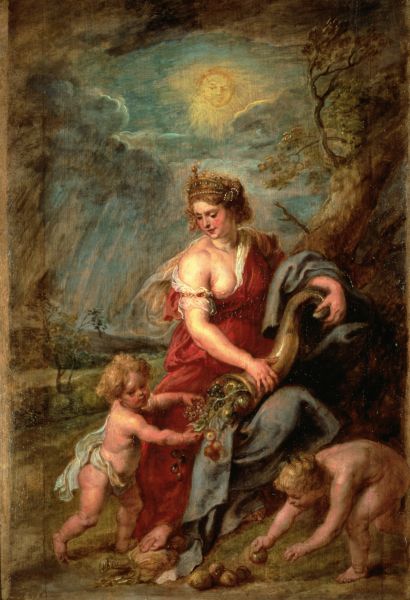
Credits: The Horn of Plenty on a painting by Rubens

In Greek mythology, the constellation is sometimes identified as Amalthea, the goat that suckled the infant Zeus after his mother, Rhea, saved him from being devoured by his father, Cronos. The goat's broken horn was transformed into the cornucopia or horn of plenty. Capricornus is also sometimes identified as Pan, the god with a goat's head, who saved himself from the monster Typhon by giving himself a fish's tail and diving into a river.

What a story and what a joy to look back for a while in our rich CDHK history. I hope this episode will inspire you to write an all new haiku or tanka.

broken horn
pours richness into the world -
not to the gods

© Chèvrefeuille

Hm ... I don't know if this is a great one? It's clear that it points to the inequitable distribution of wealth around the globe ... and that was the first thing which came in mind as I prepared this episode.

This episode is NOW OPEN for your submissions and will remain open until September 7th at noon (CET). I will (try to) publish our next episode, a new CD-Special, but I haven't yet chosen a featured haiku poet, later on.

Saturday, October 4, 2014

Carpe Diem Tan Renga Challenge # 52, Mark M. Redfearn's "a single sunbeam"


Dear Haijin, visitors and travelers,

Sorry for the delay of this Tan Renga Challenge, we had visitors so I had no time to write it. This week I have a wonderful haiku by Mark M. Redfearn for you to 'work with' and create a Tan Renga. Here is the haiku for starting the Tan Renga with:

a single sunbeam
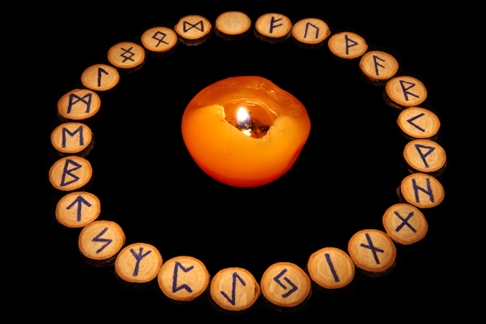
scribbling runes on fallen leaves -
autumn graffiti

© Mark M. Redfearn

A wonderful haiku I think to start a Tan Renga with. Up to you ... the challenge to write a second stanza of 7-7 syllables, in the classical way this time, to continue or complete this Tan Renga.

Credits: Runes

Here is my attempt to make the Tan Renga complete:

a single sunbeam
scribbling runes on fallen leaves -
autumn graffiti.           (Mark)

between the colored leaves
the first page of Genesis.            (Your host)

And now it's up to you my dear haiku-family members ....

This CD Tan Renga Challenge is NOW OPEN for your submissions and will remain open until next Friday October 10th at 7.00 PM (CET). Have fun... be inspired and share your Tan Renga with us all.


Friday, November 1, 2013

Carpe Diem's Tan Renga Challenge Month #II Mark M. Redfearn's "by the garden path"


Dear Haijin, visitors and travelers,

Awesome ... our first Tan Renga Challenge Month has started with a great response on the first Tan Renga Challenge on the haiku by Jessica. Really I am so glad to see how you all are reacting on this new Carpe Diem month. Thank you all for being part of this new month of Carpe Diem.

Today I love to share a haiku written by Mark M. Redfearn to challenge you to make the Tan Renga complete. Mark wrote this haiku in response of the first Garry Gay Special ... here it is:

by the garden path
an upside down flowerpot
cottage for a toad


It's a wonderful haiku to start a Tan Renga with. It can go in all directions ... so much to associate on ... so come on and make this Tan Renga complete by writing the second stanza (7-7).


My attempt to complete this Tan Renga:

by the garden path
an upside down flowerpot
cottage for a toad                                     (Mark M. Redfearn)

colorful flowers on the wall
once painted by grandmother                    (Chèvrefeuille, your host)

And ... now it's up to you ... come on have fun, be inspired and make the Tan Renga complete. This Tan Renga Challenge will stay on 'til November 4th 11.59 AM (CET) and I will (try) to post our new episode later on today around 7.00 PM (CET). !! Now open for your submissions !!


Tuesday, October 15, 2013

Carpe Diem #323, Threnody (provided by Mark M. Redfearn)


Dear Haijin, visitors and travelers,

Today we have another prompt in 'reprise', it's provided by Mark M Redfearn, and we had that prompt earlier this year around April 17th. I recall that I wrote a sad episode in loving memory of my brother who died September 3rd 1995 at the age of 35 at Lungcancer. You can find that episode HERE.
Today that prompt is on again and I decided to try to make this a joyful episode, because (in my opinion) death is not the end, but the beginning of a new life in Eternity in the Golden City, the Heavenly Jerusalem.
At the end of May 2013, in that month we had all prompts based on the Tarot cards, we finally entered the heavenly realms. That episode you can find HERE.

Death is not the end
it's a new beginning -
phoenix rises again

What a joy to know that there is new life after death and what a joy that we can (in diverse religions said) reincarnate to live again. In various religions and cultures death isn't the end and therefore has to be celebrated. Of course it's very sad to loose a loved one, but to know that death is not the end ... makes the pain and the loss of the beloved less painful.

Obon-Festival also called: Festival of the Lanterns

Last September, as we had all classical Japanese kigo for autumn, we had also a prompt about "The Festival of the Dead" or "Festival of the Lanterns". (You can find that episode HERE.)
The Festival of the Dead in Japan, which is called Obon, is held every year in the month of August. The festival often goes by a second name: The Festival of Lanterns. As in the traditional festival of Halloween, the souls of the departed return to the world of the living during this time. However, unlike Halloween, in which the souls of the dead are often imagined as malevolent or angry, like the Headless Horseman, Obon is a day when the spirits return to visit their relatives.

Obon-dancers

Many Buddhists in Japan celebrate this holiday by preparing offerings of special food for their ancestors’ spirits, which are placed on altars in temples and in their homes. As the sun goes down families light paper lanterns and hang them in front of their houses to help the spirits find their way home. The celebrations end with families sending colorful paper lanterns lit by candles floating down the rivers and bays of Japan and out to sea. The string of colorful lights bobbing in the water are meant to guide the spirits of their loved ones back to the realm of the dead until next year.

It's a festive celebration, because the Japanese honor their ancestors very strong. And that's what we all do I think. I honor my ancestors by having their photo's in my home surrounded with candles and every year on their birthdays my wife and I placing the flowers which our ancestors liked the most in front of their photo's. For example: grandma's flowers were Fresias, those fragile flowers with their sweet perfume.


Fresias
at her birthday
honoring my grandma -
the scent of Fresia


the scent of Fresia
brings back sweet memories
at her birthday


house altar
photo's of loved ones
I light a candle

I light a candle
in front of my brother's photo -
the scent of Old Spice

I think this has become a nice episode and it's not a sad episode, but a joyful episode, because ... death is not the end, it's a new beginning ... remember your lost ones, cherish them in the warmth of your heart. They will be there for you always.

This prompt will stay on 'til October 17th 11.59 AM (CET) and I will post our new episode, symbiotic (provided by Sam Edge), later on today around 7.00 PM (CET).
!! Threnody is open for your submissions at 7.00 PM (CET) !!


Wednesday, April 17, 2013

Carpe Diem #173, Threnody (provided by Mark M. Redfearn)


Dear Haijin, visitors and travelers,

This episode is really a struggle for me to write. This prompt brings a lot of emotions in my mind. Today I will try to write an episode on Threnody (provided by Mark M. Redfearn). Why giving it a try? Well ... first I didn't know this word and I had to sought it out in the dictionary. I found the meaning of this word Requiem and that made me very sad. A Requiem is a death mass and immediately it brought thoughts to me of my brother, who passed away in 1995 at Lungcancer on the age of 35.
Another thing which came in mind was the classical Catholic Mass composed by W.A. Mozart (1756-1791) Requiem in D minor which he composed for  the Austrian count Franz Von Walsegg, as a Tribute to the passing of his young wife Anna. Mozart began his final composition in Prague, suffering from an undetermined illness, which would eventually take his life and rob him of the chance to see the completion of his Magnum Opus. After Mozart's death, his understudy 'Franz Xaver Süssmayr', at the behest of Mozart's wife, completed the missing parts of the Requiem. 
Requiem Mass was first performed on January 2, 1793, in a private concert for the benefit of Mozart's grieving wife, Constanze Mozart.
I have found a wonderful (short piece) of this Requiem in D minor on You Tube. I think it's a great composition and it really is Mozart's Magnum Opus unless he couldn't complete it by himself.


I hope you did enjoyed it. To write a haiku on this prompt is, to me at least, not easy. It brings to much emotions, but I have to do this ...


in the cathedral
from dust to dust again -
requiem mass

requiem mass
for an everlasting love
my dear brother

my dear brother
burning a candle for him
in the cathedral


Well ... this one wasn't easy to write ... I had a thick throat and tears in my eyes as I finally wrote this cascading haiku in loving memory for my brother (1959-1995) who died on September 3rd 1995 almost 36 yrs of age. He's still missed, but we will see each other again when I finally will write my own death haiku and close my eyes forever.

Sorry for the sad tone of this episode, but I had to write this one. Not alone for myself, but also for those who have lost a beloved one.

This episode of Carpe Diem will stay on 'til April 19th 11.59 AM (CET) and I will post our new episode, whisper (provided by Cathy of Haiku Plate Special), later on today around 10.00 PM (CET).