Showing posts with label Tibetan rites and secrets. Show all posts

Tuesday, June 27, 2017

Carpe Diem #1210 Tibetan Book Of Dead (Bardo Thodol)


Dear Haijin, visitors and travelers,

This wonderful journey through Tibet is almost over and i think we have had a really wonderful and magical experience here. So it is with sadness that I am creating this penultimate (regular) episode. Today I love to inspire you through the Tibetan Book of Dead, not that one we had for our first Theme Week last year, but that original one in which the rituals are described to give peace to the dying and in which the soul is guided to the right realm were it will wait to be reborn.

Earlier this week I wrote an episode about Shambhala, that magical kingdom somewhere in the Himalayans. Shambhala isn't a physical place in my opinion it is the place were our souls are waiting to become reborn. Another episode was about reincarnation and those two prompts are interconnected with our prompt for today ... the Tibetan Book Of Dead. (Downloadable  HERE)

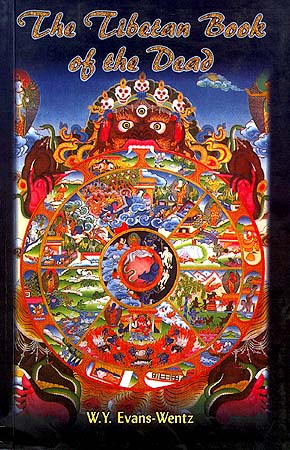
Tibetan Book Of The Dead

Let me tell you a little bit more about The Tibetan Book Of Dead:

It is meant to be a guide for those who have died as they transition from their former life to a new destination. The work has been traditionally attributed to Padma-Sambhava, an Indian mystic who was said to have introduced Buddhism to Tibet in the 8th century. Legend has it that while visiting Tibet, Padma-Sambhava found it necessary to conceal sanskrit works he had arranged to be written.The Tibetans of that time were not ready for the spiritual teachings contained therein, so he hid his texts in strange and remote locations, leaving them to be discovered at a later time when their spiritual message could be received by those with an open mind.

The most famous of those that discovered and revealed Padma-Sambhava's writings was Karma Lingpa who was born around 1350 CE. According to his biography, Karma Lingpa found several hidden texts on top of a mountain in Tibet when he was fifteen years old. Within those texts, he found a collection of teachings entitled: The Self-Emergence of the Peaceful and Wrathful Deities from Enlightened Awareness. These teachings contained the texts of the now famous Great Liberation upon Hearing in the Bardo. The Tibetan Book of the Dead was first published in 1927 by Oxford University Press, London. (Source: holybooks.com)

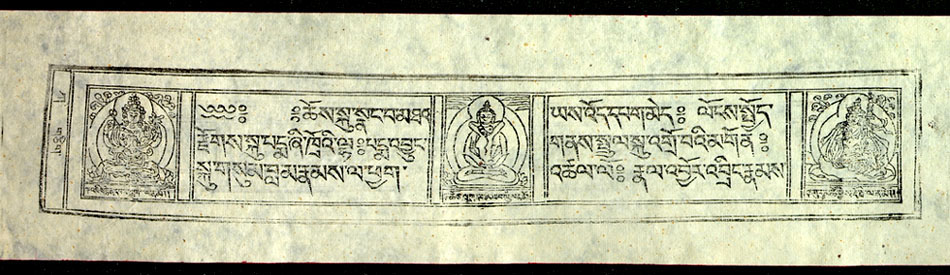
Tibetan Book Of The Dead (original)
The above image shows  the part of The Tibetan Book Of The Dead in which the passed away man or woman will be facing the demons to challenge him / her to be "weighted". I think this phase is similar with what in other religions is called "judgement" or "limbo", but that I don't know for sure.

Here is a "quote" from this part of The Tibetan Book Of The Dead:

[...] "O nobly-born, listen undistractedly. Not having been able to recognize when the Peaceful [Deities] shone upon thee in the Bardo above, thou hast come wandering thus far. Now, on the Eighth Day, the blood-drinking Wrathful Deities will come to shine. Act so as to recognize them without being distracted." [...]

aftermath
life weighted by the gods
to be reborn


© Chèvrefeuille

Well ... it is not an easy task I think this time, but I am looking forward to your responses on this prompt.

By the way ... next month we will have all kigo for summer for prompts, classical and non-classical. So that will be another great month of Carpe Diem Haiku Kai. I hope to publish our new prompt-list later this week.

This episode is NOW OPEN for your submissions and will remain open until July2nd at noon (CET). I will try to publish our new episode, Dalai Lama, later on. For now .... have fun!


Monday, June 26, 2017

Carpe Diem #1209 reincarnation the Tibetan Vision


Dear Haijin, visitors and travelers,

Welcome at a new episode of our wonderful Haiku Kai. this month it is all about Tibet, a Magical Experience, we have seen already the beauty of Tibet and we have read wonderful poems written by the renown Tibetan poet and yogi Milarepa and today we are going to look a little bit closer to one of the "pillars" of Budhism, reincarnation.
In our first CDHK Theme Week the one about the Tibetan Book of Living and Dying, we have already had a quick look at reincarnation, but for this episode I decided to dive into the matter of reincarnation (especially Tibet ideas) a bit more. However ... I couldn't really find a good background on this and so I had to decide to search the Internet. I ran into a nice essay about Tibetan ideas on reincarnation which I love to share here with you.

As you maybe know in Tibetan Buddhism the only one who can recognize a reincarnation is His Holiness The Dalai Lama. His last recognition (as far as I know) was on July 9th 2013. He then recognized a Tibetan boy born in Nepal as the reincarnation of one of his teachers and former head of Nyingma, the oldest tradition of Tibetan Buddhism.
The Tibetan spiritual leader gave his seal of recognition to Ngawang Tenzin Choekyi Lodoe Rabsel, a Tibetan boy born to Choeling Trulku Ngawal Choepal Gyatso and Paylung Tsewang Dolma in Kathmandu on July 25, 2013.

The announcement was made on July 6, 2015 to coincide with the 80th birthday of His Holiness the Dalai Lama.

Ngawang Tenzin Choekyi Lodoe Rabsel, the recognized reincarnation of Trulshik Rinpoche of
It is a bit stronge to see a young boy (above) as the reincarnation of one of the Heart Lamas of Nyingma, the oldest tradition of Tibetan Buddhism. As this little boy was recognized as a reincarnated spiritual teacher he was just 2 years. From the moment of recognition the life of this young boy and his family will change drastical. However the parents of this young boy will be grateful and honored that their son will become one of the leading Tibetan Lamas.

Tibetan reincarnation (tulku)?

The reincarnation system (tulku), a distinguishing characteristic of Tibetan Buddhism, is based on the theory that Buddha's soul never vanishes, but reincarnates in succession to lead his followers and to accomplish his mission. One of the first reincarnations among the Buddhist monks in Tibet is Karma Pakshi. In 1193, before Dusum Chenpa, a religious leader, the first Karmapa of the Karma Kagyu tradition of Tibetan Buddhism, passed away, he told his disciples that he would return as a reincarnated being. His disciples soon led a search for his infant reincarnation in accordance with his will. Several years later, Karma Pakshi turned out as the first reincarnation in Tibet and trained to be Karma Kagyu leader. After Karma Pakshi's reincarnation, the reincarnation system was adopted by other sects gradually to keep a consistent religious leadership. By applying the system, heirs for hundreds of Gyalwas (Living Buddhas) were selected, among whom the Dalai Lama and the Panchen Lama are the most prestigious. The Yellow Hat sect, Gelugpa tradition of Tibetan Buddhism also applied the system to hand down the titles conferred on the third Dalai Lama and the fourth Panchen Lama to keep their established religious and secular title and power. By the end of the Qing Dynasty there were 160 high lamas registered with the Board for Mongolian and Tibetan Affairs, each applying the reincarnation system to identify their next successors.
Lhamo Latso Lake

Religious methods and rituals are used to identify a reincarnation of a late high lama. A search party headed by another high lama begins the search. After a religious retreat, lamas, dispatched in disguise, scour Tibet for special signs: new mothers who had unusual dreams, children who have special knowledge without being taught, and special physical traits, such as big ear lobes. The lamas refer to oracles, portents, dreams and  the late lama's prophesy in order to aid them in their search. Some lamas are sent to Lhamo Latso, the Oracle Lake, to look for prophetic visions to help locate the reincarnation.
Once the High Lamas have found the home and the boy they believe to be the reincarnation, the boy undergoes a series of tests to affirm the rebirth. They present a number of artifacts, only some of which belonged to the previous Dalai Lama, and if the boy chooses the items which belonged to the previous Dalai Lama, this is seen as a sign, in conjunction with all of the other indications, that the boy is the reincarnation.

Many believe the Dalai Lama to be an earthly manifestation of Avalokiteśvara (Chenrezig). Eventhough this thought was only recently formulated by the fifth Dalai Lama, Ngawang Lobsang Gyatso ( 1617 -1682 ). It is said that Padmasambhava prophesied that Avalokiteśvara will manifest himself in the Tulku lineages of the Dalai Lamas and the Karmapas. Another Tibetan source explains that Amitabha Buddha gave to one of his two main disciples, Avalokiteśvara, the task to take upon himself the burden of caring for Tibet. In Tibetan Buddhism, Tara came into existence from a single tear shed by Chenrezig. When the tear fell to the ground it created a lake, and a lotus opening in the lake revealed Tara. In another version of this story, Tara emerges from the heart of Chenrezig. In either version, it is Chenrezig’s outpouring of compassion which manifests Tara as a being.

Avalokiteshvara
As I was preparing this episode I also sought for haiku on reincarnation and I ran into a nice haiku written by Martha Magenta:
reincarnation
each raindrop
lost at sea


© Martha Magenta

And I found another nice haiku on reincarnation by Rajkumar Mukherjee:

future born in me
with love of present for past
who knows what he holds


© Rajkumar Mukherjee

By the way I couldn't find a way to contact them to ask their permissions, so if you know these two poets or you are one of these two poets, please let me know if you are okay with it.

Reincarnation (Dutch website)
Here are a few poems I wrote on reincarnation or related themes:

several lives
once lived and re-lived -
Lotus blooms again
reaching for a new day of life
cherished by the sun
the final frontier
to become newly born -
conquering death
phoenix spreads its wings
after the dark cold winter night
finally spring
© Chèvrefeuille

This episode is open for your submissions tonight at 7:00 PM (CET) and will remain open until July 1st at noon (CET). I will try to publish our new episode, Tibetan Book of Death, later on.


Tuesday, June 13, 2017

Carpe Diem #1206 Yoga (especially Tibetan 5 rites Yoga)


Dear Haijin, visitors and travelers,

Welcome at a new episode of our Haiku Kai. This month we are on a virtual journey through Tibet. That wonderful spiritual country in the Himalayans, Recently Hamish pointed it me to the Tibetan Yoga of the five (5) rites, a very strong and powerful way of Yoga in which you can revive yourself to the max. There are even some great results of rejuvenation told. I love to introduce to you this beautiful kind of Yoga.

Tibetan Yoga, the Five Rites
Tibetan Yoga comprises of 5 simple, yet dynamic yogic exercises called 5 Tibetan Rites, meditation, praanayam and positive thinking.
The Five Tibetan Rites is a yoga routine based on a ritual of exercises done by the Tibetan Lamas, which helped them to live very long and healthy life and to stay ever young. (They were developed over centuries in the monasteries of Tibet. In 1930 a retired British army officer, who learnt these from the Lamas, brought them to the west). They are now practiced around the world and are said to prevent aging. The entire routine can be completed in less than 20 minutes. An important part of the Tibetan exercises is a conscious synchronization of breathing while performing physical activity.
They balance the 7 chakras & regulate the hormonal output. They effect our digestive system, cardio vascular system, nervous system and respiratory system.

These low profile yogic secrets of the Lamas will unearth all the energies and an awesome power lying dormant within you, aligning it with the cosmic energy to give you the best of both mind & body.
Meditation
History of Tibetan Yoga
Tibetan Yoga is the union of mind, body and spirit, & is based on Buddhism. The Godly Tibetan Lamas believe in living each moment to the fullest, i.e. to be consciously and totally present in every moment. These Lamas lived for 100 years and more but looked & felt like they were 50 years old. Their secret of eternal youth & vitality was a set of 5 simple yogic exercises called the ‘5 Rites' which were developed over centuries in the monasteries of Tibet.

What are those five Tibetan Rites? Let me tell you a little bit more about them. In this Tibetan Rites Yoga there are also a 6th and 7th rite, but those I will not bring here.
Tibetan rite 1
Tibetan Rite 1
"Stand erect with arms outstretched, horizontal with the shoulders. Now spin around until you become slightly dizzy. There is only one caution: you must turn from left to right." A tip for this is to look at the end of your right hand as a reference point.
Tibetan rite 2
Tibetan rite 2
"Lie full length on rug or bed. Place the hands flat down alongside of the hips. Fingers should be kept close together with the finger-tips of each hand turned slightly toward one another. Raise the feet until the legs are straight up. If possible, let the feet extend back a bit over the body toward the head, but do not let the knees bend. Hold this position for a moment or two and then slowly lower the feet to the floor, and for the next several moments allow all of the muscles in the entire body to relax completely. Then perform the Rite all over again."
"While the feet and legs are being raised it is a good idea also to raise the head, then while the feet and legs are being lowered to the floor lower the head at the same time."
Tibetan rite 3
Tibetan rite 3
"Kneel on a rug or mat with hands at sides, palms flat against the side of legs. Then lean forward as far as possible, bending at the waist, with head well forward—chin on chest. The second position of this Rite is to lean backward as far as possible. Cause the head to move still further backward. The toes will prevent you from falling over backward. The hands are always kept against the side of the legs. Next come to an erect (kneeling) position, relax as much as possible for a moment, and perform Rite all over again."
Tibetan rite 4
Tibetan rite 4
"Sit erect on rug or carpet with feet stretched out in front. The legs must be perfectly straight -- back of knees must be well down or close to the rug. Place the hands flat on the rug, fingers together, and the hands pointing outward slightly. Chin should be on chest -- head forward."
"Now gently raise the body, at the same time bend the knees so that the legs from the knees down are practically straight up and down. The arms, too, will also be vertical while the body from shoulders to knees will be horizontal. As the body is raised upward allow the head gently to fall backward so that the head hangs backward as far as possible when the body is fully horizontal. Hold this position for a few moments, return to first position, and RELAX for a few moments before performing the Rite again."
"When the body is pressed up to complete horizontal position, tense every muscle in the body."
Tibetan rite 5
Tibetan rite 5
"Place the hands on the floor about two feet apart. Then, with the legs stretched out to the rear with the feet also about two feet apart, push the body, and especially the hips, up as far as possible, rising on the toes and hands. At the same time the head should be brought so far down that the chin comes up against the chest. Next, allow the body to come slowly down to a ‘sagging’ position. Bring the head up, causing it to be drawn as far back as possible."
"The muscles should be tensed for a moment when the body is at the highest point, and again at the lowest point."

There are several claims of participants in these rites that they regained health, strenght and even regained youth. If that's true I don't know, but if it is true than for sure these rites are worth trying.
Isn't it awesome?
regaining youth
through the Tibetan rites
secrets reveiled
© Chèvrefeuille
This episode, sorry for the lenght of it, is open for your submissions tonight at 7:00 PM (CET) and will remain open until June 18th at noon (CET). I will try to publish our next episode, non-resistance, later on. For now ... have fun. Maybe try the rites yourself it takes only 20 minutes to do them all five.