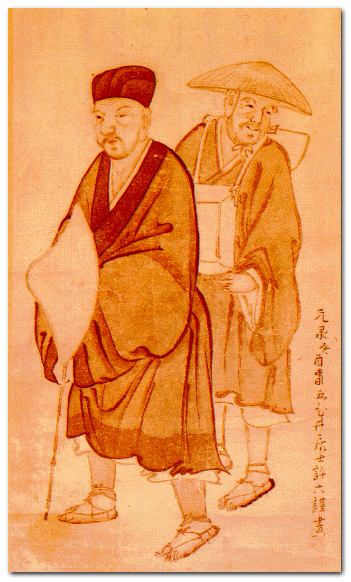
Tuesday, May 19, 2015

Carpe Diem #735 even woodpeckers


Dear Haijin, visitors and travelers,

We are still on the trail with Basho and at the moment we are on the trail with him to the deep north his most famous journey. In "The Narrow Road into the Deep North" (Oku no Hosomichi) he visited famous places on the Northern part of the Southern Isle Honshu. Today we have a wonderful haiku which Basho wrote at the place were his Zen-master Butcho has lived for a while. In this haiku he reverses to a "waka" by his Zen master:

less than
five foot square
grass shelter
not needed
unless there is rain


© Butcho (Tr. Jane Reichhold)

With this haiku came a preface:

"I understand that the Priest Butcho composed this poem about his home here. Seeing this place is so much more impressive than hearing about it, and I feel my heart is purified".

Basho's poem/haiku could be saying that, for him, a grove of trees is enough of a hut. Because trees constantly renew themselves, a woodpecker could not inflict the same damage it could on a building. Basho reveres the priest so much he equates his hut with a temple. It is said that Basho pinned this verse on the post the hut.

even woodpeckers
do not damage this hut
a summer grove


© Basho (Tr. Jane Reichhold)

There is another similar haiku which is known by Basho. Basho wrote, a while after his "Narrow Road" as he was staying somewhere at Lake Biwa, a haibun which is known as "Genjuan no Fui" or "The Unreal Hut". I love to share that haibun here with you including the haiku.


Pasania
The Unreal Hut

My body, now close to fifty years of age, has become an old tree that bears bitter peaches, a snail which has lost its shell, a bagworm separated from its bag. It drifts with the winds and clouds that know no destination. From the lofty peaks descends a fragrant wind from the south, and the northern wind steeped in the distant sea is cool. It was the beginning of the fourth moon when I arrived, and the azaleas were still blossoming. Mountain wisteria hung on the pines. Cuckoos frequently flew past, and there were visits from the swallows. In this hut where I live as a hermit, as a passing traveler, there is no need to accumulate household possessions. ... But I should not have it though from what I have said that I am devoted to solitude and seek only to hide my traces in the wilderness. Rather, I a m like a sick man weary of people, or someone who is tired of the world.. What is there to say? ... I labor without results, am worn of spirit and wrinkled of brow. Now, when autumn is half over, and every morning and each evening brings changes to the scene, I wonder if  that is not what is meant by dwelling in unreality. And here too I end my words.

among these summer trees,
a pasania *--
something to count on.


© Basho (Tr. Burton Watson)

(* The pasania is a majestic and ancient tree with spreading trunk and splendid canopy, hence "something to count on.") 

A wonderful story I think. It fits this episode so well. In my opinion these two haiku you cannot see without each other, but that's just my opinion.

high in the sky
in my tree house -
the spring breeze


© Chèvrefeuille

Not a strong haiku I think, but I love to give another idea to the "hut" as mentioned in the haiku by Basho. And the first thing which came in mind was a tree house, so I just had to use that.

This episode is open for your submissions tonight at 7.00 PM (CET) and will remain open until May 22nd at noon (CET). I will try to publish our new episode, one patch of a rice field, later on.

Monday, May 18, 2015

Carpe Diem #734 a summer mountain


Dear Haijin, visitors and travelers,

In a way the Japanese and Dutch people are the same, they have a lot in common, but as we look at their shoes .... than there is something the same (not totally). We the Dutch are well known around the globe for our tulips, windmills and ... our wooden shoes. The Japanese had wooden clogs with two bars on the sole (or as we will see in our haiku today ... one bar) and we (the Dutch) had (and still have) wooden shoes, but why did they use them?
The Japanese used them to walk elegant (like the geisha) or climb mountains (like monks), but the Dutch used them mostly to walk through their flat and muddy countryside. Our feet stayed dry and warm, because of the wooden shoes. We are known for those wooden shoes, but of course there is a lot more than that. We have very tasteful cheese and we have Rembrandt and Van Gogh.
Van Gogh painted wonderful paintings for a while which were inspired on the Japanese woodblock prints. And there is something else the Japanese and Dutch have in common ... we have a trading relation for more than 400 years. Maybe you have heard from Deshima or Dejima a small isle in the Bay of Nagasaki. It was used by the Dutch as a trading post from 1641 until 1853.

Credits: Deshima or Dejima

The chief Dutch official in Japan was called the Opperhoofd by the Dutch, or Kapitan by the Japanese. This descriptive title did not change when the island's trading fell under Dutch state authority. Throughout these years, the plan was to have one incumbent per year—but sometimes plans needed to be flexible. Every year the Kapitan visited the Emperor on New Year's Day. Later this visit was replaced to March and it was once in five years.
During Basho's life the Kapitan was Johannes Camphuys, the Governor of the V.O.C. and he visited the emperor a few times. Basho did compose a few haiku about this Deshima trader and his visits, here are those two haiku which I found:

even the captain
bows down before
the lord of spring


© Basho (Tr. Jane Reichhold)

the captain and
the flowers have come
on a saddled horse


© Basho (Tr. Jane Reichhold)

Isn't that a wonderful idea? Here I am your host from The Netherlands hosting a haiku family and there is such an old bond between my country and Japan .... it's awesome. But why this "story" in this post? Well I will try to explain that. Our haiku for today "a summer mountain" has in its second line a reference to "wooden clogs" and "bowing" and as I was preparing this episode that first haiku "even the captain" came in mind ... so I just had to tell something more about this connection between Japan and The Netherlands.

Back to our haiku for today. Basho visited the Gyoja Do of Komyoji Temple and saw the image of the legendary priest En no Goja wearing wooden clogs. Because the saint was very strong when climbing mountains, Basho prays to the clogs, not the saint, to help him climb the mountain. Normally Japanese wooden clogs have two horizontal bars that raise the foot above the mud. These clogs (to which he prays) have only one bar, so it was much like walking on ice skates, these "one barred" wooden clogs are called "tengu" and it refers to Japanese mythology. 
Tengu ("heavenly dog") are a type of legendary creature found in Japanese folk religion and are also considered a type of Shinto god (kami) or yōkai (supernatural beings).The earliest tengu were pictured with beaks, but this feature has often been humanized as an unnaturally long nose, which today is widely considered the tengu's defining characteristic in the popular imagination.
Buddhism long held that the tengu were disruptive demons and harbingers of war. Their image gradually softened, however, into one of protective, if still dangerous, spirits of the mountains and forests. Tengu are associated with the ascetic practice known as Shugendō, and they are usually depicted in the distinctive garb of its followers, the yamabushi.

Japanese Wooden Clogs (two bars)
The "one bar" refers to the idea of a unnaturally long nose> Of course it wasn't easy to walk on these tengu certainly not in the mountains, but En no Goja used them always. So it's not a strange idea that Basho prays to the wooden clogs, the tengu (one barred), because he needed the strength for his journey.

natsu yama ni ashida o ogamu kadode kana

a summer mountain
I pray to the wooden clogs
at departure


© Basho (Tr. Jane Reichhold) 

The mountain stands for finding Enlightenment and Basho was strongly seeking for that. Enlightenment is his goal when he starts his Narrow Road. I think in his Narrow Road we can read his transformation to an enlightened person. His Narrow Road was tough and full of disappointment, but also full of joy and spirituality.
In his Spirit I wrote my own Narrow Road, my quest for Enlightenment. My Narrow Road is still going on, but with the International recognition I have been given in 2011, that Enlightenment is nearer than I could ever dream of.
Basho's haiku is such a nice one and in that haiku he is so ... particularly present. Can I write a haiku in the same Spirit?

searching wisdom
I pray to Mother Earth
before leaving


© Chèvrefeuille

Awesome! I think I have succeeded a haiku in Basho's Spirit and a step forward to Enlightenment.

I wonder ... will She climb the mountain, the way to Enlightenment, with me?


And here is another haiku which was inspired on the haiku by Basho:

on wooden shoes
the farmer plows his fields
a sea of tulips


© Chèvrefeuille

Sorry guys ... it has become a little bit to long this episode, but I was on a roll with this haiku so ... I hope you will forgive me that I have taken a little bit more of your time.
This episode is NOW OPEN for your submissions and will remain open until May 21st at noon (CET). I will (try to) publish our next episode, even woodpeckers, later on. For now .... have fun!


Sunday, May 17, 2015

Carpe Diem #733 for a while


Dear Haijin, visitors and travelers,

First I love to thank Georgia (a.k.a. Bastet) for taking care for our posts of this weekend. I have enjoyed my free weekend and had a bit time to respond on my unread mail and to comment on all of your wonderful haiku shared through the prompts of this month.

Yesterday we entered the realm of the most famous journey by Matsuo Basho, "the narrow road into the deep north". And today we are going further on this journey in which we will step in the footsteps of Basho. Our haiku for today we have seen earlier, maybe you can remember that as you will read this haiku for today.

The verse/haiku which is our prompt for today was written on May 20th of the year 1688 at Urami (no take) Falls, about four miles (six km) west of Nikko. The waterfalls were previously accesible from behind, but an earthquake and flood in 1905 made the path inaccessible. In the haiku Basho is referring to the ninety-day period of ascetic seclusion prescribed for Buddhist monks each summer. In that year (1688) the event started on June 3rd.
This haiku is part of his Oku no Hosomichi, but it wasn't written during his journey as we can see at the date (1688), because he started his most famous trip in 1689. This means that he made his most famous haibun on a later date using haiku written earlier. And that's what the most sources tell us too. Basho composed/compiled his most famous haibun in the years after this almost 160 days journey he went on.

shi baraku wa taki ni komoru ya ge no haijime

for a while
secluded behind the waterfall
summer retreat begins


© Basho (Tr. Jane Reichhold)


Isn't it a wonderful haiku? It gives me a lot of different feelings and thoughts. What an experience this must have been to sit behind a waterfall listening to the sound of the falling water, the sound of water droplets falling ... must have been a spiritual experience and that's why Basho is referring to the ninety day seclusion of Buddhist monks ... a time to meditate, to contemplate and become one with nature, one with the Cosmos .... awesome.
How I am longing for such an experience. Going away, on my own, only myself and nature. Trying to find new strength and energy to go on with my life ... being silent ... one with the Cosmos .... finally finding the peace which I need so much .... finding the balance back ...

This haiku inspired me to write the following haiku (not a new one, but from my archives, but it came in mind immediately) ...


the sound of water
soothing - like meditating
behind the waterfall


(c) Chèvrefeuille  

Well .... we are on our way to the deep north together with Basho and his travel companion Sora ... and we will learn the beauty of Japan ... that faraway country to which I have lost my heart.

This episode is open for your submissions tonight at 7.00 PM (CET) and will remain open until May 20th at noon (CET). I will (try to) publish our new episode, a summer mountain, later on. For now ... be inspired and compose an all new haiku and share it with us.


Saturday, May 16, 2015

Carpe Diem #732 "A bell at sunset"


Dear Haijin, visitors and travellers,

Sanjin Gosaiden Shrine and Basho at Dewa Sanzan Sacred Mountains in Japan's Yamagata Prefecture

Today I've visited  Jane Reichhold's Bare Bones School of Haiku trying to understand and therefore explain to you something about today's haiku by Basho:

(spring 1689)

Spending a lonely spring evening in a country cottage


bell at sunset
also was not heard
a spring evening  

© Basho (trans. Jane Reichhold)

But before I talk about what Ms Reichhold has to say about the technique used by Basho in this haiku, I'd like to zoom in on the time and placing of the haiku.  Where was Basho and when? This is the year that he left Edo for his "Narrow Road to the Deep North". Edo was a former fishing village that had become very important under the rule of the Tokugawa shogunate in 1603.  After the Meiji restoration in 1868, during which the Tokugawa family lost its influence, the emperor and the imperial family moved there from Kyoto, and the city was re-named to its current name, Tokyo. 

As we saw yesterday, Basho discovered that his spirits rose and his haiku changed direction once he began his travels.  In fact when he returned to Edo after his first journey where:  "He met several poets who called themselves his disciples and wanted his advice; he told them to disregard the contemporary Edo style and even his own 'Shrivelled Chestnuts', saying it contained "many verses that are not worth discussing.""

During his 1689 voyage he would develop his karumi style.

Now for the technique used here.  It is a variation of the "hidden author" technique whereby the haiku poet would speak of him/herself as "the old man" "the traveller" or something similar.  In this case however it's the subject that's absent; "the technique was to write about a subject that could not be sensed, but only imagined."  Basho was from Edo, where temple bells rang in the evening, now, on his voyage there are no bells. Here's another that came from the same period:


kane tsukanu/ stow a nani o ka/ haru no kure

[bell not-ring/ village as for what do / spring’s evening]


no bell ringing
what do the villagers do
on a spring evening

© Basho (trans. Jane Reichhold)

Very interesting no?  So what should we be writing about ... something that doesn't take place ... which is of course only something that can be imagined. Yikes!


no poplar seeds
are falling like snow
under the rainfall

the cuckoo's call
unheard on the plains
on a spring morning

© G.s.k. '15

But then again, we may be inspired not by the technique but by our interpretation of the haiku's inner meaning for us, or a vision of a warm spring evening.  Whatever inspires you to compose a new haiku,  please leave your link below so that we may read it!  Ciao, Bastet

This episode is open for your submissions tonight at 7.00 PM (CET) and will remain open until May 19th at noon (CET).

Friday, May 15, 2015

Carpe Diem #731 - "How enticing"


Dear Haijin, visitors and travelers,

It's springtime and finally the weather is becoming warm and a little more stable.  It's a wonderful time to travel and have an exciting adventure, perhaps with good friends, which is what I did this last weekend!  Many centuries ago, Basho also decided to take a trip in spring, not his first as we can see from his haiku.


So today let's peek into the life of  Basho as he anticipates his next spring trip, perhaps contemplating travelling with Kawai Sora into the interior of Japan:


Omoshiro ya/ kotoshi no haru mo/ tabi no sora

[literal translation: exciting!/ this year’s spring also/ journey’s sky]

how enticing
in the spring of this year
again on a journey

© Basho (trans. Jane Reichhold)
(spring 1689)

The first of Basho's journeys resulted from a series of events which had rendered him dissatisfied and lonely, although he had attained a certain amount of fame in Edo.  So,  in 1684 Basho departed from Edo, alone for the first of his four journeys, taking the "Edo's Five Routes" which in Medieval times was considered to be very dangerous, and probably Basho did not expect to return from that trip.  However as his trip progressed his spirit improved very much and he began to feel better.  He met many friends during his travels and enjoyed the changing seasons and countryside.  His poetry became more vivacious and less introspective which reflects the joy he felt travelling.  This trip took him to Mount Fuji, Ueno and Kyoto.  He travelled again after returning to Edo.

In 1689 Basho began plans for a longer trip and the above haiku was sent to one of Basho's pupils, Kyorai as a sort of announcement of his intentions. His plans culminated on May 16, 1689 when he left Edo again, this time accompanied by his student and apprentice Kawai Sora which took him to the Northern Provinces of Honshu and lasted for 156 days culminating in his masterpiece Oku no Hosomichi, or The Narrow Road to the Deep North

Jane Reichhold brings to our attention that the last line of this haiku,  tabi no sora (journey's skies) probably refers to his intended companion for the journey, since Sora  means 'sky'. 


And here is my haiku relating to my recent trip to San Giorgio in Piano (Italy) where I participated in a Medieval festival:


a spring journey
through bright fields of green
into the past

© G.s.k. '15

Well, it's not a strong haiku and the only relationship to Basho's adventure and mine is that they took place in the late spring.  The haiku should perhaps been an announcement.  Or maybe not.  Now it's your turn!

Looking for this particular haiku was a wonderful adventure, something I'd invite everyone to try at least once.  Of course I went searching on Google as I didn't happen to have this specific haiku in my possession.  The note was found in a book written by Ian Marshall entitled:  "Border Crossings: Walking the Haiku Path on the International Appalachian Trail" and the note is from Jane Reichhold's book: Basho (on pages 131, 316).  The haiku in Japanese with it's literal translation and date was found in a pdf document entitled: "Matsuo Basho - Two Hundred Selected Haiku" by Tim Chichott.  The information about Basho's life was found in the Wikipedia.  For the full itinerary of Basho’s trip please visit “Narrow Road to the North”.

I hope you enjoyed the post and feel inspired to create your own original haiku based on Basho's poem, have fun!  Ciao, Bastet

This episode is open for your submissions tonight at 7.00 PM (CET) and will remain open until May 18th at noon (CET).


Carpe Diem Tan Renga Challenge #85, "the ancient woman"


Dear Haijin, visitors and travelers,

It's Friday again and .... it's time again for a new episode of our special feature TRC (Tan Renga Challenge). We are on the trail with Basho and as you maybe know every TRC this month will be a haiku by Matsuo Basho (1644-1694), one of the five greatest haiku poets ever.
For those who are new here I will explain the goal of the TRC. In the Carpe Diem TRC I will give a haiku, the first stanza of the Tan Renga. A Tan Renga is a short chained poem written by two different poets and has two stanza. The first stanza (the hokku) counts three lines (approximately 5-7-5 syllables) and a two lined second stanza (the ageku) which counts approximately 7-7 syllables and is a continuation of the first stanza through association on the images in the first stanza.
The goal of the TRC is two write a second stanza towards the first, say a kind of "answer". For this week's TRC I have chosen a wonderful haiku by Basho which he wrote in his younger years. This haiku he wrote at the age of 21.

uba-zakura saku ya rogo no omoi ide

the ancient woman
cherry tree blooms in old age
an event to remember

© Basho (at the age of 21)

Credits: Cherry tree view

The cherry tree is thought be personified, but the verse could be simply a play of words on another name of the higan-zakura cherry tree, the uba - old woman or nanny, zakura = cherry tree. There is also the thought that to see a very old cherry tree covered with the youth of new blossoms looks like an old woman wearing an abundance of powder and rouge. Still, Basho's last line seems to take a kindly view - this is an event for the tree to remember and for the persons to remember. Some authorities see a connection between the first four words of the verse and a passage in the play "Sanemori" spoken by an aged samurai, "I am certain I will die in battle. No event in my old age will be more memorable than that". Others view the use of personification as an indication of the Teimon style, the dominant renga technique as Basho was learning.

What an awesome verse to start this Tan Renga with. Compose/write the second stanza of this Tan Renga through association on the images in the first stanza. For example, you can use the image of "the ancient woman" or the blooming cherry tree.

Here is my attempt to make this Tan Renga complete by adding the second stanza:

the ancient woman
cherry tree blooms in old age
an event to remember                (Basho)

like a young girl she stands
strong in the wind, the old sakura               (Chèvrefeuille)

I like this completion a lot ... how immodest ... (smiles) and now it's up to you, my dear Haijin, to complete this Tan Renga by adding your second stanza. Have fun!

This Tan Renga Challenge is open for your submissions at noon (CET) and will remain open until next Friday, May 22nd at noon (CET).

Thursday, May 14, 2015

Carpe Diem Haiku Special #147 - "Those Fireflies" by Yosa Buson


Dear Haijin, visitors and travelers,

Today's CD Special was composed by one of Basho's spiritual disciples, Yosa Buson, author of today's haiku special:

longing for the grass
at the bottom of the pool
those fireflies.

© Buson

As you can see today's episode is dedicated to fireflies one of the summer kigo!  In the past on Carpe Diem Haiku Kai, our host Chèvrefeuille has already introduced us to a lovely firefly haiku by Basho and by other haiku poets, let's have a look:

at sun down
the fragile light
of a firefly

© Basho

Kisa Lagoon--
sparkling with fireflies
the rice planting boat

an evening spot
for calling fireflies...
planting a willow

© Issa

cool clear water
and fireflies that vanish
that is all there is...

© Chiyo-Ni


Now back to Yosa Buson's haiku ... I imagine a moonless summer evening, out in the fields a pool of water that cools the sun-burnt fields of grass, which have become yellow stubs, only a memory of what once was high grass.  You can feel the heat radiate from the ground and then, suddenly, the first flash of those fairy lights in the evening sky - fireflies! 

The goal of a Carpe Diem Special is to write a haiku in the same sense, tone and spirit as the one written by our featured haiku-poet, today Yosa Buson, so here's my attempt:


Gregory Crewdson

burnt summer grass
near the shimmering pool
first fireflies

© G.s.k. ‘15


Please share your inspired haiku below and I hope you will enjoy yourselves! Ciao, Bastet

This episode is open for your submissions tonight at 7.00 PM (CET) and will remain open until May 17th at noon (CET).