Showing posts with label praise to the emptiness. Show all posts

Wednesday, March 29, 2017

Carpe Diem #1182 drop of rain


Dear Haijin, visitors and travelers,

Here it is the last regular episode of CDHK's exploration of Persian poetry "praise to the emptiness" in which we explored wonderful poems by three very renown Persian poets, Rumi, Hafiz and Saadi. In this last episode I have a nice poem by Saadi for you, maybe it's not a poem more a kind of parable (as Jesus Christ for example told), but I think it's a nice way to conclude this beautiful spiritual month full of poems ...

Ocean
Well ... I will again make it myself easy and give you only the poem without my thoughts on it. Just enjoy the read and become inspired.

The Pearl and the Ocean

A drop of rain trickled from a cloud into the ocean. When it beheld the breadth of its waters it was utterly confounded:

"What a place is this Sea, and what am I? If it is existent, verily I am non-existent."

Whilst it was thus regarding itself with the eye of contempt, an oyster received and cherished it in its bosom.

Fortune preferred it to a place of honor; for it became a renowned royal Pearl.

Because it was humble, it found exaltation: it knocked at the door of Nonentity that it might arise into Being.

© Saadi (c. 1213-1291) (From The Bustan; translated by Samuel Robinson)

I hope you all did like this month of CDHK in its new "environment". As I look back on this month I know that you did like it and I also know that the way I have "re-done" CDHK has become awesome. I like my weekends off and that gave me more peace, a better health and for sure more energy.

This episode is NOW OPEN for your submissions and will remain open until April 3rd at noon (CET). I will publish our "weekend meditation", a new Namasté episode, later on. For now ... have fun!

PS. I hope to publish our new promptlist before the weekend.


Tuesday, March 28, 2017

Carpe Diem #1181 broken heart


Dear Haijin, visitors and travelers,

Another day in haiku and tanka paradise ... Today I have a beautiful poem by Hafiz, the most loved poet of Persia. Every Persian (Iranian), old and young, can at least recite one poem written by him. Hafiz is renown all around the world and that makes him the most important and renown Persian poet ever.

I hvae chosen to make it myself easy today. So I will give you only the poem by Hafiz and than you can go ... create your own haiku or tanka inspired on the poem by Hafiz, or maybe a ghazal or Sijo.

This poem is titled: I've Said It Before and I'll Say It Again and is extracted from: Drunk on the Wind of the Beloved in a translation by Thomas Rain Crowe.

Broken Heart
And here is the poem by Hafiz to inspire you:

I've Said It Before and I'll Say It Again

I've said it before and I'll say it again:
It's not my fault that with a broken heart, I've gone this way.

In front of a mirror they have put me like a parrot,
And behind the mirror the Teacher tells me what to say.

Whether I am perceived as a thorn or a rose, it's
The Gardener who has fed and nourished me day to day.

O friends, don't blame me for this broken heart;
Inside me there is a great jewel and it's to the Jeweler's shop I go.

Even though, to pious, drinking wine is a sin,
Don't judge me; I use it as a bleach to wash the color of hypocrisy away.

All that laughing and weeping of lovers must be coming from some other place;
Here, all night I sing with my winecup and then moan for You all day.

If someone were to ask Hafiz, "Why do you spend all your time sitting in
The Winehouse door?," to this man I would say, "From there, standing,
I can see both the Path and the Way.

© Hafiz (Tr. Thomas Rain Crowe)

And this is my attempt to create a tanka based on this poem:

roses
broken in the bud
trembled love
you left me alone
and broke my heart

© Chèvrefeuille

This episode is open for your submissions tonight at 7:00 PM (CET) and will remain open until April 2nd at noon (CET). I will publish our new episode, drop of rain, later on. For now .... have fun!


Monday, March 27, 2017

Carpe Diem #1180 departure


Dear Haijin, visitors and travelers,

Recently I read a wonderful weblog on spiritual growth and I hope that is a little bit the task of CDHK too. Maybe you are familiar with the idea of spiritual growth and if not .... well no problem at all. We are now living in what is called "the time of Aquarius" this is the time in which (according to astrology) humankind is ascending to another state of spiritual life. This is the time of spiritual growth. As we look around us than we can see that in so many things. For example we can see this in nature, global warming, makes us aware that we have to do something, we have to care for nature. Without nature we as humans cannot live. We need nature, not just for our food, but also for our spiritual health and physical health. Nature ... the major theme for us as haiku and tanka poets. We are the keepers of nature or as I stated earlier this month we are the keepers of Earth. We need her ...

This month I choose for the beauty of Persian poetry and themed this month "praise to the emptiness" and I think that theme was in almost all the poems we have read this month.  What is "emptiness"? Well it's one of the pillars of Zen Buddhism and for haiku (and tanka). Every haiku (or tanka) needs that emptiness, not only in its words, but also in its lay-out. In one of my first haiku anthologies I published (back in 1998) I had only one haiku a page ... That emptiness places the haiku at the most important spot ... in the center.


Today I have a wonderful poem by Rumi. This poem titled "departure" is extracted from 'Persian Poems', an Anthology of verse translations edited by A.J.Arberry, Everyman's Library, 1972 and translated by R.A. Nicholson. As I read this poem I saw dervishes swirl and maybe that makes this poem that awesome. Dervishes swirl, a Sufi way of meditating, to make contact with the Higher Power, with God or Allah or what ever name you will give it.

As I wrote earlier in this post emptiness is very important, but of course there is also need for a nice post to read I think, so I didn't choose for a lay-out with emptiness, but maybe you can use that idea of emptiness in the lay out for your response.

DEPARTURE

Up, O ye lovers, and away! 'Tis time to leave the world for aye.
Hark, loud and clear from heaven the form of parting calls-let none delay!
The cameleer hat risen amain, made ready all the camel-train,
And quittance now desires to gain: why sleep ye, travellers, I pray?
Behind us and before there swells the din of parting and of bells;
To shoreless space each moment sails a disembodied spirit away.
From yonder starry lights, and through those curtain-awnings darkly blue,
Mysterious figures float in view, all strange and secret things display.
From this orb, wheeling round its pole, a wondrous slumber o'er thee stole:
O weary life that weighest naught, O sleep that on my soul dost weigh!
O heart, toward they heart's love wend, and O friend, fly toward the Friend,
Be wakeful, watchman, to the end: drowse seemingly no watchman may.

© Rumi (Tr. R. A. Nicholson)

What can this poem mean? Reading it and re-reading it It brings me the idea of leaving this world, or in other words ... death. Is this what is meant here? I think it is, but maybe it is also a way of telling that you have to leave your common path and take another route ... or even more in other words ... it is time for changing your path ... to grow spiritual.

Departure (Image found on Pinterest)

Here at CDHK we have had "departure" earlier as prompt. As I was preparing this post I ran into the history of CDHK and found a few nice posts about "departure".

farewell verse
as I depart from the train station -
forget me not

© Chèvrefeuille 

Or what do you think of this haiku by Basho which he wrote at the beginning of "Narrow Road", his most famous haibun?

the passing spring
birds mourn, fishes weep
with tearful eyes

© Basho (Tr. Jane Reichhold)

Or this one by myself which I wrote (and published) earlier this month:

reborn again
leaving all behind
first spring day

© Chèvrefeuille

Departure ... is something we see very often in our daily life, not only real departure, but also spiritual departure (as it is meant in the poem by Rumi). Departure is part of our lives. Its included in our life.

autumn departure (Japan)

Maybe this tanka fits the poem by Rumi more than I first thought, so let's give it a try as a response on this poem by Rumi:

autumn departs
in deep silence willow leaves fall -
tears on this grave
as the willow is green again
another year has gone

© Chèvrefeuille

Departure ... it's part of our life ... 

This episode is open for your submissions tonight at 7.00 PM (CET) and will remain open until April 1st at noon (CET). I will try to publish our new episode, broken heart, later on. For now ... have fun!


Sunday, March 26, 2017

Carpe Diem #1179 Arise


Dear Haijin, visitors and travelers,

The weekend is almost gone and as I am publishing this new episode the submissions also start for our "weekend meditation". I must admit that I am grateful that I have chosen to be free in the weekends. It gives me time to relax and the opportunity to do the private things I need. For example: visiting relatives or just sit back and read that novel that I started to read but never brought to its end. So these weekends off are a blessing.

This month we are exploring the beauty of Persian poetry and today I have a well known poetess for you. Her name is Tahirih and she was a Baha' i believer. Her being Baha'i was the reason that she was executed, because she had left Islam and became Baha'i. After her death her poetry became almost holy for the Baha'i. Let me tell you a little bit more about her.

Tahirih (photo found on Pinterest)
Táhirih ("The Pure One"), also called Qurratu l-ʿAyn ("Solace/Consolation of the Eyes") are both titles of Fatimah Baraghani (1814 or 1817 – August 16–27, 1852), an influential poet and theologian of the Bábí faith in Iran. Her life, influence and execution made her a key figure of the religion. The daughter of Muhammad Salih Baraghani, she was born into one of the most prominent Azeri families of her time. Táhirih led a radical interpretation that, though it split the Babi community, wedded messianism with Bábism.

As a young girl she was educated privately by her father and showed herself a proficient writer. Whilst in her teens she married the son of her uncle, with whom she had a difficult marriage. In the early 1840s she became familiar with the teachings of Shaykh Ahmad and began a secret correspondence with his successor Kazim Rashti. Táhirih travelled to the Shi'i holy city of Karbala to meet Kazim Rashti, but he died a number of days before her arrival. In 1844 aged about 27, she became acquainted with the teachings of the Báb and accepted his religious claims. She soon won renown and infamy for her zealous teachings of his faith and "fearless devotion". Subsequently exiled back to Iran, Táhirih taught her faith at almost every opportunity. The Persian clergy grew resentful of her and endeavoured to have her imprisoned and stopped. She battled with her family throughout her life who wanted her to return to the traditional beliefs of her family.

Táhirih was probably best remembered for unveiling herself in an assemblage of men during the Conference of Badasht. The unveiling caused a great deal of controversy and the Báb named her "the Pure One" to show his support for her. She was soon arrested and placed under house arrest in Tehran. A few years later in mid-1852 she was executed in secret on account of her Bábí faith. Since her death Bábí and Bahá’í literature venerated her to the level of martyr, being described as "the first woman suffrage martyr". As a prominent Bábí (she was the seventeenth disciple or "Letter of the Living" of the Báb) she is highly regarded by Bahá'ís and Azalis and often mentioned in Bahá'í literature as an example of courage in the struggle for women's rights. Her date of birth is uncertain as birth records were destroyed at her execution.

Shrine of the Bab in Haifa
The poem I have chosen is in my opinion one of her best.

Arise 

O slumbering one, the beloved has arrived, arise!
Brush off the dust of sleep and self, arise!
Behold the good will has arrived,
Come not before him with tears, arise!
The mender of concerns has come to you,
O heavy-hearted one, arise!
O one afflicted by separation,
Behold the good tidings of the beloved’s union, arise!
O you withered by autumn,
Now spring has come, arise!
Behold the New Year brings a fresh life,
O withered corps of yesteryear, up from your tomb, arise!

© Tahirih (Tr. Farzaneh Milani)

Well ... I think I didn't say to much ... a real beauty. It inspired me to create the following poem:

awake
the darkness has gone
awake
cherry blossoms, plum blossoms, daffodils
awake and praise the Creator

© Chèvrefeuille

I hope you liked this post and of course I hope it will inspire you to create haiku, tanka or other Japanese poetry form. 

This episode is open for your submissions tonight at 7.00 PM (CET) and will remain open until March 31st at noon (CET). I will try to post our new episode, departure, later on. For now ... have fun!


Wednesday, March 22, 2017

Carpe Diem #1178 Theme Week Hafiz (4) knowledge


Dear Haijin, visitors and travelers,

This is the last post for the Theme Week about Hafiz, the most beloved poet from the Persian (Iranian) people. Almost every one, young and old, can recite the poems of Hafiz. His poems are really beautiful and full of wisdom. The Persian people know that, they are using his poetry to get answers on their questions and today's poem is one of the most wonderful in my opinion with a great message.

The poem is titled: "The School of Truth" and is extracted from "Drunk On the Wind of the Beloved" in a translation by Thomas Rain Crowe.

School of Truth

O fool, do something, so you won't just stand there looking dumb.
If you are not traveling and on the road, how can you call yourself a guide?
In the School of Truth, one sits at the feet of the Master of Love.
So listen, son, so that one day you may be an old father, too!
All this eating and sleeping has made you ignorant and fat;
By denying yourself food and sleep, you may still have a chance.
Know this: If God should shine His lovelight on your heart,
I promise you'll shine brighter than a dozen suns.
And I say: wash the tarnished copper of your life from your hands;
To be Love's alchemist, you should be working with gold.
Don't sit there thinking; go out and immerse yourself in God's sea.
Having only one hair wet with water will not put knowledge in that head.
For those who see only God, their vision
Is pure, and not a doubt remains.
Even if our world is turned upside down and blown over by the wind,
If you are doubtless, you won't lose a thing.
O Hafiz, if it is union with the Beloved that you seek,
Be the dust at the Wise One's door, and speak!

© Hafiz 

In this poem I read something interesting which brought me the idea to dive into the ancient secretive knowledge of the Alchemists.

Alchemist's Laboratory
Maybe you know Paulo Coelho's novel "The Alchemist", it was his first novel and one of the best he wrote in my opinion. In this novel Paulo describes the story of a young man on a quest to find a treasure on which he had a dream. His quest brings him finally to Egypt and its pyramids. During his quest he encounters an Alchemist who is on a quest to find the fountain of life or the elixer of life. The young man is caught immediately by that idea, but he also is caught by the search for the stone of wisdom to turn everything into gold (like the story of that Greek king Midas).

As I was reading "The Alchemist" I was caught by the secretive knowledge of the Alchemists. So let me tell you a little bit more about that. By the way ... while diving into this matter I ran into a muslim Alchemist, so maybe that fits our theme too.

Alchemy is a philosophical and proto-scientific tradition practiced throughout Europe, Egypt and Asia. It aimed to purify, mature, and perfect certain objects. Common aims were chrysopoeia, the transmutation of "base metals" (e.g., lead) into "noble" ones (particularly gold); the creation of an elixir of immortality; the creation of panaceas able to cure any disease; and the development of an alkahest, a universal solvent. The perfection of the human body and soul was thought to permit or result from the alchemical magnum opus and, in the Hellenistic and western tradition, the achievement of gnosis. In Europe, the creation of a philosopher's stone was variously connected with all of these projects.
Jabir ibn Hayyan, the father of Chemistry
As I mentioned above I ran into an alchemist from Persia. Let me tell you a little about him. His name was Jabir ibn Hayyan and he lived from 712 until 815, so he lived for over 100 years. He is nowadays known as "the father of chemistry".
Jabir was a natural philosopher who lived mostly in the 8th century; he was born in Tus, Khorasan, in Persia, well known as Iran then ruled by the Umayyad Caliphate. Jabir in the classical sources has been entitled differently as al-Azdi al-Barigi or al-Kufi or al-Tusi or al-Sufi.
In total, nearly 3,000 treatises and articles are credited to him. The scope of the corpus is vast: cosmology, music, medicine, magic, biology, chemical technology, geometry, grammar, metaphysics, logic, artificial generation of living beings, along with astrological predictions, and symbolic Imâmî myths.
The 112 Books dedicated to the Barmakids, viziers of Caliph Harun al-Rashid. This group includes the Arabic version of the Emerald Tablet, an ancient work that proved a recurring foundation of and source for alchemical operations. In the Middle Ages it was translated into Latin (Tabula Smaragdina) and widely diffused among European alchemists.
The Seventy Books, most of which were translated into Latin during the Middle Ages. This group includes the Kitab al-Zuhra ("Book of Venus") and the Kitab Al-Ahjar ("Book of Stones").
The Ten Books on Rectification, containing descriptions of alchemists such as Pythagoras, Socrates, Plato and Aristotle.
The Books on Balance; this group includes his most famous 'Theory of the balance in Nature'.
Jabir states in his Book of Stones (4:12) that "The purpose is to baffle and lead into error everyone except those whom God loves and provides for". His works seem to have been deliberately written in highly esoteric code, so that only those who had been initiated into his alchemical school could understand them. It is therefore difficult at best for the modern reader to discern which aspects of Jabir's work are to be read as ambiguous symbols, and what is to be taken literally. Because his works rarely made overt sense, the term gibberish is believed to have originally referred to his writings .

It is said that Jabir ibn Hayyah has influenced the Weestern world is a great way. And that makes this little "circle" complete, because with this sentence I am back at the poem by Hafiz. Hafiz's works are renown around the globe and I think his poems have influenced the Western world as much as did Jabir ibn Hayyan.

Alchemy (phot found on Pinterest)

I think the poem by Hafiz describes the alchemy between God, Allah, Higher Self, Great Spirit or what ever name you will give it. Without an open mind and a heart full of love you cannot have a relation with that Higher Power. I think that we, haiku poets, are also a kind of alchemists, because we can tell a lot in just a few words, with those few words we describe the beauty of the Creation and through that we are the alchemists ... through that we know that our love for nature can be a "trigger" to find the Philosopher's Stone to help the world to appreciate nature and its beauty to the max.

alchemy
strong medicine for love
nature smiles

© Chèvrefeuille

I hope you did like this episode, it wasn't an easy task to create it, because I love this Alchemy and all that has to do with it, so ... if this episode was to long than my excuses for that.

This episode is open for your submissions tonight at 7.00 PM (CET) and will remain open until March 27th at noon (CET). I will try to publish our new episode, a new weekend-meditation with Universal Jane, later on. For now .... have fun!

Tuesday, March 21, 2017

Carpe Diem #1177 Theme Week Hafiz (3) morning breeze


Dear Haijin, visitors and travelers,

I like to create these posts here at CDHK. It is always a joy to make them and to see how everyone is responding. I am truly proud to be your host here at CDHK and I am glad to see how you all are responding this month and especially this week.
In this Theme Week I introduce beautiful poems by Hafiz to you and today I have another beauty to share, but first I love to share a few "morning breeze" haiku and tanka here:

A haiku by Yosa Buson:

see the morning breeze
ruffling his so silky hair -
cool Caterpillar


© Buson
And a tanka by Chenou Liu:

the morning breeze
turns maple leaves to song...
alone at my desk
I hear how Mother's words
'come home' have aged


© Chenou Liu (source: poemhunter)
And here are two haiku I once wrote in which I used "breeze":

young cherry trees -
morning breeze caresses
fragile blossoms


cherry blossoms bloom
such a fragile beauty -
morning breeze
© Chèvrefeuille

Cherry blossoms
Well ... let us take a look at the poem by Hafiz for today's inspiration. Another beauty I would say. This poem is titled "Like The Morning Breeze" and is taken from "Drunk on the Wind of the Beloved" in a translation by Thomas Rain Crowe.


Like The Morning Breeze

Like the morning breeze, if you bring to the morning good deeds,
The rose of our desire will open and bloom.
Go forward, and make advances down this road of love;
In forward motion, the pain is great.
To beg at the door of the Winehouse is a wonderful alchemy.
If you practice this, soon you will be converting dust into gold.
O heart, if only once you experience the light of purity,
Like a laughing candle, you can abandon the life you live in your head.
But if you are still yearning for cheap wine and a beautiful face,
Don't go out looking for an enlightened job.
Hafiz, if you are listening to this good advice,
The road of Love and its enrichment are right around the curve.

© Hafiz
A wonderful poem and I hope it will inspire you to create haiku, tanka or another Japanese poetry form. Have fun!
This episode is open for your submissions tonight at 7.00 PM (CET) and will remain open until March 26th at noon (CET). I will try to post our next episode, knowledge, later on.


Monday, March 20, 2017

Carpe Diem #1176 Theme Week Hafiz (2) lover


Dear Haijin, visitors and travelers,

Today is the second day of the Theme Week for this month in which we are exploring the beauty of Persian (Iranian) poetry especially through the poems by Rumi, Hafiz and Saadi. In this Theme Week Hafiz plays the "leading role" because of the fact that he is one of the most loved Persian poets nowadays. His poetry is used by a lot of Persian (Iranian) people to get answers on "burning" questions.
As we saw yesterday in our first Theme Week episode ... the poems by Hafiz can give certain answers on deeper questions ... and today I think that's also true.

The title of this episode "lover" is extracted from a wonderful poem title "Let Thought Become Your Beautiful Lover" (part of "The Gift"). In this poem Hafiz describes the meaning of prayer through the idea of a beautiful woman. And if you read this poem again (and again) than it's almost a prayer. A prayer in praise of the Creator. Hafiz describes praying as a kind of love.

Persian Lovers (painting)

Let Thought Become Your Beautiful Lover

Let thought become the beautiful Woman.
Cultivate your mind and heart to that depth

That it can give you everything
A warm body can.
Why just keep making love with God's child--
Form


When the Friend Himself is standing
Before us
So open-armed?
My dear,
Let prayer become your beautiful Lover


And become free,
Become free of this whole world
Like Hafiz.

© Hafiz taken from “The Gift” translated by Daniel Ladinsky
A wonderful poem don't you think so too? In this poem I read Hafiz's strong love for all and everything and through his love for God ... he has become free ... Is this what he means in this poem? Praying can set you free ... I think that is possible, but I think not everyone will "learn" that from this poem ... it's maybe not the answer on your question ...

Praying
I dived in to my archives and found a few haiku and a tanka in which the "answer" from the poem by Hafiz can be found. I realised while I was searching through my archives that I had written a lot of haiku (and tanka) about praying and prayer.

praying hands
stronger than weapons
I believe
praying to a Higher Power
gives me strength


© Chèvrefeuille

in deep prayer
eyes closed in devotion -
Lotus starts to bloom
deep silence
only whispered prayers -
the scent of incense


Praying Eagle

praying hands
seeking the wisdom of the Lord -
cry of an eagle
scent of Jasmine
the sound of a gurgling brook
my mind in peace


praying to the gods
offering them the gifts of nature
peace of mind

© Chèvrefeuille
Another beautiful poem by Hafiz we have explored in this episode. Hafiz is really one of the greatest Persian poets I think. I hope you did like this episode and that I have inspired you.

This episode is open for your submissions tonight at 7.00 PM (CET) and will remain open until March 25th at noon (CET). I will (try to) publish our next episode, morning breeze, later on. For now have fun!

Wednesday, March 8, 2017

Carpe Diem #1170 fountain


Dear Haijin, visitors and travelers,

Maybe you know that I host on Mind Love Misery's Menagerie also a weekly feature. That feature is titled "Heeding Haiku With Chèvrefeuille" and today I posted there a new episode of that feature with a wonderful poem by Hafiz to inspire. So if you are interested in that poem by Hafiz, than feel free to visit Mind Love Misery's Menagerie.

This month is already one week old and I think I have inspired you with beautiful poems from Persian poets. I have visited and read all your wonderful blogs and websites and I am glad that I had the time to visit you all. Of course I will try to do that but as you all know ... time is not always at my side.

Today I love to share a wonderful poem by Saadi. This poem is also extracted from "The Bustan" (The Orchard) Saadi's first book of poems. It's about an inscription on a fountain ... I think it is a beauty, but that's just my humble opinion.

Ruins of Shahnameh or Jamshid's Kingdom
This poem is titled: "Inscription on the fountain of Jemshid (or Jamshid) and I think it needs a little bit explanation. We have to dive into Persian history to find more about Jamshid. So here it goes.

Jamshid is a mythical King in Iranian traditions and culture and there is a long history behind him. In Avestan scripts and Pahlavi scripts and ancient literatures, there are a lot of aptitudes and magnificent figures which allocated to him. In Shahnameh, Jamshid is the son of Tahmouras and he was a charismatic king, who lost his divine charisma due to his arrogance and vanity and finally he was killed by Zahhak.

Jamshid was the prototype model ruler, he was a legendary figure like king Solomon, his wisdom knew no bounds and he had demons and beasts and birds under his control, he could see the future and had total dominion over the entire world, yet, exactly like Solomon he grew arrogant and considered himself to b divine, as a result, his kingdom was invaded and he himself cut in two using a saw by Zahhak or Azhidahak. Interestingly, after the Islamic conquest of Persia, the similarities between the story of Jamshid and Solomon were not missed and for a long time Persepolis which is called Takht-e-Jamshid or throne of Jamshid was also known as the throne of Solomon.

In Avesta, Jamshid is the son of Viunghant, and he has called Yima. Jamshid name is constructed from two parts, Jam and Shid. In Avestan Jam means "equal and twin" and Shid means "Sun", and Jamshid means "Sun's twin". In the second chapter of the Vendidad of the Avesta, Ahura Mazda asks Yima (Jamshid), to receive his law and bring it to men. However, Yima refuses, and so Ahura Mazda charges him with a different mission: to rule over and nourish the earth, to see that the living things prosper. This Yima accepts, and Ahura Mazda presents him with a golden seal and a dagger inlaid with gold.
King Jamshid
In Iranian Literature, especially in poetry, he is mentioned with some mythical characteristics. The most well-known metaphor of Jamshid's characteristics in ancient Iranian literature is "Jame Jam"_ Jam Chalice_. which mentions to immortality . This metaphor frequently has been used in great Persian poetries' Divanes (Poetry Collection Books), such as Hafez, Movlana, Sa'adi, etc. Jamshid was said to have had a magical seven-ringed cup, the Jām-e Jam which was filled with the elixir of immortality and allowed him to observe the universe. Also Jamshid's capital was erroneously believed to be at the site of the ruins of Persepolis, which for centuries was called Takht-i Jamshēd, the "Throne of Jamshid". (Sources: quora and wikipedia)

Now we know a little bit more about Jamshid and I think this will help to understand and become inspired by the poem of Saadi.

Fountain in one of Jamshid's palaces

Inscription on the Fountain of Jamshid

I have heard that Jamshid, of happy disposition, inscribed on a tablet at the head of a fountain:
"Many, like ourselves, have breathed at this fountain, and departed, and closed their eyes upon it.
"They captured the world by courage, or violence, but carried away with them nothing to the grave.
"They departed each one, and of that which they had tilled nothing remained to them, save a good or an evil name.
"When thine enemy hath fallen into thy hands, grieve him not further; he hath already tasted enough of sorrow.
"Better hold in thy keeping a discomfited enemy alive, than to have on thy neck the stain of his blood."

© Saadi (13th century)
Taken from “The Bustan” and translated by Samuel Robinson

Not an easy poem to become inspired by I think, but I have given it a try:

fountain of life
your heartbeat against mine
for an eternity
early sunrays cherish your body
in despair I flee away from you 

© Chèvrefeuille

Awesome ... sorry that sounds very immodest, but this is one of my best tanka ever I think.

This episode is open for your submissions tonight at 7.00 PM (CET) and will remain open until March 13th at noon (CET). I will try to post our new episode, a new Universal Jane (for the weekend), later on. For now ... have fun!


Tuesday, March 7, 2017

Carpe Diem #1169 humble


Dear Haijin, visitors and travelers,

In the second episode of this month I introduced to you the Persian poet Hafiz. Hafiz is one of the most loved Persian poets ever. His poems are used for giving answers on burning questions the reader has. The following poem is again a beauty, but I don't think in this poem you will find an answer on burning questions, but ... well you never know.
This poem is titled: "from the large jug, drink".

Persian jug

From the large jug, drink the wine of Unity,
So that from your heart you can wash away the futility of life's grief.
But like this large jug, still keep the heart expansive.
Why would you want to keep the heart captive, like an unopened bottle
of wine?
With your mouth full of wine, you are selfless
And will never boast of your own abilities again.
Be like the humble stone at your feet rather than striving to be like a
Sublime cloud: the more you mix colors of deceit, the more colorless
your ragged wet coat will get.
Connect the heart to the wine, so that it has body,
Then cut off the neck of hypocrisy and piety of this new man.
Be like Hafiz: Get up and make an effort. Don't lie around like a bum.
He who throws himself at the Beloved's feet is like a workhorse and will
be rewarded with boundless pastures and eternal rest.

© Hafiz - From: Drunk on the Wine of the Beloved (Tr. Thomas Rain Crowe)
All and Everything is Buddha
A nicely written poem with a true life's lesson I think. Let me point this out to you. To explain this I have to reproduce a part of this poem.
[...] "Be like the humble stone at your feet rather than striving to be like a
Sublime cloud: the more you mix colors of deceit, the more colorless
your ragged wet coat will get." [...]


In this "quote" I read what the spiritual roots are of haiku (and tanka). Be one with nature, be as nature, be that stone at your feet. Don't place your self in front of it, but be humble, be humble and praise nature. This is what the Zen-Buddhism background of haiku has taught us ... everyone and everything around you is Buddha. In all and everything Buddha is present. Be one ...

Humble ... what is humble, being humble? In my opinion humble means respecting nature, respecting the gift of the gods that you may be here and be part of life, part of nature. I have said it very often here at CDHK I think "your humble host" and that is true. I love to create CDHK, but I don't create it for myself ... I create it for you my dear haijin, visitors and travelers. I create CDHK just to give you the opportunity to improve your haiku and tanka writing skills ... to give you a moment of silence, excitement and unconditional love. CDHK ... is for you and I am just your humble host, the one who is given this opportunity by a Higher Power, God, Allah or what ever name you use for it.
I am grateful that I can and may be your host.


Next to the above haiga I found two haiku in which I share my gratefulness for being your host.

unseen flowers
between the oversized leaves -
a humble haijin


joy of writing
for all the friends of Carpe Diem -
makes me humble
© Chèvrefeuille
Well ... I hope I have inspired you with this post and mostly of course through this beautiful poem by Hafiz.

This episode is open for your submissions tonight at 7.00 PM (CET) and will remain open until March 12th at noon (CET). I will try to publish our new episode, fountain, later on. For now ... have fun!


Monday, March 6, 2017

Carpe Diem #1168 flute


Dear Haijin, visitors and travelers,

What a joy to read all of your responses on the first posts of this month. It's really a joy to read all of your poems. Everyone creates in his or her way and yet there are so much things the same. It feels like CDHK has really become a family in which we are sharing our love for Japanese poetry but are also sharing unconscious the same thoughts and feelings. You all are such great poets ... who am I that I can and may be your host here ... I am really honored with your warm and loving participation here. Thank you all ...

Recently I read about the philosophy of Nietzsche, he had specific ideas, but over all he shared his thoughts on existentialism. What is existentialism? Let me give you a small explanation for this:

" Existentialism is the belief that philosophical thinking begins with the human subject—not merely the thinking subject, but the acting, feeling, living human individual. While the predominant value of existentialist thought is commonly acknowledged to be freedom, its primary virtue is authenticity. In the view of the existentialist, the individual's starting point is characterized by what has been called "the existential attitude", or a sense of disorientation, confusion, or dread in the face of an apparently meaningless or absurd world. Many existentialists have also regarded traditional systematic or academic philosophies, in both style and content, as too abstract and remote from concrete human experience." (Source: Wikipedia)

What has this to do with the poem for today? Well ... what can I say? In the peom of today Rumi is speaking about "existence" and with that came my "revalation" to tell you a little bit about existentialism, because that was the first thing I thought about. Maybe that's just a coincedence, because I am reading Nietzsche's "Also Sprach Zarathustra" at the moment, one of Nietzsche's most famous works. And existence triggered me to look at existentialism ...


Let me first give you the poem by Rumi which is our source of inspiration for this episode:

We are as the flute, and the music in us is from thee;
we are as the mountain and the echo in us is from thee.
We are as pieces of chess engaged in victory and defeat:
our victory and defeat is from thee, O thou whose qualities are comely!
Who are we, O Thou soul of our souls,
that we should remain in being beside thee?
We and our existences are really non-existence;
thou art the absolute Being which manifests the perishable.
We all are lions, but lions on a banner:
because of the wind they are rushing onward from moment to moment.
Their onward rush is visible, and the wind is unseen:
may that which is unseen not fail from us!
Our wind whereby we are moved and our being are of thy gift;
our whole existence is from thy bringing into being.

© Rumi

Ah the sound of the Ney, the Persian flute. Really a wonderful sound. (More about the Persian Ney). In this poem Rumi describes our connection with the world around us, the subconscious connection between us all, and he describes it in a beautiful way. That comparison with the pieces of chess ... awesome. Than he describes our existence or non-existence, because we are all one and part of that one Being, Spirit, God or what ever name you give it.

Let us take a look again at existentialism as mentioned above: "Existentialism is the belief that philosophical thinking begins with the human subject—not merely the thinking subject, but the acting, feeling, living human individual. While the predominant value of existentialist thought is commonly acknowledged to be freedom, its primary virtue is authenticity. In the view of the existentialist, the individual's starting point is characterized by what has been called "the existential attitude", or a sense of disorientation, confusion, or dread in the face of an apparently meaningless or absurd world."

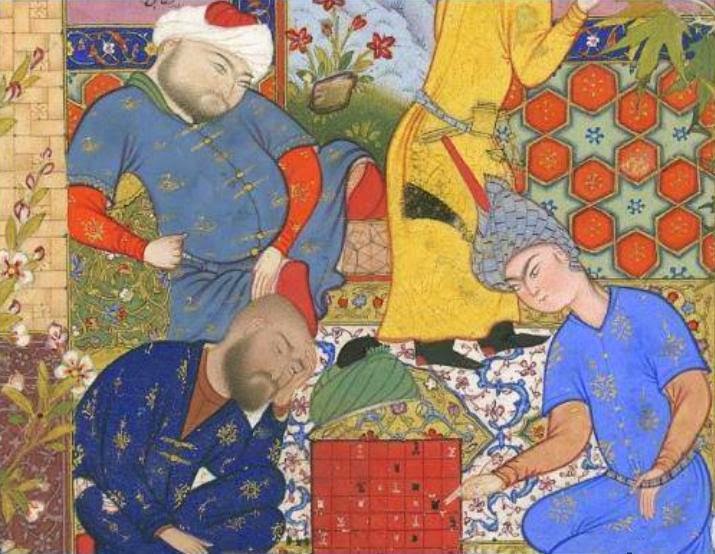
Persian Youth playing chess
Rumi describes our connection in an "absurd" way he compares us with pieces of chess, with banners moving in the wind, but he is right. Our existence is built on that absurdity of the world. Look around, religions fight each other, all from aout an idea of supremacy ... and that is a real part of existentialism. Are we supreme beings? I don't think so, we are all pieces of what I call (as in earlier posts here) "god-stuff", we are all connected with that Being. That Being gives us the opportunity to exist, we are part of that Being and from out Being's unconditional love we can and may use nature, but we also have to care and have respect for nature. Isn't that what existentialism means? We exist and we exist together in a world we have to care for ... an absurd world nowadays.

What a beautiful poem with all those deeper layers, not only spiritual, but also philosophical ... really wonderful. Rumi, in my opinion, is one of Persia's best poets.

It will not be easy to become inspired by this above post, but based on the poem by Rumi I came up with the following:

a game of chess
played in the shadow of lion banners -
the wind unseen


© Chèvrefeuille
This episode will be open for your submissions tonight at 7.00 PM (CET) and will remain open until March 11th at noon (CET). I will try to publish our new episode, humble, later on. For now ... have fun!


Sunday, March 5, 2017

Carpe Diem #1167 The Dancer


Dear Haijin, visitors and travelers,

Welcome at a new episode of CDHK. As you all have noticed I didn't publish this weekend. That's my own choice to find some time for myself. I however had a difficult weekend, because I like creating CDHK and it felt like I was amputated this weekend, but ... I know it's better for me to take the weekends off. I hope you will understand that. After all ... I just have to say ... I liked having a weekend off. Please let me know if you are okay with this new structure of CDHK.

Today I have a wonderful poem by one of Persia's best poets ever. He lived in the medieval times and was not only a great poet, but also a great philosopher. Today I love to share a poem by Saadi (1203-1292).

Saadi
Let me tell you a little bit more about Saadi:

Abū-Muhammad Muslih al-Dīn bin Abdallāh Shīrāzī, better known by his pen-name Saadi, also known as Saadi of Shiraz, was one of the major Persian poets and literary men of the medieval period. He is not only famous in Persian-speaking countries, but has been quoted in western sources as well. He is recognized for the quality of his writings and for the depth of his social and moral thoughts. Saadi is widely recognized as one of the greatest poets of the classical literary tradition, earning him the nickname "Master of Speech" or "The Master" among Persian scholars..

The poem of today is extracted from the first book of poetry written by Saadi, Bustan, the orchard. Bustan is a book of poetry by the Persian poet Saadi, completed in 1257 and dedicated to the Salghurid Atabeg Sa'd I or Sa'd II. It was Saadi's first work, and its title means "the orchard". The book contains the fruits of Saadi's long experience and his judgments upon life, and is illustrated by a vast collection of anecdotes. It includes accounts of Saadi's travels and his analysis of human psychology. He often mentions his accounts with fervor and advice similar to Aesop's fables.

As I was preparing this episode and saw the title of this poem by Saadi I first thought it was about the swirling Sufi dancers, but it turned out that it was about just a pair of youngsters dancing.

Persian dancers
Dancing is a joy and its origins are found on several places, but the most beautiful origin I think is that humankind watched at nature and saw how animals and especially birds were courting. 

The poem of today describes that "courting" in a particular way.

The Dancer

I heard how, to the beat of some quick tune,
There rose and danced a Damsel like the moon,
Flower-mouthed and Pâri-faced; and all around her
Neck-stretching Lovers gathered close; but, soon

A flickering lamp-flame caught her skirt, and set
Fire to the flying gauze. Fear did beget
Trouble in that light heart! She cried amain.
Quoth one among her worshipers, "Why fret,

Tulip of Love? Th' extinguished fire hath burned
Only one leaf of thee; but I am turned
To ashes--leaf and stalk, and flower and root--
By lamp-flash of thine eyes!"--"Ah, Soul concerned

"Solely with self!"--she answered, laughing low,
"If thou wert Lover thou hadst not said so.
Who speaks of the Belov'd's woe is not his
Speaks infidelity, true Lovers know!"

© Saadi (c. 1213-1291)(Tr. Edwin Arnold)

courting swans (photo found on Pinterest)

I think is a wonderful poem and it can be a source of inspiration, maybe for this specific poem a tanka will fit, because tanka is known as the love poem. So maybe I can challenge you to create a tanka inspired from this poem.

shadows on the wall
her skirt as thin as silk
moves by itself
she teases him to come and play
arouses his senses and flies away

© Chèvrefeuille

I hope you did like this wonderful poem by Saadi and I hope it will inspire you to create tanka (or haiku).

This episode is open for your submissions tonight at 7.00 PM (CET) and will remain open until March 10th at noon (CET). I will try to publish our new episode, flute, later on.