Showing posts with label Persian poets. Show all posts

Thursday, March 29, 2018

Carpe Diem #1400 The Awakening, a love poem by Rumi


Dear Haijin, visitors and travelers,

Welcome at the last regular episode of our wonderful Kai in March. This month we explored the Qu'ran and the wonderful poetry by the Mystical Poet Rumi. We have read wonderful ideas, thoughts, verses and more, but ... every month has its end. So this is the last episode (regular) of March 2018. Next month I hope t inspire you through all kinds of themes to create haibun, as you maybe know of the Kamishiba feature here or maybe through that wonderful (classic piece of literature) "The Small Path Into The Deep North", by the renown haiku master Matsuo Basho. Well ... that's next month. This month we have only this episode and of course the last weekend-meditation of March too.

Rumi, the Mystical Poet
For this last episode I have chosen a love poem written by Rumi and translated by Deepak Chopra. In my opinion this poem is the most beautiful of this month. It is titled "The Awakening". Enkoy the read and I hope you all will be inspired to create your own Japanese poetry.

The Awakening:

In the early dawn of happiness
you gave me three kisses
so that I would wake up
to this moment of love

I tried to remember in my heart
what I’d dream about
during the night
before I became aware 
of this moving 
of life

I found my dreams 
but the moon took me away
It lifted me up to the firmament
and suspended me there
I saw how my heart had fallen
on your path
singing a song

Mount Fuji, the Holy Mountain of Japan, in early dawn

Between my love and my heart
things were happening which
slowly slowly 
made me recall everything

You amuse me with your touch
although I can’t see your hands.
You have kissed me with tenderness
although I haven’t seen your lips
You are hidden from me.

But it is you who keeps me alive

Perhaps the time will come
when you will tire of kisses
I shall be happy 
even for insults from you
I only ask that you 
keep some attention on me.

© Rumi (Taken from: The Love Poems of Rumi by Deepak Chopra)

A nice poem I think full of lovely scenes and therefore a rich source of inspiration.

Entwined Bodies (image found on Pinterest)

this moment
in the light of dawn
your lips touch mine
sunbeams carress our naked bodies
entwined in the aftermath

© Chèvrefeuille

Hm ... not bad this tanka. As you all know Tanka isn't really my "cup of tea", but I like the form and I think a tanka, a love poem, is the only poem that fits this beautiful poem by Rumi.

This episode is NOW OPEN for your submissions and will remain open until April 5th at noon (CEST). I will try to publish our weekend-meditation later on. For now .... have fun!


Wednesday, March 28, 2018

Carpe Diem #1399 The Beauty Of The Heart


Dear Haijin, visitors and travelers,

Welcome at a new episode of our wonderful Kai. This month we are exploring the beauty of the poetry by the Mystical Poet Rumi and today I have taken a poem from Masnavi: Teachings by Rumi. It's a wonderful collection of poems by Rumi translated by E.H. Whinfield.

The title I have extracted from the first line of the poem.

The Beauty Of The Heart:

The beauty of the heart
is the lasting beauty:
its lips give to drink
of the water of life.
Truly it is the water,
that which pours,
and the one who drinks.
All three become one when
your talisman is shattered.
That oneness you can't know
by reasoning.
© Rumi (Taken from: Masnavi: Teachings of Rumi by E.H. Whinfield)
Cover Teachings of Rumi

This episode is NOW OPEN for your submissions and will remain open until April 4th at noon (CEST). I will try to publish our next episode later on. For now .... have fun!

Sunday, March 25, 2018

Carpe Diem #1396 Unfold Your Own Myth


Dear Haijin, visitors and travelers,

Welcome at the last few episodes of this wonderful month. In this month I tried to inspire you through the Qu'ran and through the beautiful poems by Rumi. This month was awesome to create, but not easy to respond on. Next month we will dive into the "matter" of writing Haibun (Prose and poetry) and I think April will be a cool month too.

Today's poem for your inspiration is taken from "The Essential Rumi" by Coleman Barks and is titled "Make Your Own Myth". It's a nice poem and it describes the wonders of creating your own myth as e.g. Moses did or Napoleon. Everyone of us can create his / her own myth, but what do you create as you "create your own myth"?

Let me tell you in short what a myth is:

Myth is a folklore genre consisting of narratives that are ostensibly historical, though often supernatural, explaining the origins of a cultural practice or natural phenomenon. The word "myth" is derived from the Greek word mythos, which simply means "story". Mythology can refer either to the study of myths, or to a body or collection of myths. Myth can mean 'sacred story', 'traditional narrative' or 'tale of the gods'. A myth can also be a story to explain why something exists.

Stonehenge? A Myth?
Human cultures' mythologies usually include a cosmogonical or creation myth, concerning the origins of the world, or how the world came to exist. The active beings in myths are generally gods and goddesses, heroes and heroines, or animals and plants. Most myths are set in a timeless past before recorded time or beginning of the critical history. A myth can be a story involving symbols that are capable of multiple meanings.

A myth is a sacred narrative because it holds religious or spiritual significance for those who tell it. Myths are often therefore stories that are currently understood as being exaggerated or fictitious.

Myth ... a story to explain why something or someone exists and that's maybe the "deeper layer" in the poem by Rumi, which I will share hereafter. Rumi is known as the "Mystical Poet" and it's easy to see that "myth" is part of Mystic thought. So there is a reason why we exist ... 


Unfold Your Own Myth:

Who gets up early to discover the moment light begins?
Who finds us here circling, bewildered, like atoms?
Who comes to a spring thirsty
and sees the moon reflected in it?
Who, like Jacob blind with grief and age,smells the shirt of his lost son
and can see again?
Who lets a bucket down and brings up
a flowing prophet? Or like Moses goes for fire
and finds what burns inside the sunrise?

Jesus slips into a house to escape enemies,
and opens a door to the other world.
Solomon cuts open a fish, and there's a gold ring.
Omar storms in to kill the prophet
and leaves with blessings.
Chase a deer and end up everywhere!
An oyster opens his mouth to swallow one drop.
Now there's a pearl.

A vagrant wanders empty ruins.
Suddenly he's wealthy.

But don't be satisfied with stories, how things
have gone with others. Unfold
your own myth, without complicated explanation,
so everyone will understand the passage,
We have opened you.

Start walking toward Shams. Your legs will get heavy
and tired. Then comes a moment
of feeling the wings you've grown,
lifting.

© Rumi (The Essential Rumi by Coleman Barks)

A wonderful, very spiritual and mystical, poem I would say. Enough to become inspired by ... at least I hope that I have inspired you with this poem, because I wasn't inspired to create my inspired poetry after reading this poem.

Butterfly ... to unfold my own myth

making my own myth
feeling one with nature around me
I am a butterfly
born from the silk cocoon
made by a caterpillar

© Chèvrefeuille

Hm ... nice tanka (how immodest) after all I was inspired enough ...

This episode is open for your submissions right now and will remain open until April 1st at noon (CEST). I will try to publish our new episode, another beauty by Rumi, later on. For now ... have fun!


Friday, March 23, 2018

Carpe Diem #1395 The Dream


Dear Haijin, visitors and travelers,

Welcome at a new episode of our renown Haiku Kai, the place to be if you like to write and share Japanese poetry with the world. This month we are exploring the beauty of the poems by the Mystical Poet from Persia, Rumi.

Today I have a nice (but "very" long) poem for you. This poem is titled "The Dream That Must Be Interpreted", or short "The Dream" and it was taken from "The Essential Rumi" by Coleman Barks.

Dreams
And here is the poem for your inspiration:

The Dream That Must Be Interpreted:

This place is a dream.
Only a sleeper considers it real.

Then death comes like dawn,
and you wake up laughing
at what you thought was your grief.

But there's a difference with this dream.
Everything cruel and unconscious
done in the illusion of the present world,
all that does not fade away at the death-waking.

It stays,
and it must be interpreted.

All the mean laughing,
all the quick, sexual wanting,
those torn coats of Joseph,
they change into powerful wolves
that you must face.

The retaliation that sometimes comes now,
the swift, payback hit,
is just a boy's game
to what the other will be.

You know about circumcision here.
It's full castration there!

And this groggy time we live,
this is what it's like:

                              A man goes to sleep in the town
where he has always lived, and he dreams he's living
in another town.

                           In the dream, he doesn't remember
the town he's sleeping in his bed in.  He believes
the reality of the dream town.

The world is that kind of sleep.

The dust of many crumbled cities
settles over us like a forgetful doze,

but we are older than those cities.
                                                   We began
as a mineral.  We emerged into plant life
and into the animal state, and then into being human,
and always we have forgotten our former states,
except in early spring when we slightly recall
being green again.
                            That's how a young person turns
toward a teacher.  That's how a baby leans
toward the breast, without knowing the secret
of its desire, yet turning instinctively.

Humankind is being led along an evolving course,
through this migration of intelligences,
and though we seem to be sleeping,
there is an inner wakefulness
that directs the dream,

and that will eventually startle us back
to the truth of who we are.

© Rumi (taken from: The Essential Rumi by Coleman Barks)


A Dreamcatcher
A wonderful poem I would say. I hope this poem will inspire you ...

dreamtime
inner feelings and emotions
come alive

© Chèvrefeuille


And here is a haiku by my master, Matsuo Basho, on dreams:

snow on Mount Fuji -
Rosei creates the world
in his dream


© Basho (age 34)

And for closure one from my archives:

sharing my dreams
with everyone and everthing
a new spring day

as thousand birds sing their song
in praise of God


© Chèvrefeuille

And now it is up to you my dear Haijin. This episode is NOW OPEN for your submissions and will remain open until March 29th at noon (CET). I will try to publish our new weekend-meditation episode later on. For now ... have fun!


Thursday, March 15, 2018

Carpe Diem #1390 The Flute Weeps


Dear Haijin, visitors and travelers,

Welcome at a new episode of our wonderful Haiku Kai. This part of the month we are reading poems written by Rumi, the Mystical Poet, for our inspiration. Today I have a short post for you, because I am on the nightshift. So I will give only the poem by Rumi for your inspiration. It's another beauty and in a way it sounds like one of the quatrains by Omar Khayyam especially the part on wine (at the end of the poem).

Here is "The Flute Weeps" by Rumi (title extracted from the first line):

The Flute Weeps:

the flute weeps
to the pacing drum


the drunken camel
rises from its knees
and tugs at the rope of reason


the bird flutters
in the heart’s cage
putting out his head
on this side and that


the flood fills

the ancient riverbed
and once again
the riverbanks are green


Falcon
the falcon hears
the royal drum
and circles seeking
the wrist of the king


the musk deer
smells the lion
and her haunches are trembling


the madmen have seen

the moon in the window;
they are running to the roof
with ladders


somewhere tonight
a dervish cries


“it was my soul
in the wine!

it was my soul!”


© Rumi (Tr. Daniel Liebert)


A real beauty I would say. I hope it will inspire you to create haiku, tanka or other Japanese poetry form.


This episode is open for your submissions tonight at 7:00 PM (CET) and will remain open until March 22nd at noon (CET). I will try to publish our new episode, a new weekend-meditation, later on. For now .... have fun!

Wednesday, March 14, 2018

Carpe Diem #1389 Begging Bowl


Dear Haijin, visitors and travelers,

What a joy this part of the month is. We are reading the poems of Rumi, the Mystical Poet. Rumi has really written wonderful beautiful poems with a deep spiritual meaning hidden in it.
As you all know haiku has a Zen-Buddhistic base and that brought me the idea to share a poem by Rumi in which you can read this base too. I even remembered a haiku I have written once that fits the "tone" of this poem by Rumi.

thrown away bowl
once filled with rice 
dances on the wind

© Chèvrefeuille

Or this one:

an empty bowl
but in it is the spirit of emptiness -
the spring breeze

© Chèvrefeuille

I think you all understand in which direction these haiku are pointing. In these haiku we can read one of the pillars of Buddhism, Emptiness. And that Emptiness is part of the poem by Rumi which I love to share with you for your inspiration. As I stated above, emptiness is part of Buddhism, but Rumi wasn't a Buddhist, he was a Sufi. But there is something with him. He has said himself that he wasn't of any kind of religion. There are sources that say that Rumi was muslim, but he never said that himself. He was one of the earliest enlightened spirits that said "All Gods Are One God".

Young Buddhist Monk with Begging Bowl (image found on Pinterest)

So ... I am looking forward to your responses on this beauty by Rumi:

Saladin's Begging Bowl:

Of these two thousand "I" and "We" people,
which am I?

Don't try to keep me from asking!
Listen, when I'm this out of control!
But don't put anything breakable in my way!

There is an original inside me.
What's here is a mirror for that, for you.

If you are joyful, I am.
If you grieve, or if you're bitter, or graceful,
I take on those qualities.

Like the shadow of a cypress tree in the meadow,
like the shadow of a rose, I live
close to the rose.

If I separated myself from you,
I would turn entirely thorn.

Every second, I drink another cup of my own blood-wine.
Every instant, I break an empty cup against your door.

I reach out, wanting you to tear me open.

Saladin's generosity lights a candle in my chest.
Who am I then?

His empty begging bowl.

© Rumi (Tr. Coleman Barks)

Let me tell you a little about the background of the begging bowl as used in Buddhism. I think it will help you to relate to this poem by Rumi.

Buddhist Monk along the way to Osaka (Japan)

The begging bowl or alms bowl is one of the simplest but most important objects in the daily lives of Buddhist monks. It is primarily a practical object, used as a bowl in which to collect alms (either money or food) from lay supporters.

But the begging bowl also has symbolic significance associated with the historical Buddha. According to one legend, when he began meditating beneath the Bodhi Tree, a young woman offered him a golden bowl filled with rice, thinking he was the divinity of the tree. He divided the rice into 49 portions, one for each day until he would be enlightened, and threw the precious bowl into the river.

This and other legends, combined with its humble monastic uses, have made the simple begging bowl a symbol of the Buddha's teachings on nonattachment. The Vinaya states that monks may use bowls made of either iron or clay, and they can be small, medium, or large.

Well ... what a nice poem this is and as we look at the "back-story" what a wonder it is that through this poem by Rumi we can find the classic ideas about haiku ... one of those ideas is "a Buddhistic" layer.

an empty bowl
thrown away in the sink
the faint scent of tea
as I empty the kettle -
time for coffee

© Chèvrefeuille

This episode is open for your submissions tonight at 7:00 PM (CET) and will remain open until March 21st at noon (CET). I will try to publish our new episode later on. For now ... have fun!


Tuesday, March 13, 2018

Carpe Diem #1388 The Community Of The Spirit


Dear Haijin, visitors and travelers,

I hope you all do like the change of theme from the Quran to Rumi The Mystical Poet. Rumi is one Persia's most known poets next to Hafiz. There are more than 60.000 poems known written by Rumi. He not only wrote poems as we will read here, he also wrote quartrains like Omar Khayyam.

Today I haven't enough time to create a "big" episode, because I am on the nightshift. So for today I only will share an other wonderful poem by Rumi to inspire you. I think this poem can be an awesome source of inspiration and I hope you all will be inspired to create haiku, tanka or another Japanese poetry form.

water ripple
A Community Of The Spirit:

There is a community of the spirit.
Join it, and feel the delight
of walking in the noisy street,
and being the noise.

Drink all your passion,
and be a disgrace.

Close both eyes
to see with the other eye.

Open your hands,
if you want to be held.

Sit down in this circle.

Quit acting like a wolf, and feel
the shepherd's love filling you.

At night, your beloved wanders.
Don't accept consolations.

Close your mouth against food.
Taste the lover's mouth in yours.

You moan, "She left me." "He left me."
Twenty more will come.

Be empty of worrying.
Think of who created thought!

Why do you stay in prison
when the door is so wide open?

Move outside the tangle of fear-thinking.
Live in silence.

Flow down and down in Always
widening rings of being.


© Rumi
A beautiful poem on love, real love I think. So I love to challenge you to create a haiku or tanka on love inspired on this beautiful poem by Rumi.

This episode is open for your submissions tonight at 7:00 PM (CET) and will remain open until March 20th at noon (CET). I will try to publish our new episode later on.

Monday, March 12, 2018

Carpe Diem #1387 The Breeze at Dawn


Dear Haijin, visitors and travelers,

Welcome at a new episode of our wonderful Kai, the place to be if you like to write and share Japanese poetry ... were we honor and respect each other. That last part of this first line is what I am striving for. We are a warmhearted family of haiku poets from all over the globe. We all have our own ideas and thoughts, our own beliefs or philosophies and that makes Carpe Diem Haiku Kai.

Recently I changed the theme of this month, maybe you felt that as failure or disrespect, but that was not my intention. I only noticed that the Quran is a very difficult source of inspiration, because of our differences in background and beliefs. So that's my reason why I changed the theme to Rumi the Mystical Poet. Rumi is a renown poet from the 13th century and he is renown for the beauty of his poetry. In this part of March we will explore poems written by him and I hope his poems will inspire you to create haiku, tanka or another form of Japanese poetry.


Today I have chosen another beauty of Rumi. This one I have given the title "the breeze at dawn". This title is taken from the first line of the poem. I hope this poem will inspire you ...

The Breeze of Dawn:

The breeze at dawn has secrets to tell you.
Don't go back to sleep.

You must ask for what you really want.
Don't go back to sleep.

People are going back and forth across the doorsill
where the two worlds touch.

The door is round and open.
Don't go back to sleep.

© Rumi

What do you think of this poem? I love this one. I feel the fragility of  the dawn and the breeze that awakens me. I listen to the song of birds, the voice of the breeze, the beating of my heart ... it's a holy moment.

sunbeams caress (image found on Pinterest)

sunbeams caress my body
through the breeze the sheets have slipped from me
Ra kisses me awake

© Chèvrefeuille

I have tried to create a classical haiku this time, but I don't know if I succeeded, but I think this is a beautiful haiku (how immodest).

This episode is open for your submissions tonight at 7:00 PM (CET) and will remain open until March 19th at noon (CET). I will try to publish our new episode, another beauty by Rumi, later on today. Have fun for now and be inspired.


Wednesday, November 29, 2017

Carpe Diem #1316 Moon of My Delight


Dear Haijin, visitors and travelers,

Welcome at the last episode of our wonderful CDHK month about "The Rubaiyat" by Omar Khayyam. It was a joy and a honor to bring you these quatrains. They are all extraordinary beautiful and I hope that you all have found in some way satisfaction and appreciation for this great Persian poet.

As I told you yesterday the last episodes will be short, only the quatrain and my thoughts about it.

Here is our last quatrain for this month and maybe ... I will create another CDHK month about the poetry of Omar Khayyam. There are a lot of quatrains written by him so I think we can do another month about his poetry next year.

Here is our quatrain for today, I titled it "Moon of My Delight" and that title sounds like music in my ears, because my "big love" "the moon" is all present here.

Ah, Moon of my Delight who know'st no wane,
The Moon of Heav'n is rising once again:
How oft hereafter rising shall she look
Through this same Garden after me - in vain!

© Omar Khayyam (Tr. FitzGerald)

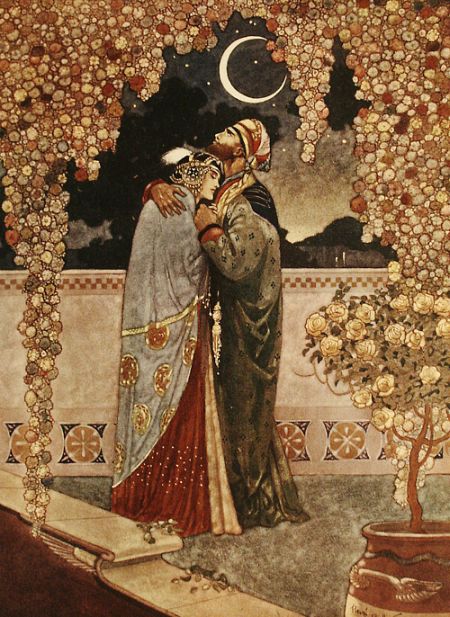
Moon of My Delight (René Bull)
Background:

“Moon of my Delight” is the Poet’s Beloved, she being constant, unlike the Moon of Heaven, which waxes and wanes as the month goes by. The meaning of the last two lines is that there will come a time when the Moon of Heaven looks down upon the Poet’s Garden, but will no longer find him there, because he will be dead. Incidentally, it is an easily missed fact that the rising Moon in this verse, at the end of the poem, pairs with the rising Sun in verse 1 at the beginning, the whole poem thus effectively following the course of Omar’s musings through a symbolic day, from Sunrise to Moonrise. Did FitzGerald intend this from the beginning, or did he only notice it later? It is a fact that FitzGerald only pointed out the Sunrise to Moonrise progression in a letter written to his publisher Bernard Quaritch in 1872, fully thirteen years after the appearance of the first edition. Talking of Omar, he wrote:

“He begins with Dawn pretty sober and contemplative: then as he thinks and drinks, grows savage, blasphemous, etc, and then again sobers down into melancholy at nightfall.”

Well isn't that a coincedence? We started with 'dawn' and with this last verse of this month we will end with the rise of the moon. The circle of life closed again. A month of joy closed ...

dawn
until down
moonrise

© Chèvrefeuille (experimental haiku)

This episode is open for your submissions tonight at 7:00 PM (CET) and will remain open until December 6th at noon (CET). I will try to publish our new episode, the first of a new month, later on. For now ... have fun! And thank you for participating in this wonderful CDHK month about Omar Khayyam's "The Rubaiyat".


Tuesday, November 28, 2017

Carpe Diem #1315 Scheme of Things


Dear Haijin, visitors and travelers,

I will take a few days of, but of course I will not leave you without your daily dose of CDHK. I have created the last few episodes of this month and the first of December already and scheduled them for the right time of publishing. I have a very busy week to come and I just had to make a choice to were my priority is. This week that's at my work, so ...
Yesterday I gave you a short episode and the upcoming episodes will be short too. Only the quatrains and my own thoughts about them.

So here is our new episode titled "Scheme of Things":

Ah Love ! could thou and I with Fate conspire
To grasp this sorry Scheme of Things entire,
Would not we shatter it to bits - and then
Re-mould it nearer to the Heart's Desire !

© Omar Khayyam (Tr. FitzGerald)

A wonderful expression of how most of us feel!

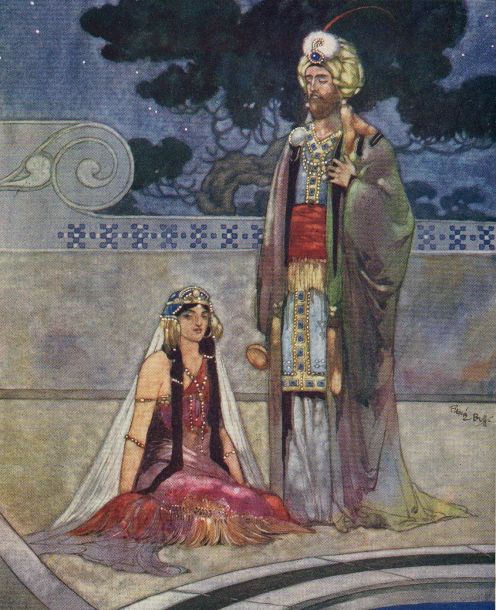
Heart's Desire (René Bull)
desire
your heart beats
with mine


© Chèvrefeuille (experimental haiku)

This episode is NOW OPEN for your submissions and will remain open until December 5th at noon (CET). I will publish (scheduled) our next episode later on. Have fun!