Showing posts with label Carpe Diem Little Creatures. Show all posts

Saturday, April 25, 2015

Carpe Diem Little Creatures #21, Chiyo-ni's "spider's thread"


Dear Haijin, visitors and travelers,

It's my pleasure to bring you a new episode of our Little Creatures feature in which I share haiku written by classical and non-classical haiku poets in which the little creatures of nature e.g ants, daisies, wren and as in today's episode, spiders are the theme of her haiku.

For this episode I have chosen a haiku written by Chiyo-ni (1703-1775). Maybe you know her. In my opinion she belongs to that group of greatest haiku poets ever, because she has written wonderful haiku ... she stood not only in nature, but was part of nature and that makes her haiku so strong in their images.

In her day it was said that Chiyo-ni's style was true to Basho's. Although Chiyo-ni acquired her own unique voice, eventually, she was surely influenced in her early period by the prevalence of Basho's teachings in the Kaga region.

Basho's style of haiku was formulated by others over the years. His well-known fundamentals usually include: sabi (detached loneliness), wabi (poverty of spirit), hosomi (slenderness, sparseness), shiori (tenderness), sokkyo (spontaneity), makoto (sincerity), fuga (elegance), karumi (simplicity), kyakkan byosha (objectivity), and shiZen to hitotsu ni naru (oneness with nature).
 

Chiyo-ni (1703-1775)

"Oneness with nature" seems especially resonant in Chiyo-ni's haiku. Basho's theory of oneness with nature was that the poet should make a faithful or honest sketch of nature. In the Sanzohi (1702), Basho's disciple, Doho, explains his teacher's theory: "Learn about the pine from the pine and the bamboo from the bamboo--the poet should detach his mind from self . . . and enter into the object . . . so the poem forms itself when poet and object become one." This experience is analogous to the Buddhist idea of satori, or enlightenment, what Kenneth Yasuda called the "haiku moment." When writing haiku, Chiyo-ni immersed herself in nature, honestly observing what she saw, as in the following
a single spider's thread
ties the duckweed
to the shore

© Chiyo-ni
Purity and clarity . . . are central to Chiyo-ni's poetry. The haiku poet, Shoin, who wrote the preface to Chiyo-ni Kushu, stated:

"Chiyo-ni's style is pure, like white jade, without ornament, without carving, natural. Both her life and writing style are clear/pure. She lives simply, as if with a stone for a pillow, and spring water to brush her teeth. She is like a small pine, embodying a female style that is subtle, fresh, and beautiful. Chiyo-ni knows the Way, is in harmony with Nature. One can better know the universe, through each thing in the Phenomena, as in Chiyo-ni's haiku, than through her books."


Her clear writing style went hand in hand with her Buddhist practice. In her haiku, water can be a symbol for clear perception. She saw the world clearly and expressed her words clearly, using the image of water, of her most frequently used images, to reflect nature.
The goal of this CD feature Little Creatures is to compose/write a haiku inspired on the given haiku following the classical rules (as you can find in Chapter 10 of Haiku Writing Techniques, above in the menu). This episode is NOW OPEN for your submissions and will remain open until Saturday May 2nd at noon (CET).

For now .... have fun, be inspired and share your haiku with us all.

Saturday, April 11, 2015

Carpe Diem Little Creatures #20, "Wren"


Dear Haijin, visitors and travelers,

It's a while ago that I published a Carpe Diem Little Creatures episode, but this Saturday I have a new CD Little Creatures episode for you with an all new logo. This week I have chosen to bring a little bird under your attention. In Dutch we call this little bird "Winterkoninkje", in English this little fellow is called "Wren" and the scientific name is Troglodytes troglodytes.
Not so long ago I spotted a Wren in my frontyard. It was searching for food and it came very close to me, but (it's a shame) I hadn't my photo-camera at hand, so the photo which I will share here isn't made by me.

Credits: Wren (Troglodytes troglodytes)
The Wren is very common in The Netherlands, but its only seen in winter, that's why we call this little fellow "Winterkoninkje" in my country.

The Eurasian wren (Troglodytes troglodytes), is a very small bird, and the only member of the wren family Troglodytidae found in Eurasia and Africa (Maghreb). In Anglophone Europe, it is commonly known simply as the wren. It was once lumped with Troglodytes hiemalis of eastern North America and Troglodytes pacificus of western North America as the winter wren. The Eurasian wren occurs in Europe, a belt of Asia from northern Iran and Afghanistan across to Japan. It is migratory in the only northern parts of its range. (Source: Wikipedia)

As it occurs Wren is a classical kigo for winter and so there had to be haiku about Wren. So I 'dived into' the WWW to search for haiku on Wren (or misosazai) and I found a gorgeous "free-style" haiku written by Santoka Taneda, our featured haiku poet of March.

hissori kuraseba misosazai

I live
withdrawn and
a wren


© Santoka Taneda (1882-1940)

And I found a wonderful haiku on Wren at THE Issa website Haikuguy:
misosazai kugatsu misoka mo gatten ka

hey wren!
do you realize it's Ninth Month
30th day?


This undated haiku seems to be a revision of this one that Issa wrote in 1813:

misosazai kono tsugomori wo gatten ka

hey wren!
do you realize
it's the 30th?


In the old Japanese calendar, the 30th day of Ninth Month was the last day of autumn. Since the wren is a winter bird, Issa is either saying: "You're a day early!" or: "Get ready; your season starts tomorrow!" Issa implies here that the Wren doesn't need a calendar.

Credits: Wren © John Bridges

I have also sought for haiku on Wren written by Basho, but I couldn't find any. What I found was a haiku written on Wren by Izen, one of the disciples/students of Basho. Izen wrote this haiku in Basho's last days.

light of foot indeed
in its flight through bamboo groves,
a wren passing by
.   

©  Izen (1646-1711)

It's really a wonderful little bird and it even has a deeper spiritual meaning especially the Celtic meaning, because the Celts are much alike haiku poets, they are one with nature.

Celtic meanings of this little bird begin with observations in raising their young. Both male and female wrens take part in caring for their young. This is symbolic of sharing tasks within the home. It's also a reminder to not getting stuck in gender roles, and approach the "traditional" from a fresh, innovative angle.
The wren is an active little bird, and so its symbolic Celtic meanings include activity, vibrancy, alertness and efficiency. The wren is rarely seen resting on her laurels. The Celts honored that fastidiousness, and took the lesson of making progress each day to heart in their own lives.
Further, the wren is quite sociable. She reminds us to keep a happy heart and be kind to others.

Symbolic Celtic Meanings for the Wren

Friendliness; Sharing; Determined; Quick-Witted; Active; Agile; Creativity; Light-Hearted; Free-Spirited.

This light, bright cheer carries over into the delightful song of the wren. Bards were particularly inspired by this songbird's lyrics, and the wren wins high status as a symbol of musical poetry, art and song. (listen to the wonderful fragile song of the Wren)


Like many songbirds, the wren is a champion at migration and movement. She's content to flit from place to place with shallow roots. This is symbolic of the old adage "home is where the heart is."
In this respect, the wren reminds us it is not the material items we gain, but the quality of relationships made along the way that enrich our lives.
We can also interpret the wren's flighty ways as a message to branch out, expand our circle of contacts, and step out of our habitual rounds in life.
The wren may be tiny, but she packs a powerful symbolic message, encouraging us to go beyond the realm of the "known" and to access the adventure that waits for us!

Well ... we have learned a lot about this wonderful little bird and I think it will inspire you to write an all new haiku. Of course I had to compose my own 'Wren"-haiku and so I wrote the following haiku:

without anxiety
Wren looks for food in the garden
a sacred moment


© Chèvrefeuille

What a joyful episode of Little Creatures this was and now it's up to you to write a haiku on Wren.

This episode is NOW OPEN for your submissions and will remain open until next Saturday April 18th at noon (CET).


Saturday, March 7, 2015

Carpe Diem Little Creatures #19, "Violets"


Dear Haijin, visitors and travelers,

It's Saturday again and this week we have a new episode of our bi-weekly "Little Creatures" feature in which the goal is to write a classical haiku (following the rules as mentioned in Lecture 1) and share it with us all.
In this special feature I share haiku about "little creatures" (insects, birds, flowers etc.) composed by classical or non-classical haiku-poets, known and unknown. And this week I have chosen for a haiku composed by my haiku-master Basho.

yamaji kite naniyara yukashi sumire-gusa

coming along the mountain path,
there is something touching
about these violets

© Basho (Tr. R.H.Blyth)

Naniyara expresses Basho's unwillingness to notice the violet, to make a verse on it. Somehow or other it compels him to notice it, importuning him like a weeping infant;

"a violet by a mossy stone half hidden from the eye"

This flower and the heart of Basho's have some deep affinity. It's even said that Basho wrote this while on one of his journeys encountering a beautiful man. As you maybe know Basho was interested in the homosexual love. The truth will be staying in the middle ....

Buson also wrote about violets, but his observation was more objective and not subjective as is the one by Basho.

suwaritaru fune wo agareba sumire kana

getting off the boat
that had grounded, -
the violets!

© Buson (Tr. R.H. Blyth)

Violets
Basho's verse is extended and "explained" by Gyodai:

sumire tsumeba chiisaki haru no kokoro kana

picking a violet, -
the slender
heart of spring!

© Gyodai

And here is another beauty written by Naojo:

tsumu mo ashi tsumanu mo ashiki sumire kana

to pluck it is a pity,
to leave it is a pity,
Ah, this violet!

© Naojo

For closure, when  the violet is held in the hand, it seems alsmost an extension of one's own body, giving a feeling of intimacy beyond the power of the eye. Koshu describes this in his haiku:

te ni toreba nao utsukushiki sumire kana

the violet:
held in the hand,
yet more lovely

© Koshu

This last verse (by Koshu) could have been written by Basho as one would follow the explanation that Basho was interested in the love between man ...

Violets
All wonderful haiku I think and that little flower, the violet, is so fragile and beautiful, it's a haiku by itself. Here is my attempt to write/compose an all new haiku in the classical way:

fragile and a beauty,
the purple leaves like velvet,
cherished in the rain


© Chèvrefeuille

The above version is in my opinion very artificial, but I ask you to write a classic haiku so I have to do that myself too. However my first version of this above haiku is more beautiful (as I may say so). It's not in the classical way, more like the "free style" of Santoka Taneda (1882-1940) so if you don't mind I love to share that (first) version also here:

fragile beauty,
these purple leaves like velvet,
cherished in the rain

© Chèvrefeuille

By the way ... I think you have noticed it. In these two haiku by myself I have used punctuation and that's new for my haiku ... I never use punctuation, because without punctuation the reader, you, can decide the tone by yourself. With punctuation I take your freedom of mind away ... and that's certainly not my way of being a haiku poet.

This episode is open for your submissions today at noon (CET) and it will remain open until next Saturday March 14th at noon (CET). Have fun!

Saturday, February 21, 2015

Carpe Diem Little Creatures #18, Issa's "rice blossoms"


Dear Haijin, visitors and travelers,

It's Saturday again and it's time for our bi-weekly feature "little creatures". As you all know (maybe) Kobayashi Issa (1763-1827) is THE haiku-master of the little creatures. Issa wrote a lot of haiku about the little creatures like bees, bugs, fireflies and, as we will see in this episode, about dragonflies.

As I was preparing this episode I visited the Haikuguy website were you can find every haiku known and unknown written/composed by Kobayashi Issa. This visit I especially looked at dragonfly haiku. Why? I don't know ... just because I like Issa's dragonfly haiku I think. I think the "dragonfly"-haiku which I have chosen for this episode is one of his most beautiful haiku on dragonflies.

Credits: Rice Blossoms
tombô mo ogamu te tsuki ya ine no hana

the dragonfly too
folds hands in prayer...
rice blossoms


(c) Kobayashi Issa
The "too" (mo) implies that a farmer, perhaps Issa, is the other person in the scene offering a prayer of thanksgiving for the good rice crop, that now has gone to blossom and is ready for harvest. The dragonfly joins in. Issa's poem deserves to be read at face value: this dragonfly really is praying, not just seeming to pray. The fact that its "hands" are rubbing together is, of course, coincidental. But this prayer-like gesture captures Issa's attention and leads him to conclude that the little dragonfly sitting in stillness, perhaps on the blooming tip of a rice plant, is, in fact, praying. If the key prayer in Pure Land Buddhism is one of gratitude for Amida Buddha's saving grace--an experience of trusting in the Other Power of the Beyond while letting go of selfish calculations--then the dragonfly, non-calculating, surrendering to the wind, fully attuned to the present moment...is the purest embodiment of prayer. (Source: Haikuguy.com)
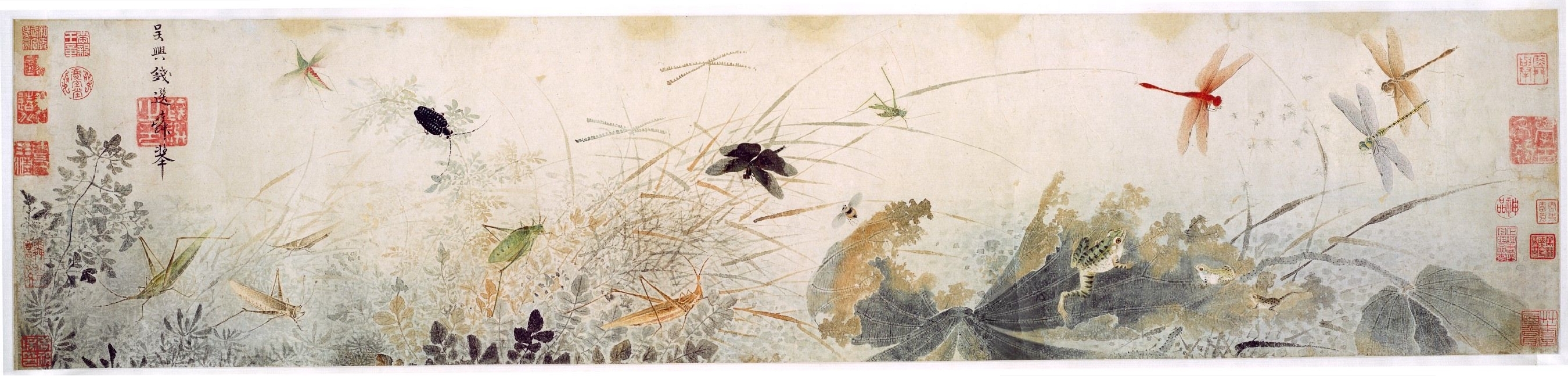
Credits: Qian Xuan - Early Autumn
Wow! What a great woodblock print in which we can see lots of little creatures and ofcourse dragonflies (at the right side of the image) ... I think this image fits this Little Creatures feature very well, maybe I am going to use it to create a new logo for our Little Creatures feature, but that's more a thought.

As you all know the goal of this Little Creatures feature is to write/compose an all new haiku inspired on this post and following the classical rules (as you can find in our CD Lecture 1) ... not an easy task I think ... but worth a try.

cherry blossoms bloom
first bees come to gather honey -
cherries in autumn

(c) Chèvrefeuille

What a joyful haiku this is, it has caught the the essence of the task of the bees ... I like this one ... how pretentious (smiles) ... As you all know I am not such a fan of the 5-7-5 syllables structure, but I have succeeded in this one ... and it was a struggle. I love to share a second version of this haiku, but than in (as I call it kanshicho-style):

cherry blossoms
bees gather honey
cherries in fall


(c) Chèvrefeuille

Which one do you like? Without influencing your ideas ... I like that 2nd version the most, because it's more my way of writing haiku.
Credits: Bee on Cherry Blossom
Well ... it's now up to you my dear Haijin to write an all new haiku inspired on this Little Creatures episode. Have fun, be inspired and share.

This episode is open for your submissions today at noon (CET) and it will remain open until next Saturday February 28th at noon (CET).


Saturday, February 7, 2015

Carpe Diem Little Creatures #17, Ippyo's "all the Chrysanthemums"


Dear Haijin, visitors and travelers,

Another week has gone and it's time again for our bi-weekly "Little Creatures" feature in which I challenge you all to watch at the small little things of nature. This week's theme is however not about a small little thing, but it's about Chrysanthemums (a real kigo for autumn and even for winter) and Chrysanthemums aren't really little flowers.

As I was preapring this new episode of "Little Creatures" I ran into a nice article published in a magazine named "Early Modern Japan" Fall 2003. This article is titled "The Evening Banter of Two Tanu-ki: Reading the Tobi Hiyoro Sequence" and written by Scot Hislop. In this article the author is looking closer to a han-kasen performed by Issa and Ippyo. In one of the links of this han-kasen Ippyo writes/composes the "haiku" which will be our leading verse for this episode of "Little Creatures", but let me first tell you a little bit more about this Tobi Hyoro Sequence.


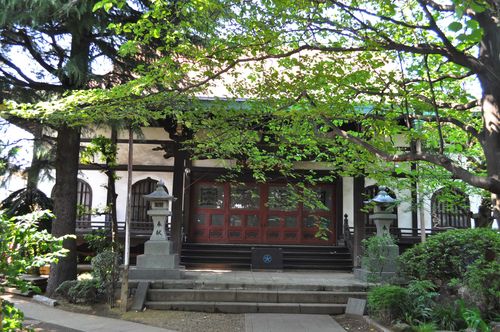
Credits: Hongyoji Temple Nippori

The Tobi Hiyoro Sequence.

The Tobi hiyoro sequence was composed by Issa and Ippyō and was included in Nishi kasen, a
text compiled by Ippyō. There are slightly variant texts but I have followed the version presented in Maruyama Kazuhiko’s Issa to sono Shūhen. The date on which Issa and Ippyō started to compose this text is, according to Ippyō’s preface and Issa’s diary, the seventh day of the tenth month of Bunka 12 (1815). The prefatory notes to the text in Issa zenshū state that even though it is only a han-kasen (a han-kasen sequence consists of 18 links. It follows the format of the first half of a kasen sequence), the distinctive features of Issa’s style of composition show through clearly in it. It is also important to pay attention to how close Issa’s style is to Ippyō’s. Here is the "preface" of this han-kasen
Preface

去年(こぞ)の冬、わが物見塚(もの みづか)に旅寝せし信濃の一茶が、たぬ きの夜話といふは
Last winter, Issa from the province of Shinano came to pass the night at my “Monomi-zuka.” The following is the evening banter of tanuki...

(Ippyō was the priest of Hongyōji, a temple located near Nippori in Edo. There are now several kuhi (rocks upon which hokku/haiku have been inscribed) with Issa’s hokku on them within the precincts. “Monomi-zuka” refers to the remains of a watchtower that was built by Ōta Dōkan, a famous 15th century poet, castle builder, and general.)


The "haiku" which is our lead this episode was the 13th link of this Tobi Hyoro Sequence and was written by Ippyo. Here I will share that link from the Tobi Hyoro Sequence:

泰平(たいへい)と天下の菊が咲 (さき)たちて 一瓢

all the chrysanthemums
under heaven have peacefully
begun to bloom
(c) Ippyō (1815)

It's surely an idea to read this article your self and if you want to read it, please let me know than I can email it to you. (Or you can find this article to which I am referring here at: https://kb.osu.edu )

Ok ... back to our "Little Creatures" episode ... as you all know the goal of this feature is to write an all new haiku based on this post following the classical rules which you can find in Carpe Diem's Lecture 1 (in the menu above) and as you all (maybe) know, that's not my "cup of tea" to follow those classical rules, but for these Little Creatures episodes I just have to do that myself too.


Here is my attempt to write an all new (classical) haiku inspired on this post. I tried to bridge the gap with our Impressionism-month and especially with Vincent van Gogh.

such a bad feeling
he needs to beat insanity -
white Chrysanthemum


(C) Chèvrefeuille

Well ... I hope you all did like this "Little Creatures" episode and I hope that it will (and can) inspire you to write/compose an all new haiku in the classical way ... have fun! This "Little Creatures" episode is open for your submissions today at noon (CET) and will remain open until next Saturday February 14th at noon (CET).

Friday, January 23, 2015

Carpe Diem's "Little Creatures" #16, Daisies


!! This is the CD Little Creatures episode of Saturday January 24th !!

Dear Haijin, visitors and travelers,

It my pleasure to present a new episode of our "Little Creatures" feature inwhich the little creatures of nature are playing the leading role. This time I have chosen for a beautiful little flower, the Daisy. And I love to tell you all a little bit more about this nice sweet little flower. There is so much to tell about Daisies so let's go:
If you’re thinking about white daisies, there’s more to daisies than that.  They can also be bright and sunny yellow, purple, pink, red, and orange. Daisies look like cartwheels with petals as spokes.  In other ways, it also looks like a star that’s shining brightly.Even if daisies are a very common name for this flower, it’s also known in many other names.  Names like ox eye, horse gowan, moon penny, poverty weed and dog blow all pertain to the daisy.
Daisies are not poisonous.  In fact, a lot of people add daisy leaves to their bowl of fresh garden salad.


Daisies
Victorian Interpretation:  Daisies have many different meanings attached to them.  In the Victorian age, it meant innocence, purity, and loyal love.  It also means that you’ll keep someone’s secret.  You’re saying that “I vow never to tell anyone” - when you give someone a daisy.
Superstitions:  Based on Scottish lore, daisies were referred to as gools.  For every farmer who owns a wheat field, they have an employee called the gool rider.  They had the task of removing the daisies from the fields.  For these farmers, if a big crop of daisies was found in your field, you had to pay a fine in the form of a castrated ram.
For the Celts, daisies were thought to be the spirits of children who died when they were born.  It’s God’s way of cheering them up when He created the daisies and sprinkled them on the earth.  This has a big connection to daisies symbolizing innocence.
What's the meaning of Daisies: 
Daisies are flowers that mean different things to different people.  It can mean cheerfulness particularly for the yellow colored blossoms and it can mean youthful beauty and gentleness.  Some people look at the daisy to be a symbol of good luck.  However, the most popular meanings attached to the daisy are - loyal love, innocence and purity.  It’s also a taken to convey the message – “I’ll never tell”.Apart from the Celtic legend that daisies were the spirits of children, the symbol of innocence also comes from the story about a dryad who oversaw meadows, forests and pastures.  One of the nymphs, Belides danced around with her nymph sister when the god of the orchards, Vertumnus saw her.  To make sure that she escapes his attentions, she turned herself into a daisy thus preserving her innocence.In terms of loyal love, daisies are used by women particularly in the Victorian age to see which suitor loves them the most.  By picking on the flower’s petals, a woman would know who loves her and who does not.
Daisies
I found a few wonderful haiku on Daisies:

sitting silent still
low to earth, resting old bones
the daisies still grow.


© Caroline Brown
Or what do you think of this one:

A misty light fog
hiding spring daisies in bloom
lifts with dawns sunrise


© Travis Morgan

And I found another nicely written haiku with Daisies as theme:

poppies and Daisies
among the swaying wheat sheaves
a field mouse nibbles


All wonderful haiku inspired on Daisies. Here are a few I wrote myself:

around the mansion
daisies standing strong together
after the storm

miracles happen
in the tiniest things
daisies blooming


thousand daisies
around the farmer's house -
lowing of a cow
© Chèvrefeuille


The goal of this Little Creatures feature is to write an all new haiku inspired on the theme. The haiku can be classical or non-classical that's up to you. For this episode I have an extra rule ... you have to write a eight (\8) stanza renga with a twist. What does that mean "with a twist" you have to follow the following "line-structure" 3 lines 2 lines 3 lines 2 lines 2 lines 3 lines 2 lines 3 lines, but of course this is not an obligation. Feel free and inspired.

This "Little Creatures" episode is open for your submissions Saturday January 24th at noon (CET) and will remain open until January 31st at noon (CET).


Friday, January 9, 2015

Carpe Diem "Little Creatures" #15, Buson's "Mud-Snails


Dear Haijin, visitors and travelers,

I owe you all a new episode of our bi-weekly special "Little Creatures". So here it is ... I hadn't time to create and publish it last Thursday, so my apologies ...

As you all maybe can remember this special feature is meant to "learn" you all to watch at the little things of nature. Issa for example was a haiku -poet who looked very close to his surroundings and he honored all the little creatures, such as flies and bedbugs. Haiky is sometimes called the poetry of the Micro-World and I think that's very true ... as haiku poets we look closely to all creatures around us including the little creatures and today I have a wonderful haiku written by Buson (1716-1784), one of the big-five haiku poets, about "mud-snails". I will first give you the haiku and than I will try to tell something more about that haiku.

hiroinokosu tanishi ni tsuki no yûbe kana

mud-snails:
a few remain uncaught
under the evening moon

© Yosa Buson

And here is one by Matsuo Basho which he wrote at the age of 39:

sode yogosuran tanishi no ama no hima o nami


with dirty sleeves
farmers-turned-fishermen pick up mud snails
ever so busy


© Matsuo Basho (at the age of 39)

Tanishi (or mud-snail)
"Tanishi" are edible snails, supposed to be a cure for beri-beri.The poet has been collecting, in rather a desultory way, these snails in the rice-fields. It begins to grow dark. The spring moon rises, and from the rice-field come the voices of a few mud-snails that have been left behind. There is something ironical, that is, something both pathetic and comical in the sound.
In actual fact, these snails do not, of course, make any sound at all. Some other creatures' squeaking or crying is still mistaken, by ordinary Japanese, for the sound of the tanishi. This, however, in no way affects the value, the poetry of the verse, which is not in the region of science any more than of humanitarianism.

I found a few other haiku about mud-snails the first one is by Jûjô and the second haiku is by Gomei. I just love to share them here also.

nuritate no aze wo yurideru tanishi kana

the mud-snail
in the newly-made rice-field bank,
joggles its way out

© Jûjô

nisanjaku hôte tanishi no higurekeri

the mud-snail
crawls two or three feet, -
and the day is over

© Gomei

Gorgeous haiku written about mud-snails, a nice little creature, and they (the above mentioned haiku-poets) had an eye for them. They saw the little creatures, the mud-snails, as part of their surroundings.

slowly, but slowly
the mud-snail finds its way
after the heavy rains

© Chèvrefeuille

Snails in the moonlight (Couldn't retrieve the owner)

Ah ... I love those little creatures and I think this haiku is very nicely built .... Here is another one, a cascading haiku-series which I wrote last year for Haiku Horizons.

watching a snail
in the light of the full moon
just a silver trail

just a silver trail
points me to the right place
mountain monastery

mountain monastery
finally becoming one
I bow to my master

I bow to my master
Matsuo Basho told me the way
to watch a snail

© Chèvrefeuille

A nice post it has become I think. I hope you did love the read and that the "mud-snails" will inspire you to write also haiku (or tanka) about snails. You don't need to follow the classical rules, but try to follow the following rule: short line, long line, short line ... and maybe you can bring in a juxtaposition (as we have learned last wednesday) in your haiku (or tanka).

!! More on Tanishi !!

This episode of Carpe Diem's "Little Creatures" is NOW OPEN for your submissions and will remain open until next Thursday January 15th at noon (CET). For now .... have fun! Let your muse inspire you ...!


Thursday, December 11, 2014

Carpe Diem "Little Creatures" #14, Basho's " spring rain "


Dear Haijin, visitors and travelers,

It's time for a new episode of our bi-weekly feature "Little Creatures". This week I love to challenge you all to write an all new haiku in the classical way (5-7-5; cutting-word; seasonword; deeper meaning; inter-changeable first and third line) inspired on a haiku written by Matsuo Basho about a Hornet's nest (or Wasps' nest). A Hornet or Wasp are "little creatures" not always nice to us, but they are beautiful creatures.

Here is the haiku by Basho which is your source of inspiration for this episode:

suzumebachino su kara yane doro darake no mizutamari wo kaishi te haru no ame wo shizuku

s
pring rain,
leaking through the roof,
dripping from the wasps' nest.


© Matsuo Basho (1644-1694)

Credits: (Partial) woodblock print Wasps

It's not a wellknown haiku by Basho and I am not that fond on this haiku by Basho. To me it looks somewhat amateuristic, but maybe that's to blame the translator of this haiku. I have tried to translate it myself, but I couldn't really find a smoother way for this haiku, but I love to share (of course) my translation:

from the hornet's nest
drips the spring rain
through the leaking roof


© Chèvrefeuille

Maybe not the best translation too, but it reads (in my opinion) somewhat smoother, but that's just my idea/feeling. And I have written another version in which I have tried to catch the same feeling but with a twist:

from the old Hornet's nest
drips the spring rain through the leaking roof -
sound of a tap-dancer

© Chèvrefeuille

By the way it wasn't easy to write this new haiku because of the rules I gave I too had to use the 5-7-5 syllables count. To help me get the right syllables count I have used a syllables-counter on the Internet. The English syllables rules are very different with the ones we use here in Dutch.

Well ... I hope you all did like this "Little Creatures" episode and I hope it will inspire you to write/compose an all new haiku following the classical rules as mentioned above.
This episode of "Little Creatures" is open for your submissions at noon (CET) and will remain open until next Thursday at noon (CET).

Thursday, November 27, 2014

Carpe Diem "Little Creatures" #13, "The Whirligig "


Dear Haijin, visitors and travelers,

As you know I have change some things at our Haiku Kai. One of those changes is the bi-weekly special feature in which "Little Creatures" and "Sparkling Stars" will appear in turns. So this week it's an episode of Little Creatures. And I have found a nice haiku written by Tan Taigi (1709 -1771).He became famous through Masaoka Shiki, who took up his haiku. Taigi was a haiku poet who lived in the mid Edo-period. At the age of 40 he became a priest at the temple Daitoku-Ji  in Kyoto. Later in his life, he stayed in a hermitage called Fuya-An (Hermitage with no night) in the precincts of the courtesan pleasure quarters Shimabara  in 1748 and lived as a friend of Yosa Buson. He liked to socialize and drink sake and used to say

 “When praying to Buddha I write haiku,  when praying to the Shinto gods I write haiku”.
Because of his heavy drinking he suffered a brain hemorrhage and died in the Year Meiwa 8. He is burried at the temple Korin-ji in Kyoto.

shizumareba nagaruru ashi ya mizusumashi

the whirligig;
when it stops skating,
the legs float away


© Taigi


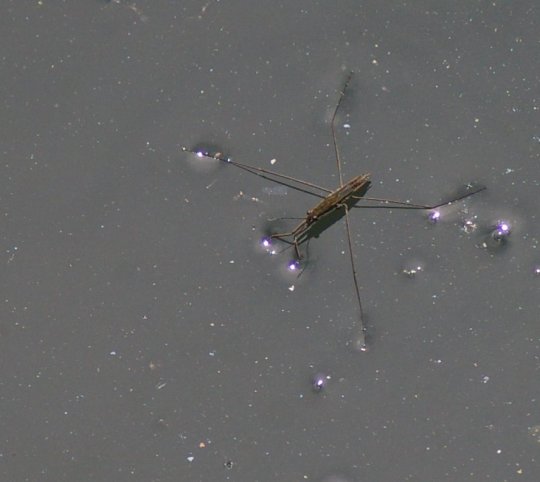
Credits: Whirligig or pond-skater

The amembo, the pond-skater, seen skating in summer, has a long slender body, long legs, and wings at certain times. When for a moment it ceases its perpetual gyrating and figure-skating, the current pulls his legs along and the whole posture of the insect becomes assymmetrical. This is all there is in this haiku, but we feel in and through it just as much of the power of nature, law, inevitability, as in the rising of the sun or the procession of the seasons.

It's a very nice and fragile insect this Whirligig (pond-skater) we see it very often here in The Netherlands and it's a sign that the waters (ponds, rivers and so on) are clean, because to skate upon water the surface of that water has to have a certain tension. That tension is only seen in very clean water (with a lot of oxygen).

The goal of this "Little Creatures" feature is to look closer to our surroundings and try to write/compose a haiku in the classical way (5-7-5; seasonword; cuttingword; a short moment; in a way a spiritual or deeper layer and the first and third line have to be interchangable). So here is my attempt to write a haiku inspired on this one by Taigi (by the way I am not that familiar with Taigi).

This episode is open for your submissions at noon (CET) and will remain open until next Thursday December 4th at noon (CET). Have fun!

Thursday, November 13, 2014

Carpe Diem "Little Creatures" #12, Snails, a haiga


Dear Haijin, visitors and travelers,

Last week I hadn't enough time to write an episode of our Carpe Diem "Little Creatures", but this week I just can't miss another episode. The last weeks I have thought a lot about Carpe Diem Haiku Kai and about our future ... I think Carpe Diem Haiku Kai has proven that it has a place on the Internet for all those haiku-poets and lovers of haiku out there in the world.
As you all know I have opened up to you all with my concerns about all the extra features, which I love to make by the way, and I have given all your ideas a thought. It finally brought me the following idea to change Carpe Diem Haiku Kai.

I have decided to use the Carpe Diem special features (e.g. Distillation or Imagination) not as an extra post, but as a part of the regular prompts of Carpe Diem Haiku Kai. So this episode of "Little Creatures" will be a "Carpe Diem Imagination" and a "Carpe Diem Haiga Festival".

I love to share a haiga which I have made recently of a haiku which I wrote in 2013:

"granddad come look!"
my grandson beckons me closer
"a homeless snail"

© Chèvrefeuille

There are several haiku written about snails, in our Mount Fuji episode, several days ago, we had for example a haiku by Issa:

little snail
inch by inch, climb
Mount Fuji!


© Kobayashi Issa

Or what do you think of this haiku by myself, in that beloved cascading way. This cascading haiku I wrote in June 2014:

watching a snail
in the light of the full moon
just a silver trail


just a silver trail
points me to the right place
mountain monastery
mountain monastery
finally becoming one
I bow to my master


I bow to my master
Matsuo Basho told me the way
to watch a snail


© Chèvrefeuille


Credits: Snail

Well ... I think it's clear what the goal is of this new episode of "Little Creatures", write/compose an all new haiku about snails and make it into a haiga ... or write a cascading haiku on snails ...
This episode is NOW OPEN for your submissions and will remain open until November 20th at noon (CET). Have fun!

Thursday, October 30, 2014

Carpe Diem "Little Creatures" #11, "A Swallow" by Issa


Dear Haijin, visitors and travelers,

Issa is "the master" of "Little Creatures". He had an eye for those little creatures as we can read in a lot of haiku by him. This week's "Little Creatures" episode is about a wonderful little bird, the Swallow. I have found a nice "swallow"-haiku by Issa in which he also sees the humor of its actions.

daibutsu no hana kara detaru tsubame kana

a swallow
flew out of the nose
of the Great Buddha


© Kobayashi Issa

Credits: The Great Buddha of Kamakura in autumn

This great statue of Buddha will be the one at Nara, or at Kamakura. From the ordinary, relative point of view, we have a contrast between the sacred and the profane in the Swallow's flying out of the nose of the Buddhist image. From the absolute point of view, it is all the same whether the Swallow flies out of from the Holy Nose of Buddha or from the eaves of a public house. But the region of this poem is in neither the relative nor the absolute. It is in life itself, life which is neither law nor destiny but both. If, leaving this meaningless abstract talk, we reconstruct the poetical experience of Issa, we get the same thing, only expressed in more understandable terms. Issa felt the rightness of the Swallow's flying wherever its wings would carry it, yet recognized that the image was more than a mere mass of metal. Above all, he felt there was a significance in this clash between law and freedom, a significance which dries up into words when it is explained.

Credits: Great Buddha of Nara

Another verse by Issa, belonging to the winter season, which also illustrates his fusion of contraries, is the following:

nobotoke no hana no saki kara tsurara kana

from the end of the nose
of the Buddha on the moor,
hang icicles


© Kobayashi Issa

I like the style of Issa's haiku and it's really great to see in his haiku that he was very interested in the direct world around him. Every detail he saw and used in his haiku. I think he is really "the master" of the Little Creatures haiku.

Here is my haiku inspired on this wonderful set of "swallow"-haiku by Issa. I have not chosen for the Swallow, but for the Hummingbird, another wonderful little creature.

futsu no te derootasu no hachimitsu no tame no hachidori ou

hummingbird
chases for honey in the Lotus
in Buddha's hands


© Chèvrefeuille

Credits: Hummingbird on Lotus

Well ... I hope you did like this new episode of Little Creatures and that it inspires you to write all new haiku. Looking forward to all of your beautiful verses. This episode is open for your submissions today at noon (CET) and will remain open until next Thursday November 6th at noon (CET).

Thursday, October 23, 2014

Carpe Diem "Little Creatures" #10, "Yellow Valerian", one of the Seven Autumn Flowers


Dear Haijin, visitors and travelers,

This week's "Little Creatures" episode is about the Yellow Valerian, it's one of the Seven Autumn Flowers (Nanahana no Sekku) according to classical Japanese culture. In Japanese culture there are seven autumn flowers. Those are, next to the Yellow Valerian, bush clover, miscantus, kudzu, large pink, boneset and Chinese bellflower. These flowers are also classical kigo for autumn.

A haiku example on Yellow Valerian by Matsuo Basho:

hyorohyoro to nao tsuyukeshi ya ominaeshi 

a yellow valerian
with its slender stalk stands bedecked
in droplets of dew. 

© Basho

Credits: American Yellow Valerian (Orchid family)
The Yellow Valerian is a 'member' of the Orchid family ... and as you can see above ... it's a wonderful flower.

Another example:

yellow valerian flowers--
rather not bloom
in tough spring


© Chiyo-Ni

Credits: Japanese Yellow Valerian
The Yellow Valerian was once very common as a wild flower in Japan, it's already mentioned in the Manyoshu (9th century), nowadays the Yellow Valerian is decreasing.

Another nice flower is the Marigold. Why do I bring this flower up in this post? Well ... today it's the first day of Diwali, the Hindu Light-festival. During Diwali the Marigold is one of the most seen flowers to decorate homes and streets. Marigold is also known as "thousand leaves flower".


Credits: Marigold

Deepawali or Diwali is a festival of lights symbolizing the victory of righteousness and the lifting of spiritual darkness.  The word “Deepawali” refers to rows of diyas, or clay lamps. This is one of the most popular festivals in the Hindu calendar. It is celebrated on the 15th day of Kartika, according to the Hindu calendar. This festival commemorates Lord Rama's return to his kingdom Ayodhya after completing his 14-year exile. The myths around Rama and Ravana are told during another holiday, known as Dussehra or Vijaya Dashami.
The Goddess Lakshmi was Vishnu’s consort and she symbolizes wealth and prosperity. She is also worshipped on Diwali. This festival is celebrated in West Bengal as "Kali Puja", and Kali, Shiva's consort, is worshipped during Diwali. The Diwali festival in southern India often commemorates the conquering of the Asura Naraka, a king of Assam who imprisoned many people. It is believed that Krishna freed the prisoners.


Credits: Diwali decorations

Diwali celebrations may last for up to five days. Many people decorate their home and workplaces with tiny electric lights or small clay oil lamps. Bowls of water with candles and flowers floating on the surface are also popular decorations.
Many people make a special effort to clean their homes and yards before Diwali. They may also wash themselves with water and fragrant oils, wear new clothes and give gifts of sweets to family members, close friends and business associates. Fireworks are set off in the evening in some areas. Melas (fairs) are held in many towns and villages.

So .... happy Diwali!

thousand orange leaves
counting my blessings every day -
I light a candle

© Chèvrefeuille

I hope you did like this "Little Creatures" episode and I hope it will inspire you to write haiku and share them with us all.
This episode is NOW OPEN for your submissions and will remain open until next Thursday October 30th at noon.