Showing posts with label Chiyo-ni. Show all posts

Saturday, February 15, 2020

Carpe Diem Weekend Meditation #116 Renga With ... waiting for the full moon


!! Open for your submissions next Sunday February 16th at 7:00 PM (CET) !!

Dear Haijin, visitors and travelers,

Welcome at a new Weekend Meditation episode. This weekend I love to challenge you to create a Renga With ... That beautiful feature in which you have the opportunity to create haiku with known and unknown haiku masters.

This weekend I love to challenge you to create a renga with the so called "big five" (Basho, Issa, Buson, Chiyo-Ni and Shiki). And, how immodest, one of my own haiku.

Here are the six haiku to work with:

the autumn wind:
thickets and fields also,
Fuha Barrier

© Basho

a dandelion
now and then interrupting
the butterfly's dream

© Chiyo-Ni


the thunderstorm having cleared up
the evening sun shines on a tree
where a cicada is chirping 

© Shiki

simply trust:
do not also the petals flutter down,
just like that?

© Issa

in nooks and corners
cold remains:
flowers of the plum

© Buson


ancient warriors ghosts
mists over the foreign highlands -
waiting for the full moon

© Chèvrefeuille

Six nice haiku I think. Now it's up to you to create a renga with them by adding your two-lined stanza of approx. 7-7 syllables. You can choose your own "line-up". Enjoy this Renga challenge and have a wonderful weekend.

This weekend meditation is open for your submissions next Sunday, February 16th at 7:00 PM (CET) and will remain open until February 23rd at noon (CET). Enjoy!


Sunday, January 5, 2020

Carpe Diem #1792 New Beginnings ... New Year's Day


Dear Haijin, visitors and travelers,

First ... HAPPY NEW YEAR ... to you all. Let us make this a wonderful year full of love, beauty and inspiration. This month is themed "New Beginnings" and that's what this year will bring us all I hope.

As I told you several days ago my mother has been institutionalized in a nursing home for the elderly people. She has peace with it, but ofcourse it's not easy to cope with this new beginning for her and for me. Time will bring us healing for this ...

The theme for this month is New Beginnings and today we start with ... New Year's Day ... Our classical haiku masters wrote a lot of haiku about New Year's Day ... here are a few examples:

New Year’s Day
dawns clear, and sparrows
tell their tales

© Ransetsu
Japanese Crane

it’s play for the cranes
flying up to the clouds
the year’s first sunrise …

© Chiyo-ni

the first dream of the year —
I keep it a secret
and smile to myself

© Sho-u

New Year’s Day–
everything is in blossom!
I feel about average.

© Issa

Year after year
on the monkey’s face
a monkey’s face


© Basho

Japanese Calendar (Wikipedia)

The old calendar
fills me with gratitude
like a song


© Buson

New Year comes,
and I become poorer
than before


© Shiki (never published and recovered in August 2018)


All wonderful haiku on New Year's Day. In Haiku philosophy we count five seasons and the first season is New Year, it's roughly the period of December 15th and January 15th. So I challenge you to create a classical haiku themed New Year, to celebrate the new year.

Here is mine:

New Year's eve --
through the bare branches
the wind as always

© Chèvrefeuille

This episode is NOW OPEN for your submissions and will remain open until January 12th at noon (CEST). I will try to publish our new episode later on. For now ... have fun!


Saturday, November 9, 2019

Carpe Diem #1777 Classical and non-classical in symbiosis ...


Dear Haijin, visitors and travelers,

First I have to apologize for being late with publishing our regular episode of Friday November 8th, I hadn't time to create an episode.

This episode I love to challenge you with a "Crossroads Task". I will give you two haiku, you have to create a new haiku with those two haiku, a so called "fusion-ku". With your new haiku you have to create a Troiku (more about Troiku above in the menu).

I have chosen a haiku by a non-classical poetess, Jane Reichhold (1937-2016) and a classical poetess, Chiyo-Ni (1703-1775). Here are the two "crossroads" haiku to work with:

cricket silence
between scraping sounds
autumn begins

© Jane Reichhold

it touches the line
of my fishing pole -
this summer moon


© Chiyo-Ni

And now it's up to you to create your "fusion-ku" and your Troiku and share it with us all.

This episode is NOW OPEN for your submissions and will remain open until November 16th at noon (CET). I will publish our new weekend-meditation later today.


Monday, November 4, 2019

Carpe Diem #1775 Morning Glory!


Dear Haijin, visitors and travelers,

Welcome at a new (somewhat belated) episode of our wonderful Kai. This month we will focus mostly on haiku, because haiku was the first theme here at CDHK and the only theme. Its therefore that I have chosen the theme for this month "Never Change A Winning Team". I will challenge you with a great diversity of haiku created by classical and non-classical haiku poets and I hope to challenge you today with a new feature.


I have titled this new feature "Carpe Diem's Transformation" and the goal is to transform a given haiku into a tanka. You have to use the scenes and images in the given haiku to create a transformed haiku into a tanka.

The first haiku I would love to see you transform into a tanka is that renown haiku by Chiyo-Ni about the Morning Glory. Here is that haiku:

asano eikou yoku baketto entanguru watashiha mizuwo motomeru

morning glory!
the well bucket-entangled,
I ask for water

© Chiyo-Ni


And now ... it's up to you to transform this beautiful haiku by this renown female haiku master into a tanka. Have fun!

This episode is NOW OPEN for your submissions and will remain open until November 11th at noon (CET). I will try to publish our new episode, later on. That will be a new Tan Renga Wednesday.


Thursday, June 20, 2019

Carpe Diem #1686 Troiku Month (15) Nightingale


Dear Haijin, visitors and travelers,

Welcome at a new episode of our beautiful Troiku month. This month is running towards its end, but we have still 10 days to go. Tomorrow Summer will start and I hope it will be a wonderful Summer, but I hope it will not be as hot as last year. The Netherlands suffered than from a very hot summer with tropical temperatures. Well we will see.

Today I have a nice haiku by Chiyo-Ni, one of the most famous classical haiku poetesses we know. She is renown by that wonderful haiku about the Morning Glory, but that's not the haiku I have chosen.

The haiku I have chosen to challenge you with is a beauty too and she wrote it in honor of Matsuo Basho, who she saw as her teacher, her master. She wrote this on a haiga with a portrait of Basho and it is a real beauty, but maybe it will not be easy to create a Troiku with.

to listen,
fine not to listen, fine too...
nightingale

© Chiyo-Ni (1703-1775)


Nightingale

This episode is open for your submissions tonight at 7:00 PM (CEST) and will remain open until June 27th at noon (CEST). I will try to publish our new weekend meditation later on. For now ... be inspired and have fun!


Thursday, May 2, 2019

Carpe Diem #1656 Tan Renga Challenge May 2019 (3) Dandelion and Butterfly


Dear Haijin, visitors and travelers,

What a joy to create this month full of TRC's created from modern and classical haiku. Today I have a nice classical, not so renown, haiku by one of the most famous female haiku poets, Chiyo-Ni.
As I discovered haiku back in the late eighties I only read haiku created by male poets, but at the start of this century I discovered that there were also female haiku poets. Chiyo-Ni was one of the first haiku poetesses I discovered I was immediately in love with the beauty of her haiku especially that gorgeous one themed "morning glories", that renown one.

I think I have read the most of her haiku, but the haiku to work with today I wasn't familiar with so I am looking forward to your responses on this haiku.


Butterfly on Dandelion

Here is the first stanza of today's TRC, a haiku by Chiyo-Ni:

a dandelion
now and then interrupting
the butterflys dream

© Chiyo-Ni

Well ... it's now up to you to create a Tan Renga with this one. Have fun!

This episode is open for your submissions tonight at 7:00 PM (CEST) and will remain open until May 9th at noon (CEST). I will try to publish our new weekend meditation later on.


Friday, March 15, 2019

Carpe Diem Weekend Meditation #76 Renga With ... the Big Five


!! Open for your submissions next Sunday March 17th at 7:00 PM (CET) !!

Dear Haijin, visitors and travelers,

Time flies when you have fun they say, but time flies really fast. It's again time for a new weekend meditation and after that first Light Retreat, started today, I have another challenge for you. As you all know in my opinion there were five great haiku poets, or as I call them "The Big Five". Maybe you know which haiku poets I mean with the big five?

Yes ... I knew you all would know it. The "big five" are Basho, Issa, Buson, Shiki and Chiyo-Ni. This weekend I love to challenge you with a new episode of "Renga With ..." This weekend that will be a Renga With ... The Big Five.


I have chosen a two haiku by Basho and of the other four I have chosen one haiku. It's up to you to create a renga with those haiku. You can choose your own "line-up" and I hope you will try to "close" the chain by a ageku (closing verse) that refers back to the hokku (starting verse).

Here are the haiku to work with:

wisteria beans
let's make that a theme for haikai
a flower fruit 

how glorious
young green leaves
flash in the sun

© Basho (Tr. Jane Reichhold)

garden butterfly
as the baby crawls, it flies―
crawls close, flutters on

© Issa

Plum Blossom

in nooks and corners
cold remains:
flowers of the plum

© Yosa Buson (tr. RH Blyth)

the wild geese take flight
low along the railroad tracks
in the moonlit night

© Masaoka Shiki

the flowering branch of the plum
gives its scent
to him who broke it off

© Chiyo-Ni

A wonderful range of haiku by these five haiku poets and you, my dear haijin, can enjoy the opportunity to create a renga with these five great haiku poets by adding your two-lined stanza.

I hope you all will have a wonderful weekend with a lot of inspiration. I am looking forward to your renga with the big five.

This weekend meditation is open for your submissions next Sunday March 17th at 7:00 PM (CET) and will remain open until March 24th at noon (CET). Have a wonderful weekend.


Wednesday, February 6, 2019

Carpe Diem #1601 Tan Renga Challenge Month 2019 (5) the weight of a butterfly


Dear Haijin, visitors and travelers,

Welcome at a new episode of Carpe Diem Haiku Kai. This month it's Tan Renga Challenge month so every theme / prompt is a haiku by a modern or classical haiku poet and the goal is to create a Tan Renga with it by adding your two-lined second stanza of approximately 14 syllables. The second stanza you can create through association on the scene(s) in the given haiku.

Today I have a wonderful, not so well known haiku by female haiku master Chiyo-Ni. I think you all know her at least from her wonderful Morning Glory haiku. That Morning Glory haiku however is not the haiku to work with today.

Here is the haiku to work with:

waterweed
floating away, despite 
the butterfly's weight on it

© Chiyo-Ni (Tr. Ueda)


This episode is NOW OPEN for your submissions and will remain open until February 13th at noon (CET). I will try to publish our new episode later on.


Thursday, November 22, 2018

Carpe Diiem #1551 Dew Of The World (Revise That Haiku ... Hineri)


Dear Haijin, visitors and travelers,

Maybe you remember our special feature "revise that haiku" here at our wonderful Kai. It's a "tricky" feature, because I challenge you to "revise" haiku by renoen classical and nonclassical haiku poets. So ... it's possible that I ask you to "revise" haiku written by one of the "big-five" (Basho, Buson, Chiyo-Ni, Issa and Shiki) and that's exactly what I am going to do this episode.

I will give you two haiku, one by Chiyo-Ni and one by Issa, and the background to "revise", but that's not all what I am asking of you this time (it's a hineri, with a "twist", episode). I also ask you to create a "fusion"-haiku with your two revisions and to create a Troiku with that "fusion"-haiku. A tough challenge I think, but I am sure that you all can do it, because you are all very gifted and talented haiku poets. Are you ready?

Let me give the three parts of this "revise that haiku ... hineri" challenge:

1. Revise the both haiku;
2. Create a "fusion"-haiku with the revised versions;
3. Compose a Troiku with your "fusion"-haiku.

cup-shaped flower (Drymocallis Convallaria)

Here are the haiku including the background. (Taken from: Haiku Volume 3, Summer-Autumn, by R.H. Blyth):

koborete wa tada no mizunari beni no tsuyu

the dew of the rouge flower,
when it is spilled
is simply water

© Chiyo-Ni

The reddish-yellow flower is cup-shaped and hold rain or dew in the same way as the camellia. There is great "virtue" in the expression tada no. If we translate it "only" water, we get the feeling of disillusionment without the insight into the nature of things, into what Carlyle says "the great Fact of existence". The poet, like the great man,

fly as he will, he cannot get out of the awful presence of this Reality. Though all men should forget its truth, and walk in a vain show, he cannot. (Carlyle, Heroes and Hero Worship)

Lotus

hasu no ha ni kono yo no tsuyu wa magarikeri

on the lotus leaf,
the dew of this world
is distorted

© Issa

This expresses Issa's view of life, his world-view. The dew is of its nature perfect, but when it falls on the leaf of the lotus, it loses its spherical beauty and lies there twisted and deformed. This is the fundamental concept, or rather, intuition of Mahayana Buddhism, the original goodness of man, original, not in time, but in essence, in its nature.

Two wonderful haiku ... and I hope that your "revisions" will be as beautiful. I am looking forward to your responses on this tough challenge. If possible, please share not only your Troiku, but also your "fusion"- haiku and your revisions.

This episode is NOW OPEN for your submissions and will remain open until November 29th at noon (CET). I will try to publish our new weekend meditation later on. For now ... good luck! Enjoy this tough challenge!


Sunday, November 18, 2018

Carpe Diem #1547 Renga With ... the big five haiku poets


Dear Haijin, visitors and travelers,

I hope you all will have a wonderful weekend in which you could relax, meditate and contemplate. I had a nice weekend myself and the weather was great. I ran into a gorgeous tree in all its autumn beauty ... and I love toshare that image here with you:

Amber Tree (© Chèvrefeuille)
Look at that beauty ... it's a feast for my eyes and I had never seen it. All those different colors on the same tree wow!

Okay back to today's episode. Today I love to challenge you (again) to create a renga together with the "big five", Basho, Chiyo-Ni, Issa, Buson and Shiki. Here are the haiku to use in a line-up of your own choice. You have to add your two lined stanza (approx. 7-7 syllables) to make the renga a story about autumn.

it is seen
in the papier-maché cat
the morning of autumn

© Basho

along this road
goes no one
this autumn eve

© Basho

when I go out of the gate
I also am a traveller
in the autumn evening

© Buson

autumn's bright moon
however far I walked, still afar off
in an unknown sky

© Chiyo-Ni

two houses!
two houses making rice-cakes:
autumn rain

© Issa

Small Wooden Drum (source unknown)

with the autumn tempest
the small drum
falls from its shelf

© Shiki

A nice series of haiku I would say. Enjoy this challenge and the opportunity to create a renga with the five renown haiku poets.

This episode is NOW OPEN for your submissions and will remain open until November 25th at noon (CET). Have fun!


Wednesday, November 7, 2018

Carpe Diem #1540 chrysanthemums


Dear Haijin, visitors and travelers,

Autumn ... a season full of beauty in the broadest sense of the word. I love the colorful leaves, the bright full moon, but the most I love the Chrysanthemums with all the colors like a rainbow. There are a few haiku on Chrysanthemums I love to share here for your inspiration:

Drinking the morning green tea,
The monk is calm.
The flowers of chrysanthemum.


Bloom quickly.
The ninth day is very soon.
The chrysanthemum.


© Matsuo Basho

how terrifying
her rouged fingers
against the white chrysanthemums

© Chiyo-Ni

Chrysanthemums Rainbow (Image by Jan Tyler/E+/Getty Images)

Before the white chrysanthemum
the scissors hesitate
a moment.

© Yosa Buson

Let's scatter
all the funeral chrysanthemums we have,
in the coffin  


© Soseki

All wonderful haiku by classical masters on Chrysanthemums. I love that image by the way it's really a rainbow of Chrysanthemums. And I think you all will know other beauties, but today I love to challenge you to create your own Chrysanthemums beauty ... have fun!

in the backyard
gazing at the Milky Way -
white chrysanthemums

chrysanthemum tea
a whole new sensation
tickles my senses

© Chèvrefeuille

This episode is NOW OPEN for your submissions and will remain open until November 14th at noon (CET). I will try to publish our new episode later on. Have fun!


Friday, November 2, 2018

Carpe Diem Weekend Meditation #57 Renga With ... six haiku poets


!! Open for your submissions next Sunday November 4th at 7:00 PM (CET) !!

Dear Haijin, visitors and travelers,

Welcome at a new weekend-meditation our feature that gives you the opportunity to meditate and contemplate before you submit your work. Let me give you a small update first. As you all know the hospital where I am working has ran into bankruptcy so I am unemployed at the moment. Of course my colleagues and I are hoping that the hospital will be re-opened and it looks positive at the moment. There are a few investors who would like to take over, but right at the moment it's not clear which one will get "the bone". So I have a few appointments for a new job. One of those interviews I have had yesterday (Thursday November 1st) and I am glad that interview was succesful. I have already my contract for that new job, but I have still a few interviews to do, so I haven't yet signed it. Why didn't I sign? Well ... it's just for a few months. Of course that's better than nothing, but I am looking for a longtime commitment.


For this weekend meditation I have cjosen to challenge you to create a Renga With ... not with one other haiku poet, but with six different haiku poets. So this weekend you can make a renga with the following haiku poets: Basho, Issa, Chiyo-Ni, Buson, Shiki and Jane Reichhold. Of course you may choose your own line-up. Your task is to add the two-lined stanza between the haiku through association on the scene(s) in the haiku.

Here are the six haiku to work with:

all my years
floating in the river
a childish heart


© Jane Reichhold (taken from our tribute e-book "All My Years")

a flash of lightning:
the screech of a night-heron
flying in the darkness


© Basho

the coolness
of the sound of water at night,
falling back into the well


© Issa

autumn's bright moon,
however far I walked, still afar off
in an unknown sky


© Chiyo-Ni

autumn's bright moon

pressing sushi;
after a while,
a feeling of loneliness

© Buson

at the gate of a deserted house,
a cicada is crying in the rays
of the evening sun


© Shiki

What an awesome challenge this is ... creating a renga with all those wonderful and renown haiku poets. I hope you will enjoy this wonderful task. By the way ... try to create a "closed chain" with an ageku that connects with the hokku.

This weekend-meditation is open for your submissions next Sunday November 4th at 7:00 PM (CET) and will remain open until November 11th at noon (CET). Enjoy your weekend.


Monday, October 1, 2018

Carpe Diem #1512 Chiyo-Ni ... THE female haiku master (Renga With ...)


!! Second regular post of today, because of logistical reasons !!

Dear Haijin, visitors and travelers,

Welcome at the third regular episode of this festive anniversary month. This month we are celebrating our 6th anniversary with themes that follow the alphabet. Today we have arrived at the letter C and for this episode I have chosen to tell you a little bit more about Chiyo-Ni (1703-1775) THE female haiku master who followed in the footsteps of Basho. She brought the teachings of Basho back in her haiku.

Here at CDHK we have had several episodes about Chiyo-Ni and her poetry is a joy to read. You all be familiair with that renown haiku about the Morning Glory:

morning glory!
the well bucket-entangled,
I ask for water

© Chiyo-Ni (Tr. Patricia Donegan, taken from "Chiyo-Ni Woman Haiku Master")

Morning Glory (woodblock print)
Chiyo-ni was born in Matto, Kaga Province (now Hakusan, Ishikawa Prefecture), in February 1703, the eldest daughter of a scroll mounter. At an early age, Chiyo-ni was introduced to art and poetry, and she began writing haiku poetry at the age of seven. By the age of seventeen, she had become very popular all over Japan for her poetry.

Her poems, although mostly dealing with nature, work for a unity of nature with humanity. Her own life was that of the haikai poets who made their lives and the world they lived in one with themselves, living a simple and humble life. She was able to make connections by being observant and carefully studying the unique things around her ordinary world and writing them down.

At age twelve, Chiyo-ni's studied under two haiku poets who had themselves apprenticed with the great poet Matsuo Bashō, and many in her time saw her as one of Bashō's true heirs, both in her poetry and in her humble attitude of warm awareness toward the world and her simple living. She studied Basho's style of writing poems in her early years, although she did develop on her own as an independent figure with her own unique voice.

Chiyo-Ni (1703-1775)

She was well aware of being considered Bashō's heir and on a portrait of Bashō she wrote in calligraphy:

to listen, 
fine not to listen, fine too... 
nightingale

She appears to say that while she did listen to him, she also did not copy him, "not to listen, fine too."

In around 1720 she married a servant of the Fukuoka family of Kanazawa, and had one child with him, a son, who died in infancy. Her husband died of disease not long after in 1722. She valued her independence too much, and despite her loneliness, she did not remarry, so she returned home to her parents.

It may be that after her husband's death Chiyo-ni lived with and cared for her elderly parents and worked in the families scroll mounting business. She wrote:

parents older than I 
are now my children 
the same cicadas

After her parents died, she adopted a married couple to carry on the family business and in 1754, at the age of fifty-two (by East Asian age reckoning), Chiyo-ni chose to become a Buddhist nun. "Not", she said, "in order to renounce the world, but as a way 'to teach her heart to be like the clear water which flows night and day." Chiyo-ni shaved her head and started to live in a temple with other nuns and took the Buddhist name Soen. She continued her writing and lived the rest of her simple yet peaceful life in the manner of haikai.

In 1764, she was chosen to prepare the official gift for Maeda Shigemichi, the daimyō of her region, to the Korean Delegation led by civil minister Jo Eom. Chiyo-ni crafted and delivered 21 artworks based on her twenty-one haiku.

Chiyo-ni died in 1775.

The Eternal Grasshopper
"Oneness with nature" seems especially resonant in Chiyo-ni's haiku. Basho's theory of oneness with nature was that the poet should make a faithful or honest sketch of nature. In the Sanzohi (1702), Basho's disciple, Doho, explains his teacher's theory: "Learn about the pine from the pine and the bamboo from the bamboo--the poet should detach his mind from self . . . and enter into the object . . . so the poem forms itself when poet and object become one." This experience is analogous to the Buddhist idea of satori, or enlightenment. When writing haiku, Chiyo-ni immersed herself in nature, honestly observing what she saw, as in the following haiku:

sound of things
dropping from the tree--
autumn wind

a single spider's thread
ties the duckweed
to the shore

Roughly ninety percent of her haiku are about things in nature rather than the social realm. This kind of haiku practice emphasizing seeing things clearly, becoming one with nature, and living the Way of Haikai, co-emerged with her Buddhist practice.

Dandelion (image found on Pinterest)

Here is another beauty, not so renown I think, by Chiyo-Ni:

a dandelion
now and then interrupting
the butterfly's dream

© Chiyo-Ni (Tr. unknown)

A long story maybe, but Chiyo-Ni is worth reading, she is (next to Basho) one of my favorite haiku poets. She has created really wonderful haiku with scenes very close to nature.

In the above "story" you read six (6) haiku written by Chiyo-Ni ... what does that mean? Well ... I challenge you to create a Renga (a minimum of six stanza and a maximum of 12 stanza) together with Chiyo-Ni. Your task is to add the two-lined stanza of approximately 14 syllables to the renga. You can choose your own line-up of the haiku given by me.


This episode is open for your submissions tonight at 10:00 PM (CEST) and will remain open until October 8th at 7:00 PM (CEST). I will post our new episode later on.

Source: Simply Haiku
Source 2: Wikipedia

Thursday, May 10, 2018

Carpe Diem's Quest for a (new) Masterpiece ... introduction

credits logo-image
Dear Haijin, visitors and travelers,

Have you written your masterpiece yet? I hope so, but what is a masterpiece? I think a masterpiece is a haiku (or tanka) that has the power, the strength, to become a classic or an evergreen.

Here at CDHK I have often shared that beautiful masterpiece by Matsuo Basho (1644-1694), that is renown even by people who are not familiair with haiku. You all will already know which haiku I mean, we even created an exclusive CDHK E-book inspired on that renown haiku ...

old pond
a frog jumps
water sound

© Basho (Tr. Chèvrefeuille)

I think you all agree that this is a masterpiece ...


Another masterpiece, in my opinion, is that beauty by Chiyo-Ni about the Morning Glories:

morning glory!
the well bucket-entangled,
I ask for water

© Chiyo-Ni

For sure you will know other masterpieces by classical (and non-classical) haiku (or tanka) poets, but the goal of this new feature isn't the quest for known (renown) masterpieces, but to create masterpieces, it's a real challenge, because you, my dear haijin, visitors and travelers, have to challenge yourself to create your masterpiece.

What makes a haiku (or tanka) a masterpiece? Well ... I will give it a try to tell you what a haiku (or tanka) makes a masterpiece in my opinion.
First: It has to describe a moment that got your attention.
Second: You have to use the right words. Words that describe the moment in its true way.
Third: Maybe ... use the classical way of creating haiku (or tanka) (as mentioned in CDHK Lecture One above in the menu).
Fourth: It has been written right from the heart or soul not the mind.
Fifth: It's (maybe) in the sense and tone of the classical haiku (tanka) poets.
Sixth: It has to be ... how shall I say it ... be your child, your creation ... in a masterpiece we can read, between the lines, the poet who created it.


scent of Honeysuckle
arouses the senses of youngsters
hot summer night

© Chèvrefeuille

Not a masterpiece maybe, but all the above things mentioned are there.

This new feature is a tough one I think, but I also think you all can do it. You are all devoted members of CDHK, but above that you are all devoted haiku (and tanka) poets ... so I think you all can do it ... create your masterpiece and share it with us all.

With this new feature I also hope to talk you over to create a new exclusive CDHK E-book with these masterpieces ...

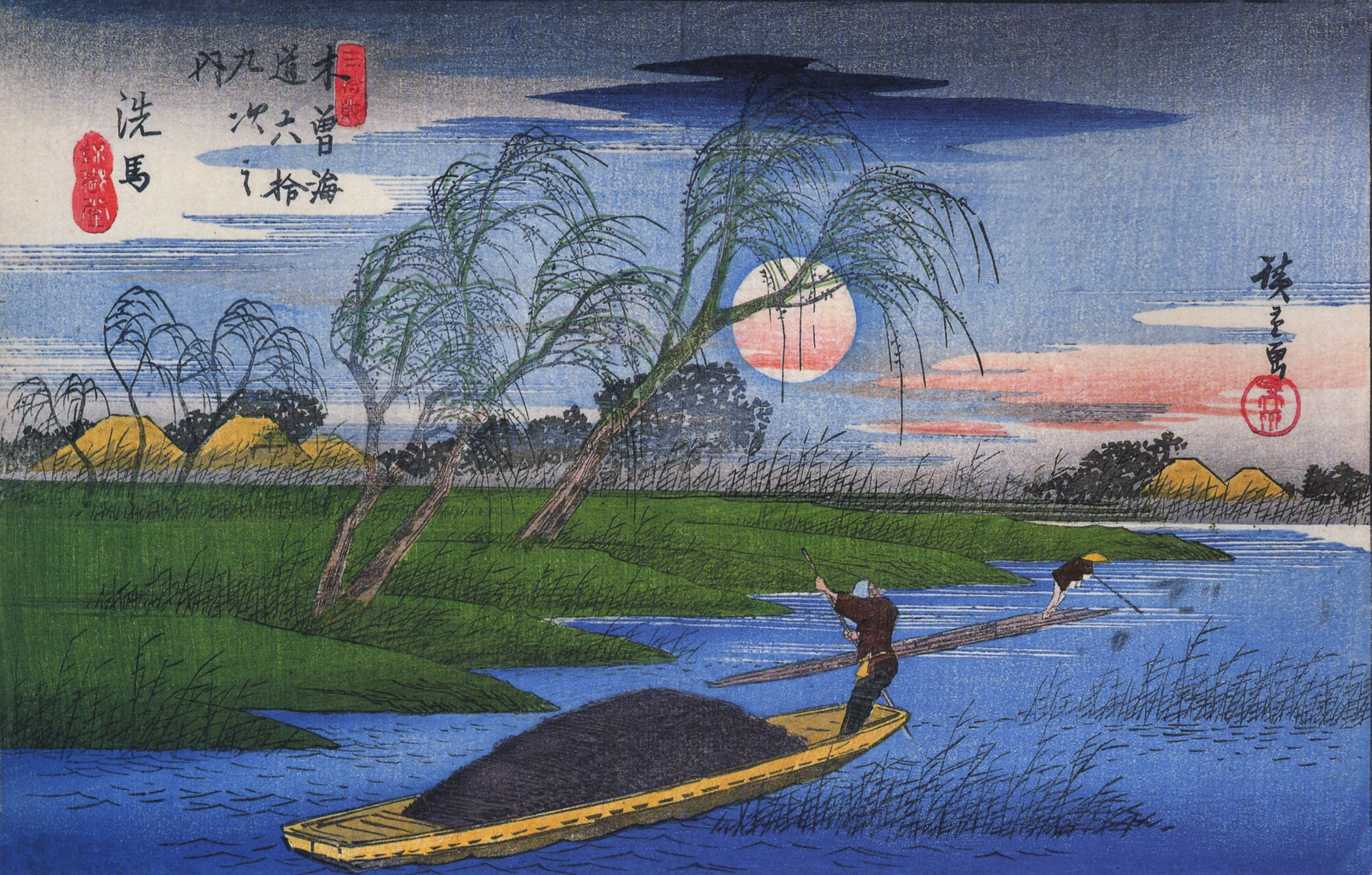
This new feature is awesome I think and for this introductory episode I have also a nice theme for you to work with. In the logo of this new feature you see a Japanese woodblock print by Hiroshige (1797-1858) titled "Men poling boats past a bank with willows".

Wind Blown Grass Across The Moon - Hiroshige

Utagawa Hiroshige, was a Japanese ukiyo-e artist, considered the last great master of that tradition.
Hiroshige is best known for his landscapes, and for his depictions of birds and flowers.
The subjects of his work were atypical of the ukiyo-e genre, whose typical focus was on beautiful women, popular actors, and other scenes of the urban pleasure districts of Japan's Edo period (1603–1868). The popular Thirty-six Views of Mount Fuji series by Hokusai was a strong influence on Hiroshige's choice of subject, though Hiroshige's approach was more poetic and ambient than Hokusai's bolder, more formal prints.

The above painting by Hiroshige, Wind Blown Grass Across The Moon, is a wonderful painting ... a masterpiece ... Look at the poetic scene, the simple use of colors. Just a few lines to tell the whole story. That's the way to create a masterpiece.


Lilies of the valley
their sweet perfume makes me drowsy
hot summer night
between silken sheets her warmth
honeysuckle coolness

© Chèvrefeuille

A challenging new feature ... NOW OPEN for your submissions. This episode will remain open until May 17th at noon (CEST). This new feature I will publish once a week.


Monday, March 19, 2018

Carpe Diem Crossroads #2 the summer moon


Dear Haijin, visitors and travelers,

I was flabbergasted as I read all of your responses on this new feature "Crossroads" in which I challenge you to create (only) haiku inspired on two or more given haiku (sometimes a "normal" poem, a sedoka or a tanka). A kind of "fusion" haiku so to say. So I think I will try to make this feature a weekly one. So this week I have another nice challenge for you.

This week I have chosen two beauties by two very different haiku poets from the past. The first haiku is by Kobayashi Issa:

a thousand gallons
shower from the eaves...
cherry blossoms

© Issa

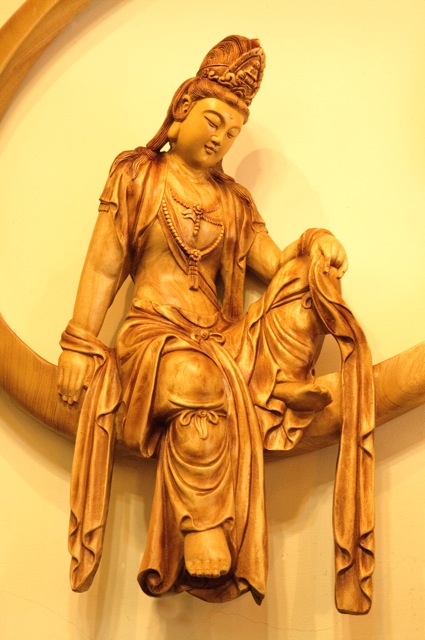
Statue of Chiyo-Ni

And here is another one, but this time written by Chiyo-Ni:

it touches the line
of my fishing pole -
this summer moon 

© Chiyo-Ni

Two wonderful haiku to work with I think. I will give it a thought, but that doen't mean that you all have to wait. More about "crossroads" you can find HERE.

This episode of "Crossroads" is NOW OPEN for your submissions and will remain open until Monday March 26th at 7:00 PM (CET). Have fun!


Saturday, February 17, 2018

Carpe Diem Weekend-Meditation #20 Revise That Haiku


!! Open for your submissions next Sunday February 18th at 7:00 PM (CET) !!

Dear Haijin, visitors and travelers,

Welcome at a new CDHK Weekend-Meditation. This weekend I love to challenge you to "revise" a haiku created by one of the classical haiku poets. This weekend-meditation that will be a haiku created by Chiyo Ni (1703-1775). Let me first tell you a little bit more about Chiyo-Ni.

Chiyo-ni (Kaga no Chiyo) was a Japanese poet of the Edo period, widely regarded as one of the greatest poets of haiku. Being one of the few women haiku poets in pre-modern Japanese literature, Chiyo-ni has been seen an influential figure. Before her time, haiku by women were often dismissed and ignored. She began writing Haiku at seven and by age seventeen she had become very popular all over Japan and she continued writing throughout her life. Influenced by the renowned poet Matsuo Bashō but emerging and as independent figure with a unique voice in her own right, Chiyo-ni dedication toward her career not only paved a way for her career but it also opened a path for other women to follow. Chiyo-ni is known as a "forerunner, who played the role of encouraging international cultural exchange".

She is perhaps best known for this haiku:

morning glory!
the well bucket-entangled,
I ask for water
© Chiyo-Ni
Today, the morning glory is a favorite flower for the people of her home town, because she left a number of poems on that flower.

Chiyo-ni standing beside a well. This woodcut by Utagawa Kuniyoshi illustrates her most famous haiku: finding a bucket entangled in the vines of a morning glory, she will go ask for water rather than disturb the flower.
The "Morning Glory" haiku is one of her renown haiku. I think you all have read this one very often. This is the haiku you have to "revise" this weekend. It will not be an easy task, but I think you all will succeed in this task.
Of course I have given it a try myself, and it was for sure not easy, but I think this "revision" is really nice (how immodest).
in the light of dawn
Morning Glory embraces the well
my neighbor gives me water
© Chèvrefeuille
What do you think of this "revision"? Please share your thoughts through the comment-field.
This weekend-meditation is open for your submissions next Sunday February 18th at 7:00 PM (CET) and will remain open until February 25th at noon (CET). Have a great weekend and enjoy this challenge to revise this renown haiku by Chiyo-Ni. 
 

Thursday, September 14, 2017

Carpe Diem Weekend-Meditation #2 Troiku "a hundred gourds"


!! Open for your submissions next Sunday September 17th around 7:00 PM (CET) !!

Dear Haijin, visitors and travelers,

Welcome at a new episode of our "weekend-meditation" with a new logo as you can see. I was busy creating it last weekend, so it wasn't possible to use it then. As you maybe have read in the menu above or have read in one of the earlier posts this month I have chosen new kinds of "weekend-meditations. Last weekend I challenged you to create "squared Tan Renga", and I have read wonderful submissions.

As you maybe know I have invented several new ways of being creative with haiku for example the Troiku and the Soliloque No Renga. Both are wonderful ways to be creative with haiku and gives you the opportunity to "think out of the box".
This "weekend-meditation" I love to challenge you to create a (or more) Troiku. More about Troiku you can find above in the menu. Not only an explanation of the Troiku you can find in the menu, but also an exclusive CDHK e-book "Flamingo Clouds". Both are great to read and both give you an idea of what Troiku is (or can be).

Chiyo-Ni (1703-1775)

For this "weekend-meditation" I love to challenge you to create a Troiku based on a classical haiku by Chiyo-Ni (1703-1775) one of the five famous haiku poets. Chiyo-Ni was the first female haiku poet / master and was a disciple of the Way of Basho. She never knew him in life, but she admired him and wrote in his spirit.

For this Troiku I have chosen a not so well known haiku written by Chiyo-Ni to start the Troiku with. This haiku she wrote at the age of 6 years, and it is a real beauty ... in which we already can see (and read) her high standard of writing haiku.

in my garden
starflowers bloom
come and see

© Chiyo-Ni (age 6)

Or ... as a kind of connection with our theme "Imagination Without Limits", you may also use the following haiku for your Troiku.

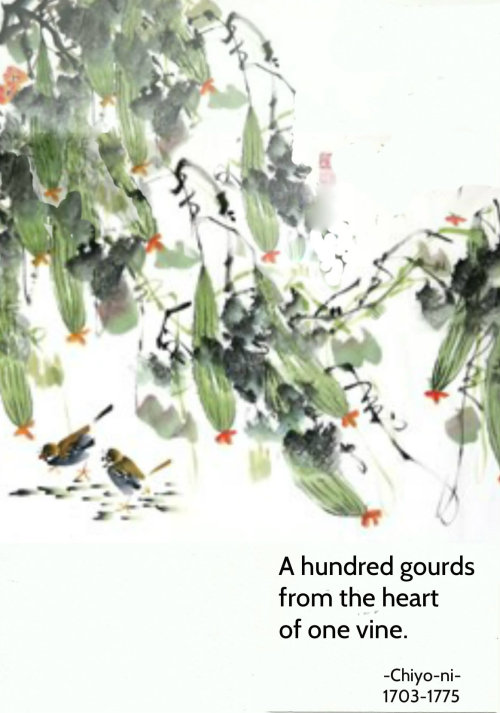
Haiga "A Hundred Gourds" (found on Tumblr)
Enough to work with this weekend I would say. Have a great weekend!

This weekend-meditation is open for your submissions next Sunday September 17th around 7:00 PM (CET) and will remain open until September 24th at noon (CET).


Wednesday, May 4, 2016

Carpe Diem Tan Renga Challenge Month May 5th (4) a haiku Chiyo-Ni "morning glory"


Dear Haijin, visitors and travelers,

Isn't it awesome to create Tan Renga together as in the underscore of the logo "chained together". It is really a joy to read all your completions, but I haven't had time to visit you all or comment on your completion. I hope to catch up the upcoming days ... Sometimes I will only "like" your completion and sometimes I will comment, but I promise you that I will visit you all.

Today (May 5th) here in The Netherlands we are celebrating freedom with a lot of festivities and I hope that the haiku I have for you as the starting verse / stanza of our Tan Renga will give that 'freedom' idea also.
For today's Tan Renga Challenge I have chosen for a wellknown haiku by Chiyo-Ni, as you maybe have read already on our twitter account. The goal is to complete the Tan Renga by adding a second stanza through association. That second stanza counts two lines of approx. 7-7 syllables.


Morning Glory
morning glory!
the well bucket-entangled,
I ask for water


© Chiyo-Ni (1703-1775)

A beautiful haiku I would say and I think it's a nice starting verse for our Tan Renga. Here is my attempt to create a Tan Renga of this haiku by adding the second stanza.

morning glory!
the well bucket-entangled,
I ask for water
                                            © Chiyo-Ni (1703-1775)

celebrating the first day of spring
drinking tea together with my love
         © Chèvrefeuille      

While I was thinking about the second stanza I remembered that I once have written my own "narrow road into the deep north', that famous haibun by Basho. In that haibun (my own) I included a haiku about drinking tea with friends. My second stanza is inspired on that haiku.

Well ... now it is up to you to complete the Tan Renga by adding a second stanza.

This episode is open for your submissions tonight at 7.00 PM (CET) and will remain open until May 9th at noon (CET). Our new starting verse for May 6th is already published on our twitter account. May 6th we will have a haiku by Hamish "Managua" Gunn as the starting verse. For now ... have fun!