Showing posts with label Sogyal Rinpoche. Show all posts

Thursday, December 14, 2017

Carpe Diem #1327 A Perfect Life ...?


Dear Haijin, visitors and travelers,

Well ... this episode will be a bit strange, because it's about the question "Do I Have a Perfect Life?" Today's novel is one of the novels I haven't read fully yet. Of course I had to read it while preparing this month in which we are inspired through the novels written by Paulo Coelho, but I couldn't complete my reading because of circumstances.

Today's quote I have taken from Coelho's novel "Veronika Decides to Die". Yes it's about the questions someone asks him or her self according to their life ... Veronika decides to die is about committing suicide. As you all know Jane Reichhold also decided to die by committing suicide. She no longer could cope with her illness, fybromyalgia. So the theme of this novel comes very close to our, to my, feelings and thoughts.
To me being suicidal or having suicidal thoughts isn't strange, because I know what it is. Several years ago, at the beginning of this century, I had a severe burn-out and I had suicidal thoughts, so this episode comes as close to me as is possible.

cover

Let me give you a brief overview of this novel:

Veronika is a beautiful young woman from Ljubljana, Slovenia who appears to have the perfect life, but nevertheless decides to die (commit suicide) by overdosing with sleeping pills. While she waits to die, she cancels the suicide letter she starts to her parents while suddenly provoked by a magazine article.

The magazine article wittily asks "Where is Slovenia?", so she writes a letter to the press justifying her suicide, the idea being to make the press believe that she has killed herself because people don't even know where Slovenia is. Her plan fails and she wakes up in Villete, a mental hospital in Slovenia, where she is told she has only a few days to live due a heart condition caused by the overdose.

Her presence there affects all of the mental hospital's patients, especially Zedka, who has clinical depression; Mari, who suffers from panic attacks; and Eduard, who has schizophrenia, and with whom Veronika falls in love. During her internment in Villete she realizes that she has nothing to lose and can therefore do what she wants, say what she wants and be who she wants without having to worry about what others think of her; as a mental patient, she is unlikely to be criticized. Because of this new-found freedom Veronika experiences all the things she never allowed herself to experience, including hatred and love.

In the meantime, Villete's head psychiatrist, Dr. Igor, attempts a fascinating but provocative experiment: can you "shock" someone into wanting to live by convincing her that death is imminent? Like a doctor applying defibrillator paddles to a heart attack victim, Dr. Igor's "prognosis" jump-starts Veronika's new appreciation of the world around her.

An excellent story I think and it brings me thoughts about nature. The story in this novel you can compare with the circle of life. And maybe that's an inspirational idea for your Japanese poetry.

Circle of Life
eternal circle
lotuses blooming and decaying -
ancient wisdom grows

© Chèvrefeuille

And that's so true, but it is not in the same feeling as the story above, but ... well it's the circle of life. Here is the quote from "Veronika Decides to Die" for your inspiration:

[...] "An awareness of death encourages us to live more intensely." [...] (Source: Veronika Decides to Die - Paulo Coelho

A very short quote, but a quote with a lot of layers. My thoughts immediately went back to our first Theme Week (2016) about "The Tibetan Book of Living and Dying". And a quote by Sogyal Rinpoche returned to me:

[...] "Everyone of us will once face death, that idea makes us sad and anxious, but it is inevitable, but as you can face your mortality than that will keep your life in balance". [...]  (Sogyal Rinpoche form "The Tibetan Book of Living and Dying".)

phoenix spreads its wings
after the dark cold winter night
finally spring

© Chèvrefeuille

Isn't that the same as meant in the quote from "Veronika Decides to Die"?

Well ... much to think about ... This episode is NOW OPEN for your submissions and will remain open until December 21st at noon (CET). I will try to publish our new episode later on.

PS. If you like to read the exclusive CDHK e-book created after the theme week about "The Tibetan Book of Living and Dying" than you can find it on issuu.com 

PPS. I have created an account on issuu.com 


Monday, November 20, 2017

Carpe Diem #1308 A Game of Chess


Dear Haijin, visitors and travelers,

I hope you all have had a wonderful inspirational weekend. I had a busy weekend at work, so I hadn't time to publish this regular episode on time. We are going on with our exploration of "The Rubaiyat"  by Omar Khayyam. As I was preparing this episode that I have titled "A Game of Chess" a haiga I created a while ago came in mind. I love to share that haiga here with you, maybe you can remember it.

Haiga "A Game of Chess" (© Chèvrefeuille, 2015)
What has this to do with the inspirational quatrain for today? Well ... in this quatrain Omar Khayyam describes life as a game of chess. Let me give you today's quatrain and than we start "talking" about it.

'Tis all a Chequer-board of Nights and Days
Where Destiny with Men for Pieces plays:
Hither and thither moves, and mates, and slays,
And one by one back in the Closet lays.

© Omar Khayyam (Tr. FitzGerald)

Background:

Life is here likened to a game of Chess or Checkers, the black and white squares of the Chess-board being likened to Nights and Days. Destiny is the player who captures (slays) pieces in the course of the game, removing them from the board and putting them back in the storage box (Closet.) It is Destiny too, who finishes the game – “mates” in Line 3 is “Check Mate” – the term for the end of a Game of Chess. The overall idea is that Destiny kills us all off, one by one.

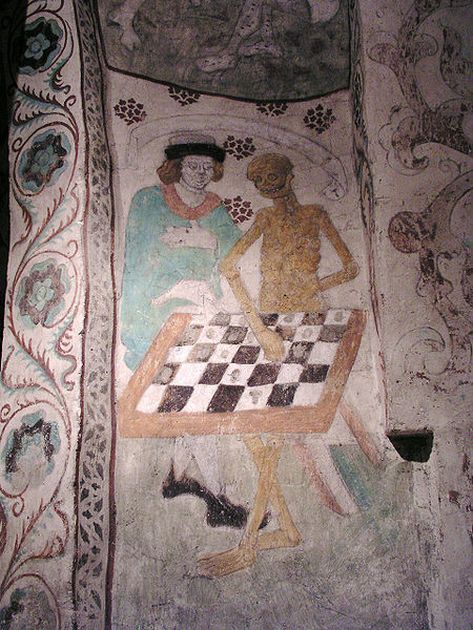
The related image of Death playing Chess with Mortals to decide where and when they will die is probably best known to most people through Ingmar Bergman’s film “The Seventh Seal” of 1957. What is less well known is that Bergman got the idea for this image from a wall-painting in the medieval church of Täby in Stockholm, dating from the latter half of the 14th century!

Death playing Chess (Medieval church Täby in Stockholm)

The idea that human life is a game of the gods is ancient. Thus, as Canter notes in his article “Fortuna in Latin Poetry”, the goddess Fortuna “delights in mockery and in making man the victim of her sport." Thus, Virgil, in The Aeneid talks of Fortuna mocking mankind by knocking them down then picking them up again, as fancy takes; Horace, in his Odes, talks of Fortuna pursuing her wanton sport by deliberately switching her favours from one person to another; and Juvenal in his Satires talks of Fortuna raising men from the gutter to high office just to amuse herself.

The Roman tragedian Pacuvius, who lived in the 2nd century BC, wrote of the goddess Fortuna as follows:

Dame Fortune, some philosophers maintain,
Is witless, sightless, brutish; they declare
That on a rolling ball of stone she stands;
For whither that same stone a hazard tilts,
Thither, they say, falls Fortune; and they state
That she is witless for that she is cruel,
Untrustworthy, unstaid; and, they repeat
Sightless she is because she nothing sees
Whereto she’ll steer herself: and brutish too
Because she cannot tell between the man
That’s worthy and unworthy. But there are
Other philosophers who against all this
Deny that there is any goddess Fortune,
Saying it is Chance Medley rules the world.
That this is more like unto truth and fact
Practice doth teach us by the experience;
Orestes thus, who one time was a king,
Was one time made a beggar.

(The translation is by E.H.Warmington)

In modern times, Bertrand Russell opened his essay “A Free Man’s Worship”, first published in 1903, with an account of God’s creation of Man, as given by the devil Mephistopheles to Dr. Faustus:

“The endless praises of the choirs of angels had begun to grow wearisome; for after all, did he not deserve their praise? Had he not given them endless joy? Would it not be more amusing to obtain undeserved praise, to be worshipped by beings whom he tortured? He smiled inwardly, and resolved the great drama should be performed.”


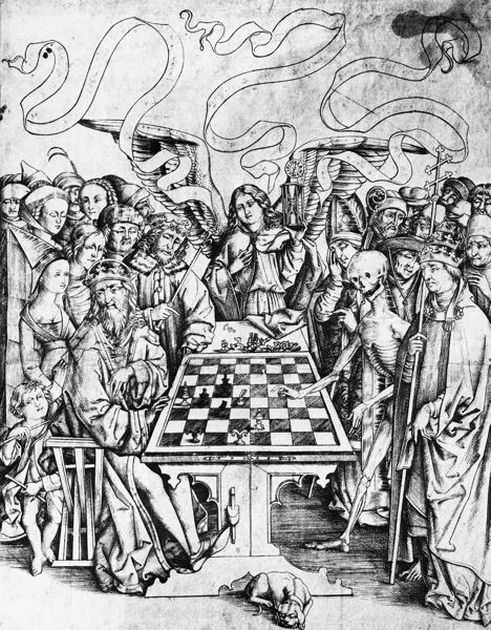
Death Playing Chess by Israhel von Meckenem

Omar Khayyam was very lyrical about death and it seems to me that he accepted the idea of "death belonging to life", as we also saw in the Tibetan Book of Living and Dying by Sogyal Rinpoche, (The theme of our first CDHK Theme-week).

chess
game of life and death
like nature

© Chèvrefeuille

I hope you liked this episode and that it will inspire you. This episode is NOW OPEN for your submissions and will remain open until November 27th at noon (CET). I will try to publish our new episode later on.


Friday, February 26, 2016

Carpe Diem Extra February 26th - New CDHK e-book The Tibetan Book of Living and Dying


Dear Haijin, visitors and travelers,

Our first CDHK Theme Week has ended and as I have promised at the start of the first Theme Week I have gathered all the Theme Week post and your responses in a new CDHK e-book.
In this new CDHK e-book you can find the posts and the responses on those posts by you my dear Haijin. I have tried to create a nice e-book, but I cannot guarantee that I have used all the responses in their form as published by you, maybe I have forgotten someone's response ... if that has happened than I apologize for that.

You can find our new CDHK e-book, free for download, at the left side of our Kai. I hope you will enjoy the read.

Namaste,

Chèvrefeuille, your host.

Monday, February 22, 2016

Carpe Diem Theme Week #1 episode 7: The Tibetan Book of Living and Dying Insight 6 balance isn't always necessary


Dear Haijin, visitors and travelers,

Welcome at the last episode of our first Carpe Diem Theme Week in which we explored The Tibetan Book of Living and Dying by Sogyal Rinpoche. We discovered that life and dead belong to each other and that we can learn from dead how to be in our life. In this last episode we learn that balance isn't always necessary.

Introduction

This month our regular prompts are all about senses and in one of the first (regular) episodes of this month Hamish asked us to look at "equilibrium / balance" and I think this introduction I already have written, so I will quote myself here:

[...] "Balance ... it has not only to do with movement, but I think it also has to do with "inner balance". You have to be "in balance" mentally to stay focused on the things you have to do in your life. As I look at myself than I need "inner-balance" to do my work as an oncology nurse. I have very ill patients who need my care and attention and my love, so I can only give that to them if I am in balance myself.

To stay in balance myself I use to write. First novels and later I wrote more and more haiku to keep myself in balance. In my poetry I can find that balance through the scenes in my haiku, but also through being your host here at Carpe Diem Haiku Kai. I wonder ... what if I had not the opportunity to write or being your host? Then I think I would be less successful in my job as an oncology nurse.

in the light of dawn
sunflowers reach to the blue sky
praising their Creator

© Chèvrefeuille

A nice haiku in which I see "balance" in the strength of the Sunflowers reaching to the blue sky. As I "analyze" this than I associated on "light of dawn" to come to "sunflowers". And on "blue sky" to come to "Creator" in the third line. A nice "baransu"-haiku I would say." [...] (original post HERE)


Balance isn't always necessary.

Disappointment. It's one of the things which can bring us out of balance. Just like sadness and e.g. loss. The realization that we will not be here anymore about, say one hundred years, brings us out of balance. Questions like "How do my children and grandchildren survive as I am not there anymore?" or "What's next?" are crawling into my mind.

After reading and re-reading The Tibetan Book of Living and Dying we have learned one thing for sure: "Life isn't easy, but we have live it to the fullest". The book makes us think about all and everything. Out of balance? What does that mean? We loose our balance through all kinds of things. Things were we care about such like art and love. Losing our balance can be positive too. It makes us stronger, because we are searching for ways to regain our balance. Losing our balance and regaining it makes us human. We are flexible beings. We adapt ourselves constantly as we find ourselves in new, unexpected situations. Just through all those things we learn to develop balance.

As we discussed in one of the earlier posts for this first Theme Week, Rinpoche sees life as a bardo (a kind of transition station) and that's not a such bad idea in my opinion. It shows us that our consciousness has senses, lives in a world, observes, starts relationships, living life. Rinpoche says: "Life is to discover the goodness of life, an exercise to realize that life is good and that also means ... accepting dead as part of our life."

Look at yourself with compassion from the depth of your consciousness, your soul. It's a peaceful thought to know that our daily personality has a deeper Inner Self to whom we can listen always. Our Inner Self is our tower of strength. A lovely Inner Voice, that whispers: "Yes you are out of balance, but don't worry you will regain your balance. You need this difficult time to grow and become stronger and more balanced. So don't worry, don't be afraid, I am there, I am with you. I travel with you". Isn't that a reassured idea? Isn't that the reason to live your life to the fullest?

Seeking The Inner Self
My response

This Theme Week was awesome. It was (at least to me) an eye-opener to discover that life and dead belong together, that life and dead are siblings ...

I hope (know) that you all did enjoy it, but it wasn't easy to create these posts or write haiku about it. Haiku inspired on The Tibetan Book of Living and Dying ... it really wasn't easy, but we did it. Through the six Insights we have discovered ... learned a lot. And every lesson can inspire you to create the beauty of haiku ... thank you all for being here.

deep silence
the spring breeze whispers
"life is great"

© Chèvrefeuille


This last episode of our first Carpe Diem Theme Week is NOW OPEN for your submissions and will remain open until February 24th at noon (CET). I am looking forward to your responses and I hope you will be here again next month as we will have another wonderful Carpe Diem Theme Week.

Namaste


Saturday, February 20, 2016

Carpe Diem Theme Week #1 episode 5 Tibetan Book of Living and Dying: Insight 4 the power of compassion is limitless


Dear Haijin, visitors and travelers,

First I have to apologize for being this late with publishing. I hadn't enough spare time to write this 5th Theme Week episode. I was busy with work and family.

Today we are looking at the 4th Insight the Tibetan Book of Living and Dying reveals to us. This episode is about 'compassion'. I remember that w have had 'compassion' earlier here at CDHK as a prompt and it was in several other episodes a source for inspiration. Today however 'compassion' we will explore as part of living and dying.

enlightened soul
remains solid and truthful
full of compassion

full of compassion
Tara inspires her worldly followers -
lotus reaches for the sun

lotus reaches for the sun
finally enlightenment is near
Om Mane Padme Hum


© Chèvrefeuille


Introduction


Let me first look at the meaning of compassion and than I will bring t into the theme. What is compassion?

Rinpoche says the following about compassion in The Tibetan Book of Living and Dying:

[...] "It is not simply a sense of sympathy or caring for the person suffering, not simply a warmth of heart toward the person before you, or a sharp clarity of recognition of their needs and pain, it is also a sustained and practical determination to do whatever is possible and necessary to help alleviate their suffering. Compassion is not true compassion unless it is active. Avalokiteshvara, the Buddha of Compassion, is often represented in Tibetan iconography as having a thousand eyes that see the pain in all corners of the universe, and a thousand arms to reach out to all corners of the universe to extend his help."[...] (Source: The Tibetan Book of Living and Dying - Sogyal Rinpoche)


The power of compassion is limitless

The strength of The Tibetan Book of Living and Dying is that it gives you a kind of manual to handle living and dying in your surroundings especially when you are facing death or are confronted with dying and dead. Most often we don't know what to do or say. Is it possible to help someone who faces dead?
Rinpoche says: "only love and compassion" can be of help in such a situation. Compassion, as you could have read above, is something different than remorse. In compassion there is respect. It sounds easy, but compassion is not only affection and warmth, it is also an everlasting and practical steadfastness to do everything possible to make suffering more easy.
The Buddah of Compassion,  Avalokiteshvara, is often depicted as having thousand eyes and arms and gives an idea what compassion really means. The Buddha of Compassion sees all the pain in the Universe and with his 1000 arms he offers help throughout the Universe.

How to be compassionate? You can gain that through loving kindness. Look at the other as you would look at yourself. We are all the same notwithstanding spiritual or religious differences. We have all the same feelings and desires. If you were in the position of facing death, what would you like to do, what would you want that others would do for you?

Compassion is only compassion, real compassion, if you do something. Just be there, be present ... can be enough.

Credits: Buddha of Compassion, Avalokiteshvara

My response

Today we looked at Insight 4, Compassion. As I think about compassion the first thing which comes in mind is Buddha. I see his eyes in front of me and I feel how his compassionate eyes are touching me deep. Compassion ... a wonderful emotion, which we see to less in the world of today. Maybe ... maybe there will be a time, far in the future, that every living thing on Earth will be compassionate. I hope ... this will become true.

full of compassion
the Buddha looks into the world
with sad eyes
I look around in my world
dreaming of better times

© Chèvrefeuille

Again my apologies for being this late with this Theme Week episode, but I hope it will inspire you to create an all new haiku, tanka or other Japanese poetry form.

This episode is NOW OPEN for your submissions and will remain open until February 22nd at noon (CET). I will (try to) publish our new episode in this Theme Week, Insight 5 the teacher is not sacred too, later on.

Wednesday, February 17, 2016

Carpe Diem Theme Week #1 episode 3 The Tibetan Book of Living and Dying Insight 2 "through the chinks comes the light"


Dear Haijin, visitors and travelers,

Welcome at this delayed episode of our Theme Week. I have tried to find some spare time to create this episode. Yesterday I told you something about the first Insight and today I will try to tell you something about the 2nd Insight for our daily life as can be learned from The Tibetan Book of LIving and Dying.


Introduction

What happens exactly as you die? In the Tibetan Book of Living and Dying Sogyal Rinpoche explains it through the idea/ thought of bardo. "Bardo" means "inbetween" and its a kind of transition-mode. Let us look further in the depth of the meaning of bardo, maybe than we can understand it 100%.

Through the chinks comes the light

The original meaning of bardo is, the space between the moment of dying and reincarnation / rebirth. As we 'dive' deeper into this matter than we discover more than one bardo. Let's go ...

First there is the bardo of living and dying. This is a painful bardo, but also the moment that the nature of spirit / soul becomes real and in a way breaks through the armor of the body. This we can see in, for example, the story of Easter as Jesus prays in the Garden of Gethsemane and asks His Father, God, to take away the cup of poison. Than He is arrested and indures the pain of 39 lashes and the crucifixion. As He dies He commands His Spirit to His Father. This is what we can call the bardo of living and dying.
 
 
Credits: Near Death Experience (NDE)
 
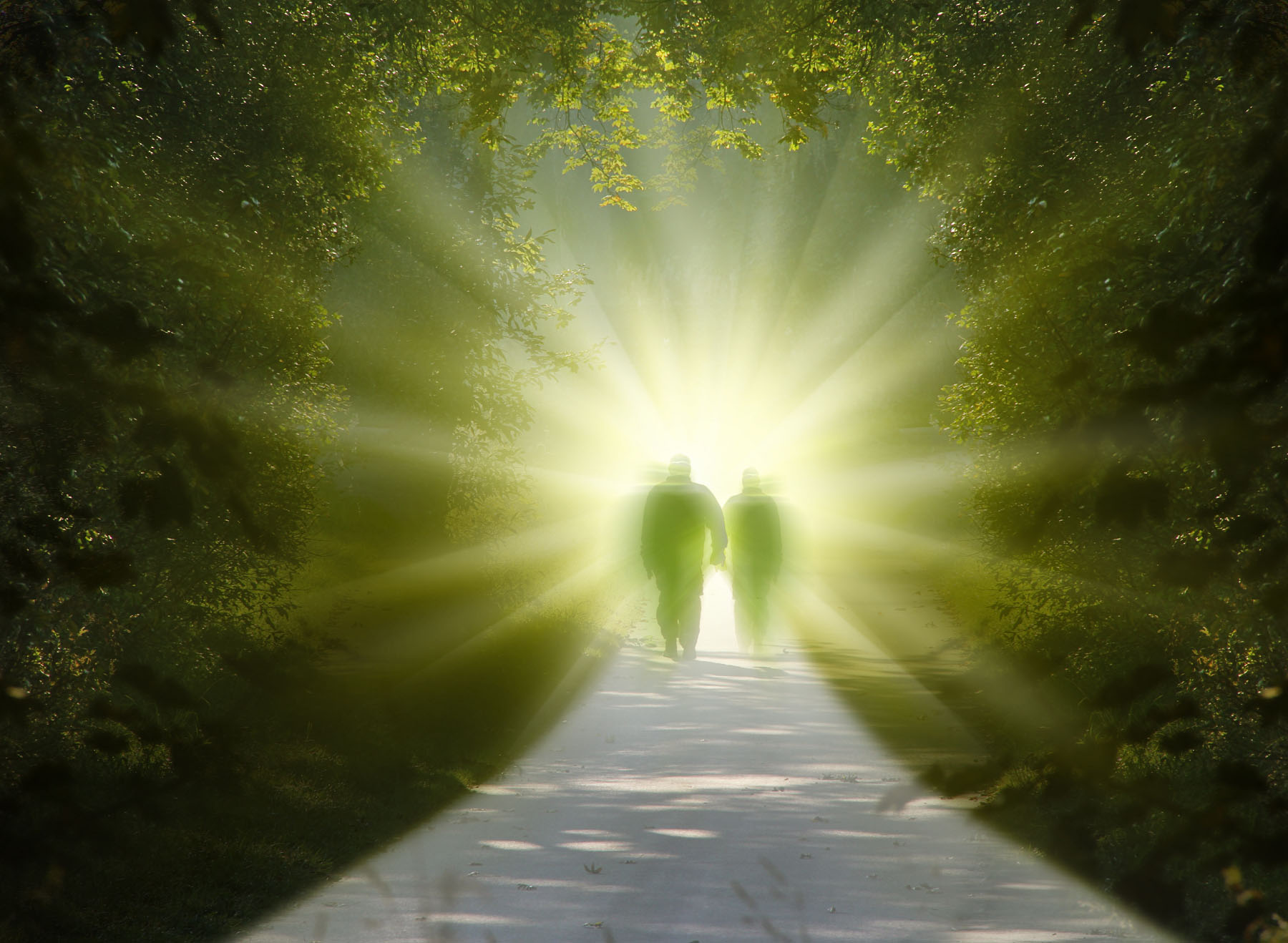
What follows is the bardo which is called the shining bardo or dharmata, the state of consciousness / mind after death. To explain this shining bardo, wasn't easy, because I could not find something to explain it with. Than I got a revelation. This shining bardo you can see as a bright light, the radiation of the pure nature of spirit / mind. It's a state of pure happiness. In a way this you can see as what is happening as you (someone) has a Near Death Experience (NDE). I ran into a few stories about NDE when I was preparing these episodes. As you read the reports about NDE than everyone sees a bright light in which shadows are moving, ancestors mostly, but angels too.
This shining bardo doesn't stay forever. Sometimes it takes / endures seven days, but it can also take seven weeks.

The next bardo is called the bardo of becoming. The consciousness / mind finds a new place, in a new body and a new life gets started. This we can also see in the story of Easter. After three days, and taht's very fast as we compare this with the Tibetan idea about living and dying, Jesus rises from the grave. He conquered dead and became an enlightened being who walks a short time on this earth and than rises to Heaven making the Holy Spirit, a kind of reborn energy, avalable to the world. With His ressurection and entering Heaven He broke the Circle of Bardo, as did Buddha.

In Tibetan tradition of bardo the songs from The Book of the Dead were recited by the monks to lead the spirit. Rinpoche goes further in this idea and describes his ideas in The Tibetan Book of Living and Dying. In his book he sees life as it is as a bardo. The bardo between birth and the moment of sying, life in itself is a transition. It's a time in which we learn, contemplate, meditate and prepare on death.

Rinpoche goes even further, a period of uncertainty can also be a bardo. For example, the moment you come home and see that there has been a burglary while you were away. Or that moment between "I have bad news" and "I have to tell you ..." At that moment the concrete of your reality breaks and you feel that the ground is disappearing beneath your feet. Than the realization comes ... you see the essence. No more time for futilities. It's a moment of truth ... you can see what really is important.

This is what this Insight means ... discover the truth by tearing down the veil. This is what happened as Jesus died at the cross. The veil that hid the Holy of Holies was torn apart exposing the holiest place in the temple and the revelation that Jesus really was the Son of God.

Credits: Phoenix

My response

To write a haiku, tanka or another Japanese poetry form about this 2nd Insight isn't easy I think, but I had to try it myself (of course) and this is what came in mind, a haiku from my archives:

phoenix spreads its wings
after the dark cold winter night
finally spring

© Chèvrefeuille

I hope I inspired you. This Theme Week episode is NOW OPEN for your submissions and will remain open until February 19th at noon (CET). I will (try to) publish our next episode of this CD Theme Week, Insight 3 thinking about death gives life meaning, later on.


Monday, February 15, 2016

Carpe Diem Theme Week #1 epsiode 2 The Tibetan Book of Living and Dying, Insight 1 We are travelers


Dear Haijin, visitors and travelers,

What a joy to write the first "real" episode (after yesterday's introduction) for our first Carpe Diem Theme Week in which we are exploring the depths of "The Tibetan Book of Living and Dying" written  by Sogyal Rinpoche.

I promised you to tell a little bit more about the Insights this beautiful book can give us to use in our (daily) life. Today I love to share the first Insight: We are travelers.


Introduction

Every post here at CDHK I start with the same sentence "dear Haijin, visitors and travelers" and that last word "travelers" I think you will interpret in a slightly different way after this first Insight. We are travelers ... that's so true. We are always on our way, which fits our modern life by the way, to our work, the office, the hospital, on a holiday and so on, but have you looked at your life as a journey, a travel?

As I started this Theme Week the only thing I knew about my own spirituality is that I am on a path to fulfill the goals which life, or spirit, or the universe, has given me. And I hope to reach those goals some day ... somewhere.

We are travelers

Reincarnation is one of the central ideas of Tibetan Buddhism and The Tibetan Book of Living and Dying. I hope to explain this (with the help of Soygal of course).

Rinpoche makes a difference between our "ego", our daily personality, our "I", the form / shape our psyche has in our body in which we live our life, and the deeper, natural consciousness, which is our essence.

Credits: Veil Nebula

What happens when we die? In fact only our body dies, but our consciousness "rises" to another new state of being, another dimension maybe. That is our rigpa, the absolute nature of mind (spirit), the consciousness before thoughts and emotions occur / rise. Later it will be reborn in another body.

Death is not the absolute end. Our body doesn't exist anymore, but our consciousness travels on. The idea of dying can be paralyzing, but in this vision death is just a moment of transition. That makes the idea of death lighter: we are travelers, continuous on our way from one world to another.

My response

Finally our consciousness will reach enlightenment, maybe not in this life, but maybe in another life.

ghostly nebulae
covers the old graveyard
cherry blossom blooms


© Chèvrefeuille

Well ... find your inspiration, awaken your muse and share your haiku, tanka or other Japanese poetry form with us all. (Or maybe a Tibetan form of poetry?)

This episode of our first Theme Week is NOW OPEN for your submissions and will remain open until February 17th at noon (CET). I will publish our next episode, Insight 2, later on.


Sunday, February 14, 2016

Carpe Diem's Theme Week #1 The Tibetan Book of Living and Dying, an introduction


Dear Haijin, visitors and travelers,

Welcome at the first episode of our Carpe Diem Theme Week of February 2016. As you could have read in our CD-Extra of yesterday I have created an all new feature for our inspiration. This new feature I have called "Carpe Diem's Theme Week" and the goal is to create one week of special prompts about a Theme for your (and mine) inspiration.

This week I have a wonderful "spiritual" Theme Week for you ... This first Carpe Diem Theme Week is all about The Tibetan Book of Living and Dying and the Insights it gives to us, to use now, while we are still alive walking through life every day again. In this Theme Week I hope to inspire you.

For every Theme Week (the third week of every month) I also create a special logo and for this week I have created an over all logo (as you can see above), but also a special logo for this Theme Week. For this logo I have used an image of the Wheel of Life ... as it is known in Tibetan Buddhism.


"Everyone of us will once face death, that idea makes us sad and anxious, but it is inevitable, but as you can face your mortality than that will keep your life in balance". Sogyal Rinpoche

This is the leading pattern in the so called "Tibetan Book of Living and Dying" by Sogyal Rinpoche. This book is the first book in English that gives us the insights of the "Bardo Thödol" or "The great liberation through hearing in the so called "in between" state of mind, short before real death, as the soul is free once again".

The Tibetan Book of the Dead is one of the holiest in nyingma-buddhism, the classical Tibetan school of Buddhism. The texts from this book were recited, during and after one's death, by the Lama's to take care of the transition of consciousness (the soul) to a new spiritual phase.
The Tibetan Book of the Dead was part of the terma, holy texts which were hidden in a time that Buddhism was oppressed. These terma were sometimes more than one hundred years later recovered by a tertön, a Buddhist priest who explained the texts in a new time. It is believed that Sogyal Rinpoche was a reincarnation of such a tertön.

Sogyal Rinpoche translated The Tibetan Book of the Dead in a way that fits the Western reality and spirituality. Worldwide The Book of Living and Dying (this is the modern title) became a bestseller.

In this first Carpe Diem Theme Week I will try to explain the Insights of the Book of Living and Dying for our life now ...

once lost
wisdom returns to the world -
Narcissus blooms


© Chèvrefeuille


As you all know I am an oncology nurse and that means that I have to do with patients who die after their sickbed. Confronted with dead / death every day was certainly not how I once saw my life and future, but God brought this on my path and I am grateful for that every day again.
In my opinion death is part of life and it is certainly not definitely, because I believe in reincarnation. If you think that way, death isn't something to be afraid of. Of course there are other religious ideas about death and those I ideas I certainly respect.

In Buddhism life is a school in which we create our consciousness (and sub-consciousness) and if, you didn't reach that in the proper way than you have to enter a new life after death. However, if you look at the spiritual meaning of the Book of Living and Dying than it fits the idea that we are all on a journey to find balance in our daily life. This spiritual meaning is the base of these series of posts. I will take you on a spiritual journey along six spiritual Insights revealed / discovered in the Tibetan Book of Living and Dying.

I hope you all will go with me on this journey and maybe ... just maybe you will discover a new path or a better path ... of course that's not the goal of this Carpe Diem Theme Week. I just love to share some ideas about that spiritual and religious background of our beloved haiku.

secrets unveiled
through the Wheel of Life
seasons come and go


© Chèvrefeuille

Wheel of Life (Bhutan)

Share your inspired haiku, tanka or other Japanese poetry form with us all ... what inspired you to write your haiku? 

This first episode of our Carpe Diem Theme Week is open for your submissions tonight at 7.00 PM (CET) and will remain open until February 16th at noon (CET). I will publish our next episode of our first Theme Week, Insight 1 We are all travelers, later on.