Showing posts with label The Rubaiyat. Show all posts

Wednesday, November 29, 2017

Carpe Diem #1316 Moon of My Delight


Dear Haijin, visitors and travelers,

Welcome at the last episode of our wonderful CDHK month about "The Rubaiyat" by Omar Khayyam. It was a joy and a honor to bring you these quatrains. They are all extraordinary beautiful and I hope that you all have found in some way satisfaction and appreciation for this great Persian poet.

As I told you yesterday the last episodes will be short, only the quatrain and my thoughts about it.

Here is our last quatrain for this month and maybe ... I will create another CDHK month about the poetry of Omar Khayyam. There are a lot of quatrains written by him so I think we can do another month about his poetry next year.

Here is our quatrain for today, I titled it "Moon of My Delight" and that title sounds like music in my ears, because my "big love" "the moon" is all present here.

Ah, Moon of my Delight who know'st no wane,
The Moon of Heav'n is rising once again:
How oft hereafter rising shall she look
Through this same Garden after me - in vain!

© Omar Khayyam (Tr. FitzGerald)

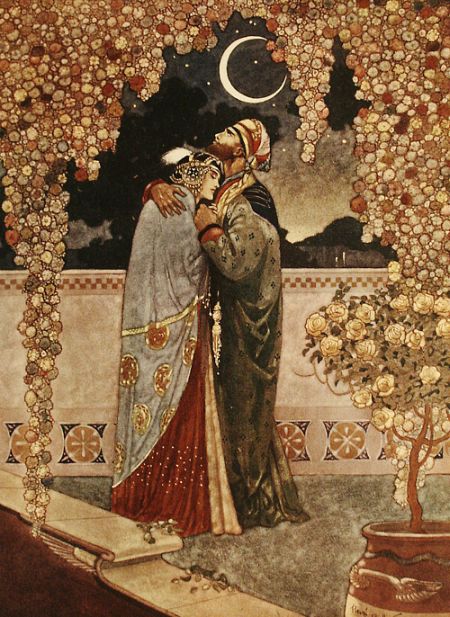
Moon of My Delight (René Bull)
Background:

“Moon of my Delight” is the Poet’s Beloved, she being constant, unlike the Moon of Heaven, which waxes and wanes as the month goes by. The meaning of the last two lines is that there will come a time when the Moon of Heaven looks down upon the Poet’s Garden, but will no longer find him there, because he will be dead. Incidentally, it is an easily missed fact that the rising Moon in this verse, at the end of the poem, pairs with the rising Sun in verse 1 at the beginning, the whole poem thus effectively following the course of Omar’s musings through a symbolic day, from Sunrise to Moonrise. Did FitzGerald intend this from the beginning, or did he only notice it later? It is a fact that FitzGerald only pointed out the Sunrise to Moonrise progression in a letter written to his publisher Bernard Quaritch in 1872, fully thirteen years after the appearance of the first edition. Talking of Omar, he wrote:

“He begins with Dawn pretty sober and contemplative: then as he thinks and drinks, grows savage, blasphemous, etc, and then again sobers down into melancholy at nightfall.”

Well isn't that a coincedence? We started with 'dawn' and with this last verse of this month we will end with the rise of the moon. The circle of life closed again. A month of joy closed ...

dawn
until down
moonrise

© Chèvrefeuille (experimental haiku)

This episode is open for your submissions tonight at 7:00 PM (CET) and will remain open until December 6th at noon (CET). I will try to publish our new episode, the first of a new month, later on. For now ... have fun! And thank you for participating in this wonderful CDHK month about Omar Khayyam's "The Rubaiyat".


Tuesday, November 28, 2017

Carpe Diem #1315 Scheme of Things


Dear Haijin, visitors and travelers,

I will take a few days of, but of course I will not leave you without your daily dose of CDHK. I have created the last few episodes of this month and the first of December already and scheduled them for the right time of publishing. I have a very busy week to come and I just had to make a choice to were my priority is. This week that's at my work, so ...
Yesterday I gave you a short episode and the upcoming episodes will be short too. Only the quatrains and my own thoughts about them.

So here is our new episode titled "Scheme of Things":

Ah Love ! could thou and I with Fate conspire
To grasp this sorry Scheme of Things entire,
Would not we shatter it to bits - and then
Re-mould it nearer to the Heart's Desire !

© Omar Khayyam (Tr. FitzGerald)

A wonderful expression of how most of us feel!

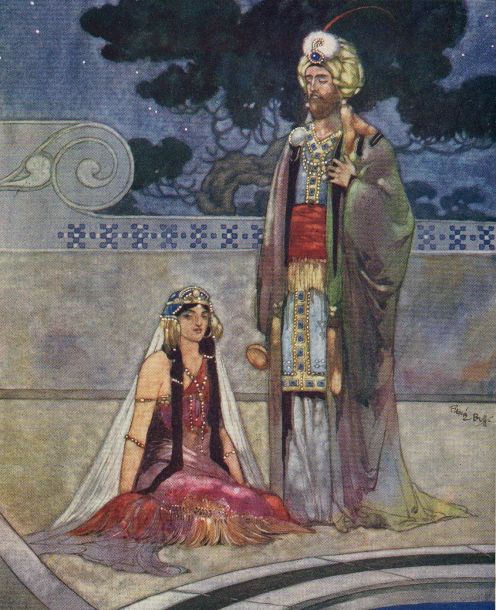
Heart's Desire (René Bull)
desire
your heart beats
with mine


© Chèvrefeuille (experimental haiku)

This episode is NOW OPEN for your submissions and will remain open until December 5th at noon (CET). I will publish (scheduled) our next episode later on. Have fun!


Carpe Diem #1314 The Nightingale


Dear Haijin, visitors and travelers,

My excuses for the late publishing of this new episode. I had a very busy day so I hadn't time to create the episode. Now I have some spare time after a busy shift at work. I think I will make it myself easy this time.

I will only give you the quatrain by Omar Khayyam which I have selected from "The Rubaiyat". No background information also. Only the quatrain ... and maybe some own thoughts about it. Let me give you the quatrain to work with (this is quatrain no. 72 by the way).

Alas, that Spring should vanish with the Rose!
That Youth's sweet-scented Manuscript should close!
The Nightingale that in the Branches sang,
Ah, whence, and whither flown again, who knows?

© Omar Khayyam (Tr. FitzGerald)

We have seen the Rose and Spring earlier here in one of the quatrains. This time it seems to tell us something more about the fading of time, or the fading youth. There is a verse in Isaiah that tells us something a like:

“All flesh is grass, and all the goodliness thereof is as the flower of the field: The grass withereth, the flower fadeth.” (Isaiah 40: 6-7)

Japanese Nightingale (image found on Pinterest)

Than we see the up-bringing of the Nightingale, a wonderful bird that we have seen very often here at CDHK. In this verse it looks like the Nightingale is an image for youth, it's said that the Nightingale is the Bird of Youth. I couldn't find a reference to that idea, but to be honest I haven't search it for a long time.

Well ... no haiku or tanka by myself this time, but I love to share with you our new CDHK logo. I like to create a specific logo for every month, but it takes to mauch time, so I have created a new logo which I will use at CDHK at the start of December 2017.


This episode is NOW OPEN for your submissions and will remain open until December 5th at noon (CET). I will try to publish our new episode later on. For now ... have fun, be inspired and share.

Sunday, November 26, 2017

Carpe Diem #1313 The One True Light


Dear Haijin, visitors and travelers,

We are entering the last few days of November. This month was a challenge for me to create, because I was not familiar with "The Rubaiyat" by Omar Khayyam and not familiar with the quatrain. But I did it again, of course not without help of the Internet, especially the website by Bob Forrest was a great source of information for me. I hope you did like this month, I enjoyed it ...

Okay ... I hope you all have had a wonderful weekend and I hope you will have an awesome week. I had a relaxed weekend, but of course I couldn't let go of CDHK. I have been very busy with the preparations for our next month. December we will (i hope) find our inspiration in quotes which I have extracted from several novels by Paulo Coelho. As you all know Coelho is one of my favorite authors and I have read a big part of the novels he has written. I think December will be a nice month. Of course in December we will have our weekend-meditations and our CDHK special feature "Seven Days Before Christmas" will be featured again, just because I like that feature.

Cover "The Rubaiyat"
Today's episode is titled "The One True Light" and it's extracted from today's quatrain. Before I share this quatrain I love to give you a brief meditation ...

As I read this quatrain I was pleasantly surprised because in this quatrain I sensed Omar Khayyam's spirituality. I have told you a few times this month that Khayyam wasn't 100% muslim, sufi or christian, but in this verse I sensed more christianity than in all the other verses we have read this month. In my opinion in this quatrain Khayyam shows us that he is a christian and that he finally dared to be open about that. Of course in his time there wasn't that "evil" fight between Islam and other religions, at least not that I know of.
At the other hand this verse can also tell us that all religions are the same, because Khayyam mentions also Islam and Judaism next to Christianity. Was Khayyam the first philosopher who dare to say that all Gods Are One?

Let me give you the quatrain for today:

And this I know: whether the one True Light,
Kindle to Love, or Wrath consume me quite,
One Glimpse of It within the Tavern caught
Better than in the Temple lost outright.

© Omar Khayyam (Tr. FitzGerald)

The One True Light
Background:

“The One True Light” is the Divine Light of Truth, and whether it infuses one with Love (= enthusiasm or devotion ?) or consumes one with Wrath (= exasperation or distaste?), it is better to have glimpsed it in the Tavern than not to have glimpsed it at all in the Temple (Mosque, Church or Synagogue). There is perhaps here some mockery of organised religion: does one really need a Mosque, a Church, a Synagogue – a Temple of any sort – in order to know God? In the Ouseley Manuscript, translated by Heron Allen we can find the following verse (no. 32) with a similar message:

In the spring, on the bank of the river and on the bank of the field,
With a few companions and a playmate houri-shaped,
bring forth the cup, for those that drink the morning draught
are independent of the mosque and free from the synagogue.

Or what do you think of these first two lines of verse 24 of the Ouseley Manuscript:

In cell, and college, and monastery, and synagogue
Are those who fear hell and those who seek after heaven.

Heron-Allen’s note on the first line indicates that the references are specifically to a Christian cell or monastery; the school attached to a mosque; a collective monastery or cloister; and a Jewish synagogue.

I think this quatrain is a very strong verse in which one can sense the spirituality and the power of the gods. 

morningmist
sunrays
true light

© Chèvrefeuille (experimental haiku)

Well ... as I said earlier, another challenging episode, for sure not an easy one to work on or to work with. So ... good luck!

This episode is NOW OPEN for your submissions and will remain open until December 3rd at noon (CET). I will try to publish our new episode later on. For now ... have fun!

PS. At the left of our home-page you can read one of the "Seven Days Before Christmas 2016" episodes, just to give you an idea what this tradtional special feature means.


Thursday, November 23, 2017

Carpe Diem #1312 The Grape


Dear Haijin, visitors and travelers,

This month we are reading "The Rubaiyat" by Omar Khayyam. One of the themes is "wine", the joy of life. And in today's quatrain this theme returns in a very rare way, but also in a wonderful way. In this quatrain Omar Khayyam "becomes completely one with wine" in a certain kind of way.

I am not a drinker of wine, I am more of beer and bourbon, not to much and certainly not every day. Of course I like a cold beer so now and than, after a busy day at work for example, but only if it is the last day of work before a few spare days. I never drink as I have to work.

hot summer night
drinking a cold beer with my love 

ah her sweet perfume

© Chèvrefeuille

Okay ... back to "The Rubaiyat", sorry for leaving the path for a little while. I think the following quatrain is one of the most beautiful quatrains of "The Rubaiyat", in my opinion of course.

Ah, with the Grape my fading Life provide,
And wash my Body whence the life has died,
And in a Winding Sheet of Vine Leaf wrapt,
So bury me by some sweet Gardenside.

© Omar Khayyam (Tr. FitzGerald)

In a way this verse is somewhat morbide, but it also describes a wonderful funeral. Khayyam says literaly that he wants a funeral in the way of how his life has been.

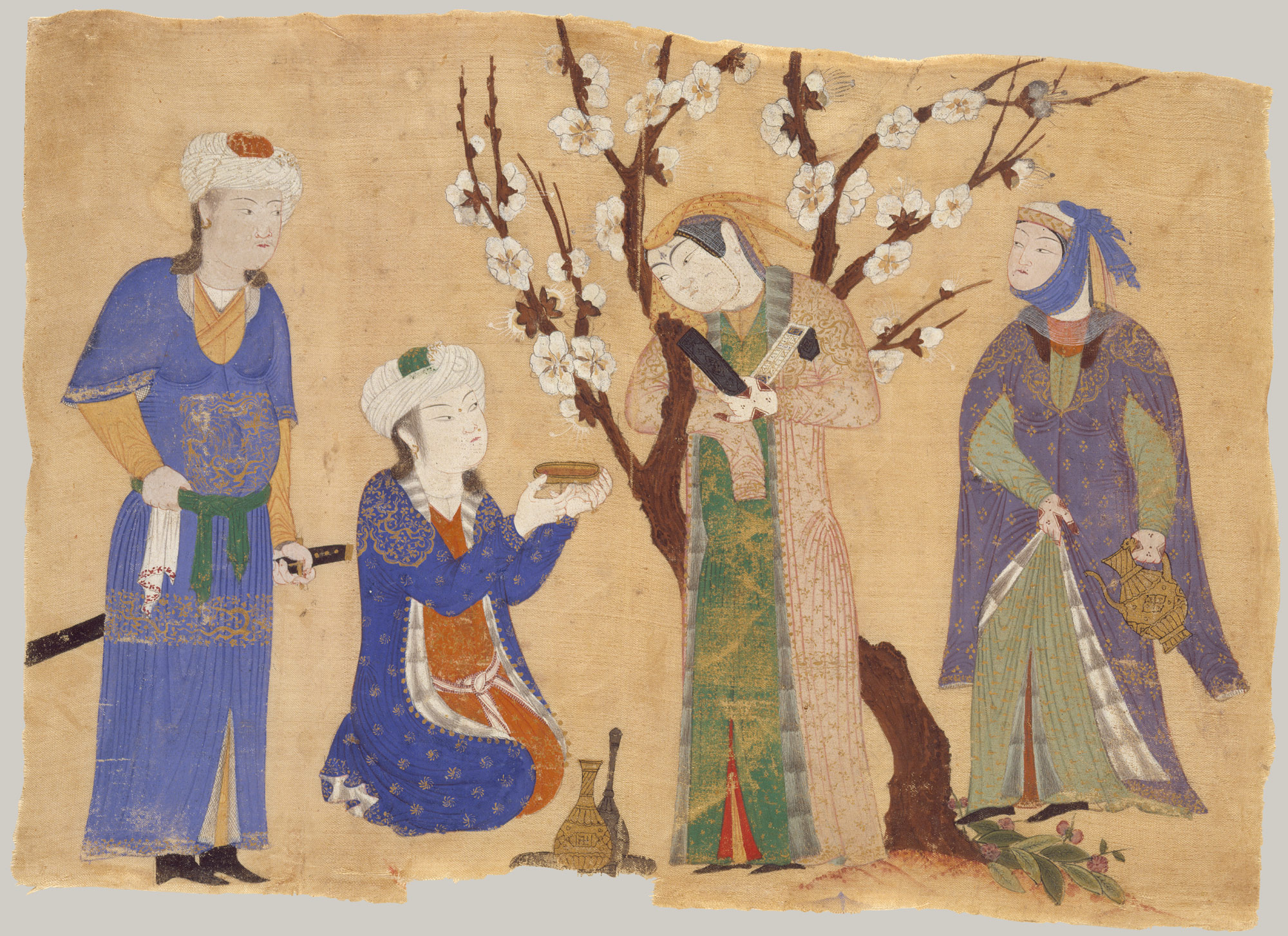
Drinking Wine in the Garden (Persian art)
Let me give you the background on this quatrain I have praised.

Background: (Source: Bob Forrest)

The meaning is: let me drink Wine while I live, and when I die, wash my body in Wine, give me a Vine Leaf for my shroud, and bury me in a nice Garden somewhere.

Edward Scott Waring, in his book A Tour to Sheeraz, by the Route of Kazroon and Feerozabad (1807), of which FitzGerald had a copy, relates the following:

“Many of the great people keep sets of Georgian boys, who are instructed to sing, to play on various instruments, and perform feats of activity. The Persian songs are very sweet and pathetic; and the music which accompanied their voices I thought to be very good. Their songs are in praise of wine and beauty, mixed with frequent complaints of the cruelty of their mistresses. The following is a specimen of their songs:

Hasten hither, O cup bearer! ere I die;
See that my shroud be made of the leafy vine.
Wash me in rosy wine,*
And scatter my ashes at the door of the tavern.
I am faithful, I am still constant;
Turn not away from me, for I am a suppliant.

The Arabic songs are sung in parts, and much quicker than the Persian time. There are two men at Sheeraz who are considered to be very superior players on an instrument very like a violin; I heard them, and admired them much, but could form no judgment on their performance. These men, and the dancers, drink wine in enormous quantities, and that too publicly.” 

Waring’s footnote (*) reads: “It is the custom in all Mussulman countries to wash the body before it is buried.”

A Tour To Sheeraz by Edward Scott Waring (cover)
FitzGerald used several sources himself to create his translation of "The Rubaiyat" by Omar Khayyam. Of course that's okay, but as we have seen / read, sometimes his translation is very different of other translations. Maybe that has to do with the difficulty of translating Persian to English. 

last breath
autumn leaves the low lands
first Robin spotted

© Chèvrefeuille

We are running towards the end of this wonderful CDHK month. There is just one week to go, so I am busy with the preparations of December 2017. That month will be an awesome month full of quotes taken from the novels by Paulo Coelho, one of my favorite authors (as you already know), in which he shares a lot of his knowledge and insights. His novels all have a certain kind of spirituality and philosophy in it, of course in every novel you can sense his presence. December will be really an awesome month I think. Of course I will bring the weekend=meditations too and our traditional "Seven Days Before Christmas" feature. More to come soon!

This episode is NOW OPEN for your submissions and will remain open until November 30th at noon (CET). I will try to publish our new weekend-meditation later on.

PS. I have our new exclusive CDHK E-book in tribute of Jane Reichhold almost ready. I hope to make it available for downloading next week. So you have to be patient ...


Wednesday, November 22, 2017

Carpe Diem #1311 Moving Finger


Dear Haijin, visitors and travelers,

Welcome at a new episode of our Haiku Kai were we are exploring Omar Khayyam's "The Rubaiyat" an anthology of quatrains he wrote during his life time. It's incredible that these beauties became known 100 years after his death. Until than no one knew about this artistic background of this great scholar.

Here at CDHK we are gathered all through that same art ... we are all poets, writers, photographers, painters, sculptors and haijin. In the quatrain for today it's all about "writing" and I will try to explain the background of this quatrain together with Bob Forrest, a connoisseur of Omar Khayyam. He wrote a verse to verse essay about "The Rubaiyat", a great source of knowledge which I have used this month. Next to his ideas I also have my own ideas about the meaning of the quatrains.

Let me give you the verse for today:

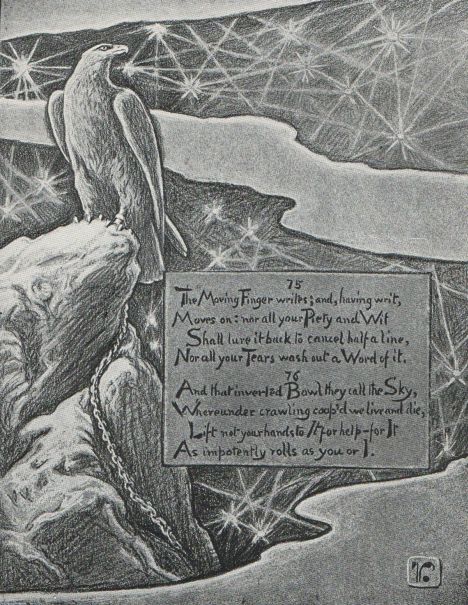
The Moving Finger writes; and, having writ,
Moves on: nor all thy Piety nor Wit
Shall lure it back to cancel half a Line,
Nor all thy Tears wash out a Word of it.

© Omar Khayyam (Tr. FitzGerald)

This is my idea about this quatrain's meaning: In this quatrain Omar praises the beauty of writing, but also the "dark side" of writing, because what is written can not be changed and can be explained in several ways. Isn't that what we are seeking for with our haiku? Writing it and hoping it will be great and don't needs revisions?

Goose feather pen

As you know I write my haiku mostly "impromptu", but I also have revised several haiku that I created, not because of tears that washed out the lines, but because I tried to make them better, maybe more complex, maybe to challenge myself to make the haiku more pure, more transparent, more satisfying. Recently I started to create haiku, the experimental way, to paint with a minimum of words. Sometimes I succeeded in that goal, but it isn't easy to "experiment" with haiku.

Let me go back to the idea of revision, as you maybe can remember Basho revised several of his haiku. There are several haiku by Basho known with the same scene in several versions. Maybe you can remember our CDHK month in which we followed in his footsteps ... We walked his "Narrow Road" with joy and the beauty of his haiku. "Narrow Road" however took Basho five years of revision before he was satisfied with it. So ... revising your haiku, tanka or other poem isn't a bad thing. It shows you as the poet who loves to create his / her poems. The poet cherishes the scene he / she loves to share, the poet becomes one with it. Finally the poem is ready ... your poem will whisper that to your heart.

Okay ... back to the background of this quatrain.

Background: (source: bob forrest web)

The meaning is perfectly clear, and powerful in its expression, but why “the Moving Finger” as opposed to the moving Pen? Perhaps the intention is to portray something like a finger tracing out letters in the (shifting) Sands of Time? Or compare the famous Biblical episode of Belshazzar’s Feast in Daniel 5.5, in which “the fingers of a man’s hand” trace out the words MENE MENE TEKEL UPHARSIN (Daniel 5.25) on the wall. At any rate, a Pen does feature in the original Persian verses on which this verse is based. Heron Allen translated one original verse thus:

From the beginning was written what shall be;
Unhaltingly the Pen (writes) and is heedless of good and bad;
On the First Day He appointed everything that must be –
Our grief and our efforts are vain.

A.J.Arberry translated a similar original verse thus:

Nothing becomes different from what the Pen has once written,
and only a broken heart results from nursing grief;
though all your life through you swallow tears of blood
not one drop will be added to the existing score.

This verse is an excellent example of how FitzGerald takes ideas from Omar Khayyam, and then creates something new and powerful from them which at the same time preserves the essence of the original.

This quatrain, incidentally, became the subject of a sermon delivered by a Reverend E.F. Dinsmore, later published in the form of a booklet, The Moving Finger of Omar Khayyam (1909). Rev. Dinsmore approached the verse from a moralistic point of view, arguing that though one could not wash out the errors of the past, by leading a good Christian life one could minimise the errors of the future, and thus to some extent control the Moving Finger.

Dinsmore made a small booklet of his sermon and used the following illustration by Vedder for its cover.

The Moving Finger (by Rev. Dinsmore; cover)
Writing ... is the most beautiful kind of art (in my opinion). I love writing ...

words
flow like a river
pen moves

© Chèvrefeuille (experimental haiku)

Let your inspiration flow like the ink of a pen, like a finger writing in the sand ... be inspired.

This episode is NOW OPEN for your submissions and will remain open until November 29th at noon (CET). I will try to publish our new episode later on. For now ... have fun!


Tuesday, November 21, 2017

Carpe Diem #1310 Ball Game


Dear Haijin, visitors and travelers,

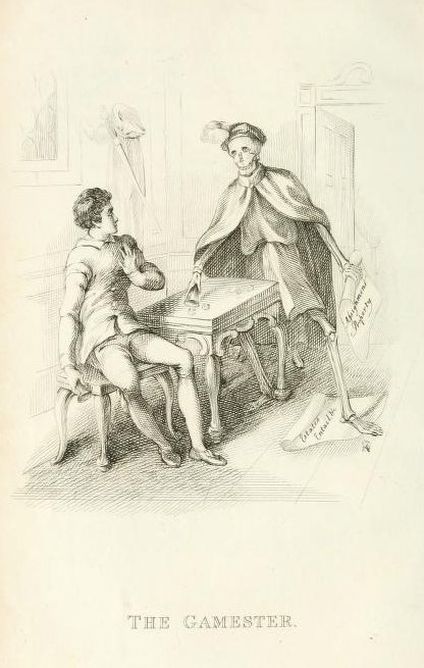
In an earlier episode I told you about "life as a chess game", but as I was exploring the quatrains I ran into another verse in which life is compared with a game. That verse intrigued me so I just had to share it here with you. By the way there are several other ideas about life and death as a game. There are images of the Devil playing dice or being a street-magician ... all to give an image for life and death. Life and death can not be seen separated, because (as we know from the Tibetan Book of Living and Dying) death belongs to life, without death there is no life.

An image to show you the idea that death uses a game:

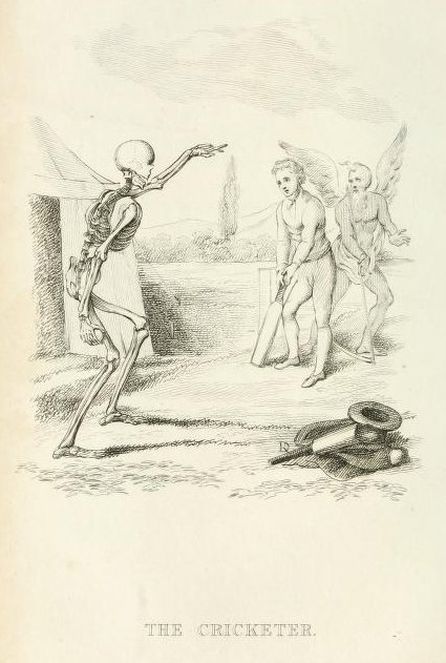
The Devil playing Cricket

Here is the quatrain for your inspiration today:

The Ball no Question makes of Ayes and Noes,
But Right or Left as strikes the Player goes;
And He that toss'd Thee down into the Field,
He knows about it all – HE knows – HE knows!

© Omar Khayyam (Tr. FitzGerald)

Background:

Life here is likened to a Ball Game, actually the equivalent of our modern game of Polo. Ayes are votes in favor of a proposal; Noes are votes against. The first line means that the Ball (Man) has no choice (no vote) in the Game (of Life), it just goes here and there according to the whim of the Player who hits it. The reference here is surely to Free Will and Destiny – we are given Life (the Ball), but how much Choice (Free Will) do we really have in it? We are seemingly just bounced from here to there. But though it makes little sense to us, God (He that tossed thee, the ball, down into the playing field) – he knows what it is all about, he knows, HE knows, for He is Omniscient – he just isn't telling US…. (Another interpretation is in terms of the Rules of the Game: the Ball doesn't know the rules, it just goes here and there according to which player hits it where; only He (God) who made up the game knows the Rules, he knows, HE knows….)

Life (and Death) viewed as a game has given rise to many interesting images, here is another image to show you that.

The Devil playing dice
life is but a game
nature rolls the dices

seasons change

© Chèvrefeuille

I think there is another wonderful game, a game I love by the way, that can be seen as the ongoing battle between good and bad or life and death ... I created a tanka about it:

cherry stone clam
delicious for it's taste -
playing Go
the sweet memories of clams
once tasted

© Chèvrefeuille (2013)

Well ... life is a game ... so enjoy it, because life is short ... as is a game with a limited time.

This episode is open for your submissions tonight at 7:00 PM (CET) and will remain open until November 28th at noon (CET). I will try to publish our next episode later on.

PS. At "My Haiku Pond Academy" on Facebook you can find a new contest in which you are challenged to create Troiku. You can visit the CONTEST HERE.


Monday, November 20, 2017

Carpe Diem #1309 Earth's First Clay


Dear Haijin, visitors and travelers,

Well ... I don't really know if this quatrain for today will inspire you. At least it didn't inspire me, just because of it's difficulties hidden it. This quatrain tells us about the first man, Adam, created from the Earth's first clay, but with this creation he also created the last man ...

Let me give you the quatrain for today:

With Earth's first Clay They did the Last Man's knead,
And then of the Last Harvest sowed the Seed:
Yea, the first Morning of Creation wrote
What the Last Dawn of Reckoning shall read.

© Omar Khayyam (Tr. FitzGerald)

modern art: The Creation of Adam

Background: (source: bob forrest web)

This verse can be taken as a pessimistic suspicion that everything is predestined: with the Earth’s first Clay, from which God created (moulded, as a sculpture) the first man, Adam, God also created (“knead” = shape, as in shaping the dough for a loaf of bread) the clay for the Last Man. The second line likens God’s creation of Man to planting a crop: the Harvest at the End of the World is predetermined by the Seed which God planted at the Beginning. The last two lines neatly contrast WRITE at the Creation, with READ at the End (Last Dawn of Reckoning.)

There are similarities in the creation of Adam in several religions, here it's used as in Islam, but also as used in Christianity.

This episode is NOW OPEN for your submissions and will remain open until November 27th at noon (CET). I will try to publish our new episode later on. For now ... have fun!


Carpe Diem #1308 A Game of Chess


Dear Haijin, visitors and travelers,

I hope you all have had a wonderful inspirational weekend. I had a busy weekend at work, so I hadn't time to publish this regular episode on time. We are going on with our exploration of "The Rubaiyat"  by Omar Khayyam. As I was preparing this episode that I have titled "A Game of Chess" a haiga I created a while ago came in mind. I love to share that haiga here with you, maybe you can remember it.

Haiga "A Game of Chess" (© Chèvrefeuille, 2015)
What has this to do with the inspirational quatrain for today? Well ... in this quatrain Omar Khayyam describes life as a game of chess. Let me give you today's quatrain and than we start "talking" about it.

'Tis all a Chequer-board of Nights and Days
Where Destiny with Men for Pieces plays:
Hither and thither moves, and mates, and slays,
And one by one back in the Closet lays.

© Omar Khayyam (Tr. FitzGerald)

Background:

Life is here likened to a game of Chess or Checkers, the black and white squares of the Chess-board being likened to Nights and Days. Destiny is the player who captures (slays) pieces in the course of the game, removing them from the board and putting them back in the storage box (Closet.) It is Destiny too, who finishes the game – “mates” in Line 3 is “Check Mate” – the term for the end of a Game of Chess. The overall idea is that Destiny kills us all off, one by one.

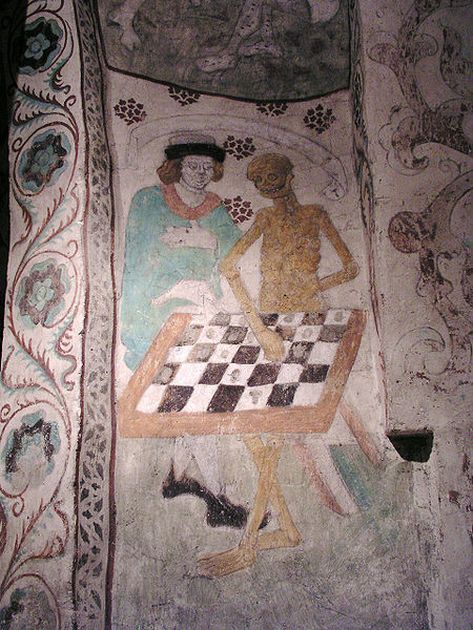
The related image of Death playing Chess with Mortals to decide where and when they will die is probably best known to most people through Ingmar Bergman’s film “The Seventh Seal” of 1957. What is less well known is that Bergman got the idea for this image from a wall-painting in the medieval church of Täby in Stockholm, dating from the latter half of the 14th century!

Death playing Chess (Medieval church Täby in Stockholm)

The idea that human life is a game of the gods is ancient. Thus, as Canter notes in his article “Fortuna in Latin Poetry”, the goddess Fortuna “delights in mockery and in making man the victim of her sport." Thus, Virgil, in The Aeneid talks of Fortuna mocking mankind by knocking them down then picking them up again, as fancy takes; Horace, in his Odes, talks of Fortuna pursuing her wanton sport by deliberately switching her favours from one person to another; and Juvenal in his Satires talks of Fortuna raising men from the gutter to high office just to amuse herself.

The Roman tragedian Pacuvius, who lived in the 2nd century BC, wrote of the goddess Fortuna as follows:

Dame Fortune, some philosophers maintain,
Is witless, sightless, brutish; they declare
That on a rolling ball of stone she stands;
For whither that same stone a hazard tilts,
Thither, they say, falls Fortune; and they state
That she is witless for that she is cruel,
Untrustworthy, unstaid; and, they repeat
Sightless she is because she nothing sees
Whereto she’ll steer herself: and brutish too
Because she cannot tell between the man
That’s worthy and unworthy. But there are
Other philosophers who against all this
Deny that there is any goddess Fortune,
Saying it is Chance Medley rules the world.
That this is more like unto truth and fact
Practice doth teach us by the experience;
Orestes thus, who one time was a king,
Was one time made a beggar.

(The translation is by E.H.Warmington)

In modern times, Bertrand Russell opened his essay “A Free Man’s Worship”, first published in 1903, with an account of God’s creation of Man, as given by the devil Mephistopheles to Dr. Faustus:

“The endless praises of the choirs of angels had begun to grow wearisome; for after all, did he not deserve their praise? Had he not given them endless joy? Would it not be more amusing to obtain undeserved praise, to be worshipped by beings whom he tortured? He smiled inwardly, and resolved the great drama should be performed.”


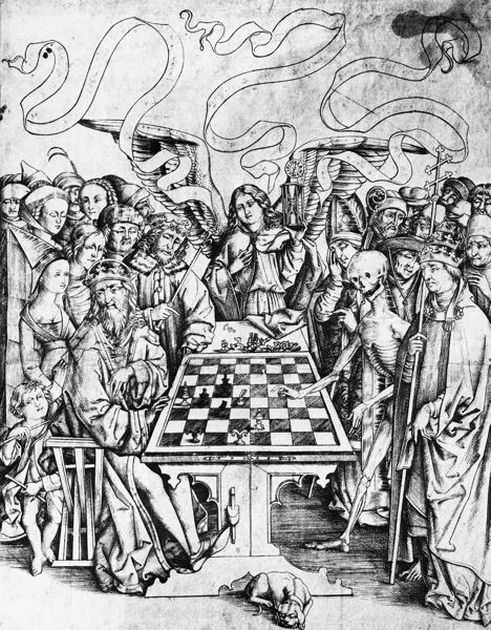
Death Playing Chess by Israhel von Meckenem

Omar Khayyam was very lyrical about death and it seems to me that he accepted the idea of "death belonging to life", as we also saw in the Tibetan Book of Living and Dying by Sogyal Rinpoche, (The theme of our first CDHK Theme-week).

chess
game of life and death
like nature

© Chèvrefeuille

I hope you liked this episode and that it will inspire you. This episode is NOW OPEN for your submissions and will remain open until November 27th at noon (CET). I will try to publish our new episode later on.


Thursday, November 16, 2017

Carpe Diem #1307 The Vessel


Dear Haijin, visitors and travelers,

It's a little bit sad day today. I failed an exam I had today, but well it's not something to worry about. I will make it again on another day. Now I only have my thoughts at this episode. What can I tell you about this quatrain? It's the sequel of the verse of yesterday. These two verses are connected and I will try to explain that with a little help of bob forrest, who wrote a verse to verse explanation of "The Rubaiyat". It's that explanation I used this month already in all the episodes. Before I had heard about "The Rubaiyat", I really hadn't a clue what a quatrain was or who Omar Khayyam was so I just needed a suitable source of information. It took me some time to find the verse to verse explanation, but I am glad that I found it. "The Rubaiyat" is a wonderful compilation of quatrains with a whole lot of hidden layers, without the verse to verse explanation I couldn't make this month.

Omar Khayyam
Let me give you the quatrain for your inspiration:

I think the Vessel, that with fugitive
Articulation answered, once did live,
And merry-make; and the cold Lip I kiss'd
How many Kisses might it take - and give !

© Omar Khayyam (Tr. FitzGerald)

Background:

“The Vessel” here is the earthen bowl of the previous verse. The lip of the bowl becomes the lip of someone once living, and thus once capable of giving kisses.

The idea that, on death, we return to earth or clay from which can be made a Vessel/ Cup/Bowl is but one idea. Another idea is that our clay may become that of simple building bricks. Thus, for example, Hafiz wrote that “this ruined world is resolved, when we are dead, to make only bricks of our clay!” (from Ode VI in the translation by Cowell).

It's a joy to read again a "note" to an other Persian poet, Hafiz, in this explanation. Hafiz is one of my favorite Persian poets and I even think he is also the most loved Persian poet all around the globe. In the poems by Hafiz we found also several hidden layers.

Hafiz quote
In Christian tradition the phrase “ashes to ashes, dust to dust”, is common use in the tradition of a funeral, but it isn’t a phrase in the Holy Scripture it is based on Genesis 3:19, Genesis 18:27, Job 30:19, and Ecclesiastes 3:20. Those passages say that we begin and end as dust.

So is there also a reference to Christian belief in this quatrain by Omar Khayyam? Maybe it is, maybe it is not. I don’t know. However I like the idea that we can find references to Christian belief in a Persian compilation of verses.

smoke rises
from the pyre
to Heaven

© Chèvrefeuille (experimental haiku)

This episode is NOW OPEN for your submissions and will remain open until November 23rd at noon (CET). I will publish our new "weekend-meditation" later on. For now ... have fun!


Wednesday, November 15, 2017

Carpe Diem #1306 The Secret Well of Life


Dear Haijin, visitors and travelers,

Welcome at a new episode of our Haiku Kai were we are exploring the beauty of Omar Khayyam's "The Rubaiyat" as translated by FitzGerald. "The Rubaiyat" is a compilation of 100 quatrains, but as I told you earlier this month, "The Rubaiyat" is just a small part of Khayyam's quatrains, he created around 2000 quatrains.

Today's episode I have titled "The Secret Well of Life". In my opinion "the secret well of life" is similar with the "Elixer of Life" as was the goal for the Alchemists. They not only were searching for the "Stone" to create gold, but also for the "Elixer of Life". If this is true for this quatrain we will see.

As I was preparing this month I read "The Rubaiyat" and there were several quatrains in which Khayyam uses "earthen bowls" or "pots". In this quatrain that's also a theme.

Earthen Pots (this is one of the first logos I used by the way)
Let me give you the quatrain for today and after that the background (source: bob forrest):

Then to this earthen Bowl did I adjourn
My Lip the secret Well of Life to learn:
And Lip to Lip it murmured - "While you live
Drink ! - for once dead you never shall return.

© Omar Khayyam (Tr. FitzGerald)

Background:

This is the first of many references to earthen bowls or pots, which for Omar Khayyam are both drinking vessels and symbolic of people (via Adam being made from clay or earth; hence earth to earth, ashes to ashes etc.) In some cases, he pictures the Clay from which an Earthen Vessel is made as being that formed from the body of some long-dead person which has turned back into earth again. Here, in drinking from the bowl, the poet’s lip presses on the lip of the bowl. Here again we have Omar’s philosophy, repeated throughout the poem, but here expressed by the earthen wine bowl, “Drink! – for once dead you never shall return!”

The following lines by Hafiz involve not only the image of the cup of mortal clay touching the lips of the living, but also other Omarian images of the transience of Kings and of flowers growing from the dust of the dead or from their spilt blood. The translation is from Gertrude Bell's Poems from the Divan of Hafiz (1897), poem 26:

...Time's revolving sphere
Over a thousand lives like thine has rolled.
That cup within thy fingers, dost not hear
The voices of dead kings speak through the clay?
Kobad, Bahman, Djemshid, their dust is here.
'Gently upon me set thy lips!' they say.

What man can tell where Kaus and Kai have gone?
Who knows where even now the restless wind
Scatters the dust of Djem's imperial throne?
And where the tulip, following close behind
The feet of Spring, her scarlet chalice rears,
There Ferhad for the love of Sherin pined,
Dyeing the desert red with his tears.

© Hafiz

(The forbidden love between the lowly Ferhad and the princess Sherin is an old Persian love story. Ferhad killed himself in the desert when he was tricked into believing that Sherin was dead. Hearing of Ferhad's death, Sherin also killed herself, and subsequently the two were buried together.)


Ferhad and Shirin (a Persian lovestory)

The Persian love-story about Ferhad and Shirin is similar with that tragedy created by Shakespeare, Romeo and Juliet. It's a forbidden love, because Shirin is a princess and Ferhad is just a low-ranked man. As Ferhad dies, Shirin takes her own life, because she cannot live with Ferhad.

The title of this episode is extracted from the quatrain used and it can also refer to that strong love as mentioned in the story of Ferhad and Shirin. Isn't love the secret well of life?

This episode is NOW OPEN for your submissions and will remain open until November 22nd at noon (CET). I will try to publish our new episode later on. For now ... have fun!


Tuesday, November 14, 2017

Carpe Diem #1305 No Key


Dear Haijin, visitors and travelers,

Welcome at a new episode of our Haiku Kai. This month it's all about "The Rubaiyat" by the Persian poet and scholar Omar Khayyam. In this 'book' we read quatrains, say about 100 of them, but Khayyam wrote more than 2000 quatrains, however this month we will only look at "The Rubaiyat". The translations I use are by FitzGerald, who published the first English edition of "The Rubaiyat" in the 19th century. FitzGerald gave this selection the title "The Rubaiyat" which means "quatrains".

The Rubaiyat, one of the more recent prints
Todays quatrain (no. 32) is the sequel to the verse of yesterday. Today's episode I have titled "No Key", because it refers to the essence of this verse.
Maybe you can remember that we read "Aleph" by Paulo Coelho while on the Trans Siberian Railroad. In "Aleph" Paulo is on a quest to find his former life. He dreams sometimes of a place with several doors. Those doors cannot open cmpletely, or even not opened at all. There is No Key. "No Key" is something we see and hear regular in spirituality. "No Key" to open the door, the path and more.
In this 32th quatrain that's the essence of the verse ... not all can be opened ...

Here is the quatrain to work with today:

There was a Door to which I found no Key:
There was a Veil past which I could not see:
Some little Talk awhile of ME and THEE
There seemed – and then no more of THEE and ME.

© Omar Khayyam (Tr. FitzGerald)

closed door
Background:

The Door and Veil are metaphorical barriers which prevent us from seeing the answer to the riddle of human Death and Fate. The idea seems to be that while the mysterious voices behind these barriers talk about us, we live; but once they stop talking, we must die. It is interesting that in Islam, “…death is believed to be a door to the realm of the afterlife, which according to Islamic tradition starts with the grave.” It is interesting, too, that “the Veil” is a term commonly used by Spiritualists to describe the supposed barrier that exists between the spirit world and the land of the living.

As I look at this background (source: Bob Forrest) then something is coming to my attention. Omar Khayyam, was not only a poet and scholar, but also a philosopher. In this quatrain he shows us who he looks at the spirit world. As a mystery, something that we can not catch. Another thing which caught my attention is that in the Qu'ran, as it seems, there is also an idea about the afterlife. It is seen as a realm, but that realm we only can reach through opening the door to the grave. That's also the idea about afterlife in Christian tradition. As I was reading this quatrain I thought immediately that Khayyam had questions about the afterlife, he shows that through the use of "the veil" in this verse. "The Veil" between life and death. Can it be that he questioned the afterlife, if that was really the end? Or was he thinking that there had to be something else ... reincarnation for example.

The Veil? The ethereal 4th dimension? Afterlife? Reincarnation?
behind the veil
mystery awaits
new life?


© Chèvrefeuille (experimental haiku)

This episode is NOW OPEN for your submissions and will remain open until November 21st at noon (CET). I will try to publish our new episode later on.


Monday, November 13, 2017

Carpe Diem #1304 The Seventh Gate


Dear Haijin, visitors and travelers,

As I was preparing this month, by reading the entire "Rubaiyat" there were several quatrains I didn't understand. Those quatrains sounded magical and mysterious. Today's quatrain is such a quatrain which I couldn't understand at first, but after reading the background on this verse it became very clear what the meaning was of this quatrain. This quatrain gives you in words a visual of the Universe as was thought about in the time of Khayyam.
Nowadays we know that the sun is the center of our Universe, but in the time of Khayyam everyone thought that the Earth was the center of the Universe. Omar Khayyam as an astronomer however had already ideas about our Universe ... in his idea the sun was the center of the Universe, so he was far ahead of his time.

The Universe
Let me give you the verse for today ... it's again a nice one, but the choice of words sounds magical and mysterious in my opinion.

Up from Earth's Centre through the seventh Gate
I rose, and on the Throne of Saturn sate,
And many Knots unravel'd by the Road;
But not the Knot of Human Death and Fate.

© Omar Khayyam (Tr. FitzGerald)

Background:

Above I already gave a kind of explanation of this quatrain. I think this background (source: Bob Forrest web) will give you all a better explanation of this quatrain.

At the time of Omar Khayyam, the Earth was generally believed to be at the centre of the universe, and surrounded by seven spheres associated with the then known seven planets. In order of distance from the Earth, the spheres were those of: (1) The Moon, (2) Mercury, (3) Venus, (4) the Sun, (5) Mars, (6) Jupiter, (7) Saturn. The sense of this verse is that the Poet ascended to the outermost sphere of the universe so that he could view the whole “from the outside”, and though this journey made many things clear to him, he could still not see the answer to the riddle of human Death and Fate.

The Ancient Idea Of The Universe, The Flower Of Life

It is sometimes said that Omar Khayyam, as an astronomer, was ahead of his time, and advocated a Sun-centred model of the Universe rather than the more ‘obvious’ Earth-centred one, but this verse does seem to be Earth-centred. Of course, this is FitzGerald’s translation, and is a poetic reference rather than an astronomical one. Nevertheless, more literal translations of the Persian also seem to be Earth-centred. Thus Edward Heron-Allen gives, “From the Nadir of the earthly globe, up to the Zenith of Saturn”; and Edward Henry Whinfield, “down from Saturn’s wreath, unto this lowly sphere of Earth beneath.” 

at sunrise
birds praising their Creator
without questions

© Chèvrefeuille

Let me give you a brief explanation of this haiku. We humans are always searching for answers, we have thousand questions, we want to know everything, but birds never question their existence and praise their Creator every day again. Isn't that awesome ... !?

This episode is NOW OPEN for your submissions and will remain open until November 20th at noon (CET). I will try to publish our new episode later on.


Sunday, November 12, 2017

Carpe Diem #1303 Seed of Wisdom


!! Sorry for being this late with publishing !!!

Dear Haijin, visitors and travelers,

Welcome at a new episode of our wonderful daily meme here at Carpe Diem Haiku Kai, the place to be if you like to write and share Japanese poetry. A warmhearted family of lovers of Japanese poetry.
We are busy with the exploration of Omar Khayyam's "The Rubaiyat" and until today I think it is a joy to read your responses on all these beautiful quatrains.

Our episode's title "seed of wisdom" is extracted from the 28th quatrain from "The Rubaiyat" and I love to tell you a little bit more about the "seed of wisdom". On several occasions I was adressed as "sensei" or "master", but in my opinion that's to much honor. I am only a guy who loves to share a little bit of his knowledge about haiku, tanka and other Japanese poetry forms. Of course there was once a seed planted, I think in my case, that was somewhere in the late eighties as I discovered haiku. I was immediately caught by this wonderful tiny poem from the Far East. I studied several books about this poetry form and as I started CDHK in 2012 I was a connaisseur of haiku and later on I also became addicted to Tanka and studied that form too. And than ... there is of course my own philosophy in which "unconditional love for all and everything" is the most important idea. That "seed of wisdom" was planted back in the time I was a teenager, in that time I ran into the occult and was caught by it. It made me sick and it took a while to become free again, but in that time I found the reason of my life here on earth, I found the wisdom I needed ... I even gave word to it in one of the novels I have written ... the "seed of wisdom" has bloomed and still blossoms further ...

Seed Of Wisdom
Here is the quatrain to work with. I will of  course give you also a little bit background on this quatrain.

With them the seed of Wisdom did I sow,
And with mine own hand wrought to make it grow;
And this was all the Harvest that I reap'd--
"I came like Water, and like Wind I go."

© Omar Khayyam (Tr. FitzGerald)

Background:

The development of the Poet’s philosophical studies are likened to a crop – seed, growth, harvest – and yet the end result is the realisation of the utter transience of earthly life, and the pointlessness of philosophising: “I came like Water, and like Wind I go”. Compare the reference to the Wind in John 3.8 (“The wind bloweth where it listeth, and thou hearest the sound thereof, but canst not tell whence it cometh, and whither it goeth…”); also the epitaph on the tomb of the poet John Keats in Rome: “Here lies one whose name was writ in water.”

Much less well known than the epitaph of Keats is the following verse by John Masefield, typewritten on a piece of paper addressed to his "Heirs, Administrators and Assigns", and found only after his death in 1967. Curiously, it asks that Water and Wind be allowed to disperse his ashes after cremation:

Let no religious rite be done or read
In any place for me when I am dead,
But burn my body into ash, and scatter
The ash in secret into running water,
Or on the windy down, and let none see;
And then thank God that there's an end of me.

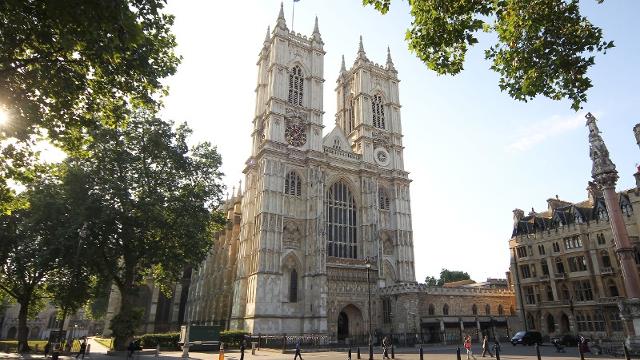
Westminster Abbey London England

He didn't get his wish, of course - as Poet Laureate he was doomed to have his ashes interred in Poets' Corner in Westminster Abbey, amidst traditional pomp and ceremony. Also ignored were his wishes regarding publication of his life and letters, as expressed in a short poem entitled "Sweet Friends", which poem became the last in the edition of the Collected Poems of John Masefield, first published by Heinemann in 1923:

Print not my life nor letters; put them by:
When I am dead let memory of me die.
Blessed be those who in their mercy heed
This heartfelt prayer of mine to Adam's Seed;
Blessed be they, but may a curse pursue
All who reject this living prayer, and do.

I like to explore the background of these quatrains by Omar Khayyam, but of course I have my sources to share this background with you all.

sunflowers bloom
seed of wisdom spread out
a new day rises


© Chèvrefeuille

Sorry for being late. This episode is NOW OPEN for your submissions and will remain open until November 19th at noon (CET). I will try to publish our new episode later on. I am on the nightshift so I hope to be on time tomorrow.


Thursday, November 9, 2017

Carpe Diem #1302 past regrets and future fears


Dear Haijin, visitors and travelers,

Another day has gone and here I am again, after a bad day of sleep, because I am on the nightshift, to create a new episode in our wonder Haiku Kai were we are a loving family of haiku poets. That love makes me proud. Five years ago I started CDHK and here we are still alive and kicking better than ever.

This month it's all about "The Rubaiyat" by Omar Khayyam, a 12th century Persian poet and scholar. It's his legacy we are using this month. Through his quatrains we get a glimpse of the time he lived in. And even today his work still renown and loved as we can see this month.

Omar Khayyam (image found on Pinterest)
Today I have another beautiful quatrain for you to work with. In this quatrain one of the themes of "The Rubaiyat" returns again, wine and drinking it. In one of the earlier episodes I shared already a few quatrains in which this theme is mentioned.

Let me give you the quatrain for today:

Ah! my Beloved, fill the Cup that clears
TO-DAY of past Regrets and future Fears –
To-morrow? – Why, To-morrow I may be
Myself with Yesterday's Sev'n Thousand Years.

© Omar Khayyam (Tr. FitzGerald)

Background:

“The Cup that clears” = a glass of wine; the meaning is not unlike drinking to drown one’s sorrows over past regrets and future fears. The end of the verse seems to mean something like “tomorrow, the ‘me’ of today will just be another part of history”. According to some, in Omar Khayyam’s day, “yesterday’s 7000 years” was reckoned to be the number of years of human history that had elapsed since the creation of Adam and Eve, though FitzGerald, in his first edition, thought it signified 1000 years for each of the 7 planets.

Planets

Any reference to tomorrows and yesterdays almost inevitably recalls that famous speech from Macbeth (Act 5, Scene 5) beginning:

To-morrow, and to-morrow, and to-morrow,
Creeps in this petty pace from day to day,
To the last syllable of recorded time;
And all our yesterdays have lighted fools
The way to dusty death.


As I read this quatrain I immediately became in touch with it. The scene described in  "the Cup that clears TO-DAY of past Regrets and future Fears" is recognizable. I think we all can relate to that scene. There was a time I drank to much to forget my sorrows, my problems ..., but there is always a way out. I "survived" that time through the (unconditional) love of my family and friends. There even came a day that I decided to never drink again. Of course a great goal to strive for, but a nice cold beer now and than I can really appreciate.

tears
splash into wine
dreams

© Chèvrefeuille (experimental haiku)

A short episode maybe, but in it is a whole story to relate to, and I even think it's one of the quatrains that for sure can inspire you in a great way.

This episode is NOW OPEN for your submissions and will remain open until November 16th at noon (CET). I will try to publish our new episode, a new weekend-meditation, later on. Have fun!