Showing posts with label classical kigo for spring. Show all posts

Monday, April 29, 2019

Carpe Diem #1653 passing spring (yuku haru)


Dear Haijin, visitors and travelers,

Welcome at the last episode of this month in which we explored the beauty of modern and classical kigo for spring and because of the fact that this is the last episode I have chosen for a classical kigo that fits this last episode ... passing spring (yuku haru).

At the end of spring we are longing for summer, spring has passed by and has spread new life all around us. Nature is in full bloom and the bare branches are covered with blossoms and young green leaves. The meadows are sprinkled with the most beautiful flowers on earth ... isn't it exiting? Finally we can say ... the light has returned to us and now we may celebrate summer.

Spring passes
and the birds cry out—tears
in the eyes of fishes

© Matsuo Bashō (Tr Sam Hamill, taken from "Narrow Road Into The Deep Interior")

The above haiku is an example of this classical kigo, passing spring (yuku haru), isn't it a beauty?
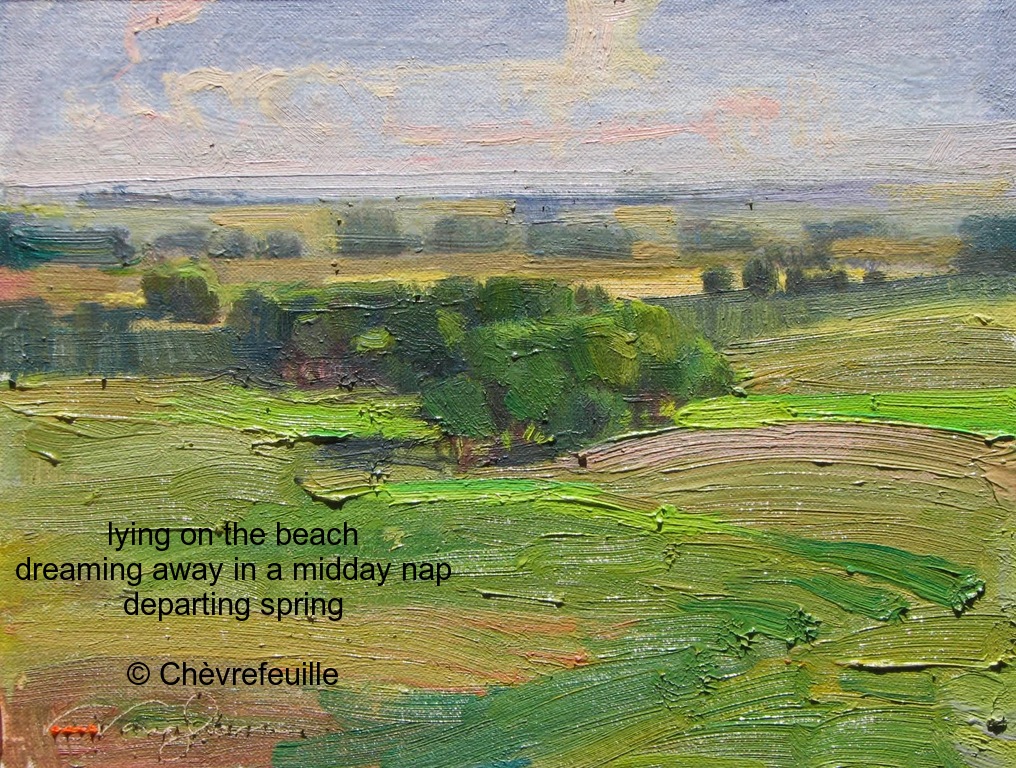


lying on the beach
dreaming away in a midday nap
departing spring

© Chèvrefeuille

I couldn't come up with a new haiku, so I shared a beauty from my archive. This episode is NOW OPEN for your submissions and will remain open until May 6th at noon (CEST). I will try to publish our new (first) episode of May later on. Next month all the prompts will be Tan Renga Challenges. For now ... have fun!


Thursday, April 18, 2019

Carpe Diem #1651 dropwart (seri), Japanese parsley


Dear Haijin, visitors and travelers,

What a wonderful spring day we have had here in The Netherlands. Whole day sunshine a really nice temperature ... it felt almost like a early summer day. Yes it was a gorgeous day. And I hope you all have had such a wonderful day too.

This month it's all about classical and non-classical kigo (seasonwords) for spring and today I have another nice classical kigo taken from the Shiki saijiki, dropwart (seri) or Japanese parsley.

Dropwart (Seri) (Japanese Parsley)
Dropwart is part a broad range of herbs, there are a lot of species of this parsley family. It's a spring kigo that is (was) used all spring, because it grows and blooms in all spring.

I have found a nice example for this classical kigo, a haiku by Yosa Buson (one of the "big five" haiku poets):

furudera ya houroku suteru seri no naka

By an old temple
a broken clay kitchen pot
in a field of water parsley


© Yosa Buson

And here is another "parsley"-haiku:

This is all there is;
the path comes to an end
among the parsley.


© Alan Watts

Two wonderful haiku I think as an example for this classical kigo for spring.

This episode is NOW OPEN for your submissions and will remain open until April 25th at noon (CEST). I will try to publish our new weekend meditation later on.


Tuesday, April 16, 2019

Carpe Diem #1649 shining wind (kaze hikaru)


Dear Haijin, visitors and travelers,

Welcome at a new episode of our wonderful Carpe Diem Haiku Kai, the place to be if you like to create haiku, tanka or other Japanese poetry form, and share them with the world. This month we are exploring classical and non-classical kigo (seasonwords) for spring, And today I have another nice classical kigo for spring taken from the Shiki Saijiki, "shining wind (kaze hikaru).

It's a not so renown kigo and it needs a little bit of explanation. Shining wind (kaze hikaru) refers to  the sparkling of spring sunshine and a gentle wind on a sunny spring day.

Here is an example of the use of this kigo in a haiku:

kaze hikaru makoto no nata ni hanagoro mo

Wind shines
around truth's flag
and the symphony of flowers as well

© Taeko Watanabe. (*1960 -)


Katsushika Hokusai- Plum Blossom and the Moon

fragile green leaf
whispers in the shining wind
in early sunlight


© Chèvrefeuille

Well ... I am looking forward to your responses. This episode is NOW OPEN for your submissions and will remain open until April 23rd at noon (CEST). I will try to publish our new episode later on.


Monday, April 15, 2019

Carpe Diem #1648 skylark (hibari)


Dear Haijin, visitors and travelers,

What a wonderful spring day we had here in The Netherlands. It felt almost like early summer, I even could stay a while outside in the garden enjoying the warmth of the sun on my face. Yes ... it was an awesome spring day.

This month we are exploring classical and non-classical kigo for spring and today I have another wonderful classical kigo extracted from the Shiki saijiki for you all to work with. Our classical kigo for today is Hibari (Skylark).


Skylark (woodblock-print by Bijutsu Sekai (1803-1896)

And here are a few haiku from my archive:

mezzo-soprano sings
a love song by Chopin -
cry of a Skylark   

in touch with the gods
pine trees reaching for heaven -
skylarks sing their song

© Chèvrefeuille

And here is another example with this classical kigo created by Matsuo Basho (1644-1694), my sensei:

hibari naku naka no hyoshi ya kiji no koe

through the skylark's singing
comes the beat
of pheasants' cries

© Basho


Ofcourse I had to create a new one and that wasn't an easy task, but I think I succeeded with the following haiku:

high in the sky
the faint shadow of a skylark
hear! he praises the Creator


© Chèvrefeuille

This episode is NOW OPEN for your submissions and will remain open until April 22nd at noon (CEST). I will try to publish our new episode later on.


Sunday, April 14, 2019

Carpe Diem #1647 Japanese-radish flower (daikon no hana)


Dear Haijin, visitors and travelers,

I hope you all have had a wonderful weekend full of inspiration. I am looking forward to all of your wonderful "new masterpieces". Maybe you have written that masterpiece just a few minutes ago or maybe you have written it a while ago, but weren't sure of it was a masterpiece. Well ... in my opinion every haiku, tanka or other Japanese poetry form is a masterpiece, because you have written it. It was your experience with nature, that moment short as the sound of a pebble thrown into water.

This month we are exploring the classical and non-classical seasonwords for spring. Spring is the season of new life. Everywere you look you can see that new life, young green leaves, a diversity of blossoms and flowers ... birds creating their new nest ... to create new life.

wakaba shite    om me no shizuku    nuguwa baya

young leaves
I would like to wipe away
tears in your eyes

© Basho (Tr. Chèvrefeuille)

Young Green Leaves
But let us take a look at our new spring kigo. Today I have chosen for a classical kigo taken from the Shiki saijiki, Japanese-radish flower (daikon no hana), but what kind of plant this is? I have ran through the Internet and found the following description of this plant.

Daikon literally means ‘big root’. This long white crunchy vegetable looks like horseradish, but it’s mild-flavored, similar to watercress. Daikon is also known as winter radish, oriental radish or Japanese radish. By itself, daikon radish is a superb vegetable. It’s a staple of Japanese food culture,  whether pickled, garnished, or served steaming in miso soup. Traditionally know as a yin food, it cools and calms the body.

Japanese-radish flowers (daikon no hana)
Here are a few examples for this classical kigo by my master Matsuo Basho:

kiku no ato daikon no hoka sara ni nashi

After the chrysanthemums,
Apart from radishes,
There is nothing.

mononofu no daikon nigaki hanashi kana

samurai's gathering--
their chat has the pungent taste
of daikon radish

© Matsuo Basho (1644-94)

And now ... it is up to you my dear CDHK family-members. This episode is NOW OPEN for your submissions and will remain open until April 21st at noon (CEST). I will try to publish our new episode later on.


Monday, April 8, 2019

Carpe Diem #1643 beach combing (shiohigari)


Dear Haijin, visitors and travelers,

Before I start this new episode I have an announcement to make. As you all know I love creating our wonderful Haiku Kai, but as you all know too, it takes a lot of my time. I don't have a problem with that, but my family has. Every day I am busy with creating CDHK through research, conceptual posts and so on. So my wife and kids sometimes tell me to put away my laptop and give time to them. Ofcourse I am willing to do that. So earlier today I decided to take a week of this month. This means, one week there will not be a new episode every day. The only thing I do in that week is creating the "Heeding Haiku With Chèvrefeuille" episode at Mindlovemisery's Menagerie. I will take a week off every season from now on. My first week off is this month April 19th until April 27th. I will publish our weekend meditation before that week off on Friday 19th and at the end of that week I will "restart" on Friday 26th with our weekend meditation. I hope this will give me some time to relax and giving more time to my family. I hope you all don't have a problem with that.


beachcombing (image © Marge Lachmuth)

Maybe you think "beachcombing? that sounds modern", but that isn't true, it's a classical kigo for spring taken from the Shiki Saijiki. Beachcombing is a wonderful acitivity, it's a kind of treasurehunt along the beach at low tide. Let me give you the Japanese description of beachcombing (shiohigari):

The Shiohigari is a popular Japanese tradition during spring and summer. In the literal sense of the word, it means "tide hung-out-to-dry hunt". It is an outdoor leisure activity of clam digging that is usually enjoyed by families and group of friends. It is in the months of March to June that it is normally done, but it is best to do it in May and June due to air temperature and water condition. It is also during the golden week that the beaches are the most crowded.  Annually, thousands of Japanese drive down to the beaches to hunt down Asari or Japanese littleneck clams. Then, the clams will be enjoyed later in a sumptuous meal.


Beachcombing (image found on Pinterest)

Here is an example haiku with this kigo by Chiyo-Ni:

On the low-tide beach,
Everything we pick up
Moves.

Or this one created by Basho:

A green willow,
Dripping down into the mud,
At low tide.

And to conclude this episode about "beachcombing" a haiku by a not so renown haiku poet, Rofu:

Ebb-tide;
The crab is suspicious
Of the footprint.

Well ... I think you all understand the meaning of this kigo and how to use it. So have fun!

This episode is NOW OPEN for your submissions and will remain open until April 15th at noon (CEST). I will try to publish our new episode later on.


Tuesday, April 2, 2019

Carpe Diem #1639 blossom haze (hanagumori)


Dear Haijin, visitors and travelers,

Spring ... my favorite season (next to autumn). I love spring and I am always glad to see the first signals od spring. For example: first cherry blossom and snowdrops. Yes spring ... nature leaves its hibernation state and comes alive again.

This month we are exploring the classical and non-classical kigo (seasonwords) for spring and today I have a wonderful classical kigo for you to work with. Today our classical kigo is blossom haze (hanagumori). I will try to explain the meaning of this kigo.

A clouded sky during the Cherry blossom season, blossom haze, is "hanagumori", only in this season used as a kigo for late spring and never used for other flowers in haze or clouds. (Source: Gabi Greve's World Kigo Database)

An example by Shiki:

hanagumori miyako so sumi no Asukayama

blossom haze -
in a corner of the capital
is Asukayama 

© Masaoka Shiki

And another one, more of modern times, by Ayabe Jinki (1929-2015)

tenpura ni kagiru sakana ya hanagumori

this fish is best
as Tempura . . .
cherry blossom haze 

© Ayabe Jinki

blossom haze (hanagumori)

Of course I have given it a try to create a haiku with this classical kigo about blossom haze:

against dark clouds
more fragile than they aready are
cherry blossoms


© Chèvrefeuille

And I found a few other haiku on blossom haze in my archive:

blossom haze -
walking in the middle
of falling petals

Ah! those cherries
have to let go their blossoms -
blossom haze

© Chèvrefeuille (2013)

All beautiful haiku on blossom haze. I hope I inspired you with this new episode on blossom haze, a classical kigo for spring.

This episode is NOW OPEN and will remain open until April 9th at noon (CEST). I will try to publish our new episode later on.