Showing posts with label tea. Show all posts

Monday, February 13, 2017

Carpe Diem #1153 Raku, Japanese pottery


Dear Haijin, visitors and travelers,

Several episodes ago I told you a little bit more about the tea ceremony and I treated you on a haibun about the tea ceremony. I love to go back to that haibun for a while with this quote:

[...] "The tea ceremony is coming to an end. I admire the earthenware tea bowls." [...]

The tea bowls are wonderful pieces of art work and they are created with a beautiful and aesthetic manner of pottery. This pottery is called Raku. And I love to tell you a little bit more about this other wonderful Japanese art form, Japan is really a country in which art is very important and we will see several kinds of Japanese art work this week. Yesterday I started with Ikebana and today that will be Raku, the Japanese way of pottery.

Black Raku Tea Bowl, with Crane
Look at that beautiful tea bowl ... isn't it wonderful, so fragile, but strong, not perfect, but almost perfect as it was meant to be.

Raku ware (raku-yaki) is a type of Japanese pottery traditionally used in Japanese tea ceremonies, most often in the form of chawan tea bowls. It is traditionally characterized by being hand-shaped rather than thrown; fairly porous vessels, which result from low firing temperatures; lead glazes; and the removal of pieces from the kiln while still glowing hot. In the traditional Japanese process, the fired raku piece is removed from the hot kiln and is allowed to cool in the open air.
Raku means "enjoyment", "comfort" or "ease" and is derived from Jurakudai, the name of a palace, in Kyoto, that was built by Toyotomi Hideyoshi (1537–1598), who was the leading warrior statesman of the time.

In the 16th century, Sen Rikyū, the Japanese tea master, was involved with the construction of the Jurakudai and had a tile-maker, named Chōjirō, produce hand-moulded tea bowls for use in the wabi-styled tea ceremony that was Rikyū's ideal. The resulting tea bowls made by Chōjirō were initially referred to as "ima-yaki" ("contemporary ware") and were also distinguished as Juraku-yaki, from the red clay (Juraku) that they employed. Hideyoshi presented Jokei, Chōjirō's son, with a seal that bore the Chinese character for raku. Raku then became the name of the family that produced the wares. Both the name and the ceramic style have been passed down through the family (sometimes by adoption) to the present 15th generation (Kichizaemon). The name and the style of ware has become influential in both Japanese culture and literature.

Raku ware marked an important point in the historical development of Japanese ceramics, as it was the first ware to use a seal mark and the first to focus on close collaboration between potter and patron. Other famous Japanese clay artists of this period include Dōnyū (grandson of Chōjirō, also known as Nonkō; 1574–1656), Hon'ami Kōetsu (1556–1637) and Ogata Kenzan (1663–1743).

White Raku teabowl Fuji-san (Mount Fuji) by Honami Kōetsu
The above white tea bowl named Fuji-San is in my opinion the top perfection. I love these rough style non-glazed tea bowls to me this is the beauty and the aesthetic of Raku, but that's just my humble opinion.

I found a nice haiku by Basho which in a way directs to the tea ceremony:

A monk sips morning tea,
it's quiet,
the chrysanthemum's flowering.

© Matsuo Basho (Tr. Robert Hass)

Is he referring to the tea ceremony created by Rykyu? I don't know, but it creates that scene in a very nice way.

Or this beauty inspired on a tea bowl written by Kikusha-Ni

in the tea bowl
this motion of the clouds
of 'little spring'

© Kikusha-Ni (Tagama Kikusha Zennshu (1753-1826)

Kikusha-Ni describes a tea bowl in this one and it looks fabulous.

A last one written by Yozakura, the Unknown haiku poet:

in this tea house
the smell of cherry blossoms
scooping hot water

© Yozakura

Awesome!

Tea Bowl (Raku art) image found on Pinterest
To close this episode about Raku I love to share a haiku from my archives. I wrote this back in 2014:

crystal clear water
ghostly curls of steam -
the perfume of tea

© Chèvrefeuille

And ... of course ... I have tried to create a new haiku also, more related to Raku:

perfection
this tea bowl
and cherry blossoms

© Chèvrefeuille

translucent tea cup
hides a deep secret
ghost of tea
geisha gathering tea leaves
for her lover’s ceremony

© Chèvrefeuille

Well .... I hope I have inspired you today. This episode is NOW OPEN for your submissions and will remain open until February 18th at noon (CET). Have fun!


Thursday, January 28, 2016

Carpe Diem #905 Throw That Pebble #3 drinking tea


Dear Haijin, visitors and travelers,

It is time again for our special feature "Throw That Pebble" with (of course) the regular prompt. Today that prompt is "drinking tea" and it is a modern kigo extracted from Jane Reichhold's "A Dictionary of Haiku". By the way ... recently I got a very uplifting email from Jane and I love to share a quote from that email with you.

Quote from email by Jane Reichhold:

[...] "You simply amaze me with the wealth of information you have on your website! You have one of the best sites on Japanese poetry you know! I am proud of you and pleased to be associated with you! Thanks for letting me tag along." [...]

I am honored that someone, that famous, like Jane Reichhold, says this about Carpe Diem Haiku Kai. I am just your humble host and I am glad and proud to be your host and to glorify the beauty of haiku and all those other wonderful Japanese poetry forms.


Today our prompt is drinking tea and as you all know the Japanese have drinking tea raised to an art-form. Tea ... a lovely hot drink, but also as ice-tea a good drink. Tea is worth a ceremony as we can see in classical Japan.


Japanese green tea

In Japan (even now) the tea ceremony is wonderful. I have once written a haibun on the tea ceremony of Rykyu, unfortunately that haibun I have written in my maiden language Dutch. The tea ceremony is full of spirituality and aesthetic.
Tea ... what about tea? Just tea ... enjoy it ... you.re so blessed when you drink tea (it's not my kind of drink, I am more of coffee). Take a cup and be inspired to write a haiku.

drinking tea
together with friends
what a party

what a party
being part of Rykyu's tea ceremony
drinking tea is art
© Chèvrefeuille

And here are a few haiku written by Jane Reichhold about tea for your inspiration


morning light
the taste of snow
in thin tea

heart-shadow
handle of a cup
of herb tea

clear tea
holding a calm
in the storm

out of the cup
cold air giving steam
a shape
© Jane Reichhold

Ah! That wonderful and very spiritual tea ceremony ... awesome isn't it?

As you know for "Throw That Pebble" you have only 24 hours to respond. Why such a short time? Well ... because haiku is the impression of a moment as short as the sound of a pebble thrown into water. That's why I challenge you to respond within 24 hours ... to learn to stay in the moment ... that short moment of time which is described in haiku.

This episode is NOW OPEN for your submissions and will remain open until January 29th 7.00 PM (CET), that's only 24 hours! I will (try to) publish our new episode, Ume-no-hana (ume flower), later on.


Saturday, July 18, 2015

Carpe Diem Utabukuro #5 Origami frog


Dear Haijin, visitors and travelers,

It's Saturday again, and as you all know it's my weekend off, but as Always I do the special episodes myself. And today that's an all new episode of our special feature "Carpe Diem Utabukuro".

This feature is based on a haiku by Basho which he wrote when he was around 22 years of age, it's one of his earliest known haiku according to Jane Reichhold. The logo above is a bag with a wonderful Japanese woodblock-print and in the logo you can read the romaji translation of the haiku on which this new feature is based. I will give that haiku here again:

はなにあかぬなげきやこちのうたぶくろ
hana ni akanu
nageki ya kochi no
utabukuro


© Basho
And this is the translation by Jane Reichhold:

flower buds
sadly spring winds cannot open
a poem bag


© Basho (Tr. Jane Reichhold)
The goal of CD's Utabukuro is not difficult, because I just ask you to share a haiku or tanka which you admire. That haiku or tanka can be one of a classical or non-classical haiku poet or one by yourself. You can choose what ever you like, but it has to be a haiku or tanka. Maybe the haiku brings you sweet (or sad) memories or you just like it. Explain why you have chosen that haiku or tanka to share here "in" CDHK's Utabukuro, poem bag, and ... that is the second task for this feature, write/compose an all new haiku inspired on the one you have chosen.

William J. Higginson (1938-2008)
This time I have chosen for a series of three haiku written by William J. Higginson (1938-2008) a well known American haiku poet, who once was the president of the Haiku Society of America. He has written wonderful haiku and these three in particular I like the most. I will first give the three haiku which I have chosen:
origami frog:
what old pond is he hoping
to find in the dusk?

I look up
from writing
to daylight.
writing again
the tea water
boiled dry

© William J. Higginson (1938-2008) 
Origami: Jumping Frog
That first haiku touched me, because it brought immediately that wellknown haiku by Basho, my master, in mind:
ふるいけやかわずとびこむみずのおと
furu ike ya
kawazu tobikomu
mizu no oto


an ancient pond
a frog jumps in
the splash of water


© Basho (1644-1694)
The haiku by Higginson is a nice reproduction of this classic haiku and it refers towards that classic haiku by Basho. I like the humor in it.
I think you can recall the haiku which I wrote as an example of the baransu haiku writing technique with the first line of this well known haiku by Basho:

the old pond
yesterday ... Irises bloomed
only a faint purple
© Chèvrefeuille

And there are more haiku written, inspired on this one, so here is another example:

little child
reaches for the water lilies
not seeing the frog


© Chèvrefeuille
Or what do you think of this one composed by Yozakura (the Unknown Haiku poet):

against his nature,
a frog in front of the fireplace -
the cry of a stork
© Yozakura

All wonderful haiku I think, and all in some way connected to that famous "frog pond"- haiku.
The other two haiku by Higginson touched me because of the imagery in it. I see myself as the poet who sees the new day rise and who let the tea water boiled dry. I really can imagine those scenes. As I am busy preparing the posts for CDHK than I am all with haiku and cdhk and time flies without thinking of time. So those two haiku can be easily be written for me ... as I am totally with haiku ...

time flies
another 24 hours gone
writing haiku

© Chèvrefeuille

And I love to share a "tea-haiku" which I once wrote back into 2012 for Poets United's Wonder Wednesday. (You can find that post HERE).

translucent tea cup
hides a deep secret
ghost of tea


geisha's secret life
gathering tea leaves
for her lover


© Chèvrefeuille
Geisha
I hope you did like the read and I hope to see nice posts in response ... you don't need to use the haiku mentioned here by the way, you can choose a favorite haiku or tanka and share your feelings with us, the only thing needed is that you have to write an all new haiku or tanka inspired on the poems you have shared. Have fun.

This Utabukuro episode is open for your submissions at noon (CET) and it will remain open until next Saturday July 25th at noon (CET).

Saturday, October 18, 2014

Carpe Diem "Sparkling Stars" #10, Tea


Dear Haijin, visitors and travelers,

As I am preparing this episode of "Sparkling Stars" (I first write all the episodes, before setting them online) it's around 5.30 AM (CET) and I am not in the nightshift anymore, but I couldn't sleep. I have slept that's for sure, but only for a couple of hours, a very deep sleep. As I awoke I tried to stay in bed for a while, but couldn't sleep anymore. So I got up to make me a cup of tea and something to eat.
That cup of tea brought an image in mind, the tea-ceremony as performed by the classical tea-master Rykyu. Isn't it great to take part in such a tea-ceremony?
I remember that I once wrote a haibun about me being a participant in a tea-ceremony performed by Rykyu. It was a great experience.

Yozakura (1640-1716)

Not so long ago I introduced Yozakura (1640-1716) , the unknown haiku master, to you all. Recently I discovered a few haiku written by him and I love to share them with you all. These haiku he must have written after participating in a tea ceremony, but I don't know that for sure.

deep silence
only the sound of boiling water
an empty cup

© Yozakura

all alone
at the foot of Mt. Fuji -
tea and nothing else

© Yozakura

in this tea house
the smell of cherry blossoms
scooping hot water

© Yozakura

All wonderful haiku I think and in a way all associated with tea or the tea ceremony. In classical (and non-classical) Japan drinking tea is a spiritual and religious experience. The Japanese have turned drinking tea into an Art.


crystal clear water
ghostly curls of steam -
the perfume of tea

© Chèvrefeuille

Look around and see the beauty of the little things, the beauty of boiling water. Try to see Art in all those little things.

shimmering pebble
between colorful leaves -
departing summer

© Chèvrefeuille

Can you do that? I think you all can see the beauty in those little things, because that's what haiku does with you, with us. Through haiku, that short moment, that eye blink, we make Art

I am looking forward to all of your beautiful pieces of Art ... haiku inspired on the above haiku, this post ...

This episode is NOW OPEN for your submissions and will remain open until next Saturday October 25th at noon (CET). For now ... have fun!


Friday, December 7, 2012

Carpe Diem #64, Tea Flowers (cha no kana)


Dear Haijin, visitors and travelers,

Awesome! You all posted wonderful haiku on our 'Special by Buson'  and 'Charcoal'. I am so glad to see that Carpe Diem gives you the joy to write haiku and surely this month of Classical Japanese Kigo (seasonswords) isn't easy, even to me.
Today our prompt is Tea Flowers (cha no kana). Tea Flowers, or better Tea Blossoms, are wonderful and fragile and the flowers are also used to make tea. In Japan a large range of tea is consumed, but it's also used in a ornamental way.
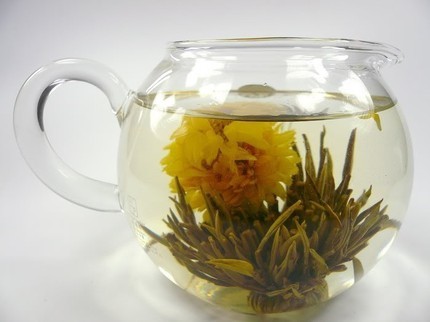
A tea blossom or flowering tea can be an "arrangement of delicate tea leaves and freshly dried flowers that are hand sewn and dried into a ball shape. They are designed to unfurl into beautiful flower-like arrangements when steeped in hot water. They are usually prepared in a clear teapot, cup, mug or other clear vessel so that you can enjoy the performance."
As soon as you pour hot water into the clear mug with the blossom, it, well, blossoms right before your eyes. It's should be a beautiful sight!
Tea Flowers or Tea Blossom as ornament

It's was common to use this as we use bouquets of flowers on our table. In this way it's easier to write haiku on Tea Flowers. For example:


On Tea Blossom:

playing hide-and-seek
in tea blossoms ...
sparrows


(c) Buson (?)

Tea Blossom

So let's go craft a few haiku on tea blossom/tea flower (cha no hana).


on the table
a ball of glass sprouting
yellow tea blossom

blossoming tea
for a wedding gift -
Ah! What a sight.


Well ... to me this one wasn't easy to do, but I hope to read wonderful haiku on this prompt for today.

This prompt will stay on 'till December 9th 11.59 AM (CET) and I will publish our new prompt Winter Rain (fuyu no ame) later on today around 10.00 PM (CET). 


Have fun, enjoy the read, be inspired and write your haiku for Carpe Diem.


Sunday, November 11, 2012

Carpe Diem Special #6, Issa - the year's first sky


Dear haijin, visitors and travelers,

As you all may know the Carpe Diem Specials for November are haiku written by Kobayashi Issa (1763-1823). He's known for his sad life (he lost several children at young age) and his haiku are wonderfully written like children's ideas. His haiku are all easy to understand, because of this simpleness. His 'nom de plum' was Issa, which means 'cup of tea'. So for this first Special of November I have chosen a haiku with tea in it.

Kobayashi Issa (1763-1823)

During his life time Issa wrote over 20.000 haiku and this is one the 20.000 haiku:

hatsu-zora no moyô ni tatsu ya cha no keburi
rising into
the year's first sky...
tea smoke 

The year in which he wrote this haiku isn't known. As we look closer to this haiku we can see (and read) that he wrote this haiku in the classic season New Year (so somewhere between January 1st and January 15th).
New Year's day was a great day in classic Japan and was also called 'Great Day'. Why is this a haiku written in New Year?  I think that's clear ' the year's first sky ...' shows us that.


Serving Tea
Our goal for these Carpe Diem Specials is to write a haiku inspired on the one I gave of the classical haiku-poet. I do understand that this isn't always easy, but ... inspiration is always there I think. In these Specials of November I hope to give you all more information about Issa, one of the four greatest haiku-masters (like Basho, Buson and Shiki).

For my own contributions to these November Specials I have created a new weblog on Issa I will try to write a new haiku (or a few) inspired on the ones by Issa and in his Spirit.
For this first November Special I have written the next haiku:


tea smoke wisps
on New Year's day
just like last year


Well I hope you're inspired. Have fun, be inspired and share your creativity with Carpe Diem.

This Special will stay on 'till November 12th 11.59 AM (CET) and I will publish our new prompt 'fountain' today around 10.00 PM (CET).