Showing posts with label Claude Monet. Show all posts

Sunday, July 12, 2015

Carpe Diem Time Glass #35 weeping willow


Dear Haijin, visitors and travelers,

It's Sunday and that means time for a new episode of our time challenging feature "Time Glass" in which is the goal to write/compose haiku (or tanka) inspired on a given prompt and photo within 24 hours. "Time Glass" challenges you to be in the moment, as short as the sound of a pebble thrown into water, the essence of haiku.

This week's prompt is "Weeping Willow"

And this is the photo to become in the inspirational mood to write an all new haiku.

Credits: Weeping Willow (and boat)
The above photo shows a place in Giverny (France) this was the place were Monet once lived and started to paint in his so wellknown Impressionistic style.

Well I hope you are inspired to respond within 24 hours with a haiku (or tanka) inspired on the given prompt and photo. Have fun!

This Time Glass episode is open for your submissions tonight at 7.00 PM (CET) and will remain open for only 24 hours until Monday July 13th at 7.00 PM (CET). So you have just 24 hours to respond.


Wednesday, February 11, 2015

Carpe Diem #666, Poppies


Dear Haijin, visitors and travelers,

Recently I was given a present by Jane Reichhold ... finally I can read her "Writing and Enjoying Haiku". I started reading it immediately and it was an "eye-opener", not in the idea "all new", but more in the idea "yes I knew it". It's a great book to read and it will certainly make my haiku-ing better. I am very grateful that Jane send it to me and it gives me the opportunity to broaden my ideas and visions on haiku. Awesome!

As I created the prompt-list for February I realized that I had used several of the prompts earlier and so it is with our prompt for today poppies. I remember for example an episode of our "distillation"- feature in which I shared a wonderful poem by John McCrae "In Flanders Fields". I love to share that poem here once again.

In Flanders fields the poppies blow
Between the crosses, row on row,
That mark our place; and in the sky
The larks, still bravely singing, fly
Scarce heard amid the guns below.

We are the Dead. Short days ago
We lived, felt dawn, saw sunset glow,
Loved and were loved, and now we lie
In Flanders fields.

Take up our quarrel with the foe:
To you from failing hands we throw
The torch; be yours to hold it high.
If ye break faith with us who die
We shall not sleep, though poppies grow
In Flanders fields.


© John McCrae


In some way I have the feeling this poem fits our impressionism theme very much, but maybe that's just wishful thinking. It's a very strong poem with a very deep meaning and full of emotions. Yes ... for sure this poem is impressionism.

And I recall an episode on Basho Revisited in which I wrote about a haiku by Basho on White Poppies, here is that haiku by Basho:

shira geshi ya   shigure no hana no   saki tsu ran

white poppy
it must have bloomed
from a wintry shower


© Matsuo Basho

I even can remember that I tried to explain in that episode that Basho was indeed writing in Kanshicho-style (which we have discussed here in one of our episodes of "Ask Jane ...") for several years. After that period Basho re-wrote his haiku in Kanshicho-style to the regular haiku-style.
As you maybe know in every episode of Basho Revisited I try to write a haiku in the same sense, tone and spirit as the one by Basho, whom I see as my master, and here is my attempt to write an all new haiku on this one of the "white poppy":


at sunrise
poppies still redder
sacrifice for God


© Chèvrefeuille

Let us look back at the poem by John McCrae ... then we can see that this haiku I wrote fits the "impression" which is "painted" in the poem "In Flanders Field". A coincidence I think, but it came to my attention as I was preparing this episode.

We are busy with our central theme impressionism this month and all our prompts this month are based on Impressionistic paintings. This episode is inspired on this painting by Claude Monet (1873):

Credits: Landscape with Poppies - Claude Monet (1873)
Wow! What a wonderful painting ... it's really an Impression of a field with poppies and it's so clear that this is the "hand" of Claude Monet. Must be fabulous to paint like Monet, but ... I am not that much a painter with oil-pastel ... I am more a painter with words (smiles). As I stated in one of our "Haiku Writing Techniques" episodes, I think that a haiku is an impression of a moment in time, as short as the sound of a pebble thrown into water. How can haiku be more then that? It's ... just an impression of a moment in time and it's awesome to catch that moment in time with so little words ....

one summer day
poppies coloring the meadows -
raindrops start to fall

© Chèvrefeuille

Is this an impression of the scene I see? Well ... it could be ... 

This episode is open for your submissions tonight at 7.00 PM (CET) and will remain open until February 14th at noon (CET). I will try to publish our new episode, Tulips, later on. For now ... have fun, be inspired and share your "impression", your haiku with us all.


Wednesday, February 4, 2015

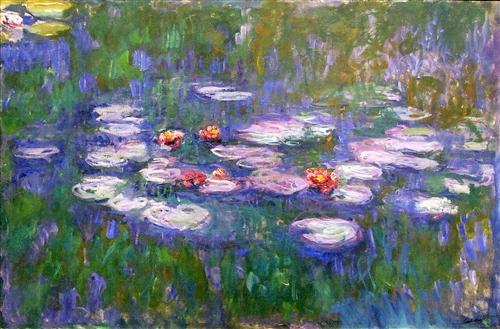
Carpe Diem #662, Water Lilies


!! I publish this episode earlier, because I am in the nightshift !!

Dear Haijin, visitors and travelers,

Impressionism ... is our leading theme this month and I will often use paintings by the "Godfather" of Impressionism, Claude Monet. Impressionism, the name says it all, ... it's an impression of the scene, but that sounds more easy than it really is, because the impressionists were mostly painting in plain-air, so outside, and were obsessed with the light during the day. The daylight in the morning is very different, with the light of noon for example and the day light of a late summer evening is also very different with the day.
Impressionists painted impressions and during the years this style changed to pointillism and cubism.

For today's prompt, Water Lilies, I have chosen another nice painting by Claude Monet, this one is one of his most known paintings and it is often used to show what Impressionism means.
Water Lilies - Claude Monet

A wonderful painting I think and in this one you can see what "impressionism" means. The Water Lilies are just a faint image of the reality, but you can see that it are Water lilies. It's done with strong short brush-lines and when you look at it from a distance than those strong brush lines are flowing together to become a wonderful image/painting.

Haiku are very similar with Impressionism, because in the three lines of a haiku we have to catch a moment as short as the sound of a pebble thrown into water, this is very similar with the idea of painting with the light of the day during the day as is one of the major rules in Impressionism.

I found a wonderful "water lily" haiku written by Sylvia Forges-Ryan in which she brings together this idea which I wrote above "haiku is Impressionism";

Among these lilies
in Monet’s pond
Basho’s water sound

© Sylvia Forges-Ryan & Edward Ryan


And they noted:
Here’s that splash again, only now it brings together the spontaneity of Nature―Basho’s “water sound” ―and the art of a painted garden. Even in a pond as beautiful as Monet’s, filled with a mass of lovely water lilies, the frog still goes “pop!” The splash breaks through the stillness of the art.

An awesome haiku I think ... isn't it great to see how an ancient poem (frogpond haiku) and an ancient painting (Waterlilies) are melting together in one haiku?
That frog, responsible for the sound of water, will not be stopped by the Water lilies ... he has to make that sound, that one moment on which a haiku is based.

Awesome ... isn't it? We are all haiku poets, but we are also Impressionistic painters ... (smiles).


Here is my impression of "water lily". It's one from my archive, but I think it fits this episode very well ...

strange perfume
from a faraway place
lotuses blooming
© Chèvrefeuille
This episode is open for your submissions tonight at 7.00 PM (CET) and will remain open until February 7th at noon (CET). I will (try to) post our next episode, Starry Night, later on.

Saturday, January 31, 2015

Carpe Diem #660, Impressions


Dear Haijin, visitors and travelers,

I don't have the new prompt-list ready for this month, so my apologies for that. This month I love to go further on the idea of Impressionism as I described in our last "Haiku Writing Techniques" episode "surprise". This month I will try to challenge you with all wonderful images, photos and other things e.g. music and ask you to write a haiku ... an impression ... of the scenes which I share here. (As you can see I haven't a proper logo for this month ...)

Impressionism is a 19th-century art movement that originated with a group of Paris-based artists. Their independent exhibitions brought them to prominence during the 1870s and 1880s, in spite of harsh opposition from the conventional art community in France. The name of the style derives from the title of a Claude Monet work, Impression, soleil levant (Impression, Sunrise), which provoked the critic Louis Leroy to coin the term in a satirical review published in the Parisian newspaper Le Charivari.
Impressionist painting characteristics include relatively small, thin, yet visible brush strokes, open composition, emphasis on accurate depiction of light in its changing qualities (often accentuating the effects of the passage of time), ordinary subject matter, inclusion of movement as a crucial element of human perception and experience, and unusual visual angles. The development of Impressionism in the visual arts was soon followed by analogous styles in other media that became known as impressionist music and impressionist literature.

And today I have a wonderful Impressionistic painting by Claude Monet, Haystacks (sunset), for your inspiration.
Claude Monet, Haystacks (Sunset)
I would say .... "go for it" ... try to write/compose a haiku and share your "impression" with us, be one with the painting, try to step into the shoes of the Impressionists ...

in the faint light
of the departing sun -
a sedge warbler sings


© Chèvrefeuille

This episode is NOW OPEN for your submissions and will remain open until February 3rd at noon (CET). I will try to post our next episode, ?????, later on. PS. I hope to publish our new prompt-list this weekend