Showing posts with label Lotus. Show all posts

Wednesday, April 20, 2016

Carpe Diem Theme Week 3: Magnolia Blossoms, haiku by Soseki Natsume; 4 watch birth and death


Dear Haijin, visitors and travelers,

Welcome at a new episode in our Carpe Diem Theme Week "Magnolia Blossoms, haiku by Soseki Natsume". This is already the fourth episode, so we are halfway this third Theme Week.

As I was preparing this Theme Week I dived into the life of Soseki Natsume, a contemporary of Shiki, and found wonderful haiku, but I also found several books and novels he wrote. The haiku for today is extracted from the novel "Zen Haiku: Poems and Letters of Natsume Soseki", by Natsume Soseki translated by Soiku Shigematsu.

watch birth and death:
the lotus has already
opened its flower.


© Soseki Natsume (Tr. Soiku Shigematsu)

From the back-cover of this novel:

"One of the greatest of Japan's modern novelists, Natsume Soseki was also an outstanding poet, calligrapher, and painter. For this translation, the translator has carefully chosen from Soseki's haiku those conveying the author's unique sense of both the individualism and universality of Zen, as well as it's vitality. To these have been added selections from Soseki's extended conversations with Zen monks, as well as anecdotes from his life and examples of his own calligraphy and painting."

Soseki, meaning stubborn in Chinese, was a nom de plume. Here's a haiku of springtime and the refusal to conform that just occurred to me as my car idled at a weeded wonderland of a road median today:

weeds push
to crack the street--
nature rebels


About "watch birth and death", the above haiku, I found a review by Ivan M. Granger at Poetry Chaikhana: 

This poem is a powerful haiku.

[...] "We've got birth, death... and flowering. What else is there?


Birth and death, they are a given, unavoidable. Often seekers assume that in the limited timeline strung between those two points, they must race to make the lotus flower of awareness open. But Soseki's Zen practice has revealed a fundamental truth: By contemplating birth and death with a truly still mind, one realizes that the lotus does not need to be opened; independent of death and birth and the thin space of time between them, the lotus is already open! Awareness naturally and always IS. We don't become awakened, we just notice that we already are awakened. "The lotus has already / Opened its flower." [...] (Ivan M. Granger)

What can I say more about the beauty of this haiku? I rest my case ...

And now it's up to you, my dear Haijin, visitors and travelers, to create an all new haiku, tanka or other Japanese poetry form inspired on this beautiful haiku by Soseki Natsume (or Natsume Soseki).

My response:

As you maybe know I love to create haiku about cherry blossoms, sunflowers, clouds and more, but I also created a few about lotuses. I dived into my archive to share a few of those with you in response on this CD Theme Week episode.

spirit grows -
from the bottom of the pond
into the light
the Lotus reaches from the deep -
spirit grows

uncertain of its goal
rising from the depths of the pond
lotus flowers

hummingbird
chases for honey in the Lotus
in Buddha's hands

in deep prayer
eyes closed in devotion -
Lotus starts to bloom

green dragonfly
almost invisible on the Lotus leaves -
the sound of raindrops 
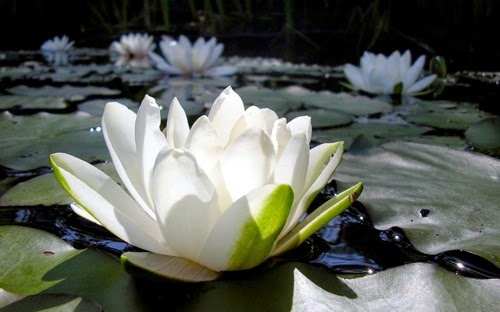
© Chèvrefeuille


And to conclude this wonderful episode of our third CD Theme Week in which we explore the beautiful haiku by Soseki Natsume I have another haiku, this time a cascading one:

lotus flowers
rising from the depths of the pond
everlasting love

everlasting love
like a river flows onwards
uncertain of its goal

uncertain of its goal
rising from the depths of the pond
lotus flowers

© Chèvrefeuille

It has become a little to long episode I think, but I wasn't aware of the many haiku and tanka I wrote about Lotuses ... sorry I was on a roll.

This episode of our Third CD Theme Week "Magnolia Blossoms, haiku by Soseki Natsume" is NOW OPEN for your submissions and it will remain open until April 22nd at 10.00 PM (CET). Have fun, be inspired and share your haiku, tanka or other Japanese poetry form with us all here at Carpe Diem Haiku Kai, the place to be if you like to write and share haiku.


Monday, August 3, 2015

Carpe Diem #789 Lotus flowers


Dear Haijin, visitors and travelers,

As I started preparing this episode I realized that Lotus flowers is a prompt which we have had several times earlier here at our Kai, but why did I decide to do this? Let me tell you.
As I was a kid, say around 10 years old, I was introduced through school to Egypt and The Nile and the first thing I saw of Egypt, next to the famous pyramids, the Lotus flowers on The Nile. I immediately "fell in love" with those beauties. Maybe it was my first step to Enlightenment. As you will know Lotuses are starting deep down the water in the mud and they finally grow to the light and expose their beauty. Spiritually seen this is where Lotuses stand for ... Inner Growth and becoming wise.
Since my childhood we are more than 40 years further and I am still growing, my Inner Wisdom grows and there will be a moment in time that we call Enlightenment, maybe soon or not I will reach that moment ... Haiku and tanka, have helped me to become wise and in balance and of course I hope that you are having that same feeling.

spirit grows -
from the bottom of the pond
into the light
the Lotus reaches from the deep -
enlightenment


© Chèvrefeuille

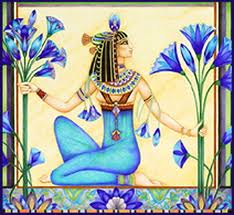
Egyptian lotus
Recently Hamish (of Haiku Forest) said to me, in one of his comments, that my haiku are looking different than former haiku I have written. He said, some what like this: "I can see your happiness and enthusiasm for this new month. Your haiku are becoming more mysterious".

I think he is right, because I am experimenting with a more mysterious way of writing haiku, more spiritually, more from my Inner Self, my Inner Wisdom, maybe more Zen .... I even have thought to give this way of composing haiku another "name" instead of haiku, something like shinpi tekidesu which means "mysterious" in Japanese, but ... well I will stick to haiku I think.

Well ... we are busy with our journey over The Nile to find its source. We will see a lot of beauty and more ....

To conclude this episode I have gathered several "lotus-haiku" from my archives which I love to share here again:

awakening
at last - Lotuses start blooming
in the old pond

uncertain of its goal
rising from the depths of the pond
lotus flowers

hummingbird
chases for honey in the Lotus
in Buddha's hands

don't hide your light
let it shine bright without regret -
Lotus will bloom again

in deep prayer
eyes closed in devotion -
Lotus starts to bloom

deep hidden thoughts
reaching for the morning sunlight -
Lotus opens her heart

green dragonfly
almost invisible on the Lotus leaves -
the sound of raindrops  

© Chèvrefeuille


Credits: Green Dragonfly of Lotus leaves

A Tan Renga once written in response on a haiku by Cathy Tenzo:

the Buddha himself
did not start enlightened
he walked the path
       
(Cathy Tenzo)
following the signs along the path
the lotus comes to full bloom
         (Chèvrefeuille)


All wonderful haiku, as wonderful as our journey over The Nile in our papyrus boat with full sails. I hope you did like this episode.

This episode is open for your submissions tonight at 7.00 PM (CET) and will remain open until August 6th at noon (CET). I will try to publish our new episode, our first Tokubetsudesu episode this month in which our runner up of the "summertime" kukai, Jen of Blog It Or Lose It, will be the featured haiku poetess, later on.

Thursday, April 23, 2015

Carpe Diem #712, Lotus


Dear Haijin, visitors and travelers,

What a joy this month gives me, of course it's a tough month to create the episodes, but I love doing it. It's a wonderful story this Bhagavad Gita and I think you all like this themed month too. For today I love to do it a little bit different.

Maybe you can recall our special feature "Carpe Diem Imagination" in which the goal was to create a haiku inspired on a given image (as I do e.g. in the Time Glass feature). As you can read in the title of this episode, Lotus, is our prompt for today and therefore I love to challenge you to create a haiku inspired on an image of the Lotus.

Credits: Lotus
A wonderful image I think and I hope it will inspire you to create an all new haiku. Feel free to use another image of a Lotus or to create a tanka or haiga instead of a haiku.

I have chosen to use a haiku from my archives, so no newly created haiku this time.

spirit grows -
from the bottom of the pond
into the light

into the light
the Lotus reaches from the deep -
spirit grows

© Chèvrefeuille

The stage of growth the lotus flower is in represents a different stage of enlightenment. A closed lotus flower represents the time before enlightenment. A lotus flower fully bloomed and open represents full enlightenment and self-awareness. And that's were it is all about in the Bhagavad Gita. This idea of the Lotus representing spiritual growth we also see in Buddhism.

This episode is open for your submissions tonight at 7.00 PM (CET) and will remain open until April 26th at noon (CET). I will (try to) publish our new episode, devotion, later on. For now .... have fun, be inspired and share your haiku with us all.


Wednesday, April 8, 2015

Carpe Diem Special #141, Kala Ramesh's "lotus viewing"


Dear haijin, visitors and travelers,

It's really a honor that I may use the haiku by Kala Ramesh and this month will be exciting because of the journey through the Bhagavad Gita. As asked Kala for permission she emailed me several haiku which I could use and she even had a haiku which fits our Bhagavad Gita theme this month. That haiku is our CD-Special today.

lotus viewing . . .
the flowering
within

© Kala Ramesh

As you maybe know the Lotus stands for inner growth and spiritual growth and that's exactly what the Bhagavad Gita is about. There he stands, Arjuna, in the middle of two great armies. He becomes sad and anxious as he sees those armies and than he and Krishna start a conversation. That conversation will lead Arjuna to that moment that the Lotus, from the depths of the pond grows to the surface of the pond reaching for the sun and than .... the Lotus blooms fully .... Arjuna becomes enlightened and sees the balance between life and dead, between good and evil ... than he sees Atman.

This is what I sense as I read the haiku by Kala, a wonderful and spiritual haiku ... awesome.

Credits: Lotus in full bloom (Dutch website)

As you all know (maybe) the goal of these CD-Specials are to write a haiku in the same sense, tone and spirit as the one given (in this episode the haiku by Kala Ramesh). No need to follow the classical rules, but if you like to do so than ... please feel free.

Here is my attempt to write/compose a new haiku inspired on the one by Kala and in the same sense, tone and spirit as her haiku (I hope).

awakening
at last - Lotuses start blooming
in the old pond

© Chèvrefeuille

A beauty I would say, but that's not up to me of course. Another one which I love to share here also:


lotus flowers
rising from the depths of the pond
everlasting love

everlasting love
like a river flows onwards
uncertain of its goal

uncertain of its goal
rising from the depths of the pond
lotus flowers


© Chèvrefeuille


Well ... enough inspiration I think. Now it's up to you, my dear Haijin, visitors and travelers, to write/compose (an all new) haiku inspired on the haiku by Kala Ramesh trying to catch the sense, tone and spirit ....

PS. The above haiku are from my archives.

This episode is open for your submissions tonight at 7.00 PM (CET) and will remain open until April 11th at noon (CET). I will (try to) publish our new episode, immortality, later on. Than we will go on with our journey and exploration of the Bhagavad Gita.

Wednesday, February 4, 2015

Carpe Diem #662, Water Lilies


!! I publish this episode earlier, because I am in the nightshift !!

Dear Haijin, visitors and travelers,

Impressionism ... is our leading theme this month and I will often use paintings by the "Godfather" of Impressionism, Claude Monet. Impressionism, the name says it all, ... it's an impression of the scene, but that sounds more easy than it really is, because the impressionists were mostly painting in plain-air, so outside, and were obsessed with the light during the day. The daylight in the morning is very different, with the light of noon for example and the day light of a late summer evening is also very different with the day.
Impressionists painted impressions and during the years this style changed to pointillism and cubism.

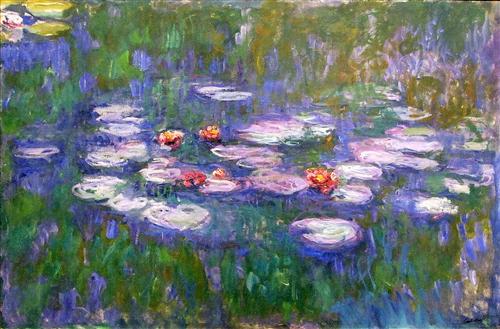
For today's prompt, Water Lilies, I have chosen another nice painting by Claude Monet, this one is one of his most known paintings and it is often used to show what Impressionism means.
Water Lilies - Claude Monet

A wonderful painting I think and in this one you can see what "impressionism" means. The Water Lilies are just a faint image of the reality, but you can see that it are Water lilies. It's done with strong short brush-lines and when you look at it from a distance than those strong brush lines are flowing together to become a wonderful image/painting.

Haiku are very similar with Impressionism, because in the three lines of a haiku we have to catch a moment as short as the sound of a pebble thrown into water, this is very similar with the idea of painting with the light of the day during the day as is one of the major rules in Impressionism.

I found a wonderful "water lily" haiku written by Sylvia Forges-Ryan in which she brings together this idea which I wrote above "haiku is Impressionism";

Among these lilies
in Monet’s pond
Basho’s water sound

© Sylvia Forges-Ryan & Edward Ryan


And they noted:
Here’s that splash again, only now it brings together the spontaneity of Nature―Basho’s “water sound” ―and the art of a painted garden. Even in a pond as beautiful as Monet’s, filled with a mass of lovely water lilies, the frog still goes “pop!” The splash breaks through the stillness of the art.

An awesome haiku I think ... isn't it great to see how an ancient poem (frogpond haiku) and an ancient painting (Waterlilies) are melting together in one haiku?
That frog, responsible for the sound of water, will not be stopped by the Water lilies ... he has to make that sound, that one moment on which a haiku is based.

Awesome ... isn't it? We are all haiku poets, but we are also Impressionistic painters ... (smiles).


Here is my impression of "water lily". It's one from my archive, but I think it fits this episode very well ...

strange perfume
from a faraway place
lotuses blooming
© Chèvrefeuille
This episode is open for your submissions tonight at 7.00 PM (CET) and will remain open until February 7th at noon (CET). I will (try to) post our next episode, Starry Night, later on.

Friday, May 2, 2014

Carpe Diem's Tan Renga Challenge #33, Kuheli's "the lotus bloomed"


Dear Haijin, visitors and travelers,

Another week has gone by and we are already in our first days of May and on our way through the rich history of Legends, Myths, Saga and Folktales, but we have also our weekly Tan Renga Challenge.

This week's Tan Renga is started with a haiku written/composed by Kuheli of Kajori, Only One Life which she wrote in response on our Tagore Distillation. As I read her haiku I was in awe and fell in love with this wonderful haiku. I am glad that Kuheli gave me permission to use her haiku for our Tan Renga Challenge.

The goal of the Tan Renga Challenge is to write/compose a second stanza (7-7) towards a given haiku (first stanza 5-7-5) as a completion or continuation of the scene which is painted in the first stanza. As you know I am not of the straight rules so your second stanza don't has to be 7-7 syllables, but if you will use that rule ... well feel free ....

Credits: Lotus Flower

the Lotus bloomed
before the summer breath
and now I wake up


© Kuheli

A beauty don't you think so too? Well ... the challenge is on ... write a second stanza (of two lines) towards this haiku and complete or continuate the haiku and it's scenery.

Here is my attempt to write a second stanza towards this haiku by Kuheli:

the Lotus bloomed
before the summer breath
and now I wake up
            (Kuheli)

deep down inside of my heart
I realise that life is short
              (Chèvrefeuille)

Hm ... I am not completely satisfied with this completion ... I used the Lotus for my inspiration to write that second stanza ... a Lotus is such a spiritual flower, it's life is short, to short is our life to learn all and everything what the Lotus learns us.

This Tan Renga Challenge is NOW OPEN for your submissions and will remain open until May 9th 11.59 AM (CET). For now have fun, be inpsired and share your completed Tan Renga with us all here at our Haiku Kai. !! I hope you all like our new logo for the Tan Renga Challenge !!