Showing posts with label China. Show all posts

Sunday, February 4, 2018

Carpe Diem #1362 Gansu (Northern route)


Dear Haijin, visitors and travelers,

I hope you all have had a wonderful weekend and that you all will have new energy for a new week full of the beauty of the ancient Silk Road. This month we are on a journey "Along The Silk Road" and especially we are following the Northern and Southern Route. That means we especially are following the "Silk Road" through China and "around" the Taklamakan Desert. While we are on this journey we are reading a wonderful "esoteric" novel written by Hermann Hesse, Siddhartha, in which we are following a young Brahman son who is on a journey to find himself, his inner peace, to become enlightened. Why are we reading this novel? Well Buddhism entered China along the "Silk Road", so Siddhartha is a nice novel to read while on our journey.

Samanas in the forests
[...] " The first light of day shone into the room. The Brahman saw that Siddhartha was trembling softly in his knees. In Siddhartha's face he saw no trembling, his eyes were fixed on a distant spot. Then his father realized that even now Siddhartha no longer dwelt with him in his home, that he had already left him.
The Father touched Siddhartha's shoulder. "You will," he spoke, "go into the forest and be a Samana. When you'll have found blissfulness in the forest, then come back and teach me to be blissful. If you'll find disappointment, then return and let us once again make offerings to the gods together. Go now and kiss your mother, tell her where you are going to. But for me it is time to go to the river and to perform the first ablution."
He took his hand from the shoulder of his son and went outside. Siddhartha wavered to the side, as he tried to walk. He put his limbs back under control, bowed to his father, and went to his mother to do as his father had said." [...]
(Source: Siddhartha by Hermann Hesse)


And so started Siddhartha's journey ... his first step was going to his father to ask his permission to leave his home to become a Samana.
For us there is no need to ask permission to leave the home for our journey along the Silk Road, but we are on our way. Today we arrive at Gansu. Let me tell you a little bit about Gansu in the time of the Silk Road.
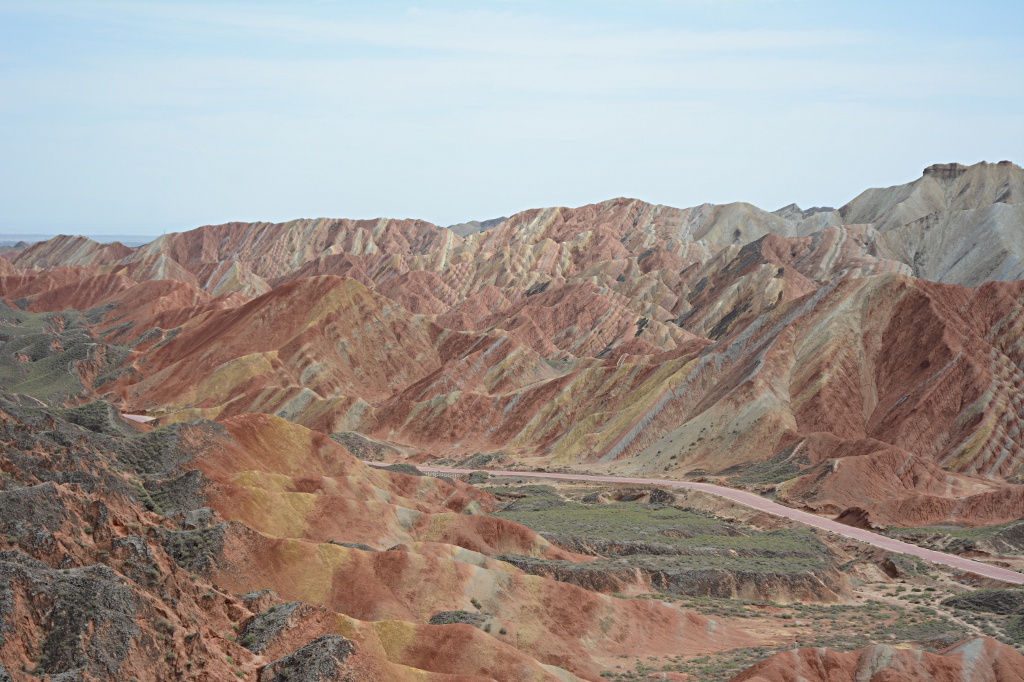
Panorama shot Daxia River Valley
In imperial times, Gansu was an important strategic outpost and communications link for the Chinese empire, as the Hexi Corridor runs along the "neck" of the province. Hexi Corridor or Gansu Corridor refers to the historical route in Gansu province of China. As part of the Northern Silk Road running northwest from the bank of the Yellow River, it was the most important route from North China to the Tarim Basin and Central Asia for traders and the military. The corridor is a string of oases along the northern edge of the Tibetan Plateau. To the south is the high and desolate Tibetan Plateau and to the north, the Gobi Desert and the grasslands of Outer Mongolia. At the west end the route splits in three, going either north of the Tian Shan or south on either side of the Tarim Basin. At the east end are mountains around Lanzhou before one reaches the Wei River valley and China proper.
Hexi Corridor
 
The Han dynasty extended the Great Wall across this corridor, building the strategic Yumenguan (Jade Gate Pass, near Dunhuang) and Yangguan fort towns along it. Remains of the wall and the towns can be found there. The Ming dynasty built the Jiayuguan outpost in Gansu. To the west of Yumenguan and the Qilian Mountains, at the northwestern end of the province, the Yuezhi, Wusun, and other nomadic tribes dwelt, occasionally figuring in regional imperial Chinese geopolitics.
By the Qingshui treaty, concluded in 823 between the Tibetan Empire and the Tang dynasty, China lost much of western Gansu province for a significant period.
After the fall of the Uyghur Empire, an Uyghur state was established in parts of Gansu that lasted from 848 to 1036 AD. During that time, many of Gansu's residents were converted to Islam.
Along the Silk Road, Gansu was an economically important province, as well as a cultural transmission path. Temples and Buddhist grottoes such as those at Mogao Caves ('Caves of the Thousand Buddhas') and Maijishan Caves contain artistically and historically revealing murals.

Magoa Caves (Caves of the Thousand Buddhas)
Buddhism entered China along the Silk Road. Some say Buddhism came to China by the maritime route, but after scientific researches by several scientists, the over all conclusion was that Buddhism came along the Silk Road.

Did Samanas live along the Silk Road? Maybe at the places were traders stopped, the caravanserais, but I don't know that for sure. Could it be that Siddhartha was along the Silk Road while he was with the Samanas. Personally I think that wasn't possible, but in Siddhartha's later journey we will see a connection with the Silk Road. 

above the valley
hidden in his cave
Buddha meditates

without listening to the traders
beneath his feet


© Chèvrefeuille
Pff ... that wasn't easy. It was for sure not an easy task to create a haiku or tanka inspired on this episode, but I think my tanka fits the episode in a way.
This episode is open for your submissions tonight at 7:00 PM (CET) and will remain open until February 11th at noon (CET). I will try to publish our new episode, Taklamakan Desert (Northern route), later on. For now .... Be inspired

Thursday, February 1, 2018

Carpe Diem #1361 Chang'an (Northern Route)


[...] "After the usual time of the exercise in meditation had passed, Govinda rose. The evening had come, it was time to perform the evening's ablution. He called Siddhartha's name. Siddhartha did not answer. Siddhartha sat there lost in thought, his eyes were rigidly focused towards a very distant target, the tip of his tongue was protruding a little between the teeth, he seemed not to breathe. Thus sat he, wrapped up in contemplation, thinking Om, his soul sent after the Brahman as an arrow." [...]
(Source: Siddhartha by Hermann Hesse)

Dear Haijin, visitors and travelers,

After doing my morning excercise, the greeting of the sun, a yoga-salutation, I decided to create this new episode. After my meditation I thought that we are going to follow the Chinese "Silk Road" around the "Taklamakan Desert". The Chinese had a "northern route" and a "southern route" and those "trails" we will follow the upcoming days. We will visit places along those "trails" and I hope to tell you something about those places. Today we will start at Chang'an (nowadays Xi'an) for our first halting place (or caravanserai).

the first day
after salutating the early morning light
birds point the way

© Chèvrefeuille


The northern route started at Chang'an (now called Xi'an), an ancient capital of China that was moved further east during the Later Han to Luoyang. The route was defined around the 1st century BCE when Han Wudi put an end to harassment by nomadic tribes.

The northern route travelled northwest through the Chinese province of Gansu from Shaanxi Province and split into three further routes, two of them following the mountain ranges to the north and south of the Taklamakan Desert to rejoin at Kashgar, and the other going north of the Tian Shan mountains through Turpan, Talgar, and Almaty (in what is now southeast Kazakhstan). The routes split again west of Kashgar, with a southern branch heading down the Alai Valley towards Termez (in modern Uzbekistan) and Balkh (Afghanistan), while the other travelled through Kokand in the Fergana Valley (in present-day eastern Uzbekistan) and then west across the Karakum Desert. Both routes joined the main southern route before reaching ancient Merv, Turkmenistan. Another branch of the northern route turned northwest past the Aral Sea and north of the Caspian Sea, then and on to the Black Sea.

Chang'an Great Wild Goose Pagoda

Along this part of the Silk Road many goods were brought to China for example, dates, saffron powder, sandelwood, glass bottles and myrrh. In return the Chinese brought porcelain and silk brocade back along the Silk Road to the countries of origine of the trading goods as there were India and Persia.

In a way you can see this whole structure of trading trails as the Internet nowadays. Maybe you can say that the Internet is our modern Silk Road, but that's not always very clear, because there has been a time (and maybe it's still so) that the "modern silk road" was used for trading / smuggling drugs and weapons. That kind of "modern silk road" doesn't exist anymore on the easy to "travel" Internet as we use daily. That "modern silk road" is now hidden on the so called "deep web" or "dark web", the criminal part of the Internet. That part of the Internet I am not familiar with and I hope to stay far from that part this month.

Let me tell you a little bit more about Chang'an:

Chang'an was an ancient capital of more than ten dynasties in Chinese history, today known as Xi'an. Chang'an means "Perpetual Peace" in Classical Chinese since it was a capital that was repeatedly used by new Chinese rulers. During the short-lived Xin dynasty, the city was renamed "Constant Peace"; yet after its fall in AD 23, the old name was restored. By the time of the Ming dynasty, a new walled city named Xi'an, meaning "Western Peace", was built at the Sui and Tang Dynasty city's site, which has remained its name to the present day.

Chang'an had been settled since Neolithic times, during which the Yangshao Culture was established in Banpo in the city's suburb. Also in the northern vicinity of the modern Xi'an, Qin Shi Huang of the Qin dynasty held his imperial court, and constructed his massive mausoleum guarded by the famed Terracotta Army.

The Terracotta Army (wikimedia-image)

From its capital at Xianyang, the Qin dynasty ruled a larger area than either of the preceding dynasties. The imperial city of Chang'an during the Han dynasty was located northwest of today's Xi'an. During the Tang dynasty, the area to be known as Chang'an included the area inside the Ming Xi'an fortification, plus some small areas to its east and west, and a major part of its southern suburbs. The Tang Chang'an hence, was 8 times the size of the Ming Xi'an, which was reconstructed upon the premise of the former imperial quarter of the Sui and Tang city. During its heyday, Chang'an was one of the largest and most populous cities in the world. Around AD 750, Chang'an was called a "million people's city".

The Han dynasty, as metioned above, is also the "founder" of the "Silk Road". They created it to open the Chinese borders to the outside world for trading purposes ... Without the establishing of the Silk Road by the Han dynasty, there wouldn't be a "Silk Road".

entering the city
the sweet perfume of spices
mouth watering

© Chèvrefeuille

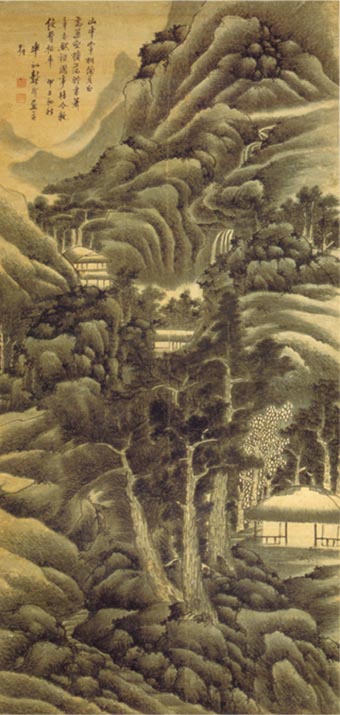
Nature around Chang'an (painting by unknown Chinese painter)

high above the silk road
pine woods stretch against the mountains
breath taking

© Chèvrefeuille

A wonderful start of this journey Along The Silk Road I think ... I hope I have inspired you to create Japanese poetry and of course hope to see you again tomorrow. For now ... have a nice day full of inspiration.

This episode is open for your submissions tonight at 7:00 PM (CET) and will remain open until February 8th at noon (CET). I will try to publish oiur new episode, a new weekend meditation, later on.


Wednesday, December 14, 2016

Carpe Diem #1096 The Great Wall of China by Einar Englund,


Dear Haijin, visitors and travelers,

Welcome at a new episode of Carpe Diem's daily haiku-meme. This month we are trying to find inspiration in classical music of all ages and of all over the world. Today I have that "all over the world" taken very literal, because this composition by Einar Englund is titled "The Great Wall of China".

The Great Wall of China (photo taken from the Internet)
Must be awesome to walk that Great Wall, maybe it is an once in a life time trip, but not for me. So why not listen to the music titled with this Great Wall? Maybe I can imagine walking there while listening to the music, we will see and hear.

Einar Englund (1916-1999)

Let me first tell you a little bit more about Einar Englund, before we listen to this beautiful composition "The Great Wall of China".

Sven Einar Englund (1916 – 1999) was a Finnish composer. Sven Einar Englund was born at Ljugarn in Gotland, Sweden. He married twice: in 1941 to Meri Mirjam Gyllenbögel, who died 1956 (they had one son and two daughters including the ballerina and choreographer Sorella Englund); and in 1958 he married Maynie Sirén, a singer, with whom he had one son.
One of the most important Finnish symphonists since Jean Sibelius, Englund was a native Swedish speaker who often felt that his career was sidelined from the mainstream of Finnish music.
He was 17 when he began studies at the Sibelius Academy in Helsinki in 1933. Already a considerable pianist, he continued his studies with Martti Paavola and Ernst Linko while studying composition with Bengt Carlson and Selim Palmgren.
Following his graduation in 1941, Englund was conscripted into military service. During his time in the Finnish Continuation War he was wounded in his hand, which almost brought to an end his hopes of pursuing a career as a concert pianist. He would often recall the bizarre, though life-threatening incident, with a smile. Einar Englund died
June 27, 1999 in Visby, Sweden. He has created a lot of music sure worth listening to. (Video by Wellesz Opus)


Enjoyed? Inspired? I am looking forward to your responses inspired on this beautiful piece of music.

This episode is NOW OPEN for your submissions and will remain open until December 19th at noon (CET). I will try to publish our new episode, Serenade in D major by Ethel Smyth, later on.