Showing posts with label Japanese Festivals. Show all posts

Sunday, June 17, 2018

Carpe Diem #1455 half-year's end festival (nagoshi)


Dear Haijin, visitors and travelers,

I hope you all have had a wonderful weekend and for the fathers ... did you have a nice Father's Day? I really had a wonderful Father's Day, because I could go walk with my grandson and my son-in-law along the most beautiful Oldtimers. Every year on Father's Day the city were I am living is organizing the so called "Oldtimer Day". Just around the corner of my home there were hundreds of Oldtimers and I enjoyed watching them and sit in them. My grandson was enthousiastic too, just like me and my son-in-law. Yes I had a wonderful Father's Day together with my kids and grandchildren. Awesome ... so to say.

Okay enough about my weekend, back to the business of every day ... creating a beautiful episode for our wonderful Kai. This month we are exploring classical kigo for summer and today that will be a nice one I think. Today's kigo is: half-year's end festival (nagoshi).

Nagoshi Festival Fireworks

Nagoshi is a great Japanese festival. Nagoshi (half year's end festival) and it's one of the 100.000 festivals which occur in Japan. Nagoshi is a kind of 'end summer' festival and it lasts for three days. Let us take a closer look at this festival.

Omura Nagoshi Matsuri (Festival) is a summer event held on the evenings of August 1st, 2nd, and 3rd. Nagoshi is a shortening of “Nagoshi no Harae” which translates to “summer purification rites.” The original event brought to Japan from China occurred in the summer, usually on the last day of the 6th lunar month (June 30). However, because Japan adopted the Gregorian calendar rather than the Chinese calendar, many ancient Chinese rituals take place a month later than the original date. Therefore, Nagoshi no Harae takes place on July 31. On this day, People visit one of Omura’s 25 Shinto shrines to be purified of their sins and then, beginning August first is the celebration of that cleanse. A fireworks show is held over the bay on the first evening, displaying 3,000 to 4,000 rounds.

On the evening of the second and third, there are many vendors selling an array of food, drinks (alcoholic and non), toys, candy and Omura specialty products on the main road that leads from Omura Train Station. There are also various performances, visual arts and games for your entertainment. The main event, happening on the night of the third, is a two-hour parade/dance competition featuring many local Omura groups. Everyone dances the Omura Ondo, the region dance, while parading around Nagoshi Yume Dori (Dream Street) otherwise known as Omura Station Road.

Nagoshi Festival

What a joyful festival to celebrate the end of Summer. I don't know if there are such festivals in other regions of the world. Not in my country by the way, we celebrate the start of Summer, but never the end of it.

leaves are coloring
at the end of summer
days become shorter

© Chèvrefeuille

The above haiku is from my archives, but I had to come up with a new one too ...

dancing in the rain
summer runs towards its end
leaves start to color


© Chèvrefeuille

What a wonderful festival this must be. It feels really like the end of summer and I hope that I caught that essence in my second haiku.

This episode is NOW OPEN for your submissions and will remain open until June 24th at noon (CEST). I will try to publish our new episode, sweetfish (ayu), later on. To conclude this episode here is the winter kigo for our friends on the Southern Hemisphere, year market (toshi no ichi).

Friday, October 30, 2015

Carpe Diem #847 Kasuga Wakamiya Festival


Dear Haijin, visitors and travelers,

Welcome at the last episode of our Third anniversary month. It was really a joy to make this month for you all and I really had a festive feeling this month. I thank you all for being part of our Carpe Diem Haiku Family and I hope to celebrate our fourth anniversary, October next year, with you all. I am looking forward to another nice year of wonderful themes and prompts.

Today I published our new prompt-list for November 2015. next month we will return to the Altia Mountains in the way of the shaman reading The Zahir by Paulo Coelho and visiting the Altai Mountains and its spiritual power.
Next Sunday I will have finally time to look at our "peace of mind" kukai and than I hope to publish the results and announce the winner and the runner up.

Okay ... back to our prompt for today. Today we are visiting the Kasuga Wakamiya Festival. Let me tell you a little bit more about this Japanese festival.

Credits: Kasuga Wakamiya Festival

This is an annual festival held in Wakamiya Shrine, branch of Kasuga Grand Shrine. It is said that Tadamichi Fujiwara, Kampaku (Chief Advisor of Emperor), started this festival to pray for bumper crops on Sept.17 in the 2nd year of Hoen (1136) in the late Heian era.

In the past, monk soldiers of the Kofuku-ji Temple participated in the festival. However, because of the policy of separation between Shintoism and Buddhism in the Meiji era, the festival changed into one for the whole Nara. The date changed to December 17. On the festival day, Divine Spirit of Wakamiya is transferred to a small place called Otabisho, near the approach to Kasuga Grand Shrine. In the daytime you can see a parade of people wearing clothes of entertainment and martial arts, and feudal lords as well. At night you can see dedicatory entertainments such as Shinto music and dancing (Kagura), court dance and music (Bugaku), ritual music and dancing (Dengaku) and Seinoo until the Divine Spirit gets back to the shrine. These entertainments are designated as important intangible folk cultural assets.

Credits: Kasuga Wakamiya Shrine
A nice festival to close this festive month with. I hope you all did like this month of celebrating our third anniversary and I really hope to celebrate our fourth anniversary next year.

three years of haiku
celebrated here and now
with laughter and tears

© Chèvrefeuille

This episode is NOW OPEN for your submissions and will remain open until November 2nd at noon (CET). I will (try to) publish our new episode, our first episode of November, frosted grass, later on. Have fun!


Wednesday, October 28, 2015

Carpe Diem #846 Chichibu Night Festival


Dear Haijin, visitors and travelers,

We are running towards the end of our Third anniversary month in which we visited all wonderful Japanese Festivals and read wonderful haiku by our featured haiku poets, Michael Dylan Welch, Cor van den Heuvel and Tom D'Evelyn. This month wasn't easy to make, but I hope you all enjoyed it very much. I did enjoy the making of it ... that's for sure.

Today we have to attend another wonderful Japanese Festival, Chichibu Night Festival. Let me tell you something more about this festival.

The Chichibu Night Festival (Chichibu Yomatsuri) is the festival of Chichibu Shrine in Chichibu City, Saitama Prefecture, just 90 minutes from central Tokyo. It is held every year on December 2nd and 3rd, with the main action taking place on the 3rd. It has a history of more than 300 years.

Credits: Chichibu Shrine

The Chichibu Night Festival is considered one of Japan's top three festivals to feature floats, the others being Kyoto's Gion Matsuri and the Takayama Matsuri. Its floats are ornately decorated with lanterns, tapestries and gilded wood carvings and are accompanied by drum and flute music.
The festival's other attraction is its fireworks display, which lasts almost two and a half hours and gives you the rare opportunity to enjoy Japanese fireworks during winter. Additionally, the streets are lined with stands selling festival foods and amazake (sweet rice wine) to combat the cold December night.

The main events of the Chichibu Festival take place on December 3. In the afternoon and early evening, the six floats are displayed in their respective neighborhoods and at Chichibu Shrine, before they are being pulled through the streets of Chichibu towards the city hall from around 19:00.

The climax takes place on the plaza in front of the city hall, when one float after the other is pulled up the slope onto the plaza and they all line up. From 19:30 to 22:00 a long, spread out fireworks display is held, which can be seen from many places around town. (Hereafter you can watch a video about Chichibu Night Festival)


Awesome! What a wonderful festival. Very festive and rare, because it's not a common use to have fireworks in autumn. Fireworks in Japan are more for summer according to several sources.

colorful flowers
enlighten the autumn night
almost winter


© Chèvrefeuille

I hope you all did like this episode and that it will inspire you to write an all new haiku, tanka or other Japanese poetry form.

This episode is open for your submissions tonight at 7.00 PM (CET) and will remain open until October 31st at noon (CET). I will (try to) publish our new episode, our last CD Special of this anniversary month, later on. For now .... have fun!


Sunday, October 25, 2015

Carpe Diem #845 Niihama Taiko Festival


Dear Haijin, visitors and travelers,

I promised you earlier that I would announce our kukai winner, but during lack of time I haven't had the possibility to look at all of your votes. My apologies for that inconvenience I hope to publish the results later this week.

Today I have a wonderful festival to share, at least in my opinion, because I am a big fan of the Taiko (a kind of Japanese drum). Today we will visit the Niihama Taiko Festival. Let me tell you a little bit more about this festival.

Each year, from October 16th to 18th, the city of Niihama in Ehime Prefecture holds the Niihama Taiko Matsuri (drum festival) to give thanks for an abundant autumn harvest. Forty-seven floats, called taiko-dai, are paraded through the five districts of Niihama in a festival dating back 300 years. During the three days of the festival, the streets of Niihama fill with over 350,000 visitors to watch this annual event. Each 17 foot high, 36 foot long taiko-dai is a 2.5-ton float. About 150 men bear each heavy taiko-dai on their shoulders through the streets of Niihama in a competition for the best carrying style. In the middle of each float is a large taiko drum that gives the float its name. The drum is beat rhythmically throughout the night to urge on the float bearers who are dressed in the uniforms of Edo era firemen. (The Edo era lasted from 1600 to 1868.) Each taiko-dai float is elaborately embroidered with expensive gold and silver thread with designs such as dragons, wild birds, famous buildings, or characters from legend. The design of each taiko-dai is chosen by the Niihama neighborhood that sponsored the float and construction can cost hundreds of thousands of dollars. Many neighborhoods chose designs that adorn the float with dozens of paper lanterns. You can see a video clip of the Niihama festival at night with its thousands of glowing lanterns on the bouncing and spinning taiko-dai hereafter.


Wow ... what a wonderful festival don't you think so too. It's similar with e.g. Thanksgiving everywhere around the globe, but this Japanese Festival is really stunning.

I remembered a haiku which I wrote in spring 2014 as we were on a pilgrimage along the 88 temples on the island Shikoku. I love to share that haiku here again:

Japanese drums
resonate through the spring-night -
evil spirits flee

evil spirits flee
as prayers for compassion
resonate through the night


©  Chèvrefeuille

Or what do you think of this haiku written in November 2013:

Taiko drummers
in the midst of the night
chasing ghosts

chasing ghosts
with their strong drumming sound
Taiko drummers


© Chèvrefeuille

And this one which wrote recently:


parade of floats
under the blooming cherry trees
sound of Taiko drums

© Chèvrefeuille


the sound of taiko
makes me excited
what a joy


© Chèvrefeuille

This episode is open for your submissions tonight at 7.00 PM (CET) and it will remain open until October 28th at noon (CET). I will try to publish our new episode, a new CD Special, later on. For now ... have fun!

Saturday, October 24, 2015

Carpe Diem #844 Hiroshima Lantern festival


Dear Haijin, visitors and travelers,

Welcome at a new episode of Carpe Diem Haiku Kai's third anniversary month. In this episode I will look at the 70th anniversary of the atomic bomb on Hiroshima. This attack was the end of the second world war, but ... now ... more than 70 years later its the one topic issue to which our thoughts go as we talk about Hiroshima.

Hiroshima is the capital of Hiroshima Prefecture, and the largest city in the Chūgoku region of western Honshu, the largest island of Japan. The city's name, means "Wide Island" in Japanese. Hiroshima gained city status on April 1, 1889. On April 1, 1980, Hiroshima became a designated city. As of 2006, the city had an estimated population of 1,154,391. Kazumi Matsui has been the city's mayor since April 2011.

Hiroshima is best known as the first city in history to be targeted by a nuclear weapon when the United States Army Air Forces (USAAF) dropped an atomic bomb on the city at 8:15 a.m. on August 6, 1945, near the end of World War II.

The city’s flower is the Oleander, because the Oleander was the first to bloom again after the explosion of the atomic bomb in 1945.

Credits: Oleander, the flower of Hiroshima
As a child I was afraid that someday such an atomic bomb would destroy the whole world. I saw the photos of the destruction of Hiroshima and that made me very anxious and tears streaming over my cheeks. Those photos had a huge impact on me ... maybe that was one of the reasons that I became a nurse and a haiku poet. Both things made me whom I am now.

Today we are invited to the Hiroshima Lantern festival it's part of the Hiroshima Peace memorial and it takes place every year on August 6th. 
August 6th is a significant day for anyone in Hiroshima. Although most businesses run as usual, school children are called into school for "peace education" and many locals and tourists gather in the central Peace Park to reflect on lives loss and hope for a peaceful future.

The Peace Memorial Ceremony starts at 8:15am each year in memory of the victims of the atomic bomb, which was dropped above Hiroshima at that time on August 6, 1945. At the start of the ceremony, the park's Peace Bell is rung and sirens sound across the city. Despite the park being completely packed with people, everyone stands perfectly still to observe a minute's silence, allowing you to really feel the power of this moment.

On this occasion, there are usually a few political speeches and testimony by those who lived through the event as well as those who lost loved ones. There are also short speeches by children growing up in Hiroshima about their hopes for a peaceful future. The ceremony also includes a release of 1,000 doves (after the Mayor's Speech) and the end of the ceremony is marked by a 450 member chorus and wind ensemble performing the "Hiroshima Peace Song".

In the evening, there is the lantern festival (our theme today) where over 10,000 lanterns are put into the water next to the A-bomb memorial and across the river from the steps in front of the information center. The evening activities are less formal, there are no long speeches, but it is a very powerful experience. As the light from the dome shines down on the water lit by the many colorful lanterns floating downstream. (Beneath you can watch a video about this event)


What to say more ... after this video I am speechless. let us hope and pray that the use of this kind of destruction will never occur again.

Maybe you know the meaning of the Crane. The Crane stands for thousand years or everlasting life. At the grounds of Hiroshima and Nagasaki the monuments are decorated with garlands of folded Cranes, it's a wonderful sight and it makes you humble ... all those Cranes folded through the hands of children  to remember those who died during the atomic bomb attack of Hiroshima and Nagasaki.

It's the story of strength ... the Japanese are very strong people and I think we all can learn from them.

silent remembrance
lanterns float towards the horizon
prayers rise

© Chèvrefeuille

This episode is open for your submissions tonight at 7.00 PM (CET) and will remain open until October 27th at noon (CET). I will (try to) post our new episode, Niihama Taiko Festival, later on. For now ... have fun, but with respect to those lost in this atomic bombing.

Thursday, October 22, 2015

Carpe Diem #843 Tokushima Awa Odori (Dance Festival)


Dear Haijin, visitors and travelers,

Do you like this anniversary month? All those wonderful Japanese festivals are really a joy. It feels like we are part of those festivities and it feels like we are starting to become more one with the country that gave birth to our beloved haiku.
Today I have another wonderful Japanese Festival for you, Tokushima Awa Odori (Dance Festival), it is a festival full of traditional Japanese dances. Here is a You Tube video about Awa Odori:


Well ... did I say to much? Let me tell you a little bit more about this Awa Odori, this dance festival, which not only is celebrated in Tokushima, but everywhere in Japan, but also in other countries e.g Paris (France).

The Awa Dance Festival (Awa Odori) is held from 12 to 15 August as part of the Obon festival in Tokushima Prefecture on Shikoku in Japan. Awa Odori is the largest dance festival in Japan, attracting over 1.3 million tourists every year.
Groups of choreographed dancers and musicians known as “ren” dance through the streets, typically accompanied by the shamisen lute, taiko drums, shinobue flute and the kane bell. Performers wear traditional obon dance costumes, and chant and sing as they parade through the Streets.
Awa is the old feudal administration name for Tokushima prefecture, and odori means dance.
The earliest origins of the dance style are found in the Japanese Buddhist priestly dances of Nembutsu-odori and hiji-odori of the Kamakura Period (1185-1333), and also in kumi-odori, a lively harvest dance that was known to last for several days.
Credits: Awa Odori
The Awa Odori festival grew out of the tradition of the Bon odori which is danced as part of the Obon "Festival of the Dead", a Japanese Buddhist celebration where the spirits of deceased ancestors are said to visit their living relatives for a few days of the year. The term "Awa Odori" was not used until the 20th century, but Obon festivities in Tokushima have been famous for their size, exuberance and anarchy since the 16th century.
Awa Odori's independent existence as a huge, city-wide dance party is popularly believed to have begun in 1586 when Lord Hachisuka Iemasa, the daimyo of Awa Province hosted a drunken celebration of the opening of Tokushima Castle. The locals, having consumed a great amount of sake, began to drunkenly weave and stumble back and forth. Others picked up commonly available musical instruments and began to play a simple, rhythmic song, to which the revelers invented lyrics.
There were (are) a few strict rules for this “dance event”:
1. The bon-odori may be danced for only three days.
2. Samurai are forbidden to attend the public celebration. They may dance on their own premises but must keep the gates shut. No quarrels, arguments or other misbehavior are allowed.
3. The dancing of bon-odori is prohibited in all temple grounds.
This suggests that by the 17th century, Awa’s bon-odori was a well-established as a major event, lasting well over three days — long enough to be a major disruption to the normal functioning of the city. It implies that samurai joined the festival alongside peasants and merchants, disgracing themselves with brawling and unseemly behavior. In 1674, it was “forbidden for dancers or spectators to carry swords (wooden or otherwise), daggers or poles”. In 1685 revelers were prohibited from dancing after midnight and dancers were not allowed to wear any head or face coverings, suggesting that there were some serious public order concerns.
In the Meiji Period (1868-1912) the festival died down as the Tokushima's indigo trade, which had financed the festival, collapsed due to imports of cheaper chemical dyes. The festival was revitalized at the start of the Showa Period (1926) when Tokushima Prefectural authorities first coined the name ‘Awa Odori’.
Credits: Awa Odori
During the daytime a restrained dance called Nagashi is performed, but at night the dancers switch to a frenzied dance called Zomeki. As suggested by the lyrics of the chant, spectators are often encouraged to join the dance.
Men and women dance in different styles. For the men’s dance: right foot and right arm forward, touch the ground with toes, then step with right foot crossing over left leg. This is then repeated with the left leg and arm. Whilst doing this, the hands draw triangles in the air with a flick of the wrists, starting at different points. Men dance in a low crouch with knees pointing outwards and arms held above the shoulders.
The women's dance uses the same basic steps, although the posture is quite different. The restrictive kimono allows only the smallest of steps forward but a crisp kick behind, and the hand gestures are more restrained and graceful, reaching up towards the sky. Women usually dance in tight formation, poised on the ends of their geta sandals.

Children and adolescents of both sexes usually dance the men's dance. In recent years, it has become more common to see adult women, especially those in their 20's, dancing the men's style of dance. 
Credits: Yakko Odori (gif)
Some of the larger ren (dance groups) also have a yakko odori, or kite dance. This usually involves one brightly dressed, acrobatic dancer, darting backwards and forwards, turning cartwheels and somersaults, with freestyle choreography. In some versions, other male dancers crouch down forming a sinuous line representing the string, and a man at the other end mimes controlling the kite.
Wow ... what a beautiful and festive festival this is ...

sailors loaded with sake
dancing through the Streets
Awa Odori is born


© Chèvrefeuille

it's a strange sight
sailors loaded with sake
dance like fools


© Chèvrefeuille


This wasn't an easy episode to write haiku about, but I like this festival a lot and I love to be part of such a festival once ... well keep on dreaming I would say to myself.

This episode is open for your submissions tonight at 7.00 PM (CET) and will remain open until October 25th at noon (CET). I will try to publish our new episode, a new CD Special, later on. For now ... have fun!


Carpe Diem #842 Tanabata Festival


Dear Haijin, visitors and travelers,

As you have seen I don't have enough time this week to be on time with publishing, but I hope to do better the upcoming days ... so please be patient, time will be back at my side soon.
Today I have a well known Japanese Festival for you all to attend, Tanabata, in our rich history we have seen this festival several times already, because of the wonderful haiku Basho has written about this festival.
Credits: Tanabata Festival (July 7th)
On the seventh day of the seventh month, now celebrated on July 7, is Tanabata ("Star Festival"). This is the night once a year when the crow herder, the star Altair, crosses the Milky Way on a bridge of magpie wings to meet the weaver-girl, Vega, for a night of celestial love making. On a summer night, considered by the Japanese as the beginning of autumn, in this hemisphere, these are the two brightest stars seen directly overhead. If it rains the lovers cannot meet. Traditionally, on this evening people gather for outdoor picnics. Children of all ages make  wishes by writing them on strips of paper to be tied on bamboo bushes. The word uchuten is a compound word made by Basho incorporating "rain in the middle of heaven" and "ecstasy."
The festival was introduced to Japan by the Empress Kōken in 755. It originated from "The Festival to Plead for Skills" (Kikkōden), an alternative name for Qixi, which was celebrated in China and also was adopted in the Kyoto Imperial Palace from the Heian period.
The festival gained widespread popularity amongst the general public by the early Edo period, when it became mixed with various Obon or Bon traditions (because Bon was held on 15th of the seventh month then), and developed into the modern Tanabata festival. Popular customs relating to the festival varied by region of the country, but generally, girls wished for better sewing and craftsmanship, and boys wished for better handwriting by writing wishes on strips of paper. At this time, the custom was to use dew left on taro leaves to create the ink used to write wishes. Incidentally, Bon is now held on 15 August on the solar calendar, close to its original date on the lunar calendar, making Tanabata and Bon separate events. 
Credits: Tanabata
Tanabata was inspired by the famous Chinese folklore story, "The Weaver Girl and the Cowherd". Some versions were included in the Man'yōshū, the oldest extant collection of Japanese poetry.The most popular version is as follows:
Orihime (Weaving Princess), daughter of the Tentei (Sky King, or the universe itself), wove beautiful clothes by the bank of the Amanogawa (Milky Way, lit. "heavenly river"). Her father loved the cloth that she wove and so she worked very hard every day to weave it. However, Orihime was sad that because of her hard work she could never meet and fall in love with anyone. Concerned about his daughter, Tentei arranged for her to meet Hikoboshi (Cow Herder Star) who lived and worked on the other side of the Amanogawa. When the two met, they fell instantly in love with each other and married shortly thereafter. However, once married, Orihime no longer would weave cloth for Tentei and Hikoboshi allowed his cows to stray all over Heaven. In anger, Tentei separated the two lovers across the Amanogawa and forbade them to meet. Orihime became despondent at the loss of her husband and asked her father to let them meet again. Tentei was moved by his daughter’s tears and allowed the two to meet on the 7th day of the 7th month if she worked hard and finished her weaving. The first time they tried to meet, however, they found that they could not cross the river because there was no bridge. Orihime cried so much that a flock of magpies came and promised to make a bridge with their wings so that she could cross the river. It is said that if it rains on Tanabata, the magpies cannot come and the two lovers must wait until another year to meet.
What a gorgeous festival this must be according to Basho's haiku ... it was surely a wonderful festival full of love.
Tanabata no awanu kokoro ya uchuten
for the Star Festival
even when hearts cannot meet
rainy-rapture


© Basho (Tr. Jane Reichhold)

do not even peer
through the leaves of the silk tree
light falls from the stars

tanabata -
autumn is truly here
as nights begin
© Basho (Tr. Chèvrefeuille)
Or this one, in which he (Basho) mentions lovers very strong:

sazo na hoshi   hijikimono ni wa   shika no kawa


surely star-lovers
using as a rug
a deer skin
© Basho


All great haiku inspired on Tanabata. It will not be easy to compose an all new haiku inspired on this Tanabata. Well ... here is my attempt to write a haiku inspired on Tanabata and the story about Orihime (Weaving Princess) and Hikoboshi (Cow Herder):

with tears in my eyes
I saw the blooming flowers
of the weeping cherry


© Chèvrefeuille
And now it is up to you my dear friends. This episode is NOW OPEN for your submissions and will remain open until October 25th at noon (CET). I will try to publish our new episode, Tokushima Awa Odori, later on. For now ... have fun, be inspired and share.


Tuesday, October 20, 2015

Carpe Diem #841 Gion Matsuri


Dear Haijin, visitors and travelers,

As you could have read ... I hadn't time to create this new episode on time, so I love to apologize again for the delay. I will try to publish the following episodes on time. At the moment I am in the nightshift and maybe I have time to create a few episodes and schedule them, but I can not guarantee that ... well I will do the best I can.

Today's episode is about Gion Matsuri another wonderful Japanese Festival. The Gion Festival (Gion Matsuri) takes place annually in Kyoto and is one of the most famous festivals in Japan. It goes for the entire month of July and is crowned by a parade, the Yamaboko Junkō on July 17 and July 24. It takes its name from Kyoto's Gion district.

Kyoto's downtown area is reserved for pedestrian traffic on the three nights leading up to the massive parade. These nights are known as yoiyama on July 16 and July 23, yoiyoiyama on July 15 and July 22, and yoiyoiyoiyama on July 14 and July 21. The streets are lined with night stalls selling food such as yakitori (barbecued chicken skewers), taiyaki, takoyaki, okonomiyaki, traditional Japanese sweets, and many other culinary delights. Many girls dressed in yukata (summer kimono) walk around the area, carrying with them traditional purses and paper fans.
Credits: Gion Matsuri
 
During the yoiyama evenings leading up to the parade, some private houses in the old kimono merchant district open their entryways to the public, exhibiting valuable family heirlooms, in a custom known as the Byōbu Matsuri, or Folding Screen Festival. This is a precious opportunity to visit and observe traditional Japanese residences of Kyoto.
 
This festival originated as part of a purification ritual (goryo-e) to appease the gods thought to cause fire, floods and earthquakes. In 869, the people were suffering from plague and pestilence which was attributed to the rampaging deity Gozu Tennō. Emperor Seiwa ordered that the people pray to the god of the Yasaka Shrine, Susanoo-no-mikoto. Sixty-six stylized and decorated halberds, one for each province in old Japan, were prepared and erected at Shinsen-en, a garden, along with the portable shrines (mikoshi) from Yasaka Shrine.

This practice was repeated wherever an outbreak occurred. In 970, it was decreed an annual event and has since seldom been broken. Over time the increasingly powerful and influential merchant class made the festival more elaborate and, by the Edo period (1603–1868), used the parade to brandish their wealth.
 
In 1533, the Ashikaga shogunate halted all religious events, but the people protested, stating that they could do without the rituals, but not the procession. This marks the progression into the festival's current form. Smaller floats that were lost or damaged over the centuries have been restored, and the weavers of the Nishijin area offer new tapestries to replace destroyed ones. When not in use, the floats and regalia are kept in special storehouses throughout the central merchant district of Kyoto in the care of the local people.

Credits: Gion Matsuri 1920
 
This festival also serves as an important setting in Yasunari Kawabata's novel, The Old Capital which he describes, along with the Festival of Ages and the Aoi Festival, as "the 'three great festivals' of the old capital."

Gion Matsuri
celebrating redemption
of Gozu Tenno's wrath


© Chèvrefeuille
Not a very strong one, but it gives the essence of this wonderful festival.

This episode is NOW OPEN for your submissions and will remain open until October 23rd at noon (CET). I will (try to) publish our new episode, a new episode of CD's Haiku Writing Techniques, later on. For now ... have fun!


Sunday, October 18, 2015

Carpe Diem #840 Hokkaido Shrine Festival


Dear Haijin, visitors and travelers,

Greetings from a greyish The Netherlands. It's raining here since three days and this will last for the upcoming days too I think. What a joy it is to create this new episode, the new festive and colorful, episode as I look outside to the greyish weather.

Today we have a very unique Festival. It's a festival especially celebrated in Sapporo (Japan) in the Hokkaido Shrine, this is a shinto shrine. Let me first tell you a little bit more about this beautiful shinto shrine and after that I will tell you something more about the Hokkaido Shrine Festival.

Hokkaido Shrine (Sapporo Japan)

The Hokkaidō Shrine (Hokkaidō Jingū) is a Shinto shrine located in Sapporo, Japan. Sited in Maruyama Park, Chūō-ku, Sapporo, the Hokkaido Shrine enshrines four kami including the soul of the Emperor Meiji. A number of contributors of the Exploration in Hokkaidō such as Mamiya Rinzō are also enshrined.
In 1869, by an order of the Emperor Meiji, a ceremony to enshrine three kami (Shinto deities); Ōkunitama, Ōkuninushi, and Sukunahikona, was held in Tokyo. They were enshrined as the three deities of the Hokkaido reclamation (Kaitaku Sanjin), and they were later moved to Sapporo by officers in the Kaitakushi, the previous government of Hokkaidō prefecture.
An interim building of the shrine for three kami was constructed in 1870 in Sapporo, although its location was different from the current point where the Hokkaidō Shrine stands. In 1871, the shrine was erected to the current place and named as the "Sapporo Shrine" (Sapporo Jinja), and on September 14 an inaugural ceremony was held.
From 1889 through 1946, Sapporo-jinja was officially designated one of the Kanpei-taisha, meaning that it stood in the first rank of government supported shrines.
The soul of the Emperor Meiji was newly enshrined to the shrine in 1964, and the building was officially renamed to the current "Hokkaido Shrine".

The area of the Hokkaido Shrine is 180,000 m², and is adjacent to Maruyama Park. During the season which cherry blossoms in the area bloom, the shrine is crowded with people enjoying Hanami. Many people also visit the shrine during Japanese New Year to go Hatsumōde. 
From June 14 to 16 in every year, the Main festival of Hokkaido Shrine, also called "Sapporo Festival" (Sapporo Matsuri), is held, and the line of people bearing Mikoshi parades down the street which leads to the shrine. It also manages a Scouting activities.
Mikoshi
The Sapporo Matsuri is a Japan festival. Hokkaido Shrine is one of the most famous Japanese temples in Hokkaido and holds a celebration every year from June 14th to June 16th. During the day time you can see groups of people carrying a portable shrine (mikoshi) , chanting and grunting in the main downtown areas of Odori and Sapporo. The men take turns parading the portable shrine around town wearing Heian era costumes, usually with no trousers!
In the evening there is a festival with many Japan food stalls, horror shows and some carnival games, such as “hit the coconuts”. The festival is held in the beautiful Nakajima Park, a short subway ride from Sapporo Station. This is the busiest festival ever, busier than any music festival because the pathways in Nakajima Park are very narrow so it gets very congested very quickly. It gets much better once you get past the paths and into the open ground area with all the carnival shows and games.
Everyone comes to this festival dressed up like going out for a night on the town, so the festival is probably a good opportunity to meet some attractive people. It’s a great atmosphere because it's usually mid-week and everyone is excited to have something to do after work or school. Also the beautiful surroundings of Nakajima park add to it. It is even possible to row boats in the lake, which is usually packed with couples.

A very nice and bright festival this is I think ... would be awesome to attend it, but ... well keep on dreaming. Here is a You Tube video about this Hokkaido Shrine Festival:
 

Well ... I am a bit late with this episode, but I hope it was worth the waiting.

This episode is NOW OPEN for your submissions and will remain open until October 21st at noon (CET). I will (try to) publish our new episode, Gion Matsuri, later on. For now ... have fun!

Friday, October 16, 2015

Carpe Diem #839 Kodomo No Hi (Children's Day, former Boys Day)


Dear Haijin, visitors and travelers,

First I love to thank you all for voting for our "peace of mind" kukai submissions. I will gather the points and I hope to announce our winner next week.

Kodomo No Hi (Children's Day, former Boys Day) or Tango (Boys' Day or Boys' Festival). This  festival is always on the 5th day of the 5th moon in the lunar calendar which was used in classical Japan. When Japan started to use the Western calendar this day would have been on the 5th of June, but Boys' Day however is still at hand on 5th May, so you would say it's for Spring, but that's not true. Boys' Festival was one the first Summer festivals, so it's a kigo for early Summer.
On this day Japanese families celebrate Tango-no-Sekku, the Boys' Festival. With its special customs and observances, it is Japan's way of celebrating the healthy growth and development of her young boys.

If one travels through Japan from the latter half of April to early May, one sees nearly everywhere huge, gay-colored Koi-Nobori, carp-like streamers made of paper or cloth, which fill with wind and seem to swim in the air. Together with long red and white ribbons, the carp are hoisted on a bamboo pole, mounted by a pair of gilded pinwheels, high above the rooftops. A carp is flown for each son in the family, a very large one for the eldest, the others ranging down in size.
The carp has become the symbol of the Boys' Festival because the Japanese consider it the most spirited of fish, so full of energy and power that it can fight its way up swift-running streams and cascades. Because of its strength and determination to overcome all obstacles, it stands for courage and the ability to attain high goals. The carp is an appropriate symbol to encourage manliness and the overcoming of life's difficulties leading to consequent success.

Koi-Nobori

There are several legends around this Boy’s Festival which I love to share one of here:
This legend traces the origin of the Boys' Festival to Tokimune Hojo's victory over them invading Mongols on May 5, 1282. As a result, Samurai families erected the flags and streamers in celebration of the victory. Others believe that the unification of the country by the Ashikaga Shogun in the 14th century had been celebrated in this fashion on every May 5 until the interior decorations came to be emphasized.

displayed helmet
the young boy's father
a samurai

© Chèvrefeuille

In the modern observance of Tango-no-Sekku, a display is arranged in the tokonoma, or alcove, in the guest rooms of Japanese houses. Among the decorations are a miniature helmet, suits of armor, a sword, a bow and arrow, silk banners bearing the family crest and the warrior dolls which represent Kintaro, a Herculean boy who grew up to be a general; Shoki, an ancient Chinese general believed to protect people from devils; and Momotaro, the Japanese David the Giant killer.

boys playing
samurai battles
with Irises

© Chèvrefeuille


Japanese Iris (Shobu)

Shobu, the Japanese iris, the long narrow leaf of which is somewhat like a sword in shape, has always been closely associated with the Boys' Festival. The iris leaf is prominent in the observance of Tango-no-Sekku because the sound of the word Shobu, although written with different characters, implies striving for success.

striving for success
the young boys play like Samurai
Iris swords in hand

© Chèvrefeuille

A lovely Festival I think as Japan has many. I hope you enjoyed the read and I hope that you all are inspired to write haiku. Have fun, be inspired and creative ... share your haiku with us here on Carpe Diem, the place to be if you like writing and sharing haiku.

This episode is a “reprise” episode, we had this Japanese Festival earlier in June 2013. So I have taken the choice to “re-produce” that same episode here another time. Not because of laziness, but because I haven’t time enough to create an all new episode.

This episode is NOW OPEN for your submissions and will remain open until October 19th at noon (CET). I will try to publish our next episode, another CD Special, later on.


Thursday, October 15, 2015

Carpe Diem #838 Inuyama Festival


Dear Haijin, visitors and travelers,

If you haven't voted yet for our "peace of mind" kukai submitted haiku than please feel free to do so before 10.00 PM (CET). You can send your votes to carpediemhaikukai@gmail.com

Today we have another wonderful Japanese Festival to attend. It is, as I look at several photos of this festival, really an awesome festival to attend. So please come with me to the Inuyama Festival in the Japanese Castle town of Inuyama.

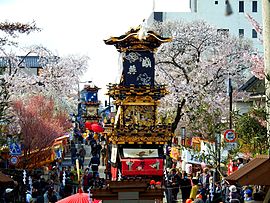
The Inuyama Matsuri is held at the beginning of April in the city of Inuyama in Aichi Prefecture. 
Coinciding with the blooming of the cherry blossoms, the festival features processions of three leveled ‘dashi’ – traditional wheeled floats.

Credits: Inuyama Festival (Dashi)
The beginning of Inuyama festival

Inuyama festival was originally an event of the Haritsuna shrine, where Inuyama’s genius is enshrined. This became an annual event in 1635, by the chief retainer Hayatonosho Masatora Naruse’s order.

The highlight of Inuyama festival is a parade by 13 floats. Every float has very gorgeous three layered construction, Japanese automaton (or Karakuri puppets) and some of these can be seen only here in Inuyama.

All of these 13 floats are designated as Aichi prefectural tangible folk assets. The parade of floats itself is not that rare in Japan and can be seen all over Japan and floats are called in different ways. Hoko, Dashi, Yatai, Danjiri are examples of them and in Inuyama, floats are called Yama.

Credits: Haritsuna Shrine (were Inuyama Festival once was started)

parade of floats
under the blooming cherry trees
sound of Taiko drums

© Chèvrefeuille

With this haiku I have tried to bring that sweet Haiku Writing Technique of earlier this week "sense switching" and I think I succeeded. (What follows is a short video about Inuyama Festival, enjoy).


I hope you did like this episode on Inuyama Festival and I hope it will inspire you all to write an all new haiku (or tanka).

This episode is NOW OPEN for your submissions and will remain open until October 18th at noon (CET). I will (try to) publish our new episode, Kodomo No Hi (Children's Day, former Boys Day), later on. Have fun!

Monday, October 12, 2015

Carpe Diem #837 St. Patrick's Day


Dear Haijin, visitors and travelers,

I think this episode will be a short one, because of lack of time and maybe because I think that the most of you know what St. Patrick's Day means. I didn't know that St. Patrick's Day was celebrated in Japan, because I know this holiday only from Ireland. So let us take a closer look at what St. Patrick's Day means and why it is celebrated in Japan.

Saint Patrick's Day, or the Feast of Saint Patrick (Irish: Lá Fhéile Pádraig, "the Day of the Festival of Patrick"), is a cultural and religious celebration held on 17 March, the traditional death date of Saint Patrick (c. AD 385–461), the foremost patron saint of Ireland.

Saint Patrick's Day was made an official Christian feast day in the early 17th century and is observed by the Catholic Church, the Anglican Communion (especially the Church of Ireland), the Eastern Orthodox Church, and Lutheran Church. The day commemorates Saint Patrick and the arrival of Christianity in Ireland, and celebrates the heritage and culture of the Irish in general. Celebrations generally involve public parades and festivals, céilithe, and the wearing of green attire or shamrocks. Christians also attend church services and the Lenten restrictions on eating and drinking alcohol are lifted for the day, which has encouraged and propagated the holiday's tradition of alcohol consumption.

Saint Patrick's Day is a public holiday in the Republic of Ireland, Northern Ireland, the Canadian province of Newfoundland and Labrador, and the British Overseas Territory of Montserrat. It is also widely celebrated by the Irish diaspora around the world, especially in Great Britain, Canada, the United States, Argentina, Australia and New Zealand.

Credits: St. Patrick

Saint Patrick:

Patrick was a 5th-century Romano-British Christian missionary and bishop in Ireland. Much of what is known about Saint Patrick comes from the Declaration, which was allegedly written by Patrick himself. It is believed that he was born in Roman Britain in the fourth century, into a wealthy Romano-British family. His father was a deacon and his grandfather was a priest in the Christian church. According to the Declaration, at the age of sixteen, he was kidnapped by Irish raiders and taken as a slave to Gaelic Ireland. It says that he spent six years there working as a shepherd and that during this time he "found God". The Declaration says that God told Patrick to flee to the coast, where a ship would be waiting to take him home. After making his way home, Patrick went on to become a priest.

According to tradition, Patrick returned to Ireland to convert the pagan Irish to Christianity. The Declaration says that he spent many years evangelizing in the northern half of Ireland and converted "thousands". Patrick's efforts to convert, subjugate, and drive off the Pagans (specifically the Celts) were eventually turned into an allegory in which he drove "snakes" out of Ireland. (Ireland never had any snakes.)(Source: Wikipedia)
Irish Clover, it is said that St. Patrick used this to explain the Holy Trinity to the Pagans
Now we know a little bit more about St. Patrick. So let us take a look at how St. Patrick's Day is celebrated in Japan. According to several sources St. Patrick's Day was introduced to Japan very recently in 1992 since then it has become a celebration all over Japan.
Japan has a surprisingly large number of St. Patrick's Day events with parades in several cities. The largest by far is the Tokyo St. Patrick's Day Parade in Omotesando with 15,000 participants and 50,000 spectators. The event features marching bands, cheerleaders and plenty of enthusiastic supporters. It's celebrated on March 15th instead of March 17th as is the custom in other countries.
Credits: St. Patrick's Day Parade Tokyo
Well ... it has become a longer episode than I had planned, but it's a nice episode I think. I wasn't inspired so I surfed the Internet to find a few examples of haiku on St. Patrick's Day.

on St Patrick’s Day
shamrock confetti showers
she thinks of her home


© Barbara A Taylor (Australia)

St. Patrick‘s Day –
not knowing any better,
lambs dance a set


© Paddy Bushe (Ireland)

I hope you did like this episode and I hope it will inspire you to write/compose an all new haiku or tanka.
!! I am (hopelessly) behind with commenting I hope to catch up a.s.a.p. !!

This episode is NOW OPEN for your submissions and will remain open until October 15th at noon (CET). I will (try to) post our next episode, a new Haiku Writing Techniques episode, later on. For now ... have fun!