Showing posts with label Mongolia. Show all posts

Friday, November 27, 2015

Carpe Diem #868 Stag Beetle / Flying Deer


Dear Haijin, visitors and travelers,

First this ... as I was preparing the prompt-list for this month I thought that this episode, stag beetle, was the right choice, but after almost three weeks I discovered that the prompt had to be "flying deer", because that's what was meant. So in this episode, it's all about a "flying deer" and not about the (insect) stag beetle.

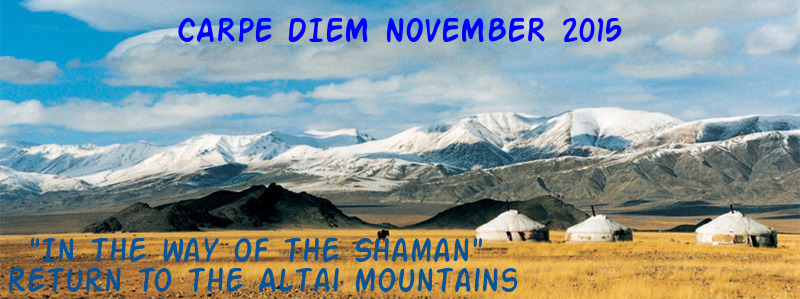
I love to tell you about a kind of "astral journey" I made while I was preparing November's prompt-list. It felt like I was really there, so it was a wonderful spiritual journey through the land of the Tuvan (people) and the Altai Mountains. I hope I can find the right English words to tell you this story.

[...] "Three days, two canyons and crossing several rivers later my companions and I arrive at the sacred Shevet Uul valley, where the prehistoric humans left signs and carvings behind on the rocks. As I walk on I smell the sweet perfume of thyme. A hare jumps away. There ... I see the first horseman. carved, with a lasso in his hand. A little further I see a primitive image of an Ibex, a kind of mountain goat with long horns, carved in the rocks. Solidified life, everywhere I look. Horsemen and galloping horses, Ibexes, a wild boar and magnificent magical creatures. Than ... my heart misses a heart beat. In front of me tumble a lot of little creatures, monkey like, in a dark universe of solidified magma. I forget to breath ... I see a huge flying deer with antlers of spiraling curls and legs elegantly floating through the skies. This magnificent animal escaping from two reaching hands, is three thousand years ago made by humans from the Bronze Age. The half open mouth is from a goose, symbol of the soul; its flight is pointing to the universe, maybe its a symbol of the transformation of the soul that rises to Heaven after dead.
I visit a Tuvan family and the grandfather of this family tells me about the "magical monkey" who is the creator of all carvings on the rocks in the Shevet Uul valley. No human could have done that, only this mythological creature. And the "flying deer" is one of the deities who are pointing us the way, teach us the way to let go and accept life as it is." [...]


Credits: Flying Deer (petroglyph Altai Mountains, Shevet Uul)

It was an uplifting "astral journey" and it opened my eyes to look to my world from another perspective ... a perspective of unconditional love, love for all and everything ... The "flying deer" is always there just around the corner of my mind and he shows up on moments of sadness, but also on moments of great joy ... and every time again it helps me to remember that I have to take life as it comes.

flying deer
points towards the after-life
true acceptation


© Chèvrefeuille

cry of an eagle
reaches the ears of the flying deer
listen to nature


© Chèvrefeuille

This episode was a joy to create, but it wasn't easy ... NOW OPEN for your submissions and it will remain open until November 30th at noon (CET). I will (try to) publish our new episode, our last CD Special by Ese, our featured haiku poetess, later on.


Monday, November 23, 2015

Carpe Diem #865 torn apart book (reading nature)


[...] "A sense of paradise descends from the skies. And I am aware that I am living through an unforgettable moment in my life; it is the kind of awareness we often have precisely when the magic moment has passed. I am entirely here, without past, without future, entirely focused on the morning, on the music of the horses’ hooves, on the gentleness of the wind caressing my body, on the unexpected grace of contemplating sky, earth, men. I feel a sense of adoration and ecstasy. I am thankful for being alive. I pray quietly, listening to the voice of nature, and understanding that the invisible world always manifests itself in the visible world." [...] (The Zahir - Paulo Coelho)


[...] “What is Tengri?” “The word means ‘sky worship’; it’s a kind of religion without religion. Everyone has passed through here—Buddhists, Hindus, Catholics, Muslims, different sects with their beliefs and superstitions. The nomads became converts to avoid being killed, but they continued and continue to profess the idea that the Divinity is everywhere all the time. You can’t take the Divinity out of nature and put it in a book or between four walls. I have felt so much better since coming back to the steppes, as if I had been in real need of nourishment. Thank you for letting me come with you.” [...] (The Zahir - Paulo Coelho)


Dear Haijin, visitors and travelers,

What a joy ... this month we are exploring the Altai Mountains and their spiritual meaning. In this last week of this month we will even come closer to that spirit. As you have read in the above quotes from The Zahir by Paulo Coelho it's all about reading nature this day. 


Credits: Reading Nature (the Altai Mountains)

I remember an article which I read about a woman exploring the region of the Altai Mountains. She had a Mongolian guide who never used a map or travel-book ... he could read his path, the weather coming and so on ... just by reading nature. Reading nature is one of the most important pillars of what is called Tengrism or 'sky worship’. 
That's truly being one with nature ... to have the ability to read nature's signs. Those signs are all around us. In plain simple words I can say: As I see the buds of the cherry grow ... than I know that spring is coming. Or ... as I see the changing colors of leaves at the end of summer I know that autumn is coming.
Isn't that beautiful? Let me look at our beloved haiku ... what do I see? I see kigo (seasonwords) who are pointing to the season in which the haiku was written ... through those kigo we can read nature ... that makes the haiku not only a Japanese poetry form, but also a poetry form of the Altai Mountains, haiku is part of Tengrism ... look around you .... see the signs of nature and read them ... just read them.

yellow meadow
starts to become green again
spring is coming


© Chèvrefeuille

Awesome ... reading nature is really a spiritual experience ...

This episode is NOW OPEN for your submissions and will remain open until November 26th at noon (CET). I will try to publish our new episode, another Haiku Writing Technique, later on. For now ... have fun!


Monday, November 2, 2015

Carpe Diem #849 Yaks


Dear Haijin, visitors and travelers,

We are on a journey through the land of shamanism and tengrism Mongolia and especially the Altia Mountains. A very characteristic scene are the yaks, a kind of cattle, which are used for several goals. As I was preparing this episode I asked my self the question "What is the spiritual meaning of the yak?" To me it seems there is no spiritual meaning, but it turned out otherwise.

Yak is a sign of the primal zodiac and it's about the same as Taurus. So let us take a look at this primal zodiac sign.

Stubborn determination is the hallmark of the Yak. Those born under this sign simply do not accept “no” for an answer. Hard work and dedication to a cause will earn you the highest respect in a Yak’s eyes. Members of this sign tend to see things as “black or white”, meaning that there is rarely a middle ground to any situation. People’s actions are either right or wrong, things are either good or bad, people are either hard workers or lazy slobs. The word “compromise” does not exist in the vocabulary of a Yak. They know how they feel and have no reason to question it.

Yaks hate change. They prefer a steady, dependable routine where they can focus their efforts on moving forward one day at a time. Working is where they feel the most comfortable, whether in their career or on their homes, in their gardens, or on their hobbies. Yaks tend to live for their future goals rather than for the moment, and it can take a lot of convincing to get them to take a break. It’s too bad, too, because a well-rested and serene Yak can be one of the best companions to have around. Finding a balance between work and life, or rather living for the future versus living for the present, should be an important goal for everyone born under this sign.

It is notable that some of history’s most notorious dictators were Yaks. Saddam Hussein, Adolf Hitler, and Niccolo Machiavelli, though all in very different ways, believed passionately and resolutely that fear and force amongst one’s own people were necessary components to creating and maintaining a strong following. This, of course, doesn’t mean that Yaks are evil or inhumane. Rather, comparing these former leaders shows that many Yaks share the trait of having a steadfast and uncompromising world view that they truly believe is best for all others to follow. The otherwise quiet and thoughtful Yak can become quite emphatic in sharing their passionate political viewpoints. One of this sign’s major life purposes is to learn to see past their own point of view and accepting the ideas of others, even if they personally disagree with them.

Yak

Yaks keep a small, but loyal group around them. They don’t like going out much and prefer quiet, familiar places when they do. Yaks don’t do small-talk well, they simply don’t have the time or patience for it. Those who know them well appreciate their ability to cut straight to the point and not sugar-coat conversations. If you can get a Yak friend to relax you will find that they are quite intelligent, loyal, and even fun to have around. If anyone outside the group were to try and cause trouble, the Yak would be the first to put an end to the situation - with force. Yaks will defend their closest friends and family with shocking force, but only when they deem it necessary.
Love is complicated for the Yak. Their difficulty in accepting others points of view can make long-term relationships difficult. Yaks are not rude or dismissive, but they know what they believe and will violate all social rules just to prove that they are right. In time, most members of this sign learn to suppress this trait in social situations, but they still have a hard time making long-term commitments until they have accepted that their way is not the only way or have managed to find a partner that will let them be the boss. Yaks often have admirers, but they are terrible at flirting. Striking up a casual conversation is not the most comfortable task for a Yak, though in time most figure out how to relax enough to be socially graceful. Age and experience do wonders for this side of a Yak’s personality.
The short spiritual meaning and spiritual power of the Yak is Healing stillness or numbness.

As part of our journey we are reading The Zahir by Paulo Coelho and this above mentioned meaning of the Yak is very strongly present in this novel ... that we will discover later on this month.

silence deepens
as the yak comes closer
overwhelming


© Chèvrefeuille

This episode is NOW OPEN for your submissions and will remain open until November 5th at noon (CET). I will (try to) publish our new episode, Tsengel (a vulcano), later on if my PC will stay stable.


Sunday, April 27, 2014

Carpe Diem Special #89, Soen Nakagawa's "awoken from a nap"


Dear Haijin, visitors and travelers,

This month of Carpe Diem is coming to it's end almost. We have had a wonderful month with beautiful Modern kigo for Spring, we had our first Ghost-Writer week and we had the CD-Specials by Soen Nakagawa, our featured haiku-poet for this month. And last but not least we had our first Tan Renga Squared Challenge ...
I am a little bit sad that this month will be over soon and that we don't have those wonderful haiku by Soen Nakagawa anymore, but ... well ... that's life (smiles) all things are coming to an end. I am still busy with creating our new prompt-list for May ... I hope to publish it asap, but before May 1st.

Ok ... another nice haiku written by Soen Nakagawa has to be here in the middle of our attention and I think I have found a wonderful haiku for your inspiration. I hesitated by the way to use this one, because it's a very uncommon haiku in which Soen Nakagawa uses 'penis'.
As I read that haiku for the very first time in the on-line magazine "Frogpond, 32.1 (2009)'' I was in a little shock. I had never read a haiku of a haiku-master in which the word 'penis' was used explicitly, but after a while I thought ''why not it's part of nature''. So I decided to use that haiku for this last CD-Special of April.

Credits: Steppe

This haiku  is one of Soen’s own favorites:

Aiming my penis
out over the steppes
awoken from a nap

(c) Soen Nakagawa

To this haiku he adds, “The word penis had never been used before in a haiku, and I was criticized for exposing such a thing! But a penis is just a penis. Nowadays there is confusion regarding sex. But in truth, sexual energy, like digestive energy, is God’s fine energy, Buddha’s energy, cosmic energy.” 

It's so like Soen himself who used plastic cups for the 'tea-ceremony' and instant coffee ...
As I stated above I was in a kind of shock, but after a while a haiku by Basho came in mind in which he (Basho) is not using the word ''penis'' itself, but hidden in another image.

ought one laugh or cry
when my Morning Glory
withers up

(c) Basho

In this haiku by Basho he refers to his penis ... not using the exact word, but ''my Morning Glory''. Of course its just a word, but I am more of the ''hidden word'' than of calling it by its name in haiku, but that's just the way I honor haiku.

Credits: Morning Glories

The goal of these CD Specials is to write a haiku in the same tone, sense and spirit as the one given. So let me try to write a haiku in the same sense, tone and spirit as the one by Soen Nakagawa.

Excalibur ...
pulled out of the stone -
a new day rises


(c) Chèvrefeuille

Well ... what do you think ...? It's for sure in the same sense, tone and spirit I think ... (blushing).

This Special episode is open for your submissions tonight at 7.00 PM (CET) and will remain open until April 30th 11.59 AM (CET). I will try to post our new episode, Safflower, later on today. For now ... have fun!