Showing posts with label Seven Sacred Autumn Flowers. Show all posts

Saturday, November 8, 2014

Carpe Diem #601, Chinese Bellflower (or Kikyo)


Dear Haijin, visitors and travelers,

Another day has gone by, and I am still in lack of time, so this post will not be that long. Today our prompt is the last one of the Seven Sacred Autumn Flowers, the Chinese Bellflower or Kikyo, and I like this plant/flower a lot. It's a very fragile flower and here in the Netherlands we call this sometimes 'paper-flower".

Chinese Bellflower, growing to 60 cm (24 in) tall by 30 cm (12 in) wide, it is an herbaceous perennial with dark green leaves and blue flowers in late summer. A notable feature of the plant is the flower bud which swells like a balloon before fully opening. The five petals are fused together into a bell shape at the base, like its relatives, the campanulas. There are varieties with white, pink and purple blooms in cultivation. In Korea, white flowers are more common.

Credits: Chinese Bellflower or Kikyo
I have sought the Internet and I ran into the following haiku on Chinese Bellflower (or Kikyo):

raiun ni kikyo murasaki yurchajimu

under thunderheads
the purple of the bellflowers
begins to sway


© Kyoko Kaneko

in a pot, Chinese
bellflowers begin to fade -
misty rain


© Shiki

Chinese bellflowers
bloom in mother's color
dark violet


© Murasaki Sagano

All three are gorgeous and I even found a haiku by Yozakura, our unknown haiku-poet:

purple bellflowers
swaying in the breeze -
the sound of water

© Yozakura

And I love to share my attempt here also:

fragile beauty
purple flowers like paper
Chinese bellflower

© Chèvrefeuille


Credits: Fragile Beauty ... like paper
And now it is up to you to write an all new haiku in response of this post about the Chinese Bellflower.

This episode is NOW OPEN for your submissions and will remain open until November 11th at noon (CET). I will (try to) publish our new episode, our second haiku by Tomas Tranströmer, our featured haiku poet this month, later on.


Friday, November 7, 2014

Carpe Diem #600, Boneset or Fujibakama (Eupatorium Japonicum)


Dear Haijin, visitors and travelers,

Today our prompt is Boneset (or Fujibakama), there are a lot of species of this herd, so it wasn't easy to find the right one. It's even possible that I have chosen the wrong boneset, but according to it's Latin name, Eupatorium Japonicum, I think I have the right one.
I can't discribe the beauty of Boneset ... it's a gorgeous flowering herb and I can see why the Japanese find this herb one of the Seven Sacred Autumn Flowers ... just their beauty I think ...

Credits: Boneset (or Fujibakama)
I couldn't find any haiku about this beautiful herb, but finally after researching the Internet I ran into a haiku written by someone named Hata3 (he/she has a blogspot weblog) on Boneset.

~ hyû hyû to kogarashi huku ya fujibakama

a whirring sound
of the withering wind -
flowers of Eupatorium


© Hatayama Akimi (Hata3)

It's a nice one, and the description of the Boneset with sound is such a great idea. It's a bit wooden sound as I may believe the background information I have found about this herb.

purple flowers
sounding like chopsticks -
at dinner time

© Chèvrefeuille

This episode is open for your submissions tonight at 7.00 PM (CET) and will remain open until November 10th at noon (CET). I will (try to) publish our next episode, Chinese Bellflower or Kikyo, later on. For now have fun!


Thursday, November 6, 2014

Carpe Diem #599, Yellow colored Valerian or Ominaeshi, one of the seven sacred autumn flowers


Dear Haijin, visitors and travelers,

It's almost time to publish our new episode as I am writing it right now. I had a busy day an hadn't enough time to publish it earlier. This episode is a kind of "re-prise", because in an earlier post, last month, I had a "Little Creatures"-episode about this same flower, but at that moment I hadn't the idea to bring the seven sacred autumn flowers as a prompt, so forgive me, if this "re-prise" is somewhat fast after it's original.

The Yellow colored Valerian is a part of the flower-family of Honeysuckle (what a coincedence, my penname "Chèvrefeuille" is French for Honeysuckle) and this part is called Patrinia.There are about 17 species native to grassy mountain habitats in China, Siberia and Japan. These are unassuming clump-forming perennial plants having thin, erect stems with few leaves and bearing a terminal inflorescence with yellow or white flowers.
Credits: Yellow colored Valerian or Ominaeshi (Japan)
It's a nice flowering plant and I think I leave it to this ... let the photo inspire you to write an all new haiku.

This episode is NOW OPEN for your submissions and wil remain open until November 9th at noon (CET). I will publish our new episode, Boneset or Fujibakama, later on. For now ... just have fun! !! By the way I will publish our new episode of "Little Creatures" tomorrow, because of lack of time. So please have a little bit patience !!


Wednesday, November 5, 2014

Carpe Diem #598, Large Pink (Nadeshiko) or Carnation, one of the Seven Sacred Autumn Flowers


Dear Haijin, visitors and travelers,

What an awesome posts we have had the last few days. The first Tranströmer special and that nice GW-post about Edgar Allan Poe ... and you all are very inspired to write haiku in response of those posts. Thank you all for your participation and contributions. That's what makes Carpe Diem Haiku Kai.
In our last "Just Read" episode I published an article written by Fay Aoyagi of Blue Willow Haiku World about "Moon in the Haiku Tradition". You all could respond on that article by submitting a haiku about "moon". I was really surprised to read all of your wonderful "moon"-haiku and I decided to make an anthology of "moon"-haiku which I gave the title "for the sake of the moon". I hope you all like that idea and I hope that I can  and may use your haiku on "moon" for that anthology. I love to make that anthology available next December as an ebook here on Carpe Diem Haiku Kai. Please let me know if it's ok that I use your haiku (of course credited).


Ok ... back to our episode of today. Today I love to introduce another one of the Seven Sacred Autumn Flowers to you all. The "sacred flower" this time is the Large Pink (Nadeshiko) or Carnation and I have found a few wonderful haiku written by Issa, Shiki and Narayanan Raghunathan (co-founder of Wonder Haiku Worlds) about Nadeshiko or Large Pink:

nadeshiko ya jizô bosatsu no ato saki ni

blooming pinks
behind and in front
of Saint Jizo

nadeshiko ya hitotsu saite wa tsuyu no tame

pinks--
one is blooming
thanks to the dew


© Kobayashi Issa

hagi kikyo nadeshiko nando moe ni-keri

bush clover, bellflowers
and also pinks
have sprouted

© Masaoka Shiki

cool dawn --
the nadeshiko field
sways in breeze

© Narayanan Raghunathan (co-founder of Wonder Haiku Worlds)

Credits: Large Pink or Nadeshiko
It looks so fragile ... and I think it's a fragile flower. In the Western world we call this flower Carnation and there are over 300 different species of this wonderful flower. In my country (The Netherlands) we see very often Carnations in mourning bouquets, that's one of the reasons why my wife don't want to get Carnations for her birthday or another festive day.

on this grave
next to a little teddy bear
purple carnations

© Chèvrefeuille

Well ... I hope you did like this episode and I hope it will inspire your to write an all new haiku. This episode is open for your submissions tonight at 7.00 PM (CET) and will remain open until November 8th at noon (CET). I will (try to) publish our next episode, Yellow Valerian, later on. For now ... have fun! By the way I am behind with commenting hope to catch up a.s.a.p.


Sunday, November 2, 2014

Carpe Die #597, Kudzu (or Arrowroot)


Dear Haijin, visitors and travelers,

Today our third (sacred) autumn flower, Kudzu, is our prompt. Kudzu is not only a wonderful plant with gorgeous purple flowers, but it is also one of the most used herbs in traditional Chinese Medicine. It's one of the 50 most used herbs in Chinese medicine and it is used for several kinds of illnesses e.g. migraine and vertigo. So it's really a sacred autumn flower

Credits Kudzu
I found a haiku with Kudzu (or Arrowroot) in it written by Nishimoto Itto (1907-1991)

satomiya mo Togakushi michi mo kuzu no aki

at the village shrine
and at the road to Mount Togakushi -
arrowroot in autumn 


© Nishimoto Itto (1907 - 1991)

And another one by Issa:

waga kaki ya uki yo no kuzu no hana-zakari

my fence--
the floating world's arrowroot
in full bloom


© Issa

I have tried to find more haiku on Kudzu, but there are not much haiku about this Sacred Autumn Flower. So you have to do it with these two.

Here is my attempt:

dew shimmers
on the purple flowers of Kudzu -
leaves fall

© Chèvrefeuille

I hope you did like this post and that it will inspire you tou towrite your own haiku on Kudzu or Arrowroot. This episode is open for your submissions tonight at 7.00 PM (CET) and will remain open until November 5th at noon (CET). I will (try to) post our next episode, our first CD-Special by Tomas Tranström, later on. For now ... have fun!


Saturday, November 1, 2014

Carpe Diem #596, Miscanthus (or Susuki)


!! This episode is published earlier than I normally do, because I am in the nightshift !!

Dear Haijin, visitors and travelers,

Today we are going on with the exploration of the Seven Sacred Autumn Flowers and today that's the Miscanthus a species of flowering grass, native to eastern Asia throughout most of China, Japan, Taiwan and Korea. It is an herbaceous perennial grass, growing to 0.8–2 m (3–7 ft) tall, rarely 4 m (13 ft), forming dense clumps from an underground rhizome. The leaves are 18–75 cm (7–30 in) tall and 0.3–2 cm broad. The flowers are purplish, held above the foliage. This plant is the preferred structure for the nesting of some species of paper wasps, such as Ropalidia fasciata.

Credits: Miscanthus Sinensis in Autumn

As I look at the Miscanthus it looks similar with pampasgrass, but it's more fragile. And it's one of the beloved Autumn flowers of the Japanese people.

I have sought for haiku about Miscanthus, but found only haiku written about Miscanthus by Basho. Of course I haven't sought every haiku-poet, but the "big-five" for sure. So here are the haiku by Basho which I have found:

inazuma ya  kao no tokoro ga  susuki no ho

lightning—
through the face,
miscanthus plumes


shiorashiki  na ya komatsu fuku  hagi susuki

a lovely name—
Little Pine, where the wind wafts
over bush clover and miscanthus


yuki chiru ya  hoya no susuki no  karinokoshi
snow falling—
miscanthus for the shrine hut
still uncut


Credits: Miscanthus or Susuki

tomokakumo  narade ya yuki no  kareobana

somehow
still alive—snow on
withered miscanthus

bashō uete mazu nikumu ogi no  futaba kana
by my new banana plant
the first sign of something I loathe—
a miscanthus bud

All wonderful haiku written by Basho ... to come near to the beauty of these Miscanthus-haiku will not be easy, but I have to try of course.

Here is my attempt to write a haiku inspired on Miscanthus:

swaying in the breeze
like waves in the ocean
Miscanthus leaves


© Chèvrefeuille

This above haiku is a re-written one which I have earlier posted in a post about pampasgrass and in this version it looks even greater ... according to the above photo Miscanthus looks like the ocean. Well .... I hope you are inspired too.This episode is open for your submissions tonight at 7.00 PM (CET) and will remain open until November 4th at noon (CET). I will (try to) post our next episode, Kudzu, later on today.


Friday, October 31, 2014

Carpe Diem #595, Bush Clover (one of the seven sacred autumn flowers)


Dear Haijin, visitors and travelers,

It's my pleasure to present to you our first prompt of our new month of Carpe Diem Haiku Kai, November. The first seven (regular) prompts will be the seven sacred autumn flowers and today the first of those sacred autumn flowers is Bush Clover (Hagi).

“The loneliness Of autumn on the beach More even than that of Suma In the surf Mingled with small shells Petals of the bush clover” (Matsuo Basho; The Small Road Into the Deep North)

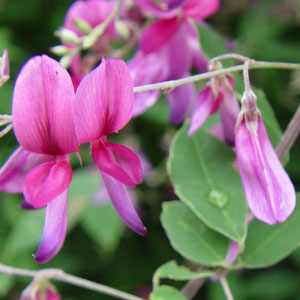
The delicate, flowering bush clover has been a favorite motif with Japanese poets since time immemorial. Small pink flowers are borne at the end of arching stems and mix attractively with dainty leaves. It is a vigorous, deciduous shrub of the pea family, and several wild species can be found growing on damp hills and moors. There is a white-flowered variety, but the parti-colored pink types are more common. In the 10th century, no aristocratic villa would have been complete without the modest bush clover, blooming in a dew-drenched garden. Today, there is still a corner in our hearts and small gardens for this charming autumn bush. 
Credits: (Japanese) Bush Clover (Hagi)
And I have sought for haiku written by our classical masters about the Bush Clover. I have found quiet a lot of haiku about Bush Clover.

mire te yuku ya   hito mo okashi   ame no hagi

to get wet
by passing a man is interesting
bush clover in rain


© Basho
shiratsuyu wo kobusanu hagi no uneri kana

not spilling the glistening dew,
the bush clover,
undulating


© Basho

yuujo no onajiyane no moto de amarini moga nemutte iru hagi to tsuki

under the same roof
courtesans, too, are asleep --
bush clover and the moon


© Basho 

Credits: Bush Clover (Hagi) Woodblock Print

hagi no me ya hito ga shiraneba shika ga kuu

bush clover sprouting--
when people aren't looking
the deer eats


© Issa


yase hagi ya bukuri-bukuri to chiri ni keri

barren bush clover--
softly, softly its blooms
have scattered


© Issa

ashimotono akino oboroya hagino hana

the autumn haze 
at my feet--
bush-clover flowers


© Buson


kogitsuneno nanni musekemu kohagihara
the little fox,
what made him cough--
in a field with bush clover?

© Buson
 
Credits: Hagi (Bush Clover) woodblock print 1840

All wonderful haiku ... can it be possible to write all new haiku after all these beauties? Let me give it a try ...

bush clover spreads
my garden becomes a purple sea -
autumn dew shimmers

© Chèvrefeuille

Hm ... not a strong one, but I like it ... This episode is open for your submissions tonight at 7.00 PM (CET) and will remain open until November 3rd at noon (CET). I will publish our new episode, Miscanthus, later on.