Showing posts with label Waka. Show all posts

Wednesday, June 13, 2018

Wandering Spirit: faasuto iyaa wizu Basho (first year with Basho)


the story continues


After my first meeting with the master, with Basho, I was excited and proud to have a haiku written by him personally. I cherished that haiku and decided to calligraph it on white silk. As I had done that I bought a small wooden box and put the haiku on silk into it carefully.

Like a treasure
Hidden in the depth of the mountains
His haiku

© Yozakura

Several days later Basho invited me to his home. I was honored that he invited me.
“Yozakura”, he said. “I have a proposal for you”.
I nodded and my heart beat rose to unknown height.
“Your haiku are wonderful Yozakura, but they can become more sophisticated. I can teach you how. Do you want to be one of my students?”
“I would be honored master Basho. Yes, I love to become one of your students”, I answered.
Basho hugged me and gave me a kiss on my forehead.
“That that is settled. Welcome Yozakura. Please stay with me. Let us write a chained verse together. Do you want to write the first verse?”
I looked at him and stammered: “I would be honored, but I am just a beginning haiku poet. I don’t know if my haiku are worth to start a chained verse with”.
“Lesson One, dear Yozakura, every haiku is a real beauty. It has nothing to do with being a beginner or a professional. It has to do with the love of nature. Look at the pine-tree and see the pine-tree as Buddha. Your haiku are extraordinary wonderful Yozakura … don’t forget that!”
I bowed my head. “I will write the first verse master Basho”, I whispered.

dewdrops shimmer (image found on Pinterest)
At dawn
Birds sing their song
Dewdrops shimmer

© Yozakura

“Brilliant”, Basho said. “This is a nice haiku to start with. Now I have to write the second verse, but I need your help with it. In which season your haiku is written?”
I felt a little bit embarrassed as he asked me which season it was written in.
“I don’t really know. ‘Dawn’ can be used in every season as can ‘birds sing their song’, but I don’t know if ‘dewdrops’ can be used in every season. I think ‘dew’ is a kigo for spring or summer. So this haiku is a spring haiku, because all scenes noticed give me a spring feeling’, I answered. Basho smiled.
“Than it is a spring haiku Yozakura. Now to write the second verse. What do you want that this second verse tells us?”
“I would love to see, the beauty of flowers and young life”. Basho applauded.

Cherry blossoms bloom again
Shelter for young sparrows

© Basho

“That’s what I thought too master”, I laughed. “The beauty of cherry blossoms and the offspring of sparrows. Fragile beauty and the seemingly roughness of sparrows without colors as bright as the cherry blossoms”.
I became excited. I never had done a chained verse in the manner of Basho. “He is really a renga master”, I thought.
“Well … let us go on to the third verse. Read that verse again Yozakura, say it aloud, try to feel what it is painting. Become a part of the scene. Be a spectator that sees this scene”.
I, of course, did what he asked from me. How could I not do that. I was his apprentice so I just did what he asked. I said the second verse aloud … became a part of it. It felt like I was one with the scene. I was the young sparrow in the shelter of the cherry blossom.
“Now … I will make it a little bit more difficult for you my dear Yozakura. It’s your turn to write the next verse, but I love to see a moon theme in it. Do you think you can do that?”
“I think I can, but are you willing to give me some time? This way of writing chained is somewhat new to me”.
“Yes of course you can. Are you still staying at the home of your brother?”
“Yes”.
“Than go home and take your time. A chained verse doesn’t see the light in one day”.

Later that day Kichirou and I had dinner and I told him about my first lesson. “Basho asked me to write the first verse of a chained verse. That was a honor and than he asked me for help with creating the second verse. It was really awesome to work with him. He is a very nice and attractive man, but he is also very wise”.
“Sounds like you have had a good time Yozakura”, Kichirou said.
“Yes it was a real nice day. How was your day?”
“My day was good too. I met a wonderful painter. He told me about haiga. That’s a kind of painting in which haiku are used. He gave me this”.

Willow Tree (woodblock print, by Kawase Hasui, inspired on Saigyo's renown waka)

Kichirou reached for a roll of rice paper and showed it to me. It was an awesome painting inspired on a waka by Saigyo about a willow tree. The willow tree was really beautifully painted and in the pond its reflection was magnificent. The waka calligraphed in a great way. I felt tears rolling from my cheeks.
“Who has painted this … it is … it is wonderful”, I stammered.
“His name is Takayuki and he is a young man, very talented as you can see. I have asked him to make a haiga inspired on that haiku you got from Basho. He will be visiting us tomorrow. As a former Wakashu I think you will appreciate him”.
I smiled. “Hoshina was the first man I fell in love with. There is no place in my heart for a new love my dear brother”.
After dinner we sat on the verandah enjoying each other’s company. Kichirou was reading a book and I was busy to create a new verse for the chained verse Basho and I started.
“Kichirou?” I asked.
“Yes my brother?”
“This is the chained verse we started today, but I have no idea how to bring the moon into the third verse. Maybe you can help me”.
“Please … read what you have already”, Kichirou answered.
At dawn
Birds sing their songs
Dewdrops shimmer;
That’s the first verse and this is the verse Basho created inspired on the first.
Cherry blossoms bloom again
Shelter for young sparrows;
And now I have to write the third verse, but in that verse I have to use “moon” as Basho asked me”.
“How do I do that?” Kichirou asked.
“By looking at that second verse and let your heart speak to you through the images you see”.
Kichirou nodded. “Let me hear that second verse again”.
I read it aloud a few times again and than I saw how Kichirou smiled.
“Do you have an idea my brother?”
“What do you think of this idea: fragile beauty makes the night mysterious in the moonlight”.
“Awesome Kichirou, but that last line. I don’t know. In your second line you use mysterious and than you use moonlight. I think that there is no need to use moonlight. What do you think of this line? The moon is female so I thought of this ‘she … is beautiful’. Than it makes the mystery bigger, more intense and I think that’s a nice contrast with fragile in the first line”.
I saw that Kichirou understood what I meant, but he wasn’t quite satisfied.
“Your third line is nice, but than you have used two times ‘beauty’, maybe you can change that third line into ‘she … the one I love’, because you love the moon.
I looked at him. "What do you mean?"
"Well ..."
I saw that he weighed his words. "Don't be afraid to say what you think my brother".
"You had a loving relation with Hoshina".
I nodded. "Yes you are right. I loved him very much. I am still missing him. I know they call male to male love "moonlove" ... so I think that third line you proposed is very nice and keeps the mystery.

Moon (woodblock by Gesso Yoshimoto) (found on Pinterest)

We were awake early after a good night's sleep. The sun was already above the horizon and the village was already alive. We sat on the porch and ate our breakfast in profound silence. My thoughts were at Basho's lesson of yesterday.
"I am looking forward to my next lesson of master Basho", I said.
Kichirou looked at me. "He must be special".
"Yes he is, my brother. In a way I feel like him. We even have a connection, a click, with each other. It feels like I know him for a long time instead of just a few weeks. I am excited how our renga will evolve ..."

After a warm cup of tea I took off and went to Basho. He embraced me and gave me a kiss on my forehead. "Good to see you again Yozakura. I am looking forward to create our renga together. I think we will do a half kasen-renga. That means only eighteen verses instead of thirty-six. Is that okay?"
"Yes i think so too. I love to create a complete kasen-renga, but it's not easy to create that as a starting poet. So ... yes let us create a half kasen-renga".
I had a wonderful day with master Basho. The sun was already downing as we finally had created our half kasen-renga.
"You did a great job Yozakura", Basho said.
I blushed and bowed my head. "Thank you master Basho", I whispered.
He looked at me and shook his smiling head.
"You really did great Yozakura. You are looking at a very proud master". He embraced me.
"It's time. The day runs towards its end. Go home Yozakura enjoy the renga we created".
He gave me small booklet we had created from our renga. He even had painted a wonderful scene on the cover. "It's my gift to you Yozakura. Do I see you again tomorrow?" I nodded.

Dew drops shimmer (image found on Pinterest)
After dinner I took the small booklet of our renga and I read it. It made me proud and I love to share the renga Basho and I created with the world. So here it is:

Dewdrops shimmer 

At dawn
Birds sing their song
Dewdrops shimmer

Cherry blossom blooms again
Shelter for young sparrows

The pale moon hangs
Still fresh against the sky
Trailing morning glories      (© Dolores)

A new day rises on my naked body
The sheet that covered me slipped away

Birds sing their song
Dewdrops shimmer like diamonds
Just an illusion

Her feet caress the fresh grass
The moist of the wet earth

Reflection
In puddles of rain
Clouds are dancing

Cherry blossom petals sway on the wind
Their temporarily beauty gone

On this grave
Beneath the blooming wisteria
Her name

After the rain, clouds break open
The blue sky in all her beauty

Dragonkite
Climbs towards heaven
Reaches for the sun

In front of the fireplace
Two souls become one in a glass of wine

Sparkling wine
Flames dance in her hand
He is granted a smile

After the heat this summer night
Honeysuckle perfume and coolness

Warm embrace
Skin to skin we lay down
On the beach

Seagulls cry against the wind
Waves splash in the light of dawn

Reaching for the sun
Swaying on the warm air
Swallows dance together

Dewdrops vaporise as a new day rises
Morning glories bloom for just a moment

"That's a very nice renga Yozakura", Kichirou laughed. "Can I read it again?" I saw how he enjyed the renga and his smile made me proud.

- to be continued -


Thursday, June 15, 2017

Carpe Diem Time Travel #2 The Tale of Genji


!! Open for your submissions next Sunday June 18th at 7:00 PM (CET) !!

Dear Haijin, visitors and travelers,

Welcome at a new episode of our "Time Travel" feature. This feature I have created especially for our "weekend-meditation" and its goal is to create new haiku, tanka or other Japanese poetry form inspired on poems from ancient times. For example: waka taken from the Man'yoshu, as we did in the first episode of this new feature.

This episode I love to introduce to you a well known Japanese novel from the 11th century, The Tale of Genji. And I will share a few poems from this Tale with you to inspire you. Let me (with help from Mark Cartwright) tell you a little bit more about this ancient Japanese novel.

Tale of Genji (by Mark Cartwright); published on 10 April 2017 at www.ancient.eu 

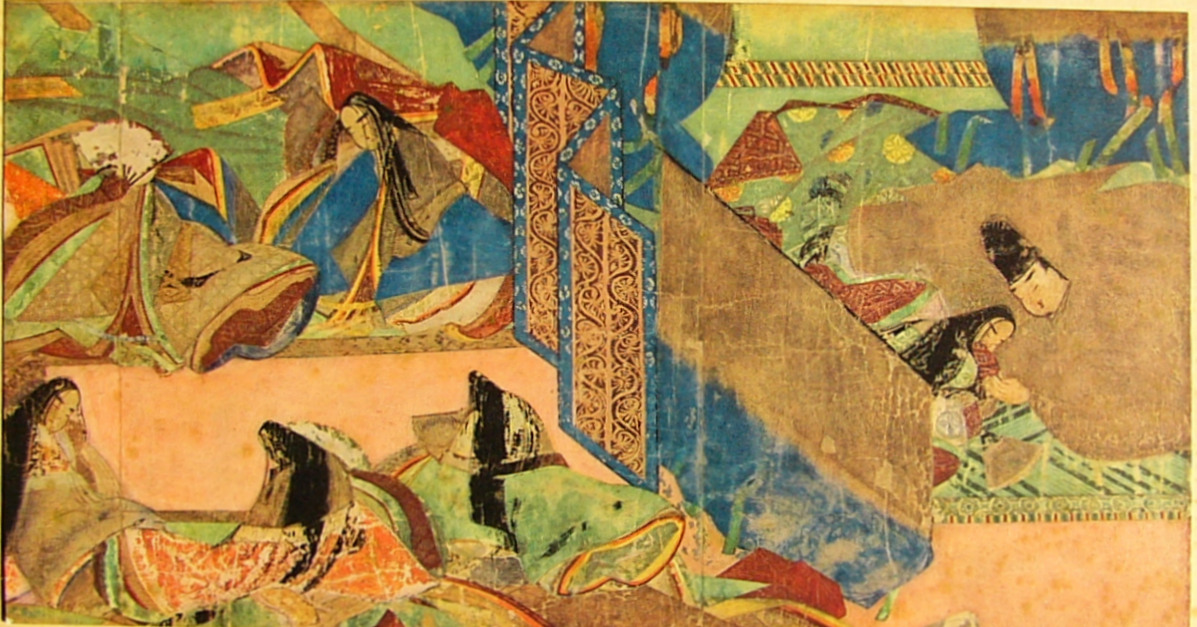
The 'Tale of the Genji' or Genji Monogatari, written in the 11th century CE by Murasaki Shikibu, a court lady, is Japan's oldest novel and possibly the first novel in world literature. The classic of Japanese literature, the work describes the life and loves of Prince Genji and is noted for its rich characterization and vivid descriptions of life in the Japanese imperial court. The work famously reproduces the line 'the sadness of things' over 1,000 times and has been tremendously influential on Japanese literature and thinking ever since it was written. The 'Tale of Genji' continues to be retranslated into modern Japanese on a regular basis so that its grip on the nation's imagination shows no sign of loosening.

Hand painted illustration from the Tale of Genji

Murasaki Shikibu

The work's author is considered to be a lady of the imperial court by the name of Murasaki Shikibu who wrote it over several years and completed it around 1020 CE during the Heian period (794-1185 CE). Murasaki is also known as To no Shikibu. Murasaki was a nickname and shikibu means 'secretariat,' which was the role of her father as in ancient Japan it was common to call a daughter by her father's position. She was a member of the Fujiwara clan. Her birth is accepted as around 973 CE and her death after 1013 CE, the date of the last mention of her in court documents. Details of her life are sketchy except that her father was Fujiwara no Tametoki, a provincial governor, and that she married a fellow Fujiwara clan member, one Fujiwara no Nobutaka, with whom she had one daughter, Daini no Sammi. Murasaki's husband died in 1001 CE, and she then became a lady-in-waiting (nyobo) to Empress Akiko (aka Shoshi) where she displayed great talent in the arts, particularly calligraphy, the harp (koto), painting, and poetry. Besides the novel, other surviving works by Murasaki include poems and her diary.

The novel describes life in the Japanese Imperial Court. Its etiquette & intrigues & above all the central character of Prince Genji. (Genji Monogatari)

The Japanese title Genji Monogatari may be translated as 'The Tale of Prince Genji.' It consists of 54 chapters and 750,000 words, although the final 13 chapters are regarded as a later addition by a minority of scholars principally because the story then no longer concerns Genji but his son Kaoru and takes on a darker tone. Neither do scholars entirely agree on the order of the chapters as many seem like later insertions by the author and several are parallel chapters or narabi where events occur not after but contemporary with the events described in earlier 'ordinary' chapters (hon no maki).

The novel describes life in the Japanese imperial court, its etiquette and intrigues, and, above all, the central character of Prince Genji who is the perfect gentleman in looks and deed. Genji's relations, love affairs, and transition from youth to middle age are all captured by Murasaki's astute writing which combines romanticism and realism in equal measure to capture a timeless treatment of human relations and the general impermanence of all things.

Scene from The Tale of Genji (Brooklyn Museum)

In her own words Murasaki describes this discovery:

"But I have a theory of my own about what this art of the novel is...it happens because the storyteller's own experience of men and things, whether for good or ill - not only what he has passed through himself, but even events which he has only witnessed or been told of - has moved him to an emotion so passionate that he can no longer keep it shut up in his heart. Again and again something in his own life or that around him will seem to the writer so important that he cannot bear to let it pass into oblivion". (Mason, 96)

Murasaki Shikibu (978-1014) is seen as the inventor of the "Psychological Novel", as she shows in her Tale of Genji.

Murasaki Shikibu (978-1014)
Now we know a little bit about the background of The Tale of Genji and now we are looking to a few poems from this wonderful ancient Japanese novel.

In The Tale of Genji we see very often two characters speaking with each other through poems, so maybe we can say that The Tale of Genji was the first kind of Tan Renga. In the examples I will show you that.

This first poem is a stand alone poem:

since my departure for this dark journey,
makes you so sad and lonely,
fain would I stay though weak and weary,
and live for your sake only!


And here is a beautiful example of a "poem-conversation":

fain would one weep the whole night long,
as weeps the Sudu-Mushi's* song,
who chants her melancholy lay,
till night and darkness pass away


(the "answer"):

to the heath where the Sudu-Mushi sings,
from beyond the clouds one comes from on high
and more dews on the grass around she flings,
and adds her own, to the night wind's sigh.


* Sudu-Mushi are a kind of insects which sing in herbage grass especially in autumn evenings

Scene from The Tale of Genji
Another example of a "poem-conversation":

when on my fingers, I must say
I count the hours I spent with thee,
is this, and this alone, I pray
the only pang you've caused on me?
you are now quits with me


(the "answer"):

from me, who long bore grievous harms,
from that cold hand and wandering heart,
you now withdraw your sheltering arms,
and coolly tell me, we must part


Chrysanthemum (woodblock print)
A last example of what I have called here a "poem-conversation":

even this spot, so far to view
with moon, and Koto's gentle strain,
could make no other lover true,
as me, thy fond, thy only swain
one turn more!
stay not your hand when one is near,
who so ardently longs to hear you


(the "answer"):

sorry I am my voice to low
to match the flute's far sweeter sound,
which mingles with the winds that blow
the autumn leaves upon the ground


All wonderfully crafted poems in which we can sense the love between the characters. Strong emotions hidden in their words. The Tale of Genji, a psychological love story.

Cicada (woodblock print)

Here is the "poem-conversation" to work with. Let this "poem-conversation" inspire you to create haiku, tanka or other Japanese poetry form in which you try to catch the strong emotions hidden in the Tale of Genji.

where the cicada casts her shell
in the shadows of the tree,
there is one whom I love well
though her heart is cold to me


(the "answer"):

amidst dark shadows of the tree,
cicada's wing with dew is wet,
so in mine eyes unknown to thee,
spring sweet tears of fond regret


An awesome "poem-conversation" to work with I think. So I have given it a try with this tanka:

weeping willow
hides her red-stained eyes
behind broken roses
trampled with the foot he cherished
even kissed that last night


© Chèvrefeuille

Well ... sorry for this long episode, but I was on a roll. I hope you do not mind. This "weekend-meditation" is open for your submissions next Sunday June 18th at 7:00 PM (CET) and will remain open until June 23rd at noon (CET). I will try to publish our new episode, the first of our Theme Week about Milarepa, the renown poet and yogi from Tibet, later on. Have a great weekend ... be inspired and enjoy creating your haiku, tanka or other Japanese poetry form.

PS. You can find a pdf filed version of "The Tale of Genji" HERE


Thursday, June 1, 2017

Carpe Diem's Time Travel, Ancient Japanese Poetry To Inspire You #1 little I should grieve


!!! Open for your submissions next Sunday June 4th 7:00 PM (CET) !!!

Dear Haijin, visitors and travelers,

Welcome at a completely new feature for our "weekend-meditation". As you maybe remember, last month I announced to end the "Universal Jane" feature, not to forget her, but to create space for a new feature. Of course I will create another special feature to honor Jane Reichhold here at Carpe Diem Haiku Kai.

This new feature for our "weekend meditation" I have titled "Time Travel, Ancient Japanese Poetry To Inspire You" and in this new feature I will take you on a trip back into time, a time in which poetry was only an art for the higher classes of Japan. A lot of those poems were gathered in several anthologies like the Kokinshu (or Kokin Wakashu - 920 AD) or the Man'yoshu (Collection of Ten Thousand Leaves - 745 AD). In these anthologies the "editors" have gathered long poems (like Choka) and short poems (like Waka).

In this new feature I will try to tell you a little bit background on these anthologies and will give you a few examples. Than I will introduce the poem which you have to use for your inspiration.

For this first episode of "Time Travel" I have made a nice choice from the Man'yoshu, but let me first tell you a little bit about the background.

The Man'yoshu or 'Collection of Ten Thousand Leaves' is an anthology of ancient Japanese poems compiled c. 759 CE during the Nara Period but including many earlier works. The most likely person to have assembled the collection is Otomo no Yakamochi, himself a prolific poet who included nearly 500 of his own works in the Man'yoshu. The Man'yoshu is regarded as a literary classic and high point of Japanese poetry.

Otomo no Yakamochi

Many scholars consider the Man’yoshu to have been compiled by the poet Otomo no Yakamochi (c. 718-785 CE)

On an evening when the spring mists
Trail over the wide sea,
And sad is the voice of the crane,
I think of my far-off home.

© Otomo no Yakamochi

The Man'yoshu collection contains poems which were all written in the Japanese of that time, i.e. using Chinese characters phonetically. The work consists of 4,496 poems organized into 20 books, the vast majority being in the waka (aka waku) style, that is each poem has precisely 31 syllables in five lines (5+7+5+7+7). 262 poems, in contrast, are written in the longer nagauta style, which can have up to 200 lines. There are also 62 sedoka poems (six-line poems of 38 syllables) and four poems written in Chinese. The poems come in three broad thematic categories; zoka (miscellaneous), somon (mutual inquiries or love poems), and banka (elegies). The poems cover a period of four centuries and it is likely they were intended to be sung.

A few examples of the poems in the Man’yoshu:

Countless are the mountains
in Yamato,
but perfect is
the heavenly hill of Kagu:
When I climb it
and survey my realm,
Over the wide plain
the smoke wreaths rise and rise,
over the wide sea
the gulls are on the wing;
a beautiful land it is,
Akitsushima,
the Land of Yamato.

© Emperor Jomei 

Cherry Blossoms (image found on WP)

There I found you, poor man! - 
Outstretched on the beach,
On this rough bed of stones,
Amid the busy voices of the waves.
If I but knew where was your home,
I would go and tell;
If your wife but knew,
She would come to tend you.
She, not knowing the way hither,
Must wait, must ever wait, 
Restlessly hoping for your return -
Your dear wife - alas!

© Kakinomoto Hitomaro 

Two wonderful poems from this very ancient anthology of Japanese poetry. All poems I have read so far are even more beautiful as if they were selected to overrule each other ...


For this first episode of "Time Travel, Ancient Japanese Poetry To Inspire You" I have chosen a "waka" written by Princess Kagami (7th century):

Even a breeze may fail me
When I desire it.
Little I should grieve,
If only, sure of its coming,
I could await even a breeze.

© Princess Kagami

This "waka" was written in response on a sedoka written by her younger sister Princess Nukada, the most famous female poet of her time.

Well ... I hope you did like this new feature and I hope I have inspired you to create your haiku, tanka or other Japanese poetry form inspired on that sad sounding "waka" by Princess Kagami.

Here is my attempt to create a haiku inspired on this "waka":

through tears
cherry blossoms scattered
by the breeze

© Chèvrefeuille

This "weekend-meditation" is open for your submissions next Sunday June 4th at 7:00 PM (CET) and will remain open until June 9th at noon (CET). Have fun! I will try to publish our new episode, Om Mane Padme Hum, later on. Have a great weekend!

PS. The Solution to our Haiku Puzzler of May 2017 you can find HERE


Monday, October 10, 2016

Carpe Diem Special (2nd guest) Kala Ramesh #2 "tangled thoughts . . ." (tanka)


Dear Haijin, visitors and travelers,

Welcome at the second Carpe Diem Special by Kala Ramesh. In the first CD-Special by Kala I shared haiku written by her with you all, today I love to share a few tanka by Kala with you.
Kala is not only a gifted haiku poetess, but she also writes beautiful tanka in a very nice and personal way. Her tanka are mostly a reflection of daily happenings like for example "children trying to stretch their playing time before going to bed".

As you all know I am not such a great tanka poet, but I love the form. Let me tell you first a little bit more about tanka, for those visiting here who not know about tanka.
Tanka is, like haiku, an ancient Japanese poetry form and it derived from the waka and maybe partially from renga . Maybe you have heard from tanka and waka or maybe you are familiar with "The Tale of Genji" (a wonderful classical piece of literature in which the poetess used waka).


Scenes from "The Tale of Genji"

Back in 2013 I once created a Carpe Diem Distillation episode about "The Tale of Genji" and I love to share here the waka which I presented there again:

mishi hito no
keburi o kumo to
nagamureba
yuube no sora mo
mutsumashiki ka na

the evening sky itself
becomes something to cherish
when I gaze at it,
seeing in one of the clouds
the smoke from her funeral pyre

© Murasaki Shikibu (11th century)

weeping willow

Here at CDHK we have seen several posts in which I shared waka by classical poets/esses, maybe you can remember this one too. It's a waka by Saigyo and it was the inspiration for a well known haiku by Matsuo Basho (1644-1694):

along the way
where water is running
in the willow shade
I have stopped to rest
for a little while


© Saigyo (12th century)

And this is the haiku which Basho wrote after reading this waka by Saigyo:

one patch of a rice field
when it was planted I left
the willow tree
© Basho (Tr. Jane Reichhold)
Waka ... an ancient but beautiful poetry form from which the Tanka derived. Tanka is a short poem with five lines following the syllables count 5-7-5-7-7 (or in Japanese sounds, onji) and mostly the first part (say the "haiku" part) brings up a scene, but by putting the second part (say the "response" part) towards it that scene changes. The "pivot" of the tanka is the third line mostly. Tanka is a nice form to work with and as you know next month November 2016 we will have a Tanka month here at Carpe Diem Haiku Kai created around "Teika's Ten Tanka Writing Techniques".
Kala Ramesh
Okay ... back to Kala Ramesh, our 2nd guest this celebration month. Last week we had the first special by Kala with haiku and today I love to share a few of her tanka.
an evening
of tangled thoughts . . .
through branches
even this rugged moon
looks tattered at the edges
© Kala Ramesh
These tanka are in my opinion really nice, but I don't know if I am capable to say such a thing because I am not such a good tanka poet. Of course I tried to create a new haiku or tanka in response on this CD Special by Kala Ramesh:
the days shorten
the colorful leaves
Ah! what a sight
mysterious moon
behind thin clouds
leaves falling
tears fall
this autumn day
has gone by
such sadness
without the full moon
© Chèvrefeuille
This episode is NOW OPEN for your submissions and will remain open until October 14th at noon (CET). I will try to publish our new episode, knitting wool, later on. For now .... have fun!


Tuesday, May 10, 2016

Carpe Diem Tokubetsudesu #79 Looking Back In Time ... "Sparkling Stars"


Dear Haijin, visitors and travelers,

In this new episode of Tokubetsudesu, a special one "looking back in time", I love to introduce (again) a classical haiku-poetess named Koyu-Ni, she was (as e.g. Chiyo-Ni) a Buddhistic nun (as can be seen at her name, "ni" stands for "female monk".) There aren't many haiku known by her. I ran into this one as I was preparing this episode and I decided to make it myself easy today. Why? This Tokubetsudesu episode is a “reprise” from our rich CDHK history, maybe you remember our special feature “Sparkling Stars”.
hana chirite shizuka ni narinu hito-gokoro
the blossoms have fallen:
our minds are now
tranquil
© Koyu-Ni (Tr. R.H. Blyth)

[...] Koyu-Ni died in 1782, her family name was Matsumato. She is one of the more prominent woman poets of the Edo period. She learned haiku from Songi the First. [...]


Fallen Cherry Blossoms covers the water, looks like a pink river

I love to share a translation of my own for this haiku:
tranquility -
finally I have found peace,
blossoms have fallen
© Koyu-Ni (Tr. Chèvrefeuille)

I think that in this translation the peace of mind is stronger present. With every gust of wind I am anxious that the fragile Cherry blossoms will be scattered and torn apart, but as all blossoms have fallen than my heart and mind are at peace, there is no anxiety anymore and that gives me that feeling of tranquility.
Not that this tranquility is superior to the excitement of our hearts while the Cherry blossoms were blooming. It is neither better nor worse. It is simply inevitable, like the blooming, like the falling of the Cherry blossoms themselves.

There is a Waka by  Narihira (825-880), which may well have been the original of this haiku:

were there
no cherry blossoms
in this world
our minds might know
serenity in spring

© Narihira

A humorous verse, by Basho (1644-1694), of the same import, is the following:
hana ni nenu kore mo tagui ka nezumi no su
is it not like a mouse's nest, -
this being unable to sleep
for the flowers?


© Basho (Tr. R.H. Blyth)

That is to say, the poet is unable to sleep at night because of the excitement of the Cherry blossoms, and compares his heart to the nest of the mice who are squeaking and scuffling all night long.


Cherry Blossoms in full bloom

One more, by Shado (died 1737), who was a student under Basho:
hana chitte take miru noki no yasusa kana

the flowers having fallen,
looking at the bamboos,
it is restful under the eaves
© Shado

All wonderful haiku I think, tributes to the beauty of the Cherry blossoms, and the anxiety to see them fall and be scattered.
Life and dead are living together just on a thin line of silk, so close to one another, but that's the circle of life, the beauty of Mother Nature. This is what haiku is ... writing about nature and mankind as being part of its beauty.
The goal of this Tokubetsudesu episode (in which I gave you a reprise episode of “Sparkling Stars” is to write a classical haiku, following the classical rules of haiku, about the circle of life of the fragile Cherry blossoms (or any other fragile blossom). Have fun, be inspired and share your haiku with us all here at Carpe Diem Haiku Kai, the place to be if you like composing haiku and sharing them with the world.

Sakura in my backyard

As you maybe know I am not a big fan of the classical rules. In a way I am more like Santoka Taneda, who also was a "free-styler" in haiku, but of course I had to try it myself to create a classical haiku. So here is my attempt to create a classical haiku on the fragility of blossoms.

fragile cherry blossoms
cover the backyard of the mansion
tears rolling down my cheeks


© Chèvrefeuille

Awesome ... I did it ... I created a classical haiku ... Now it is up to you my dear Haijin, visitors and travelers.

This "looking back in time" Tokubetsudesu episode is open for your submissions tonight at 7.00 PM (CET) and will remain open until May 15th at noon (CET). I have already published our new Tan Renga Challenge "hokku" (starting verse) for May 12th, May 13th and May 14th at our twitter account.


Monday, January 19, 2015

Carpe Diem Ask Jane #8, Is tanka another name for waka or are these two different forms?


Dear Haijin, visitors and travelers,

Not so long ago Gillena emailed a question for Jane and with this episode of "Ask Jane" I present that question by Gillena. By the way Jane has become 78 last Saturday and I have send her our love and congratulations with her birthday.

Waka (literally "Japanese poem") or Yamato uta is a genre of classical Japanese verse and one of the major genres of Japanese literature. The term was coined during the Heian period, and was used to distinguish Japanese-language poetry from kanshi  (poetry written in Chinese by Japanese poets), and later from renga.
The term waka originally encompassed a number of differing forms, principally tanka ("short poem") and chōka ("long poem"), but also including bussokusekika, sedōka ("whirling head poem") and katauta ("poem fragment"). These last three forms, however, fell into disuse at the beginning of the Heian period, and chōka vanished soon afterwards. Thus, the term waka came in time to refer only to tanka.
Japanese poet and critic Masaoka Shiki created the term tanka in the early twentieth century for his statement that waka should be renewed and modernized. Until then, poems of this nature had been referred to as waka or simply uta ("song, poem"). Haiku is also a term of his invention, used for his revision of standalone hokku, with the same idea.
Traditionally waka in general has had no concept of rhyme (indeed, certain arrangements of rhymes, even accidental, were considered dire faults in a poem), or even of line. Instead of lines, waka has the unit  and the phrase


++++++++++++++++++++++++++++++++++++++++++++++
++++++++++++++++++++++++++++++++++++++++++++++


Dear Jane,

Is tanka another name for waka or are these two different forms?

Gillena Cox

-0-0-0-0-0-0-0-

Dear Gillena,

It is good to see you here in Holland on Carpe Diem! Thanks for the question.
Yes waka and tanka are basically the very same form. In the Japanese passion for giving a thing various names at various times, and since we in English have borrowed the Japanese terms, we are stuck with this problem.

In the very beginning poems in the tanka form were called “uta” or songs and occasionally even this word is still used. I found Akiko Yosano writing in Japan in 1901 did this. Also Jim Wilson, an American in California, in his books of tanka, composes music that can be used to sing or accompany any of his tanka. This is possible because he uses a strict syllable count.

When the Japanese began to compose other song forms (in the 800 CE) they changed the name from uta to waka.  Waka has remained in use up until today when both waka and tanka are employed for the same form. Whenever the court world of Japan refers to the form they use the older world of waka. Most modern Japanese, when speaking of the form and the poems, use the word tanka which translates to “short poem or song or elegance.”  Thus it is possible to hear all three terms used to indicate the same thing. I hope this gives you courage to write down whatever you are feeling in poetry!

Jane

Jane Reichhold
PS.: I (your host) will include a waka by Ariwara no Motokata

Within the year
Spring has come again;
The one year:
What should I say: that it's last year,
Or that it's the year to come?

As you can see, Waka follows the same form as Tanka.

+++++++++++++++++++++++++++++++++++++++++++++
+++++++++++++++++++++++++++++++++++++++++++++

I hope you did like this episode of "Ask Jane". Do you have a question for Jane? Than please feel free to email your question to:


I will take care that your question will be brought under the attention of Jane.