Showing posts with label journey through Japan. Show all posts

Friday, February 3, 2017

Carpe Diem #1144 Samurai


Dear Haijin, visitors and travelers,

Welcome at a new episode of Carpe Diem Haiku Kai, the place to be if you like to write and share haiku and tanka (or other Japanese poetry forms). This month we are on a journey through the land of haiku, Japan. Japan the land of the rising sun and a beautiful, very spiritual, country to live I think.

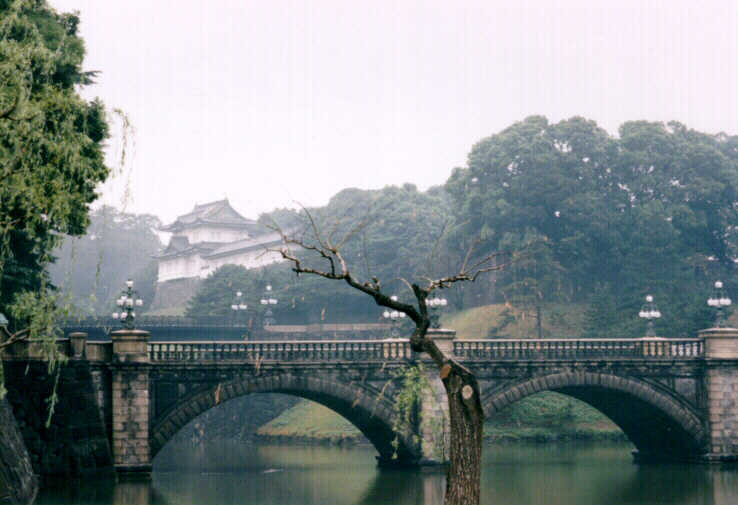
Yesterday I told you all about Edo, ancient Tokyo, the capital of Japan. Edo was build around Edo Castle. let me tell you a little bit more about Edo Castle before I will face the prompt for today, samurai.

Edo Castle (Edo-jō), also known as Chiyoda Castle (Chiyoda-jō), is a flatland castle that was built in 1457 by Ōta Dōkan. It is today part of the Tokyo Imperial Palace and is located in Chiyoda, Tokyo, then known as Edo, Toshima District, Musashi Province. Tokugawa Ieyasu established the Tokugawa shogunate here. It was the residence of the shogun and location of the shogunate, and also functioned as the military capital during the Edo period of Japanese history. After the resignation of the shogun and the Meiji Restoration, it became the Tokyo Imperial Palace. Some moats, walls and ramparts of the castle survive to this day. However, the grounds were more extensive during the Edo period.

Edo Castle as it must have been in the 17th century
Edo Castle was the military capital during the Edo period and the shogun had an army of samurai to rely on. 

Samurai were the military nobility or "those who serve in close attendance to the nobility," the pronunciation in Japanese changed to saburai. An early reference to the word "samurai" appears in the Kokin Wakashū(905–914), the first imperial anthology of poems, completed in the first part of the 10th century.

By the end of the 12th century, samurai became almost entirely synonymous with bushi, and the word was closely associated with the middle and upper echelons of the warrior class. The samurai followed a set of rules that came to be known as bushido. While they numbered less than 10% of Japan's population samurai teachings can still be found today in both everyday life and in modern Japanese martial arts. 

ancient warriors
between battle and peace
writing haiku 

© Chèvrefeuille

Every samurai had an art next to his military business. That's a real Japanese way of a aesthetic life. A well balanced life ... a hard and a soft side of living and with satisfaction.

Matsuo Basho was the son of a low ranked samurai and for a long time he had the idea to follow in his 'father's footprints'. He even became the page of a high ranked samurai's son, Yoshitada. He (Basho) and Yoshitada became good friends. (Some sources say that they had a relationship). Basho was very sad when his young master and friend died at the age of 22. It was than that Basho said farewell to his idea to become a samurai and started to write haiku to become a well known haiku master.


samurai sword
exposed to the rough weather
washing away the battle 

© Chèvrefeuille

And a last one  inspired on the Boys'  Festival:

striving for success
the young boys play like Samourai
Iris swords in hand

© Chèvrefeuille (from my archive)

I hope I have inspired you to create haiku or tanka. This episode is NOW OPEN for your submissions and will remain open until February 8th at noon (CET). I will try to publish our new episode, Emperor, later on.


Thursday, February 2, 2017

Carpe Diem #1143 Edo, ancient Tokyo


Dear Haijin, visitors and travelers,

First I thought this month will be a "piece of cake" to create, but it's more difficult than I had thought, but ... I will bring this month again with passion, but maybe (again) without prompt-list, because I prepare every episode at the moment I start up my PC every day, so ... don't be angry with me if there will not be a prompt-list this month.

Yesterday (that episode I published earlier today) we arrived at Tokyo, the modern capital of Japan, but Tokyo wasn't always named Tokyo. In the time of Basho, and other great haiku poets, Tokyo was known as Edo. So today we are traveling with the "Tardis" of Dr. Who back into time ... to Edo in the 17th century.

Tardis
Edo ("bay-entrance" or "estuary"), also romanized as Jedo, Yedo or Yeddo, is the former name of Tokyo. It was the seat of power for the Tokugawa shogunate, which ruled Japan from 1603 to 1868. During this period, it grew to become one of the largest cities in the world and home to an urban culture centered on the notion of a "floating world".

From the establishment of the Tokugawa bakufu headquarters at Edo, the town became the 'de facto' capital and center of political power, although Kyoto remained the formal capital of the country. Edo grew from what had been a small, little-known fishing village in 1457 into the largest metropolis in the world with an estimated population of 1,000,000 by 1721.

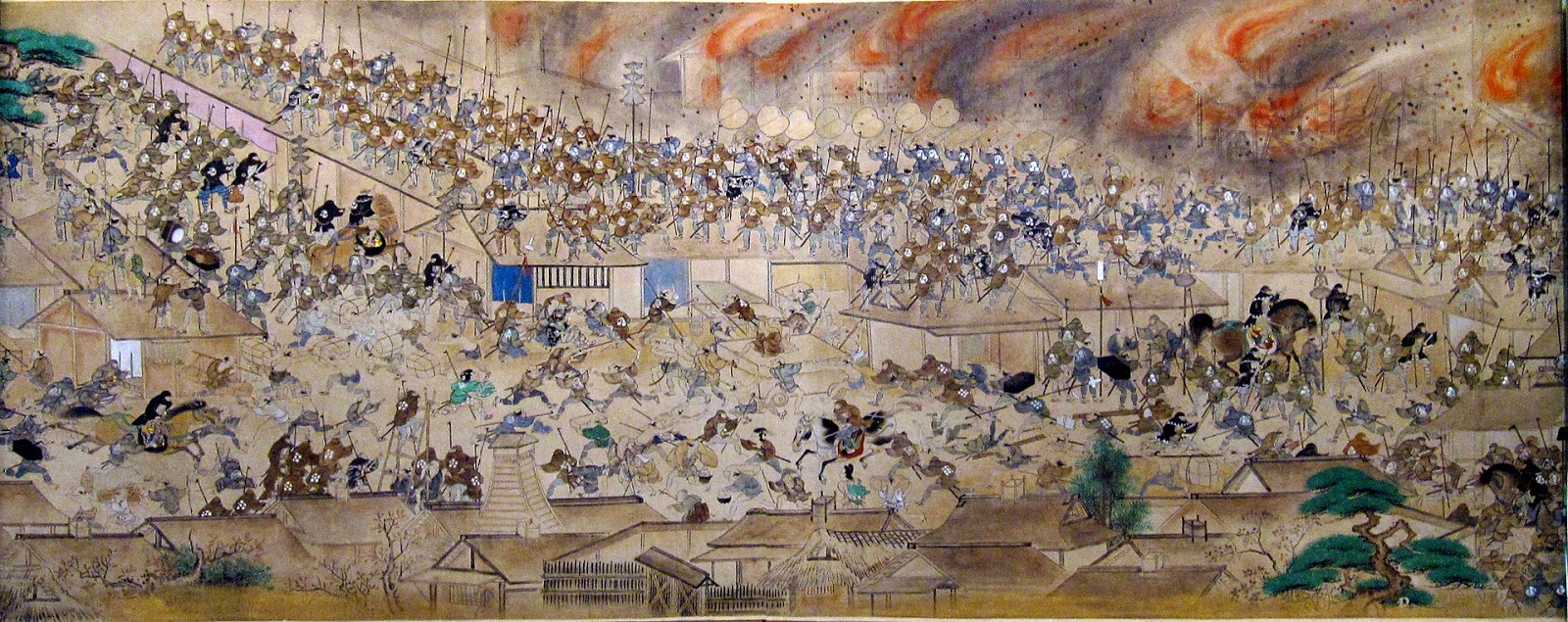
Edo was repeatedly devastated by fires, with the Great Fire of Meireki in 1657 being the most disastrous. An estimated 100,000 people died in the fire. During the Edo period, there were about 100 fires mostly begun by accident and often quickly escalating and spreading through neighborhoods of wooden machiya which were heated with charcoal fires. Between 1600 and 1945, Edo/Tokyo was leveled every 25–50 years or so by fire, earthquakes, or war.

The Great Meireki fire
In 1868, when the shogunate came to an end, the city was renamed Tokyo ("eastern capital"). The emperor moved his residence to Tokyo, making the city the formal capital of Japan:

Maybe you remember the story of Yozakura, Wandering Spirit (which by the way will be continued this month), that in the Great Fire of Meireki his father died. It was his biggest loss after the loss of his mother and it brought him the name of Yozakura, the Wandering Spirit.

feeling alone
lost in the woods around Edo -
just the autumn wind

© Yozakura

After his youth, Basho (my haiku master) moved to Edo to become a poet of renga and, as we all know, he became the most famous haiku master ever. During his time Basho learned to create his haiku as we know them. During his life he visited several times Edo again and wrote several haiku about or in praise of Edo. Here are a few beauties:

tenbin ya kyo¯ edo kakete chiyo no haru

on the scales—
Kyoto and Edo balanced
in this spring of a thousand years

fuji no kaze ya ogi ni nosete edo miyage

wind from Mt. Fuji—
carrying it in my fan,
a souvenir for those in Edo

aki totose kaette edo o sasu kokyo

autumn, ten years:
now I point to Edo
as the old home

© Basho (Tr. David L. Barnhill, taken from Basho's haiku, selected poems by Matsuo Basho)

Edo was formed around the Edo Castle:

Edo Castle
Edo ... a beautiful place to be in ancient Japan, but a town with a devastating history, but also the place were several haiku poets came to fame.

day dreamer
the scent of cherry blossom
walking through Edo


© Chèvrefeuille

Well ... I hope you did like this episode and I hope it will inspire you to create haiku or tanka. By the way the background information on Edo I found at wiki.

This episode is open for your submissions tonight at 7.00 PM (CET) and will remain open until February 7th at noon (CET).