Showing posts with label senryu. Show all posts

Tuesday, December 11, 2018

Carpe Diem #1564 Las Vegas ... come on gamble (out of the box)


Dear Haijin, visitors and travelers,

We are haiku-ing along the Pan American Highway, a 30.000 km long highway straight through the Americas from north to south. Yesterday we stopped at the City of Angels and today ... we will stop in ... say the opposite of Los Angeles, Las Vegas ... in the mddle of the desert were you can have a wonderful vacation and ... gambling.

Maybe you can remember our special feature "Out Of The Box" in which I challenged you all to create another kind of Japanese poetry or a different Far Eastern country like Korea for example.

Today I love to give you a "new" task. Think Out Of The Box with the themes of haiku. For example create a senryu, Cherita, Kyoka, or Sedoka. You also may "gamble" with the form by going free style. In other words ... "today it's your choice and not mine".

Las Vegas
The above image is a "still" of a time-lapse of the Las Vegas Strip. It's a nice image and I hope it will inspire you to think "Out Of The Box" ... well go for it!

This episode is NOW OPEN for your submissions and will remain open until Dacember 18th at noon (CET). I will try to publish our new episode later on. For now ... have fun!


Sunday, October 7, 2018

Carpe Diem #1516 Robin D. Gill, a haiku poet pur sang (Out Of The Box)


Dear Haijin, visitors and travelers,

I hope you all have had a wonderful weekend to relax, to meditate and contemplate, but now it's Monday again so here we go with a new episode. Today I have chosen the letter G and that letter brings you a modern haiku poet, Robin D. Gill.

In this month of celebration I love to introduce new features and new haiku poets, but that isn’t easy. While searching the Internet for new names in haiku I ran into Robin D. Gill, one of modern times renown haiku poets. I have to say “I never had heard of him", but while searching the Internet I became a bit curious and reading several articles about him I just had to introduce him to you all.

Robin Dallas Gill, born in 1951 at Miami Beach, Florida, USA, and brought up on the island of Key Biscayne in the Florida Keys, is a bilingual author in Japanese and English. He wrote extensively on stereotypes of Japanese identity before moving on to publishing his research on, and translations of Japanese poetry, especially the genres of haiku and senryū.

Robin D. Gill

He is considered a 'maverick' writer within the field of Western studies on Edo-period poetry. He writes haiku in Japanese under the haigō (haiku pen-name) Keigu ('Yours foolishly', an homophonous pun on 'Yours truly'). Since 2013, he has been engaged in writing in Japanese for a Japanese audience, hoping to help, via introductions to the comic traditions of Japanese poetry, to shake Japan out of its "cultural doldrums". Much of his output has, according to Gill's own testimony, been done while a pauper for much of his life.

Gill's work focuses on kigo or seasonal keyword thematics in traditional Japanese poetry, ranging widely over haiku, senryū, waka and kyōka (crazy poems), concentrating in each successive book on sub-themes, with the poems arranged in thematic chains. Characteristically, he provides the original Japanese text, with romanized transliteration, a word-for-word literal gloss, and then multiple versions (what he calls by his portmanteau neologism, paraverse, though the method was used by Hiroaki Sato.) that enable the reader to see the variety of potential readings to be elicited from an otherwise ostensibly simple, straightforward set of verses, accompanied by notes. Gill's richness of competing English versions of the one original has been seen as a distinct advance on earlier renderings of Japanese poetry, while his digressive style, often original but somewhat diffuse, can distract and, Kern argues, make too much demands on the reader's time.

Sea Cucumber (© François Michonneau)

One of his most famous books is titled “Rise, Ye Sea Slugs!” 1000 Holothurian Haiku, (2003),a title that refers to the sea cucumber (Namako). A sea species that worldwide counts around 1700 different kinds.

In "Rise, Ye Sea Slugs!" Gill has gathered only "old haiku" about sea cucumbers and has ordered them like their species. However ... I was more interested in his own haiku and senryu, but I have to say his own haiku and senryu are not easily to find on the Internet, so it took me some time to extract a few examples of his own haiku and senryu, but here they are, mainly senryu:

Sometimes
a hoe sounds so good
a man will shiver

A wasp at work --
thick make-up is nothing
to be ashamed of

Mean fall sunlight
here in Brooklyn 2 square-ft
X 2 hrs per room

© Robin D. Gill (extracted from The Haiku Foundation)

I don't know what to say about him, but I think he is an awesome haiku/senryu poet pur sang, but his most known works are his translations of Japanese haiku and senryu as he did for example in "Rise, Ye Sea Slugs!". 

Translating haiku and senryu isn't easy, so for that I have to applaud Gill.

Maybe you remember our "out of the box" feature. (I will give you a link at the end) In "Out Of The Box" I challenged you to create something different than haiku or tanka. So this episode I love to challenge you to create senryu, the more satirical kind of haiku full of humour.

Reading Newspaper (image found on Pinterest)

Here is one of my own senryu, not really my "cup of tea":

another day
caught in black ink
newspaper


© Chèvrefeuille (free-style & experimental)

I hope you enjoyed this episode and I hope I have inspired you to create senryu. This episode is open for your submissions tonight at 7:00 PM (CEST) and will remain open until October 14th at noon (CEST). For now ... have fun!


Friday, September 8, 2017

Carpe Diem's Road to Yesterday Celebrating Five Years of Japanese Poetry #1 Introduction "right from the heart"


Dear Haijin, visitors and travelers,

Let us take a trip back in time, back to September 2012, especially September 17th 2012. On that day I put Carpe Diem online with a kind of introductory, welcoming episode, for a new daily haiku meme inspired on a few other daily haiku memes in which I participated.

0-0-0-0-0-0-0-0-0

September 17, 2012:

our first logo

This is my new weblog. I am Chèvrefeuille a Dutch haiku poet. I love to start a new daily meme for haiku poets. This weblog is the base for that haiku meme.
I hope to see a lot of visitors to enjoy the fun of writing haiku, a classical Japanese poem, on a theme given every day.

be inspired
write your little verses
right from the heart

I hope to see you all soon.

0-0-0-0-0-0-0-0-0

As I look back to that time of preparations for the first ever prompt at Carpe Diem I smile. What nervous I was if it would work, if I could make it happen ... a daily haiku meme ... I was excited as I started, but also anxious ... because it had took me a lot of time and I just hoped it would work, it would become a success ... At that time I thought: "I just will give it a try, maybe it will last only for a few months, but than I have tried it". At that time I really hadn't thought that Carpe Diem would still exist several years later, yes of course I hoped it would be a success ... but there was at first the language. I had chosen to use English, but that's not my maiden language and at that time I didn't wrote a lot in English, but ... during the years I think my English has become better, at least good enough to write the blogs / episodes.

When the preparations were ready I finally could publish the first episode, Waterfall, that was on September 21st 2012, but the submissions started on October 1st 2012.

0-0-0-0-0-0-0-0-0

September 21st, 2012:


For starters ... I will give the first prompt for this new daily haiku meme today. So you can think about it and be inspired.
Carpe Diem is a new daily haiku meme in which you can share your haiku. The haiku (or senryu) can be a classical or a non-classical one. It's all up to you. The first prompt for CARPE DIEM is waterfall. I think this is a great prompt to start with. Let flow your inspiration like a waterfall and share your haiku with us.

waterfall of colors
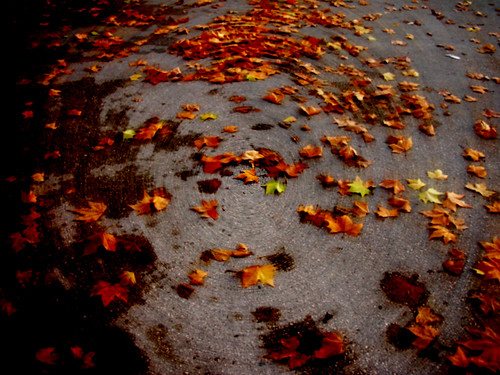
leaves whirl through the street -
departing summer

© Chèvrefeuille

Source: whirling leaves

Please be so kind to share a thought in the comment form. Do you have an idea for a new prompt? Well ... share it with us. I look forward to your contributions for this new haiku meme. And I hope it will be a success. I will try this to the end of the year ... so I hope that I can continue this haiku meme in January 2013.

0-0-0-0-0-0-0-0-0

And so it started ... Carpe Diem, a daily haiku-meme. Back than the most episodes were short, mostly because of the fact that my English wasn't good enough, but also because of me being nervous if this project would succeed.
Well ... next month we will celebrating our fifth anniversary ... and I really hadn't thought that Carpe Diem, nowadays called Carpe Diem Haiku Kai, would be still alive and kicking. CDHK has grown, we are a real family of haiku loving poets, and there are more parts of CDHK and of course there was the wonderful cooperation with Jane Reichhold. She inspired me to go on and was also the one who gave me the inspiration, the idea, to create exclusive CDHK e-books.

Five years after the start of Carpe Diem ... a good reason to celebrate and I have to thank you all, my dear Haijin, visitors and travelers ... you all are my inspiration, my source, my engine to go on with Carpe Diem Haiku Kai.

like a family
you my dear friends I embrace -
unconditional love
shared by a bunch of haiku poets
from all over the world

© Chèvrefeuille

I am looking forward to our fifth anniversary next month and I hope you all do too, because we make Carpe Diem Haiku Kai together.

Have a great weekend.

Namasté,

Chèvrefeuille, your host

Chèvrefeuille, your host

Monday, November 21, 2016

Carpe Diem Special Japanese Poetry In The Lowlands #4 Mariëtte Schrijver


Dear Haijin, visitors and travelers,

Welcome at a new Carpe Diem Special. This month I am introducing a few of my haiku colleagues from The Netherlands and today I love to introduce Mariëtte Schrijver to you. Mariëtte started recently with creating haiku and senryu and, as I may believe her words, she was immediately caught and addicted to this wonderful little poem from the Far East. I can imagine that feeling, because I had the same feeling as I started creating haiku back in the eighties.

I encountered Mariëtte on the Facebook page "Haiku het jaar rond" (A whole year of haiku) where the goal is to create haiku following the real season of time, so the haiku now are themed autumn. As I read one of her first haiku published on that FB-page I was immediately caught by her way of writing haiku. Very nice scenery and close to the beauty of nature. Mariëtte follows the strict syllables count of haiku and I think that's very strong for someone who just has started to create haiku. It also follows what we learned from Jane Reichhold. Jane told us: "When you start to write haiku follow the rules, but when you are a haiku poet for a longer period and have mastered the form then try to create your haiku in your own special way, without counting syllables. Than try to follow the fragment and phrase in your haiku".

As you all know I am not that "brave" in my haiku according to the strict rules, it's (so to say) not my "cup of tea", but sometimes its awesome to try to create haiku the classical way.

Here are a few haiku by Mariëtte Schrijver, I have tried to translate her haiku doing justice to the Dutch Original:

het dovende licht
laat laatste bloemen zingen
over de velden


the dying light
lets the last flowers sing
over the fields


© Mariëtte Schrijver (Tr. Chèvrefeuille)


The above haiku she wrote as "caption" for this photo (© photo Mariëtte Schrijver) and I think it fits wonderful.

Another nice haiku written by her is the following:

de herfst haast zich voort
boom en wolken versmelten
met de grashalmen


autumn rushes
tree and clouds become one
with blades of grass


© Mariëtte Schrijver (Tr. Chèvrefeuille)

As I was preparing this episode I ran through a lot of haiku written by Mariëtte, but not all her haiku are haiku I think, several of them are more senryu. Here is an example of a senryu written by Mariëtte (this one was already in English, so no translation needed). With this senryu came a beautiful photo by Mariëtte herself, it is made with IPhone-Art, this means the photo and the adjustments are made with the IPhone:


just a bit small talk
between the boy and a bird
nothing matters now


© Mariëtte Schrijver

As you have noticed this senryu follows the 5-7-5 rule in a great way. I hope you did like this introduction to the haiku and senryu by my fellow Dutchman Mariëtte Schrijver. I think she is very gifted and has found her own wonderful style of writing haiku (and senryu).

This episode is NOW OPEN for your submissions and will remain open until November 26th at noon (CET). Have fun!

Thursday, October 9, 2014

Carpe Diem "Ask Jane ..." #3 Senryu?


Dear Haijin, visitors and travelers,

It's my pleasure to publish our third "Ask Jane ..." episode. In this episode Jane gives an answer on a question by Opie Houston about Senryu. As I forwarded this question I myself had question about senryu, so in this episode Jane will give an answer on both questions.
Enjoy the read.

0-0-0-0-0-0-0-0-0-0-0-0-0-0-0-0-0-0-0-0-0-0-0-0-0-0-0-0-0-0-0-0-0-0


Dear Jane,
ah! pundit
pouring over my haiku...
petrol

Jane, it is nice to see you here. I have a question about the differences between senryu and haiku...
thanks,
Opie in Houston

Dear Opie,
The problem with giving haiku two names is because both are Japanese words that mean something very different from what the words have come to stand for in English. In Japan, senryu is the name for poems without a kigo or season word but are in every other aspect just the same as haiku. Since we English writers so quickly and continually ignored using the season words, and yet continued to call our works haiku, we have lost that defining meaning in our works.
We have, in our ignorance, given senryu another definition which is not one of the indications of a senryu in Japanese. I think we can thank Robert Spiess for much of the error. In his magazine, Modern Haiku, he would separate all the haiku he accepted into two groups. Those with a reference to humankind and those only about nature. Any mention of a person would throw the haiku into the (much smaller) senryu pile. He did this for years in spite of the considerable evidence that Japanese old masters all had references to humans in their poems.
For many years the haiku scene was infected by English editors who made senryu into a pejorative word by calling any haiku they felt was poorly written or contained the human reference as a senryu. Thank goodness we are over this phase but the ill will continues.
Perhaps this is because senryu were created as a game, mostly played as a pastime in bars in the 1600s in Tokyo. A senryu master would post either a two or three-line haiku. For a few coins the customers would compete by writing a link or response which was judged by its ability to make fun of women, or sex, or both together. There were thousands of these responses published by a man who used the pen name Senryu to hide his identity.  These poems finally became so scurrilous that their publication was halted by the government in the 1700s. For many years afterwards there were Japanese who denied knowing about senryu. Only in the 1900s did some accept the term but claimed they were only interested in the “clean” ones.
Knowing this, I am puzzled that anyone would choose to call their haiku senryu.  Still, some English writers persist and have added the idea that senryu are the jokes - the funny haiku. Since one half of the Japanese word haiku is “hai” and one of the definitions of hai is funny or broken or strange, it seems to me that haiku can comfortably contain any modern haiku on any subject. I feel we do not need an additional division between our haiku, and since the word senryu has such a questionable history, why try to add that to our haiku? In addition, people can rarely agree on which haiku should be tossed onto the senryu pile. Even Kristjaan wrote that he cannot tell them apart and he is right on!

On to Opie’s haiku with his question.
ah! pundit
pouring over my haiku...
petrol
This is an excellent haiku and he has competently used a haiku technique to its best advantage. Notice how he uses the verb ‘pouring.’ That is the one word that applies to the ideas of reading and studying AND petrol! That is the genius in this haiku and gives it both its meanings in a very funny way. The poem has a depth and the longer one thinks about it, new meanings come to light – literally in the fire. This IS a haiku and one that gave me a good laugh and I delight in recalling it. Thanks Opie! 

PS
If you need more convincing about senryu, you could read these articles online
or get the book, Writing and Enjoying Haiku.

0-0-0-0-0-0-0-0-0-0-0-0-0-0-0-0-0-0-0-0-0-0-0-0-0-0-0-0-0-0-0-0-0

I hope you all did like this article by Jane Reichhold and I hope it will give you all more insight on that strange English editor based name for haiku, senryu. Let us listen to what Jane said in the above article ... haiku and senryu are the same, so let us use only the name HAIKU for our beloved poems.
Thank you Jane for this clear answer ... and I am looking forward to our next "Ask Jane ..." episode. 

Do you have a question for Jane? Feel free to email your question to our special "Ask Jane ..." email-address:


And maybe ... your question will be answered in the next episode of "Ask Jane ..."

Namaste,

Chèvrefeuille, your host
(pseudonym of Kristjaan Panneman, a Dutch haiku poet)

Monday, August 25, 2014

Carpe Diem's "Vision Quest" #1 day 1 "New Moon"


Dear Haijin, visitors and travelers,

I think I have created an all new and wonderful feature in which I challenge you to 'quick'-write a new haiku or senryu. In this new feature I will give three days in a roll a haiku for your inspiration. Sounds easy? Maybe it is easy, but the difficulty is in the time you may use to write a new haiku ... just 24 hours.
I have called it Carpe Diem's Vision Quest and I think that's what it is. Let me first tell you a little bit more about what a Vision Quest is.

A Vision Quest is a rite of passage, similar to an initiation, in some Native American cultures. It is a turning point in life taken before puberty to find oneself and the intended spiritual and life direction. It's an ancient way to find your Inner Self and what your task is for this life in the way of opening your eyes to the spiritual world.

Credits: Vision Quest
Of course this is not really what our "Vision Quest" is meant for. The goal is to 'learn' how you, as a haiku-poet, can see the beauty of the moment on which the haiku is based.
For this new feature, which will take three days, I will give one haiku a day for your inspiration. Meditate and contemplate over it, try to see the scene and find the deeper meaning. If you have done that write/compose a new haiku or senryu (no tanka, kyoka, haibun or other form) inspired on the scene and deeper meaning of the given haiku/senryu.
For this feature you have just 24 hours to respond, so tn three days, you have to write three new haiku or senryu. There is no prompt, just the haiku, which you can use for your inspiration. Carpe Diem's Vision Quest will take place once in a season. So this first episode is for summer.
Our next Vision Quests are in:

November 2014 (autumn)
February 2015 (winter)
May 2015 (spring)

After that fourth Vision Quest I will look if I will continue with it or not.

Credits; Vision Quest
For this first Carpe Diem Vision Quest I have chosen three haiku written by myself. I hope you all will like this new feature.
In your response post I hope to read which scene you saw, which deeper meaning it revealed to you and of course your inspired haiku or senryu.

Here is our first haiku/senryu for the first day of this first Vision Quest:

new moon
she, our moon will grow again
a new life cycle

© Chèvrefeuille (2012)

A nice one to start with I think. You have to respond before August 26th at 6.00 PM (CET); I will publish our second day of this Vision Quest around that same time.
For now ... go on your Vision Quest explore the scene and the deeper meaning in your mind and share your inspired haiku with us all. Have a great Vision Quest!


Sunday, October 13, 2013

Carpe Diem's Freestyle #4


Dear Haijin, visitors and travelers,

To give you all the space to share your haiku, senryu, tanka, kyoka and all other Japanese kinds of poetry I have launched a little while ago the Carpe Diem's Freestyle feature. I will try to publish a Freestyle episode once a month.

Freestyle is what it is ... just share your poetry without a given prompt, maybe you have read a wonderful haiku, or did you write an awesome haiku but it didn't suit to the prompts given. Then this is the place to share that poetry with Carpe Diem. Feel free to share your poetry and enjoy the publishing here at Carpe Diem Haiku Kai.


For this episode of "Free-style" I love to share a "Troiku" I have used one of my favorite haiku written by my Master Basho:

the pumpkins look cool
flecked with mud
from the morning dew

1: the pumpkins look cool
    almost humanlike -
    all souls night

2: flecked with mud
    the white chrysanthemums
    after the storm

3: from the morning dew
    Monarch butterfly drinks to life -
    sound of funeral bells

Awesome! What a nice Troiku, even better then I thought. After reading it twice aloud I felt that there is a connection between all three haiku destilled from the haiku by Basho.


Monarch Butterfly

Well I hope you liked it and I love to invite you all to share your own Freestyle here with us. This Freestyle-episode will stay on 'till November 15th 11.59 AM (CET) and I will try to publish that same day the new episode of Freestyle.


Thursday, March 7, 2013

Carpe Diem Imagination #3, city park


Dear haijin, visitors and travelers,

I have a new episode of Carpe Diem Imagination for you today. For those who are new here I will explain the goal of this Carpe Diem Imagination again. I give you a picture, photo or something for your inspiration. In other words 'paint with words' what's the picture does with you, means to you and so on. Today I have a wonderful photo for you for your inspiration.


silence  ...
in the middle of town
the old pond


Well ... I hope to read wonderfully composed haiku inspired on this photo. Let your imagination flow and share yours with us all here on Carpe Diem, a community for haijin.


This episode of Carpe Diem Imagination will stay on 'till March 14th 11.59 AM (CET).