Dear Haijin, visitors and travelers,
As you all maybe know ... sometimes I try to translate haiku into another language than the original, but one way or another those translations are always not strong enough or the "painted" scene with its deeper meaning is lost. So I have asked Jane a question about translating haiku.
+++++++++++++++++++++++++++++++++++++++++++
+++++++++++++++++++++++++++++++++++++++++++
Dear Jane,
How are
you? I hope you are well and that your health has become better. I have a
question for you about "translating haiku".
I started
writing/composing haiku in Dutch at the end of the eighties. Somewhere in 2005
I wrote my first haiku in English:
a lonely
flower
my companion
for one night
A strong
haiku I think with a very deep meaning, but as I tried to translate it to Dutch
the essence which I caught in the English version I couldn't catch. The scene
stayed the same, but the deeper layer I couldn't find ... I think this has to
do with the deeper meaning of English words and the differences in that meaning
in Dutch.
Is it possible to translate haiku into another language than its
original and catch that same feeling or deeper meaning?
 |
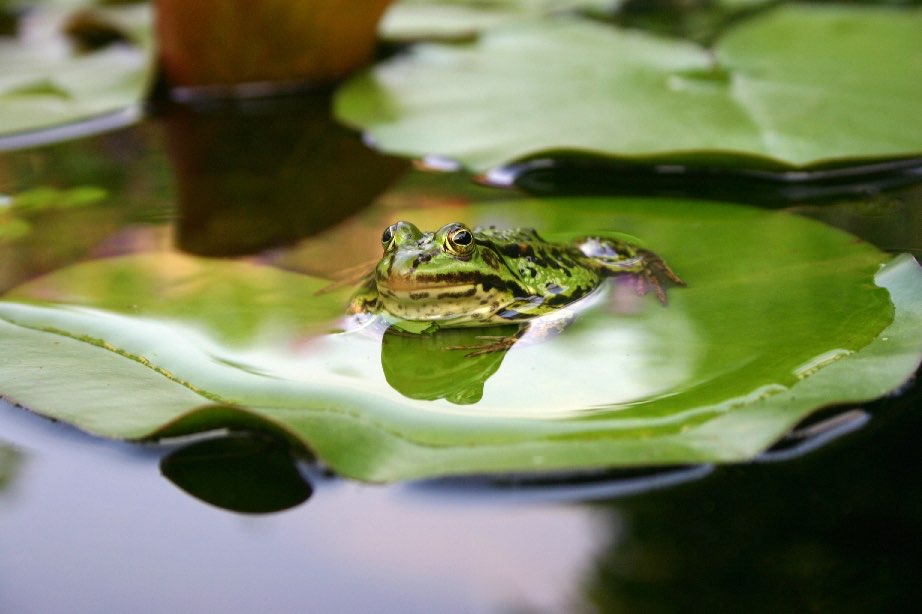
| frogpond |
I have read
a lot of haiku since I discovered this wonderful poetry form. And for example I
ran into several translations of Basho's famous "frogpond haiku":
furu ike ya
kawazu tobikomu mizu no oto (1686)
an ancient
pond
a frog jumps in
the splash of water
I don't
know who the translator was, but I found another translation of this famous
haiku:
A lonely
pond in age-old stillness sleeps . . .
Apart, unstirred by sound or motion . . . till
Suddenly into it a lithe frog leaps
Translated
by Curtis Hidden Page
These
translations are so different, but the essence of the haiku is lost in that
second haiku in my opinion of course. I once
tried to translate it myself and I came up with the following:
old pond -
the sound of water resonates
as a frog jumps in
© Kristjaan Panneman (a.k.a. Chèvrefeuille)
Why is it
so difficult to translate haiku? In my opinion I think this has to do with the
Japanese language. It's very clear that Japanese works with sound units (onji),
but the characters can mean a lot too.
In short:
Why is it
so difficult to translate haiku from the one language to the other language
without loosing the essence of the original?
I hope you
can give us at Carpe Diem Haiku Kai some insight in translating haiku and how
to catch the essence ...
Warm greetings,
Kristjaan
+++++++++++++++++++++++++++++++++++++++++++++++++++++
Dear
Kristjaan,
Well you
have jumped into a can of worms with translations! I think the biggest mistake
translators make is adding words that are not in the original text in an attempt to convey the levels of
meaning the original has for them. This suavely cripples that translation. Do
you have a copy of my book, Basho's Complete Haiku? In the notes at the end I
give word-for-word translations of all of Basho's hokku. There you can see the
word 'resonance' is not in the original.
(I am
sorry! I tried to copy your version from your letter and my d--- computer lost
the copy!) But you did add the word that spoils the translation (IMO).
I truly
feel that as a translator, word-for-word translations are the kindest way to
handle the work. If one wants to say more or show layers one finds in a haiku,
then do that in a discussion of the poem and not in the translation.
 |
| A Lonely Flower |
In your
a lonely
flower
my companion
for one night
I would
question the use of "lonely" -
that is a human feeling you are giving to a thing. You may feel lonely when
there is only one of you (do you?) but the flower is not alone if you are
there!
a single
flower
my companion
for one night
or
a single
tulip
my companion
for one night
has more
connotations. . . even some sexual with single / unmarried and tulip / two
lipped! I hope this helps!
\o/ Jane
 |
| Jane Reichhold |
++++++++++++++++++++++++++++++++++++++++++++++++
++++++++++++++++++++++++++++++++++++++++++++++++
Thank you Jane for this wonderful and clear explanation of my question. Thank you for your kind words and a special thank you for you for the "re-write" of my haiku as you have done. With the explanation you have given I think my "lonely flower" has become now "a single flower".
Dear Haijin I think you all have ideas about translating haiku. Please respond in the comments field with your ideas about translating haiku. Maybe I can create a nice feature around translating haiku.
Namaste,
Chèvrefeuille, your host