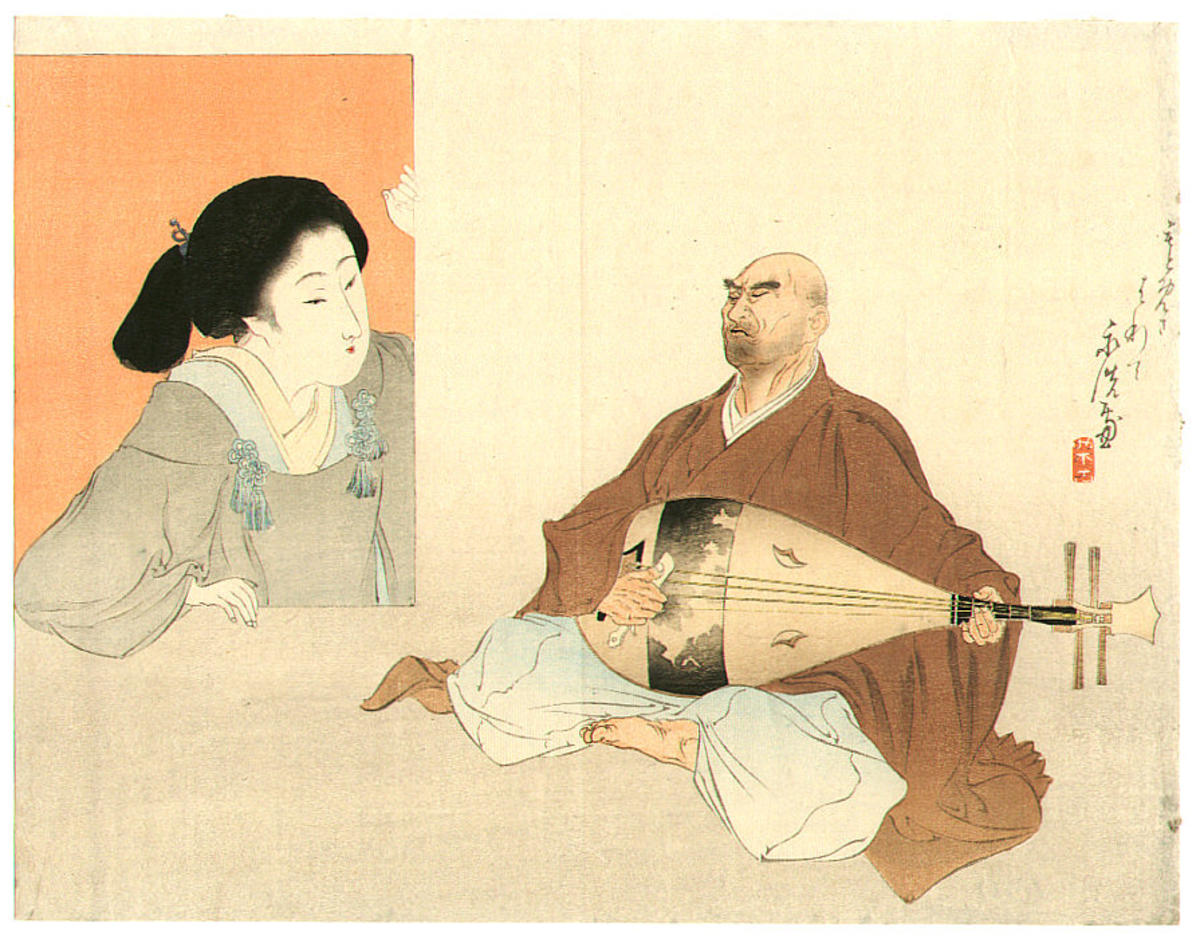
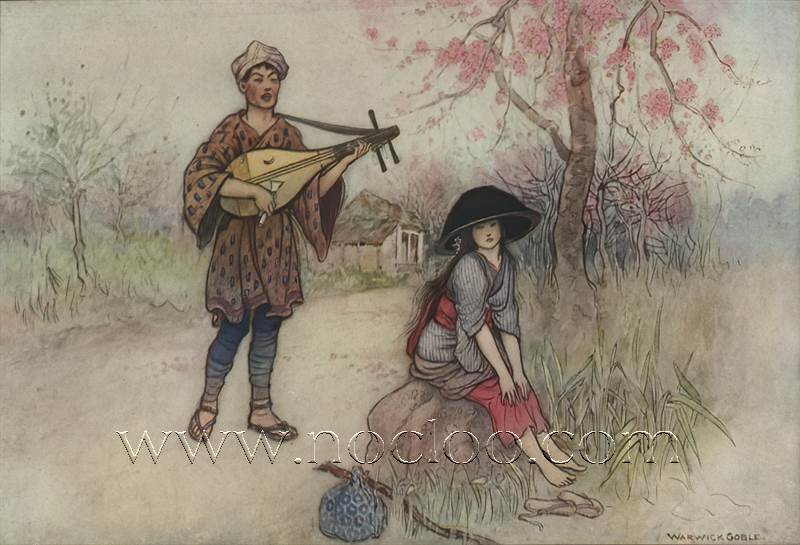
Showing posts with label Japanese fairytales. Show all posts

Wednesday, January 31, 2018

Carpe Diem #1359 The Tea Kettle


!! Our New Promptlist is online, it's not yet fully complete !!

Dear Haijin, visitors and travelers,

It's with a little bit of sadness that I create our last episode of January 2018. Time passed fast and we already are entering February 2018. Next month we will go on a journey along the ancient Silk Road and during that journey we will read Hermann Hesse's Siddhartha, a wonderful novel about a spiritual journey of the young Brahman son, Siddhartha, but that's for tommorrow. Today we have our last fairytale, an other nice Japanese story, "The Tea Kettle", but first I love to share a few haiku about Tea here:


crystal clear water
ghostly curls of steam -
the perfume of tea
cleaning the tea bowls
while the water is cooking
ah! that silence
drinking tea
together with friends
what a party
being part of Rykyu's tea ceremony
drinking tea is art
© Chèvrefeuille


The Tea Kettle:

Long ago, as I’ve heard tell, there dwelt at the temple of Morinji, in the Province of Kotsuke, a holy priest. Now there were three things about this reverend man. First, he was wrapped up in meditations and observances and forms and doctrines. He was a great one for the Sacred Sutras, and knew strange and mystical things. Then he had a fine exquisite taste of his own, and nothing pleased him so much as the ancient tea ceremony of the Cha-no-yu; and for the third thing about him, he knew both sides of a copper coin well enough and loved a bargain. None so pleased as he when he happened upon an ancient tea-kettle, lying rusty and dirty and half-forgotten in a corner of a poor shop in a back street of his town.
“An ugly bit of old metal,” says the holy man to the shopkeeper; “but it will do well enough to boil my humble drop of water of an evening. I’ll give you three rin for it.” This he did and took the kettle home, rejoicing; for it was of bronze, fine work, the very thing for the Cha-no-yu.

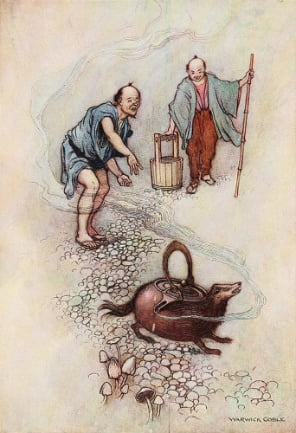
(Japanese) Tea Kettle

A novice cleaned and scoured the tea-kettle, and it came out as pretty as you please. The priest turned it this way and that, and upside down, looked into it, tapped it with his finger-nail. He smiled. “A bargain,” he cried, “a bargain!” and rubbed his hands. He set the kettle upon a box covered over with a purple cloth, and looked at it so long that first he was fain to rub his eyes many times, and then to close them altogether. His head dropped forward and he slept.

And then, believe me, the wonderful thing happened. The tea-kettle moved, though no hand was near it. A hairy head, with two bright eyes, looked out of the spout. The lid jumped up and down. Four brown and hairy paws appeared, and a fine bushy tail. In a minute the kettle was down from the box and going round and round looking at things.
“A very comfortable room, to be sure,” says the tea-kettle.
Pleased enough to find itself so well lodged, it soon began to dance and to caper nimbly and to sing at the top of its voice. Three or four novices were studying in the next room. “The old man is lively,” they said; “only hark to him. What can he be at?” And they laughed in their sleeves.
Heaven’s mercy, the noise that the tea-kettle made! Bang! bang! Thud! thud! thud!
The novices soon stopped laughing. One of them slid aside the kara-kami and peeped through.
“Arah, the devil and all’s in it!” he cried. “Here’s the master’s old tea-kettle turned into a sort of a badger. The gods protect us from witchcraft, or for certain we shall be lost!”
“And I scoured it not an hour since,” said another novice, and he fell to reciting the Holy Sutras on his knees.
A third laughed. “I’m for a nearer view of the hobgoblin,” he said.
So the lot of them left their books in a twinkling, and gave chase to the tea-kettle to catch it. But could they come up with the tea-kettle? Not a bit of it. It danced and it leapt and it flew up into the air. The novices rushed here and there, slipping upon the mats. They grew hot. They grew breathless.
“Ha, ha! Ha, ha!” laughed the tea-kettle; and “Catch me if you can!” laughed the wonderful tea-kettle.
Presently the priest awoke, all rosy, the holy man.
“And what’s the meaning of this racket,” he says, “disturbing me at my holy meditations and all?”
“Master, master,” cry the novices, panting and mopping their brows, “your tea-kettle is bewitched. It was a badger, no less. And the dance it has been giving us, you’d never believe!”
“Stuff and nonsense,” says the priest; “bewitched? Not a bit of it. There it rests on its box, good quiet thing, just where I put it.”

The Tea Kettle (painting by Warwick Goble)

Sure enough, so it did, looking as hard and cold and innocent as you please. There was not a hair of a badger near it. It was the novices that looked foolish.
“A likely story indeed,” says the priest. “I have heard of the pestle that took wings to itself and flew away, parting company with the mortar. That is easily to be understood by any man. But a kettle that turned into a badger—no, no! To your books, my sons, and pray to be preserved from the perils of illusion.”
That very night the holy man filled the kettle with water from the spring and set it on the hibachi to boil for his cup of tea. When the water began to boil—
“Ai! Ai!” the kettle cried; “Ai! Ai! The heat of the Great Hell!” And it lost no time at all, but hopped off the fire as quick as you please.
“Sorcery!” cried the priest. “Black magic! A devil! A devil! A devil! Mercy on me! Help! Help! Help!” He was frightened out of his wits, the dear good man. All the novices came running to see what was the matter.
“The tea-kettle is bewitched,” he gasped; “it was a badger, assuredly it was a badger … it both speaks and leaps about the room.”
“Nay, master,” said a novice, “see where it rests upon its box, good quiet thing.”
And sure enough, so it did.
“Most reverend sir,” said the novice, “let us all pray to be preserved from the perils of illusion.”
The priest sold the tea-kettle to a tinker and got for it twenty copper coins.
“It’s a mighty fine bit of bronze,” says the priest. “Mind, I’m giving it away to you, I’m sure I cannot tell what for.” Ah, he was the one for a bargain! The tinker was a happy man and carried home the kettle. He turned it this way and that, and upside down, and looked into it.
“A pretty piece,” says the tinker; “a very good bargain.” And when he went to bed that night he put the kettle by him, to see it first thing in the morning.
He awoke at midnight and fell to looking at the kettle by the bright light of the moon.
Presently it moved, though there was no hand near it.
“Strange,” said the tinker; but he was a man who took things as they came.
A hairy head, with two bright eyes, looked out of the kettle’s spout. The lid jumped up and down. Four brown and hairy paws appeared, and a fine bushy tail. It came quite close to the tinker and laid a paw upon him.
“Well?” says the tinker.
“I am not wicked,” says the tea-kettle.
“No,” says the tinker.
“But I like to be well treated. I am a badger tea-kettle.”
“So it seems,” says the tinker.
“At the temple they called me names, and beat me and set me on the fire. I couldn’t stand it, you know.”
“I like your spirit,” says the tinker.
“I think I shall settle down with you.”
“Shall I keep you in a lacquer box?” says the tinker.
“Not a bit of it, keep me with you; let us have a talk now and again. I am very fond of a pipe. I like rice to eat, and beans and sweet things.”
“A cup of saké sometimes?” says the tinker.
“Well, yes, now you mention it.”
“I’m willing,” says the tinker.
“Thank you kindly,” says the tea-kettle; “and, as a beginning, would you object to my sharing your bed? The night has turned a little chilly.”
“Not the least in the world,” says the tinker.
The tinker and the tea-kettle became the best of friends. They ate and talked together. The kettle knew a thing or two and was very good company.
One day: “Are you poor?” says the kettle.
“Yes,” says the tinker, “middling poor.”
“Well, I have a happy thought. For a tea-kettle, I am out-of-the-way—really very accomplished.”
“I believe you,” says the tinker.
“My name is Bumbuku-Chagama; I am the very prince of Badger Tea-Kettles.”
“Your servant, my lord,” says the tinker.
“If you’ll take my advice,” says the tea-kettle, “you’ll carry me round as a show; I really am out-of-the-way, and it’s my opinion you’d make a mint of money.”
“That would be hard work for you, my dear Bumbuku,” says the tinker.
“Not at all; let us start forthwith,” says the tea-kettle.

The Tea Kettle (haiga-like drawing)

So they did. The tinker bought hangings for a theatre, and he called the show Bumbuku-Chagama. How the people flocked to see the fun! For the wonderful and most accomplished tea-kettle danced and sang, and walked the tightrope as to the manner born. It played such tricks and had such droll ways that the people laughed till their sides ached. It was a treat to see the tea-kettle bow as gracefully as a lord and thank the people for their patience.
The Bumbuku-Chagama was the talk of the countryside, and all the gentry came to see it as well as the commonalty. As for the tinker, he waved a fan and took the money. You may believe that he grew fat and rich. He even went to Court, where the great ladies and the royal princesses made much of the wonderful tea-kettle.
At last the tinker retired from business, and to him the tea-kettle came with tears in its bright eyes.
“I’m much afraid it’s time to leave you,” it says.
“Now, don’t say that, Bumbuku, dear,” says the tinker. “We’ll be so happy together now we are rich.”
“I’ve come to the end of my time,” says the tea-kettle. “You’ll not see old Bumbuku anymore; henceforth I shall be an ordinary kettle, nothing more or less.”
“Oh, my dear Bumbuku, what shall I do?” cried the poor tinker in tears.
“I think I should like to be given to the temple of Morinji, as a very sacred treasure,” says the tea-kettle.
It never spoke or moved again. So the tinker presented it as a very sacred treasure to the temple, and the half of his wealth with it.
And the tea-kettle was held in wondrous fame for many a long year. Some persons even worshipped it as a saint.

mystical tea kettle
worshipped like a saint
sacred treasure


© Chèvrefeuille

With this fairytale our mysterious and magical month is over. Next month we will go on a journey along the ancient Silk Road.

All the fairytales used in January were extracted from the website fairytalez, a wonderful website full of wonderful fairytales. For sure worth a visit if you like to read more fairytales.

By the way The Tea Kettle is used fully here, so there is no follow-up at our "The Story Goes On" page.

This episode is NOW OPEN for your submissions and will remain open until February 7th at noon (CET). I will try to publish our new episode, the introductory episode to the Silk Road, later on. For now .... have fun!


Tuesday, January 30, 2018

Carpe Diem #1358 Green Willow


Dear Haijin, visitors and travelers,

Welcome at the penultimate episode of January 2018. Today I have another nice Japanese fairy tale for your inspiration, Green Willow, and I love to share a few "willow" haiku first, but first a tanka:

autumn departs
in deep silence willow leaves fall -
tears on this grave
as the willow is green again
another year has gone


© Chèvrefeuille

And here a few haiku themed "willow":

to sweep the garden
before I leave
falling willow leaves


© Basho (1644-1694)

tears of a geisha
her virginity lost to a soldier -
pussy willow blooms

© Chèvrefeuille
And to close this "introduction" a renown Tanka by Saigyo. A Tanka that inspired a lot of haiku poets, classical and non-classical, to create haiku.

along side the path
fresh water flows, and
in the willow’s shade
just for a little while
would I take my ease..


© Saigyo (1118-1190)


Green Willow:


Tomodata, the young samurai, owed allegiance to the Lord of Noto. He was a soldier, a courtier, and a poet. He had a sweet voice and a beautiful face, a noble form and a very winning address. He was a graceful dancer, and excelled in every manly sport. He was wealthy and generous and kind. He was beloved by rich and by poor.Now his daimyo, the Lord of Noto, wanted a man to undertake a mission of trust. He chose Tomodata, and called him to his presence.“Are you loyal?” said the daimyo.“My lord, you know it,” answered Tomodata.“Do you love me, then?” asked the daimyo.“Ay, my good lord,” said Tomodata, kneeling before him.“Then carry my message,” said the daimyo. “Ride and do not spare your beast. Ride straight, and fear not the mountains nor the enemies’ country. Stay not for storm nor any other thing. Lose your life; but betray not your trust. Above all, do not look any maid between the eyes. Ride, and bring me word again quickly.”Thus spoke the Lord of Noto.


Green Willow (painting by Warwick Goble)

So Tomodata got him to horse, and away he rode upon his quest. Obedient to his lord’s commands, he spared not his good beast. He rode straight, and was not afraid of the steep mountain passes nor of the enemies’ country. Ere he had been three days upon the road the autumn tempest burst, for it was the ninth month. Down poured the rain in a torrent. Tomodata bowed his head and rode on. The wind howled in the pine-tree branches. It blew a typhoon. The good horse trembled and could scarcely keep its feet, but Tomodata spoke to it and urged it on. His own cloak he drew close about him and held it so that it might not blow away, and in this wise he rode on.


autumn tempest burst
rain poured down in a torrent
howling wind


© Chèvrefeuille


The fierce storm swept away many a familiar landmark of the road, and buffeted the samurai so that he became weary almost to fainting. Noontide was as dark as twilight, twilight was as dark as night, and when night fell it was as black as the night of Yomi, where lost souls wander and cry. By this time Tomodata had lost his way in a wild, lonely place, where, as it seemed to him, no human soul inhabited. His horse could carry him no longer, and he wandered on foot through bogs and marshes, through rocky and thorny tracks, until he fell into deep despair.


lost souls wander and cry
voices from times long ago
seek for inner peace


© Chèvrefeuille


“Alack!” he cried, “must I die in this wilderness and the quest of the Lord of Noto be unfulfilled?”
At this moment the great winds blew away the clouds of the sky, so that the moon shone very brightly forth, and by the sudden light Tomodata saw a little hill on his right hand. Upon the hill was a small thatched cottage, and before the cottage grew three green weeping-willow trees.


Green Willow

“Now, indeed, the gods be thanked!” said Tomodata, and he climbed the hill in no time. Light shone from the chinks of the cottage door, and smoke curled out of a hole in the roof. The three willow trees swayed and flung out their green streamers in the wind. Tomodata threw his horse’s rein over a branch of one of them, and called for admittance to the longed-for shelter.
green willows
swaying in the wind like dancers
owls cry

© Chèvrefeuille

At once the cottage door was opened by an old woman, very poorly but neatly clad.
“Who rides abroad upon such a night?” she asked, “and what wills he here?”“I am a weary traveller, lost and benighted upon your lonely moor. My name is Tomodata. I am a samurai in the service of the Lord of Noto, upon whose business I ride. Show me hospitality for the love of the gods. I crave food and shelter for myself and my horse.”
As the young man stood speaking the water streamed from his garments. He reeled a little, and put out a hand to hold on by the side-post of the door.
“Come in, come in, young sir!” cried the old woman, full of pity. “Come in to the warm fire. You are very welcome. We have but coarse fare to offer, but it shall be set before you with great good-will. As to your horse, I see you have delivered him to my daughter; he is in good hands.”


Green Willow

At this Tomodata turned sharply round. Just behind him, in the dim light, stood a very young girl with the horse’s rein thrown over her arm. Her garments were blown about and her long loose hair streamed out upon the wind. The samurai wondered how she had come there. Then the old woman drew him into the cottage and shut the door. Before the fire sat the good man of the house, and the two old people did the very best they could for Tomodata. They gave him dry garments, comforted him with hot rice wine, and quickly prepared a good supper for him.
Presently the daughter of the house came in, and retired behind a screen to comb her hair and to dress afresh. Then she came forth to wait upon him. She wore a blue robe of homespun cotton. Her feet were bare. Her hair was not tied nor confined in any way, but lay along her smooth cheeks, and hung, straight and long and black, to her very knees. She was slender and graceful. Tomodata judged her to be about fifteen years old, and knew well that she was the fairest maiden he had ever seen.

combing her hair
graceful and full of sensuality
her firm breasts

smiling like a god send being
she embraces her lover


© Chèvrefeuille

Rice Wine

At length she knelt at his side to pour wine into his cup. She held the wine-bottle in two hands and bent her head. Tomodata turned to look at her. When she had made an end of pouring the wine and had set down the bottle, their glances met, and Tomodata looked at her full between the eyes, for he forgot altogether the warning of his daimyo, the Lord of Noto.
“Maiden,” he said, “what is your name?”She answered: “They call me the Green Willow.”“The dearest name on earth,” he said, and again he looked her between the eyes. And because he looked so long her face grew rosy red, from chin to forehead, and though she smiled her eyes filled with tears.
Ah me, for the Lord of Noto’s quest!
Then Tomodata made this little song:
“Long-haired maiden, do you know
That with the red dawn I must go?
Do you wish me far away?
Cruel long-haired maiden, say—
Long-haired maiden, if you know
That with the red dawn I must go,
Why, oh why, do you blush so?”
And the maiden, the Green Willow, answered:
“The dawn comes if I will or no;
Never leave me, never go.
My sleeve shall hide the blush away.
The dawn comes if I will or no;
Never leave me, never go.
Lord, I lift my long sleeve so….”
“Oh, Green Willow, Green Willow …” sighed Tomodata.


-0-0-0-0-0-0-0-

And the story goes on ... you can find the last part of this fairytale on our "The Story Goes On" page above in the menu.


This episode is NOW OPEN for your submissions and will remain open until February 5th at noon (CET). I will try to publish our last episode of this month, The Tea-Kettle, later on. For now ... have fun!


Sunday, January 28, 2018

Carpe Diem #1357 The Flute


Dear Haijin, visitors and travelers,

What a joy this weekend was. It was a busy weekend but I had no worries. We moved our daughter back in with her boyfriend. They had a tough time and they needed to be separated for a few weeks, but it turns out that the both of them need each other. So it was a joy this weekend.

This episode is titled "The Flute" and it brought a nice haiku in mind by Jane Reichhold, I still miss her, that I love to share here again:

shadows of leaves
cover the open holes
her flute forgotten

© Jane Reichhold

Maybe you can remember this haiku. I used it in one of our Tan Renga Challenge months, I think it was the year 2016. Here is another haiku in which "flute" is used:

dreams come alive
the old monk plays the bamboo flute
becomes young again

© Chèvrefeuille


The Flute:

Long since, there lived in Yedo a gentleman of good lineage and very honest conversation. His wife was a gentle and loving lady. To his secret grief, she bore him no sons. But a daughter she did give him, whom they called O’Yoné, which, being interpreted, is “Rice in the ear.” Each of them loved this child more than life, and guarded her as the apple of their eye. And the child grew up red and white, and long-eyed, straight and slender as the green bamboo.

weeping willow
slender as the green bamboo
child's laughter

© Chèvrefeuille

When O’Yoné was twelve years old, her mother drooped with the fall of the year, sickened, and pined, and before the red had faded from the leaves of the maples she was dead and shrouded and laid in the earth. The husband was wild in his grief. He cried aloud, he beat his breast, he lay upon the ground and refused comfort, and for days he neither broke his fast nor slept. The child was quite silent.
Time passed by. The man perforce went about his business. The snows of winter fell and covered his wife’s grave. The beaten pathway from his house to the dwelling of the dead was snow also, undisturbed save for the faint prints of a child’s sandalled feet. In the spring-time he girded up his robe and went forth to see the cherry blossom, making merry enough, and writing a poem upon gilded paper, which he hung to a cherry-tree branch to flutter in the wind. The poem was in praise of the spring and of saké. Later, he planted the orange lily of forgetfulness, and thought of his wife no more. But the child remembered.

Bamboo flute

Before the year was out he brought a new bride home, a woman with a fair face and a black heart. But the man, poor fool, was happy, and commended his child to her, and believed that all was well.
Now because her father loved O’Yoné, her stepmother hated her with a jealous and deadly hatred, and every day she dealt cruelly by the child, whose gentle ways and patience only angered her the more. But because of her father’s presence she did not dare to do O’Yoné any great ill; therefore she waited, biding her time. The poor child passed her days and her nights in torment and horrible fear. But of these things she said not a word to her father. Such is the manner of children.
Now, after some time, it chanced that the man was called away by his business to a distant city. Kioto was the name of the city, and from Yedo it is many days’ journey on foot or on horseback. Howbeit, go the man needs must, and stay there three moons or more. Therefore he made ready, and equipped himself, and his servants that were to go with him, with all things needful; and so came to the last night before his departure, which was to be very early in the morning.
He called O’Yoné to him and said: “Come here, then, my dear little daughter.” So O’Yoné went and knelt before him.
“What gift shall I bring you home from Kioto?” he said.
But she hung her head and did not answer.
“Answer, then, rude little one,” he bade her. “Shall it be a golden fan, or a roll of silk, or a new obi of red brocade, or a great battledore with images upon it and many light-feathered shuttlecocks?”
Then she burst into bitter weeping, and he took her upon his knees to soothe her. But she hid her face with her sleeves and cried as if her heart would break. And, “O father, father, father,” she said, “do not go away—do not go away!”
“But, my sweet, I needs must,” he answered, “and soon I shall be back—so soon, scarcely it will seem that I am gone, when I shall be here again with fair gifts in my hand.”

The Flute - Warwick Goble (image found on Pinterest)

“Father, take me with you,” she said.
“Alas, what a great way for a little girl! Will you walk on your feet, my little pilgrim, or mount a pack-horse? And how would you fare in the inns of Kioto? Nay, my dear, stay; it is but for a little time, and your kind mother will be with you.”
She shuddered in his arms.
“Father, if you go, you will never see me more.”
Then the father felt a sudden chill about his heart, that gave him pause. But he would not heed it. What! Must he, a strong man grown, be swayed by a child’s fancies? He put O’Yoné gently from him, and she slipped away as silently as a shadow.

Ah! the beauty of nature -
geisha, peonies in her hair,
playing the Shakuhachi

© Chèvrefeuille

But in the morning she came to him before sunrise with a little flute in her hand, fashioned of bamboo and smoothly polished. “I made it myself,” she said, “from a bamboo in the grove that is behind our garden. I made it for you. As you cannot take me with you, take the little flute, honourable father. Play on it sometimes, if you will, and think of me.” Then she wrapped it in a handkerchief of white silk, lined with scarlet, and wound a scarlet cord about it, and gave it to her father, who put it in his sleeve. After this he departed and went his way, taking the road to Kioto. As he went he looked back thrice, and beheld his child, standing at the gate, looking after him. Then the road turned and he saw her no more.


The city of Kioto was passing great and beautiful, and so the father of O’Yoné found it. And what with his business during the day, which sped very well, and his pleasure in the evening, and his sound sleep at night, the time passed merrily, and small thought he gave to Yedo, to his home, or to his child. Two moons passed, and three, and he made no plans for return.

-0-0-0-0-0-0-0-0-

The story goes on above in the menu

This episode is NOW OPEN for your submissions and will remain open until February 4th at noon (CET). I will try to publish our new episode, Green Willow, later on.


Thursday, January 25, 2018

Carpe Diem #1356 The Peony Lantern (Japanese fairy-tale)


Dear Haijin, visitors and travelers,

Welcome at a new episode of our Haiku Kai. This month we are reading fairy tales together and I hope you all find your muse to create haiku, tanka or other Japanese poetry form inspired on these fairy tales. Today I have a nice Japanese fairytale for you "The Peony Lantern", but first I love to share a few haiku themed peony.

For example this cascading haiku which I wrote back in 2013:

deep mysteries
hidden in the Peonies -
secret lover

secret lover
face behind a bouquet of Peonies -
the first step

the first step
sending Peonies to my love
deep mysteries

© Chèvrefeuille (2013)

Peonies (Shosei Takahashi)

Or this one written in 2015:

pink flowers bloom
between green dewy leaves
a double peony

© Chèvrefeuille


The Peony Lantern:

In Yedo there dwelt a samurai called Hagiwara. He was a samurai of the hatamoto, which is of all the ranks of samurai the most honourable. He possessed a noble figure and a very beautiful face, and was beloved of many a lady of Yedo, both openly and in secret. For himself, being yet very young, his thoughts turned to pleasure rather than to love, and morning, noon and night he was wont to disport himself with the gay youth of the city. He was the prince and leader of joyous revels within doors and without, and would often parade the streets for long together with bands of his boon companions.
One bright and wintry day during the Festival of the New Year he found himself with a company of laughing youths and maidens playing at battledore and shuttlecock. He had wandered far away from his own quarter of the city, and was now in a suburb quite the other side of Yedo, where the streets were empty, more or less, and the quiet houses stood in gardens. Hagiwara wielded his heavy battledore with great skill and grace, catching the gilded shuttlecock and tossing it lightly into the air; but at length with a careless or an ill-judged stroke, he sent it flying over the heads of the players, and over the bamboo fence of a garden near by. Immediately he started after it. Then his companions cried, “Stay, Hagiwara; here we have more than a dozen shuttlecocks.”
“Nay,” he said, “but this was dove-coloured and gilded.”
“Foolish one!” answered his friends; “here we have six shuttlecocks all dove-coloured and gilded.”
But he paid them no heed, for he had become full of a very strange desire for the shuttlecock he had lost. He scaled the bamboo fence and dropped into the garden which was upon the farther side. Now he had marked the very spot where the shuttlecock should have fallen, but it was not there; so he searched along the foot of the bamboo fence—but no, he could not find it. Up and down he went, beating the bushes with his battledore, his eyes on the ground, drawing breath heavily as if he had lost his dearest treasure. His friends called him, but he did not come, and they grew tired and went to their own homes. The light of day began to fail. Hagiwara, the samurai, looked up and saw a girl standing a few yards away from him. She beckoned him with her right hand, and in her left she held a gilded shuttlecock with dove-coloured feathers.
The samurai shouted joyfully and ran forward. Then the girl drew away from him, still beckoning him with the right hand. The shuttlecock lured him, and he followed. So they went, the two of them, till they came to the house that was in the garden, and three stone steps that led up to it. Beside the lowest step there grew a plum tree in blossom, and upon the highest step there stood a fair and very young lady. She was most splendidly attired in robes of high festival. Her kimono was of water-blue silk, with sleeves of ceremony so long that they touched the ground; her under-dress was scarlet, and her great girdle of brocade was stiff and heavy with gold. In her hair were pins of gold and tortoiseshell and coral.
When Hagiwara saw the lady, he knelt down forthwith and made her due obeisance, till his forehead touched the ground.
Then the lady spoke, smiling with pleasure like a child. “Come into my house, Hagiwara Sama, samurai of the hatamoto. I am O’Tsuyu, the Lady of the Morning Dew. My dear handmaiden, O’Yoné, has brought you to me. Come in, Hagiwara Sama, samurai of the hatamoto; for indeed I am glad to see you, and happy is this hour.”
So the samurai went in, and they brought him to a room of ten mats, where they entertained him; for the Lady of the Morning Dew danced before him in the ancient manner, whilst O’Yoné, the handmaiden, beat upon a small scarlet-tasselled drum.
Afterwards they set food before him, the red rice of the festival and sweet warm wine, and he ate and drank of the food they gave him.

The Peony Lantern (Painting by Warwick Goble)

It was dark night when Hagiwara took his leave. “Come again, honorable lord, come again,” said O’Yoné the handmaiden.
“Yea, lord, you needs must come,” whispered the Lady of the Morning Dew.
The samurai laughed. “And if I do not come?” he said mockingly. “What if I do not come?”
The lady stiffened, and her child’s face grew grey, but she laid her hand upon Hagiwara’s shoulder.
“Then,” she said, “it will be death, lord. Death it will be for you and for me. There is no other way.” O’Yoné shuddered and hid her eyes with her sleeve. The samurai went out into the night, being very much afraid.

being afraid
in the dark alley
tough Samurai


© Chèvrefeuille

Long, long he sought for his home and could not find it, wandering in the black darkness from end to end of the sleeping city. When at last he reached his familiar door the late dawn was almost come, and wearily he threw himself upon his bed. Then he laughed. “After all, I have left behind me my shuttlecock,” said Hagiwara the samurai.

Peony Lantern (image found on Pinterest)

The next day Hagiwara sat alone in his house from morning till evening. He had his hands before him; and he thought, but did nothing more. At the end of the time he said, “It is a joke that a couple of geisha have sought to play on me. Excellent, in faith, but they shall not have me!” So he dressed himself in his best and went forth to join his friends. For five or six days he was at joustings and junketings, the gayest of the gay. His wit was ready, his spirits were wild.

on a quest
to find his love
morning dew shimmers


© Chèvrefeuille

Then he said, “By the gods, I am deathly sick of this,” and took to walking the streets of Yedo alone. From end to end of the great city he went. He wandered by day and he wandered by night, by street and alley he went, by hill and moat and castle wall, but he found not what he sought. He could not come upon the garden where his shuttlecock was lost, nor yet upon the Lady of the Morning Dew. His spirit had no rest. He fell sick and took to his bed, where he neither ate nor slept, but grew spectre-thin. This was about the third month. In the sixth month, at the time of niubai, the hot and rainy season, he rose up, and, in spite of all his faithful servant could say or do to dissuade him, he wrapped a loose summer robe about him and at once went forth.
“Alack! Alack!” cried the servant, “the youth has the fever, or he is perchance mad.”
Hagiwara faltered not at all. He looked neither to the right nor to the left. Straight forward he went, for he said to himself, “All roads lead past my love’s house.” Soon he came to a quiet suburb, and to a certain house whose garden had a split bamboo fence. Hagiwara laughed softly and scaled the fence.

-0-0-0-0-0-0-0-

This fairytale continues on our "The Story Goes On" page above in the menu.

This episode is NOW OPEN for your submissions and will remain open until February 1st at noon (CET). I will try to publish our new weekend-meditation later on. For now .... have fun!


Wednesday, January 24, 2018

Carpe Diem #1355 The Sea King and the Magic Jewels (Japanese fairytale)


Dear Haijin, visitors and travelers,

What a joyful month this is. All those wonderful fairytales from 1001 Nights and now those beauties from the Motherland of Haiku, Japan. I have read wonderful fairytales a lot of them I hadn't heard of or read. I think that same idea you all will have. Today I have another nice Japanese fairytale for you. A long tale I have to say, so this one I have split in two parts. It's a story that is loved by children and adults like you and me will enjoy it too.


The Sea King and the Magic Jewels:

Prince Rice-Ear-Ruddy-Plenty loved a beautiful and royal maiden, and made her his bride. And the lady was called Princess Blossoming-Brightly-as-the-Flowers-of-the-Trees, so sweetly fair was she. But her father was augustly wrath at her betrothal, for his Augustness, Prince Rice-Ear-Ruddy-Plenty, had put aside her elder sister, the Princess of the Rocks (and, indeed, this lady was not fair), for he loved only Princess Blossoming-Brightly. So the old King said, “Because of this, the offspring of these heavenly deities shall be frail, fading and falling like the flowers of the trees.” So it is. At this day, the lives of their Augustnesses, the Heavenly Sovereigns, are not long.
Howbeit, in the fullness of time, the lady, Blossoming-Brightly-as-the-Flowers-of-the-Trees, bore two lovely men children, and called the elder Fire Flash and the younger Fire Fade.

Prince Fire Flash was a fisherman, who got his luck upon the wide sea, and ran upon the shore with his august garments girded. And again, he tarried all the night in his boat, upon the high wave-crests. And he caught things broad of fin and things narrow of fin, and he was a deity of the water weeds and of the waters and of the fishes of the sea. But Prince Fire Fade was a hunter, who got his luck upon the mountains and in the forest, who bound sandals fast upon his feet, and bore a bow and heavenly-feathered arrows. And he caught things rough of hair and things soft of hair, and he knew the trail of the badger and the wild cherry’s time of flowering. For he was a deity of the woods.

The Sea King and the Magic Jewels (Warwick Goble painting)

Now Prince Fire Fade spoke to his elder brother, Prince Fire Flash, and said, “Brother, I am aweary of the green hills. Therefore let us now exchange our luck. Give me thy rod and I will go to the cool waters. Thou mayest take my great bow and all my heavenly-feathered arrows and try the mountains, where, trust me, thou shalt see many strange and beautiful things, unknown to thee before.”
But Prince Fire Flash answered, “Not so … not so.”

And again, after not many days were past, Prince Fire Fade came and sighed, “I am aweary of the green hills … the fair waters call me. Woe to be a younger brother!” And when Prince Fire Flash took no heed of him, but angled with his rod, day and night, and caught things broad of fin and things narrow of fin, Prince Fire Fade drooped with desire, and let his long hair fall untended upon his shoulders. And he murmured, “Oh, to try my luck upon the sea!” till at last Prince Fire Flash, his elder brother, gave him the rod for very weariness, and betook himself to the mountains. And all day he hunted, and let fly the heavenly-feathered arrows; but rough of hair or soft of hair, never a thing did he catch. And he cried, “Fool, fool, to barter the heavenly luck of the gods!” So he returned.

And his Augustness, Prince Fire Fade, took the luck of the sea, and angled in sunshine and in gloom; but broad of fin or narrow of fin, never a fish did he catch. And, moreover, he lost his brother’s fish-hook in the sea. So he hung his head, and returned.
And Prince Fire Flash said, “Each to his own, the hunter to the mountain, and the fisherman to the sea … for thou and I have brought nothing home, and this night we sleep hungry. We may not barter the luck of the gods. And now, where is my fish-hook?”
So Prince Fire Fade replied, saying softly, “Sweet brother, be not angry … but, toiling all day with thy fish-hook, broad of fin or narrow of fin, not a fish did I catch; and, at the last, I lost thy fish-hook in the sea.”
At this his Highness, Prince Fire Flash, flew into a great rage, and stamping his feet, required the fish-hook of his brother.
And Prince Fire Fade made answer, “Sweet brother, I have not thy fish-hook, but the deep sea, whose bottom no man may search. Though I should die for thee, yet could I not give thee back thy fish-hook.”

The Sea King and the Magic Jewels (image found on Pinterest)

But his elder brother required it of him the more urgently.
Then Prince Fire Fade burst the wild wisteria tendrils which bound his august ten-grasp sword to his side. And he said, “Farewell, good sword.” And he broke it into many fragments, and made five hundred fish-hooks to give to his brother, Prince Fire Flash. But Prince Fire Flash would have none of them.
And again Prince Fire Fade toiled at a great furnace, and made one thousand fish-hooks; and upon his knees he humbly offered them to his brother, Prince Fire Flash. For he loved his brother. Nevertheless Prince Fire Flash would not so much as look at them, but sat moody, his head on his hand, saying, “Mine own lost fish-hook will I have, that and no other.”
So Prince Fire Fade went grieving from the palace gates, and wandered lamenting by the seashore; and his tears fell and mingled with the foam. And, when night came, he had no heart to return homewards, but sat down, weary, upon a rock amid the salt pools. And he cried, “Alas, my brother, I am all to blame, and through my foolishness has this come upon me. But oh, my brother, together were we nursed upon the sweet breast of our mother, Princess Blossoming-Brightly-as-the-Flowers-of-the-Trees, for almost hand in hand did we come into the world.”
And the moon rose so that the sea and the Central Land of Reed Plains was light. But Prince Fire Fade ceased not to lament.
Then Shiko-Tsuchi-no-Kami, the Lord of Sea Salt, came with the rising tide, and spoke, “Wherefore weeps the Heaven’s Sky Height?”
And Prince Fire Fade made answer: “I have taken my brother’s fish-hook, and I have lost it in the sea. And though I have given him many other fish-hooks for compensation, he will have none of them, but desires only the original fish-hook. Truly, the gods know, I would give my life to find it; but how should that serve?”

sea fruits

And Shiko-Tsuchi-no-Kami took him by the sleeve to where a boat moved upon the water, and set him in the boat and pushed it from the shore, saying, “My son, pursue the pleasant path that Tsuki-Yomi-no-Kami, His Augustness, the Moon Night Possessor, has made for thee upon the waters. And, at the end, thou shalt come to a palace made of fishes’ scales, which is the palace of the great King of the Sea. Before the gate there is a clear well, and by the well-side there grows a cassia tree with many spreading branches. Therefore climb thou into the branches of the cassia tree, and there wait for the King’s daughter, who shall come to give thee counsel.”
And Prince Fire Fade, standing up in the boat, made obeisance, and thanked the Lord of Sea Salt. But this one girded his august garments and pushed the boat before him, till he was thigh-deep in the water. And he said, “Nay, nay, fair youth, no thanks, only do my bidding.”
So his Augustness, Prince Fire Fade, came to the Sea King’s palace. And he forthwith climbed the cassia tree and waited among its green branches.

-0-0-0-0-0-0-0-

What a nice story, an adventurous one I would say. But this story goes on at our "The Story Goes On"page above in the menu.

This episode is open for your submissions tonight at 7:00 PM (CET) and will remain open until January 31st at noon (CET). I will try to publish our new episode, The Peony Lantern, later on. For now ... have fun and be inspired.


Tuesday, January 23, 2018

Carpe Diem #1354 The Black Bowl (Japanese fairytale)


Dear Haijin, visitors and travelers,

First I have to apologize because I am late with publishing our new episode. This episode will be a long one, because this fairytale from Japan is to beautiful to publish it in two parts. So embrace your self, because this will be a "long" read.
Today's episode is titled "The Black Bowl". This fairytale has a nice moral, because it's about inner beauty. And this fairytale is also a nice story about perseverance. Enjoy the read, but first I love to share a haiku from my archive.

thrown away bowl
once filled with rice 
dances on the wind

© Chèvrefeuille

Or this one:

an empty bowl
but in it is the spirit of emptiness -
the spring breeze

© Chèvrefeuille

This one fits the story more likely than the first, but both are in a way connected to this fairytale.


The Black Bowl:

Long ago, in a part of the country not very remote from Kyoto, the great gay city, there dwelt an honest couple. In a lonely place was their cottage, upon the outskirts of a deep wood of pine trees. Folks had it that the wood was haunted. They said it was full of deceiving foxes; they said that beneath the mossy ground the elves built their kitchens; they said that long-nosed Tengu had tea-parties in the forest thrice a month, and that the fairies’ children played at hide-and-seek there every morning before seven.

haunted forest
elves dance their morning salutation
a new day rises

© Chèvrefeuille

Over and above all this they didn’t mind saying that the honest couple were queer in their ways, that the woman was a wise woman, and that the man was a warlock—which was as may be. But sure it was that they did no harm to living soul, that they lived as poor as poor, and that they had one fair daughter. She was as neat and pretty as a princess, and her manners were very fine; but for all that she worked as hard as a boy in the rice-fields, and within doors she was the housewife indeed, for she washed and cooked and drew water. She went barefoot in a grey homespun gown, and tied her back hair with a tough wistaria tendril. Brown she was and thin, but the sweetest beggar-maid that ever made shift with a bed of dry moss and no supper.

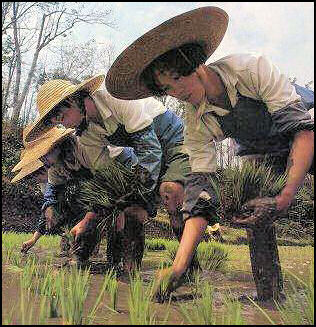
Rice planting

roots of elegance
on this trip to the far north
rice-planting song

© Basho (Tr. Jane Reichhold)

By-and-by the good man her father dies, and the wise woman her mother sickens within the year, and soon she lies in a corner of the cottage waiting for her end, with the maid near her crying bitter tears.
“Child,” says the mother, “do you know you are as pretty as a princess?”
“Am I that?” says the maid, and goes on with her crying.
“Do you know that your manners are fine?” says the mother.
“Are they, then?” says the maid, and goes on with her crying.
“My own baby,” says the mother, “could you stop your crying a minute and listen to me?”
So the maid stopped crying and put her head close by her mother’s on the poor pillow.
“Now listen,” says the mother, “and afterwards remember. It is a bad thing for a poor girl to be pretty. If she is pretty and lonely and innocent, none but the gods will help her. They will help you, my poor child, and I have thought of a way besides. Fetch me the great black rice-bowl from the shelf.”
The girl fetched it.
“See, now, I put it on your head and all your beauty is hidden away.”
“Alack, mother,” said the poor child, “it is heavy.”
“It will save you from what is heavier to bear,” said the mother. “If you love me, promise me that you will not move it till the time comes.”
“I promise! I promise! But how shall I know when the time comes?”
“That you shall know…. And now help me outside, for the sweet morning dawns and I’ve a fancy to see the fairies’ children once again, as they run in the forest.”

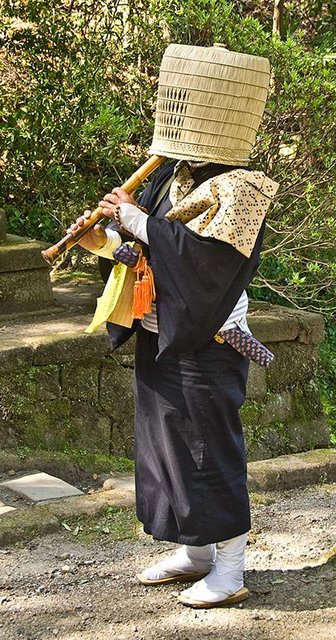
Komuso monk

So the child, having the black bowl upon her head, held her mother in her arms in a grassy place near the great trees, and presently they saw the fairies’ children threading their way between the dark trunks as they played at hide-and-seek. Their bright garments fluttered, and they laughed lightly as they went. The mother smiled to see them; before seven she died very sweetly as she smiled.
When her little store of rice was done, the maid with the wooden bowl knew well enough that she must starve or go and find more. So first she tended her father’s and mother’s graves and poured water for the dead, as is meet, and recited many a holy text. Then she bound on her sandals, kilted her grey skirts to show her scarlet petticoat, tied her household gods in a blue printed handkerchief, and set out all alone to seek her fortunes, the brave girl!
For all her slenderness and pretty feet she was a rarely odd sight, and soon she was to know it. The great black bowl covered her head and shadowed her face. As she went through a village two women looked up from washing in the stream, stared and laughed.
“It’s a boggart come alive,” says one.
“Out upon her,” cries the other, “for a shameless wench! Out upon her false modesty to roam the country thus with her head in a black bowl, as who should cry aloud to every passing man, ‘Come and see what is hidden!’ It is enough to make a wholesome body sick.”

black bowl
hides her pretty face
no distraction

© Chèvrefeuille

On went the poor maid, and sometimes the children pelted her with mud and pebbles for sport. Sometimes she was handled roughly by village louts, who scoffed and caught at her dress as she went; they even laid hands upon the bowl itself and sought to drag it from her head by force. But they only played at that game once, for the bowl stung them as fiercely as if it had been a nettle, and the bullies ran away howling.
The beggar-maiden might seek her fortune, but it was very hard to find. She might ask for work; but see, would she get it? None were wishful to employ a girl with a black bowl on her head.
At last, on a fine day when she was tired out, she sat her upon a stone and began to cry as if her heart would break. Down rolled her tears from under the black bowl. They rolled down her cheeks and reached her white chin.

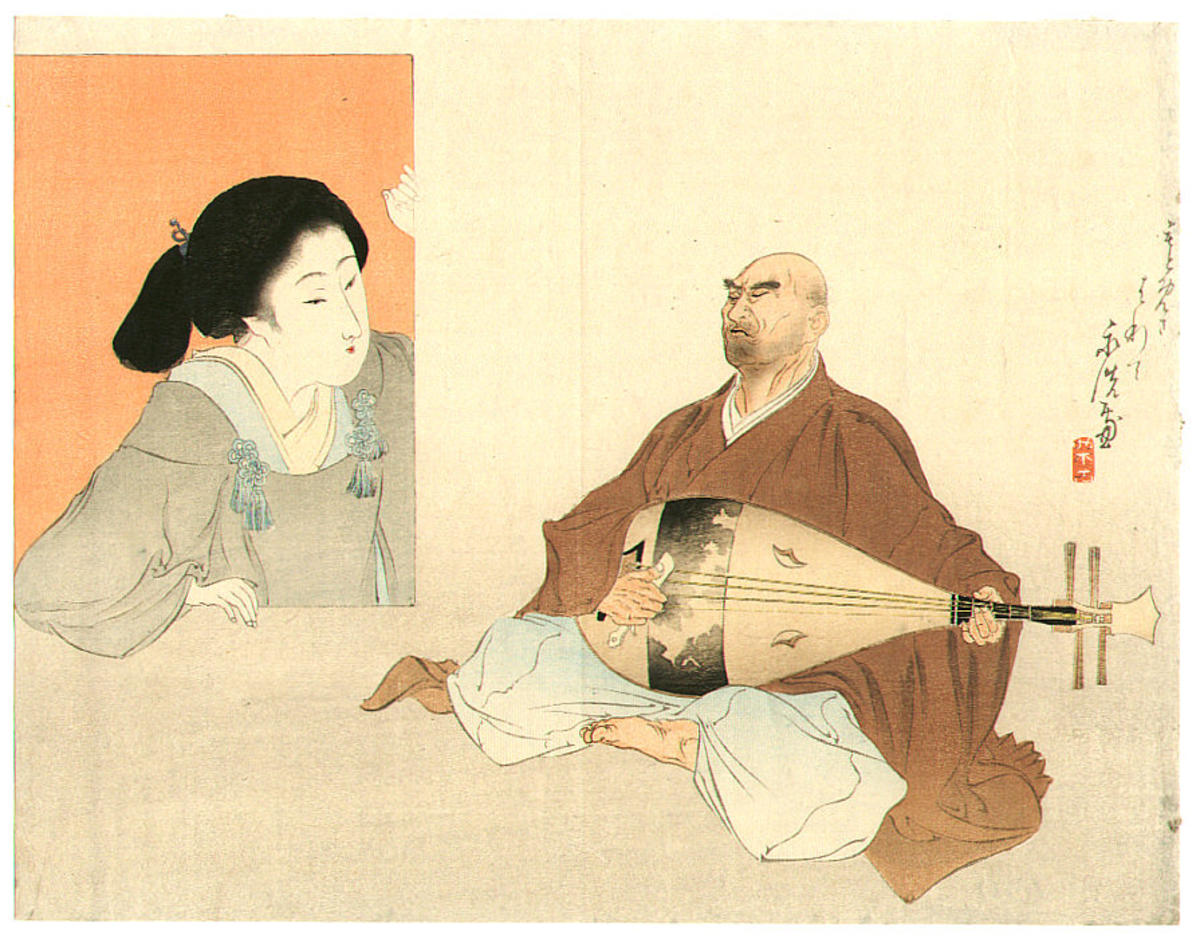
Biwa player

A wandering ballad-singer passed that way, with his biwa slung across his back. He had a sharp eye and marked the tears upon the maid’s white chin. It was all he could see of her face, and, “Oh, girl with the black bowl on your head,” quoth he, “why do you sit weeping by the roadside?”
“I weep,” she answered, “because the world is hard. I am hungry and tired…. No one will give me work or pay me money.”
“Now that’s unfortunate,” said the ballad-singer, for he had a kind heart; “but I haven’t a rin of my own, or it would be yours. Indeed I am sorry for you. In the circumstances the best I can do for you is to make you a little song.” With that he whips his biwa round, thrums on it with his fingers and starts as easy as you please. “To the tears on your white chin,” he says, and sings:

“The white cherry blooms by the roadside,
How black is the canopy of cloud!
The wild cherry droops by the roadside,
Beware of the black canopy of cloud.
Hark, hear the rain, hear the rainfall
From the black canopy of cloud.
Alas, the wild cherry, its sweet flowers are marred,
Marred are the sweet flowers, forlorn on the spray!”

“Sir, I do not understand your song,” said the girl with the bowl on her head.
“Yet it is plain enough,” said the ballad-singer, and went his way. He came to the house of a passing rich farmer. In he went, and they asked him to sing before the master of the house.

The Black Bowl (Warwick Goble painting)

“With all the will in the world,” says the ballad-singer. “I will sing him a new song that I have just made.” So he sang of the wild cherry and the great black cloud.
When he had made an end, “Tell us the interpretation of your song,” says the master of the house.
“With all the will in the world,” quoth the ballad-singer. “The wild cherry is the face of a maiden whom I saw sitting by the wayside. She wore a great black wooden bowl upon her head, which is the great black cloud in my song, and from under it her tears flowed like rain, for I saw the drops upon her white chin. And she said that she wept for hunger, and because no one would give her work nor pay her money.”
“Now I would I might help the poor girl with the bowl on her head,” said the master of the house.
“That you may if you wish,” quoth the ballad-singer. “She sits but a stone’s throw from your gate.”

The long and short of it was that the maid was put to labour in the rich farmer’s harvest-fields. All the day long she worked in the waving rice, with her grey skirts kilted and her sleeves bound back with cords. All day long she plied the sickle, and the sun shone down upon the black bowl; but she had food to eat and good rest at night, and was well content.
She found favour in her master’s eyes, and he kept her in the fields till all the harvest was gathered in. Then he took her into his house, where there was plenty for her to do, for his wife was but sickly. Now the maiden lived well and happily as a bird, and went singing about her labours. And every night she thanked the august gods for her good fortune. Still she wore the black bowl upon her head.
At the New Year time, “Bustle, bustle,” says the farmer’s wife; “scrub and cook and sew; put your best foot foremost, my dear, for we must have the house look at its very neatest.”
“To be sure, and with all my heart,” says the girl, and she put her back into the work; “but, mistress,” she says, “if I may be so bold as to ask, are we having a party, or what?”
“Indeed we are, and many of them,” says the farmer’s wife. “My son that is in Kyoto, the great and gay, is coming home for a visit.”

Presently home he comes, the handsome young man. Then the neighbours were called in, and great was the merry-making. They feasted and they danced, they jested and they sang, many a bowl of good red rice they ate, and many a cup of good saké they drank. All this time the girl, with bowl on her head, plied her work modestly in the kitchen, and well out of the way she was—the farmer’s wife saw to that, good soul! All the same, one fine day the company called for more wine, and the wine was done, so the son of the house takes up the saké bottle and goes with it himself to the kitchen. What should he see there but the maiden sitting upon a pile of faggots, and fanning the kitchen fire with a split bamboo fan!
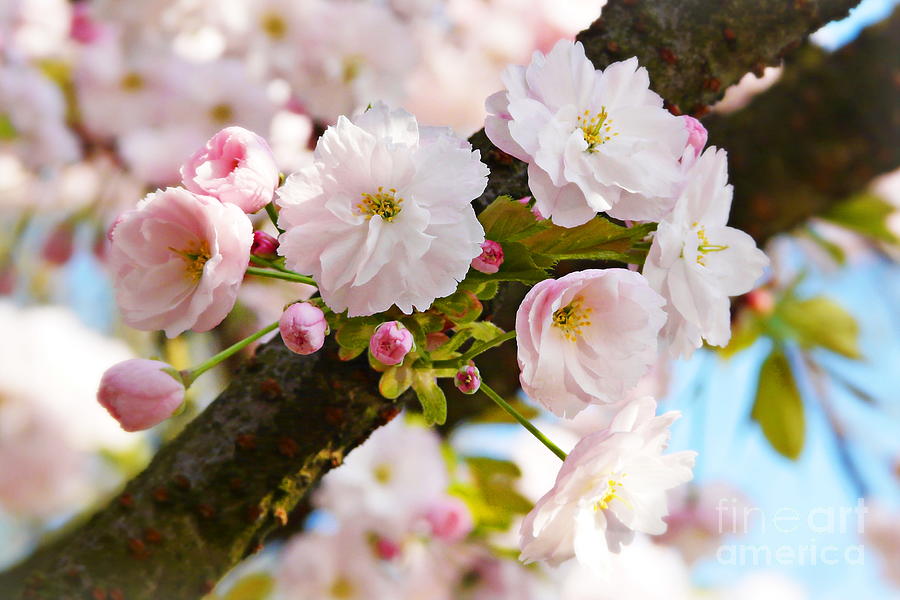
“My life, but I must see what is under that black bowl,” says the handsome young man to himself. And sure enough he made it his daily care, and peeped as much as he could, which was not very much; but seemingly it was enough for him, for he thought no more of Kyoto, the great and gay, but stayed at home to do his courting.
His father laughed and his mother fretted, the neighbours held up their hands, all to no purpose.
“Oh, dear, dear maiden with the wooden bowl, she shall be my bride and no other. I must and will have her,” cried the impetuous young man, and very soon he fixed the wedding-day himself.

Wild Cherry (© photo Angela Doelling)

When the time came, the young maidens of the village went to array the bride. They dressed her in a fair and costly robe of white brocade, and in trailing hakama of scarlet silk, and on her shoulders they hung a cloak of blue and purple and gold. They chattered, but as for the bride she said never a word. She was sad because she brought her bridegroom nothing, and because his parents were sore at his choice of a beggar-maid. She said nothing, but the tears glistened on her white chin.
“Now off with the ugly old bowl,” cried the maidens; “it is time to dress the bride’s hair and to do it with golden combs.” So they laid hands to the bowl and would have lifted it away, but they could not move it.
“Try again,” they said, and tugged at it with all their might. But it would not stir.
“There’s witchcraft in it,” they said; “try a third time.” They tried a third time, and still the bowl stuck fast, but it gave out fearsome moans and cries.
“Ah! Let be, let be for pity’s sake,” said the poor bride, “for you make my head ache.”
They were forced to lead her as she was to the bridegroom’s presence.
“My dear, I am not afraid of the wooden bowl,” said the young man.
So they poured the saké from the silver flagon, and from the silver cup the two of them drank the mystic “Three Times Three” that made them man and wife.

inner beauty revealed
after wearing a black bowl
everlasting love

© Chèvrefeuille

Then the black bowl burst asunder with a loud noise, and fell to the ground in a thousand pieces. With it fell a shower of silver and gold, and pearls and rubies and emeralds, and every jewel of price. Great was the astonishment of the company as they gazed upon a dowry that for a princess would have been rich and rare.
But the bridegroom looked into the bride’s face. “My dear,” he said, “there are no jewels that shine like your eyes.”

-0-0-0-0-0-0-0-

A wonderful fairytale and I hope you all have appreciated as much as I did. Sorry (again) for this long episode, but I think you will understand why I couldn't split this story.

This episode is NOW OPEN for your submissions and will remain open until January 30th at noon (CET). I will try to publish our new episode, The Sea King and the Magic Jewels, later on. For now ... have fun!