Showing posts with label O-Henr0. Show all posts

Wednesday, October 17, 2018

Carpe Diem #1524 O-Henro Shikoku pilgrims (memory lane)


Dear Haijin, visitors and travelers,

At CDHK we have done a lot of pilgrimages, one of the pilgrimages was on Shikoku Island along the 88 temples of Kobo Daishi, the once in a lifetime pilgrimage of Buddhists. I love to look back at that beautiful pilgrimage.

I remember that we first travelled with Trans Siberian Railway straight through the former USSR and read that wonderful novel by Paulo Coelho, Aleph. At the end of that journey we arrived on Shikoku Island and became O'Henro or pilgrims of Shikoku. What a wonderful time that was here at CDHK. We visited all the 88 temples in two months and (maybe) found peace of mind.

To become real O-Henro we had to change clothes (virtualy) without those special clothes we couldn't do the Shikoku Pilgrimage. I remember that we experienced the beauty of all the temples and for sure, as I look at myself, that changed my life.

O-Henro traditional clothing
At every temple we said the Heart Sutra ... to become silent and open-minded for changing:

Heart Sutra:

Heart of the Great Wisdom Sutra

When a sincere truth seeker attains the wisdom of enlightenment, he realizes that all the five senses are empty and he transcends every suffering.
Listen: All things are no different from emptiness; emptiness is not different from all things. Form is emptiness; emptiness is form. Feelings, perceptions, impulses, consciousness are also like this.
Listen: The original nature of all things is neither born nor extinguished. There is no purity, no defilement; no gain, no loss.
In this world of emptiness there is no form, no feelings, perceptions, impulses, or consciousness. No eye, ear, tongue body, or mind. Therefore, no color, sound, smell, taste, touch, or thought. The world of form does not exist, nor the world of the mind or of ignorance; no old age and no death.
Yet there is continuous ignorance, old age, and death.
There is no suffering, no cause of suffering, no cessation of suffering; no wisdom and no attainment because there is nothing to be attained. The compassionate truth-seeker depends upon the wisdom of enlightenment.
When the mind does not become attached to anything, there are no obstacles and fear does not exist. This mind goes beyond all disruptive views and attains Nirvana. All the Buddhas of the past, present and future depend upon the wisdom of enlightenment--and so attain the supreme, wisdom of enlightenment as the great unexplainable true word, the great shining true word that is able to remove all suffering. It is true, not false. This true word of wisdom says:
Gyate Gyate Hara Gyate Hara So Gyate Bodhi Sowa Ka.

O-Henro at one of the 88 temples on Shikoku Island
In our first episode of the Shikoku Pilgrimage I shared a so called "cascading haiku", but for this episode I have "redone" that "cascading haiku" into a tanka.

pilgrims chanting
the Heart Sutra to honor Kukai -
cry of a Vulture
breaks through the serene temple -
pilgrims chanting

© Chèvrefeuille

This pilgrimage took us two whole months (February & March 2014) and I love to share part of the first episode of March 2014, about the 40th temple Kanjizai-ji.
Kanjizai-ji (temple 40)
[...] Kanjizai-ji is situated in the town called Ainan and is devoted to Yakushi Nyorai or the Buddha of Medicine and Healing. He is still one of the most important Buddhas especially during rituals which are performed at funerals, because he is also the Buddha who leads the buddhists to Nirvana.

Nirvana calling
Yakushi Nyorai guides you
to Enlightenment

© Chèvrefeuille

With Kanjizai-ji temple we are on our way to the last temple of the Shikoku Trail. Than we will have seen and visited the 88 temples who are inspired on the life of Kobo Daishi (774-835) who was born on Shikoku Island and was one of the founders of Shingon Buddhism. [...]

It was really an honor to be on the Island of Shikoku as your guide and inspirator. Thank you all.

The task for this episode is to look back into our rich CDHK history and share your favorite episode. Please share with us why you did like that specific episode and maybe you can share a new haiku or tanka inspired on your favorite episode.

This episode is NOW OPEN for your submissions and will remain open until October 24th at noon (CEST). I will try to publish our new episode later on. For now ... have fun!


Monday, March 24, 2014

Carpe Diem #430, Sanuki Kokubun-ji (temple 80)


Dear O-Henro ... Haijin, visitors and travelers,

Today we will visit the 80th temple on the Shikoku trail, Sanuki Kokobun-ji, and that's the start of our last stage for this pilgrimage.
As you could have read in the last few post I have started a new feature named "Ghost-Writers" and I am glad that two of our family-members of Carpe Diem Haiku Kai already have said that they will be Ghost-Writer in week 15. Jules and Managua have emailed me that have taken the challenge to write a post as "Ghost-Writer". I am glad they did ... their posts will really be a joy to read I think ... we will see.

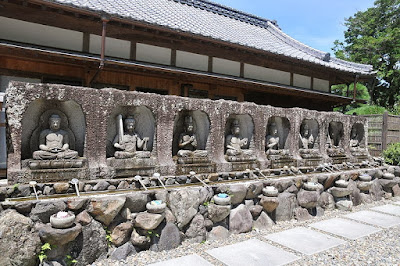
Sanuki Kokubun-ji (讃岐国分寺?) is an Omuro Shingon temple in Takamatsu, Kagawa Prefecture, Japan. The provincial temple of former Sanuki Province and Temple 80 on the Shikoku 88 temple pilgrimage, it is said to have been founded by Gyōki in 741. The main image is of Senjū Kannon and Juichimen. Around Senju also known as Guanyin there are a lot of legends I love to share here two of those legends.The first is "Guanyin and the Thousand Arms" and the second is "Guanyin and Shancai"


Sanuki Kokubun-ji (temple 80)

Guanyin and the Thousand Arms:

One Buddhist legend from the Complete Tale of Guanyin and the Southern Seas  presents Guanyin as vowing to never rest until she had freed all sentient beings from the samsara or reincarnation. Despite strenuous effort, she realized that there were still many unhappy beings yet to be saved. After struggling to comprehend the needs of so many, her head split into eleven pieces. The buddha Amitabha, upon seeing her plight, gave her eleven heads to help her hear the cries of those who are suffering. Upon hearing these cries and comprehending them, Avalokitesvara attempted to reach out to all those who needed aid, but found that her two arms shattered into pieces. Once more, Amitabha came to her aid and appointed her a thousand arms to let her reach out to those in need. Many Himalayan versions of the tale include eight arms with which Avalokitesvara skillfully upholds the Dharma, each possessing its own particular implement, while more Chinese-specific versions give varying accounts of this number.


Guanyin and Shancai:


Legend has it that Shancai (also called Sudhana in Sanskrit) was a disabled boy from India who was very interested in studying the dharma. When he heard that there was a Buddhist teacher on the rocky island of Putuo he quickly journeyed there to learn. Upon arriving at the island, he managed to find Guanyin despite his severe disability.
Guanyin, after having a discussion with Shancai, decided to test the boy's resolve to fully study the Buddhist teachings. She conjured the illusion of three sword-wielding pirates running up the hill to attack her. Guanyin took off and dashed to the edge of a cliff, the three illusions still chasing her.
Shancai, seeing that his teacher was in danger, hobbled uphill. Guanyin then jumped over the edge of the cliff, and soon after this the three bandits followed. Shancai, still wanting to save his teacher, managed to crawl his way over the cliff edge.
Shancai fell down the cliff but was halted in midair by Guanyin, who now asked him to walk. Shancai found that he could walk normally and that he was no longer crippled. When he looked into a pool of water he also discovered that he now had a very handsome face. From that day forth, Guanyin taught Shancai the entire dharma.

Temple devoted to Guanyin in Surabaya Indonesia

There are a lot of Buddhistic Legends and Tales, so maybe I will use a few of them in our upcoming Carpe Diem month about Legend, Myth and Saga next May.

Really nice stories full of devotion and spirituality. It is said that Chinese fishermen pray to Guanyin with the Thousand Arms to have a save trip and to come home save. It is obvious that Buddhism one of the most important religions is in the Far Eastern countries and that the Buddhistic boddhisattvas have more than one name in those regions.

many names
for the same boddhisattvas -
one religion

(c) Chèvrefeuille

Another one more in the sphere of the traditional haiku-art:

fishermen praying
to have a good catch and return save -
koi carp pond

(c) Chèvrefeuille

To conclude this episode another wonderful photo of Sanuki Kokubun-ji Temple.

Sanuki Kokubun-ji (temple 80)
boddhisattvas gather
in front of Sanuki Kokubun-ji
guiding pilgrims

(c) Chèvrefeuille

This episode is open for your submissions tonight at 7.00 PM (CET) and will remain open for your submissions until March 27th 11.59 AM (CET). I will (try to) publish our new episode, Negoro-ji (temple 82), later on today.
Have fun, be inspired and share your haiku with us all here at Carpe Diem Haiku Kai.

Namaste