Showing posts with label trip along memory lane. Show all posts

Wednesday, October 17, 2018

Carpe Diem #1524 O-Henro Shikoku pilgrims (memory lane)


Dear Haijin, visitors and travelers,

At CDHK we have done a lot of pilgrimages, one of the pilgrimages was on Shikoku Island along the 88 temples of Kobo Daishi, the once in a lifetime pilgrimage of Buddhists. I love to look back at that beautiful pilgrimage.

I remember that we first travelled with Trans Siberian Railway straight through the former USSR and read that wonderful novel by Paulo Coelho, Aleph. At the end of that journey we arrived on Shikoku Island and became O'Henro or pilgrims of Shikoku. What a wonderful time that was here at CDHK. We visited all the 88 temples in two months and (maybe) found peace of mind.

To become real O-Henro we had to change clothes (virtualy) without those special clothes we couldn't do the Shikoku Pilgrimage. I remember that we experienced the beauty of all the temples and for sure, as I look at myself, that changed my life.

O-Henro traditional clothing
At every temple we said the Heart Sutra ... to become silent and open-minded for changing:

Heart Sutra:

Heart of the Great Wisdom Sutra

When a sincere truth seeker attains the wisdom of enlightenment, he realizes that all the five senses are empty and he transcends every suffering.
Listen: All things are no different from emptiness; emptiness is not different from all things. Form is emptiness; emptiness is form. Feelings, perceptions, impulses, consciousness are also like this.
Listen: The original nature of all things is neither born nor extinguished. There is no purity, no defilement; no gain, no loss.
In this world of emptiness there is no form, no feelings, perceptions, impulses, or consciousness. No eye, ear, tongue body, or mind. Therefore, no color, sound, smell, taste, touch, or thought. The world of form does not exist, nor the world of the mind or of ignorance; no old age and no death.
Yet there is continuous ignorance, old age, and death.
There is no suffering, no cause of suffering, no cessation of suffering; no wisdom and no attainment because there is nothing to be attained. The compassionate truth-seeker depends upon the wisdom of enlightenment.
When the mind does not become attached to anything, there are no obstacles and fear does not exist. This mind goes beyond all disruptive views and attains Nirvana. All the Buddhas of the past, present and future depend upon the wisdom of enlightenment--and so attain the supreme, wisdom of enlightenment as the great unexplainable true word, the great shining true word that is able to remove all suffering. It is true, not false. This true word of wisdom says:
Gyate Gyate Hara Gyate Hara So Gyate Bodhi Sowa Ka.

O-Henro at one of the 88 temples on Shikoku Island
In our first episode of the Shikoku Pilgrimage I shared a so called "cascading haiku", but for this episode I have "redone" that "cascading haiku" into a tanka.

pilgrims chanting
the Heart Sutra to honor Kukai -
cry of a Vulture
breaks through the serene temple -
pilgrims chanting

© Chèvrefeuille

This pilgrimage took us two whole months (February & March 2014) and I love to share part of the first episode of March 2014, about the 40th temple Kanjizai-ji.
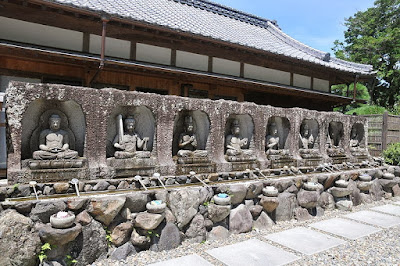
Kanjizai-ji (temple 40)
[...] Kanjizai-ji is situated in the town called Ainan and is devoted to Yakushi Nyorai or the Buddha of Medicine and Healing. He is still one of the most important Buddhas especially during rituals which are performed at funerals, because he is also the Buddha who leads the buddhists to Nirvana.

Nirvana calling
Yakushi Nyorai guides you
to Enlightenment

© Chèvrefeuille

With Kanjizai-ji temple we are on our way to the last temple of the Shikoku Trail. Than we will have seen and visited the 88 temples who are inspired on the life of Kobo Daishi (774-835) who was born on Shikoku Island and was one of the founders of Shingon Buddhism. [...]

It was really an honor to be on the Island of Shikoku as your guide and inspirator. Thank you all.

The task for this episode is to look back into our rich CDHK history and share your favorite episode. Please share with us why you did like that specific episode and maybe you can share a new haiku or tanka inspired on your favorite episode.

This episode is NOW OPEN for your submissions and will remain open until October 24th at noon (CEST). I will try to publish our new episode later on. For now ... have fun!


Friday, July 6, 2018

Carpe Diem Weekend Meditation #40 Sparkling Stars ... "the autumn full moon"


!! Open for your submissions next Sunday July 8th at 7:00 PM (CEST) !!

Dear Haijin, visitors and travelers,

Welcome at a new weekend meditation, our special feature for the weekend. The weekend before last weekend I introduced to you a new feature "Along Memory Lane A Trip Back In Time" in which I will take you back into the rich history of Carpe Diem Haiku Kai. This weekend I love to go back in time to a special feature in which I shared masterpieces written by the classic and non-classic haiku poets ... Sparkling Stars ... In that feature I not only shared haiku by classical and non-classical haiku poets, but all those haiku were in a way my favorite.


Sparkling Stars is a bit similar with the CD-Specials, but there is a little difference. I will introduce a 'masterpiece' of one of the classic haiku-poets (well-known and less-known) to inspire you to write a new haiku. Here is the difference with the CD-Specials. Those new haiku, inspired on the 'masterpiece', have to follow the classical rules of haiku:

1. 5-7-5 syllables
2. a kigo (or seasonword)
3. a kireji (or cutting word, in Western languages mostly interpunction)
4. a moment as short as the sound of a pebble thrown into water
5. a deeper meaning (could be Zen-Buddhistic or other spiritual or religious thought)
6. and the first and the third line are interchangeable.

For this weekend meditation "along memory lane, a trip back in time" I have chosen one of the haiku I used in this feature earlier here at CDHK ... I even had the guts to reproduce the whole episode ... sorry for that. I like to take the easy way sometimes.


Sometimes I am an a melancholic mood, mostly after a busy day at work, than I have to go outside in the late evening to smell the perfume of the coming night, to look at the stars and if she, the moon, is there I look at her in pure adoration. I love her. Sometimes she stands there high in the sky in full regalia, sharing her sun-reflected light with me. Sometimes she looks a bit sad and ashamed than she hides her beautiful face behind a veil of clouds. She doesn't know that I love her and that I adore her beauty. Her beauty is the best as she hides behind a thin veil of clouds. Than she is surrounded with a beautiful halo which is so colorful and bright ... than she looks like a queen, a goddess ...
Not so long ago I had such a melancholic mood. I went outside and looked up to the dark sky ... there she was, my love, almost full and clothed with a gorgeous light orange gown ... "Wow", I thought. "You're looking great my love!"

the night deepens
darker and darker the sky
without the streetlights
the night sky looks like a light show
the full moon and thousands of stars

© Chèvrefeuille

Isn't it a wonderful tribute to her, the moon, whom I love so much? As I look at my loving wife ... than I see her everlasting beauty, than she, is my full moon.


Why such a long introduction? Well ... I will explain that. To the Japanese, ancient and modern, the moon of autumn is the most beautiful gift of Mother Nature. There are countless haiku written inspired on the beauty of the autumn moon.
As I look at my own haiku-archive I can almost say that at least one third of them is about the moon in all her occurring images.

Basho also has written a lot of haiku about the moon and for sure the most 'moon'-haiku are about the moon of autumn. The haiku which I have chosen for this episode of "Sparkling Stars" isn't the best haiku by Basho, but it needed this long introduction, because it tells you more about my love for the moon and the love for the moon by Basho.

The Way of Haiku requires not only a Franciscan poverty, but the concentration of all the energies of mind and body, a perpetual sinking of oneself into things. Basho tells us, and it is to be noted, we believe him:

meigetsu ya ike o megurite yo mo sugara

the autumn full moon:
all night long
I paced round the lake.

© Basho

All night gazing at the moon, and only this poor verse to show for it? But it must be remembered that Basho was a teacher. And thus we too, when we look at the moon, look at it with the eyes of Basho, those eyes that gazed at that moon and its reflection in the placid water of the lake.

Full Moon of July (photo © Alison Hale)
Call me a nutcase, a dreamer or a fool, but I think that I am like Basho, that we all are like Basho, because we all are gazing at the beauty of our planet. We all are in love with the beauty of Mother Nature ... and that makes us all moon-lovers.

tears of joy
spilled into the old pond -
the moon's reflection

© Chèvrefeuille

Well ... I hope you did like the read and that it will inspire you to write an all new haiku about the moon maybe or about the beauty of Mother Nature. Have fun, be inspired and share your "sparkling star" with us all here at our Haiku Kai.

This weekend meditation is open for your submissions next Sunday July 8th at 7:00 PM (CEST) and will remain open until July 15th at noon (CEST). Have a great weekend!


Friday, June 22, 2018

Carpe Diem Weekend Meditation #38 A Trip Along Memory Lane #1 Carpe Diem Special


!! Open for your submissions next Sunday June 24th at 7:00 PM (CEST) !!

Dear Haijin, visitors and travelers,

I welcome you all at a new episode of our Carpe Diem Weekend Meditation, our weekend challenge or our meditation and contemplation feature for the weekend. This weekend I have a new feature for you to work with, but I have to tell you something about the background of this feature.

As you all know I started with Carpe Diem Haiku Kai (then titled only Carpe Diem) back in October 2012. Before I started with CDHK I had some experience with writing haiku (or tanka) every day on two other websites. Those websites however did this for just one month (February and September). I was a very active participant in those daily memes and I missed it almost immediately after writing the last episode of the daily haiku meme in September 2012. So I wanted to fill that hole and decided to create my own daily haiku meme. Well ... right on that moment I created Carpe Diem, now renown as Carpe Diem Haiku Kai, and started to create every day haiku (or tanka).
To make Carpe Diem more attractive I created several special features. The first special feature I created was simply titled Carpe Diem Special and in that feature I introduced several known and unknown haiku poets and gave a haiku written by them. The goal was to create a haiku in the same tone and sense as the given haiku. In other words I tried to inspire my visitors to create haiku in the way of the given classic haiku poet.

This weekend I love to bring a "new" episode of this Carpe Diem Special feature, but of course I had several other special features here at Carpe Diem Haiku Kai for example the weekly Tan Renga Challenge or "Little Ones" and more.

Credits Logo
 Okay ... here is the first "stop" on our Trip Along Memory Lane, a trip back in time: This weekend I have (as said above) an episode of that feature titled "Carpe Diem Special" and the goal is to create a new haiku, tanka or other form of Japanese poetry in the same tone and sense as the given haiku. For this Carpe Diem Special I have chosen haiku written by a not so renown haiku poet: Sumitaku Kenshin (1961-1987).

Sumitaku Kenshin

Sumitaku Kenshin wrote mostly one-lined haiku-like poems, so it's a little bit strange to share these with you, because we are all haiku poets that use the three-line lay-out of haiku, but well ... maybe it inspires you to explore this way of writing haiku ... you never know.

Here are the (5) haiku to work with:

While lost in talking, the stars have grown more and more distinct 

How happy! Bathing in the tub full to overflowing 

A dragonfly, with its thin wings sick in summer 

Autumn is lonely, a mosquito bites me 

A lonely night, someone begins to laugh 

All nice one-line haiku to inspire you, but don't forget ... the task is to create in the same sense and tone.

Well ... I wish you all a wonder weekend and I am looking forward to your responses on this new weekend-meditation feature "Along Memory Lane, A Trip Back In Time".

This weekend meditation is open for your submissions next Sunday June 24th at 7:00 PM (CEST) and will remain open until July 1st at noon (CEST). For now ... have fun and have a great weekend!