Showing posts with label mythology. Show all posts

Sunday, March 25, 2018

Carpe Diem #1396 Unfold Your Own Myth


Dear Haijin, visitors and travelers,

Welcome at the last few episodes of this wonderful month. In this month I tried to inspire you through the Qu'ran and through the beautiful poems by Rumi. This month was awesome to create, but not easy to respond on. Next month we will dive into the "matter" of writing Haibun (Prose and poetry) and I think April will be a cool month too.

Today's poem for your inspiration is taken from "The Essential Rumi" by Coleman Barks and is titled "Make Your Own Myth". It's a nice poem and it describes the wonders of creating your own myth as e.g. Moses did or Napoleon. Everyone of us can create his / her own myth, but what do you create as you "create your own myth"?

Let me tell you in short what a myth is:

Myth is a folklore genre consisting of narratives that are ostensibly historical, though often supernatural, explaining the origins of a cultural practice or natural phenomenon. The word "myth" is derived from the Greek word mythos, which simply means "story". Mythology can refer either to the study of myths, or to a body or collection of myths. Myth can mean 'sacred story', 'traditional narrative' or 'tale of the gods'. A myth can also be a story to explain why something exists.

Stonehenge? A Myth?
Human cultures' mythologies usually include a cosmogonical or creation myth, concerning the origins of the world, or how the world came to exist. The active beings in myths are generally gods and goddesses, heroes and heroines, or animals and plants. Most myths are set in a timeless past before recorded time or beginning of the critical history. A myth can be a story involving symbols that are capable of multiple meanings.

A myth is a sacred narrative because it holds religious or spiritual significance for those who tell it. Myths are often therefore stories that are currently understood as being exaggerated or fictitious.

Myth ... a story to explain why something or someone exists and that's maybe the "deeper layer" in the poem by Rumi, which I will share hereafter. Rumi is known as the "Mystical Poet" and it's easy to see that "myth" is part of Mystic thought. So there is a reason why we exist ... 


Unfold Your Own Myth:

Who gets up early to discover the moment light begins?
Who finds us here circling, bewildered, like atoms?
Who comes to a spring thirsty
and sees the moon reflected in it?
Who, like Jacob blind with grief and age,smells the shirt of his lost son
and can see again?
Who lets a bucket down and brings up
a flowing prophet? Or like Moses goes for fire
and finds what burns inside the sunrise?

Jesus slips into a house to escape enemies,
and opens a door to the other world.
Solomon cuts open a fish, and there's a gold ring.
Omar storms in to kill the prophet
and leaves with blessings.
Chase a deer and end up everywhere!
An oyster opens his mouth to swallow one drop.
Now there's a pearl.

A vagrant wanders empty ruins.
Suddenly he's wealthy.

But don't be satisfied with stories, how things
have gone with others. Unfold
your own myth, without complicated explanation,
so everyone will understand the passage,
We have opened you.

Start walking toward Shams. Your legs will get heavy
and tired. Then comes a moment
of feeling the wings you've grown,
lifting.

© Rumi (The Essential Rumi by Coleman Barks)

A wonderful, very spiritual and mystical, poem I would say. Enough to become inspired by ... at least I hope that I have inspired you with this poem, because I wasn't inspired to create my inspired poetry after reading this poem.

Butterfly ... to unfold my own myth

making my own myth
feeling one with nature around me
I am a butterfly
born from the silk cocoon
made by a caterpillar

© Chèvrefeuille

Hm ... nice tanka (how immodest) after all I was inspired enough ...

This episode is open for your submissions right now and will remain open until April 1st at noon (CEST). I will try to publish our new episode, another beauty by Rumi, later on. For now ... have fun!


Saturday, September 26, 2015

Carpe Diem #827 Phoenix


Dear Haijin, visitors and travelers,

What a joy ... another month of CDHK is running to it's end and we have just a few days before we are starting with our third anniversary month. Incredible that CDHK is still here alive and kicking. I am proud to be your host and that makes me humble too, because who am I that I may make CDHK for a worldwide family of haiku poets. Thank you all for being part in this haiku loving family.


Today we are going further on our space odyssey to encounter another (not so well known) constellation Phoenix. The Phoenix rises from its ashes and I hope that CDHK will never come to the point that it will die and has to be reborn like a phoenix.


Credits: Rise like a Phoenix

Let us first take a look at the mythology of this mythical creature. In Greek mythology, a phoenix or phenix is a long-lived bird that is cyclically regenerated or reborn. Associated with the sun, a phoenix obtains new life by arising from the ashes of its predecessor. According to some sources, the phoenix dies in a show of flames and combustion, although there are other sources that claim that the legendary bird dies and simply decomposes before being born again. According to some texts, the phoenix could live over 1,400 years before rebirth. Herodotus, Lucan, Pliny the Elder, Pope Clement I, Lactantius, Ovid, and Isidore of Seville are among those who have contributed to the retelling and transmission of the phoenix motif. The phoenix was adopted as a symbol in early Christianity.

As you maybe know I am a fan of Harry Potter and in that movie series appears several times a phoenix to rescue Harry e.g. in "The Secret Chamber" and "The Order of the Phoenix". So a lot of us have grown up with this mythical creature.

like a phoenix
the sun rises every day again
conquering the night

© Chèvrefeuille

Maybe that's the deeper meaning of this creature. Resurrection and renewal every day again. Maybe you have conquered illness and came out of it like a Phoenix. I think that in everyone of us, in every human there is something like a Phoenix. As I look at myself than I sure think that's true. I have conquered several periods of illness and came out stronger as ever. So ... we all are Phoenixes ...

Ok ... back to our constellation, because that's where its all about this month. Let us take a closer look to this, not so well known, constellation.

Credits: Phoenix

Phoenix was the largest of the twelve constellations established by Petrus Plancius from the observations of Pieter Dirkszoon Keyser and Frederick de Houtman. It first appeared on a 35-cm diameter celestial globe published in 1597 (or 1598) in Amsterdam by Plancius with Jodocus Hondius. The first depiction of this constellation in a celestial atlas was in Johann Bayer's Uranometria of 1603. De Houtman included it in his southern star catalog the same year under the Dutch name Den voghel Fenicx, "The Bird Phoenix", symbolising the phoenix of classical mythology. One name of the brightest star Alpha Phoenicis—Ankaa—is derived from the Arabic ‘anqā’ "the phoenix", and was coined sometime after 1800 in relation to the constellation.

Celestial historian Richard Allen noted that unlike the other constellations introduced by Plancius and La Caille, Phoenix has actual precedent in ancient astronomy, as the Arabs saw this formation as representing young ostriches, Al Ri'āl, or as a griffin or eagle. In addition, the same group of stars was sometimes imagined by the Arabs as a boat, Al Zaurak, on the nearby river Eridanus. He observed, "the introduction of a Phoenix into modern astronomy was, in a measure, by adoption rather than by invention."

The Chinese incorporated Phoenix's brightest star, Ankaa (Alpha Phoenicis), and stars from the adjacent constellation Sculptor to depict Bakui, a net for catching birds. Phoenix and the neighboring constellation of Grus together were seen by Julius Schiller as portraying Aaron the High Priest. These two constellations, along with nearby Pavo and Tucana, are called the Southern Birds.

phoenix spreads its wings
after the dark cold winter night
finally spring


© Chèvrefeuille

That's something to see spring arriving like a Phoenix ... maybe the Phoenix is very real ...

This episode is open for your submissions tonight at 7.00 PM (CET) and will remain open until September 29th at noon (CET). I will try to publish our next episode, Sculptor, later on. For now ... have fun, be inspired and share your haiku, tanka or other Japanese poetry form with us all here at our Haiku Kai.


Friday, September 25, 2015

Carpe Diem #826 Pyxis (Mariner's compass)


Dear Haijin, visitors and travelers,

On our space odyssey we have encountered several known an unknown constellations and today we have another "unknown" constellation, Pyxis (Mariner's compass). I haven't heard from this constellation and I think most of you also will not know this constellation. So it will not be easy to write an all new haiku, tanka or other Japanese poetry form inspired on this constellation. Maybe the description can help us. Let us take a closer look at this "unknown" constellation.


Credits: Pyxis (Mariner's compass)
And here is the story behind this constellation:

The constellation Pyxis was created by the French astronomer Nicolas Louis de Lacaille in 1751-52 during his exploration of the southern skies. He named the constellation la Boussole and later Latinized the name to Pixis Nautica. The constellation appeared under this name in the second edition of Lacaille’s chart in 1763. The name was eventually shortened to Pyxis.

The constellation represents the magnetic compass used by navigators and seamen and should not be confused with Circinus, which was named after a draftsman’s compasses. Pyxis lies in the vicinity of the three constellations that were once known as Argo Navis, a single large constellation that represented the ship of the Argonauts. Lacaille was the one who divided the constellation into three smaller ones – Carina, Puppis and Vela – and this might be the reason why Pyxis is sometimes mentioned as the fourth constellation that was part of Argo Navis, even though it wasn’t. The Greek astronomer Ptolemy had catalogued the stars from Alpha to Delta Pyxidis, but not as part of Argo Navis, but as stars located on or around the ship’s mast.

look at the stars
while on the way to fulfillment
pyxis leads


© Chèvrefeuille

This episode is open for your submissions tonight at 7.00 PM (CET) and will remain open until September 28th at noon (CET). I will try to publish our next episode, Phoenix, later on.

Thursday, September 24, 2015

Carpe Diem #825 Pegasus


Dear Haijin, visitors and travelers,

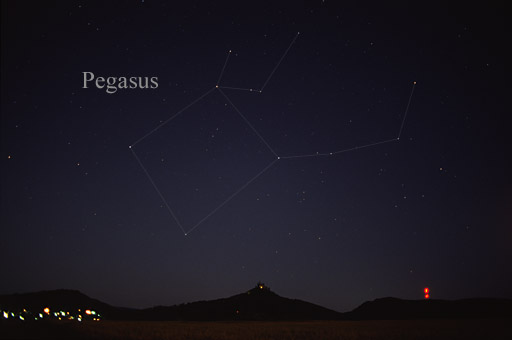
Our space odyssey was on hold a few days, but today we will go on with this exploration of our universe. Today we will encounter the constellation Pegasus. I didn't know this constellation, but Pegasus I do know. This winged horse is a gorgeous myth from the Greeks.

Let us take a closer look at Pegasus:

Credits: Pegasus

The Babylonian constellation IKU (field) had four stars of which three were later part of the Greek constellation Hippos (Pegasus). Pegasus, in Greek mythology, was a winged horse with magical powers. One myth regarding his powers says that his hooves dug out a spring, Hippocrene, which blessed those who drank its water with the ability to write poetry. Pegasus was the one who delivered Medusa's head to Polydectes, after which he travelled to Mount Olympus in order to be the bearer of thunder and lightning for Zeus. Eventually, he became the horse to Bellerophon, who was asked to kill the Chimera and succeeded with the help of Athena and Pegasus. Despite this success, after the death of his children, Bellerophon asked Pegasus to take him to Mount Olympus. Though Pegasus agreed, he plummeted back to Earth after Zeus either threw a thunderbolt at him or made Pegasus buck him off.
In ancient Persia, Pegasus was depicted by al-Sufi as a complete horse facing east, unlike most other uranographers, who had depicted Pegasus as half of a horse, rising out of the ocean. In al-Sufi's depiction, Pegasus's head is made up of the stars of Lacerta the lizard.
By the way al-Sufi was one of the famous nine Muslim astronomers. His name implies that he was from a Sufi Muslim background. He lived at the court of Emir Adud ad-Daula in Ispahan, Persia, and worked on translating and expanding Greek astronomical works, especially the Almagest of Ptolemy. He contributed several corrections to Ptolemy's star list and did his own brightness and magnitude estimates which frequently deviated from those in Ptolemy's work. He was a major translator into Arabic of the Hellenistic astronomy that had been centered in Alexandria, the first to attempt to relate the Greek with the traditional Arabic star names and constellations, which were completely unrelated and overlapped in complicated ways.
Credits: Pegasus (upside down)
A wonderful story and a wonderful constellation I think. I couldn't write a haiku at first, but after reading and re-reading I thought maybe I can do something with Hippocrene the spring dug out through Pegasus's hooves, which blessed those who drank from it with the powerful skill to write poetry. So here is my attempt inspired on Hippocrene:

after the rainstorm
horses galloping through puddles
droplets of poetry


© Chèvrefeuille


Credits: Hippocrene on Mt.Helicon

Hippocrene  was the name of a spring on Mt. Helicon. It was sacred to the Muses and was formed by the hooves of Pegasus. Its name literally translates as "Horse's Fountain" and the water was supposed to bring forth poetic inspiration when imbibed.

There are several poems in which "Hippocrene" is mentioned. An example:

John Keats (1795-1821), an English poet, mentions "Hippocrene" in his wellknown poem "Ode to a Nightingale", what is following is part of that poem. If you would like to read Keats' whole poem than follow the link above.
 
O for a beaker full of the warm South
Full of the true, the blushful Hippocrene,
With beaded bubbles winking at the brim,
And purple-stained mouth;
That I might drink, and leave the world unseen,
And with thee fade away into the forest dim


I hope you did like this episode about Pegasus and of course I hope that it will inspire you to write an all new haiku, tanka or other Japanese poetry form.

This episode is open for your submissions tonight at 7.00 PM (CET) and will remain open until September 27th at noon (CET). I will try to publish our new episode, Pyxis (Mariner's Compass), later on. For now ... be inspired and share your inspired haiku with us all.


Monday, September 21, 2015

Carpe Diem #824 Orion


Dear Haijin, visitors and travelers,

First a view announcements:

1. I have published our prompt-list for October 2015, our 3rd anniversary month;
2. Please remember that our fourth kukai "Peace of Mind" is still running and that you can submit your all new haiku (only haiku) with a maximum of three until September 25th at 10.00 PM (CET);
3. I have changed the judging-rules for our kukai. The kukai-judging is also open for those who didn't submit haiku for the kukai;
4. I am busy with creating our CDHK You Tube channel and I am exploring the possibilities to launch a CDHK merchandise line.

Ok ... enough announcements made. Let us go on with our space odyssey in which we are exploring the 88 known (and listed) constellations. We have had several unknown constellations, but the constellation for today is very known I think. Today we are encountering Orion, mostly known for its very clear three stars which are seen as the belt of Orion. Let us take a closer look at Orion:

Credits: Orion
There are numerous stories about this constellation. The most dazzling one I think is that one of the stars in Orion's belt is inhabited ... if that's true I don't know, but I was stunned when I read that idea. However that story I will not take with me in this episode, because there are several other stories based on mythology which I cherish more.

The earliest depiction that has been linked to the constellation of Orion is a prehistoric (Aurignacian) mammoth ivory carving found in a cave in the Ach valley in Germany in 1979. Archaeologists have estimated it to have been fashioned approximately 32,000 to 38,000 years ago. The distinctive pattern of Orion has been recognized in numerous cultures around the world, and many myths have been associated with it. It has also been used as a symbol in the modern world.

Ancient Near East

The Babylonian star catalogues of the Late Bronze Age name Orion "The Heavenly Shepherd" or "True Shepherd of Anu" - Anu being the chief god of the heavenly realms. The Babylonian constellation was sacred to Papshukal and Ninshubur, both minor gods fulfilling the role of 'messenger to the gods'. Papshukal was closely associated with the figure of a walking bird on Babylonian boundary stones, and on the star map the figure of the Rooster was located below and behind the figure of the True Shepherd—both constellations represent the herald of the gods, in his bird and human forms respectively.

In ancient Egypt, the stars of Orion were regarded as a god, called Sah. Because Orion rises before Sirius, the star whose heliacal rising was the basis for the Solar Egyptian calendar, Sah was closely linked with Sopdet, the goddess who personified Sirius. The god Sopdu was said to be the son of Sah and Sopdet. Sah was syncretized with Osiris, while Sopdet was syncretized with Osiris' mythological wife, Isis. In the Pyramid Texts, from the 24th and 23rd centuries BC, Sah was one of many gods whose form the dead pharaoh was said to take in the afterlife.

In ancient Aram, the constellation was known as Nephîlā′, the Nephilim may have been Orion's descendants.
Credits: Orion (as depicted by Hevelius)

Orion's current name derives from Greek mythology, in which Orion was a gigantic, supernaturally strong hunter of ancient times, born to Euryale, a Gorgon, and Poseidon (Neptune), god of the sea in the Graeco-Roman tradition. One myth recounts Gaia's rage at Orion, who dared to say that he would kill every animal on the planet. The angry goddess tried to dispatch Orion with a scorpion. This is given as the reason that the constellations of Scorpius and Orion are never in the sky at the same time. However, Ophiuchus, the Serpent Bearer, revived Orion with an antidote. This is said to be the reason that the constellation of Ophiuchus stands midway between the Scorpion and the Hunter in the sky.

East Asian antiquity

The Rig Veda refers to the Orion Constellation as Mriga (The Deer). It is said that two bright stars in the front and two bright stars in the rear are The hunting dogs, the one comparatively less bright star in the middle and ahead of two front dogs is The hunter and three aligned bright stars are in the middle of all four hunting dogs is The Deer (The Mriga) and three little aligned but less brighter stars is The Baby Deer. The Mriga means Deer, locally known as Harnu in folk parlance. There are many folk songs narrating the Harnu. The Malay called Orion' Belt Bintang Tiga Beradik (the "Three Brother Star").

Americas

The Seri people of northwestern Mexico call the three stars in the belt of Orion Hapj (a name denoting a hunter) which consists of three stars: Hap (mule deer), Haamoja (pronghorn), and Mojet (bighorn sheep). Hap is in the middle and has been shot by the hunter; its blood has dripped onto Tiburón Island.

Credits: Boy Chief of the Chippewa or Ojibwe

The Ojibwa (Chippewa) Native Americans call this constellation Kabibona'kan, the Winter Maker, as its presence in the night sky heralds winter.

Wow ... what a rich stories about Orion and what a joy to share this with you all here at our Kai. I like all those stories, but I was caught by that little short story about the "Winter Maker" and that inspired me to compose this haiku:

Orion trumpets
at the deep blue sky of the night
first snow falls


© Chèvrefeuille

And I love to share another haiku from my archives here again:


Orion's Belt
brighter than ever
in a moonless night

in a moonless night
wandering over the heath -
the Milky Way

the Milky Way
a path of thousand stars -
like a river


© Chèvrefeuille (2013)

Orion´s Belt
Well ... enough inspiration I think. So good luck .... This episode is NOW OPEN for your submissions and will remain open until September 24th at noon (CET). I will try to publish our new episode, an all new Tokubetsudesu, later on. 


Sunday, September 20, 2015

Carpe Diem #823 Ophiuchus (Serpent bearer)


Dear Haijin, visitors and travelers,

What a joy to present an all new episode in our space odyssey in which we are discovering the constellations in our Universe ... today another not so well known constellation, Ophiuchus (Serpent bearer), actually I really didn't know of this constellation and several others as we already encountered on our odyssey. I think the most of us will only know the constellations of the Zodiac and maybe (as we call them here in The Netherlands) "the big bear" and "the small bear".

Let us take a closer look at Ophiuchus or "the Serpent bearer". Ophiuchus is a large constellation located around the celestial equator. Its name is from the Greek "serpent-bearer", and it is commonly represented as a man grasping the snake that is represented by the constellation Serpens.


Credits: Ophiuchus (Serpent bearer)
There is no evidence of the constellation preceding the classical era, and in Babylonian astronomy, a "Sitting Gods" constellation seems to have been located in the general area of Ophiuchus. However, Gavin White proposes that Ophiuchus may in fact be remotely descended from this Babylonian constellation, representing Nirah, a serpent-god who was sometimes depicted with his upper half human but with serpents for legs.

The earliest mention of the constellation is in Aratus, informed by the lost catalogue of Eudoxus of Cnidus (4th century BC):

[...] To the Phantom's back the Crown is near, but by his head mark near at hand the head of Ophiuchus, and then from it you can trace the starlit Ophiuchus himself: so brightly set beneath his head appear his gleaming shoulders. They would be clear to mark even at the midmonth moon, but his hands are not at all so bright; for faint runs the gleam of stars along on this side and on that. Yet they too can be seen, for they are not feeble. Both firmly clutch the Serpent, which encircles the waist of Ophiuchus, but he, steadfast with both his feet well set, tramples a huge monster, even the Scorpion, standing upright on his eye and breast. Now the Serpent is wreathed about his two hands – a little above his right hand, but in many folds high above his left. [...]

To the ancient Greeks, the constellation represented the god Apollo struggling with a huge snake that guarded the Oracle of Delphi. Later myths identified Ophiuchus with Laocoön, the Trojan priest of Poseidon, who warned his fellow Trojans about the Trojan Horse and was later slain by a pair of sea serpents sent by the gods to punish him.

According to Roman era mythography, the figure represents the healer Asclepius, who learned the secrets of keeping death at bay after observing one serpent bringing another healing herbs. To prevent the entire human race from becoming immortal under Asclepius' care, Jupiter killed him with a bolt of lightning, but later placed his image in the heavens to honor his good works.

Credits: Ophiuchus
In several sources I found the idea that Ophiuchus once was part of the Zodiac as the 13th sign, however this idea was lost and so we only count 12 signs in the Zodiac.

What a beautiful stories this constellation has brought us and I hope it will inspire you to write/compose an all new haiku or tanka. I have given it a try and came up with this one:

Oracle of Delphi
sacred wisdom 
defended by Ophiuchus -
third eye closes

© Chèvrefeuille

Well ... not as strong as I had hoped, but I like this one. And now it's up to you my dear Haijin ... have fun!

This episode is open for your submissions tonight at 7.00 PM (CET) and will remain open until September 23rd at noon (CET). I will (try to) publish our next episode, Orion, later on.

Saturday, September 19, 2015

Carpe Diem #822 Octans (Octant)


Dear Haijin, visitors and travelers,

I had a very busy day, so I will keep this episode short (I hope). We are on a space odyssey and we are encountering another not so well known constellation. Today I hope to inspire you with Octans (Octant).
Octans is a faint constellation located in the deep southern sky. Its name is Latin for the eighth part of a circle, but it is named after the octant, a navigational instrument. Octans was one of 14 constellations created by Nicolas Louis de Lacaille during his expedition to the Cape of Good Hope, and was originally named "l’Octans de Reflexion", French for “the reflecting octant”. It was part of his catalogue of the southern sky, the Coelum Australe Stelliferum, which was published posthumously in 1763. In Europe, it became more widely known as "Octans Hadleianus", in honor of English mathematician John Hadley, who invented the octant in 1730. There is no real mythology related to Octans, partially due to its faintness and relative recentness, but mostly because of its extreme southerly latitude.

Credits: Octans
eyes wide open
navigating on the stars
a lone sailer


© Chèvrefeuille

This episode is NOW OPEN for your submissions. I will try to publish our new episode, Ophiuchus (Serpent bearer), later on.


Saturday, September 12, 2015

Carpe Diem #817 Gemini (twins)


Dear Haijin, visitors and travelers,

Maybe this episode is also a little bit of CD Time Machine or a trip along memory lane, because in our rich history we have had a series about the Zodiac and one of the prompts was Gemini (twins), but I hope to get another angle for this constellation. Today we are visiting Gemini (twins) on our space odyssey in which we will discover the mythology behind the constellations (as part of the 88 known (and described) constellations).
First I will look at Gemini as part of the Zodiac and it's meaning,it's a brief abstract of our Zodiac episode back in April 2013.

Gemini (May 22th - June 21st)
The people who were born in this period are widely known for their dual personalities and ability to change mood from moment to moment. Although they hate to be tied down, they make lively, entertaining and romantic partners, even if they can be rather fickle if bored or unhappy. The twin sides of their nature are perpetually pulling in opposite directions. Their brains are subtle and brilliant but they usually "lack continuity of purpose".
Either type make hosts of friends and are kind-hearted and generous to the person who fills their thoughts at the moment, but "out of sight, out of mind" explains their fits of "forgetfulness" as nothing else can.
In all matters of affection they are human puzzles. They can love passionately and yet be inconstant at the same moment, and it is only their shield of diplomacy and exquisite tact that keeps them from often making a mess of their lives.

And now let us look at the mythology of this constellation.

Gemini is one of the constellations of the zodiac. It was one of the 48 constellations described by the 2nd century AD astronomer Ptolemy and it remains one of the 88 modern constellations today. Its name is Latin for "twins," and it is associated with the twins Castor and Pollux in Greek mythology.
In the Hebrew Zodiac Gemini corresponds to the month of Sivan where the Torah, a twin was given Moses. Oral Torah (Mishnah, Talmud, Kabbalah etc.) and Written Torah was given to the Jewish people. In the blessing of Jacob the Tribes of Shimon and Levi are chided by Jacob: Shimon and Levi are brothers (Genesis 49:28). The two brothers destroyed the city of Shechem to avenge Dinah, their sister. "And at their will they uprooted the ox." Each night as Gemini sets it pushes Taurus out of sight.

Credits: Gemini (Castor and Pollux)

In Babylonian astronomy, the stars Castor and Pollux were known as the Great Twins.The Twins were regarded as minor gods and were called Meshlamtaea and Lugalirra, meaning respectively 'The One who has arisen from the Underworld' and the 'Mighty King'. Both names can be understood as titles of Nergal, the major Babylonian god of plague and pestilence, who was king of the Underworld.

In Greek mythology, Gemini was associated with the myth of Castor and Pollux, the children of Leda and Argonauts both. Pollux was the son of Zeus, who seduced Leda, while Castor was the son of Tyndareus, king of Sparta and Leda's husband. Castor and Pollux were also mythologically associated with St. Elmo's fire in their role as the protectors of sailors. When Castor died, because he was mortal, Pollux begged his father Zeus to give Castor immortality, and he did, by uniting them together in the heavens.

What a story. I am starting to look in a different way to the stars at night as I am getting to know more about them and this story I didn't know. I always thought that Gemini was called after the twins who created Rome, Romulus and Remus, a twin raised by a she wolf, as is the legend as we all know, but it turns out that Gemini got it's name from the Greeks.


Credits: Romulus and Remus fed by a she wolf

Well ... I must say it's not a disappointment to read the other story from which the name Gemini comes.

It was another nice trip among the stars I think and I hope it will inspire you to write all new haiku, tanka or other Japanese poetry form. Be inspired and have fun!

I wasn't inspired enough, so I decided to "re-produce" my haiku which I shared in the above mentioned Zodiac episode back in 2013.


magpie peeps
through the curtains at the twins -
glistening crystals

glistening crystals -
necklace bounds them together
my twin nieces

my twin nieces
always together, sharing their friends
and their lovers


© Chèvrefeuille (April 2013)

This episode is open for your submissions tonight at 7.00 PM (CET) and will remain open until September 15th at noon (CET). I will (try to) publish our next episode, Grus (Crane), later on. For now ... have fun!

Thursday, September 10, 2015

Carpe Diem #816 Draco (Dragon)


!! Sorry that I am publishing this late, there were other circumstances which asked my attention !!

Dear Haijin, visitors and travelers,

What a wonderful kourney among the stars we have. We have visited several constellations already and a few days ago I saw for the very first time that "W", the shape of Cassiopeia as I looked at the nightsky. I didn't know this constellation and today we have another not so well known constellation, Draco (Dragon) and maybe I can see that one tonight, I don't know. The nightsky is polluted by the lights of the cities, so maybe I can see it vaguely. I don't know.
As I was preparing this episode the first thing which came in mind was the Chinese Dragon, but also that "nasty" character in the Harry Potter series, Draco Lucius Malfoy. Can it be that J.K. Rowling had this constellation in mind as she created those famous stories about Harry Potter? I can't say.

Credits: Draco Malfoy
Let us take a look at the mythology behind this constellation ... shall there be a connection with this character from Harry Potter.

Dragons in Greek mythology that may have inspired the constellation's name include Ladon, the dragon who guarded the golden apples of the Hesperides. Hercules killed Ladon during his 12 labors; he was tasked with stealing the golden apples. The constellation of Hercules is depicted near Draco.
In Greco- Roman legend, Draco was a dragon killed by the goddess Minerva and tossed into the sky upon his defeat. The dragon was one of the Gigantes, who battled the Olympic gods for ten years. As Minerva threw the dragon, it became twisted on itself and froze at the cold North Celestial Pole before it could right itself.
Sometimes, Draco is represented as the demon son of Gaia, Typhon. And that could be the source of information on which Rowling based her character Draco Malfoy. Typhon was the most fearsome monster of Greek mythology.
Credits: Draco (Dragon)
Traditional Arabic astronomy does not depict a dragon in modern-day Draco, which is called the Mother Camels. Instead, two hyenas, represented by Eta Draconis and Zeta Draconis are seen attacking a baby camel (a dim star near Beta Draconis), which is protected by four female camels, represented by Beta Draconis, Gamma Draconis, Nu Draconis, and Xi Draconis. The nomads who own the camels are camped nearby, represented by a cooking tripod composed of Upsilon, Tau, and Sigma Draconis. In some mythology, Draco had one hundred magnificent heads, guarded the golden apple tree, and was put in the sky as a constellation for protecting the apples with valor. The constellation has been subject to many more myths, but ones that are obscure.
crystal clear sunlight
reflects all colors in the mirror -
shadow of a dragon

© Chèvrefeuille

This episode is NOW OPEN for your submissions and will remain open until September 13th at noon (CET). I will try to publish our next episode, a new CD Special and a new Time Mchine episode, later on. 

Monday, September 7, 2015

Carpe Diem #814 Corona Australis (Southern Crown)


Dear Haijin, visitors and travelers,

Today we are exploring the constellation which is most seen at the Southern hemisphere. Today I hope to inspire you through Corona Australis (Southern Crown). Corona Australis is the Southern counterpart of Corona Borealis (Northern Crown) on the Northern hemisphere. Corona Australis can be easily found at the night sky, because it looks similar with a horseshoe.
About this constellation you can find a lot of stories. I have chosen to tell you a few of those stories.

Corona Australis has been associated with the myth of Bacchus and Stimula. Jupiter had impregnated Stimula, causing Juno to become jealous. Juno convinced Stimula to ask Jupiter to appear in his full splendor, which the mortal woman could not handle, causing her to burn. After Bacchus, Stimula's unborn child, became an adult and the god of wine, he honored his deceased mother by placing a wreath in the sky.
Credits: Corona Australis (Southern Crown)

The indigenous Boorong people of northwestern Victoria saw it as Won, a boomerang thrown by Totyarguil (Altair). The Aranda people of Central Australia saw Corona Australis as a coolamon carrying a baby, which was accidentally dropped to earth by a group of sky-women dancing in the Milky Way. The impact of the coolamon created Gosses Bluff crater, 175 km west of Alice Springs. The Torres Strait Islanders saw Corona Australis as part of a larger constellation encompassing part of Sagittarius and the tip of Scorpius's tail; the Pleiades and Orion were also associated. This constellation was Tagai's canoe, crewed by the Pleiades, called the Usiam, and Orion, called the Seg. The myth of Tagai says that he was in charge of this canoe, but his crewmen consumed all of the supplies onboard without asking permission. Enraged, Tagai bound the Usiam with a rope and tied them to the side of the boat, then threw them overboard. Scorpius's tail represents a suckerfish, while Eta Sagittarii and Theta Coronae Australis mark the bottom of the canoe.  On the island of Futuna, the figure of Corona Australis was called Tanuma and in the Tuamotus, it was called Na Kaua-ki-Tonga.
Credits: Gosses Bluff crater

a horseshoe
the crown of the Southern sky -
witches dance


© Chèvrefeuille

Not as strong as I had hoped, but my goal was to fit several stories into the haiku. I think I have succeeded, but that's not up to me.

This episode is open for your submissions tonight at 7.00 PM (CET) and will remain open until September 10th at noon (CET). I will try to post our next episode, a new Tokubetsudesu episode, later on.

Monday, August 31, 2015

Carpe Diem #809 Andromeda


Dear Haijin, visitors and travelers,

Welcome at a new month of Carpe Diem Haiku Kai, the place to be if you like to write and share haiku, tanka or another nice Japanese poetry form.
This month we will leave our beloved planet Earth to go on 'a space odyssey' a trip to the stars to encounter a wonderful range of constellations. There are 88 registered constellations and they all have their own story, their own mythology, and we are going to explore them.

I love watching the night sky all those stars close by and far off our earth, or those neighboring planets far away from us, but we can see them like little stars. Will there be other life out there in the universe? Will we maybe encounter them? In a way we will encounter other life, alien life, because there are constellations named like mythological creatures and people, or gods and godesses. We will 'read' their life ... through the stars ... the constellations.

Credits: Andromeda Galaxy

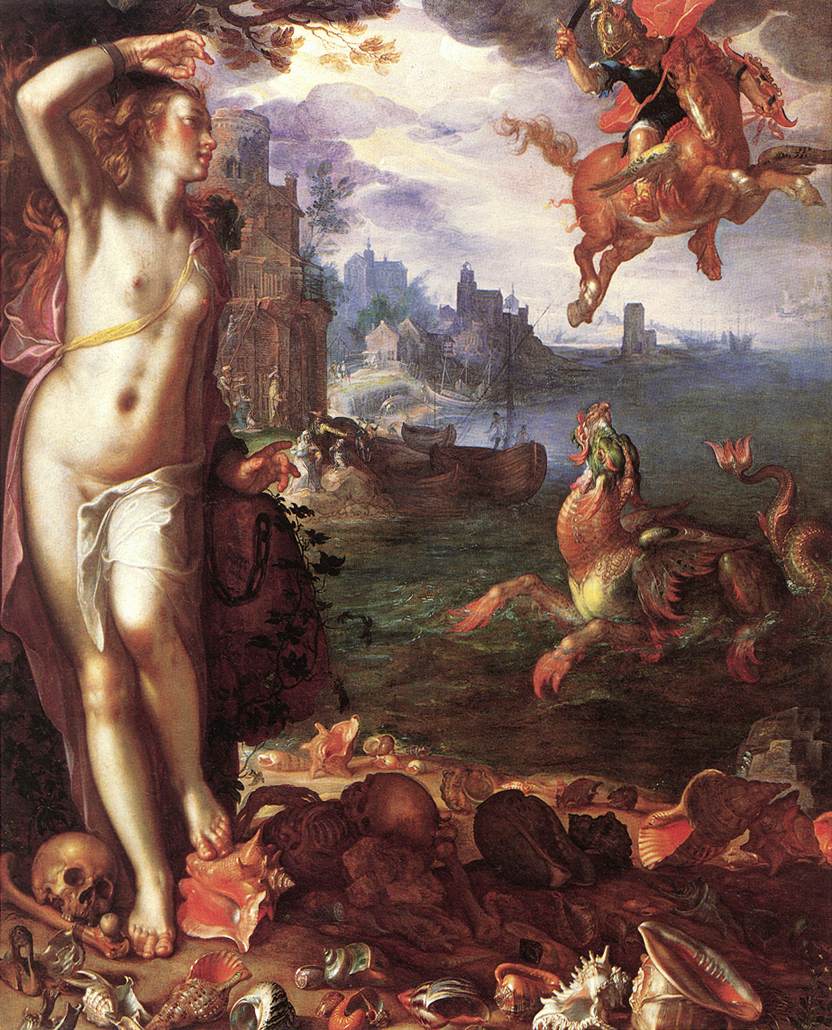
Today we will 'visit' a young woman whom was chained to the rocks because she was a sacrifice for a seamonster. She was rescued by Perseus. Here is the story, the myth behind this constellation "Andromeda".

The Myth of Perseus

Perseus is the son of Zeus, the king of the Greek gods, and a mortal woman. The woman's husband, Polydectes, king of Seriphos, was naturally angry, but when your wife has an affair with a god, what can you do? So, instead, when Perseus grew up Polydectes sent him on what he believed was an impossible quest. The king sent his step-son out to kill Medusa, one of three sisters called the Gorgons who were so ugly, anyone who looked at them would turn to stone. He appealed to the gods for help and was given a mirrored shield by Athena, the goddess of wisdom, and a pair of winged sandals by Hermes (also known as Mercury), the messenger of the gods. Perseus flew using the sandals to find Medusa. When he found her, he did not look at her. Instead, he used the reflection in the shield to guide his sword so he could behead her as she slept. As she died, the white, winged horse Pegasus sprang from her neck.
On his way back from his victory against the Gorgons, Perseus came across a woman chained to a rock, waiting to be sacrificed to a sea monster, called either Cetus or Draco, depending on which version of the myth you believe. This woman was Andromeda, the Princess. Her mother, Cassiopeia boasted that she and her daughter were more beautiful than the Nereids (or sea nymphs), which were the daughters of Poseidon (or Neptune), the god of the sea. Angered by the insult to his daughters, Poseidon sent floods to the lands ruled by Cassiopeia and her husband, King Cepheus. Cepheus consulted an oracle who told him that the only way to quell Poseidon's anger was to sacrifice his daughter.
Luckily, Perseus came on the scene just in the nick of time and killed the sea monster and saved the princess.

Credits: Perseus rescues Andromeda (Oil by Joachim Wtewael 1611)

First encounter
i lay in the arms of beauty
saved from a serpent

© Chèvrefeuille

Well ... we started with our "space odyssey" ... I hope you did like this episode.

This episode is NOW OPEN for your submissions and will remain open until September 3rd at noon (CET). I will (try to) publish our next episode, our first Tokubetsudesu episode of this month, later on.