Showing posts with label In The Footsteps of The Pharaohs. Show all posts

Saturday, August 29, 2015

Carpe Diem #808 Ripon Falls, the source of The Nile?


Dear Haijin, visitors and travelers,

We have arrived at our final destination of our trip over The Nile. This month we made in a way a time-travel along The Nile, we visited historical places in Egypt, Sudan and Uganda. Finally we are there .... at the source of The Nile.
Today our prompt is Ripon Falls, the source of The Nile, there is a long history about the exploration and discovery of the source of The Nile. Several explorers tried to find it. Here is an overview of that history.

Owing to their failure to penetrate the sudd wetlands of South Sudan, the upper reaches of the Nile remained largely unknown to the ancient Greeks and Romans. Various expeditions failed to determine the river's source. Agatharcides records that in the time of Ptolemy II Philadelphus, a military expedition had penetrated far enough along the course of the Blue Nile to determine that the summer floods were caused by heavy seasonal rainstorms in the Ethiopian Highlands, but no European of antiquity is known to have reached Lake Tana.

Credits: Tabula Rogeriana (upside down)

The Tabula Rogeriana depicted the source as three lakes in 1154.
Europeans began to learn about the origins of the Nile in the 15th and 16th centuries, when travelers to Ethiopia visited Lake Tana and the source of the Blue Nile in the mountains south of the lake. Although James Bruce claimed to be the first European to have visited the headwaters, modern writers give the credit to the Jesuit Pedro Páez. Páez's account of the source of the Nile is a long and vivid account of Ethiopia. It was published in full only in the early 20th century, although it was featured in works of Páez's contemporaries, including Baltazar Téllez, Athanasius Kircher and by Johann Michael Vansleb.

Europeans had been resident in Ethiopia since the late 15th century, and one of them may have visited the headwaters even earlier without leaving a written trace. The Portuguese João Bermudes published the first description of the Tis Issat Falls in his 1565 memoirs, compared them to the Nile Falls alluded to in Cicero's De Republica. Jerónimo Lobo describes the source of the Blue Nile, visiting shortly after Pedro Páez. Telles also used his account.

The White Nile was even less understood. The ancients mistakenly believed that the Niger River represented the upper reaches of the White Nile. For example, Pliny the Elder wrote that the Nile had its origins "in a mountain of lower Mauretania", flowed above ground for "many days" distance, then went underground, reappeared as a large lake in the territories of the Masaesyli, then sank again below the desert to flow underground "for a distance of 20 days' journey till it reaches the nearest Ethiopians." A merchant named Diogenes reported that the Nile's water attracted game such as buffalo.

Credits: John Hanning Speke (1827-1864)

Lake Victoria was first sighted by Europeans in 1858 when the British explorer John Hanning Speke (1827-1864) reached its southern shore while traveling with Richard Francis Burton to explore central Africa and locate the great lakes. Believing he had found the source of the Nile on seeing this "vast expanse of open water" for the first time, Speke named the lake after the then Queen of the United Kingdom. Burton, recovering from illness and resting further south on the shores of Lake Tanganyika, was outraged that Speke claimed to have proved his discovery to be the true source of the Nile when Burton regarded this as still unsettled. A very public quarrel ensued, which sparked a great deal of intense debate within the scientific community and interest by other explorers keen to either confirm or refute Speke's discovery. British explorer and missionary David Livingstone pushed too far west and entered the Congo River system instead. It was ultimately Welsh-American explorer Henry Morton Stanley who confirmed Speke's discovery, circumnavigating Lake Victoria and reporting the great outflow at Ripon Falls on the Lake's northern shore. Ripon Falls at the northern end of Lake Victoria in Uganda was formerly considered the source of the river Nile. In 1862–3 John Hanning Speke was the first European to follow the course of the Nile downstream after discovering the falls that his intuition had marked as the source of the Nile. (Source: Wikipedia)


Credits: Ripon Falls, according to J.H.Speke the source of The Nile (photo by J.H. Speke)

Wow .... what a story ... it's still not clear that The Nile starts there by the way. It's still a mystery ... maybe this mystery will be solved once ...

This was our last "regular" episode of this month. Tomorrow (August 31st) we will have our last CD Special by Laura Williams (a.k.a. Lolly of Lovely Things), the winner of our last kukai "summertime".

After that last CD Special of August we will start with our new journey ... a space odyssey ... we will explore space trying to understand the mythology behind several constellations. I have published our new prompt-list you can find it in the menu.

finally
we conquered The Nile
back to the future


© Chèvrefeuille

Not a very strong haiku, but it gives closure to this wonderful journey in our full sailed papyrus boat over The Nile .... I hope you all did like the trip ....

This episode is NOW OPEN for your submissions and will remain open until September 1st at noon (CET). I will (try to) publish our next episode, Lolly's 6th CD Special, later on. For now, have fun!

Friday, August 28, 2015

Carpe Diem #807 waterfall (reprise): Murchison Falls Uganda


Dear Haijin, visitors and travelers,

Today I have a prompt for you all, that we have had several times already, waterfall, but it fits The Nile really great, because in The Nile we will encounter several waterfalls. Yesterday we had "Lake Victoria" and I know for sure that you all have heard of the Victoria Falls, but today we will visit the Murchison Falls in Uganda. It's situated in a National Park with the same name. It's, according to several sources, the most beautiful and exciting waterfall of Africa.

Credits: Murchison Falls Uganda

What a beauty don't you think so too? What can I say more, maybe this video which I found on You Tube will help you to become inspired. I just had to share this video, because I think "an image tells you more than a thousand words can do. So enjoy this video. (Source: video)


Wow ... impressive ... I really can see and understand why there are sources who are excited about these falls. Awesome.

roaring thunder
resonates through the jungle
power of nature

 © Chèvrefeuille

Well ... I hope this short episode will inspire you to write/compose an all new haiku (or tanka).

This episode is open for your submissions tonight at 7.00 PM (CET) and will remain open until August 31st at noon (CET). I will publish our new episode, Ripon Falls, the source of The Nile?, later on. Have fun!

Thursday, August 27, 2015

Carpe Diem #806 Lake Victoria


Dear Haijin, visitors and travelers,

Our journey over The Nile is almost over and we are nearing the source of The Nile. Today we sail up to Lake Victoria the greatest lake in Africa. I love to tell you a little bit more about Lake Victoria.

Lake Victoria is one of the African Great Lakes. The lake was named after Queen Victoria by the explorer John Hanning Speke, the first Briton to document it. Speke accomplished this in 1858, while on an expedition with Richard Francis Burton to locate the source of the Nile River.
Lake Victoria receives its water primarily from direct precipitation and thousands of small streams. The largest stream flowing into this lake is the Kagera River, the mouth of which lies on the lake's western shore. Lake Victoria is drained solely by the Nile River near Jinja, Uganda, on the lake's northern shore.

Credits: Lake Victoria

A little geology history about lake Victoria:

During its geological history, Lake Victoria went through changes ranging from its present shallow depression, through to what may have been a series of much smaller lakes. Geological cores taken from its bottom show Lake Victoria has dried up completely at least three times since it formed. These drying cycles are probably related to past ice ages, which were times when precipitation declined globally. Lake Victoria last dried out 17,300 years ago, and it refilled beginning about 14,700 years ago. Geologically, Lake Victoria is relatively young – about 400,000 years old – and it formed when westward-flowing rivers were dammed by an up thrown crustal block.
This geological history probably contributed to the dramatic cichlid speciation that characterizes its ecology, as well as that of other African Great Lakes, although some researchers dispute this, arguing while Lake Victoria was at its lowest between 18,000 and 14,000 years ago, and it dried out at least once during that time, there is no evidence of remnant ponds or marshes persisting within the desiccated basin. If such features existed, then they would have been small, shallow, turbid, and/or saline, and therefore markedly different from the lake to which today's species are adapted.
The shallowness of Lake Victoria, its limited river inflow, and its large surface area compared to its volume make it vulnerable to the effects of climate changes.

Credits: Water Hyacinth

Lake Victoria is a beautiful lake, but it is sometimes overgrown with Water Hyacinth which damages its shores. It's possible that this "pest" of Water Hyacinth is the result of climate change.

Credits: Lake Victoria overgrown with Water Hyacinth

clear cool night
the pale light of the full moon
ripples on Lake Victoria


© Chèvrefeuille

her beauty
takes the life of the Lake
Water Hyacinth


© Chèvrefeuille

And now it's up to you my dear haijin ....

This episode is open for your submissions tonight at 7.00 PM (CET) and will remain open until August 30th at noon (CET). I will publish our next episode (a reprise one), Waterfall, later on. For now ... be inspired and share your all new haiku or tanka with us all.

Wednesday, August 26, 2015

Carpe Diem #805 White Nile


Dear Haijin, visitors and travelers,

We are nearing the end of our journey over The Nile and today we are sailing towards the White Nile. 

The White Nile is a river of Africa, one of the two main tributaries of the Nile, the other being the Blue Nile. In the strict meaning, "White Nile" refers to the river formed at Lake No at the confluence of the Bahr al Jabal and Bahr el Ghazal Rivers.
In the wider sense, the term White Nile refers to the approximately 3,700 kilometres (2,300 mi) of rivers draining from Lake Victoria into the White Nile proper. It may also, depending on the speaker, refer to the headwaters of Lake Victoria.
The 19th century search by Europeans for the source of the Nile was mainly focused on the White Nile, which disappeared into the depths of what was then known as 'Darkest Africa'. The White Nile's true source was not discovered until 1937, when the German explorer Dr. Burkhart Waldecker traced it to a stream in Rutovu at the base of Mount Kikizi.
When in flood the Sobat tributary carries a large amount of sediment, adding greatly to the White Nile's color.

Credits: White Nile
sediment
turns the Blue Nile
into white

© Chèvrefeuille

What a journey this has been until now ... we have just a few days left before we will finally encounter the source of The Nile ... and than we will take another trip .... into space, the universe as we are starting to explore the boundaries of the universe in our Space Odyssey ... I hope to publish our new prompt-list this week ...

This episode is open for your submissions tonight at 7.00 PM (CET) and it will remain open until August 29th at noon (CET). I will try to publish our next episode, Lake Victoria, later on. For now ... have fun, be inspired and share your "White Nile" haiku (or tanka) with us all.

Sunday, August 23, 2015

Carpe Diem #804 Yellow Nile (Wadi Howar)


!!! I am in the nightshift, so I have a short episode for you !!!

Dear Haijin, visitors and travelers,

Today we arrived at what was called the Yellow Nile or Wadi Howar. Let me tell you a little bit more about the Yellow Nile.

Wadi Howar (Wadi Howa) is a wadi in Sudan and Chad. It travels approximately 400 kilometers in a northeasterly direction from the Ouaddaï highlands in Chad across the North Darfur state of Sudan, before losing itself in the Libyan Desert. Towards its western end it forms a part of the international boundary between Sudan and Chad, separating the West Darfur state of Sudan and the Borkou-Ennedi-Tibesti Region of Chad.

Credits: Ouaddai Highlands with remains of the Ouaddai Empire

The wadi is the remnant of the ancient Yellow Nile, a tributary of the Nile, during the Neolithic Subpluvial, it was one of the largest rivers, lasting until 1500 BC, when the Sahara Desert returned to it present point. It met the Nile near the southern point of the Great Bend. the present extremely arid western part of Upper Nubia (northern Sudan)was temporarily linked to the Nile by way of a hitherto unknown 400 kilometer long tributary. From about 9500 to 4500 years ago, lower Wadi Howar flowed through an environment characterized by numerous ground water outlets and freshwater lakes. Savanna fauna and cattle-herders occupied this region, which today receives at most 25 millimeters of rainfall per year. At that period the southern edge of the eastern Sahara was 500 kilometers further north than today and ground water resources were recharged for the last time.

once a year
the Yellow Nile returns
rainy season

© Chèvrefeuille

This episode is NOW OPEN for your submissions and will remain open until August 26th at noon (CET). I will (try to) publish our next episode, the fifth CD Special by Lolly, later on.

Saturday, August 22, 2015

Carpe Diem #803 Lake Tana


Dear Haijin, visitors and travelers,

What a joy to create another episode of CDHK. We are on our way to the source of The Nile and yesterday we sailed on the Blue Nile and now we are arriving on Lake Tana.

Lake Tana (also spelled T'ana, an older variant is Tsana, sometimes called "Dembiya" after the region to the north of the lake) is the source of the Blue Nile and is the largest lake in Ethiopia. Located in Amhara Region in the north-western Ethiopian Highlands, the lake is approximately 84 kilometers long and 66 kilometers wide, with a maximum depth of 15 meters, and an elevation of 1,788 meters. Lake Tana is fed by the Lesser Abay, Reb and Gumara rivers; and its surface area ranges from 3,000 to 3,500 km, depending on season and rainfall. The lake level has been regulated since the construction of the control weir where the lake discharges into the Blue Nile. This controls the flow to the Blue Nile Falls (Tis Abbai) and hydro-power station.
The lake was originally much larger than it is today. Seven large permanent rivers feed the lake as well as 40 small seasonal rivers. The main tributaries to the lake are Gilgel Abbay (Little Nile River), and the Megech, Gumara and Rib rivers.
Lake Tana has a number of islands, whose number varies depending on the level of the lake. It has fallen about 6 feet (1.8 m) in the last 400 years. According to Manoel de Almeida (a Portuguese missionary in the early 17th century), there were 21 islands, seven to eight of which had monasteries on them "formerly large, but now much diminished." When James Bruce visited the area in the later 18th century, he noted that the locals counted 45 inhabited islands, but stated he believed that "the number may be about eleven."  A 20th-century geographer named 37 islands, of which he believed 19 have or had monasteries or churches on them.

The monasteries are believed to have been built over earlier religious sites. They include the fourteenth-century Debre Maryam, and the eighteenth-century Narga Selassie, Tana Qirqos (said to have housed the Ark of the Covenant before it was moved to Axum), and Ura Kidane Mehret, known for its regalia.
Credits: Lake Tana
Well ... it's a beautiful lake I think, must be awesome to visit it once for real.

Lake Tana
religious site of Ethopia
church isles


© Chèvrefeuille

This episode is open for your submissions tonight at 7.00 PM (CET) and will remain open until August 25th at noon (CET). I will try to publish our new episode, Yellow Nile (Wadi Howar), later on.

Friday, August 21, 2015

Carpe Diem #802 Blue Nile


Dear Haijin, visitors and travelers,

We are on our way to the end of this month and are sailing on the Nile in our papyrus boat towards the source of The Nile. It has been an adventure already and it will become (I hope) even better.
I am already busy with preparing our new list of prompts for September in which I hope to tell you more about the constellations and their mythological meaning and background. I have decided to give this new month of CDHK also a title. Because of our journey through the universe I have decided to give this new month the title "A Space Odyssey" after that well known song of David Bowie.

Our New CDHK Logo for September 2015

Ok ... back to the present, the future can wait. Today we have the first of three (regular) prompts in which we will discover why The Nile has three names, Blue Nile, Yellow Nile and White Nile. And the first is Blue Nile. I have asked myself why this name, Blue Nile, is given to The Nile in Ethiopia.

The Blue Nile, ʿAbbay but pronounced Abbai’ is originating at Lake Tana in Ethiopia. With the White Nile, the river becomes one of the two major tributaries of the Nile. The upper course of the river is called the Abbay in Ethiopia, where many regard it as holy. Some Ethiopians have long identified the Blue Nile as the River Gihon mentioned as flowing out of the Garden of Eden in Genesis 2 and "encircling the entire land of Cush".
The Blue Nile is so-called because during flood times, the water current is so high that the river turns almost black (in the local Sudanese language, the word for black is also used for the color blue).

Credits: Blue Nile Falls
the sound of thunder
resonates through the canyon
Blue Nile Falls


© Chèvrefeuille

What an idea that this part of  The Nile is seen as the river Gihon which once was flowing out of the Garden of Eden. It's possible because their have been scientifical projects that stated that the Garden of Eden once was somewhere in Ethiopia. Isn't that great. We are sailing over the river that once was flowing through the Garden of Eden. This must be a mystical experience.

vague images
I feel the Garden of Eden
sailing The Nile


© Chèvrefeuille

Awesome! I hope you did like this "short" episode and that it will inspire you to write an all new haiku or tanka to share with us all here at CDHK.

This episode is NOW OPEN for your submissions and will remain open until August 24th at noon (CET) I will try to publish our new episode, Lake Tana, later on.


Thursday, August 20, 2015

Carpe Diem #801 Khartoum


Dear Haijin, visitors and travelers,

We are sailing with our papyrus boat from Alexandria to the source of The Nile. We have crossed the border between Egypt and Sudan and we have arrived in the region of Khartoum.

Khartoum is the capital and second largest city of Sudan and Khartoum state. It is located at the confluence of the White Nile, flowing north from Lake Victoria, and the Blue Nile, flowing west from Ethiopia. The location where the two Niles meet is known as the "al-Mogran", meaning the Confluence. The main Nile continues to flow north towards Egypt and the Mediterranean Sea.
Divided by the Niles, Khartoum is a tripartite metropolis with an estimated overall population of over five million people, consisting of Khartoum proper, and linked by bridges to Khartoum North and Omdurman to the west.

The origin of the word Khartoum is uncertain. One theory argues that khartoum is derived from Arabic kharṭūm meaning 'trunk' or 'hose', probably referring to the narrow strip of land extending between the Blue and White Niles. Captain J. A. Grant, who reached Khartoum in 1863 with Captain Speke's expedition, thought that the name was most probably from the Arabic qurtum, safflower (Carthamus tinctorius), which was cultivated extensively in Egypt for its oil to be used as fuel.

Credits: Skyline of Khartoum, capital of Sudan

Khartoum was established 15 miles (24 km) north of the ancient city of Soba in 1821 by Ibrahim Pasha, the son of Egypt's ruler, Muhammad Ali Pasha, who had just incorporated Sudan into his realm. Originally, Khartoum served as an outpost for the Egyptian Army, but the settlement quickly grew into a regional center of trade. It also became a focal point for the slave trade. Later, it became the administrative center of Sudan and official capital. (Source: Wikipedia)

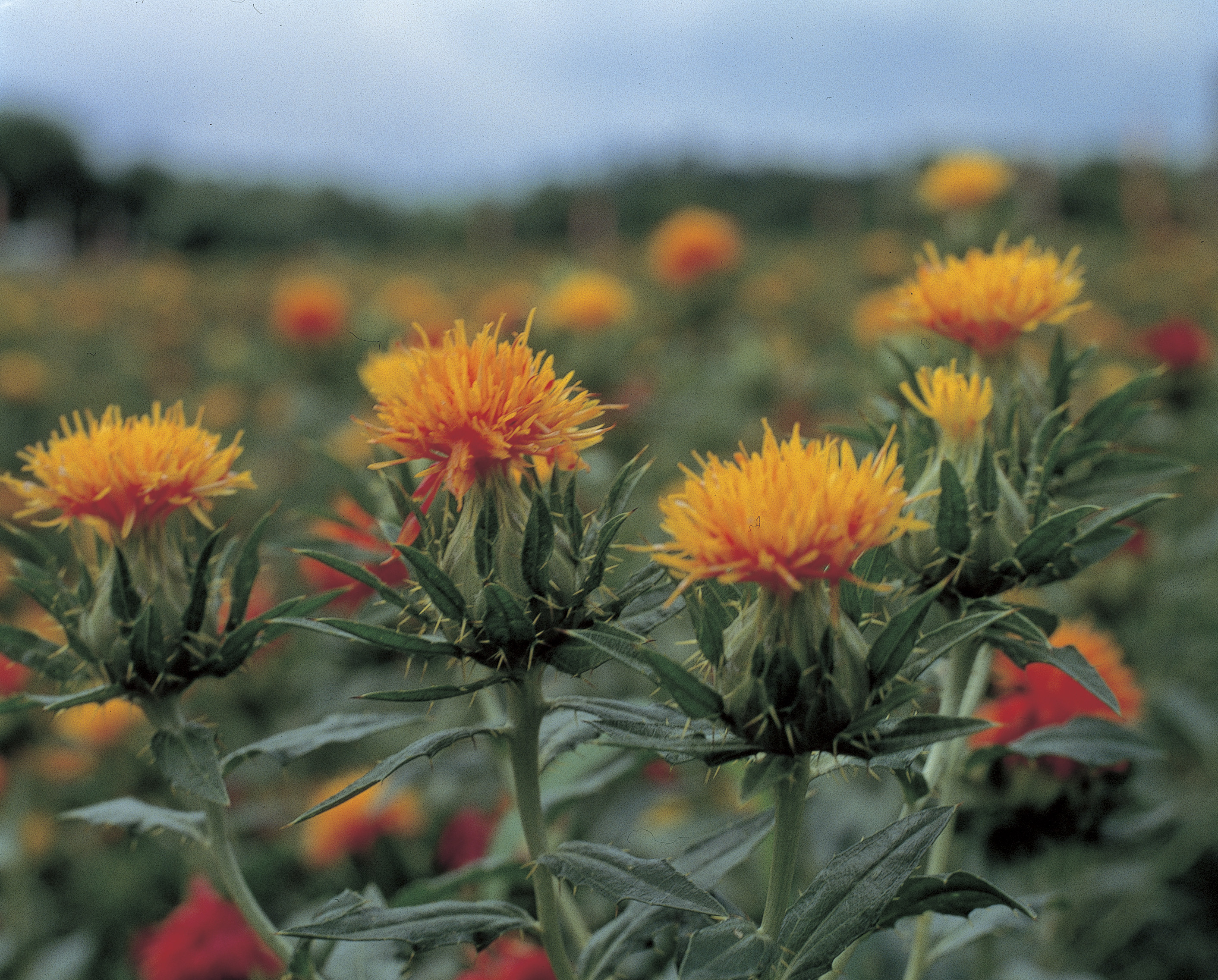
As you could read above there is the idea that Khartoum got its name from the Safflower and that makes it somewhat easier to write/compose a haiku or tanka in response of this prompt. So I love to tell you a little bit more about Safflower.
Safflower (Carthamus tinctorius L.) is a highly branched, herbaceous, thistle-like annual plant. It is commercially cultivated for vegetable oil extracted from the seeds. Plants are 30 to 150 cm (12 to 59 in) tall with globular flower heads having yellow, orange, or red flowers. Each branch will usually have from one to five flower heads containing 15 to 20 seeds per head. Safflower is native to arid environments having seasonal rain. It grows a deep taproot which enables it to thrive in such environments.

Credits: Safflower

Safflower is one of humanity's oldest crops. Chemical analysis of ancient Egyptian textiles dated to the Twelfth dynasty identified dyes made from safflower, and garlands made from safflowers were found in the tomb of the pharaoh Tutankhamen. John Chadwick reports that the Greek name for safflower (kārthamos) occurs many times in Linear B tablets, distinguished into two kinds: a white safflower, which is measured, and red which is weighed. "The explanation is that there are two parts of the plant which can be used; the pale seeds and the red florets." (Source: Wikipedia)

While I was preparing this episode I sought for examples of haiku in which the Safflower is mentioned and I found a beautiful haiku, a not so well known one, by Matsuo Basho:


mayuhaki o omokage ni shite beni no hana

an eyebrow brush
is the image drawn by
safflower blossoms


© Basho

This haiku Basho wrote as he was on his journey "oku no hosomichi" or "the small road into the deep north" in the summer of 1689. I have read this haibun several times, but this haiku I couldn't remember, but it's a beauty I think.

While surfing the Internet I ran also into a nice haiku on Safflower written by Bjórn Rudberg, you all will know him, in response on the Safflower prompt of CDHK back in April 2014. I love share that haiku here again with you:

safflower field
beneath the periwinkle sky –
sight to dye for


© Björn Rudberg

What a coincidence, I knew that I had used this Safflower earlier at CDHK, but wasn't aware of when I did use it. I think Khartoum has brought us a wonderful prompt "extra" and I hope it will inspire you to write an all new haiku or tanka to share here.

Credits: Safflower field at Yamagata

Here is my attempt, I have used the haiku which I shared in the above mentioned episode of CDHK and have revised it into the following haiku. I think it has become stronger and more in balance.

amazing sight
a yellow sea as far as I can see
Safflower field

© Chèvrefeuille

I hope you did like this episode. This episode is NOW OPEN for your submissions and will remain open until August 23rd at noon (CET). I will (try to) publish our next episode, Blue Nile, later on. For now ... have fun, be inspired and share.

Wednesday, August 19, 2015

Carpe Diem #800 Monophytism


Dear Haijin, visitors and travelers,

As prepared the prompt list for this month I discovered a theological idea which I had never heard of. It's directly the result of the monotheistic belief of The Aten, the religion "invented" by Akhenaten, and was the base of the most christian religions. I had never heard of Monophysitism our prompt for today. It isn't an easy prompt so I thought to give a brief explanation of the meaning and birth of it.

A brief definition of Monophysitism can be given as: "Jesus Christ, who is identical with the Son, is one person and one hypostasis in one nature: divine."

Monophysitism was born in the theological "School of Alexandria", which began its Christological analysis with the (divine) eternal Son or Word of God and sought to explain how this eternal Word had become incarnate as a man—in contrast to the "School of Antioch" (birthplace of Nestorianism, the antithesis of Monophysitism), which instead began with the (human) Jesus of the Gospels and sought to explain how this man had become united with the eternal Word in the Incarnation. Both sides agreed, of course, that Christ was both human and divine, but the Alexandrians emphasized divinity (including the fact that the divine nature was itself "impassible" or immune to suffering) while the Antiochines emphasized humanity (including the limited knowledge and "growth in wisdom" of the Christ of the Gospels). Individual Monophysite and Nestorian theologians in fact rarely believed the extreme views that their respective opponents attributed to them (although some of their followers may have). Ultimately, however, the dialectic between the schools of Alexandria and Antioch produced Christologies that on all sides (notwithstanding ongoing differences between the Oriental Orthodox and Chalcedonian churches) avoided the extremes and reflect both points of view. (Source: Wikipedia)

Sailing on The Nile

In the part of the world were we are this month, the region of The Nile, 
Monophysitism is the mean idea of Jesus as a divine being. Because of the difficult prompt today, I have tried to bring it here in another way.
As I look at Monophysitism and haiku than there is in a way a connection between the two ideas. In Monophysitism Jesus is seen as divine and isn't that the way we, haijin, look at nature itself? Don't we see nature as divine? All our haiku (and tanka maybe) are based on the idea of nature and mankind as part of it. Isn't nature the most important theme of our beloved haiku? We can see that e.g. in the use of kigo (seasonwords) which connects our haiku with nature. In the classical way of writing haiku we have to use a kigo, a word that points us to the season in which the haiku is written. 
In my opinion, as a believer of the Creation, all and everything is divine. This divinity I see in everything and everyone. It's based on the idea of seeing God in all and everything and that God is everything. So that tells us that nature is divine. Haiku and Monophysitism I think can be seen as the same idea.

I have sought out my archive to find a haiku fitting this idea and I think I found one:

rustling bamboo -
song of a Nightingale fades away
a new day rises

a new day rises
in the mystery of the dawn
the sound of rain

© Chèvrefeuille

I know this prompt isn't easy, so ... just try to catch the idea which I gave here "haiku is nature, so haiku is divine".

This episode is open for your submissions tonight at 7.00 PM (CET) and will remain open until August 22nd at noon (CET). I will try to publish our next episode, Khartoum, later on.

Monday, August 17, 2015

Carpe Diem #799 Nubian pyramids Meroë


Dear Haijin, visitors and travelers,

Yesterday we arrived at a wonderful ancient place "the Nubian Pyramids at Meroë. The Nubian people were influenced by the Egyptian architects of the pyramids. As we all will see at this wonderful place full of history.

enchanting
ruins of the Nubian pyramids
ancient glimpse

© Chèvrefeuille

Nubian pyramids are pyramids that were built by the rulers of the ancient Kushite kingdoms. Prior to the Kushites building these pyramids, there had been no pyramid construction in Egypt and the Nile Valley for more than 500 years.
The area of the Nile valley known as Nubia, which lies within present day Sudan, was home to three Kushite kingdoms during antiquity. The first had its capital at Kerma (2600–1520 BC). The second was centered on Napata (1000–300 BC). Finally, the last kingdom was centered on Meroë (300 BC–AD 300).
Kerma was Nubia's first centralized state with its own indigenous forms of architecture and burial customs. The last two kingdoms, Napata and Meroë, were heavily influenced by ancient Egypt culturally, economically, politically, and militarily. The Kushite kingdoms in turn competed strongly with Egypt, and during the late period of Ancient Egyptian history, the rulers of Napata conquered and unified Egypt herself. The Napatans ruled as the pharaohs of the Twenty-fifth Dynasty. The Napatan domination of Egypt ended with the Assyrian conquest in 656 BC.

Credits: Nubian Pyramids Meroë

Approximately 255 pyramids were eventually constructed at three sites in Nubia over a period of a few hundred years to serve as tombs for the kings and queens of Napata and Meroë. The first of these was built at the site of el-Kurru, including the tombs of King Kashta and his son Piye (Piankhi), together with Piye's successors Shabaka, Shabataka, and Tanwetamani. Fourteen pyramids were constructed for their queens, several of whom were renowned warrior queens. 
Later Napatan pyramids were sited at Nuri, on the west bank of the Nile in Upper Nubia. This necropolis was the burial place of 21 kings and 52 queens and princes including Anlami and Aspelta. The bodies of these kings were placed in huge granite sarcophagi.The oldest and largest pyramid at Nuri is that of the Napatan king and Twenty-fifth Dynasty pharaoh Taharqa.

The most extensive Nubian pyramid site is at Meroë, which is located between the fifth and sixth cataracts of the Nile, approximately 100 kilometres (62 miles) north of Khartoum. During the Meroitic period, over forty queens and kings were buried there.

relive the old times
visiting Meroë’s pyramids
I dream away


© Chèvrefeuille

This episode is NOW OPEN for your submissions and will remain open until August 20th at noon (CET). I will try to publish our new episode, a new Tokubetsudesu episode and the fourth CD Special by Lolly, later on. For now .... be inspired ...!

Sunday, August 16, 2015

Carpe Diem #798 Sudan


Dear Haijin, visitors and travelers,

I have had a wonderful weekend with my grandkids, but it ended not so good. Today my father has had another heart attack and is in the hospital again. So again a time of worries has begun. This time my dad looks more ill than the first time (three weeks ago). I hope he will recover again ...

Several days ago I challenged you all to write a choka, but I hadn't the opportunity to write/compose one myself. I have written my first choka ever yesterday and published it on my personal weblog at Wordpress Chèvrefeuille's haiku.

Today we are sailing into Sudan following The Nile to find its source. Yesterday we sailed Lake Nasser and now we have reach the upper side of this lake. Sudan has a very interesting history.

Flag of Sudan

Sudan, officially the Republic of the Sudan, is an African Country in the Nile Valley of North Africa, bordered by Egypt to the north, the Red Sea, Eritrea, Ethiopia, and Djibouti to the east, South Sudan to the south, the Central African Republic to the southwest, Chad to the west and Libya to the northwest. It is the third largest country in Africa. The River Nile divides the country into eastern and western halves. Its predominant religion is Islam.

Sudan was home to numerous ancient civilizations, such as the Kingdom of Kush, Kerma, Nobatia, Alodia, Makuria, Meroë and others, most of which flourished along the Nile. During the pre-dynastic period Nubia and Nagadan Upper Egypt were identical, simultaneously evolved systems of pharaonic kingship by 3300 BC. By virtue of its proximity to Egypt, the Sudan participated in the wider history of the Near East in as much as it was Christianized by the 6th century, and Islamized in the 7th. As a result of Christianization, the Old Nubian language stands as the oldest recorded Nilo-Saharan language (earliest records dating to the 9th century). Sudan was the largest country in Africa and the Arab world until 2011, when South Sudan separated into an independent country, following an independence referendum. 

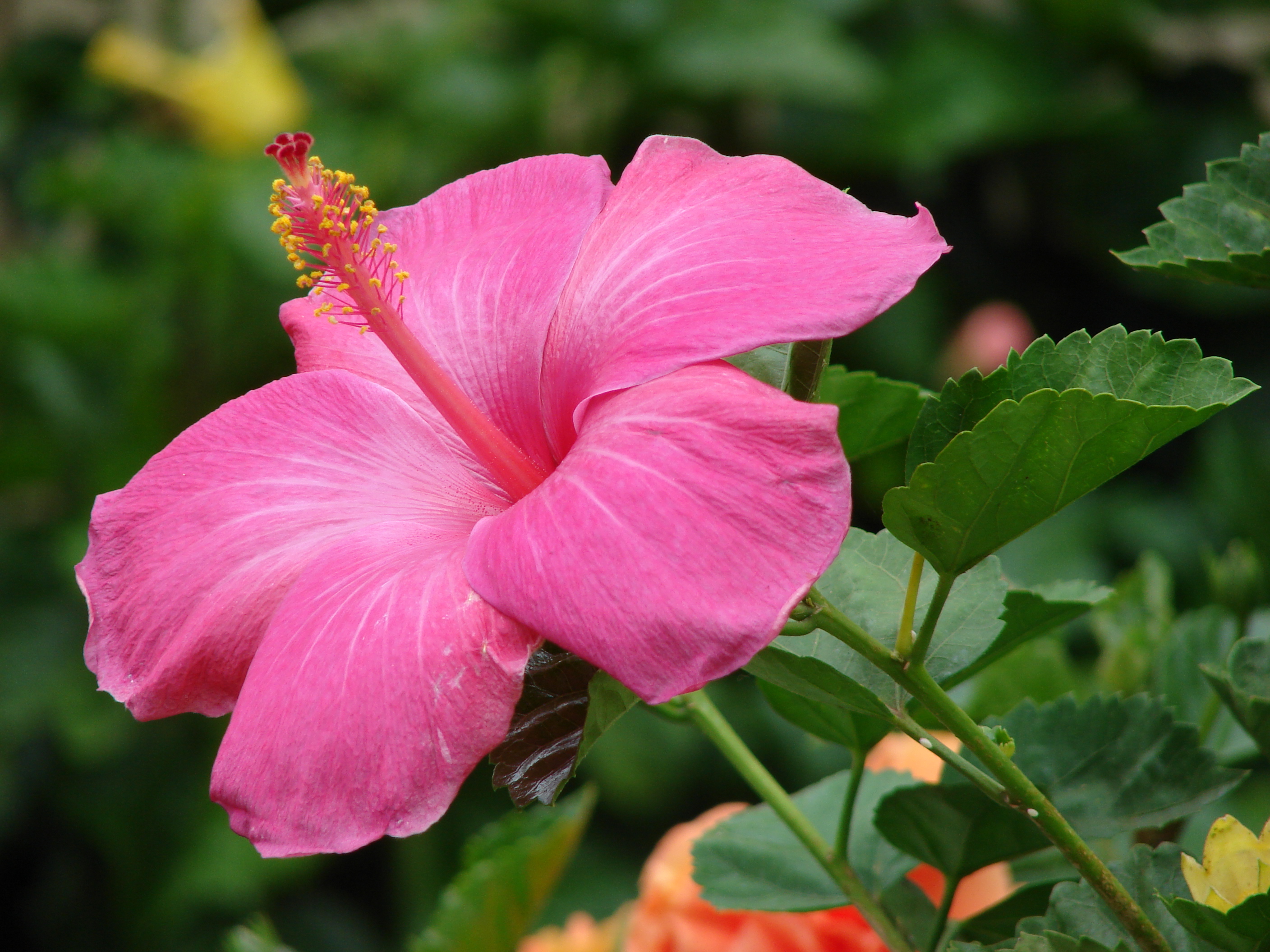
Credits: Hibiscus, the National Flower of Sudan

Sudan suffers from several challenges. For much of Sudan's history, the nation has suffered from rampant ethnic strife and has been plagued by internal conflicts, including two civil wars and the War in the Darfur region. Sudan suffers from poor human rights, most particularly dealing with the issues of ethnic cleansing and slavery in the nation.

The National Flower of Sudan is the Hibiscus. And of course you can use that also for your inspired haiku or tanka for this episode. I was inspired by this wonderful flower, the Hibiscus, and wrote/composed the next haiku:

between Meroe’s pyramids
where the sun never shines
a Hibiscus shrub


© Chèvrefeuille

Credits: Ruins of Meroe Pyramids

Sudan ... a new country to follow The Nile in our full sails papyrus boat, so find the source of The Nile. I hope you did like this episode and that it will inspire you.

This episode is NOW OPEN for your submissions and will remain open until August 19th at noon (CET). I will try to post our next episode, Nubian pyramids Meroë, later on.

Saturday, August 15, 2015

Carpe Diem #797 Lake Nasser


Dear Haijin, visitors and travelers,

This will be a short episode, because we have our grandchildren to sleep over and they are asking my time too. Today we are entering Sudan by sailing over Lake Nasser. Lake Nasser is a vast reservoir in southern Egypt and northern Sudan. It is one of the largest man-made lakes in the world. Strictly, "Lake Nasser" refers only to the much larger portion of the lake that is in Egyptian territory (83% of the total), with the Sudanese preferring to call their smaller body of water Lake Nubia. The area of Sudan-administered Wadi Halfa Salient was largely flooded by Lake Nasser.

Credits: Lake Nasser
As we are on our way to the source of The Nile we are leaving Egypt and will be entering Sudan.

I hope this short episode will inspire you.

This episode is open for your submissions tonight at 7.00 PM (CET) and will remain open until August 18th at noon (CET). I will (try to) publish our next episode, Sudan, later on.

Friday, August 14, 2015

Carpe Diem #796 Camels


Dear Haijin, visitors and travelers,

We are on our way to the source of The Nile with our full sails papyrus boat discovering the beauty of the region were The Nile is flowing.

Today our prompt is Camels and I think that needs no further introduction. For this episode, a short one, I have chosen to share an image and a haiku to inspire you (as I did for example in our Time Glass feature).

Credits: Camel
And here is the haiku to inspire you. It's one from my archives. It was written in August 2013.

through sands of time
I walk towards a caravanserai
to refresh my mind


© Chèvrefeuille (August 2013)

And another one by Menohir, a haiku poet active on All Poetry.

a camel
sharing his raindrops -
with the desert


© Menohir

This episode is NOW OPEN for your submissions and will remain open until August 17th at noon (CET). I will (try to) publish our next episode, Lake Nasser, later on. For now ... have fun!

Thursday, August 13, 2015

Carpe Diem #795 Papyrus


Dear Haijin, visitors and travelers,

!! Don't forget to submit your haiku (max three) for our third kukai "juxtaposition", the closing date is coming nearer, August 16th. So if you haven't submitted your haiku than please ... send your haiku to: carpediemhaikukai@gmail.com and don't forget to write "kukai juxtaposition" in the subject line !!

Today I have another nice episode for you all. We are on our way to the source of The Nile in our papyrusboat with full sails and today our prompt has to do with that "sailing boat", because our prompt for today is papyrus.

The word papyrus refers to a thick paper-like material made from the pith of the papyrus plant, Cyperus papyrus. Papyrus can also refer to a document written on sheets of papyrus joined together side by side and rolled up into a scroll, an early form of a book. The plural for such documents is papyri.

Papyrus is first known to have been used in ancient Egypt (at least as far back as the First Dynasty), as the Cyperus papyrus plant was a wetland sedge that was once abundant in the Sudd of Southern Sudan along with the Nile Delta of Egypt. Papyrus was also used throughout the Mediterranean region and in Kingdom of Kush. Ancient Egyptians are thought to have used papyrus as a writing material, as well as employing it commonly in the construction of other artifacts such as reed boats, mats, rope, sandals, and baskets.

Credits: Cyperus papyrus
in dreams
writing ancient haiku
on papyrus

© Chèvrefeuille

Wouldn't that be great? To write haiku once on papyrus instead of on the computer?

This episode is NOW OPEN for your submissions and will remain open until August 17th at noon (CET). I will try to publish our next episode, camels, later on. Of course there will be also an episode of our special feature "Time Machine" as planned. For now .... have fun!

Monday, August 10, 2015

Carpe Diem #794 Hymn to the Aten (CD Distillation)


Dear Haijin, visitors and travelers,

First this: My interview for a new job last Friday went ok, I am selected for a second interview tomorrow afternoon. So I am a little bit closer to that new job of Advanced Nursing Practitioner Oncology.
Second: Georgia asked me to change the "line-up" of our first Renga Party, because she has other obligations at her turn in the first round. I have published an update about this earlier today. I hope you all can understand that little change.

Today's prompt is Hymn to the Aten a hymn written by Akhenaten himself to praise and honor The Aten. For those who are already a long time member of our CDHK family they will understand the goal of this CD Distillation, but for those who are new I will give a short explanation.

The goal of the Carpe Diem Distillation is to write/compose a haiku or tanka inspired on a longer poem given, today that's the "Hymn to the Aten", but not an inspired haiku or tanka as we mostly do here. You have to "distil" the haiku or tanka from the longer poem.


The Great Hymn to Aten

Pharaoh Amenhotep IV {Akhenaten) came to the throne in c. 1370 B-C. to reign as co-regent with his father Amenhotep III (c. 1397-1360 B.C.). He attempted a religious revolution in which faith was focused on one god - Aten (the solar disk).

+ Splendid you rise in heaven's lightland,
O living Aten, creator of life!
When you have dawned in eastern lightland,
You fill every land with your beauty.
You are beauteous, great, radiant,
High over every land;
Your rays embrace the lands,
To the limit of all that you made.
Being Re, you reach their limits,
You bend them for the son whom you love;
Though you are far, your rays are on earth,
Though one sees you, your strides are unseen.

+ When you set in western lightland,
Earth is in darkness as if in death;
One sleeps in chambers, heads covered,
One eye does not see another.
Were they robbed of their goods,
That are under their heads,
People would not remark it.
Every lion comes from its den,
All the serpents bite;
Darkness hovers, earth is silent,
As their maker rests in lightland.

Credits: Aten disk

+ Earth brightens when you dawn in lightland,
When you shine as Aten of daytime;
As you dispel the dark,
As you cast your rays,
The Two Lands are in festivity.
Awake they stand on their feet,
You have roused them;
Bodies cleansed, clothed,
Their arms adore your appearance.
The entire land sets out to work,
All beasts browse on their herbs;
Trees, herbs are sprouting,

+ Birds fly from their nests,
Their wings greeting your ka.
All flocks frisk on their feet,
All that fly up and alight,
They live when you dawn for them.
Ships fare north, fare south as well,
Roads lie open when you rise;
The fish in the river dart before you,
Your rays are in the midst of the sea.


+ Who makes seed grow in women,
Who creates people from sperm;
Who feeds the son in his mother's womb,
Who soothes him to still his tears.
Nurse in the womb,
Giver of breath,
To nourish all that he made.
When he comes from the womb to breathe,
On the day of his birth,
You open wide his mouth,
You supply his needs.
When the chick in the egg speaks in the shell,
You give him breath within to sustain him;
When you have made him complete,
To break out from the egg,
He comes out from the egg,
To announce his completion,
Walking on his legs he comes from it.

+ How many are your deeds,
Though hidden from sight,
O Sole God beside whom there is none!
You made the earth as you wished, you alone,
All peoples, herds, and flocks;
All upon earth that walk on legs,
All on high that fly on wings,
The lands of Khor and Kush,
The land of Egypt.
You set every man in his place,
You supply their needs;
Everyone has his food,
His lifetime is counted.
Their tongues differ in speech,
Their characters likewise;
Their skins are distinct,
For you distinguished the peoples.


+ You made Hapy in dat (the Netherworld),
You bring him when you will,
To nourish the people,
For you made them for yourself.
Lord of all who toils for them,
Lord of all lands who shines for them,
Aten of daytime, great in glory!
All distant lands, you make them live,
You made a heavenly Hapy descend for them;
He makes waves on the mountains like the sea,
To drench their fields and their towns.
How excellent are your ways, O Lord of eternity!
A Hapy from heaven for foreign peoples,
And all lands' creatures that walk on legs,
For Egypt the Hapy who comes from dat.


+ Your rays nurse all fields,
When you shine they live, they grow for you;
You made the seasons to foster all that you made,
Winter to cool them, heat that they taste you.
You made the far sky to shine therein,
To behold all that you made;
You alone, shining in your form of living Aten,
Risen, radiant, distant, near.
You made millions of forms from yourself alone,
Towns, villages, fields, the river's course;
All eyes observe you upon them,
For you are the Aten of daytime on high.


+ You are in my heart,
There is no other who knows you,
Only your son, Neferkheprure, Sole-one-of-Re,
Whom you have taught your ways and your might.
Those on earth come from your hand as you made them,
When you have dawned they live,
When you set they die;
You yourself are lifetime, one lives by you.
All eyes are on your beauty until you set,
All labor ceases when you rest in the west;
When you rise you stir everyone for the King,
Every leg is on the move since you founded the earth.
You rouse them for your son who came from your body,
The King who lives by Maat, the Lord of the Two Lands,
Neferkheprure, Sole-ane-of-Re,
The Son of Re who lives by Maat, the Lord of crowns,
Akhenaten, great in his lifetime;
And the great Queen whom he loves, the Lady of the Two Lands,
Nefer-nefru-Aten Nefertiti, living forever.

(source: utexas.edu)
+++++++++++++++++++

Sorry for this long episode, but I couldn't decide to just pick up a few small parts of this "Hymn to the Aten", so I used it all. I hope you all are inspired through this wonderful poem, this Hymn for the Aten, to write an all new haiku or tanka distilled from this Hymn.

This episode is open for your submissions tonight at 7.00 PM (CET) and it will remain open until August 13th at noon (CET). I will try to publish our next episode, a new episode of our special feature Tokubetsudesu, later on. For now .... have fun!

Sunday, August 9, 2015

Carpe Diem #793 Amarna (City of Aten)


Dear Haijin, visitors and travelers,

First I will give you all a sneak preview on the months to come here at CDHK. Next month, September, I have chosen to tell you all a little bit more about the 88 known constellations. We will explore the universe and I hope to lead you into the mythology behind the constellations. In October we will celebrate our third anniversary with all Japanese festivals and holidays. A very festive month that will be and I am looking forward to that anniversary month. I hope to reach 600.000 views before October and than the celebration will be even better.
As you all know this week we will start with our first Carpe Diem Renga Party. I have chosen to create/compose a classical kasen-renga with those who have registered to participate. As a gift to you from Jane Reichhold I have got the opportunity to re-form her "Bare Bones School of Renga" into an CDHK e-book which I hope to get ready this week and ready for downloading at CDHK. I feel honored that Jane has given me the permission to do that.

Ok ... back to our journey on The Nile. Yesterday we entered the 18th Dynasty under Pharaoh Akhenaten, who is the "founder" of the monotheistic religion of The Aten (or Aton) and "The Right Eye of Horus" mysteryschool. Yesterday I told you that Akhenaten build a city in the region around Karnak and Luxor. That city he gave the name "Amarna" which means "The Horizon of the god Aton". Amarna is the prompt for today to inspire you all to write new haiku or tanka (or maybe some other Japanese poetry form).

Credits: Amarna (city of Aten)
 Amarna is the modern name for the city built by Akhenaten, a Pharaoh of the 18th dynasty of ancient Egypt. In modern terms, that places his reign around 1350 BCE (1353 to 1336 BCE, Freed 1999:13). Akhenaten held different religious views than his predecessors. In his theological view, the Aten (the sun disk) was supreme over all deities. However, his view is not a true monotheism, but rather the concept that the Aten had subsumed the essence of all of the other deities. This ideology was not universal, and many resisted it. None, however, were more resistant than the clergy. Priests were a largely herditary society with a great deal of financial and political power in their established bases. This was especially true at Memphis, the traditional seat of power in this time period, and Thebes, where Akhenaten's father Amenhotep III built his palace and temples. Akhenaten recognized this after building initially at Thebes, and thus chose to build a city on land that had never before been dedicated to another god or goddess. This site was what later came to be called Amarna, though it was known as Akhetaten, or "Horizon of the Aten". Amarna is located on the Eastern side of the Nile, approximately one third of the distance between Cairo and Aswan, south from Cairo.

The religious conviction that brought about the building of Amarna, though, later served to preserve it so well. The funerary structures here were devoid of the traditional gods and goddesses to preserve the dead on their journey through the underworld. Akhenaten did not truly convert his people to his religious ideology, and thus they were unwilling to risk their souls in his form of burial. Consequently, the city was abandoned shortly after Akhenaten's death.

Credits: Akhenaten depicted as a sphinx (found in Amarna)
Later Amarna became an archeologist's dream. While many of the structures were damaged to one extent or another, either due to the ravages of time or the fact that abandoned buildings were effectively convenient quarries for difficult to obtain stone, more remained in Amarna of non-religious buildings than in virtually any other site. Since later people did not build on top of the ruins, there is very little trouble in dating the artifacts found. Furthermore, the walls of mud brick survived better than virtually anywhere else, which adds a certain touch of realism to this site. Part of the reason that the average person conjures up images of stone burial chambers when they think of Ancient Egypt is that this is largely what survived. Since the tomb was to be the eternal home of the soul, and since temples were built as homes for the gods, they were made out of the most enduring substance available--stone. Ordinary buildings were made of mud brick--rectangles of varying compositions of clay and sand left to bake in the sun. While quite durable, such bricks are not up to thousands of years of wear and tear. Amarna, then, is virtually unique in allowing a snapshot view of life as it existed in the Egypt of the Bronze Age. (Source: USC)

Tomb of Akhenaten (found in Amarna) 
The area of the city was effectively a virgin site, and it was in this city that the Akhetaten described as the Aten's: 

"seat of the First Occasion, which he had made for himself that he might rest in it."

The city was built as the new capital of the Pharaoh Akhenaten, dedicated to his new religion of worship to the Aten. Construction started in or around Year 5 of his reign (1346 BC) and was probably completed by Year 9 (1341 BC), although it became the capital city two years earlier. To speed up construction of the city most of the buildings were constructed out of mud-brick, and white washed. The most important buildings were faced with local stone.
It is the only ancient Egyptian city which preserves great details of its internal plan, in large part because the city was abandoned after the death of Akhenaten, when Akhenaten's son, King Tutankhamen, decided to leave the city and return to his birthplace in Thebes (modern Luxor). The city seems to have remained active for a decade or so after his death, and a shrine to Horemheb indicates that it was at least partially occupied at the beginning of his reign, if only as a source for building material elsewhere. Once it was abandoned it remained uninhabited until Roman settlement began along the edge of the Nile. However, due to the unique circumstances of its creation and abandonment, it is questionable how representative of ancient Egyptian cities it actually is. The entire city was encircled with a total of 14 boundary stelae detailing Akhenaten's conditions for the establishment of this new capital city of Egypt. (
It may be that the Royal Wadi's resemblance to the hieroglyph for horizon showed that this was the place to found the city.) (Source: Wikipedia)

Amarna
city of the Sun -
a mirage

a mirage
lasted for only 15 years
Amarna


© Chèvrefeuille

Not as strong as I had hoped, but I enjoyed creating this episode of CDHK and I hope it will inspire you to create "your own Amarna" in a haiku or tanka.

This episode is open for your submissions RIGHT NOW and will remain open until August 12th at noon (CET). I will publish our new episode, Hymn to the Aten (CD Distillation), later on. For now have fun!