Showing posts with label on the trail with Basho. Show all posts

Friday, December 25, 2015

Carpe Diem #885 without you: Stone Mountain, at Yamanaka, from this day on


!! double episode !!

Dear Haijin, visitors and travelers,

During the holidays I will bring a few prompts together in one post, because this time of year is very dear to me and my family. We love to have time together and that makes that I have decided to bring another "double episode" today. Of course you all are part my family of haiku loving people and I just had to make this episode for you all.


++++++++++++++++++++++++++++++++++++++++++


On my way to Yamanaka hot spring, the white peak of Mount Shirane overlooked me all the time from behind. At last I came to the spot where there was a temple hard by a mountain on the left. According to the legend, this temple was built to enshrine Kannon, the great goddess of mercy, by the Emperor Kazan, when he had finished his round of the so-called Thirty- three Sacred Temples, and its name Nata was compounded of Nachi and Tanigumi, the first and last of these temples respectively. There were beautiful rocks and old pines in the garden, and the goddess was placed in a thatched house built on a rock. Indeed, the entire place was filled with strange sights.

Stone Mountain
whiter than its stones
autumn wind


© Basho (Tr. Jane Reichhold)


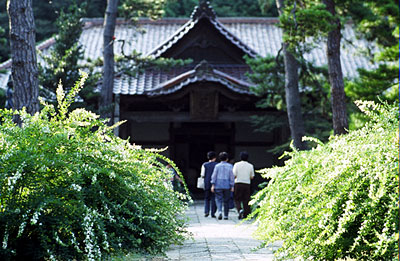
Credits: Yamanaka Hot Springs

I enjoyed a bath in the hot spring whose marvelous properties had a reputation of being second to none, except the hot spring of Ariake.

at Yamanaka
it’s not necessary to pluck chrysanthemums
hot spring fragrance


© Basho (Tr. Jane Reichhold)

The host of the inn was a young man named Kumenosuke. His father was a poet and there was an interesting story about him: one day, when Teishitsu (later a famous poet in Kyoto but a young man then) came to this place, he met this man and suffered a terrible humiliation because of his ignorance of poetry, and so upon his return to Kyoto, he became a student of Teitoku and never abandoned his studies in poetry till he had established himself as an independent poet. It was generally believed that Teishitsu gave instruction in poetry free of charge to anyone from this village throughout his life. It must be admitted, however, that this is already a story of long ago.

My companion, Sora, was seized by an incurable pain in his stomach. So he decided to hurry, all by himself, to his relatives in the village of Nagashima in the province of Ise. As he said good-bye he wrote:

no matter where I fall
I will be buried between
flowering bush-clovers


© Sora (Tr. Chèvrefeuille)

I felt deeply in my heart both the sorrow of one that goes and the grief of one that remains, just as a solitary bird separated from his flock in dark clouds, and wrote in answer:

from this day on
dew will erase the writing
on my hat


© Basho (Tr. Jane Reichhold)

(Note: Basho refers to “a party of two”, which he wrote on his hat as he and Sora started their “Narrow Road”)


Credits: Zenshoji Temple near the castle of Daishoji

I stopped overnight at the Zenshoji Temple near the castle of Daishoji, still in the province of Kaga. Sora, too, had stayed here the night before and left behind a poem.
Sora and I were separated by the distance of a single night, but it was just the same as being separated by a thousand miles. I, too, went to bed amidst the howling of the autumn wind and woke up early the next morning amid the chanting of the priests, which was soon followed by the noise of the gong calling us to breakfast. As I was anxious to cross over to the province of Echizen in the course of the day, I left the temple without lingering, but when I reached the foot of the long approach to the temple, a young priest came running down the steps with a brush and ink and asked me to leave a poem behind. As I happened to notice some leaves of willow scattered in the garden, I wrote impromptu,

sweeping the garden
I want to leave in the temple
scattered willow leaves


© Basho (Tr. Jane Reichhold)

and left the temple without even taking time to refasten my straw sandals.


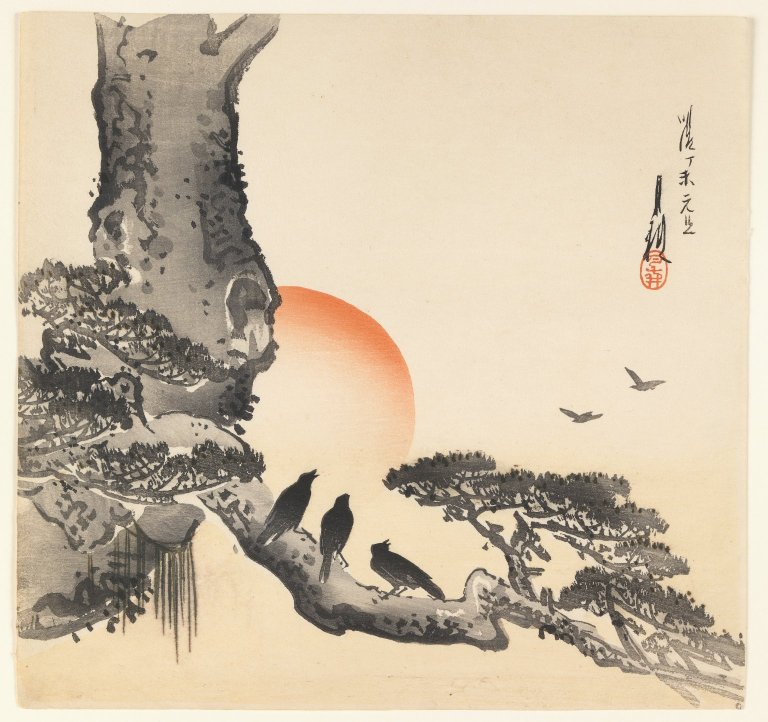
Credits: Pine tree (woodblock print Ogata Gekko)

Hiring a boat at the port of Yoshizaki on the border of the province of Echizen, I went to see the famous pine of Shiogoshi. The entire beauty of this place, I thought, was best expressed in the following poem by Saigyo.

inviting the wind to carry
salt waves of the sea,
the pine tree of Shiogoshi
trickles all night long
shiny drops of moonlight.


© Saigyo (Tr. Nobuyuki Yuasa)

Should anyone ever dare to write another poem on this pine tree it would be like trying to add a sixth finger to his hand.


++++++++++++++++++++++++++++++++++++++++++


What a sad story. Basho and Sora have been on this journey so long together and now Basho has to say goodbye to his travel companion, because of illness. It's "double sad", because Basho wasn't healthy himself, he had a chronic diseases of the intestines. He once has said "I will die on one of my travels as a result of my illness", and now Sora had to leave him because of an illness.

How sad it is to look around you and see how people are alone or lonely without family or friends ... no one has to be alone with Christmas ... but ... well we all know that there are a lot people alone and lonely now. Let us think a while of them ... and than look at ourselves.


underneath the bridge
warming their hands at a fire basket
those ... lost and alone


© Chèvrefeuille

I hadn't planned to create a wonderful episode and leave you all with such a sad toned haiku ... but that's our reality, our world is lost and alone ... but there is a power, a great power, to overcome that ... unconditional love.

Merry Christmas

This episode is open for your submissions tonight at 7.00 PM (CET) and it will remain open until December 28th at noon (CET). I will (try to) post our next episode, 
writing something; the moon clear; harvest moon; loneliness, next Sunday.


Monday, December 21, 2015

Carpe Diem #884 on our way home: the scent of early rice, the tomb also shakes, autumn coolness, red more red, a lovely name, how pitiful


!! triple episode !!

Dear Haijin, visitors and travelers,

First I have an announcement to make: this will be a "triple episode", because I hadn't time to create our episode of today, so I decided to bring you two episodes in one. This can mean that this episode will be a little bit longer than I usually do, but than we will be "back on track".
Second: Thank you all for your kind words and prayers for my dad. Just a few hours ago I heard that he will be released from the hospital. This afternoon we will have a conversation with his cardiologist.
Third: It's almost Christmas and the end of 2015 is almost there. I love to ask you all something. Please share with me, with us, with our Haiku Kai your thoughts about 2015. Which were the highlights, which prompts did you like and maybe you have ideas for new prompts or making our Haiku Kai even better than it is already.

Okay ... let's go to our "triple episode" of our "Narrow Road" which we are walking together with Basho and his companion Sora. Have fun!


+++++++++++++++++++++++++++++++++++++++++++


the scent of early rice
coming in from the right
the Ariso Sea


© Basho (Tr. Jane Reichhold)

Across the mountains of Unohana-yama and the valleys of Kurikara- dani, I entered the city of Kanazawa on July the fifteenth, where I met a merchant from Osaka named Kasho who invited me to stay at his inn.

Unohana-yama

There was in this city a man named Issho whose unusual love of poetry had gained him a lasting reputation among the verse writers of the day. I was told, however, that he had died unexpectedly in the winter of the past year. I attended the memorial service held for him by his brother.

the tomb also shakes
my weeping voice is
the autumn wind


© Basho (Tr. Jane Reichhold)

A visit to a certain hermitage, were I was invited to attend a rengaparty. I wrote the following greeting verse, which we used to start the renga with:

autumn coolness
each peeling with our hands
melons and eggplant


© Basho (Tr. Jane Reichhold)

red more red
in spite of the indifferent sun
an autumn breeze


© Basho (Tr. Jane Reichhold)

(note: normally the autumn wind was thought of as white)


Credits: Hiyoshi Shrine (Little Pines)
At a place called Little Pines:

a lovely name
at Little Pines blows
bush clover and thatch reeds


© Basho (Tr. Jane Reichhold)

(note: As you all know (I think) Basho was a very important and famous renga-master in his time. He attended a lot of renga parties and was often the haiku poet who wrote the hokku. The above haiku was the starting verse of a so called “yoyoshi”, a renga of forty-four links. This haiku which was used as the hokku, was the greeting verse to the host of this “yoyoshi”, Kosen, the chief priest of the Hiyoshi Shrine at Komatsue (which means “little pines”).

I went to the Tada Shrine located in the vicinity, where I saw Lord Sanemori's helmet and a piece of brocaded cloth that he had worn under his armor. According to the legends, these were given him by Lord Yoshitomo while he was still in the service of the Minamotos. The helmet was certainly an extraordinary one, with an arabesque of gold chrysanthemums covering the visor and the ear plate, a fiery dragon resting proudly on the crest, and two curved horns pointing to the sky. The chronicle of the shrine gave a vivid account of how, upon the heroic death of Lord Sanemori, Kiso no Yoshinaka had sent his important retainer Higuchi no Jiro to the shrine to dedicate the helmet with a letter of prayer.

how pitiful
under the armored helmet
a cricket


© Basho (Tr. Jane Reichhold)


Credits: Tada Shrine
An awesome part of the "Narrow Road" and while we are leaving Tada Shrine ... we also leave Carpe Diem Haiku Kai for today.


+++++++++++++++++++++++++++++++++++++++++


I have sought all over the Internet for an example of the poetry by Issho as mentioned in the above episode and finally I only found one haiku written by Issho. Issho was a very famous haiku poet in his own region, but he died in 1688. Basho loved to visit him, but the only thing he finds is the grave of Issho, who passed away a year before Basho arrived at the village were Issho lived.


Here is the only haiku which I could find written by Kasugi Issho. I have tried to translate it and honor Issho with that translation.

mi tsukushita me wa shirgiku ni  modori keri

seen with my eyes
white chrysanthemums
again I saw them


© Kasugi Issho (1652-1688)

A wonderful haiku I think, but Issho was more famous for his love poems, however I haven't sought the Internet for his love poems ...


Tulips

finally spring
one tulip after another blooms
rainbow garden


© Chèvrefeuille

What a joy it was to create this episode. I hope you did like it and ... I hope it inspires you to write an all new haiku, tanka or other Japanese poetry form.

This episode is NOW OPEN for your submissions and will remain open until December 24th at noon (CET). I hope to publish our new episode, a new episode of our Haiku Writing Techniques and the fourth CD special by Georgia, later on. For now .... have fun, be inspired and share.


Tuesday, December 15, 2015

Carpe Diem #880 secrets unveiled of the Deep North: coolness, cloud peaks, not permitted to tell


Dear Haijin, visitors and travelers,

First I will apologize again for being late with this new episode .... but now I will bring it to you. We are on the trail with Basho and his companion Sora on our way into the deep north following the story as told by Basho in his famous haibun Oku no Hosomichi (Narrow Road into the Deep North).

Basho was known as the traveling poet and in the last ten years of his life he traveled a lot. Of all his travels he wrote a haibun, but Oku no Hosomichi became the most famous haibun ever. I even think that there is not an other haibun which can reach the quality level of Oku no Hosomichi.


++++++++++++++++++++++++++++++++++++++++++++++++++


As I was still descending, I saw an old smithy built right on a trickling stream. According to my guide, this was where Gassan, a local swordsmith, used to make his swords, tempering them in the crystal-clear water of the stream. He made his swords with such skill and devotion that they became famous throughout the world. He must have chosen this particular spot for his smithy probably because he knew of a certain mysterious power latent in the water, just as indeed a similar power is known to have existed in the water of Ryosen Spring in China. Nor is the story of Kansho and Bakuya out of place here, for it also teaches us that no matter where your interest lies, you will not be able to accomplish anything unless you bring your deepest devotion to it. As I sat reflecting thus upon a rock, I saw in front of me a cherry tree hardly three feet tall just beginning to blossom - far behind the season of course, but victorious against the heavy weight of snow which it had resisted for more than half a year. I immediately thought of the famous Chinese poem about 'the plum tree fragrant in the blazing heat of summer' and of an equally pathetic poem by the priest Gyoson, and felt even more attached to the cherry tree in front of me. I saw many other things of interest in this mountain, the details of which, however, I refrain from betraying in accordance with the rules I must obey as a pilgrim. When I returned to my lodging, my host, Egaku, asked me to put down in verse some impressions of my pilgrimage to the three mountains, so I wrote as follows on the narrow strips of writing paper he had given me.

Mount Yudono

coolness
a crescent moon faintly seen
over Black feather Mountain


© Basho (Tr. Jane Reichhold)

cloud peaks
how many have crumbled
on the mountain of the moon


© Basho (Tr. Jane Reichhold)

not permitted to tell
how sleeves are wetted
in the bathroom


© Basho (Tr. Jane Reichhold)


as I step on coins
on sacred Yudono road
tears rush to my eyes


© Sora, Basho’s travel companion (Tr. James David Andrews)


++++++++++++++++++++++++++++++++++++++++++++++


There are several places in Japan which are seen as sacred and holy, but some of those places hide secrets too. One of those secrets was on Mount Yudono. Let me tell you a little bit more about the secrets of Mount Yudono.

Basho wrote "not permitted to tell" on Mount Yudano (meaning: bathroom). On this mountain was a spectacular waterfall which had been a Shinto place of worship since early times. Only men could visit it and only after a rigorous climb with several rituals and services in various temples. At the gate, after purification rites, they must remove their shoes to climb the rocks barefoot. In addition, before being allowed to view this wonder, each men had to swear never to reveal what he witnessed there.
Credits: Shinto ritual on Mount Yudono

In modern times, in interests of disclosure, the secret of Mount Yudano has been revealed.
Due to the wearing away of the rock and the reddish minerals in the thermal-warmed water, the waterfall looks exactly like the private parts of a woman complete with sounds and gushing water. The practice can be thought of as worshipping the reproductive aspect of the feminine earth.

Knowing this, the name of the mountain becomes clear. Even clearer is the earlier name for the mountain, Koi no Yama ("mountain of love")>

Maybe you remember this haiku from an earlier post, but you can also have read this one in our Carpe Diem Haiku Writing Techniques "double entendre".

too late for the ferry
after a steaming hot summer night
with my paramour


© Chèvrefeuille

This episode is NOW OPEN for your submissions and will remain open until December 18th at noon (CET). I will (try to) publish our next episode, another Carpe Diem Haiku Writing Techniques episode, later on. Have fun!


Sunday, December 13, 2015

Carpe Diem #879 On our way to Mogamigawa: summer rains, admirable


Dear Haijin, visitors and travelers ... or shall I say "dear haiku family members"?,

As we are going further into the deep north of Honshu Island we are now entering the region through which the river Mogami flows. Maybe the Mogami River will say something, because in one of Basho's famous haiku he speaks about the Mogami River. That haiku is one of the pieces of today's episode. And the other haiku, not so well known, but part of Oku-no-Hosomichi we will discuss too.
yesterday I told you that Basho's revised Oku-no-Hosomichi several times in the five years after his journey into the deep north. And in today's episode we will see this revising traject in one of the haiku. I hope you all will enjoy this episode.

admiring
the beauty of haiku
together with Basho

© Chèvrefeuille

I think "admiring" the beauty of haiku is the main goal here at Carpe Diem Haiku Kai. It was haiku which brought me happiness and joy ... pure by reading them first and after while starting to write them myself. It's that admiration what started Carpe Diem Haiku Kai more then three years ago. It's an every day joy to create this Kai, but it is not always easy to create the episodes ... This month, however it's only joy and happiness, because we are reading "The Narrow Road into the Deep North", Basho's most famous haibun ever written and published. There are several translations of this wonderful haibun which I have used all to make you all happy and to inspire you all. This month's haiku are almost all by Basho (or Sora, his travel companion) in a translation by Jane Reichhold whom I am very grateful that she granted me permission to use her knowledge and her work. Thank you Jane ...

Jane Reichhold

+++++++++++++++++++++++++++++++++++++++++++++++++


The River Mogami rises in the high mountains of the far north, and its upper course runs through the province of Yamagata. There are many dangerous spots along this river, such as Speckled Stones and Eagle Rapids, but it finally empties itself into the sea at Sakata, after washing the north edge of Mount Itajiki. As I descended this river in a boat, I felt as if the mountains on both sides were ready to fall down upon me, for the boat was tiny one - the kind that farmers used for carrying sheaves of rice in old times - and the trees were heavily laden with foliage. I saw the Cascade of Silver Threads sparkling through the green leaves and the Temple called Sennindo standing close to the shore. The river was swollen to the brim, and the boat was in constant peril.

summer rains
quickly gathered
Mogami River


© Basho (Tr. Jane Reichhold)

I climbed Mount Haguro on the third of June. Through the effort of my friend, Zushi Sakichi, I was granted an audience with the high priest Egaku, then presiding over this whole mountain temple acting as bishop. He received me kindly and gave me a comfortable lodging in one of the annexes in the South Valley.

On the following day, I sat with the priest in the main hall to compose some linked verse. I wrote:

admirable
snow gives its scent to
the south valley


© Basho (Tr. Jane Reichhold)


Credits: Mount Haguro (one of three most sacred shrines of the deep north

I visited the Gongen shrine on the fifth. The founder of this shrine is the priest called Nojo, but no one knows exactly when he lived. Court Ceremonies and rites during the Years of Engi, however, mentions that there is a sacred shrine on Mount Sato in the province of Dewa. The scribe must have written Sato where he should have written Kuro in the province of Dewa. According to a local history book, the name of the province itself is derived from the fact that quantities of feathers were sent to the Emperor each year as a tribute from this province. Be that as it may, this shrine on Mount Haguro is counted among the three most sacred shrines of the north, together with the shrines on Mount Gassan and Mount Yudono, and is a sister shrine of the temple on Mount Toei in Edo. Here the doctrine of Absolute Meditation preached in the Tendai sect shines forth like the clear beams of the moon, and the Laws of Spiritual Freedom and Enlightenment illuminate as lamps in utter darkness. There are hundreds of houses where the priests practice religious rites with absolute severity. Indeed the whole mountain is filled with miraculous inspiration and sacred awe. Its glory will never perish as long as man continues to live on the earth.

I climbed Mount Gassan on the eighth. I tied around my neck a sacred rope made of white paper and covered my head with a hood made of bleached cotton, and set off with my guide on a long march of eight miles to the top of the mountain. I walked through mists and clouds, breathing the thin air of high altitudes and stepping on slippery ice and snow, till at last through a gateway of clouds, as it seemed, to the very paths of the sun and moon, I reached the summit, completely out of breath and nearly frozen to death. Presently the sun went down and the moon rose glistening in the sky. I spread some leaves on the ground and went to sleep, resting my head on pliant bamboo branches. When, on the following morning, the sun rose again and dispersed the clouds, I went down towards Mount Yudono. 


++++++++++++++++++++++++++++++++++++++++++++++


A nice stage again. I wonder in several translations of "Narrow Road" the translator uses the expression "station" for the diverse stages in the story and one of those translators says that every "station" is a place of growth in spirituality and it brings Basho (and us) closer to enlightenment ... so we will see that of course as we are going on our journey further in the presence of Basho's spirit.

Earlier in this post I mentioned that Basho revised several of his haiku during the years after his journey into the deep north and one of those haiku is mentioned above. This haiku "admirable" has three distinct versions which I love to share here with you all and I will try to tell you why Basho changed this haiku at least two times. First the last version as used in "Narrow Road" in a translation by Jane of course (as are the two other versions):

admirable
snow gives its scent to
the south valley


© Basho (Tr. Jane Reichhold)


Credits: Mogami River

By the way there is another, almost the same in scene, haiku which Basho wrote as a welcome poem for one of the hosts he was welcomed by. Here is the haiku which Basho gave to Seishin while he visited him and attended in a renga-session, specifically, this greeting verse was the hokku of the renga performed at Seishin's house:

the scent of wind
from the south not far from
the Mogami River


© Basho (Tr. Jane Reichhold)

This "hokku" could be seen easily as the entwining of the two haiku in the above episode of "Narrow Road", maybe it was meant to be a kind of knot to bind the scenes together, but that's pure speculation.

Okay ... back to the revised haiku of "admirable". As I told you earlier after his journey into the deep north it took Basho five years to revise his haibun and in the revision he also revised the "admirable" haiku a few times.

admirable
making the snow fragrant
sound of the wind

admirable
making the snow go around
the wind's sound


© Basho

It's remarkable to read those other versions and to see how little changes Basho made and the scene completely different exposes. I wonder why these revisions? Of course this is all speculative, but I think Basho needed to give words to his feelings of the sight around him. With the two revisions we cannot trace the place were Basho was and why he was overwhelmed by the beauty. I think that's why he revised it to the haiku as mentioned in our episode above.
As I look at the three versions than I would probably not choose the version Basho used finally, because it is (in my opinion) not really important to mention the place in the haiku, because it is mentioned in the prose already. I would have chosen the following version:

admirable
making the snow fragrant
sound of the wind


© Basho

In this version I feel the wind, I can smell the perfume of the fresh fallen snow and the scene it paints is overwhelming and very beautiful, but that's just my humble opinion> I even would "revise" this one a little bit ... to make it even more beautiful (how immodest). I hope Basho will forgive me ...

prodigious
fragrant snow
the wind


© Basho (Tr. Chèvrefeuille)

Well ... it was again a great joy (and "struggle") to create this episode. I hope it will inspire you all.

This episode is NOW OPEN for your submissions and will remain open until December 16th at noon (CET). I will try to pubklish our new episode, coolness; cloud peaks; not permitted to tell, later on. For now .... have fun, be inspired and share your wonderful haiku with us all here at our Kai.


Saturday, December 12, 2015

Carpe Diem #878 the journey continues: an eyebrow brush; such stillness


Dear Haijin, visitors and travelers,

Today's episode will bring us further into the deep north. We will read a few haiku from Oku-no-Hosomichi, the most famous haibun ever written. It's written by Matsuo Basho (1644-1694) and it tells us the story about a journey he made through the northern part of the southern island of Japan, Honshu. Before this haibun was first published Basho revised it several times. It was published after five years of revising and through that revising it became one the most famous haibun ever.
As you all know haiku describes a moment as short as the sound of a pebble thrown into water, so it is very short moment and ... revision was not done as you and I have learned, but ... haiku can describe the same scene after the described moment several years later. Revising your haiku takes time, but it can give you certainly satisfaction, because maybe you choose new words, or you use less or more words. The words you choose while revising can even make the scene stronger and the feeling you had at the moment you wrote your haiku.
It is no shame to "revise" your haiku ... it can make your haiku stronger and more in balance. As you all know I am writing haiku since the late eighties and as I read back the haiku which I wrote at the start of my career as a haiku poet than I would certainly "revise" several haiku. Let us look at a the very first haiku which I wrote in English:

a lonely flower
my companion
for one night


I would question the use of "lonely"  - that is a human feeling you are giving to a thing. You may feel lonely when there is only one of you (do you?) but the flower is not alone if you are there!

a single flower
my companion
for one night


or

a single tulip
my companion
for one night

A Single Tulip

has more connotations. . . even some sexual with single / unmarried and tulip / two lipped!  And so this very first English haiku I wrote finally became:

a single tulip
my companion
for one night


© Chèvrefeuille

This revision makes the haiku stronger, more in balance and even a more deeper double (sexual) meaning.

Okay ... this "preface" to another episode of "Narrow Road" was just for explanation that revising haiku, as Basho did for five years, before he published his "Narrow Road" can be great and it even can help you to improve your haiku skills ... at least "revising" haiku (especially my own) did improve my haiku skills.

+++++++++++++++++++++++++++++++++++++++++++++

Credits: an eyebrow brush is the image drawn by safflower blossoms
an eyebrow brush
is the image drawn by
safflower blossoms


© Basho (Tr. Jane Reichhold)

There was a temple called Ryushakuji in the province of Yamagata. Founded by the great priest Jikaku, this temple was known for the absolute tranquility of its holy compound. Since everybody advised me to see it, I changed my course at Obanazawa and went there, though it meant walking an extra seven miles or so. When I reached it, the late afternoon sun was still lingering over the scene. After arranging to stay with the priests at the foot of the mountain, I climbed to the temple situated near the summit. The whole mountain was made of massive rocks thrown together and covered with age-old pines and oaks. The stony ground itself bore the color of eternity, paved with velvety moss. The doors of the shrines built on the rocks were firmly barred and there was no sound to be heard. As I moved on all fours from rock to rock, bowing reverently at each shrine, I felt the purifying power of this holy environment pervading my whole being.

shizukasa ya iwa ni shimiiru semi no koe

such stillness
piercing the rock
cicada’s  voice


© Basho (Tr. Jane Reichhold)

I wanted to sail down the River Mogami, but while I was waiting for fair weather at Oishida, I was told that the old seed of linked verse once strewn here by the scattering wind had taken root, still bearing its own flowers each year and thus softening the minds of rough villagers like the clear note of a reed pipe, but that these rural poets were now merely struggling to find their way in a forest of error, unable to distinguish between the new and the old style, for there was no one to guide them. At their request, therefore, I sat with them to compose a book of linked verse, and left it behind me as a gift. It was indeed a great pleasure for me to be of such help during my wandering journey.


+++++++++++++++++++++++++++++++++++++++++


A wonderful stage I think, but there is a lot of discussion about that second haiku "such stillness". How can the voice of a cicada pierce the rocks? There are a few explanations for "such stillness" which I love to share here with you, that is by the way the reason why I also reproduced the romaji translation of this haiku.

The Ryushaku-ji temple is a mountain temple with long paths through dark, old cedars and rocky pathways. The number of steps down, for example, from the summit to the main building of Risshaku-ji count out to 870. The crags there are of volcanic rock and rather porous. There is a possibility that Basho is speaking about a sense that these rocks mute the sound of the cicadas in comparison to how they sound in the forest.
Credits: Ryushaku-ji Temple (Yamadera)

A poem by Tu Fu says, "Cicadas' voices merge together at an old temple." Basho further enhanced the poetic beauty of the scene by introducing the image of rocks absorbing the voices. --Moran (1713-1779, haiku poet and chief priest of Myoho Temple in Shimousa)

Not a single sound was heard at this quiet place, except the voice of the cicadas that was so forceful that it seemed to seep into the rocks. --Sanga (Haiku poet who wrote a book on Basho in 1793)

If my sensibility is reliable, there should not be many circads here. -- Mizuho (1876-1955, tanka poet and classical scholar)

I disagree. The whole mountain is filled with the cicadas' screech. -- Watsuji (1889-1960, philosopher and scholar, an "intellectual leader of his generation")

In the word shimiiru ["to seep / stain into" -- Wallace] we sense motion in stillness, and stillness in motion. Basho, with his consummate art, captured this oneness of motion and stillness in a short poem. -- Ebara (1894-1948, scholar of renga and haikai at Kyoto University) (Source: here)

A lot to contemplate about I think. It was really a joy to create this episode and I hope that it will inspire you to write haiku, tanka or other Japanese poetry form. Here is my attempt to catch that silence in the second haiku also:

leaves rustle
the brook babbles
silence ...


© Chèvrefeuille

This episode is NOW OPEN for your submissions and will remain open until December 15th at noon (CET). I will try to publish our new episode, 
summer rains; admirable, later on.

Friday, December 11, 2015

Carpe Diem #877 Experiencing the Deep North; making the coolness; crawling out (short episode)


Dear Haijin, visitors and travelers,

Experiencing the Deep North ... I titled this episode, because we are going deeper and deeper into the deep north of the Southern Island of Japan, Honshu, together with Basho and his companion Sora. This journey is not only an adventure, it's also a spiritual path. I have read recently the Narrow Road again and I still find new themes, new knowledge, new spiritual practices and achievements.

As I am preparing this episode a post which I once wrote for my personal weblog comes in mind and I think it can explain the idea of the "Narrow Road" a little bit so I will share part of that post here with you before we are going further on our journey into the deep north.

closing the garden
no one to disturb my thoughts -
Virginia Creeper


© Chèvrefeuille
Virginia Creeper
In this haiku the closing of the garden is meant to give the mind some peace, but also to search for the deeper meaning of the thoughts. Thinking about the future? Thinking about life? All thoughts that are tumbling around in my mind. My head is so full of thoughts that I sometimes think that I need a second head. But ... that's of course not possible ... so I have to retreat for a while to order my thoughts. I have to close my garden, my house to find the peace back in my head, body and soul. Then I will find my freedom of thoughts back and that is the deeper meaning of the Virginia Creeper. The spiritual meaning of Virginia Creeper is 'seeking freedom and progress'. So the deeper (spiritual) meaning of this haiku is:

'To find freedom and progress in thoughts I have to empty my head by going on a retreat'.   Isn't it a wonderful haiku? So less words, with so much meaning.


++++++++++++++++++++++++++++++++++++++++++++


I visited Seifu in the town of Obanazawa. He was a rich merchant and yet a man of a truly poetic turn of mind. He had a deep understanding of the hardships of the wandering journey, for he himself had traveled frequently to the capital city. He invited me to stay at his place as long as I wished and tried to make me comfortable in every way he could.

making the coolness
my own dwelling place
here I sit


© Basho (Tr. Jane Reichhold)

crawling out
from under the shed
toad's voice


© Basho (Tr. Jane Reichhold)


+++++++++++++++++++++++++++++++++++++++++++++


The above episode of "Narrow Road" will continue tomorrow with two other nice haiku and of course our next part of the "Narrow Road". Until today it was a great adventure, but there will be more adventure to come ... and I hope you all will go along with me ... as we walk the "Narrow Road" together with the master, Basho, himself.

under colored leaves
the voices of thousand ants
preparing for winter

© Chèvrefeuille

walking through the forest
thousands stars sparkle in the black sky
between bare branches

© Chèvrefeuille

Hm ... not bad, not bad at all ...

This episode is open for your submissions tonight at 7.00 PM (CET) and will remain open until December 14th at noon (CET). I will (try to) publish our new episode, an eyebrow brush; such stillness, later on.


Wednesday, December 9, 2015

Carpe Diem #876 the journey continues: early summer rains; fleas and lice (a short episode)


Dear Haijin, visitors and trvaelers,

What a joy to be on the Narrow Road Into The Deep North with you all my dear family. Today we are going further into the deep north following Basho and his companion Sora on their way to find enlightenment.


+++++++++++++++++++++++++++++++++++++++++++


early summer rains
their falling leaves untouched
golden hall of light


© Basho (Tr. Jane Reichhold)


Credits: Shitomae Barrier gate

Turning away from the high road leading to the provinces of Nambu, I came to the village of Iwate, where I stopped overnight. The next day I looked at the Cape of Oguro and the tiny island of Mizu, both in a river, and arrived by way of Naruko hot spring at the barrier-gate of Shitomae which blocked the entrance to the province of Dewa. The gate-keepers were extremely suspicious, for very few travelers dared to pass this difficult road under normal circumstances. I was admitted after long waiting, so that darkness overtook me while I was climbing a huge mountain. I put up at a gate-keeper's house which I was very lucky to find in such a lonely place. A storm came upon us and I was held up for three days.

fleas and lice
now a horse pisses
by my pillow


© Basho (Tr. Jane Reichhold)


++++++++++++++++++++++++++++++++++++++++++++


I love that last haiku. It's just a real scene. It was not always very clean in the hostels were Basho stayed the night and that gave of course all kinds of nasty experiences as is shown in the "fleas and lice" haiku. I have read and re-read that haiku several times. Silently but also aloud ... and it gives me a real feeling of being one with all and everything. Maybe this "fleas and lice" haiku is one of Basho's best karumi (lightness) styled haiku.

I have given it a try myself to compose such a haiku using this "karumi" - style:

along the seashore
hand in hand with the love of my life
a seagull shits on my head


© Chèvrefeuille

Not as strong as I had hoped, but I like the simple scene and the humor hidden in it.

This episode is open for your submissions tonight at 7.00 PM (CET) and will remain open until December 12th at noon (CET). I will try to post our new episode, a new CD Special with our featured haiku poetess Georgia, later on. For now have fun!

Monday, December 7, 2015

Carpe Diem #875 the journey continues: iris leaves; summer grass


Dear Haijin, visitors and travelers,

Our journey into the deep north continues ... it's an adventure ... and I enjoy it very much and of course I hope you all enjoy it too.

As you have read or have seen Georgia's E-book "old bamboo wind chimes" is now available at our Haiku Kai, you can find the link at the right of our Kai. It has become a real beauty and it was really a joy to create it together with Georgia.


++++++++++++++++++++++++++++++++++++++++++++
Crossing the River Natori, I entered the city of Sendai on May the fourth, the day we customarily throw fresh leaves of iris on the roof and pray for good health. I found an inn, and decided to stay there for several days. There was in this city a painter named Kaemon. I made special efforts to meet him, for he was reputed to be a man with a truly artistic mind. One day he took me to various places of interest which I might have missed but for his assistance. We first went to the plain of Miyagino, where fields of bush-clover were waiting to blossom in autumn. The hills of Tamada, Yokono, and Tsutsuji-ga-oka were covered with white rhododendrons in bloom. Then we went into the dark pine woods called Konoshita where even the beams of the sun could not penetrate. This darkest spot on the earth had often been the subject of poetry because of its dewiness - for example, one poet says that his lord needs an umbrella to protect him from the drops of dew when he enters it.
We also stopped at the shrines of Yakushido and Tenjin on our way home.


When the time came for us to say good-bye, this painter gave me his own drawings of Matsushima and Shiogama and two pairs of straw sandals with laces dyed in the deep blue of the iris. In this last appears most clearly perhaps the true artistic nature of this man.
Iris leaves
I tie them to my feet
as sandal cords


© Basho (Tr. Jane Reichhold)

Relying solely on the drawings of Kaemon which served as a guide, pushed along the Narrow Road to the Deep North, and came to the place where tall sedges were growing in clusters. This was the home of the famous sedge mats of Tofu. Even now it is the custom of the people of this area to send carefully woven mats as tribute to the governor each year.
Stopping briefly at the River Noda no Tamagawa and the so-called Rock in the Offing, I came to the pine woods called Sue no Matsuyama, where I found a temple called Masshozan and a great number of tombstones scattered among the trees. It was a depressing sight indeed, for young or old, loved or loving, we must all go to such a place at the end of our lives. I entered the town of Shiogama hearing the ding-dong of the curfew. Above was the darkening sky, unusually empty for May, and beyond was the silhouette of Migaki ga Shima Island not far from the shore in the moonlight.
The voices of the fishermen dividing the catch of the day made me even more lonely, for I was immediately reminded of an old poem which pitied them for their precarious lives on the sea. Later in the evening, I had a chance to hear a blind minstrel singing to his lute. His songs were different from either the narrative songs of the Heike or the traditional songs of dancing, and were called Okujoruri (Dramatic Narratives of the Far North). I must confess that the songs were a bit too boisterous, when chanted so near my ears, but I found them not altogether unpleasing, for they still retained the rustic flavor of the past.
The following morning, I rose early and did homage to the great god of the Myojin Shrine of Shiogama. This shrine had been rebuilt by the former governor of the province with stately columns, painted beams, and an impressive stone approach, and the morning sun shining directly on the vermillion fencing was almost dazzlingly bright. I was deeply impressed by the fact that the divine power of the gods had penetrated even to the extreme north of our country, and I bowed in humble reverence before the altar.
Credits: Matsushima Island (Woodblock Print)
It was already close to noon when I left the shrine. I hired a boat and started for the islands of Matsushima. After two miles or so on the sea, I landed on the sandy beach of Ojima Island.
Much praise has already been lavished on the wonders of the islands of Matsushima. Yet if further praise is possible, I would like to say that here is the most beautiful spot in the whole country of Japan, and that the beauty of these islands is not in the least inferior to the beauty of Lake Dotei or Lake Seiko in China. The islands are situated in a bay about three miles wide in every direction and open to the sea through a narrow mouth on the south-east side. Just as the River Sekko in China is made full at each swell of the tide, so is this bay filled with the brimming water of the ocean and the innumerable islands are scattered over it from one end to the other. Tall islands point to the sky and level ones prostrate themselves before the surges of water. Islands are piled above islands, and islands are joined to islands, so that they look exactly like parents caressing their children or walking with them arm in arm. The pines are of the freshest green and their branches are curved in exquisite lines, bent by the wind constantly blowing through them. Indeed, the beauty of the entire scene can only be compared to the most divinely endowed of feminine countenances, for who else could have created such beauty but the great god of nature himself? My pen strove in vain to equal this superb creation of divine artifice.
Ojima Island where I landed was in reality a peninsula projecting far out into the sea. This was the place where the priest Ungo had once retired, and the rock on which he used to sit for meditation was still there. I noticed a number of tiny cottages scattered among the pine trees and pale blue threads of smoke rising from them. I wondered what kind of people were living in those isolated houses, and was approaching one of them with a strange sense of yearning, when, as if to interrupt me, the moon rose glittering over the darkened sea, completing the full transformation to a night-time scene. I lodged in an inn overlooking the bay, and went to bed in my upstairs room with all the windows open. As I lay there in the midst of the roaring wind and driving clouds, I felt myself to be in a world totally different from the one I was accustomed to. My companion Sora wrote:
at Matsushima
borrow your plumes from the crane
O nightingales!
© Sora (Tr. Donald Keene)

I myself tried to fall asleep, suppressing the surge of emotion from within, but my excitement was simply too great. I finally took out my notebook from my bag and read the poems given me by my friends at the time of my departure - Chinese poem by Sodo, a waka by Hara Anteki, haiku by Sampu and Dakushi, all about the islands of Matsushima.
I left for Hiraizumi on the twelfth and arrived at there after wandering some twenty miles in two days.
It was here that the glory of three generations of the Fujiwara family passed away like a snatch of empty dream. The ruins of the main gate greeted my eyes a mile before I came upon Lord Hidehira's mansion, which had been utterly reduced to rice-paddies. Mount Kinkei alone retained its original shape. As I climbed one of the foothills called Takadate, where Lord Yoshitsune met his death, I saw the River Kitakami running through the plains of Nambu in its full force, and its tributary, Koromogawa, winding along the site of the Izumigashiro castle and pouring into the big river directly below my eyes. The ruined house of Lord Yasuhira was located to the north of the barrier-gate of Koromogaseki, thus blocking the entrance from the Nambu area and forming a protection against barbarous intruders from the north. Indeed, many a feat of chivalrous valor was repeated here during the short span of the three generations, but both the actors and the deeds have long been dead and passed into oblivion. When a country is defeated, there remain only mountains and rivers, and on a ruined castle in spring only grasses thrive. I sat down on my hat and wept bitterly till I almost forgot time.

summer grass
the only remains of soldiers’
dreams


© Basho (Tr. Jane Reichhold)


Credits: Haiga "summer grass"

in deutzia flowers
Kanefusa* seems to me -
oh, such white, white hair


© Sora (Tr. Tim Chilcott)

* Sora compares Basho with a noble warrior called Kanefusa


The interiors of the two sacred buildings of whose wonders I had often heard with astonishment were at last revealed to me. In the library of sutras were placed the statues of the three nobles who governed this area, and enshrined in the so called Gold Chapel were the coffins containing their bodies, and under the all-devouring grass, their treasures scattered, their jeweled doors broken and their gold pillars crushed, but thanks to the outer frame and a covering of tiles added for protection, they had survived to be a monument of at least a thousand years.


++++++++++++++++++++++++++++++++++++++++++++++++++


The "summer grass" haiku is a very well known haiku by Basho and it once inspired me to write the following haiku:

ancient warriors ghosts
mists over the foreign highlands -
waiting for the full moon


© Chèvrefeuille

Well ... I hope you did like this episode and that it will inspire you to write an all new haiku, tanka or other Japanese poetry form.

This episode is open for your submissions tonight at 7.00 PM (CET) and will remain open until December 10th at noon (CET). I will (try to) publish our new episode, an all new CD HWT episode, later on.

Sunday, December 6, 2015

Carpe Diem #874 Rainhat Island; since the cherry blossoms


Dear Haijin, visitors and travelers,

I have read wonderful haiku this first week of our journey with Basho and that makes me proud ... you are all very gifted poets and I am happy that I may be your host here ... the joy of creating CDHK I cannot explain ...

This month we arer on our way together with Basho and his companion Sora to find the deeper meaning of life, spiritual life, and I hope we will come closer to enlightenment while traveling to the deep north.

++++++++++++++++++++++++++++++++++++++++++


Passing through the castle towns of Abumizuri and Shiroishi, I arrived at the province of Kasajima (Rainhat Island), where I asked the way to the mound of Lord Sanekata of the Fujiwara family. I was told that I must turn right in the direction of the villages of Minowa and Kasajima visible at the foot of the mountains in the distance, and that the mound was still there by the side of a shrine, buried in deep grass. I wanted to go that way, of course, but the muddy road after the early rain of the wet season and my own weakness stopped me. The names of the two villages were so befitting to the wet season with their echoes of raincoat and umbrella that I wrote:

Rainhat Island—
where did you say it was?
muddy roads in May

© Basho (Tr. Donald Keene)

 I stopped overnight at Iwanuma.

My heart leaped with joy when I saw the celebrated pine tree of Takekuma, its twin trunks shaped exactly as described by the ancient poets. I was immediately reminded of the priest Noin who had grieved to find upon his second visit this same tree cut down and thrown into the River Natori as bridge-piles by the newly-appointed governor of the province. This tree had been planted, cut, and replanted several times in the past, but just when I came to see it myself, it was in its original shape after a lapse of perhaps a thousand years, the most beautiful shape one could possibly think of for a pine tree. The poet Kyohaku wrote as follows at the time of my departure to express his good wishes for my journey:
Credits: Takekuma Pine

the Takekuma Pine:
show it to him,
late-blooming cherries


 © Kyohaku (Tr. David Landis Barnhill)

The following poem I wrote was, therefore, a reply:

since the cherry blossoms,
I was longing to see the Twin-Pine
three months have passed


© Basho (Tr. Chèvrefeuille)

++++++++++++++++++++++++++++++++++++++++++

I am in the nightshift and I hadn't taken my notes with me, so in this episode I have used translations by others instead of Jane Reichhold.

This episode is open for your submissions tonight at 7.00 PM (CET) and will remain open until December 9th at noon (CET). I will publish our next episode, iris leaves; summer grass, later on.