Showing posts with label classic meets modern. Show all posts

Saturday, January 30, 2016

Carpe Diem #907 meditation


Dear Haijin, visitors and travelers,

It's a bit sad, but also a little joy I think, because this is our last episode of January and we are going in to another month in which we will sharpen our senses together with Hamish Managua Gunn (a.k.a. Pirate). Next month will not be an easy month I think, but it will for sure be a challenge to work with all those wonderful senses. If you like to see what February is bringing than you can find the prompt-list in the menu above. I am looking forward to February and I hope you all will do ...

Today we have our last prompt of January in which we explored classical and modern kigo for winter and it was a joy to make this month. Our last prompt is meditation and it's a modern kigo for winter extracted from Jane Reichhold's "A Dictionary of Haiku" (the online version).

What is meditation? I can tell that myself, but my ideas are different as it concerns meditation. To me it's just a way to find peace in my heart, soul and mind and to me it's not
necessary to do that in complete silence or with the use of a mantra or something. So I have sought the Internet an ran across a wonderful explanation of meditation on Wikipedia:

Meditation

Meditation is a practice where an individual trains the mind or induces a mode of consciousness, either to realize some benefit or for the mind to simply acknowledge its content without becoming identified with that content, or as an end in itself.

The term meditation refers to a broad variety of practices that includes techniques designed to promote relaxation, build internal energy or life force (qi, ki, prana, etc.) and develop compassion, love, patience, generosity and forgiveness. A particularly ambitious form of meditation aims at effortlessly sustained single-pointed concentration meant to enable its practitioner to enjoy an indestructible sense of well-being while engaging in any life activity.

The word meditation carries different meanings in different contexts. Meditation has been practiced since antiquity as a component of numerous religious traditions and beliefs. Meditation often involves an internal effort to self-regulate the mind in some way. Meditation is often used to clear the mind and ease many health concerns, such as high blood pressure, depression, and anxiety. It may be done sitting, or in an active way—for instance, Buddhist monks involve awareness in their day-to-day activities as a form of mind-training. Prayer beads or other ritual objects are commonly used during meditation in order to keep track of or remind the practitioner about some aspect of that training.
Meditation may involve generating an emotional state for the purpose of analyzing that state—such as anger, hatred, etc.—or cultivating a particular mental response to various phenomena, such as compassion. The term "meditation" can refer to the state itself, as well as to practices or techniques employed to cultivate the state. Meditation may also involve repeating a mantra and closing the eyes. The mantra is chosen based on its suitability to the individual meditator. Meditation has a calming effect and directs awareness inward until pure awareness is achieved, described as "being awake inside without being aware of anything except awareness itself." In brief, there are dozens of specific styles of meditation practice, and many different types of activity commonly referred to as meditative practices. (Source: Wikipedia)


I think you all will have ideas about meditation and every one of you will have experienced meditation through haiku composing. To me creating haiku is a kind of meditation and that is (in my opinion) what Jane meant with this modern kigo for winter. Meditation is not specific for winter, but the air of winter is maybe the purest to breath and makes your mind clear and open for the influence of the "haiku spirits".

Jane gives several wonderful examples and I love to share a few of her haiku on meditation here in this post:


incense burns
inside a moon shell
whorls of smoke

monks chanting
the crooked pine
wind straightened

channels
the balance of chi
in two hands

earth-loosened
ascending heaven
monks chant

alone in the forest
closing one gate
opening the other

tapered prayer
a lone pine points
into heaven

Zen garden
patterns raked by falling rain
still the dust

© Jane Reichhold

 
All beauties I would say and I think these are great examples on meditation.
 
Credits: Meditating Monk
We are all haiku poets and we are all one with nature, with the seasons, with the elements ... we are all one with our ancestors, our past, our present, but also one with our future ... so I think this prompt can be great one ...
deep silence
sunbeams breaking, fresh snow diamonds -
the silence deepens

© Chèvrefeuille

Sorry ... I am a little bit to late with publishing ... enjoy the read and let your muse inspire you to create new and wonderful haiku, tanka or other Japanese poetry forms.


This episode is NOW OPEN for your submissions and will remain open until February 2nd at noon (CET). I will try to publish our new episode, hearing, later on. For now .... have fun!


Friday, January 29, 2016

Carpe Diem #906 Ume-no-hana (ume flower)


Dear Haijin, visitors and travelers,

January is running towards its end. We have only two episodes to go and than ... classic meets modern will be over. I hope you all did like this month ...

Today our prompt is Ume-no-hana (ume flower) and it's a classical kigo for the end of winter, or the last part of winter. Ume-no-hana (ume flower) is mostly translated as "plum" but it's more an "apricot".

I have a little background about the "ume-flower" for you:

Next to the Cherry blossom, the plum blossoms are loved by Japanese poets and where enjoyed even more than the cherry in the Heian peroid.

They are a symbol of refinement, purity and nobility and also a reminder of past love. Japanese tradition holds that the ume functions as a protective charm against evil, so the ume is traditionally planted in the northeast of the garden, the direction from which evil is believed to come.

I have found a lot of beautiful haiku and tanka (waka) about/on plum blossoms. First a tanka (waka) written by Sugawara Michizane:

When the east wind blows,
Send me your perfume,
Blossoms of
the plum:
Though your lord be absent,
Forget not the spring.

© Sugawara Michizane (845 – 903) (Tr. G. Bownas A. Thwaite)

Really a wonderful tanka (waka). This tanka I read for the very first time several years ago on the wall of one of the buildings of the Hortus Botanicus in Leiden (The Netherlands).

Here are a few haiku about/on Ume (plum) blossoms:

even the heavenly gods
crowd' round
plum blossoms

© Kobayashi Issa (Tr. David Lanoue)

ume ichi-rin ichirin hodo no atatakasa

one plum blossom
brings us just one more
step to the warmth

© Hattori Ransetsu (1654-1707) (Tr: Gabi Greve)

Credits: shira ume ni akuru yo bakari to nari ni keri

shira ume ni akuru yo bakari to nari ni keri

The night almost past,
through the white plum blossoms
a glimpse of dawn.

© Yosa Buson

Of course I had to find a haiku by my master Basho to honor him and I found the following haiku about/on plum blossoms:

scent of plum blossoms
on the misty mountain path
a big rising sun

© Matsuo Basho

And next to my love for Cherry blossoms I also wrote several haiku about/on Plum blossoms, here are a few haiku from my archive. These are all written at the start of Carpe Diem Haiku Kai back in 2012:

red plum blooming
while the last snow is melting -
finally Spring

the shivering cold
creeps into my old skeleton -
white plum blossoms

what a feast!
finally winter has gone
early plum blossoms

covered with snow
the fragile plum blossoms
longing for Spring

For closure:

scent of plum blossoms
mingles with the scent of the hearth
winter departure

© Chèvrefeuille

This episode is NOW OPEN for your submissions and will remain open until February 1st at noon (CET). I will (try to) publish our last episode of January 2016, meditation, later on. For now ... have fun!


Thursday, January 28, 2016

Carpe Diem #905 Throw That Pebble #3 drinking tea


Dear Haijin, visitors and travelers,

It is time again for our special feature "Throw That Pebble" with (of course) the regular prompt. Today that prompt is "drinking tea" and it is a modern kigo extracted from Jane Reichhold's "A Dictionary of Haiku". By the way ... recently I got a very uplifting email from Jane and I love to share a quote from that email with you.

Quote from email by Jane Reichhold:

[...] "You simply amaze me with the wealth of information you have on your website! You have one of the best sites on Japanese poetry you know! I am proud of you and pleased to be associated with you! Thanks for letting me tag along." [...]

I am honored that someone, that famous, like Jane Reichhold, says this about Carpe Diem Haiku Kai. I am just your humble host and I am glad and proud to be your host and to glorify the beauty of haiku and all those other wonderful Japanese poetry forms.


Today our prompt is drinking tea and as you all know the Japanese have drinking tea raised to an art-form. Tea ... a lovely hot drink, but also as ice-tea a good drink. Tea is worth a ceremony as we can see in classical Japan.


Japanese green tea

In Japan (even now) the tea ceremony is wonderful. I have once written a haibun on the tea ceremony of Rykyu, unfortunately that haibun I have written in my maiden language Dutch. The tea ceremony is full of spirituality and aesthetic.
Tea ... what about tea? Just tea ... enjoy it ... you.re so blessed when you drink tea (it's not my kind of drink, I am more of coffee). Take a cup and be inspired to write a haiku.

drinking tea
together with friends
what a party

what a party
being part of Rykyu's tea ceremony
drinking tea is art
© Chèvrefeuille

And here are a few haiku written by Jane Reichhold about tea for your inspiration


morning light
the taste of snow
in thin tea

heart-shadow
handle of a cup
of herb tea

clear tea
holding a calm
in the storm

out of the cup
cold air giving steam
a shape
© Jane Reichhold

Ah! That wonderful and very spiritual tea ceremony ... awesome isn't it?

As you know for "Throw That Pebble" you have only 24 hours to respond. Why such a short time? Well ... because haiku is the impression of a moment as short as the sound of a pebble thrown into water. That's why I challenge you to respond within 24 hours ... to learn to stay in the moment ... that short moment of time which is described in haiku.

This episode is NOW OPEN for your submissions and will remain open until January 29th 7.00 PM (CET), that's only 24 hours! I will (try to) publish our new episode, Ume-no-hana (ume flower), later on.


Monday, January 25, 2016

Carpe Diem #904 Kazahana (snowflakes)


Dear Haijin, visitors and travelers,

We are exploring classical and modern kigo this month and today I have a nice classical kigo (seasonword) for you, Kazahana (snowflakes).

I was a little bit confused as I sought the internet for the translation of snowflakes, all translations gave another Japanese word for snowflakes except the website of Gabi Greve. So it wasn't easy to find a few nice examples of this classical kigo, but here are a few by Issa:

little straw mat--
the cat comes with a coat
of snowflakes


snowflakes flitting down--
a winter solstice
celebration


© Kobayashi Issa

Two nice haiku I think to inspire you all. This time a short episode ... maybe it gives you all a little bit "space".

Credits: The beauty of snowflakes

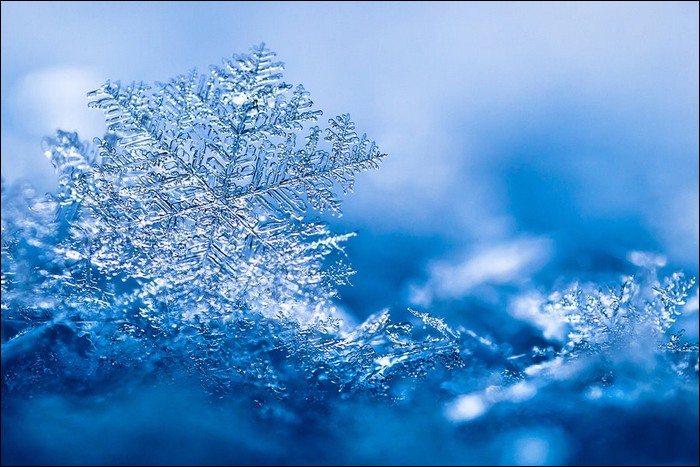
snowflakes
cover the red roses
on a new grave


© Chèvrefeuille
 

falling gently
snowflakes
fragile beauty


© Chèvrefeuille

This episode is open for your submissions tonight at 7.00 PM (CET) and will remain open until January 28th at noon (CET). I will (try to publish our next episode, a new Tokubetsudesu episode, later on.

Sunday, January 24, 2016

Carpe Diem #903 hot springs


Dear Haijin, visitors and travelers,

January is running to its end and so is our prompt-list with classical and modern kigo for winter, running towards its end. Today I have a nice prompt for you based on Jane Reichhold's "A Dictionary of Haiku", in which she gathered modern kigo for all seasons. Today the modern kigo is hot springs and maybe you can remember that we have had this prompt earlier on CDHK, because of the haiku by Basho.
A hot spring is a spring produced by the emergence of geothermal heated groundwater that rises from the Earth's crust. There are geothermal hot springs in many locations all over the crust of the earth. While some of these springs contain water that is the correct temperature for bathing, others are too hot to do so and immersion can result in injury or death. Of course in this episode the good geothermal hot springs are our theme.

Yamanaka Hot Springs

In Basho's time there were several wonderful hot springs which were frequently visited by the Japanese people and by Basho himself. One of the hot springs Basho visited was in Yamanaka. In his wonderful haibun "Oku no Hosomichi" Basho says the following about this well known hot spring in Yamanaka: 
“I enjoyed a bath in the hot spring whose marvelous properties had a reputation of being second to none, except the hot spring of Ariake.

at Yamanaka
it’s not necessary to pluck chrysanthemums
hot spring fragrance

© Basho (Tr. Jane Reichhold)

The host of the inn was a young man named Kumenosuke. His father was a poet and there was an interesting story about him: one day, when Teishitsu (later a famous poet in Kyoto but a young man then) came to this place, he met this man and suffered a terrible humiliation because of his ignorance of poetry, and so upon his return to Kyoto, he became a student of Teitoku and never abandoned his studies in poetry till he had established himself as an independent poet. It was generally believed that Teishitsu gave instruction in poetry free of charge to anyone from this village throughout his life. It must be admitted, however, that this is already a story of long ago.”

And another nice haiku which he wrote as he says farewell to his host at Yamanka hot spring:


yuno nagori   kayoi wa hada no   samukara n

tonight my skin
will miss the hot spring
it seems colder


© Basho (Tr. Jane Reichhold)


Credits: Cougar Hot Springs

Let us now take a look at the examples which Jane gives for this modern kigo.

crystal waters
warmed with the scent
of earth

ancient earth
tiredness of my old body
in hot springs

dreams
from hot mineral baths
a bright lava flow

winter night
joining us in the bath
foggy stars

© Jane Reichhold


Secret Hot Spring

It wasn't easy to create haiku with this theme in it, but I had to try it. So first I found one in my archives and I wrote two new ones.

hot springs hidden
deep inside the holy mountain
giving new life

© Chèvrefeuille (April 2014)

hidden in the forest
I ran into a secret hot spring -
Ah! that sweet scent

falling in love
while enjoying the warm water -
secret hot spring 

© Chèvrefeuille

Well ... not bad, not bad at all ...

This episode is NOW OPEN for your submissions and will remain open until January 27th at noon (CET). I will (try to) publish our new episode, 
Kazahana (snowflakes), later on. For now ... have fun, be inspired and share your haiku with us all.


Carpe Diem #902 Kangetsu (cold moon)


!!! Sorry ... lack of time, so this post is a little bit later than planned !!

Dear Haijin, visitors and travelers,

We are exploring classical and modern kigo for winter. One of the characteristic features of a haiku is the use of a kigo or seasonword. This seasonword (kigo) points towards the time of year in which the haiku was written (or seen and later written). There are a lot of kigo and those kigo are all bound together in what is called a Saijiki. Today I have a classical kigo for you  Kangetsu (cold moon), and I have a few nice haiku for you with this kigo, all written by Buson, and starting with the same line "this cold moon":


kangetsu ya kaisandoo no ki no ma yori

this cold moon -
among the trees
of the founder's hall

kangetsu ya kareki no naka no take sankan

this cold moon -
among the bare trees
three stalks of bamboo

kangetsu ya koishi no sawaru kutsu no soko

this cold moon -
the soles of my shoes
touch small pebbles

kangetsu ya matsu no ochiba no ishi o iru

this cold moon -
fallen needles of pines
shoot into stones

kangetsu ya mon o tatakeba kutsu no oto

this cold moon -
after knocking at the (temple) door
the sound of wooden clogs

kangetsu ya zoo ni yuki-au hashi no ue

this cold moon -
I meet a monk
on the bridge


© Yosa Buson
Credits: Winter Wolf

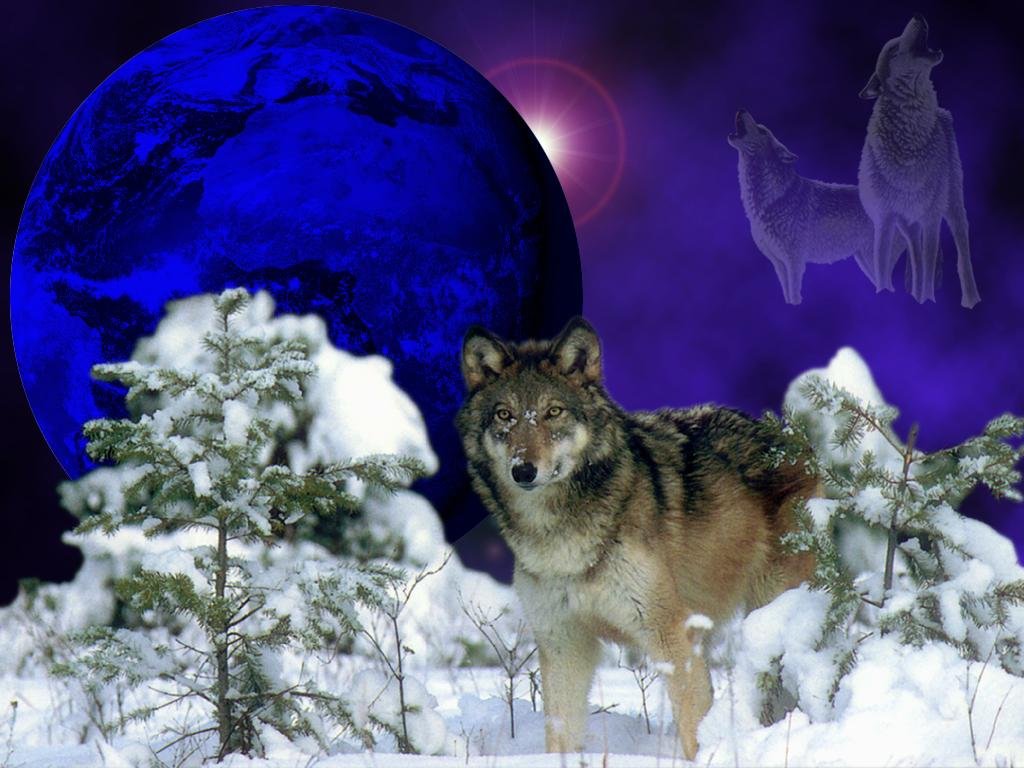
All beauties I would say and full of inspiration I think. Here is my humble try to write a haiku on Kangetsu (cold moon):

silent winter night
the full moon of January -

howling wolves


howling wolves
giving me the shivers -
praying for strength


 praying for strength
as I see the bright Wolf Moon -
silent winter night


© Chèvrefeuille

This episode is NOW OPEN for your submissions and will remain open until January 27th at noon (CET). I will (try to) post our new episode, hot springs, later on.

Wednesday, January 20, 2016

Carpe Diem #900 Daikan (Great cold)


Dear Haijin, visitors and travelers,

It's with great joy that I am preparing this new episode of Carpe Diem. Today we have our 900th regular episode of Carpe Diem and that makes me proud and humble, because I can make Carpe Diem only with your participation and input. So thank you all for being part of Carpe Diem and making it a big success.
As I started with CDHK in October 2012 I hadn't thought to be here more than three years later ... I dreamed of it, but I hadn't expected to be still alive and kicking in 2016.

Today we are going on with our classic meets modern month and today our prompt is a classical kigo for winter, daikan (great cold). Let me take you back to one of our earlier posts this month "Shoukan" (less cold):

In nature (especially on the Northern Hemisphere) January is the coldest month of winter and in Japan they have nuanced it. In Japan you have Daikan (great cold) and Shoukan (less cold).
In Japan there are a lot nuances in winter and I love to share their ideas here with you. Shoukan(less cold) fall on the 15th day after Touji(winter solstice). It is on about January the 6th. Kan(cold season) continues from Shoukan to the day before of Risshun(the first day of spring). So they (the Japanese) refer to the period of these 30 days as Kan-no-uchi(midwinter) from Kan-no-iri(beginning of midwinter) to Kan-ake(the end of cold season). Daikan(great cold) is on the 15th day, around January 20th after Shoukan. It is by far the coldest through the year. It is wrong to refer to these 15 days between Shoukan and Daikan as Shoukan. Either Shoukan or Daikan shows only one day of the twenty four designated seasonal days.

As you can read above today (as I am creating this episode) it's daikan (great cold) and it points towards the coldest moment of winter and that's around this date. So there is not much to tell about "daikan". Let's go create haiku ...

I found a nice haiku in which this classical kigo is used:

daikan no heso utsukushiku shoo kannon

the beautiful navel
of this Sacred Kannon
in the great cold

© Oishi Toyoko

"Daikan" faces to February and that means that the great cold of winter is almost gone and that we are heading for spring. This theme I found in another haiku:

coldest day of the year -
the moon lifts the tide
to overflowing

© Hoshika Katsumi 

dark blue sky
enlightened by the full moon
the coldest day gone


© Chèvrefeuille

Not as strong as I had hoped but I think it's a nice example of "daikan".

And to make a nice closure to this episode about daikan (great cold) I found another haiku about "daikan" which refers to an ancient Japanese dish for this time of year.


Credits: shimotsukare

daikan ya aji natsukashiki shimotsukare

great cold -
the nostalgic taste of
shimotsukare
*

© Koara san (Tr. Gabi Greve)

* Japanese for: to be tired of the frost

Here is a description of the dish, I could not find one word that would properly translate it ... and look at a nice haiga with it.


This episode is open for your submissions tonight at 7.00 PM (CET) and it will remain open until January 23rd at noon (CET). I will (try to) publish our new episode, a new CD-special episode, later on. Have fun!

Monday, January 18, 2016

Carpe Diem #899 beach


Dear Haijin, visitors and travelers,

As I created our prompt-list of January I made a "cocktail" of classical and modern kigo. All the classical kigo were (almost all) very clear, but those modern kigo by Jane Reichhold ... that's really something else.
As you can see/read in the title of this episode today it's about beach and I think you all will understand that I was a bit amazed as I read "beach" as a winter kigo. Here on the Northern Hemisphere I cannot see that connection of winter and beach, but on the Southern Hemisphere it must be a wonderful idea to see that beach is modern kigo for winter.

What to do with this prompt, beach, on the Northern Hemisphere where I live? Well ... I don't know, but as I read the examples given by Jane in her "A Dictionary of Haiku" (the online-version) I started to see (and believe) that "beach" can be an example of a kigo for winter. I even tried to go to the beach yesterday ... and it was really an eye-opener ...

Here are a few example haiku by Jane with this modern kigo "beach":

beach-blown
rainbows in sea foam
sand crystals

a winter's day
suddenly the sun
at a beach picnic

February sun
lying on the nude beach
fully clothed

winter beach
in thin white clouds
thoughts of snow

© Jane Reichhold

She had several other examples, but these were my favorite and especially that first example ... I can see that scene in front of me ... and I really saw that yesterday as I visited the "winter beach". Really awesome.
And than that third example ... I love to lay on a nude beach, but of course not in winter, but fully clothed walking over the nude beach has something. I just felt that I had to go bare footed there out of respect for the nude beach ... The nude beach ... gives me that feeling and if I would be there now I surely would take of my shoes and socks to feel the nude beach in winter.

bare footed
wandering about the nude beach

in heart of winter

© Chèvrefeuille

Credits: beach in winter

Not so far from my home we have a beach. It's an artificial beach, but it's beautiful. It's surrounded with trees and meadows ... and yesterday as I visited the beach with that clear blue sky after snowfall (yukibare). That steel blue sky became even more blueish. I looked around me and on the bare branches there was a dusting of snow which looked like crystals, because of the bright sunlight. That thin layer of snow started to melt and the drops became even more like diamonds ... right at that moment ... I was the richest man on earth ...

steel blue sky
on the snow covered branches
a crystal necklace

© Chèvrefeuille

This episode is open for your submissions tonight at 7.00 PM (CET) and will remain open until January 21st at noon (CET). I will try to publish our new episode, a new Tokubetsudesu episode, later on. For now .... have fun!


Sunday, January 17, 2016

Carpe Diem #898 Yukibare (clear sky between (after) snowfall)


Dear Haijin, visitors and travelers,

We have had our first snow fall last night. It was just a thin layer of snow, but it was awesome and it made me happy. Today we had that "clear sky between snowfall, yukibare, our prompt for today. I don't know if we will have more snow, but as I do believe our prompt for today yukibare (clear sky between snowfall), than we will have more snow to come. We will see. Temperature is dropping beneath zero, so maybe there is a small change that we can skate at the end of this week ... and maybe we will see more snow coming ... time will tell ...

This episode was not easy to create. I have spend a lot of time to find a few examples of haiku inwhich this classical kigo is used. Finally after a while I found some background on this kigo and a few haiku to make it somewhat clearer what this kigo means.

The winter sky in Japan differs on the side of the Japan Sea, where it snows a lot and the Pacific side, where it is usually fine and clear. So the outlook on the sky depends very much on the change of the seasonal wind direction. The high pressure (with cold air) from the North moves down toward the low pressur in the South.
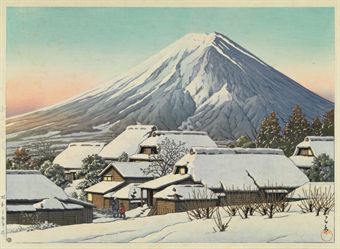
In winter the clear sky of the Pacific side lets us see Mount Fuji in all its splendor, whereas the side of the Sea of Japan is all covered in white and silver.

And here are a few examples of haiku in which yukibare is used:

after the snow
Mt. Fuji soars   
into the clear skies    

    
© Shinya Ogata


Credits: Yukibare painting by: Kawase Hasui 1944

yukibare no ushi no chibusa no man no toki

blue sky after snow
a time when milk cow’s breast
is full

© Shikyo Tomooka

yukibare ni nodumi no toudo nioikeri

fine after snow,
a smell of the kaolin
* laid
in the open air

© Takako Yana

* Kaolin, also called china clay,  soft white clay that is an essential ingredient in the manufacture of china and porcelain and is widely used in the making of paper, rubber, paint, and many other products. Kaolin is named after the hill in China (Kao-ling) from which it was mined for centuries. Samples of kaolin were first sent to Europe by a French Jesuit missionary around 1700 as examples of the materials used by the Chinese in the manufacture of porcelain.

yukibare ya hashira o yameru hitobashira

after the snow
spending the day watching
the clear blue sky


Takano Mutsuo (1947 - ) (Tr. Chèvrefeuille)

I am glad that I could create this episode, because of the difficulties I had to conquer to find examples and meaning of this classical kigo, but I think it has become a nice episode. So have fun!

This episode is NOW OPEN for your submissions and will remain open until January 20th at noon (CET). I will try to publish our new episode, beach, later on.


Saturday, January 16, 2016

Carpe Diem #897 snow viewing


Dear Haijin, visitors and travelers,

What a joy to see how you all are interactive with CDHK. I am glad to hear that you all appreciate that new feature I created "Carpe Diem Vernacular". I will publish the first episode of CD Vernacular today, but first this.
As you could have noticed I have created a new CDHK e book "Tepid and Bittersweet" in which I have gathered all the entries of our 3rd and 4th kukai. I hope you all will like this new e book. It's downloadable at the right side of our Kai.

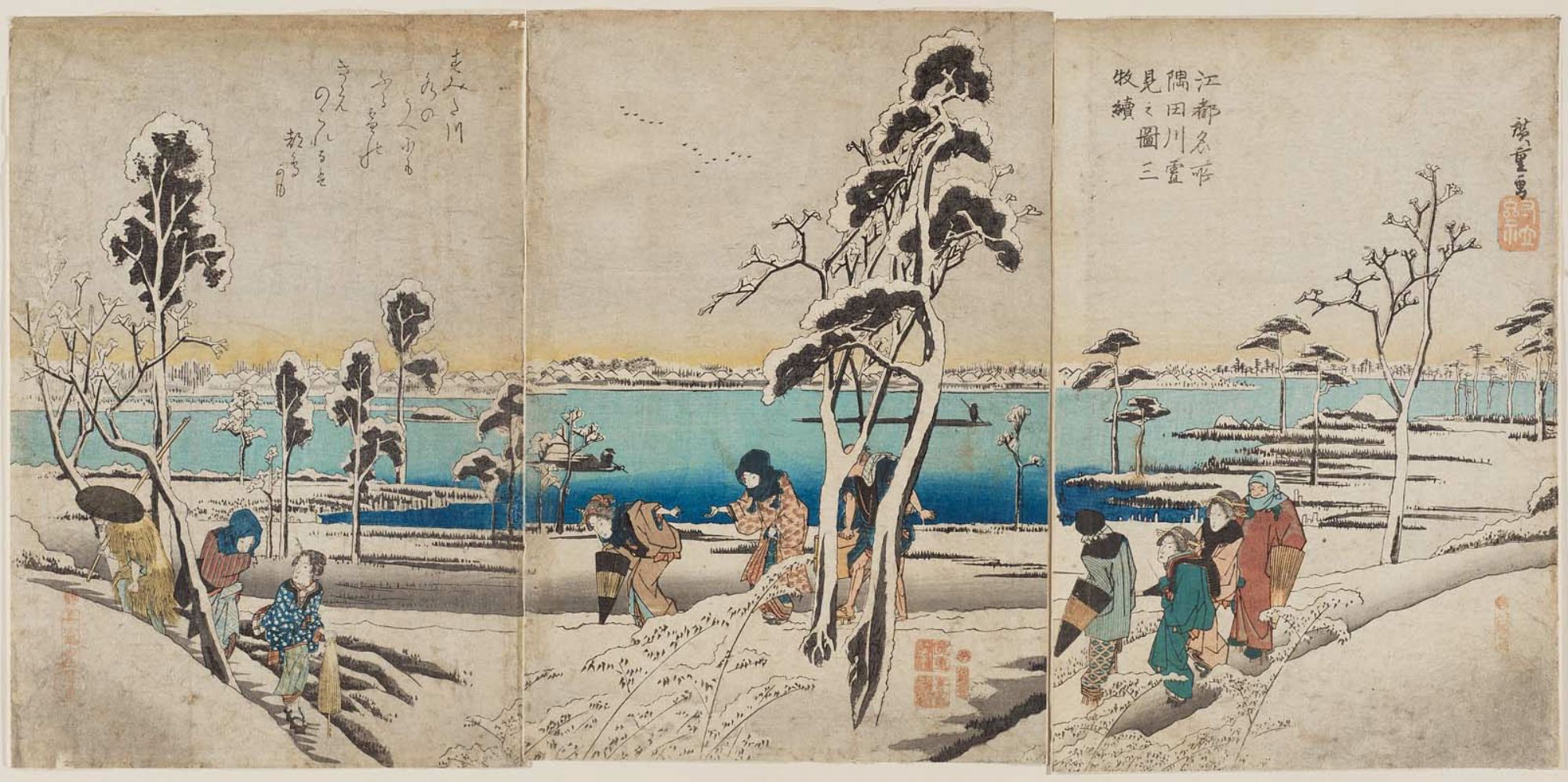
Okay ... today our prompt is snow viewing and it's based on Jane Reichhold's "A Dictionary of Haiku", so its a modern kigo (for winter). There are several examples by Jane, but I love to share first a few haiku by our classical haiku masters.

iza saraba  yukimi ni korobu  tokoro made

well then,
let’s go snow-viewing
till we all fall down

© Matsuo Basho

uma sôna yuki ya fûwari fûwari to

looking delicious
the snow falling softly
softly

yuki-guni no yuki iwau hi ya asagi-zora

a day to celebrate
snow country's snow!
a pale blue sky

© Kobayashi Issa

Credits; Snow viewing

morning snow
where can I throw away
the tea leaves?

© Chiyo-ni

furuike no oshidori ni yuki furu yuube kana

at the old pond
snow falls on mandarin ducks
in twilight

hatsuyukino sokowo tatakeba takeno tsuki

the first snow
emptying itself to its last flake--
the moon above bamboo

© Yosa Buson

All beautiful haiku inspired on the beauty of snow. Isn't that what this prompt is about? Celebrating the beauty of snow?

Here is an example by Jane Reichhold:

giant snowflakes
bring to the window
adult faces

© Jane Reichhold


Credits: Snow viewing by the Sumida River (woodblock-print by: Utagawa Hiroshige)

I am not a big fan of snow, but as it finally covers the Earth I love to step in it barefooted to feel the softness and cold of snow. It's an amazing feeling and it always looks like a fairytale. It's sad to know that through global warming we will not have lots of snow anymore here in The Netherlands. I have seen snow, but to my grandchildren snow must be a wonder ... because they haven't seen it often.

fresh fallen snow
the backyard looks like a fairytale -
on bare foot 


© Chèvrefeuille

I found a nice "modern" haiku about snow viewing written by haiku poetess Katsura Nobuko (1914-2004) and I love to share that haiku here as a kind of closure for this episode.

going snow viewing
one by one the walkers vanish
whitely falling veils


© Katsura Nobuko

I think this episode has become a nice one. So I hope it will inspire you to create all new haiku.

This episode is open for your submissions tonight at 7.00 PM (CET) and will remain open until January 19th at noon (CET). Have fun.
I will try to publish our new episode, 
Yukibare (clear sky between snowfall), later on.

Thursday, January 14, 2016

Carpe Diem #896 Neko Yanagi (pussy willow)


Dear Haijin, visitors and travelers,

We are almost through the first half of January, so our prompts of this month will become more spring-like, but are still for winter. Today I have a beautiful classical kigo for you, Neko Yanagi (pussy willow), and I think that in some regions of the world the pussy willow already starts blooming.

I searched the internet for a little background on the pussy willow, especially in the Chinese and Japanese literary world and I found a few wonderful pieces of poetry.

Li Ch'ing-Chao (1084-1151), a famous female Chinese poet, has this to say about the pussy willows:

Warm rain and soft breeze by turns
Have just broken
And driven away the chill.
Moist as the pussy willows,
Light as the plum blossoms,
Already I feel the heart of Spring vibrating.
 

Su Tung-p’o (1036-1101), the famous poet of the T'ang period, writes about the beauty of the green leaves on the willow branches in spring:

yanagi wa midori, hana wa beni
Willows stand for things green,   flowers for things red.  
Neko Yanagi (pussy willow) used as a New Year decoration
 
During the Heian period (794-1185) the court at Kyoto also adored the willows and the cherry blossoms as harbingers of Spring.

And I found a few nice haiku written by Issa and Basho:
cha no kemuri yanagi to tomo ni soyogu nari
tea steam
and willow
sway together


© Issa (Tr. Chris Drake)

haremono ni fureru yanagi no shinae kana
supple as the hands
softly touching the tumors —
willow sprays bending.


© Basho (Tr. Yuasa)


And I had to write a haiku myself with this prompt. It wasn't easy, but finally (after running through my archives) I found a nice second stanza of a Tan Renga. That stanza inspired me to write the following haiku.

tears of a geisha
her virginity lost to a soldier -
pussy willow blooms


© Chèvrefeuille
Not a real "winter-kigo" haiku I think, but in a way I like this haiku a lot ... don't ask me why, because I can not give words to that feeling I have about this haiku.
This episode is open for your submissions tonight at 7.00 PM (CET) and will remain open until January 17th at noon (CET). I will try to post our next episode, our 3rd CD Special, later on. For now ... have fun, be inspired and share your haiku with us all.  

Monday, January 11, 2016

Carpe Diem #895 Harusamu (cold spring)


Dear Haijin, visitors and travelers,

Welcome at a new episode of Carpe Diem Haiku Kai. This month we will explore classical and modern kigo (seasonwords), but first this:

As you all know I hope to start a new Renga Party soon, you can sign in to participate until January 12th 10.00 pm (CET). Later this week I hope to start with this 2nd Carpe Diem Renga Party.
Than as you have seen in one of the earlier posts the voting for the kukai "Winter" has started. I have already had several emails with points ... so don't forget to vote.
Yesterday I published a call for submissions for our second issue of Souchou, Carpe Diem's own e-zine, you can (if you like to be published in this second issue of Souchou) email your contributions to our special email-address:  carpediemhaikukaisouchou@gmail.com before March 1st 10.00 PM (CET).


Okay ... back to our episode of today. Today I have another nice classical kigo for you, Harusamu (cold spring). And this is what I found about this classical kigo for (late) winter.


Harusamu (cold spring) points towards the month February (in Japanese called: Nigatsu). Nigatsu means “footsteps of Spring”. It’s a very nice classical kigo. In classical Japan it is believed that spring starts on about February 4th, which is said to be the first day of spring. Even if the Japanese hear only the sound of the word haru (spring), they become happy and have great expectations for the coming days, though the temperature of this month is still low and it remains the coldness of winter.
The Japanese feel excited to hear the word harusamu (cold spring), even if it is cold. But the word yokan (the lingering cold of early spring) emphasizes the coldness of winter which is lingering on. As the snow begins to melt and the ice is getting thinner and thinner, the workings of animals and plants become active.

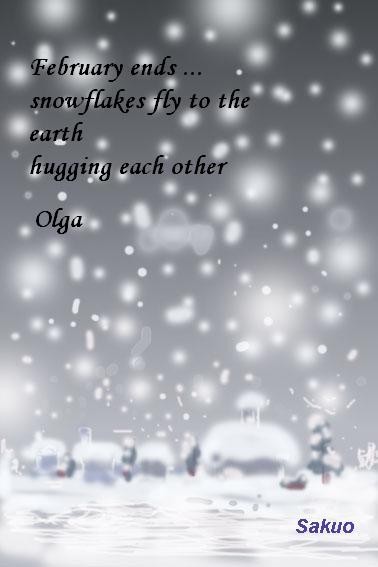
Credits: Haiku by Origa (Olga Hooper) and haiga by Nakamura Sakuo

People feel like to be released from the closed winter life, which makes them open the windows and go out.
Everyone feels the revival of life and is filled with joy, looking the scenes in which nekoyanagi (pussy willow), crocuses, katakuri (flower of dogtooth), yukiwarisou (mealy primrose), fuki-no-tou (butterbur sprout) are glittering in the sun of early spring. It is not too much to say that people have been admiring ume-no-hana (ume flower) the best since the old days. Being not only noble and beautiful but also sweet-scented, ume-no-hana, which is the first to bloom in spring, has been composed in many poems as the symbol of early spring. By seeing ume flowers, perhaps the Japanese people feel the footsteps of spring close to them.

A beautiful haiga I would say above. Here is a haiku by Issa which fits this classical kigo very well:

manroku no haru to nari keri kado no yuki

some “proper spring”
this is!
snow at the gate

© Issa (1822)

And I found a nice haiku written by Gabi Greve in which we can see this kigo also in a very nice context ... with the plum blossom. As you all maybe know the Plum blooms in late winter so this haiku fits the theme of this episode in an excellent way.

ume ichi rin ichi rin dake ja haru samushi

one plum blossom
just one blossom -
spring is still cold


© Gabi Greve

Tulip(s) in the snow

Harusamu (cold spring) ... it's that thin line between winter and spring, because in late winter it can be very cold, but it can also be very cold in early spring as is this kigo saying. I have looked into my archives to find haiku which are fitting this kigo, harusamu (cold spring) and I found a few nice haiku published once on my own personal weblog and here on Carpe Diem Haiku Kai. So it is possible that you have read these haiku earlier.

first snow of the year
covers fragile blossoms
tears in my eyes

such a sad event
young cherry blossoms frozen
in a cold spring night

Tulips in the snow
coloring a white blanket -
returning cold

© Chèvrefeuille

I hope you did like this episode. This episode is NOW OPEN for your submissions and will remain open until January 14th at noon (CET). I will (try to) publish our next episode, a new Tokubetsudesu episode, later on. I hope I will have the time, because I am in the nightshift the upcoming nights.