Carpe Diem Haiku Kai is the place to be if you like to write and share Japanese poetry forms like haiku and tanka. It’s a warmhearted family of haiku poets created by Chèvrefeuille, a Dutch haiku poet. Japanese poetry is the poetry of nature and it gives an impression of a moment as short as the sound of a pebble thrown into water. ++ ALL WORKS PUBLISHED ARE COPYRIGHTED AND THE RIGHTS BELONG TO THE AUTHORS ++ !!! Anonymous comments will be seen as SPAM !!!
Pages
- Home
- Carpe Diem Lecture 1
- Carpe Diem Lecture 2
- Carpe Diem's Library
- Carpe Diem's Kukai ...
- All My Years a tribute CDHK E-book for Jane Reichhold
- TROIKU, A new form of haiku
- Preview CDHK E-book "Flamingo Clouds" Troiku
- Tan Renga the short linked chain of two stanza
- Preview "Chained Together" an anthology of Tan Ren...
- Prompt Suggestions
Showing posts with label senses. Show all posts
Sunday, October 22, 2017
Carpe Diem #1286 Love
Dear Haijin, visitors and travelers,
Welcome at a new episode of CDHK. I hope you have all enjoyed your weekend and of course I hope the music I shared has inspired you all to create haiku, tanka or another Japanese poetry form. I am a little bit behind with commenting, but I hope to visit your posts a.s.a.p.
Today I have a wonderful prompt for you, love. It is taken form February 2016. That month the prompts were all created bij our pirate Hamish Managua Gunn. All the prompts that month had to do with our senses and ... I think it was a wonderful month.
Love ... not actually a feeling that you will expect in haiku, because love is more the terrain of tanka (or waka), but I think that haiku can be a love poem too. I even think I have said that more often here at CDHK.
Love is one of the strongest senses we have. Love for someone, love for e.g. reading and painting, but also love for nature. That love is the most important for haiku. Haiku is known as the poetry of nature and to create them you have to love nature, being in close contact with nature.
I love to share a quote from one of the Tokubetsudesu episodes:
[...] "Haiku is love, a love that grabs you by the throat and takes you into an adventure to discover the beauty of our world in all her beautiful details and bring that into the tiny form of haiku that shows us a scene, a moment that lasts only one heart beat." [...]
And here to introduce love ... a haiku which I wrote several years ago:
the last steps taken
to find universal love -
the sound of rain
© Chèvrefeuille (2014)
Well ... enough for your inspiration I think. The episode by Hamish that mentioned was published on February 24th 2016. Sure worth to read again. The above haiku is extracted from that episode.
This episode is open for your submissions tonight at 7:00 PM (CET) and will remain open until October 29th at noon (CET). I will try to publish our new episode, Ireland, later on. For now ... have fun!
Sunday, February 28, 2016
Carpe Diem #928 Extra-Sensory Perception (and Common Sense)
Dear Haijin, visitors and travelers,
Well ... this is it, our last episode of February, a last chance to sharpen your senses. This month was very special, we had our first Theme Week and we had all wonderful essays by Hamish, who also was our featured haiku poet this month.
I love to thank Hamish for his hard work and interesting essays for our Haiku Kai. Thank you Hamish.
Today our last episode Extra-Sensory Perception (and Common Sense) is a nice one and I hope it will inspire you all to write new verses.
Hamish on Extra-Sensory Perception (and Common Sense)
Ever answer a phone call, only to hear the person you were just thinking of on the other end? Ever had a dream about something that later actually happened? Ever felt like somebody read your mind? Some people may interpret these sorts of experiences as extrasensory perception, or ESP. ESP is defined as an awareness of the world that occurs through some mechanism other than the known senses — mind reading, sensing when a far-off friend is in trouble, foreseeing the future, and other phenomena more commonly associated with illusion artists than with science. So what does science have to say about ESP? Though ESP might not seem like something scientists would examine, the results of ESP — knowledge of events in the world — are well within the realm of science, and so we can use the tools of science to study phenomena sometimes attributed to ESP.
![]() |
| ESP-Cards |
Using these tools, scientists have studied whether ESP exists. Their experiments have explored all kinds of ESP, but most have focused on mind reading. In the most typical of these experiments, one person, the sender, goes through a deck of cards, each depicting one of five symbols (like a star or cross), while another person, the receiver, tries to determine what symbol the sender is looking at. To eliminate any tips from body language, the sender is often shielded from view. If the receiver were to correctly identify the symbol more often than could be explained by chance, it would suggest that ESP does indeed exist. However, researchers have found that receivers aren't particularly accurate in these experiments; no evidence of mind reading or any other sort of ESP has been found.2 Since science hasn't uncovered any evidence that ESP even exists, no scientific investigations of its potential mechanisms have been undertaken.
ESP itself
is neither scientific nor unscientific — but it can be studied scientifically
or unscientifically, and scientific studies. Those who ignore the evidence and
insist that ESP is a real, natural phenomenon fail to meet one of the key
aspects of scientific behavior: assimilating the evidence. But maybe these
people are looking from the wrong direction, that of Common Sense, which
although relies on facts and logical outcomes, misses much for many of the same
reasons. Would it not be better to look at the prism of ESP with an open mind,
given what we already know about the senses in nature?
So now,
your hardest haiku yet, an ESP haiku! Focus on Carpe Diem. What kind of haiku
do you think Carpe Diem Haiku Kai would like from you? Write it.
My response
This was really a challenging essay and Hamish's question at the end of his essay I didn't expect ...
I like to see all of your responses on this question, before I will respond myself ...
This episode is NOW OPEN for your submissions and will remain open until March 2nd at noon (CET). I will (try to) publish our new episode later on.
Labels:
anata no kankakuwo migaku,
Carpe Diem,
haiku,
Hamish Gunn,
senses
Location:
Nederland
Saturday, February 27, 2016
Carpe Diem #927 Synesthesia
Dear Haijin, visitors and travelers,
February is running towards it end and we have just two episodes to go and than ... a new month will start however I can not publish our new prompt-list, because I haven't yet created it. I hope to publish it late Sunday February 28th.
Today we are going on with sharpening our senses and this time it's all about synesthesia and I will only "do" the essay by Hamish in this episode, because of lack of time. So here is his essay.
Hamish on synesthesia
Synesthesia
is a neurological phenomenon in which stimulation of one sensory or cognitive
pathway leads to automatic, involuntary experiences in a second sensory or
cognitive pathway.
Difficulties
have been recognized in adequately defining synesthesia: Many different
phenomena have been included in the term synesthesia ("union of the
senses"). A more accurate term may be ideasthesia.
In one
common form of synesthesia → color synesthesia or color-graphemic synesthesia,
letters or numbers are perceived as colored. In spatial-sequence, or number
form synesthesia, numbers, months of the year, and/or days of the week elicit
precise locations in space, or may appear as a three-dimensional map (clockwise
or counterclockwise).
Only a
fraction of types of synesthesia have been evaluated by scientific research.
Synesthesia was the topic of intensive scientific investigation in the late
19th and early 20th centuries. Psychological research has demonstrated that
synesthetic experiences can have measurable behavioral consequences, and
functional neuroimaging studies have identified differences in patterns of
brain activation. Many find that synesthesia aids the creative process.
Buddhist
literature, both sutra and tantra, contains extensive discussions on mind and
its nature. Tantra, in particular, discusses the various levels of subtlety of
mind and consciousness. Tantric literature is replete with references to the
various subtleties of the levels of consciousness and their relationship to
such physiological states as the vital energy centers within the body, the
energy channels, the energies that flow within these and so on. The tantras
also explain how, by manipulating the various physiological factors through
specific meditative yogic practices, one can effect various states of
consciousness. Synesthesia is said to be the state shamans reach when going
into a trance. See if you can write your shaman haiku, meditating a bit first,
perhaps, or if you have shaman feelings, going into a trance! Now is the time
for your shaman haiku!
![]() |
| Fly Like An Eagle |
My response
I love the idea of shaman-haiku and I have written several of them. I love to share a few here as a response on this essay by Hamish.
resonating
drums
the five saints ... impressive beauty
spirit world opens
the five saints ... impressive beauty
spirit world opens
whispering
leaves
telling all wisdom of the steppes -
cry of an eagle
telling all wisdom of the steppes -
cry of an eagle
And a cascading haiku:
lying down
on my back
watching the deep blue night sky -
feeling my spirit
watching the deep blue night sky -
feeling my spirit
feeling my
spirit
wishing to be free forever
like an eagle
wishing to be free forever
like an eagle
like an
eagle
free and high in the blue sky
my Inner Path
free and high in the blue sky
my Inner Path
©
Chèvrefeuille
This episode is open for your submissions tonight at 7.00 PM (CET) and will remain open until March 1st at noon (CET). I will try to publish our last episode of this month, Extra-Sensory
Perception (and Common Sense), later on.
Labels:
anata no kankakuwo migaku,
Carpe Diem,
haiku,
Hamish Gunn,
senses,
shaman haiku
Location:
Nederland
Wednesday, February 24, 2016
Carpe Diem #925 Love
Dear Haijin, visitors and travelers,
Earlier this day I published a new CDHK e-book on Troiku, you can download it for free at the right side of our Kai. I think it has become a beauty ... I wish you all a happy read ...
Today our new episode on senses is Love and earlier this month we had an episode of Tokubetsudesu about love ... so maybe this continues that post or opens your eyes to look in another way at love. I did like the essay on love which Hamish wrote.
Introduction
I love to share a quote from the above mentioned Tokubetsudesu episode:
[...] "Haiku is love, a love that grabs you by the throat and takes you into an adventure to discover the beauty of our world in all her beautiful details and bring that into the tiny form of haiku that shows us a scene, a moment that lasts only one heart beat." [...]
And here to introduce love ... a haiku which I wrote several years ago:
the last
steps taken
to find universal love -
the sound of rain
to find universal love -
the sound of rain
©
Chèvrefeuille (2014)
Hamish on love
Is love an
emotion? If this was so, would it not change constantly, like other emotions?
The concept of love might be chemical, and scientific, but it could also be
defined as one of the senses. "What is love" was the most searched
phrase on Google in 2012. Biologically, love is a powerful neurological
condition like hunger or thirst, only more permanent. We talk about love being
blind or unconditional, in the sense that we have no control over it. But then,
that is not so surprising since love is basically chemistry. While lust is a
temporary passionate sexual desire involving the increased release of chemicals
such as testosterone and oestrogen, in true love, or attachment and bonding,
the brain can release a whole set of chemicals: pheromones, dopamine,
norepinephrine, serotonin, oxytocin and vasopressin. However, from an
evolutionary perspective, love can be viewed as a survival tool – a mechanism
we have evolved to promote long-term relationships, mutual defense and parental
support of children and to promote feelings of safety and security.
![]() |
| Spiritual Love |
Unlike us,
the ancients did not lump all the various emotions that we label
"love" under the one word. They had several variations, including
Philia which they saw as a deep but usually non-sexual intimacy between close
friends and family members or as a deep bond forged by soldiers as they fought
alongside each other in battle. Ludus describes a more playful affection found
in fooling around or flirting. Pragma is the mature love that develops over a
long period of time between long-term couples and involves actively practicing
goodwill, commitment, compromise and understanding. Agape is a more generalized
love, it's not about exclusivity but about love for all of humanity. Philautia
is self love, which isn't as selfish as it sounds. As Aristotle discovered and
as any psychotherapist will tell you, in order to care for others you need to
be able to care about yourself. Last, and probably least even though it causes
the most trouble, eros is about sexual passion and desire. Unless it morphs
into philia and/or pragma, eros will burn itself out. Love is all of the above.
But is it possibly unrealistic to expect to experience all six types with only
one person. This is why family and community are important. What love is
depends on where you are in relation to it. Secure in it, it can feel as
mundane and necessary as air – you exist within it, almost unnoticing. Deprived
of it, it can feel like an obsession; all consuming, a physical pain.
![]() |
| Love ... renew it every day ... |
Love is the
driver for all great stories: not just romantic love, but the love of parent
for child, for family, for country. It is the point before consummation of it
that fascinates: what separates you from love, the obstacles that stand in its
way. It is usually at those points that love is everything. Love is more easily
experienced than defined. Can you show love through a haiku?
My response
Love ... we all know what it is and what it can be ... Love can be caught in haiku too. Here are a few haiku from my archives to show that love can be caught in haiku.
watching a
geisha
monk from high up in the mountains
he's also a man
monk from high up in the mountains
he's also a man
©
Chèvrefeuille
she ... the
moon
affectionate love for ever
illuminates my path
affectionate love for ever
illuminates my path
© Chèvrefeuille
She ... the
moon ... once it was said that same gender love belonged to the night, they had
to hide, so their love was only seen in the light of the full moon. She ... the
moon ... their only friend.
affectionate
love
shared between two similar hearts
in full moonlight
they finally could kiss each other
She ... the moon ... their only friend
shared between two similar hearts
in full moonlight
they finally could kiss each other
She ... the moon ... their only friend
©
Chèvrefeuille
As I look at our time now, than we see / hear here in The Netherlands that same gender love is accepted, but there are growing signs that the acceptance of same gender love is in heavy waters. Let us hope (and pray) that this will not be a time in which unconditional love will be lost forever ...
This episode is NOW OPEN for your submissions and will remain open until February 27th at noon (CET). I will (try to) publish our next episode, nature, later on. For now ... have fun!
Labels:
anata no kankakuwo migaku,
Carpe Diem,
haiku,
Hamish Gunn,
love,
senses
Location:
Nederland
Tuesday, February 23, 2016
Carpe Diem #924 humour (reprise)
Dear Haijin, visitors and travelers,
As you can see above we are having a "reprise" episode of humour and Hamish has written this essay especially for this publication, because we both were not aware of the double prompt, so Hamish wrote an all new essay on humour which I will share beneath.
Introduction
This month we are exploring and sharpening our senses together with Hamish Managua Gunn (a.k.a. Pirate). He provides us with all the posts this month together we Ese and me.
Today we are exploring humour and as I have told you in an earlier post ... I am not a haiku poet who uses humour in his haiku. Of course I have tried it and you could have read those haiku in earlier posts at CDHK. Today, however, I love to share (in tune with Hamish's essay) a tanka inspired on clowns or in this case ... a so called Merry Andrew:
painted
face
hides his sad life -
merry-andrew
every day again wearing his mask
making the world laugh
hides his sad life -
merry-andrew
every day again wearing his mask
making the world laugh
© Chèvrefeuille
Hamish on humour
A sense of humor,
and the sense of the absurd . well, they are topics to vast to cover in just
one post, and on this second one, we should look a little behind humor to see what
it might be. In fact, that question can be answered in one sentence: humor is
tragedy.
The best
way to explore that concept is by exploring the clown. Let's see if we can
write haiku about the clown to show the different ''sides'' of humor. To outline
this post please play the music in the video below while you read, to perhaps
put you in the mood. Funnily enough, while choosing a version of this song, I
finally settled on one without singing, as I thought the piano conveyed the
mood beautifully, as well as who was playing it.
There is so much we can identify with in a circus clown - and so much we can identify about our cultures, and about life. In many ways, the topic of ''clown'' begs for an extraordinary haiku. How can we capture that pathos, the jester, joker, who paints on his happy face, bounds out into the circus ring to laughter and applause and then after the show sits in his empty caravan wiping the paint off.
There is a
certain male identity with being clown,
and female clowns have been very rare in history. That is nothing to be ashamed
of - on the contrary, because the clown sometimes shows us characterizations of
the male psyche.
For your
haiku about humor today, focus on a clown, and see how you are able to portray
him, or her. This is a difficult haiku, as a dose of too much sadness takes us
too far down the road of sentimentalism, yet a haiku about only a laughing
clown seems to lack depth.
It is a
difficult challenge, but I think a fascinating one for many reasons.
![]() |
| Clown (Original Oil on Board Painting) |
I thought I
would try a couple here, to see what I could come up with. When I think of all
the famous portrayal of clowns, from Jack Nicholson in Batman, to an
inexplicable Ronald McDonald, Charlie Chaplin, Marcel Marceau, and so many in
the circuses and TV shows of our youth, I can see a lot of material as
reference.
the show is
over
a clown stands in the night rain
make-up dripping off
a clown stands in the night rain
make-up dripping off
I wanted to
get autumn into that haiku, thus the rain, but found it hard to really get to
grips with the pathos.
at her
caravan
the clown offers a red rose
the acrobat laughs
the clown offers a red rose
the acrobat laughs
Well I
managed to get those syllables down - good thing, too, the first versions were
a rambling tale. I kind of want to put ''just'' after ''acrobat'' in the last
line, but it doesn't feel like a ''haiku word'' to me, and may just push the
haiku too far. Your turn now. I look forward to reading what you come up with,
in this theme.
![]() |
| Venice Carnival |
I love clowns, but I also feel the double-life in a clown. The most clowns are hiding their life behind their mask and that inspired me to write the following cascading haiku (with a twist at the end):
dark green
eyes
hidden behind a mask -
she's mysterious
hidden behind a mask -
she's mysterious
she's
mysterious
breathtaking glamorous mask
attractive force
breathtaking glamorous mask
attractive force
attractive
force
mystical and magical
who is she?
mystical and magical
who is she?
who is she?
thrills of unmasking at midnight
exposed to the world
thrills of unmasking at midnight
exposed to the world
she turns into a man with
dark green eyes
dark green eyes
© Chèvrefeuille
I hope you did like this reprisal of humour and I hope it will inspire you too as it did Hamish and me.
This episode is open for your submissions tonight at 7.00 PM (CET) and will remain open until February 26th at noon (CET). I will try to publish our new episode, a new episode of our special feature Tokubetsudesu, later on.
PS. Something went wrong I think, because I am a day behind with creating the posts, must be due the nightshift. My excuses for this inconvenience.
Labels:
anata no kankakuwo migaku,
Carpe Diem,
haiku,
Hamish Gunn,
senses
Location:
Nederland
Monday, February 22, 2016
Carpe Diem #923 desire
Dear Haijin, visitors and travelers,
Another nice episode about senses provided by Hamish. During lack of time I will only publish his essay about desire and that essay is a wonderful one which he created together with Ese of Ese's Voice. Here is the essay on desire.
Hi
everyone, Ese here for this post:
For the
topic of 'Sense of Desire,' I was asked to submit the first page of my planned
upcoming book, 'Butterfly Thy Name.' Please find the (true) story's start
below, and use this as your inspiration for your haiku!
I rarely
get the butterfly effect deep inside me that I feel when I see Ponto Veccio in
Firenze, or walk through the small street labyrinths of Rome. Yet I felt them,
too, when I stood barefoot on the warm beach, Porto’s heritage, with its
vintage trams and red roofs, its cobblestones and orange trees behind me, and
the ocean breathing in my face. The sea at Porto that awoke me, and set my
senses free was an indigo dream, a deep blue on the edge of Europe, as far from
Latvia one can get without jumping continents. This sea that frothed on the
beach and pulled back, sliding with a shushing sound around my toes, with its
accompanying breeze that wrapped my hair around my face, lulled me into the
belief that I could sail oceans, and hushed me when my thoughts became too
practical. Instead I watched the horizon beyond the villas pressed against
seashore, blinking with the lights of Porto in the dusk, and let the sea air
play.
I felt
exhilarated, and far from the distant meadows of scented grass beneath me, in
those summers of long Baltic days and short thunderstorm bursts, that soaked to
the seams of my dress. And in those early summer mornings, when the last
dewdrop on a blade of grass had yet to fall, I dreamt so often of journeys, a
desire rippling, dawned, as the last notes of a strummed guitar by the embers
of another campfire faded, a need, yearn for adventure, to lie back and be
swept up, taken. At those moments, with sun rays reaching from as far as I
could see, I knew that for those flutters of beautiful, exotic butterflies I
needed to seek the summers of horizons unseen.
When the
tides came in I was drinking coffee, the sea air spraying me, across the
magnificent beach. The fishermen jumped from the boats riding up onto the
beaches. They wore overalls and big boots, their chests bare, and pulled the
fishing boats up onto the wet sand with capable arms. The masculine view
rippled through me, and goosebumps sprinkled on my skin in a chilly sort of
way. I did not avert my gaze, as they wrapped up ropes, fishing nets and boxes,
before walking up the beach past me. It took one glance from one of the men,
his overalls loose and strapped on one shoulder over his bare chest. Just that
one glance and smile in those charcoal eyes for me to feel that warm desire
between my legs...
over to you!
![]() |
| Credits: desire |
Well ... I hope you have enjoyed the read and of course I hope it will inspire you to create an all new haiku in which desire is caught.
I ran through my archive and I found a nice tanka, which fits this prompt very well I think:
Lilies of
the valley
their sweet perfume makes me drowsy
hot summer night
between silken sheets her warmth
honeysuckle coolness
their sweet perfume makes me drowsy
hot summer night
between silken sheets her warmth
honeysuckle coolness
This episode is NOW OPEN for your submissions and will remain open until February25th at noon (CET). I will try to publish our new episode, humour, later on.
Labels:
anata no kankakuwo migaku,
Carpe Diem,
Ese's Voice,
haiku,
Hamish Gunn,
senses
Location:
Nederland
Saturday, February 20, 2016
Carpe Diem #922 sight (colors)
Dear Haijin, visitors and travelers,
February is running to its end and we are facing the last week of this month of CDHK in which we discovered the beauty of our senses and tried to sharpen them. Today we are looking at sight (colors). As we look around us we see the beauty of our world, mostly full of colors, but for those who are color-blind, the world is only red and green if they are partial color-blind, but if they are 100% color-blind their world is black and white ...
Introduction
I am lucky, because I can see all colors, but (and that's maybe a kind of color blindness too) I like black and white photographs, because black and white shows no differences, every one and everything looks alike and that is awesome ... maybe in a way ... this refers to compassion, as was the theme of todays Theme Week post.
fresh
fallen snow
sprinkled with the colors of autumn
everlasting
sprinkled with the colors of autumn
everlasting
A rainbow. A rose. A beautiful view over a landscape. A sunset. Where would we be without sight? And yet, NLP — Neuro-Linguistic Programming maintains that we are divided into 3 categories as people, predominantly Visual,Auditory (sound) and Kinesthetic (moving/touch/feeling). Are we all predominantly Visual, using sight as our 'main' sense? Well, take this short quiz we have devised and find out!
The minimum points for each answer is 0 — The maximum points for each answer is 5 — you may choose any number between 0 and 5 as many times as you want while answering. 5 indicates strong agreement.
VAK Survey
Section One — Visual
_____ 1. I draw mind maps when taking notes.
_____ 2. When talking to someone else I have a difficult time understanding those who do not maintain good eye contact with me or at least glance often.
_____ 3. I doodle when talking on the phone, or draw pictures.
_____ 4. When reading a novel, I pay a lot of attention to passages that picture the clothing, description, scenery, setting, etc.
_____ 5. I need a map for directions, drawn or printed, so that I can remember them.
_____ 6. I need to see the person I am taking to in order in order to keep my attention focused on the subject.
_____ 7. When meeting a person for the first time, I notice the style of dress, visual characteristics, and neatness first.
_____ 8. When I am at a party, one of the things I love to do is stand back and people-watch.
_____ 9. When recalling information I can see it in my mind and remember where I saw it.
_____ 10. If I had to explain a new procedure or technique, I would prefer to use lots of visuals.
_____ 11. In my free time I am most likely to watch television or read.
_____ 12. If my boss has a message for me, I am most comfortable when she sends a memo.
Total For Visual _______ (note: the minimum is 0 and maximum is 60)
Section Two — Auditory
_____ 1. When I read, I read out loud or move my lips to hear the words in my head.
_____ 2. When talking to someone, I have a difficult time understanding those who do not talk or respond with me.
_____ 3. I do not take a lot of notes but I still remember what was said. Taking notes often distracts me from the speaker.
_____ 4. When reading a novel, I pay a lot of attention to passages involving conversations, talking, speaking, dialogues, etc.
_____ 5. I like to talk to myself when solving a problem or writing.
_____ 6. I can understand what a speaker says, even if I am not focused on the speaker.
_____ 7. I remember things easier by repeating them over and over.
_____ 8. When I am at a party, one of the things I love to do is talk in-depth about a subject that is important to me with a good conversationalist.
_____ 9. I prefer to receive information from the radio, rather than read a newspaper.
_____ 10. If I had to explain a new procedure or technique, I would prefer telling about it.
_____ 11. With my free time I am most likely to listen to music.
_____ 12. If my boss has a message for me, I am most comfortable when he or she calls me on the phone.
Section Three — Kinesthetic
_____ 1. I am not good at reading or listening to directions. I would rather just start working on the task or project at hand.
_____ 2. When talking to someone, I have a difficult time understanding those who do not show any kind of emotional or physical support.
_____ 3. I take notes, but I rarely go back a look at them.
_____ 4. When reading a novel, I pay a lot of attention to passages revealing feelings, moods, action, drama, etc.
_____ 5. When I am reading, I move my lips.
_____ 6. I often exchange words, such as places or things, and use my hands a lot when I can’t remember the right thing to say.
_____ 7. My desk appears disorganized.
_____ 8. When I am at a party, one of the things I love to do is enjoy the activities such as dancing, games, and totally losing myself in the action.
_____ 9. I like to move around. I feel trapped when seated at a meeting or a desk.
_____ 10. If I had to explain a new procedure or technique, I would prefer actually demonstrating it.
_____ 11. With my free time I am most likely to exercise.
_____ 12. If my boss has a message for me, I am most comfortable when she talks to me in person.
SCORING PROCEDURES
Please put your scores down, and relate your scores to your personal experience. Why is it that when you are asked to bring home potatoes you never do? Is it because you were only and orally asked, not given a paper with ‘’potatoes! don't forget!’’ on it to look at? What other situations have you noticed where communication has been less than successful?
VISUAL ________ AUDIO_________ KINESTHETIC_________
Well, even if you do not score predominantly Visual, write a haiku that shines in different colors or hues. If you are not predominantly Visual, or are predominantly another sense on the VAK scale, it is useful to know, as you may be using too much of one of the 3 senses in your haiku.
Well .... a extraordinary post this time. What was the outcome of your NLP related test?
My response
![]() |
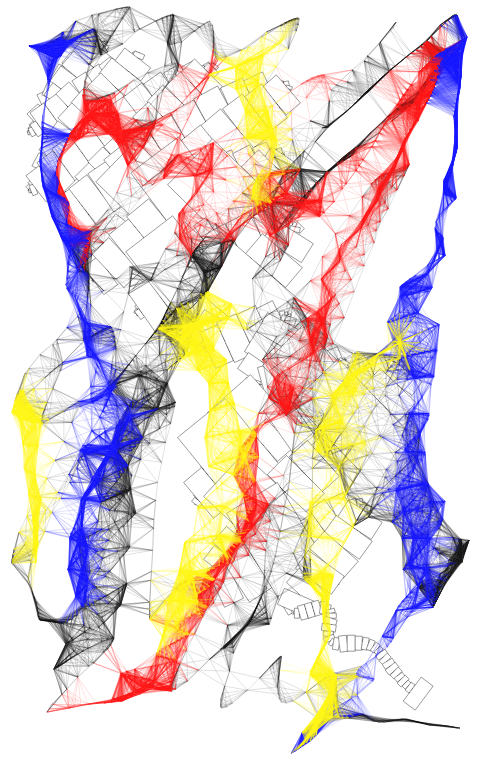
| My interpretation of Mondriaan (art work © Chèvrefeuille) |
My response
Sorry I didn't take the test, but I think I use all my senses, not only in my daily life, but also in my haiku. Here are a few examples of haiku from my archive:
waterfall
of colors
leaves whirl through the street -
departing summer
leaves whirl through the street -
departing summer
deep
silence
sunbeams breaking through the water -
the silence deepens
the silence deepens
colorful
leaves
everywhere I look ... autumn -
Ah! that sweet perfume
everywhere I look ... autumn -
Ah! that sweet perfume
through the
open window
riding along with the cold winter wind
the scent of Forsythia
riding along with the cold winter wind
the scent of Forsythia
©
Chèvrefeuille
This episode is NOW OPEN for your submissions and will remain open until February 23rd at noon (CET). I will (try to) publish our next episode, Hamish's 4th CD Special, later on.
Labels:
anata no kankakuwo migaku,
Carpe Diem,
haiku,
Hamish Gunn,
Mondriaan,
senses
Location:
Nederland
Friday, February 19, 2016
Carpe Diem #921 Absurdity / Humor
Dear Haijin, visitors and travelers,
Welcome at a very delayed episode of our regular CDHK prompts in which we are exploring the senses together with Hamish Gunn.
Here at CDHK the prompt "absurdity / humor" has been listed earlier in our existence and maybe you can remember that I am not a haiku poet who uses humor and absurdity in his haiku, so I am looking forward to your responses.
Introduction
Of course I have tried to write haiku with a kind of humor in it. Before I met Jane Reichhold I would call those haiku, senryu, but "senryu" is not a broad accepted name.
it's a
strange sight
like a waterfall they fall
drunken sailors
like a waterfall they fall
drunken sailors
along the
seashore
hand in hand with the love of my life
a seagull shits on my head
hand in hand with the love of my life
a seagull shits on my head
©
Chèvrefeuille
![]() |
| Absurdity / Humor |
Hamish on Absurdity / Humor
Humor comes in many flavors, any of which may appeal to one person but not to another, and which may be enjoyed in alternation or in combination. Here are names and descriptions of the different kinds of humor:
Anecdotal -
refers to comic personal stories that may be true or partly true but
embellished.
Blue -also
called risque or broad humor, which
refers to unrestrained, unsubtle humor often marked by coarse jokes and sexual
situations.
Burlesque,
or Slapstick - Ridicules by imitating with caricature, or exaggerated characterization.
Deadpan/Dry
- Delivered with an impassive, expressionless, matter-of-fact presentation.
Farcical -
Comedy based on improbable coincidences and with satirical elements, punctuated
at times with overwrought, frantic action.
High/highbrow
- Humor pertaining to cultured, sophisticated themes.
Droll, or
Ironic/Absurd - Humor involving incongruity and discordance with norms, in
which the intended meaning is opposite, or nearly opposite, to the literal
meaning.
Mordant -
Caustic or biting humor
Parodic -
Comic imitation often intended to ridicule an author, an artistic endeavor, or
a genre.
Self-deprecating
- Humor in which performers target themselves and their foibles or misfortunes
for comic effect.
Stand-up -
A form of comedy delivery in which a comic entertains an audience with jokes
and humorous stories.
Writing a humorous
haiku is no easy task. But it is worth trying, and giving your haiku humor,
using perhaps one of the techniques outlined above.
My response
Humor ... not really my "cup of tea", but as you could read above I have tried to write haiku with humor in it. Here is another attempt and I think it's in the "anecdotal" way:
proud like
a peacock
the businessman steps around
stumbles over the sill
the businessman steps around
stumbles over the sill
©
Chèvrefeuille
This episode is NOW OPEN for your submissions and will remain open until February 22nd at noon (CET). I will (try to) publish our next episode, sight (colors), later on. By the way, our next episode of our first CDHK Theme Week I will publish also later today, sorry for the delay.
Labels:
anata no kankakuwo migaku,
Carpe Diem,
haiku,
Hamish Gunn,
humor,
senses
Location:
Nederland
Wednesday, February 17, 2016
Carpe Diem #920 Hunger (Empathy)
Dear Haijin, visitors and travelers,
It's my pleasure to bring another episode of Carpe Diem to you. It's also a pleasure for me to announce that Chèvrefeuille's Publications soon will be publishing our new CDHK E-book by Hamish Managua Gunn. Hamish has already send me his concept and we are busy to create his E-book together. Hamish has chosen to share kikôbun with you all. In his last CD-Special you all have been introduced already to kikôbun. I am looking forward to his CDHK E-book.
![]() |
| Food For Thought (© unknown) |
Introduction
Today I will follow the same structure as I do this whole month, but this time my introduction is different, because I love to share a tanka which I created as I saw the above photo.
This is a
very touching photo, so full of pain and misery, but also full of love. As I
see it ... this young boy has to take care for his younger brother or sister.
They have no place to go. Maybe they have lost their parents through hunger or
war.
near starvation
living on the streets of the world
brotherly love
stronger than ever struggling together
fighting against hunger
© Chèvrefeuille
living on the streets of the world
brotherly love
stronger than ever struggling together
fighting against hunger
© Chèvrefeuille
Hamish on Hunger (Empathy)
There are
795 million undernourished people in the world today. That means one in nine
people do not get enough food to be healthy and lead an active life. Hunger and
malnutrition are in fact the number one risk to health worldwide — greater than
AIDS, malaria and tuberculosis combined. The good news is that hunger is
entirely solvable. There is enough food in the world to feed everyone and no
scientific breakthroughs are needed. Today’s knowledge, tools and policies,
combined with political will, can solve the problem.
Solving
hunger is a “best buy” in today’s tough economy. When nations work together to
solve hunger and invest in good nutrition, they increase productivity and
create economic opportunities. Conversely, studies have shown that countries
lose millions of dollars in economic output as a result of child under nutrition.
Solving hunger is also a contribution to peace and stability. When governments
can no longer guarantee adequate food supplies, states are prone to fall.
Volatility on food markets can quickly translate into volatility on the
streets.
Finally,
solving hunger lays the foundation for progress in many other areas of
development, including health and education. Well-nourished women have
healthier, heavier babies whose immune systems are stronger for life. A
healthy, well-fed child is also more likely to attend school.
Good
progress was made in reducing chronic hunger in the 1980s and the 1990s, but
progress began to level off between 2000 and 2010. All of us – citizens,
employers, corporate leaders and governments – must work together to end
hunger.
Your haiku
today does not need to be about the sense of hunger, but it should show
empathy, which is another way of being at one with your topic or theme.
My response
Hm ... how to catch this in a haiku or tanka? Not an easy task, but here is my tanka, I think tanka is the best poetry form for this theme:
a homeless man
seeking for food
in the garbage
I invite him for dinner
sharing my meal
seeking for food
in the garbage
I invite him for dinner
sharing my meal
© Chèvrefeuille
Labels:
anata no kankakuwo migaku,
Carpe Diem,
haiku,
Hamish Gunn,
senses,
tanka
Location:
Nederland
Monday, February 15, 2016
Carpe Diem #919 Intuition
Dear Haijin, visitors and travelers,
I hope you all have had a wonderful weekend and that the posts I shared were a source of inspiration for you all. I realize that I am asking a lot of you, especially this week in which we also have our first CD Theme Week next to the regular posts in which we are sharpening our senses with Hamish Managua Gunn.
Introduction
Today it's about intuition, also known as the sixth sense. Intuition is one of the senses we need as haiku poets. It's our intuition that brings us the haiku we are writing. As we see, maybe unconsciousness, the beauty of nature and the moment than our intuition takes over and brings us the words we need. Our intuition also alerts us as we are in a kind of dangerous situation. It activates our senses, our brain to watch out were we are going ... Intuition is also one of the main pillars of those paranormal mediums, because they cannot be of help without their intuition.
A haiku by Matsuo Basho can give you (maybe) an idea about "intuition" in haiku:
by the road
a rose mallow ... it has been
eaten by my horse!
a rose mallow ... it has been
eaten by my horse!
© Basho
(Tr. Ueda)
In this haiku we can read the "intuition" ("instinct") of the horse.
![]() |
| Credits: Intuition |
Hamish on Intuition
Intuition
is often called the '6th sense,' and is also seen as a 'feminine' sense.
Intuition is sometimes technically called the Philosophy of Mind, a branch of
philosophy that studies the nature of the mind, mental events, mental
functions, mental properties, consciousness, and their relationship to the
physical body. Academic Idealists even maintain that the mind is all that
exists and that the external world is either mental itself, or an illusion.
In the East
intuition is mostly intertwined with religion and spirituality, and various
meanings exist from different religious texts. Advaita vedanta (a school of
thought) takes intuition to be an experience through which one can come in
contact with and experience Brahman. Buddhism finds intuition being a faculty
in the mind of immediate knowledge & puts the term intuition beyond mental
process of conscious thinking, as the conscious intellect cannot necessarily
access subconscious information, or render such information into a communicable
form. In Zen Buddhism various techniques have been developed to help develop
ones intuitive capability, such as kó-an - the resolving of which leads to
states of minor enlightenment (satori).
In Islam
there are various scholars with varied interpretation of intuition, sometimes
relating the ability of having intuitive knowledge to prophethood. Siháb al
Din-al Suhrawadi in his book philosophy of illumination (ishráq) finds
intuition is a knowledge got through illumination and is mystical in nature and
also suggests mystical contemplation on this to bring about correct judgments,
while Ibn Sīnā finds the ability of having intuition as a "prophetic
capacity" terms it as a knowledge obtained without intentionally acquiring
it.
Intuition
is a difficult choice for a haiku. In fact intuition an instinct sure share a
connection, or link, even if they are not the same thing, but bringing in the
concept of 'instinct' into you haiku can help to create a haiku about an
animal's action, such as a frog's jump...
![]() |
| Intuition is seeing with your spirit |
My response
How to respond on this essay on intuition? What can I do with the idea of intuition in haiku. Mostly it will turn out to a haiku in which animal behavior is used, but can I also bring human intuition in haiku?
First a haiku in which I have tried to catch the intuition of an animal, in this case a horse:
as struck
by lightning
the horse steps back from the precipice
saves the rider's life
the horse steps back from the precipice
saves the rider's life
©
Chèvrefeuille
In this haiku the horse saves its rider from dead. Horses are very intelligent and respond in a great way. Is this the horse's intuition? It's instinct?
And I have tried to create a haiku in which I hope to catch human intuition:
as struck by lightning
the mother dives into the pond
saves her child
© Chèvrefeuille
In this haiku the horse saves its rider from dead. Horses are very intelligent and respond in a great way. Is this the horse's intuition? It's instinct?
And I have tried to create a haiku in which I hope to catch human intuition:
as struck by lightning
the mother dives into the pond
saves her child
© Chèvrefeuille
A natural response I would say ... is this intuition? Or instinct?
A lot to think about I would say. This episode is NOW OPEN for your submissions and will remain open until February 18th at noon (CET). I will try to publish our next episode, a new Tokubetsudesu episode, later on.
Labels:
anata no kankakuwo migaku,
Basho,
Carpe Diem,
haiku,
Hamish Gunn,
senses
Location:
Nederland
Saturday, February 13, 2016
Carpe Diem #918 Touch/Tactioception (Pain)
Dear Haijin, visitors and travelers,
A new day to become inspired, to sharpen the senses and to ask you something. First my question: I have reason to believe that our 2nd Renga Party is not running well, because the last days I haven't seen a comment there. So I don't know what is going wrong. I have read all the links until now and I saw that it is Milan's turn.
Today the prompt I had planned was titled "pain", but it had to be "touch/tactioception", so that's the reason why this post has another title.
Introduction
Bob Marley once said: "One good thing about music, when it hits you, you feel no pain". A true saying I think so. I once discovered the music of Karunesh and his music hit me so hard that became addicted to his music. I even have had CD-Specials in which I used music by Karunesh
Here is an example of his music:
Hamish on Touch/Tactioception (Pain)
While your
other four senses (sight, hearing, smell, and taste) are located in specific
parts of the body, your sense of touch is found all over. This is because your
sense of touch originates in the bottom layer of your skin called the dermis.
The dermis is filled with many tiny nerve endings which give you information
about the things with which your body comes in contact.
The nerve
endings in your skin can tell you if something is hot or cold (as in sense ofTemperature). They can also feel if something is hurting you. Your body has
about twenty different types of nerve endings that all send messages to your
brain. However, the most common receptors are heat, cold, pain, and pressure or
touch receptors. Some areas of the body are more sensitive than others because
they have more nerve endings. Have you ever bitten your tongue and wondered why
it hurt so much? It is because the sides of your tongue have a lot of nerve
endings that are very sensitive to pain. However, your tongue is not as good at
sensing hot or cold. That is why it is easy to burn your mouth when you eat
something really hot. Your fingertips are also very sensitive. For example, people
who are blind use their fingertips to read Braille by feeling the patterns of
raised dots on their paper.
![]() |
| Cracked Wood Texture (for example) |
Bring some
'texture' into your haiku today. Make us feel the surface of what you describe,
be it the bark of a tree or the soft fur of an animal, or something else.
My response
This will not be an easy task to bring touch into haiku, but of course I had to try it myself too and I have to say ... it wasn't easy, not easy at all, so I ran through my archive to find an "oldie".
this cold winter night
lying naked under my quilt
feels like summer
lying naked under my quilt
feels like summer
© Chèvrefeuille (2012)
And I just had to try to compose a new one in which I catch the gentle touch, the emotional touch and it resulted in the following haiku:
seeking affection
her soft hands on my thigh -
Morning Glory blooms
© Chèvrefeuille
I hope this post will inspire you to create an all new haiku or tanka, of course you may also share haiku or tanka from your archives.her soft hands on my thigh -
Morning Glory blooms
© Chèvrefeuille
This episode will be open for your submissions tonight at 7.00 PM (CET) and it will remain open until February 16th at noon (CET). I will (try to) publish our new episode, our third CD-Special by Hamish Managua Gunn, our featured haiku poet, later on. For now ... have fun!
Labels:
anata no kankakuwo migaku,
Carpe Diem,
haiku,
Hamish Gunn,
senses
Location:
Nederland
Subscribe to:
Posts (Atom)