Carpe Diem Haiku Kai is the place to be if you like to write and share Japanese poetry forms like haiku and tanka. It’s a warmhearted family of haiku poets created by Chèvrefeuille, a Dutch haiku poet. Japanese poetry is the poetry of nature and it gives an impression of a moment as short as the sound of a pebble thrown into water. ++ ALL WORKS PUBLISHED ARE COPYRIGHTED AND THE RIGHTS BELONG TO THE AUTHORS ++ !!! Anonymous comments will be seen as SPAM !!!
Here it is our last episode of 2016. We have had a wonderful year and now we are facing a new year, 2017, and I hope 2017 (our first lustrum, our first fifth anniversary) will become an awesome year starting in January with that wonderful novel by Paulo Coelho "The Pilgrimage". In January I hope to go on a pilgrimage together with you all to Santiago De Compostela while we are reading "The Pilgrimage". Maybe you can remember our pilgrimage months back in 2015, they were awesome and I hope this pilgrimage will be awesome too, I hope even more awesome than our first one.
Of course we have to remember Jane Reichhold, so I have created a wonderful Theme Week around her birthday, January 18th. If she was alive she had become 80 years, so a festive month to honor her and tribute her cannot be forgotten. By the way I hope to create a tradition around Jane's birthday every year of our existence.
This is our last episode of 2016 and I have a wonderful piece of music for you. Maybe you have read the prompt-list for December 2016, than you have seen that I had planned two musical compositons, but I decided to do just one and that one fits this day in a perfect way.
Today I love to inspire you all with this magnificent piece of music by Händel, "Music For The Royal Fireworks".
This wonderful piece of music inspired me to create the following haiku:
New Year's Eve the sound of fireworks scares the demons
Well .... what can I say more to this episode? Just this:
This episode is open for your submissions tonight at 7.00 PM (CET) and will remain open until January 4th at noon (CET). I will try to publish our new episode, pilgrimage, later on. For now ... have fun!
During lack of time I will only publish the piece of music (as planned) to inspire you. Sorry for the inconvenience. Our last CD Special I hope to publish tomorrow ... my excuses for the delay of that CD Special not only to Candy, but also to you all.
Today the composition to become inspired is created by Bruno Sanfilippo and is titled Oniria.
I hope you liked the music and I hope it will inspire you.
This episode is NOW OPEN for your submissions and will remain open until January 3rd at noon (CET). I will try to publish our next episode, Music for the Royal Fireworks by Handel, later on.
We are counting down to the end of 2016. These are the last few episodes of a wonderful year in which we have had happy times, but also sad times, but above all we had the opportunity to create wonderful poetry from the land of the rising sun.
Today I have a nice piece of music created by Adrian von Ziegler, a young composer. Maybe you remember that we have had a month full of his music here at CDHK, so maybe this piece of music you have heard, maybe not. I had planned a piece of music titled "Mists of Avalon", but it turned out that that piece of music was created by BrunuhVille and not by Adrian von Ziegler, so I have chosen another wonderful composition by Adrian von Ziegler titled "Winter Breath".
A beautiful composition that fits the time of the year in a great way, if you live on the Northern Hemisphere.
I hope this piece of music will inspire you to create wonderful haiku, tanka or other Japanese poetry forms (like e.g. Sedoka or Choka)
This tanka I took from my personal weblog and was submitted for our recent Winter Retreat.
This episode is open for your submissions tonight at 7.00 PM (CET) and will remain open until January 2nd at noon (CET). I will try to publish our next episode, Oniria by Bruno Sanfilippo, later on.
Today I love to share a "reprise" of a piece of music which I used earlier here at CDHK. Maybe you remember it, maybe not. I created this episode back in August 2013. I will not full re-create that post, but I love to share the music video of this wonderful piece of music by Guy Sweens, a young Dutch composer of New Age and Fusion music.
You can find more about him at his own website www.guysweens.com or you can read the mentioned episode HERE again.
Guy Sweens is a composer similar with that other favorite of mine Karunesh Karunesh was by the way the one who brought me the music of Guy Sweens, but that you can read in that mentioned episode of CDHK.
Here is the music video of Siddharta's Journey by Guy Sweens (video made by Nick of London)
I hope this composition will inspire you to create haiku or tanka. I love to share a re-done cascading haiku, I turned it into a set of tanka:
in the light of dawn the world looks mysterious a new day begins the sweet sounds of birds singing in the light of dawn
walking the path from richness to poverty enlightened Buddha reaching for the deep truth of life - walk his path
I hope you have had a nice holidays time with a lot of joy, love, peace and wonderful gifts. And I hope you all have found time to create new poems. I myself can say that I had wonderful days with my loved ones and I hadn't time to create.
I hope you enjoyed the music and of course I hope that you will be inspired by this music. Have a great week.
This episode is NOW OPEN for your submissions and will remain open until December 31st at noon (CET). I will try to publish our new episode, Siddharta's Journey by Guy Sweens, later on.
December is running towards its end and 2016 will be soon over and become history. It was a joy to create this month full of music to inspire you all. For today I have another nice composition for you to awaken your muse and become inspired.
Today I love to share a piece of music by Giovanni Sgambati to inspire you.
I hope this wonderful Symphony has awaken your muse and I hope it brought you great feelings and wonderful haiku or tanka..
This episode is open for your submissions tonight at 7.00 PM (CET) and will remain open until December 30th at noon (CET). I will try to publish our next epoisode, Promise by Thomas Bergersen, later on.
During the holidays I will only publish the regular prompts. The last CD Special I will publish after Christmas. I wish you all a wonderful Christmas time and a wonderful and inspirational 2017.
This episode is open for yuour submissions tonight at 7.00 PM (CET) and will remain open until December 29th at noon (CET). I will publish our next episode, Symphony No. 1 by Giovanni Sgambati, later on. For now .... have fun!
It's Christmas Eve and I have chosen a really nice piece of music by J.S. Bach, the Christmas Oratorio. Just enjoy the music and maybe it inspires you.
This is the complete version of Bach's Christmas Oratorio. I wish you all a wonderful Christmas time full of joy and laughter.
Are you inspired through this music? Please share your haiku, tanka or other Japanese poetry form with us all.
This episode is open for your submissions tonight at 7.00 PM (CET) and will remain open until December 28th at noon (CET).
I think you all will have the same feeling in this time of year. Busy ... busy ... not time. Of course there will be several of you who don't have that, but to me this time of year takes a lot of time. So again this episode I love to share only the composition which I had planned to day to inspire you.
Sofia Gubaidulina is a Russian female composer. She was born in 1931 and has written a lot of nice music.
I hope you like this piece of music I have chosen and I hope it will inspire you.
This episode is open for your submissions tonight at 7.00 PM (CET) and will remain open until December 27th at noon (CET). I will try to publish our new episode,Christmas Oratorio: Cantata #1 BWV 248 - Mov. 1/9 by J.S. Bach, later on.
Welcome at a new inspirational episode of CDHK full of wonderful music. I haven't enough time today, so this episode will not be a very big one. I will only share the composition by Dora Pejacevic (1885-1923) to inspire you. Sorry for that.
I hope this music will inspire you.
This episode is NOW OPEN for your submissions and will remain open until December 6th at noon (CET). I will try to publish our new episode, Libertango by Sofia Gubaidulina, later on.
2016 Is running towards its end and we have only ten days to go before this year will be gone and a new year will start. This month was a joy to create. I discovered the beauty of classical music created by composers I never had heard of, but ... wow what a wonderful music I have shared here and heard here ... I can only hope that you all have enjoyed it so far and I hope the last episodes will be a joy too.
Today I have a nice piece of music for you by Johanna Senfter, a female composer who isn't well known, but has created wonderful music. I hope her music will inspire you. Let me first tell you a little bit more about this female composer who was born in the 19th century and died in the 20th century.
Johanna Senfter (1879-1961)
Johanna Senfter: Johanna Senfter (1879 - 1961) was a German composer. She was born and died in Oppenheim. From 1895 she studied composition under Iwan Knorr, violin under Adolf Rebner, piano under Karl Friedberg and organ at the Hoch Conservatory in Frankfurt am Main. This gave her a considerable amount of musical training when in 1908 she became a student of Max Reger in Leipzig. She composed 9 symphonies, 26 orchestral works and concertos for piano, violin, viola, and cello. Senfter was a masterful composer of fugue. All together she left behind 134 works.
It takes some time to listen to this Symphony, but it is sure worth listening to. I hope this Symphony inspires you to create haiku, tanka or other Japanese poetry form.
As I listen to this symphony I see an open space somewhere high up in the mountains. A peaceful place to be and to enjoy the beauty of nature and the beauty of the one you love. I think this symphony is a nice inspirational source to create tanka ... so I did try to create a tanka.
high in the mountains
overwhelmed by the beauty of the Creation
I bow my head
and embrace the one I love
enjoying being part of each other
This episode is NOW OPEN for your submissions and will remain open until December 25th at noon (CET). I will try to publish our new episode,Symphony in F sharp minor Op. 41 by Dora Pejacevic, later on.
What a joy it was to do the Tanka Kukai "winter love" it was an experiment to do this tanka kukai, but I think it has become a nice kukai and it is my pleasure to announce our first winner of this Tanka Kukai:
The winner is: Xenia Tran with the following tanka:
Congratulations Xenia. With being the winner of this first Tanka Kukai, you will be featured in a new special feature here at Carpe Diem Haiku Kai ... Tanka Splendor, which I will publish later this week.
Okay back to our episode of today. Today I love to introduce Emilie Mayer, a female composer who has written wonderful pieces of music. Let me first tell you a little bit more about Emilie Mayer.
Emilie Mayer (1812-1883)
Emilie Mayer:
Emilie Luise Friderica Mayer (1812 – 1883) was a German composer of Romantic music. Emilie Mayer began her serious compositional study relatively late in life, yet she was a very prolific composer, producing some 8 symphonies and at least 15 concert overtures, plus numerous chamber works and lieder.
Emilie Mayer was the third child and eldest daughter of a well-to-do pharmacist, Johann August Friedrich Mayer and Henrietta Carolina. She received musical education at an early age, and even in her first years as a piano student, the young Emilie apparently had an eating disorder, which caused many issues in her compositions. On August 28, 1840, her life took a sudden turn: Emilie Mayer's father fatally shot himself, 26 years to the day after he buried Emilie's mother. In 1841, she moved to the regional capital city of Stettin (now Szczecin, Poland), and sought to study composition with Carl Loewe, a central figure of the musical life of the city. Author Marie Silling, writes concerning this: "The death of her father caused her first deep sorrow; in order to numb this pain, she buried herself in work. She went to Szczecin and became Loewe‘s student. After a challenging test he said in his crafty manner: "You actually know nothing and everything at the same time! I shall be the gardener who helps the talent that is still a bud resting within your chest to unfold and become the most beautiful flower!" Emilie always considered it important to be thrifty in her own life but was continually giving to the needs of others. When, for these reasons, she asked Löwe whether she could share the composition lessons with other female pupils, he answered: "such a God-given talent as hers had not been bestowed upon any other person he knew." This statement filled her with the greatest thankfulness throughout her whole life and obliged her to work extremely hard." In 1847, after the premiere of her first two symphonies (C minor and E minor) by the Stettin Instrumental Society, she moved to Berlin to continue her compositional studies. Once in Berlin, she studied fugue and double counterpoint with Adolph Bernhard Marx, and instrumentation with Wilhelm Wieprecht. She began publishing her works (e.g. lieder and chants, op. 5-7 in 1848) and performing in private concerts. Then on April 21, 1850, Wieprecht led his "Euterpe" orchestra in a concert at the Royal Theater exclusively presenting compositions by Emilie Mayer. With critical and popular acclaim, she continued composing works for public performance. She traveled to attend performances of her works, including to Cologne, Munich, Lyon, Brussels and Vienna. Emilie Mayer has composed a lot of music and she was (in my opinion) one of the best female composers of the 19th century. I hope I can inspire you with the following Symphony;
I hope you did like this piece of music and I hope it did inspire you to create haiku or tanka. I wasn't inspired to create a haiku or tanka in response on this magnificent Symphony by Emilie Mayer.
This episode is NOW OPEN for your submissions and will remain open until December 24th at noon (CET). I will try to publish our new episode, Symphony No. 4 Op. 50 by Johanna Senfter, later on.
Welcome at the 1100th episode of Carpe Diem, the regular of course, we have seen a lot of prompts coming by in the years of our existence and the modern composer for today's episode I have introduced earlier here back in 2014. Today I love to share a nice piece of music by the young Portuguese composer BrunuhVille. This composition is titled Dragon Empress and I love this one a lot. BrunuhVille is an independent composer from Portugal who creates a world of magic and fantasy between the fusion of Emotional,Orchestral,Celtic,Folk,Movie,Ethnic and World music.
high in the mountains hidden mysteries dragon's nest
Well this was a very short episode, but I think the music will inspire you to create haiku or tanka. Have fun!
This episode is open for your submissions tonight at 7.00 PM (CET) and will remain open until December 23rd at noon (CET). I will publish our next episode, Emilie Mayer's Symphony No. 4 in B minor, later on.
Another day gone, time flies slips through my fingers like grains of sand. Every new day brings us closer to the future, but also closer to the end of times and life, but that's not for today. Today I love to inspire you all through the beautiful music of a not so well known female composer, Louise Farrenc. I had never heard from her, but she really composed wonderful music.
Louise Farrenc (1804 – 1875) was a French composer, virtuosa pianist and teacher. Born Jeanne-Louise Dumont in Paris, she was the daughter of Jacques-Edme Dumont, a successful sculptor, and sister to Auguste Dumont.
Louise Farrenc enjoyed a considerable reputation during her own lifetime, as a composer, a performer and a teacher. She began piano studies at an early age with Cecile Soria, a former student of Muzio Clementi. When it became clear she had the ability to become a professional pianist she was given lessons by such masters as Ignaz Moscheles and Johann Nepomuk Hummel, and, given the talent she showed as a composer, her parents decided to let her, in 1819 at the age of fifteen, study composition with Anton Reicha, the composition teacher at the Conservatoire, although it is unclear if the young Louise Dumont followed his classes there, since at that time the composition class was open only to men. In 1821 she married Aristide Farrenc, a flute student ten years her senior, who performed at some of the concerts regularly given at the artists' colony of the Sorbonne, where Louise's family lived. Following her marriage, she interrupted her studies to give concerts throughout France with her husband. He, however, soon grew tired of the concert life and, with her help, opened a publishing house in Paris, which, as Éditions Farrenc, became one of France’s leading music publishers for nearly 40 years.
In Paris, Farrenc returned to her studies with Reicha, after which she reembarked on a concert career, briefly interrupted in 1826 when she gave birth to a daughter, Victorine, who also became a concert pianist but who died in 1859 aged thirty-three. In the 1830s Farrenc gained considerable fame as a performer and her reputation was such that in 1842 she was appointed to the permanent position of Professor of Piano at the Paris Conservatory, a position she held for thirty years and one which was among the most prestigious in Europe. Accounts of the time record that she was an excellent instructor with many of her students graduating with Premier Prix and becoming professional musicians. Despite this, Farrenc was paid less than her male counterparts for nearly a decade. Only after the triumphant premiere of her nonet, at which the famous violinist Joseph Joachim took part, did she demand and receive equal pay. Beside her teaching and performing career, she also produced and edited an influential book, Le Trésor des Pianistes, about early music performance style, and was twice awarded the Prix Chartier of the Académie des Beaux-Arts, in 1861 and 1869. Farrenc died in Paris. (Source: Wikipedia; video by Unsung Masterworks)
I think I haven't say to much, this symphony is really a beauty and it inspired me to create the following tanka:
early morning
the first sun beams cherish my body
she awakens too
my sunshine, my cooling summer rain,
she the one I will love forever
I hope you did like this episode and that this music will inspire you as it did me ...
This episode is open for your submissions tonight at 7.00 PM (CET) and will remain open until December 22nd at noon (CET). I will publish our new episode, Dragon Empress by BrunuhVille, later on.
What a joyful month this is. I have heard wonderful music, and I also heard that you all like this month full of classical music. I have tried to create a month with all different kinds of classical music, from ancient until modern times, from experimental to synthesizer ... a real joy. It takes a lot of my time to prepare all these episodes, but I love doing it, because I know you all appreciate what I am doing and you just need to have the posts on time.
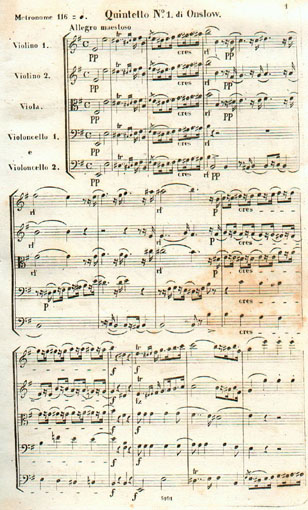
Today I have a nice piece of music by Georges Onslow, a composer I had never heard of. So I had to do some research, and well I used the online services of Wikipedia. Let me tell you a little bit more about Onslow.
André
George(s) Louis Onslow (1784 –1853) was a French composer of English descent.
His wealth, position and personal tastes allowed him to pursue a path
unfamiliar to most of his French contemporaries, more similar to that of his
contemporary German romantic composers; his music also had a strong following
in Germany and in England. His principal output was chamber music but he also
wrote four symphonies and four operas. Esteemed by many of the critics of his
time, his reputation declined swiftly after his death and has only been revived
in recent years.
Onslow's
emphasis on instrumental music, and his base in Clermont-Ferrand, set him apart
from many French composers of his era, for whom opera was a principal
aspiration – the period after 1830, in particular, was a time when Paris led
the world in grand opera. His interest in chamber ensembles and forms seemed to
align him more closely with German musical traditions. Moreover, being
possessed of an independent fortune, he could write for himself rather than
needing to pander to the desires of audiences or impresarios. Fétis complained
in 1830 "Nature worked in vain to
have a Haydn or a Beethoven born in France; such talent was better concealed in
the capital than are diamonds deep in the earth. It was the same with chamber
music such as quartets and quintets. If M. Onslow has been able to establish a
fine reputation in this genre, it is because his social position renders him
independent...he is still better known abroad than in France. The lack of
encouragement for instrumental music, a taste for futilities, and other
secondary causes which it would be too tedious to detail, have left us
insensible to anything but fantasies, variations and other trivia."
Such
comments enabled Onslow's publisher Camille Pleyel, in the same year, to
promote the composer as "notre Beethoven français" ("our French
Beethoven"), an epithet which was to be frequently repeated by critics, and
was also a trigger for rebuttal by those not so convinced of the similarity; as
for example Paul Scudo who wrote in 1854 that to compare Onslow with Beethoven
was like comparing Casimir Delavigne (a popular librettist of the time) with
Shakespeare. Indeed Onslow himself would have disowned comparison with
Beethoven's late style, according to his conversation as recorded by the music journalist
Joseph d'Ortigue: "The last quartets
of Beethoven are mistakes, absurdities, the reveries of a sick genius....I
would burn everything I have composed if I someday wrote anything resembling
such chaos." However Onslow's interest in classical forms and
counterpoint, and the styles of emotional expressiveness in his music, place
his music close to the works of his teacher Reicha, and to Onslow's German and
Austrian contemporaries of early Romantic music, such as Moscheles, Hummel, and
Schubert. (Source: Wikipedia)(Video: Unsung Masterworks)
thundering sound of falling water resonates against the rocks
Well I hope you did like this episode and that the music will be your source of inspiration. This episode is open for your submissions tonight at 7.00 PM (CET) and will remain open until December 21st at noon (CET). I will try to publish our new episode, Symphony No. 3 by Louise Farrenc, later on.
Today at 10 PM (CET) the Carpe Diem Winter Retreat and our first Tanka Kukai will close for submissions, so if you want to submit for the Winter Retreat or the Tanka Kukai than don't forget to do that before 10 PM (CET).
Welcome at a new episode of Carpe Diem Haiku Kai, a daily haiku meme. Today we are going on with the discovery of beautiful classical music of all times and from all over the world to inspire us. Today I have another nice compositon by a female composer of whom I never had heard. Today I love to inspire you with Serenade in D major by Ethel Mary Smyth (1858-1944).
Let me first tell you a little bit more about Ethyl Smyth before I share the composition for today's episode.
Dame Ethel
Mary Smyth, DBE (1858 – 1944) was an English composer and a member of the
women's suffrage movement. Smyth was born in Sidcup, Kent, which is now in the
London Borough of Bexley, as the fourth of a family of eight children. Her
father, John Hall Smyth, who was a Major-General in the Royal Artillery, was
very much opposed to her making a career in music.
Undeterred, Smyth was determined to become a composer, studied with a private
tutor, and then attended the Leipzig Conservatory, where she met many composers
of the day. Her compositions include songs, works for piano, chamber music,
orchestral and concertante works, choral works, and operas.
She lived at Frimhurst, near Frimley Green for many years, but from 1913
onwards, she began gradually to lose her hearing and managed to complete only
four more major works before deafness brought her composing career to an end. However,
she found a new interest in literature and, between 1919 and 1940, she
published ten highly successful, mostly autobiographical, books.
In recognition of her work as a composer and writer, Smyth was made a Dame
Commander of the Order of the British Empire (DBE) in 1922, becoming the first
female composer to be awarded a damehood. Smyth received honorary doctorates in music
from the Universities of Durham and Oxford. She died in Woking in 1944 at the
age of 86. (video by Unsung Masterworks)
early Sunrise while the sun climbs to the blue sky birds awaken
What a nice piece of music, I had to listen a few times to come up with the above haiku. I think it fits the music, notwithstanding the fact that a serenade is mostly in the evening and not in the early morning.
This episode is open for your submissions tonight at 7.00 PM (CET) and will remain open until December 20th at noon (CET). I will try to publish our new episode, Symphony No. 1 by Georges Onslow, later on. For now .... have fun!
Welcome at a new episode of Carpe Diem's daily haiku-meme. This month we are trying to find inspiration in classical music of all ages and of all over the world. Today I have that "all over the world" taken very literal, because this composition by Einar Englund is titled "The Great Wall of China".
Must be awesome to walk that Great Wall, maybe it is an once in a life time trip, but not for me. So why not listen to the music titled with this Great Wall? Maybe I can imagine walking there while listening to the music, we will see and hear.
Let me first tell you a little bit more about Einar Englund, before we listen to this beautiful composition "The Great Wall of China". Sven Einar Englund (1916 – 1999) was a Finnish composer. Sven Einar Englund was born at Ljugarn in Gotland, Sweden. He married twice: in 1941 to Meri Mirjam Gyllenbögel, who died 1956 (they had one son and two daughters including the ballerina and choreographer Sorella Englund); and in 1958 he married Maynie Sirén, a singer, with whom he had one son.
One of the most important Finnish symphonists since Jean Sibelius, Englund was a native Swedish speaker who often felt that his career was sidelined from the mainstream of Finnish music. He was 17 when he began studies at the Sibelius Academy in Helsinki in 1933. Already a considerable pianist, he continued his studies with Martti Paavola and Ernst Linko while studying composition with Bengt Carlson and Selim Palmgren. Following his graduation in 1941, Englund was conscripted into military service. During his time in the Finnish Continuation War he was wounded in his hand, which almost brought to an end his hopes of pursuing a career as a concert pianist. He would often recall the bizarre, though life-threatening incident, with a smile.
Einar Englund died June 27, 1999 in Visby, Sweden. He has created a lot of music sure worth listening to. (Video by Wellesz Opus)
Enjoyed? Inspired? I am looking forward to your responses inspired on this beautiful piece of music.
This episode is NOW OPEN for your submissions and will remain open until December 19th at noon (CET). I will try to publish our new episode, Serenade in D major by Ethel Smyth, later on.
As you know this month I try to inspire you by using classical music of all ages and from all over the globe. And ... I will continue that today of course. For today I have a modern classic piece of music titled "Six Japanese Gardens" composed by the female composer Kaija Saariaho. I had never heard from her or her music.
Kaija Saariaho (1952 -)
Let me tell you a little bit more about her:
Kaija Anneli Saariaho (*1952 - ) is a Finnish composer based in Paris, France. Saariaho studied composition in Helsinki, Freiburg and Paris, where she has lived since 1982. Her research at the Institute for Research and Coordination Acoustic (IRCAM) marked a turning point in her music away from strict serialism towards spectralism. Her characteristically rich, polyphonic textures are often created by combining live music and electronics. In 1986, Saariaho was awarded the Kranichsteiner Preis at the Darmstadt International Summer Courses for New Music. In 1988, she won the Prix Italia for her work Stilleben and in 1989 both Stilleben and Io were awarded the Prix Ars Electronica. In 2013 she was awarded the prestigious Polar Music Prize. During the course of her career she has received commissions from the Lincoln Center for the Kronos Quartet and from IRCAM for the Ensemble Intercontemporain, the BBC, the New York Philharmonic, the Salzburg Music Festival, the Théâtre du Châtelet in Paris and the Finnish National Opera, among others.
As I was preparing this music-month I ran into various compositions by Kaija Saariaho, some of them are beautiful, others are very difficult to follow and understand. I had mixed feelings by the composition I love to share here to inspire you. This piece of music has 6 movements and is titled "Six Japanese Gardens". (Video created by Wellesz Opus)
I hope this composition will inspire you. Here is my haiku inspired on this composition by Saariaho:
gurgling valley stream can't resist your lovely song - shadow of a Carp
And I re-created a cascading haiku series into a cascading tanka set:
rustling leaves, the sound of falling water - profound silence as I walk through my garden saying my prayers saying my prayers while walking through the garden - song of a nightingale mingles with the sounds of the garden in praise of Mother Earth
And now it is up to you ... This episode is NOW OPEN for your submissions and will remain open until December 18th at noon (CET). I will try to publish our new episode, The Great Wall of China by Einar Englund, later on.


#/media/File:George_Onslow.jpg)