Showing posts with label Paulo Coelho. Show all posts

Wednesday, December 27, 2017

Carpe Diem #1336 Elegance


Dear Haijin, visitors and travelers,

It's with pain in my heart that I am creating the last regular episode of this marvelous CDHK month in which we explored the beauty of the novels by Paulo Coelho, one of my favorite authors. We read several quotes from a lot of his novels and today I love to conclude this month with a wonderful quote from "The Witch of Portobello". Coelho published this novel in 2007 and it is really a beautiful novel sure worth a read.

I have titled this episode "elegance", because that's the 'theme' of the quote which you have to use. But what is "elegance" according Merriam Webster's Dictionary it means the following:

a : refined grace or dignified propriety : urbanity
b : tasteful richness of design or ornamentation the sumptuous elegance of the furnishings
c : dignified gracefulness or restrained beauty of style : polish the essay is marked by lucidity, wit, and elegance
d : scientific precision, neatness, and simplicity the elegance of a mathematical proof

One of the meanings of the pink rose is "elegance"
"Elegance" we find everywere around us, not only in our homes, but also outside in nature. Think about a swan for example. Or the beauty of for example a rose. Elegance is all around us and in our haiku, tanka or other Japanese poetry form we can find that elegance too. Of all poetic forms, haiku stands as one of the most elegant and immediate – a rare combination that creates an aura of mystery and artistry. This creative ambrosia, combined with an exotic history embedded in the courts and hillsides of Japan, has made haiku globally popular for the past century.

With the challenge of precisely conveying a natural movement as a universal moment in three lines and 17 or fewer syllables, it is easy to see why Western poets like W.H. Auden, Jack Kerouac, Gary Snyder, Jorge Luis Borges, Billy Collins, Allen Ginsberg, e.e. cummings, Ezra Pound, Joanne Kyger, Anne Waldman, Richard Wright, and Sonia Sanchez fell in love with haiku.

Let us take a look at a few haiku and tanka in which you can find elegance:

lightning flash–
what I thought were faces
are plumes of pampas grass

© Matsuo Basho (1644-1694)

I remember that even in a sad themed tanka you can find "elegance" like in this one:

broken wings
a butterfly crushed
under my feet
fragile beauty gone
leaving me with a broken heart

© Chèvrefeuille

Deutzia
Do you see the elegance in this haiku written by Sora, Basho's companion while he was on his road into the deep north:

white flowers in my hair
I walk through the gate into the deep north
my only gala dress

©  Sora (Tr. Chèvrefeuille)

And another elegant haiku by Basho in a beautiful translation by Jane Reichhold:

roots of elegance
on this trip to the far north
rice-planting song 

© Basho (Tr. Jane Reichhold)

Elegance in haiku and tanka awesome. Let us now go back to the quote I have chosen for this last regular episode of CDHK of 2017. A quote taken from "The Witch of Portobello" by Paulo Coelho.

[...] “Elegance is the correct posture if the writing is to be perfect. It’s the same with life: when all superfluous things have been discarded, we discover simplicity and concentration. The simpler and more sober the posture, the more beautiful it will be, even though, at first, it may seem uncomfortable.” [...] (Source: The Witch of Portobello - Paulo Coelho)

The above quote suddenly reads familiar. It sounds like I have used it in an earlier episode this month, but after checking I came to the conclusion that I hadn't used it earlier.

just one line
the beauty of a painting
caught in a haiku

© Chèvrefeuille

Not as strong as I had hoped, but I think in this haiku you can read "elegance" ... because the "elegance" of a painting is caught in just one line (or in this case three lines), because traditionally haiku were written in one line.

This episode is NOW OPEN for your submissions and will remain open until January 3rd at noon (CET). I will try to publish our last weekend-meditation of this year later on. I hope you all have enjoyed this month and this year here at CDHK. I hope to see you again in 2018 ...

HAPPY NEW YEAR


Tuesday, December 26, 2017

Carpe Diem #1335 pursue your dreams


Dear Haijin, visitors and travelers,

Welcome at a new episode of our Kai. It's another wonderful quote from "The Alchemist" and I think this quote is really an inspirational one.

"The Alchemist" is one of Coelho's most read novel all around the globe. Maybe every one on earth has read it or at least has heard about it.

Painting of an Alchemist
In "The Alchemist" the head character, a young sheperd boy, meets an alchemist as he is on his way to the pyramids of Gizeh. He learns a lot of him and he is glad that he knows the deeper truth of alchemy.

The young sheperd boy has a dream of a great treasure and that's why he is on his way to Egypt, because in his dream he sees the pyramids of Egypt. "The Alchemist" is a philosophical novel full of spirituality and the ideas, thoughts, of Coelho hemself.

Here is the quote to work with:

"People are afraid to pursue their most important dreams because they feel that they don't deserve them, or that they'll be unable to achieve them." (Source: The Alchemist by Paulo Coelho)

I once had a dream about publishing a novel. That dream I realized, another nvel followed and a haiku-book. After those dreams there were new dreams to pursue. Becoming an oncology nurse, that dream became true also. How many dreams a man can have? After several fulfilled dreams there was a new dream ... to create a daily haiku meme to promote my love for haiku and the beauty of that little poem from the Far East. Five years ago I made that dream come true by starting our Kai. I never dreamed that it would be a big success, but as we all know our Kai became a success. I had the privilege to get to know several renown haiku poets like Garry Gay and Jane Reichhold. But I also had the privilege to get to know you all ... my dear Haijin. I am grateful for the love you sprinkle on me, but I am even more grateful that you started to share your Japanese poetry with me. Thank you all for keeping a dream alive.

Dreams
dreamtime
inner feelings and emotions
come alive

© Chèvrefeuille

Keep on dreaming ... without dreams we are lost ...

This episode is NOW OPEN for your submissions and will remain open until January 2nd at noon (CET)


Monday, December 25, 2017

Carpe Diem #1334 An Empty Mind


Dear Haijin, visitors and travelers,

Here in The Netherlands we have two Christmas days, December 25th and 26th, I know that there are several other countries who have two Christmas days, but every year again I ask my self ... why do we have two Christmas days instead of just one day. I know that in several countries the day after Christmas day is called "Boxing Day" and the name goes far back in history.

"Boxing Day" what does it mean: The Oxford English Dictionary gives the earliest attestations from Britain in the 1830s, defining it as "the first week-day after Christmas-day, observed as a holiday on which post-men, errand-boys, and servants of various kinds expect to receive a Christmas-box".

The term "Christmas-box" dates back to the 17th century, and among other things meant:
A present or gratuity given at Christmas: in Great Britain, usually confined to gratuities given to those who are supposed to have a vague claim upon the donor for services rendered to him as one of the general public by whom they are employed and paid, or as a customer of their legal employer; the undefined theory being that as they have done offices for this person, for which he has not directly paid them, some direct acknowledgement is becoming at Christmas.

Boxing Day (December 26th)
In Britain, it was a custom for tradespeople to collect "Christmas boxes" of money or presents on the first weekday after Christmas as thanks for good service throughout the year. This is mentioned in Samuel Pepys' diary entry for 19 December 1663. This custom is linked to an older British tradition: since they would have to wait on their masters on Christmas Day, the servants of the wealthy were allowed the next day to visit their families. The employers would give each servant a box to take home containing gifts, bonuses, and sometimes leftover food.

Well ... let me say to you all "Happy Boxing Day"!

Back to our quote for today. Today I have chosen a wonderful quote from Paulo Coelho's "Aleph", one of his most personal novels. I think you can remember that we read this novel while we were on our trip straight through the former USSR on Trans Siberian Railroad. "Aleph" is really an awesome novel and I have read it several times ... maybe "Aleph" is my favorite novel.

I think this quote I have chosen fits the season too by the way. So let me give the quote to work with:

[...] "Now each morning, when your mind is still empty, devote a little time to the Divine … Inhale deeply and ask for all the blessings in the air to enter your body and fill every cell.  Then exhale slowly, projecting happiness and peace around you.  Repeat this ten times.  You’ll be helping to heal yourself and contributing to healing the world as well". [...] (Source: Aleph by Paulo Coelho)

My Early Morning Ritual? A Hot Cup of Coffee!
As I read and re-read this quote I am getting the feeling that I have to create a new early morning ritual, but I am not a morning-guy so to say, because I am more of the night. Maybe I have to create my own ritual to empty my mind. I even think that it will work better to have such a ritual before going to sleep. Making my mind empty ... say ... becoming again in balance ... would give me a wonderful sleep.

that perfume
whirling smoke in the sunlight
morning coffee

© Chèvrefeuille

This episode is NOW OPEN for your submissions and will remain open until January 1st at noon (CET). I will try to publish our new episode later on.

PS. I have created a new FB-page it's about Troiku and is titled "Beautiful Troiku". You can find the link to "Beautiful Troiku" at the left side of our Kai. Feel free to visit and share your Troiku there.


Sunday, December 24, 2017

Carpe Diem #1333 José's Sandals


Dear Haijin, visitors and travelers,

Welcome at a new (a little bit later than planned) episode of our wonderful Haiku Kai. As you all know this month it's all about the beauty of the novels by Paulo Coelho, but today ... well I have a nice surprise for you, say my Christmas present for you all ...

As I was preparing our special holidays e-book I ran into a wonderful Christmas tale written by Paulo Coelho. And for today's episode I love to share that Christmas tale with you all here at our Kai.

This Christmas tale by Paulo Coelho is based on a story written in 1903 by François Coppée and translated from the Portuguese by Margaret Jull Costa. (Source: www.beliefnet.com)

Christmas

A Christmas Tale: José's Sandals.
On Christmas Day, a special boy learns the true meaning of gift-giving

A long time ago, so many years ago that we can no longer remember the exact date, there lived in a village in the south of Brazil a little seven-year-old boy called José. He had lost his parents when he was very, very young and had been adopted by a miserly aunt who, even though she had lots of money, spent almost nothing on her nephew. José, having never known the meaning of love, assumed that this was simply the way life was and so it didn’t bother him at all.

They lived in an extremely affluent neighborhood, but the aunt persuaded the head teacher of the local school to take on her nephew for only a tenth of the normal tuition fee, threatening to complain to the Prefect if he declined her offer. The head teacher had no option but to agree; however, he instructed the teachers to take every opportunity to humiliate José in the hope that he would misbehave and give them a pretext for expelling him. José, having never known love, assumed that this was simply the way life was and so it didn’t bother him at all.

Christmas Eve arrived. The village priest was on holiday, and all the pupils had to go to Mass in a church some distance from the village. The girls and boys walked along, chatting about what they would find the next day beside the shoes they left out for Father Christmas: fashionable clothes, expensive toys, chocolates, skateboards, and bicycles. Since it was a special day, they were all well-dressed--all except José, who was wearing his usual ragged clothes and the same battered sandals several sizes too small (his aunt had given them to him when he was four, saying that he would only get a new pair when he was 10). Some of the children asked why he was so poor, and said they would be ashamed to have a friend who wore such clothes and shoes. Since José had never known love, their questions and comments didn’t bother him at all.

Nativity (Brazil)
However, when they went into the church, and he heard the organ playing and saw the bright lights and the congregation in their Christmas finery, saw families gathered together and parents embracing their children, José felt he was the most wretched of creatures. After Communion, instead of walking back home with the others, he sat down on the steps of the church and began to cry. He may never have known love, but only at that moment did he understand what it was to be alone and helpless and abandoned by everyone.

Just then, he noticed another small boy beside him, barefoot and apparently as poor as he was. He had never seen the boy before and so assumed that he must have walked a long way to get there. He thought: “His feet must be really sore. I’ll give him one of my sandals. That will at least relieve half of his pain.” Although José had never known love, he knew about suffering and didn’t want others to experience it too.

He gave one of his sandals to the boy and returned home with the other one. He wore the sandal first on his right foot and then on his left, so that he didn’t bruise the soles of his feet too badly on the stones along the way. As soon as he reached home, his aunt noticed that he was wearing only one sandal and told him that if he didn’t find the other sandal the next day, he would be harshly punished.

José went to bed feeling very afraid because he knew what his aunt’s punishments were like. He lay all night trembling with fear, barely able to sleep at all, and then, just as he was about to drowse off, he heard voices in the front room. His aunt rushed in, demanding to know what was going on. Still groggy from lack of sleep, José joined their visitors and, in the middle of the front room, saw the sandal he had given to the little boy. Now, however, it was surrounded by all kinds of toys, bicycles, skateboards and clothes. The neighbors were shouting and screaming, declaring that their children had been robbed, because when they woke up, they had found nothing beside their shoes at all.


At this point, the priest from the church where they had celebrated Mass the previous day arrived all out of breath: On the steps of the church a statue of the Baby Jesus had appeared, clothed entirely in gold, but wearing only one sandal. Silence fell, everyone present praised God and his miracles, and the aunt wept and begged for forgiveness. And José’s heart was filled with the energy and the meaning of love.

silence
a new king is born
love came to the world


© Chèvrefeuille

Isn't it a wonderful Christmas Tale? A lot to think about maybe. This Christmas Tale in my opinion is the true meaning of Christmas ... love and peace to you all and to the world.

This episode is NOW OPEN for your submissions and will remain open until December 31st at noon (CET). I will try to publish our new episode later on. For now ... have a wonderful Christmas!


Thursday, December 21, 2017

Carpe Diem #1332 No Time To Waste


Dear Haijin, visitors and travelers,

What a month this is. So much beauty in the quotes from the novels by Paulo Coelho and in your responses. It's not an easy month to create, but I love doing it for you. I hope you all enjoy this month and the rich source of inspiration.

Today I have a wonderful quote extracted from "Manuscript Found In Accra", very similar to that beauty by Kahlil Gibran "The Prophet". As you read in the title it's about time. We all have sometimes difficulties with time. Our work, or hobbies and our families need us every day and than we have to make choices. Not that long ago I had such a period. Lack of time ... and than the delay of CDHK, of course I know that you don't have a problem with that, but it gives me sometimes a sad feeling. Back in 2012 I made the choice to create CDHK, a daily haiku meme, and that choice implicates that I have to publish every day.

Time
I remember that we had an episode about time inspired on another nice novel by Kahlil Gibran, "sand and foam". I even use a quote back than. I love to re-produce that quote here again:

And an astronomer said, "Master, what of Time?" 
And he answered: 
You would measure time the measureless and the immeasurable. 
You would adjust your conduct and even direct the course of your spirit according to hours and seasons. 
Of time you would make a stream upon whose bank you would sit and watch its flowing. 
Yet the timeless in you is aware of life's timelessness, 
And knows that yesterday is but today's memory and tomorrow is today's dream. 
And that that which sings and contemplates in you is still dwelling within the bounds of that first moment which scattered the stars into space. 
Who among you does not feel that his power to love is boundless? 
And yet who does not feel that very love, though boundless, encompassed within the centre of his being, and moving not form love thought to love thought, nor from love deeds to other love deeds? And is not time even as love is, undivided and paceless? 
But if in you thought you must measure time into seasons, let each season encircle all the other seasons, 
And let today embrace the past with remembrance and the future with longing. 

© Khalil Gibran

Time
Okay ... back to the quote I choose to use today. And I think the above "poem" by Kahlil Gibran will also help you to become inspired.

[...] "Someone asked him that why are some luckier than the others. One of the extraordinary excerpts on this subject where he calls success as a consequence and not an end, ‘Success comes to those who do not waste time comparing what they are doing with what others are doing; it enters the house of the person who says “I will do my best’ everyday”. [...] (Source: Manuscript Found In Accra by Paulo Coelho)

Don't waste time ... because we have a continuos lack of it, take time to do the fun things of life, take your time to rest ... time is not always on our side, but let us use our time in the right way ... don't waste it. Life is to short to waste time.

fresh fallen snow
sprinkled with the colors of autumn
everlasting

© Chèvrefeuille

This episode is NOW OPEN for your submissions and will remain open until December 28th at noon (CET). I will try to publish our weeken-meditation later on. For now ... have fun!


Wednesday, December 20, 2017

Carpe Diem #1331 mirror


Dear Haijin, visitors and travelers,

Welcome at a new episode of Carpe Diem Haiku Kai, the place to be if you like to write and share Japanese poetry. This month we are inspired by quotes from the novels by Paulo Coelho, one of my favorite authors. Today I have a nice quote from Coelho's novel "The Winner Stands Alone", a wonderful novel. "The Winner Stands Alone" is very different from his other novels. This novel is a "real" novel with an exciting story.

Let me give you a short summary of "The Winner Stands Alone":

The book loosely tells the story of several individuals: Igor, a Russian millionaire; Hamid, a Middle Eastern fashion magnate; American actress Gabriela, eager to land a leading role; ambitious criminal detective Savoy, hoping to resolve the case of his life; and Jasmine, a woman on the brink of a successful modeling career. Set at the Cannes Film Festival, the tale narrates the epic drama and tension between the characters in a 24-hour period. Igor, a man of extraordinary intelligence, has promised himself to destroy worlds to get his beloved wife Ewa, who left him for a successful designer, Hamid.

The Winner Stands Alone (cover)
It wasn't an easy task to find a quote for your and my inspiration, but after a while I found a nice quote which (I hope) will inspire you.

[...] “The mirror reflects perfectly; it makes no mistakes because it doesn't think. To think is to make mistakes.” [...] (Source: The Winner Stands Alone by Paulo Coelho)

Well ... I think you all know what a mirror is, but I think you all know that other mirror, the human eyes. I think you are familiar with the "proverb" "The Eyes Are The Mirror of the Soul". Of course that's not the mirror in the quote, but of course you can use that idea too for your haiku, tanka or other Japanese poetry form.

mirror
broken mirror
thousand faces looking back
tears shimmer

© Chèvrefeuille

Hm ... not a strong haiku, but I like this one.

This episode is open for your submissions tonight at 7:00 PM (CET) and will remain open until December 27th at noon (CET). I will try to publish our next episode later on.


Tuesday, December 19, 2017

Carpe Diem #1330 loyalty


Dear Haijin, visitors and travelers,

Welcome at a new episode of our wonderful Haiku Kai, a warmhearted family of lovers of Japanese poetry especially haiku and tanka. This month we find our inspiration in the beauty of the novels by the renown Brazilian author Paulo Coelho.

Today I have chosen a nice quote from "Manuscript of Accra", a novel full of wisdom and spirituality. It is very similar with that beautiful novel by Kahlil Gibran "The Prophet". Of course I have read both novels and I loved them, but Coelho's "Manuscript ..." to me was really a novel full of beauty, but maybe that's because of the spirituality in it. It feels like Coelho's spiritual ideas are almost the same as my ideas about spirituality. In a way I feel connected with Coelho.

Path Through the Woods
This month we are "walking" the path together with Paulo Coelho's beautiful novels and today the following quote I love to share with you ... and I hope it will inspire you:

[...] ‘Loyalty has its roots in respect and respect is the fruit of Love, and Love drives out the demons of the imagination – which distrust everything and everyone – and, instead, returns purity to our gaze’. [...] (Source: Manuscript found in Accra - Paulo Coelho)

I had some difficulties with this theme "loyalty", but I think I finally came up with a nice tanka in which I have tried to catch "loyalty" in a slightly different way.

own life on hold
to be there next to his brother -
what a sacrifice
all her beloved ones gathering
around her death bed

© Chèvrefeuille

Not as strong as I had hoped, but I think this tanka fits ... in a nice way.

This episode is open for your submissions tonight at 7:00 PM (CET) and will remain open until December 26th at noon (CET). I will try to publish our new episode later on.


Monday, December 18, 2017

Carpe Diem #1329 rebirth


Dear Haijin, visitors and travelers,

I hope you all have your preparations made for the holidays and that your homes are decorated with the beauty of Christmas. We aren't ready yet, but ... well we have time enough.

This will not be a very long episode, not of lack of time, but because this quote speaks for it self. Today I have a ... difficult quote I think, but I also think you can work with it. Today's quote is extracted from Paulo Coelho's "The Fifth Mountain".

Let me give you a brief overview of this novel:

The story is based on the account of Elijah from the Hebrew Bible (1 Kings chapters 17-19). The focus is on Elijah's time in Zarephath (in this book named Akbar). Much has been added to the simple Bible story by Coelho, including Elijah witnessing the sacking of Akbar by the Assyrians, Elijah's journey up the Fifth Mountain itself (said to be the dwelling place of Baal), and Elijah's falling in love with the widow to whom God sent him.
For a considerable portion of the story Elijah is very compliant, obeying everything God's angels say. Eventually he realizes that his destiny is not being chosen by him but by God and ultimately he decides to abide by his own desires and will.

The Fifth Mountain (cover)
I am not that familiar with the story of Elijah, but as I read this novel, a while ago, that part of the Bible started to become alive and I think Coelho has created a really nice story inspired on the life of the Hebrew prophet Elijah. In this novel there are several wonderful spiritual lines to learn from and to become inspired.

Here is the quote for your inspiration:

[...] "The ashes of the dead ... will become the plants that are reborn in the spring.” [...] (Source: The Fifth Mountain by Paulo Coelho)

Isn't that a wonderful idea? I ran through my archives to find a few haiku that fit this theme "rebirth":

smoke rises
from the pyre
to Heaven

her spirit departs
with the dying of her pyre -
smoke rises to the sky

several lives
once lived and re-lived -
Lotus blooms again
reaching for a new day
cherished by the sun

And I found a nice "pi-ku":

the sun rises
the heat
already tangible
mist
spirals above the stream
another day starts in mysterious ways 

© Chèvrefeuille  

Well I hope you did like this post. This episode is open for your submissions tonight at 7:00 PM (CET) and will remain open until December 25th at noon (CET). I will try to publish our new episode later on. For now ... have fun!

Sunday, December 17, 2017

Carpe Diem #1328 Along the Road


Dear Haijin, visitors and travelers,

I hope you all have had a wonderful weekend with a lot of love, peace and inspiration. My weekend was a real joy and gave me some rest to go on being your host. As you have seen I started with our traditional holidays feature "Seven Days Before Christmas" in which we count down to Christmas Eve.

This episode I love to inspire you with a quote from Paulo Coelho's "The Pilgrimage" that wonderful novel about his spiritual pilgrimage to Santiago. Here at CDHK we have had several post about the Road to Santiago and we have had also a whole month about this pilgrimage at the start of this year.

"The Pilgrimage" is one of Coelho's most personal novels next to "Aleph" and "The Valkyries" he gives us insight in his spiritual growth while he his walking the "Road to Santiago", one of the most known pilgrimages on earth.
I remember that a few posts back I wrote about looking at nature as a child or look at nature as if you see it all for the very first time. The quote for today has a strong connection with "being a child as an adult".

Road to Santiago (Portugal)
Here is the quote for your inspiration:

[...] "I began to talk to everything along the Road: tree trunks, puddles, fallen leaves and beautiful vines. It was an exercise of the common people, learned by children and forgotten by adult." [...] (Source: The Pilgrimage by Paulo Coelho)

It sounds like Coelho has become mad, but isn't that what we all need sometimes ... to be mad? Than we can see the perspective of the bigger cause, the bigger goal. Look around you ... look at all nature's beauty as if you see it for the very first time. Nature is the best teacher we can have ... as haiku poets we know how much nature can learn us. Be a child again, be mad for a while and enjoy the beauty of nature.

wren*
between bare branches

first snow

© Chèvrefeuille (experimental haiku)

* Troglodytes troglodytes

This episode is open for your submissions tonight at 7:00 PM (CET) and will remain open until December 24th at noon (CET). I will try to publish our new episode later on.


Thursday, December 14, 2017

Carpe Diem #1327 A Perfect Life ...?


Dear Haijin, visitors and travelers,

Well ... this episode will be a bit strange, because it's about the question "Do I Have a Perfect Life?" Today's novel is one of the novels I haven't read fully yet. Of course I had to read it while preparing this month in which we are inspired through the novels written by Paulo Coelho, but I couldn't complete my reading because of circumstances.

Today's quote I have taken from Coelho's novel "Veronika Decides to Die". Yes it's about the questions someone asks him or her self according to their life ... Veronika decides to die is about committing suicide. As you all know Jane Reichhold also decided to die by committing suicide. She no longer could cope with her illness, fybromyalgia. So the theme of this novel comes very close to our, to my, feelings and thoughts.
To me being suicidal or having suicidal thoughts isn't strange, because I know what it is. Several years ago, at the beginning of this century, I had a severe burn-out and I had suicidal thoughts, so this episode comes as close to me as is possible.

cover

Let me give you a brief overview of this novel:

Veronika is a beautiful young woman from Ljubljana, Slovenia who appears to have the perfect life, but nevertheless decides to die (commit suicide) by overdosing with sleeping pills. While she waits to die, she cancels the suicide letter she starts to her parents while suddenly provoked by a magazine article.

The magazine article wittily asks "Where is Slovenia?", so she writes a letter to the press justifying her suicide, the idea being to make the press believe that she has killed herself because people don't even know where Slovenia is. Her plan fails and she wakes up in Villete, a mental hospital in Slovenia, where she is told she has only a few days to live due a heart condition caused by the overdose.

Her presence there affects all of the mental hospital's patients, especially Zedka, who has clinical depression; Mari, who suffers from panic attacks; and Eduard, who has schizophrenia, and with whom Veronika falls in love. During her internment in Villete she realizes that she has nothing to lose and can therefore do what she wants, say what she wants and be who she wants without having to worry about what others think of her; as a mental patient, she is unlikely to be criticized. Because of this new-found freedom Veronika experiences all the things she never allowed herself to experience, including hatred and love.

In the meantime, Villete's head psychiatrist, Dr. Igor, attempts a fascinating but provocative experiment: can you "shock" someone into wanting to live by convincing her that death is imminent? Like a doctor applying defibrillator paddles to a heart attack victim, Dr. Igor's "prognosis" jump-starts Veronika's new appreciation of the world around her.

An excellent story I think and it brings me thoughts about nature. The story in this novel you can compare with the circle of life. And maybe that's an inspirational idea for your Japanese poetry.

Circle of Life
eternal circle
lotuses blooming and decaying -
ancient wisdom grows

© Chèvrefeuille

And that's so true, but it is not in the same feeling as the story above, but ... well it's the circle of life. Here is the quote from "Veronika Decides to Die" for your inspiration:

[...] "An awareness of death encourages us to live more intensely." [...] (Source: Veronika Decides to Die - Paulo Coelho

A very short quote, but a quote with a lot of layers. My thoughts immediately went back to our first Theme Week (2016) about "The Tibetan Book of Living and Dying". And a quote by Sogyal Rinpoche returned to me:

[...] "Everyone of us will once face death, that idea makes us sad and anxious, but it is inevitable, but as you can face your mortality than that will keep your life in balance". [...]  (Sogyal Rinpoche form "The Tibetan Book of Living and Dying".)

phoenix spreads its wings
after the dark cold winter night
finally spring

© Chèvrefeuille

Isn't that the same as meant in the quote from "Veronika Decides to Die"?

Well ... much to think about ... This episode is NOW OPEN for your submissions and will remain open until December 21st at noon (CET). I will try to publish our new episode later on.

PS. If you like to read the exclusive CDHK e-book created after the theme week about "The Tibetan Book of Living and Dying" than you can find it on issuu.com 

PPS. I have created an account on issuu.com 


Wednesday, December 13, 2017

Carpe Diem #1326 transformation


Dear Haijin, visitors and travelers,

Transformation ... it's something we have seen here several times, it's a kind of path to find your inner truth, your inner beauty or your inner love. And that's the main theme in "Brida" another beautiful novel by Paulo Coelho. "Brida" was published in 1990 and it became a very famous novel within the "wiccan" community all around the world, because the "wiccan" believe (the "religion" of nature, like e.g. Shinto) is were this novel is about.
After "The Alchemist", the first novel I read by Coelho, I read "Brida" and again I was caught by the beauty of the story, a story that was so close to my life. As a haiku poet I am living with nature, I feel one with nature and I know that you, my dear Haijin, have that same feeling, that same connection with nature around us. Nature is the main theme of haiku (and other Japanese poetry).

Wiccan believe (image found on Pinterest)
The above image gives the heart of Wiccan ... and that's what Brida is seeking for in this novel by Paulo Coelho. Let me give you first a short overview of this novel.

Brida is the story of a beautiful young Irish girl and her quest for knowledge. She finds a hermit mage who teaches her to overcome fear and a witch who teaches her how to dance to the hidden music of the world. They see in her a gift, but must let her make her own voyage of discovery. As Brida seeks her destiny, she struggles to find a balance between her relationships and her desire to transform herself. The story makes reference to catharism and is woven around marrying the art of witchcraft to contemporary life. (Source: Wikipedia)

fragile wings
pointing the way to transformation -
the summerbreeze

© Chèvrefeuille

Pygmalion's lesson
every man and woman has to be
like a caterpillar
growing to the next level
become a butterfly

© Chèvrefeuille

That tanka shows you, in my opinion, what real transformation means. Transformation is the main theme of "Brida". So let us go on to the quote I extracted from "Brida" to work with.

transformation

[...] "She had met people who had lost the glow of being alive because they could no longer fight against loneliness and had ended up becoming addicted to it. They were, for most part, people who believed the world to be an undignified, inglorious place, and who spent their evenings and nights talking on and on about the mistakes others had made. They were people whom solitude had made into judges of the world, whose verdicts were scattered to the four winds for whoever cared to listen." [...] (Source: Brida by Paulo Coelho)

Well ... I hope that this post will inspire you ... it was a joy to create this episode, because it's so close to my believes.

This episode is open for your submissions tonight at 7:00 PM (CET) and will remain open until December 20th at noon (CET). I will try to publish our new episode later on. Have fun!


Tuesday, December 12, 2017

Carpe Diem #1325 follow the dictates of your heart


Dear Haijin, visitors and travelers,

What a wonderful month this is. As you all know I love the novels written by Paulo Coelho. I have read almost all his novels, but the novel from which the quote for today comes I haven't read yet, but of course I intend to do that without a doubt. The novel from which I extracted the quote is titled "The Valkyries" and was published back in 1992. At that time I hadn't heard from Paulo Coelho.
The love for his novels came as I read the special edition of "The Alchemist" back in 2013, that year "The Alchemist" saw a 25th anniversary edition in an awesome beauty. I was caught by the beauty of that story and became addicted to this author. So in a way you can see this month as a kind of tribute to the beauty of Paulo Coelho's novels.

The Valkyries by Paulo Coelho (cover)

Let me give you a short preview of "The Valkyries":

The book is autobiographical, but told from the third person. It deals with the exorcism of personal demons and discovering one's strength. It also deals with relationships among people, in this case, Paulo and his wife. Together with her, he embarks on a journey through the soaring heat of the Mojave desert. During the 40 days journey, surrounded by doubts and temptations and entering their innermost conflicts and questions, they met the valkyries, strange warrior women. (Source: Wikipedia)

Before I share the quote for today I also love to share a piece of Wagner's composition "The Valkyries" (Die Walkure):


An awesome piece of music. In a way this music by Wagner shows the beauty of "The Valkyries" as written by Paulo Coelho in which a group of women on motorbikes is playing a role. Coelho and his wife meet them in the Mojave desert. 
There is another religious or spiritual connection with The Bible, because as you maybe know Jesus Christ was tempted by the devil for 40 days in the desert. Paulo and his wife are in the Mojave desert for 40 days ... no coincedence of course, because Coelho uses often religious or spiritual ideas in his novels. That's the reason why I am such a big fan of his novels ... I am a spiritual person and through the novels of Coelho I learned more and more about spirituality or better said ... my spirituality.

Okay ... back to our inspirational quote for today taken from "The Valkyries":

[...] "There is no sin but the lack of love, have courage, be capable of loving, even if love appears to be a treacherous and terrible thing. Be happy in love. Be joyful in victory. Follow the dictates of your heart." [...] (Source: The Valkyries by Paulo Coelho)

be happy in love
I wasn't inspired enough so I scrolled through my archives and found the following haiku and tanka:

at the horizon
air dances in all freedom
love on the beach

watching the world
with an open heart and mind -
that's true wisdom

silence all around
the busy world has gone away
follow your heart
feel the love of Mother Nature -
sunflowers blossom

© Chèvrefeuille

I think this quote fits the time of year and I hope you will find your inspiration to create Japanese poetry.

This episode is open for your submissions tonight at 7:00 PM (CET) and will remain open until December 19th at noon (CET). I will try to publish our next episode later on.


Monday, December 11, 2017

Carpe Diem #1324 carried away by the night


Dear Haijin, visitors and travelers,

Today I have chosen a quote from a novel by Paulo Coelho that surprised me like "Eleven Minutes" did. In 2014 Paulo Coelho's new novel "Adultery" was released.

Adultery, is a story of a woman who is faced with an inevitable, life-altering choice when she chooses to break the monotony of her life. Linda is in her thirties and is facing a crisis mentally and emotionally. She begins to question the void that was growing in her, the mundane, predictable days of her life. Although her life seemed perfect in everybody's eyes a contented marriage, adorable children and a successful career - she feels a keen sense of emptiness and displeasure. But it all drastically changes when she meets a prosperous politician who happens to be her high-school boyfriend from years ago. As Linda revives the passion that was absent in her life, she would have to make a life-altering choice.

Adultery reads like a river, the story caught me immediately, not because of the theme, but because of the way Paulo Coelho describes the theme in a very nice way with a kind of love that no one would expect in a story about adultery. I read this novel only once, but I read it in one day ... the story really grabbed me. It's a story to which everyone can relate I think, not because of the adultery, but because of the hidden story ... the loss of romance, sensuality and sexuality in a marriage.

adultery (image © Luca Santostasi - broken roses)

broken roses
shards of a crystal vase
love gone wild


© Chèvrefeuille

roses bloom again
re-found love grows
two bodies as one


© Chèvrefeuille

Adultery ... an amazing story written by Paulo Coelho. "Adultery" a novel about true love I would say and I think that this quote will inspire you as it did me.

[...] “Let yourself get carried away by the night from time to time. Look up at the stars and try to get drunk on the sense of infinity. The night, with all its charms, is also a path to enlightenment. Just as a dark well has thirst-quenching water at its bottom, the night, whose mystery brings us closer to the mystery of God, has a flame capable of enkindling our soul hidden in its shadows.” [...] (Source: Adultery by Paulo Coelho)

hot summer night
two bodies entwined in love -

the full moon

© Chèvrefeuille

Do you sense the romance, the sensuality ... sexuality? Isn't it wonderful to tell so much with as less words as possible. Isn't that the power of haiku ... or shall I say .... the power of love?

This episode is open for your submissions tonight at 7:00 PM (CET) and will remain open until December 18th at noon (CET). I will try to publish our new episode later on. For now ... be inspired.

Sunday, December 10, 2017

Carpe Diem #1323 serenity


Dear Haijin, visitors and travelers,

Welcome at a new episode of our wonderful Haiku Kai. I hope you all have had a nice weekend. Here in The Netherlands we had almost the whole weekend heavy snow fall, so the world around me has become white. It's an awesome sight, because it has been a while that we had that much snow.

This month we are finding our inspiration in the novels by Paulo Coelho. And today I have a wonderful quote from his novel "The Witch Of Portobello", one of his most beloved novels. I read "The Witch ..." several times and every time again I read new things.

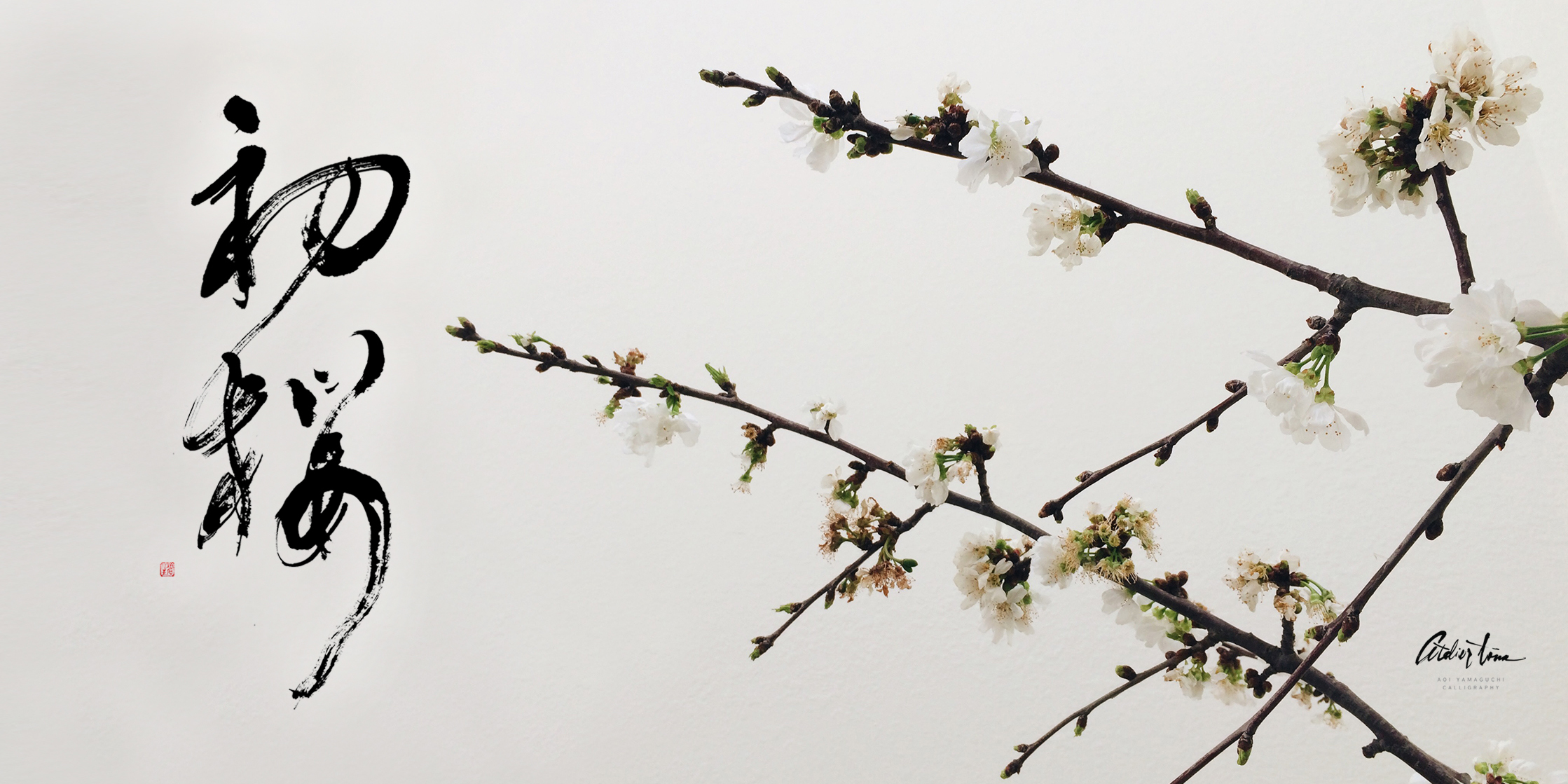
The quote for today points to a skill which we maybe know ... calligraphy. In ancient Japan calligraphy was a high art and all the classical haiku poets used it. The leading character of "The Witch ..." learns this art in the middle of the desert.

Japanese calligraphy by Aoi Yamaguchi (great website)
 Of course the quote to use I will not give you as a calligraphy. Here is the quote for your inspiration:

[...] "Naturally, if she respected the brush that she used, she would realize that in order to learn to write she must cultivate serenity and elegance. And serenity comes from the heart." [...] (Source: The Witch of Portobello - Paulo Coelho)

And here is my response, I wasn't inspired, so I dived into my archives:

migrating
back in time again I write
with a quill pen
screeching paper
the poet writes his poems

© Chèvrefeuille

Have a great week ...

This episode is open for your submissions tonight at 7:00 PM (CET) and will remain open until December 17th at noon (CET). I will try to publish our new episode later on.


Thursday, December 7, 2017

Carpe Diem #1322 follow the dream


Dear Haijin, visitors and travelers,

This month we are finding our inspiration through the novels written by Paulo Coelho. Several of his novels I have used earlier here so sometimes there will be a "deja vu" I think. Today, while I am seeking a little bit time in between the things I have to do, I will use a quote from "Aleph", Paulo Coelho's most personal novel ever. Recently we had an episode about this novel, in our anniversary month, so maybe this quote you will remember. I used it for the first time back in 2014 when we were on a trip straight through the former USSR with the Trans Siberian Railway.


Here is our inspirational quote from Aleph:

[...] "I am not a foreigner because I haven't been praying to return safely home, I haven't wasted my time imagining my house, my desk, my side of the bed, I am not a foreigner because we are all travelling, we are all full of the same questions, the same tiredness, the same fears, the same selfishness and the same generosity. I am not a foreigner because, when I asked, I received. When I knocked, the door opened. When I looked, I found." [...] (Source:'Aleph' by Paulo Coelho)
And here is one of my haiku inspired on this quote:

another day ends
reaching for the stars and the moon
into the dreamworld
© Chèvrefeuille
A short episode, but well ... enough inspiration I think. Have fun, be inspired and share your Japanese poetry with us all.
This episode is NOW OPEN for your submissions and will remain open until December 14th at noon (CET). I will try to publish our new episode later on.

Wednesday, December 6, 2017

Carpe Diem #1321 miracles


Dear Haijin, visitors and travelers,

Welcome at a new episode of our wonderful Haiku Kai. I had a very busy day at work, I had the dayshift on the so called "chemo-unit" and it was a tough day, a real tough day, but ... well my co-worker and I "survived". Every day I work with very sick people, all have a kind of cancer, but they all are strong and look at their life with gratefulness.

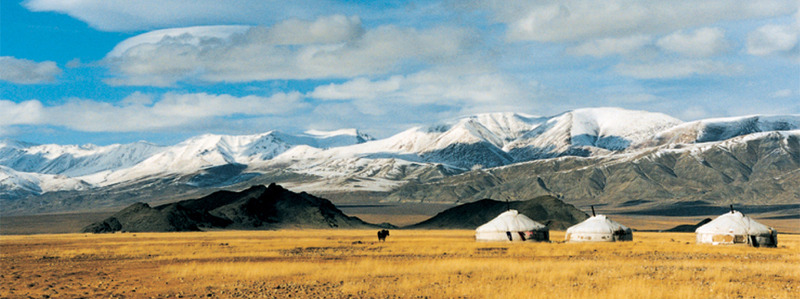
Back in 2015 we spent a whole month in the Altai Mountains of Mongolia were we discovered the way of the shaman and maybe you remember that we read "The Zahir" by Paulo Coelho, another wonderful novel.
This month I hope to inspire you through quotes taken from a big part of Coelho's oeuvre. Today I have a nice quote taken from "The Zahir". Let me give you a brief overview of this novel, like in "The Pilgrimage", this novel is also about a pilgrimage, but not as we know it. It's more a pilgrimage to find inner peace.

Altai Mountains Mongolia
Brief overview:

The Zahir means 'the obvious' or 'conspicuous' in Arabic. The story revolves around the life of the narrator, a bestselling novelist, and in particular his search for his missing wife, Esther. He enjoys all the privileges that money and celebrity bring. He is suspected of foul play by both the police and the press, who suspect that he may have had a role in the inexplicable disappearance of his wife from their Paris home.

As a result of this disappearance, the protagonist is forced to re-examine his own life as well as his marriage. The narrator is unable to figure out what led to Esther's disappearance. Was she abducted or had she abandoned the marriage? He encounters Mikhail, one of Esther's friends, during a book launch. He learns from Mikhail that Esther, who had been a war correspondent against the wishes of her husband (the protagonist), had left in a search for peace, as she had trouble living with her husband. The author eventually realizes that in order to find Esther he must first find his own self. Mikhail introduces him to his own beliefs and customs, his mission of spreading love by holding sessions in restaurants and meeting homeless people living in the streets. He tells the narrator about the voices he hears, and his beliefs related to them. The narrator, who only too frequently falls in love with women, (also known as Michael Gardiner) consults with his current lover, Marie, about his encounters with Mikhail. She warns him that Mikhail could be an epileptic. However, she also advises him to search for the Zahir as is his desire, even though she would prefer him to stay with her.

The narrator eventually decides to go in search of his Zahir. As it was Esther who had initially brought Mikhail from Kazakhstan to France, the protagonist suspects that she may in fact be in Kazakhstan. At first, he is curious about what made Esther leave, but later he realizes that troubles in her relationship with her husband may have been a major reason. As he discovers, she was interested in getting to know herself through the making of carpets. Eventually the narrator meets his Zahir and the outcome of this meeting constitutes the climax of the book. (Source: Wikipedia)

Cover The Zahir
And here is the quote for your inspiration:

[...] "The great advantage of writing about spirituality is that I know I’m bound to keep encountering people with some kind of gift. Some of those gifts are real, others are fraudulent, some of those people are trying to use me, others are merely testing me out. I have seen so many amazing things that I no longer have the slightest doubt that miracles can happen, that everything is possible, and that people are beginning to relearn the inner powers they long ago forgot." [...] (Source: The Zahir by Paulo Coelho)

As I look around me in my own environment than I can feel that I am surrounded by miracles. Miracles we are taking for granted, but that's not enough, we have to be part of it, we have to see, feel, hear, smell and taste our environment ... than we can see the miracles. The miracle of the coloring leaves, the sound of the wind, the rain on our faces, that sweet perfume of the wet earth. It are all little wonders and miracles.

Find Your Inner Child
As we regain our inner child again, bringing it out ... than the miracle is there ... than there is the healing of our body, soul, heart and mind ... This is what The Zahir is about ... this is what The Altai Mountains and the Mongolian shamans tell us, are anxious to learn us all ... nature is healing and ... if I take that feeling, that idea to our beloved haiku ... than every haiku can be healing, can be a little miracle.

That's our goal today ... try to write/compose a haiku and let it be that little wonder, that little miracle that makes you happy.

one heartbeat
a flash of light cuts through the sky
a shooting star

© Chèvrefeuille

Well ... I hope I have awakened your muses ... your source of inspiration ... maybe I have awakened that Inner Child ... 

This episode is NOW OPEN for your submissions and will remain open until December 13th at noon (CET). I will try to publish our new episode later on. For now ... feel like a child again and enjoy nature's miracles.