Showing posts with label Altai Mountains. Show all posts

Wednesday, December 6, 2017

Carpe Diem #1321 miracles


Dear Haijin, visitors and travelers,

Welcome at a new episode of our wonderful Haiku Kai. I had a very busy day at work, I had the dayshift on the so called "chemo-unit" and it was a tough day, a real tough day, but ... well my co-worker and I "survived". Every day I work with very sick people, all have a kind of cancer, but they all are strong and look at their life with gratefulness.

Back in 2015 we spent a whole month in the Altai Mountains of Mongolia were we discovered the way of the shaman and maybe you remember that we read "The Zahir" by Paulo Coelho, another wonderful novel.
This month I hope to inspire you through quotes taken from a big part of Coelho's oeuvre. Today I have a nice quote taken from "The Zahir". Let me give you a brief overview of this novel, like in "The Pilgrimage", this novel is also about a pilgrimage, but not as we know it. It's more a pilgrimage to find inner peace.

Altai Mountains Mongolia
Brief overview:

The Zahir means 'the obvious' or 'conspicuous' in Arabic. The story revolves around the life of the narrator, a bestselling novelist, and in particular his search for his missing wife, Esther. He enjoys all the privileges that money and celebrity bring. He is suspected of foul play by both the police and the press, who suspect that he may have had a role in the inexplicable disappearance of his wife from their Paris home.

As a result of this disappearance, the protagonist is forced to re-examine his own life as well as his marriage. The narrator is unable to figure out what led to Esther's disappearance. Was she abducted or had she abandoned the marriage? He encounters Mikhail, one of Esther's friends, during a book launch. He learns from Mikhail that Esther, who had been a war correspondent against the wishes of her husband (the protagonist), had left in a search for peace, as she had trouble living with her husband. The author eventually realizes that in order to find Esther he must first find his own self. Mikhail introduces him to his own beliefs and customs, his mission of spreading love by holding sessions in restaurants and meeting homeless people living in the streets. He tells the narrator about the voices he hears, and his beliefs related to them. The narrator, who only too frequently falls in love with women, (also known as Michael Gardiner) consults with his current lover, Marie, about his encounters with Mikhail. She warns him that Mikhail could be an epileptic. However, she also advises him to search for the Zahir as is his desire, even though she would prefer him to stay with her.

The narrator eventually decides to go in search of his Zahir. As it was Esther who had initially brought Mikhail from Kazakhstan to France, the protagonist suspects that she may in fact be in Kazakhstan. At first, he is curious about what made Esther leave, but later he realizes that troubles in her relationship with her husband may have been a major reason. As he discovers, she was interested in getting to know herself through the making of carpets. Eventually the narrator meets his Zahir and the outcome of this meeting constitutes the climax of the book. (Source: Wikipedia)

Cover The Zahir
And here is the quote for your inspiration:

[...] "The great advantage of writing about spirituality is that I know I’m bound to keep encountering people with some kind of gift. Some of those gifts are real, others are fraudulent, some of those people are trying to use me, others are merely testing me out. I have seen so many amazing things that I no longer have the slightest doubt that miracles can happen, that everything is possible, and that people are beginning to relearn the inner powers they long ago forgot." [...] (Source: The Zahir by Paulo Coelho)

As I look around me in my own environment than I can feel that I am surrounded by miracles. Miracles we are taking for granted, but that's not enough, we have to be part of it, we have to see, feel, hear, smell and taste our environment ... than we can see the miracles. The miracle of the coloring leaves, the sound of the wind, the rain on our faces, that sweet perfume of the wet earth. It are all little wonders and miracles.

Find Your Inner Child
As we regain our inner child again, bringing it out ... than the miracle is there ... than there is the healing of our body, soul, heart and mind ... This is what The Zahir is about ... this is what The Altai Mountains and the Mongolian shamans tell us, are anxious to learn us all ... nature is healing and ... if I take that feeling, that idea to our beloved haiku ... than every haiku can be healing, can be a little miracle.

That's our goal today ... try to write/compose a haiku and let it be that little wonder, that little miracle that makes you happy.

one heartbeat
a flash of light cuts through the sky
a shooting star

© Chèvrefeuille

Well ... I hope I have awakened your muses ... your source of inspiration ... maybe I have awakened that Inner Child ... 

This episode is NOW OPEN for your submissions and will remain open until December 13th at noon (CET). I will try to publish our new episode later on. For now ... feel like a child again and enjoy nature's miracles.

Wednesday, October 18, 2017

Carpe Diem #1282 Sacred Stones


Good day my dear Haijin, visitors and travelers,

What a joy creating a new episode in our luster month. Five years of CDHK awesome. We have visited a lot of different places and we have walked on the path of Arjuna, but we also walked the path of the Shaman straight through the Altia Mountains while reading The Zahir by Paulo Coelho. What an awesome month that was and what a joy it was to create it.

Today I love to go back to that month, November 2015, by re-doing an episode from that month. That prompt was "sacred stones" (or Ovoo). An ovoo (heap) is a sacred cairn found in Mongolian shamanic religious traditions, usually made from rocks with wood or from wood. Ovoos are often found at the top of mountains and in high places, like mountain passes. They serve mainly as Tengriism religious sites, used in worship of the mountains and the sky as well as in Buddhist or Shamanist ceremonies, but often are also landmarks.

Ovoo (Sacred Stones)
In our lives we have all places we have sweet memories at, we have points in our life that are our milestones, our sacred stones, our Ovoo. Isn't that a nice idea that the Ovoo stands also for the milestones in our life? What were your milestones for which you would build an Ovoo? In my life there are several. Let me tell you a few milestones in my life.

I once said after the death of my brother, more than 20 years ago, "I will be an oncology nurse". In 2011 I reached that milestone. In that same year another dream I had came through. Eleven of my haiku were included in a worldwide anthology "Spasms of Light". Of course there were the milestones in my life as I became a husband, a father  and a grandfather. And in 2007 I published my first novel, followed by a second novel in 2009.
The most important milestone in my life was however the launch of Carpe Diem Haiku Kai and all what it has given me. My warmhearted family of haiku loving family members of CDHK and the warm colloboration with one of the most renown modern haiku poets, Jane Reichhold. Of course there were all the others, next to you all my dear Haijin, great spirits I had the privilege to work with. For example Michael Dylan Welch, Jim Kacian, Garry Gay and the renown musician Karunesh.

Stepping Stones the Milestones of our life

All wonderful milestones in my life. I am so grateful that I can and may do this for you. It's really a joy to be your host and mentor, or as several of you have said yous sensei. I bow ... to you all ... I am just a humble guy with a big heart full of unconditonal love.

sacred stones
built like a memory on the way
high in the mountains


© Chèvrefeuille

deep silence
taking the right path ?

stepping stones

© Chèvrefeuille

I hope you did like this episode.

This episode is NOW OPEN for your submissions and will remain open until October 25th at noon (CET). I will try to publish our next episode, on our way home, later on.


Friday, May 20, 2016

Carpe Diem Theme Week #4 (5 & 6): Latifa Prayer lines 4 & 5 "I believe and I trust" & "I let go"


Dear Haijin, visitors and travelers,

Yesterday I told you all that I hadn't time enough to create a new episode for our Theme Week therefore today I love to share two episodes in one. So in this episode we will look at line 4 and 5 respectively: "I believe and I trust" and "I let go".

Introduction:

Both lines are in the middle of the Latifa Prayer and that's no coincidence I think, because these two lines belong (in a way) together.  To "let go", you have to "believe and trust" that it will become okay. Without believe and trust you cannot let go. Why?

I will give it a try to explain that thought to you. Let me give you an example: "My grandson was bullied for a long time at his school. It hurt him that much that he had a time that he tried not to go to school or as he was bullied he ran away from school. One day, while he had to be at school, he stood for my home. (We live in the close surroundings of his school). He was crying and he was angry. He told me of the bullying. I just listened to his story and than I tried to analyze (together with him) what was happening at times he was bullied? He told me that he (mostly) started with yelling to the bullies or that he ran to his teacher to tell them what was going on".

And this is what I finally told him. "You have to ignore those bullies than they will have no fun with bullying". My grandson looked at me. "How can I do that? How do I ignore them?" "As they are saying things to you you walk away with head held high. You have to be proud on yourself, because you are special and they don't know that, but you do". Than he was a little while silent and I saw how his mind was "running". Than there was the smile, that beautiful strong and proud smile. "Thank you granddad I think I do understand what you have said. As I believe and trust in an on myself than the bullies will leave me and than I can let go and be happy".

From that moment on he was a proud boy and he even started to enjoy school. Of course sometime the bullies tried it again, but they never succeeded in their bullying as they did earlier.

I think this example shows us that we can "let go" the sadness and sorrows of our life just to believe and trust on ourselves and that some Higher power is guiding us.


The Altai Mountains

My response

In a way these two lines make the "I Hope"  line of the Latifa Prayer even stronger than it already is. This shows us (I think) that the Latifa Prayer is a very strong prayer and that's why we may use it. You don't need to say that prayer every day, but the Latifa Prayer meditation you can do easily every day.

Maybe you remember that Mongolian Myth "The Cry of an Eagle" in which an almost the same situation occurs with Maidar. I read that Mongolian Myth again and I enjoyed reading it again. So for my response on this part of the Latifa Prayer I reproduce the haiku from that story here:


whispering leaves
telling all wisdom of the steppes -
cry of an eagle


© Chèvrefeuille

Well ... it was a joy again to create these post and I hope I have inspired you. This episode is open for your submissions tonight at 7.00 PM (CET) and will remain open until May 25th at noon (CET).

Monday, November 30, 2015

Carpe Diem #869 Tavn Bogd


[...] "We started climbing one of the dunes, and as we proceeded the noise grew more intense and the wind stronger. When we reached the top, we could see the mountains standing out clearly to the south and the gigantic plain stretching out all around us." [...] (The Zahir - Paulo Coelho)

Dear Haijin, visitors and travelers,

It's with sadness and pain in my heart that I am writing the last episode of CDHK for November. 2015 Runs to an end and next month we will go on "the Narrow Road to the Deep North" following in the footsteps of Matsuo Basho. I am looking forward to that wonderful journey.

But first ... Tavn Bogd (or the Five Mountains or Five Saints) five snow-capped mountains who are sacred in the Altai .. vistas are gorgeous here and the snow-capped peaks are mirrored in the pools and lakes around them. Must be a real holy experience to sit there taking in the view and the power of the mountains. Listen to the wind over the steppes, listen to the sweet sound of the grasses waving, listen to the birds ... listen to the eagle, king of the skies, and Messenger of the gods.

Credits: Tavn Bogd (Five Mountains)

The Tavn Bogd (lit. "five saints") is a mountain massif in Mongolia, on the border with China and Russia. Its highest peak, the Khüiten Peak (formerly also known as Nairmadal Peak) is the highest point of Mongolia at 4374 meters above sea level. The Tavn Bogd massif is located mostly within the Bayan-Olgii Province of Mongolia; its northern slopes are in Russia's Altai Republic, and western, in China's Burqin County.
Besides the Khüiten Peak, the Tavn Bogd massif includes four other peaks: Nairamdal, Malchin, Bürged (eagle) and Olgii (motherland). 
To inspire you a little bit more I have found a nice video on You Tube about Tavn Bogd:
 
 
Wow ... what a beautiful place ... really a holy place where you can feel the spirit of the Altai Mountains ... must be awesome to walk there and experience the magnificent nature of Mongolia .. the land of shamanism and Tengrism ... I can hear the drums of the shaman to reach his/her trance to be a mediator between the spirit wortld and us.

resonating drums
the five saints ... impressive beauty
spirit world opens


© Chèvrefeuille

Hm ... not a very strong one, but I like the feeling of it ... it's a (real) shaman haiku I think ...

PS. I have published our new prompt-list for December 2015

This episode (a little later than I had planned) is NOW OPEN for your submissions and will remain open until December 3rd at noon (CET). I will (try to) publish our new episode, our first of December, later on.


Friday, November 27, 2015

Carpe Diem #868 Stag Beetle / Flying Deer


Dear Haijin, visitors and travelers,

First this ... as I was preparing the prompt-list for this month I thought that this episode, stag beetle, was the right choice, but after almost three weeks I discovered that the prompt had to be "flying deer", because that's what was meant. So in this episode, it's all about a "flying deer" and not about the (insect) stag beetle.

I love to tell you about a kind of "astral journey" I made while I was preparing November's prompt-list. It felt like I was really there, so it was a wonderful spiritual journey through the land of the Tuvan (people) and the Altai Mountains. I hope I can find the right English words to tell you this story.

[...] "Three days, two canyons and crossing several rivers later my companions and I arrive at the sacred Shevet Uul valley, where the prehistoric humans left signs and carvings behind on the rocks. As I walk on I smell the sweet perfume of thyme. A hare jumps away. There ... I see the first horseman. carved, with a lasso in his hand. A little further I see a primitive image of an Ibex, a kind of mountain goat with long horns, carved in the rocks. Solidified life, everywhere I look. Horsemen and galloping horses, Ibexes, a wild boar and magnificent magical creatures. Than ... my heart misses a heart beat. In front of me tumble a lot of little creatures, monkey like, in a dark universe of solidified magma. I forget to breath ... I see a huge flying deer with antlers of spiraling curls and legs elegantly floating through the skies. This magnificent animal escaping from two reaching hands, is three thousand years ago made by humans from the Bronze Age. The half open mouth is from a goose, symbol of the soul; its flight is pointing to the universe, maybe its a symbol of the transformation of the soul that rises to Heaven after dead.
I visit a Tuvan family and the grandfather of this family tells me about the "magical monkey" who is the creator of all carvings on the rocks in the Shevet Uul valley. No human could have done that, only this mythological creature. And the "flying deer" is one of the deities who are pointing us the way, teach us the way to let go and accept life as it is." [...]


Credits: Flying Deer (petroglyph Altai Mountains, Shevet Uul)

It was an uplifting "astral journey" and it opened my eyes to look to my world from another perspective ... a perspective of unconditional love, love for all and everything ... The "flying deer" is always there just around the corner of my mind and he shows up on moments of sadness, but also on moments of great joy ... and every time again it helps me to remember that I have to take life as it comes.

flying deer
points towards the after-life
true acceptation


© Chèvrefeuille

cry of an eagle
reaches the ears of the flying deer
listen to nature


© Chèvrefeuille

This episode was a joy to create, but it wasn't easy ... NOW OPEN for your submissions and it will remain open until November 30th at noon (CET). I will (try to) publish our new episode, our last CD Special by Ese, our featured haiku poetess, later on.


Thursday, November 26, 2015

Carpe Diem #867 Tuvan People


Dear Haijin,visitors and travelers,


The Tuvans or Tuvinians (Tuvan: Tyvalar) are a Turkic ethnic group living in southern Siberia. They are historically known as one of the Uriankhai, from the Mongolian designation. The Tuvans' recent ethnic history is rooted in Mongol, Turkic, and Samoyedic groups of peoples.
Tuvans have historically been cattle-herding nomads, tending to their herds of goats, sheep, camels, reindeer, cattle and yaks for the past thousands of years. They have traditionally lived in yurts covered by felt or chums covered with birch bark or hide that they relocate seasonally as they move to newer pastures. Traditionally, the Tuvans were divided into nine regions called khoshuun, namely the Tozhu, Salchak, Oyunnar, Khemchik, Khaasuut, Shalyk, Nibazy, Daavan & Choodu, and Beezi. The first four were ruled by Uriankhai Mongol princes, while the rest were administered by Borjigin Mongol princes.
Uriankhai

There doesn't seem to exist a clear ethnic delineation for the application of the name Uriankhai. Mongols applied this name to all tribes of Forest People. This name has historically been applied to Tuvans. In Mongolia there are peoples also known by this name. A variation of the name, Uraŋxai, was an old name for the Sakha. Russian Pavel Nebol'sin documented the Urankhu clan of Volga Kalmyks in the 1850s. Another variant of the name, Orangkae , was traditionally used by the Koreans to refer indiscriminately to "barbarians" that inhabited the lands to their north.


Credits: Tuvan on a horse

They are two groups under the name Uriankhai: Mongol Uriankhai, Uriankhai (Tuva) of mixed Mongol-Turkic origin. All clans of the Mongol Uriankhai are Mongol, and Tuva Uriankhais have both Mongol and Turkic clans. In the beginning of the Mongol Empire (1206-1368), the Mongol Uriankhai (Burkhan Khaldun Uriankhai) were located in central Mongolia but in the mid-14th century they lived in Liaoyang province of modern China. In 1375, Naghachu, Uriankhai leader of the Mongolia-based Northern Yuan dynasty in Liaoyang province invaded Liaodong with aims of restoring the Mongols to power. Although he continued to hold southern Manchuria, Naghachu finally surrendered to the Ming dynasty in 1387–88 after a successful diplomacy of the latter. After the rebellion of the northern Uriankhai people, they were conquered by Dayan Khan in 1538 and mostly annexed by the northern Khalkha. Batmunkh Dayan Khan dissolved Uriankhai tumen and moved them to Altai Mountains and Khalkha land.


Credits: Tuvan throat singer (in Paris)

Tuvan throat singing, Khoomei, Hooliin Chor (in Mongolian, ‘throat harmony’), or Mongolian throat singing is one particular variant of overtone singing practiced by people in Mongolia, Inner Mongolia, Tuva and Siberia.
In Mongolian throat singing, the performer produces a fundamental pitch and—simultaneously—one or more pitches over that. The history of Mongolian throat singing reaches far back. Many male herders can throat sing, but women are beginning to practice the technique as well. The popularity of throat singing among Mongolian seems to have arisen as a result of geographic location and culture. The open landscape of Mongolia allows for the sounds to carry a great distance. Ethnomusicologists studying throat singing in these areas mark khoomei as an integral part in the ancient pastoral animism that is still practiced today. Often, singers travel far into the countryside looking for the right river, or go up to the steppes of the mountainside to create the proper environment for throat-singing.
The animistic world view of this region identifies the spirituality of objects in nature, not just in their shape or location, but in their sound as well. Thus, human mimicry of nature's sounds is seen as the root of throat singing. An example of this is the Mongolian story of the waterfall above the Buyan Gol (Deer River), where mysterious harmonic sounds are said to have attracted deer to bask in the waters, and where it is said harmonic sounds were first revealed to people. Indeed, the cultures in this part of Asia have developed many instruments and techniques to mimic the sounds of animals, wind, and water. While the cultures of this region share throat singing, their styles vary in breadth of development.
Credits: Tuvan shaman

Mongolian shamanism, more broadly called the Mongolian folk religion, or occasionally Tengerism refers to the animistic and shamanic ethnic religion that has been practiced in Mongolia and its surrounding areas (including Buryatia and Inner Mongolia) at least since the age of recorded history. In the earliest known stages it was intricately tied to all other aspects of social life and to the tribal organization of Mongolian society. Along the way, it has become influenced by and mingled with Buddhism. During the socialist years of the twentieth century it was heavily repressed and has since made a comeback.
Yellow shamanism is the term used to designate the particular version of Mongolian shamanism which adopts the expressive style of Buddhism. "Yellow" indicates Buddhism in Mongolia, since most Buddhists there belong to what is called the Gelug or "Yellow sect" of Tibetan Buddhism, whose members wear yellow hats during services. The term also serves to distinguish it from a form of shamanism not influenced by Buddhism (according to its adherents), called black shamanism.
Mongolian shamanism is centered on the worship of the tngri (gods) and the highest Tenger (Heaven, God of Heaven, God) or Qormusta Tengri. In the Mongolian folk religion, Genghis Khan is considered one of the embodiments, if not the main embodiment, of the Tenger. The Mausoleum of Genghis Khan in Ordos City, in Inner Mongolia, is an important center of this worship tradition.
A lot of information about the Tuvan people, I have tried to bring the most important facts together in this episode of our Kai. (Sources: Wikipedia)

This episode is NOW OPEN for your submissions and will remain open until November 29th at noon (CET). I will (try to) publish our new episode, stag beetle, later on.


Carpe Diem #866 Shevet Uul (or the valley of Shiveet Khairhan Mountain)


[...] "We started climbing one of the dunes, and as we proceeded the noise grew more intense and the wind stronger. When we reached the top, we could see the mountains standing out clearly to the south and the gigantic plain stretching out all around us."[...] (The Zahir - Paulo Coelho)

Dear Haijin, visitors and travelers,

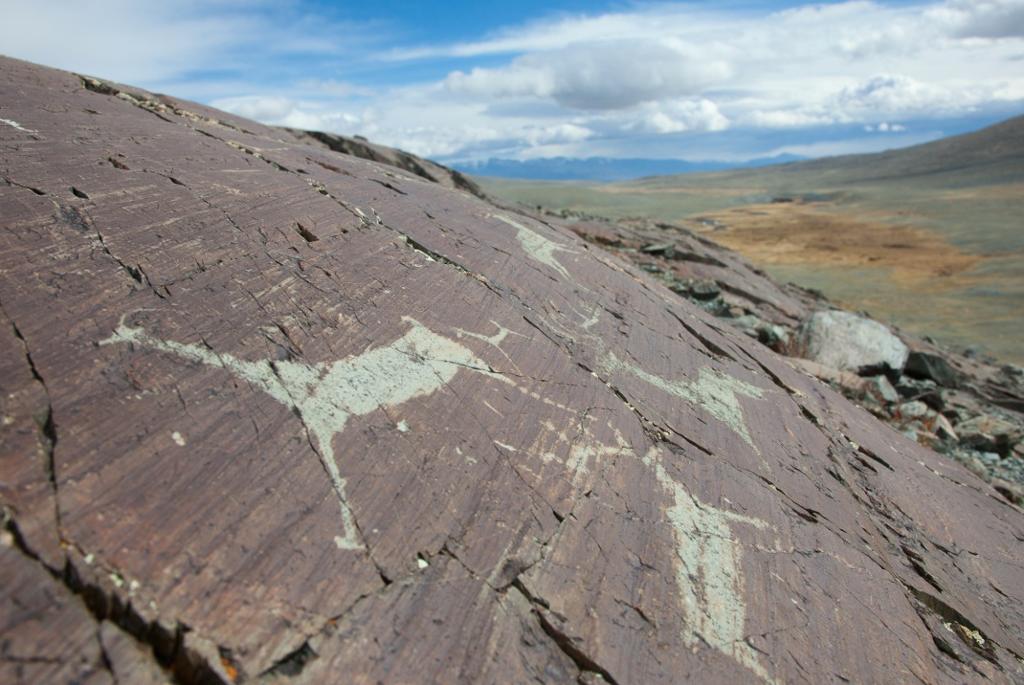
First I have to apologize for being this late with this episode, Shevet Uul). I had read about this sacred place in Mongolian Altai Mountains, but couldn't find enough to write a episode about it, so it took some more research. I discovered that "Shevet Uul" is the valley of Shiveet Khairhan Mountain and that it is a very sacred place for the Tuvan people. Shirveet Khairhan means "holy carved mountain" and it points towards a very large amount of petroglyphs which can be found on this mountain. Those petroglyphs are telling the creation of the Altai Mountains region and its religious meaning for the Tuvan.

The above quote from The Zahir by Paulo Coelho could be scened on this very mountain, because in The Zahir the head character becomes a new name ... following the Tuvan way of religion.

Credits: One of the carvings on Shiveet Khairhan Mountain

Awesome I think ... there are several other carvings in which you can see how the Tuvan thought their world was created.
This kind of petroglyph we see everywhere around the world ... they are carved or "painted" by our faraway ancestors to tell us their story. Petroglyphs are the predecessor of written words as we know them.

carvings from the past
telling the story of our ancestors
without words


© Chèvrefeuille

Not as strong as I had hoped, but I think this haiku says it all ...

This episode is NOW OPEN for your submissions and will remain open until November 29th at noon (CET). I hope to publish our next episode, Tuvan people, later on today.


Monday, November 23, 2015

Carpe Diem #865 torn apart book (reading nature)


[...] "A sense of paradise descends from the skies. And I am aware that I am living through an unforgettable moment in my life; it is the kind of awareness we often have precisely when the magic moment has passed. I am entirely here, without past, without future, entirely focused on the morning, on the music of the horses’ hooves, on the gentleness of the wind caressing my body, on the unexpected grace of contemplating sky, earth, men. I feel a sense of adoration and ecstasy. I am thankful for being alive. I pray quietly, listening to the voice of nature, and understanding that the invisible world always manifests itself in the visible world." [...] (The Zahir - Paulo Coelho)


[...] “What is Tengri?” “The word means ‘sky worship’; it’s a kind of religion without religion. Everyone has passed through here—Buddhists, Hindus, Catholics, Muslims, different sects with their beliefs and superstitions. The nomads became converts to avoid being killed, but they continued and continue to profess the idea that the Divinity is everywhere all the time. You can’t take the Divinity out of nature and put it in a book or between four walls. I have felt so much better since coming back to the steppes, as if I had been in real need of nourishment. Thank you for letting me come with you.” [...] (The Zahir - Paulo Coelho)


Dear Haijin, visitors and travelers,

What a joy ... this month we are exploring the Altai Mountains and their spiritual meaning. In this last week of this month we will even come closer to that spirit. As you have read in the above quotes from The Zahir by Paulo Coelho it's all about reading nature this day. 


Credits: Reading Nature (the Altai Mountains)

I remember an article which I read about a woman exploring the region of the Altai Mountains. She had a Mongolian guide who never used a map or travel-book ... he could read his path, the weather coming and so on ... just by reading nature. Reading nature is one of the most important pillars of what is called Tengrism or 'sky worship’. 
That's truly being one with nature ... to have the ability to read nature's signs. Those signs are all around us. In plain simple words I can say: As I see the buds of the cherry grow ... than I know that spring is coming. Or ... as I see the changing colors of leaves at the end of summer I know that autumn is coming.
Isn't that beautiful? Let me look at our beloved haiku ... what do I see? I see kigo (seasonwords) who are pointing to the season in which the haiku was written ... through those kigo we can read nature ... that makes the haiku not only a Japanese poetry form, but also a poetry form of the Altai Mountains, haiku is part of Tengrism ... look around you .... see the signs of nature and read them ... just read them.

yellow meadow
starts to become green again
spring is coming


© Chèvrefeuille

Awesome ... reading nature is really a spiritual experience ...

This episode is NOW OPEN for your submissions and will remain open until November 26th at noon (CET). I will try to publish our new episode, another Haiku Writing Technique, later on. For now ... have fun!


Saturday, November 21, 2015

Carpe Diem #864 Juniper


[...] As empty as the steppes: I understood now why Esther had decided to come here. It was precisely because everything was empty that the wind brought with it new things, noises I had never heard, people with whom I had never spoken. I recovered my old enthusiasm, because I had freed myself from my personal history; I had destroyed the acomodador and discovered that I was a man capable of blessing others, just as the nomads and shamans of the steppes blessed their fellows. I had discovered that I was much better and much more capable than I myself had thought; age only slows down those who never had the courage to walk at their own pace. [...] (fragment: The Zahir - Paulo Coelho)

Dear Haijin, visitors and travelers,

I can not remember why I have chosen this prompt for today, juniper. I think it's because of the fruits which are used to make strong sake-like wine or gin, but there is something else with juniper ... it has magical powers according to the shamans of the Altai Mountains.

For countless generations, Altai people herded their livestock across what is now known as the Golden Mountains of Altai UNESCO’s World Heritage Site, in Russia’s southern Siberia. They endured many obstacles–from Mongol hordes to Soviet oppression.  Today, they face the new challenge–climate change. Torrential downpours, freezing and thawing splinter the rock and destroy petroglyphs, the millennia-old repository of Altai people’s culture. Permafrost that preserved the remains of Altai ancestors in burial grounds for thousands of years is melting. And unpredictable snowstorms, winter rains, thawing and freezing, decimate herds of sheep and horses on which Altai people still rely heavily.
Local shamans are convinced that only through restoring their reverential relationship with the sacred and spiritual realms can Altai people and the rest of the world restore the balance of the Earth and its climate.
Credits: Shaman and Healer Maria (photo © Gleb Raygorodetsky - NGC)

One of those local shamans is Maria Amanchina, a traditional Altai shaman and healer, she lights a pipe as she sends her prayers with the smoke to the Sky, the Land, and the Spirit of Altai. The “tobacco” in her pipe are needles of the juniper. It is said that the smoke of juniper can clear peoples minds from evil and can restore the health of Mother Nature.

This is closer to Tengrism and shamanism than we were earlier in this month ... we are now entering the last phase of our journey ... the spiritual path of the shaman ...

holy smoke rises
blesses the steppes - the wind
spirit of Altai


© Chèvrefeuille

behind clouds
the cry of an eagle -
holy smokes rises


© Chèvrefeuille

This episode is NOW OPEN for your submissions and will remain open until November 24th at noon (CET). I will (try to) publish our next episode, another beautiful haiku by our featured haiku poetess Ese, later on.


Friday, November 20, 2015

Carpe Diem #863 Black Lake (Khar Us)


[...] “We drive through Almaty, stopping only to fill the tank with gas and buy some food, then we drive on in the direction of a tiny village near an artificial lake constructed by the Soviet regime. I find out where the nomad is staying, but despite telling one of his assistants that I know the man’s grandson, we still have to wait many hours, for there is a large crowd wanting the advice of this man they consider to be a saint.“ [...] (fragment from The Zahir by Paulo Coelho) 
Dear Haijin, visitors and travelers,

Today I have another nice prompt for your inspiration, Black Lake (Khar Us), but I haven't a lot to tell about this lake.

Khar Lake ("black lake") is located in the Khovd aimag (province) in western Mongolia's Great Lakes Depression. It is part of a group of lakes that were once part of a larger prehistoric lake that disappeared 5,000 years ago as the region became drier. 
Credits: Black Lake (Mongolia)

It's a wonderful lake that's for sure as you can see at the image above. A friend of mine visited this lake once and told me that it was the most beautiful, spiritual, mystical and mysterious experience he had ever had. As I look at the above image I can only say ... "this is a place where I once will be to meditate and be in close contact with nature and the spirits of the steppes".

For this episode I have another approach ... maybe you can remember our special feature "Carpe Diem Distillation", in which you had to "distil" a haiku from a longer poem. And for this episode I have a nice poem by a Mongolian poet, L. Olziitogs.

Looking at mountains, I feel I am a mountain.
Looking at mist and haze, I feel I am a cloud.
After the rain has fallen, I feel that I am grass, and
When sparrows start to sing, I remember I am morning.

       I am not a human, that’s for sure.
When stars flare up, I feel I am the darkness
When girls shed their clothes, I remember I am spring
When I smell the desire of everybody in this world,
I realize how my quiet heart is a fish’s.
       I am not a human, that’s for sure.
Under the colorful sky, an immense EMPTINESS
Starting from today I am only…
Black Lake (Mongolia)
Sorry that I am late with publishing, but you can now submit your haiku, tanka or other Japanese poetry form inspired on this episode until November 23rd at noon (CET). I will try to publish our next episode, Juniper, later on.


Thursday, November 19, 2015

Carpe Diem #862 Vistas


[...] “I left Antioch with about two hundred dollars in my pocket,” said the Dutchman, having described mountains, landscapes, exotic tribes, and endless problems in various countries with police patrols. “I needed to find out if I was capable of becoming myself again. Do you know what I mean?” [...] (The Zahir - Paulo Coelho)

Dear Haijin, visitors and travelers,

Today we have a rather strange prompt, vistas (or panoramic views), this prompt isn't specific for the Altai Mountains, but I think vistas must be awesome in these mountains so I decided to use it. To illustrate this idea I quoted from The Zahir above. In that quote a Dutchman tells his story and the main idea of that quote is "becoming myself again". I think that's what the vistas of the Altai Mountains can do. Those vistas are magnificent and beautiful and it gives you the feeling to be truly in contact with nature ... and that's what the shaman is "completely in balance and one with nature".
This "oneness" is also strong in Buddhism, one of the pilars on which haiku has been build.


For this episode of Carpe Diem Haiku Kai I love to challenge you to write an all new haiku inspired on a few images of vistas of the Altai Mountains and try to bring that "complete balance with nature, being one with nature" into your haiku.

Here are the images for your inspiration:
Credits: Altai Mountains

 
Credits: Vistas Altai Mountains


Credits: The Eagle ... one holy king of the sky

All beautiful vistas I think and these images inspired me to write the following haiku:

deep blue sky
an eagle cries ... drum of a shaman
spirits alive

© Chèvrefeuille

eyes wide open
in silent adoration of the mountains
heart lost forever

© Chèvrefeuille

This episode is NOW OPEN for your submissions, and will remain open until November 22nd at noon (CET). I will try to publish our next episode, Black Lake, later on. For now ... have fun!


Wednesday, November 18, 2015

Carpe Diem #861 Sacred Stones (Ovoo)


[...] The girl says that the next time my mother passes that way she should tie a scrap of fabric and a prayer around the small tree growing there. [...] (The Zahir - Paulo Coelho)

Dear Haijin, visitors and travelers,

We are in the Altai Mountains following the path of the shaman and today we are looking closer around us in our direct environment and as we do that we can see several natural altar like piles of stones in several countries and cultures we see that kind of "altars". Here in the Altai Mountains the Tuvan-people make those piles of sacred stones too, those piles are called "ovoo". Let me tell you a little bit more about these "ovoos". In a way the above quote from The Zahir tells us more about the Tengri spirituality as we see in the "ovoo".

An ovoo (heap) is a sacred cairn found in Mongolian shamanic religious traditions, usually made from rocks with wood or from wood. Ovoos are often found at the top of mountains and in high places, like mountain passes. They serve mainly as Tengriism religious sites, used in worship of the mountains and the sky as well as in Buddhist or Shamanist ceremonies, but often are also landmarks. Almost all researchers say that originally all ovoo were made from holy woods, and to this day they must include wood elements inside of them.

Credits: Ovoo (Sacred Stones)
When travelling, it is custom to stop and circle an ovoo three times in clockwise direction, in order to have a safer journey. Usually, rocks are picked up from the ground and added to the pile. Also, one may leave offerings in the form of sweets, money, milk, or vodka. If one is in a hurry while travelling and does not have time to stop at an ovoo, honking of the horn while passing by the ovoo will suffice.

Ovoos are also used in mountain- and sky-worshipping ceremonies that typically take place at the end of summer. Worshippers place a tree branch or stick in the ovoo and tie a blue khadag, a ceremonial silk scarf symbolic of the open sky and the sky spirit Tengger, or Tengri, to the branch. They then light a fire and make food offerings, followed by a ceremonial dance and prayers (worshippers sitting at the northwest side of the ovoo), and a feast with the food left over from the offering. (Source: Wikipedia)

three times around
the ovoo blesses my journey -
cry of an eagle


© Chèvrefeuille

I like this idea of the ovoo ... it makes you humble and with following the rules of the ovoo you honor nature, the spirits of the steppes ... be safe on your journey ...


This episode is NOW OPEN for your submissions and will remain open until November 21st at noon (CET). I will try to publish our next episode, vistas, later on. For now ... be inspired and share your haiku, tanka or other Japanese poetry form with us all.

Monday, November 16, 2015

Carpe Diem #860 Cosmic Order


"Living with nature is giving yourself totally to the Cosmic Order" - Chèvrefeuille

“I was in touch with the energy of the universe,” he replied. “God passed through my soul.” - quote from The Zahir by Paulo Coelho

Dear Haijin, visitors and travelers,

First I love to thank Hamish Manaqua Gunn (a.k.a. Pirate) for being our guest-host this weekend. His posts were wonderful. I was surprized with his "shaman-haiku" post ... what a great idea to "create" a new haiku genre especially to give words to the ideas and spirituality of the shaman. The "shaman-haiku" fits this month's theme like a glove. Thank you Hamish, my friend.

After those wonderful posts of Hamish it will not be easy for me to create our new episodes, but ... well ... my style of writing the posts is different from the style of Hamish and that makes the beauty of Carpe Diem Haiku Kai, a loving family of haiku poets.

We are on "the path with the shaman" while we are on a journey through the wonderful Altai Mountains. During our journey we are accompanied by Paulo Coelho as we are reading one of his most wonderful novels, The Zahir.

Today our prompt is Cosmic Order and that's what the people living in and around the Altai Mountains are following in their daily life. They live totally with nature and are one with the Cosmos. As I am saying in the above quote ... I too am living with nature following the Cosmis Order. How could I live in another way as a haiku poet? As a haiku poet, writing the poetry of nature (as is haiku called often) we are one with nature and part of the Cosmos (or the Universe).
Haiku IS the Cosmos I dare to say, because haiku is not only a beautiful poem, it's a way of living. As a haiku poet you have to live haiku. We are, as humans, all part of nature. We are not above nature, we are nature and therefore we have to take care for nature. Nature is the source of our poetry.

The people in the region of the Altai Mountains are nature. They are living with, by and through nature. And that we can see in their daily life. They listen to the wind, to the rain, to the snow, to the hail, to the sun, the gurgling streams ... they listen to the cry of the eagle, because for them the Eagle is holy and a Messenger of the Gods and they have to follow it.

[...] "I believe in signs. After I had walked the road to Santiago, everything had changed completely: what we need to learn is always there before us, we just have to look around us with respect and attention in order to discover where God is leading us and which step we should take next. I also learned a respect for mystery. As Einstein said, God does not play dice with the universe; everything is interconnected and has a meaning. That meaning may remain hidden nearly all the time, but we always know we are close to our true mission on earth when what we are doing is touched with the energy of enthusiasm." [...] (The Zahir - Paulo Coelho)
[...] "All men and all women are connected by an energy which many people call love, but which is, in fact, the raw material from which the universe was built. This energy cannot be manipulated, it leads us gently forward, it contains all we have to learn in this life. If we try to make it go in the direction we want, we end up desperate, frustrated, disillusioned, because that energy is free and wild." [...] (The Zahir - Paulo Coelho)

Credits: Ger (or Yurt)
In the "architecture" of their "gers" (or yurt), their homes, we can see their strong bond, connection, with the Cosmos. Everything in, at and on their gers is in balance with the Cosmis Order. Their gers are based on equality, because you have to bend your head, as you enter the ger, in praise of its owner, in praise of the Cosmos.

Entering the ger is almost the same as entering the Japanese teahouses to attend a tea-ceremony. It has also a low door that makes you bow ... in praise of the owner and host, based on equality. We are all the same, no ranks ... equal to each other.
Isn't that wonderful? We are in the Altai Mountains, but also in Japan. There are similarities between these two regions we can not over see. In the Altai Mountains they live with nature. They praise and honor nature. In Japan they live with nature, they are part of nature based on the Shinto religion. That completes the circle betwen us, haiku poets, and the people of the Altai Mountains and Japan. That is the Cosmic Order ... that is the Cosmos, the universal consciousness that binds us together, like a family ... as I love to call our haiku community Carpe Diem Haiku Kai. Thank you all for being part of this family of haiku poets. That makes me proud, but also humble. Who am I that I may be your host?

one with the Cosmos
a nature loving family
of haiku poets


© Chèvrefeuille

the cry of an eagle
resonates through the Altai Mountains
like a prayer


© Chèvrefeuille

Credits: Festival of the Golden Eagle (Altai Mountains)

circle of life
seasons come and go ... always
the Cosmos leads us


© Chèvrefeuille

deep silence
I bow my head in adoration
snowflakes fall


© Chèvrefeuille

I hope you all did like this post and that it will inspire you to write haiku, tanka or another Japanese poetry form.

This episode is NOW OPEN for your submissions and will remain open until November 19th at noon (CET). I will (try to) publish our new episode, the third haiku by our featured haiku poetess Ese, later on.

!! PS.: Don't forget our new kukai "WINTER". You can submit a maximum of three unpublished haiku (only haiku) until December 23rd 10.00 PM (CET) !!

Wednesday, November 11, 2015

Carpe Diem #856 Shepherds


Dear Haijin, visitors and travelers,

As you have read in my recent CD Extra ... i have a huge problem ... no PC, it has gone dead. So I have to use my tablet, a small one ... 7 inches. So until i have a new PC I cannot create the posts as I am always doing. So this episode, and the following, will be very small and without images.

Today our prompt is shepherds ... Shepherds in the Altai Mountains are very strong people, not only by their hard work, but also through the climat. But they will never be sad or something. They enjoy what they do and are happy with their, close to nature, life.
They are very strong and spiritual ... how to catch their character in a new haiku ... i have given it a try:

walking through the mountains
they watch their sheep with love
thanking the Altai spirits

© Chèvrefeuille

You can submit your haiku inspired on this prompt until November 14th at noon (cet).

Monday, November 9, 2015

Carpe Diem #855 Meadow(s)


Dear Haijin, visitors and travelers,

What to say about this prompt for today? I think I don't have to tell you something about this prompt, meadow(s), I even remember that we have had this prompt earlier, in another context maybe, but it's the very same.
The meadows of the valleys in the Altai mountains are wonderful and full of wonderful wild flowers and grasses ... and all those wild flowers and grasses have certain medicinal powers. Let us take a closer look at an image I have used earlier this month.


That yellow flower looks somewhat familiar with a Buttercup or Ranunculus and that is a very powerful herb to use in several conditions. Here is some more background:

Fresh leaves are historically used as external rubefacient in rheumatism, gout, arthritis, neuralgia (topically or externally applied). American Indians poulticed root for eczema, warts, boils or abscesses. Action based on irritating affected part.
It is directly applied to warts.
A tincture may be both externally applied or taken internally to treat shingles and sciatica.

More than a century ago, bulbous buttercup was recommended by herbalists for resolving dermatologic, rheumatologic, gastrointestinal, and dental complaints. When rubbed on the skin, bulbous buttercup causes blistering, swelling, and topical ulcers, which were said to alleviate pain topically as well as subcutaneously. All parts of the acrid plants were used to induce vomiting and diarrhea upon ingestion. As a painkiller, the plant was stuffed into dental cavities and its infusions were rubbed on the gums of teething infants.

The meadows of the Altai mountains are really rich in delivering powerful medicinal herbs and they were often used by the shamans, but also by the people themselves, because they have learned that from their ancestors ... in this rough surroundings there was just need to be wise to survive ... and that makes the people of the Altai mountains a strong race.

colorful meadow
Mother Nature's own pharmacy
ancestor's wisdom


© Chèvrefeuille

Another one about meadow(s) seen from another angle:


warriors of the king
fighting for glory - in the meadows
the lowing of cows


© Chèvrefeuille

Heifers

For closure another haiku in which I have caught the powerful medicinal flowers in a few lines and words.

along our life's path
straight through the meadow of health -
a field of flowers

© Chèvrefeuille

I hope you did like this episode. It's different with our other (once used prompt) meadow, but I loved creating it, however ... it wasn't easy to write this post.


in just one heart beat
the sunlight breaks through the mist
revealing the meadow

© Chèvrefeuille

This episode is NOW OPEN for your submissions and will remain open until November 12th at noon (CET). I will (try to) post our next episode, a new episode of our Haiku Writing Techniques and a new haiku by Ese, our featured haiku poetess, later on.