Showing posts with label peace of mind. Show all posts

Tuesday, June 5, 2018

Carpe Diem's Sparkle Of Joy ... introduction and first "task"


Dear Haijin, visitors and travelers,

Today I read a wonderful article in a Dutch Mindfulness magazine about Tantra. I think you all know what Tantra means, but I at first thought of it as a kind of sexuality, maybe you thought that also, but Tantra has nothing to do with sexuality. It has to do with freeing the so called "Kundalini energy" that rests around the lower back around the tail-bone. Isn't that an amazing idea? Through Tantra we can free the "Kundalini energy" and that energy can really set you free.

In Tantra, the freeing of the "Kundalini energy" is called the "Sparkle Of Joy" and that's a kind of unworldly unnatural euphorical experience ... almost ... like an orgasm ... Maybe that's why Tantra is thought about as a kind of sexuality.

Freeing the Kundalini Energy

What is the goal of this new feature "Sparkle Of Joy" ... I hope to explain that in the right words, because (as you all know) English isn't my 'maiden language'. I think this feature is meant to give words to your Inner Self, your Innermost Self, your Deepest thoughts ... Those words can give you that "Sparkle Of Joy" and can free your Kundalini energy ... and that makes your heart a little bit lighter so to say.

What can "trigger" that "Sparkle of Joy"? Well ... it can be seen in the smallest things in nature, like an ant or like the Sheperds Purse (that renown haiku by Basho) ... the beauty of the world around you.

Let me give you an example written by myself. I love the moon and stars, I love the darkness of the Night and that inspired me to create the following haiku:

walking through the forest
thousands stars sparkle in the black sky
between bare branches

© Chèvrefeuille

Or this one that I wrote after spotting an oak-tree on which I saw ants climbing up and down in a long row.

amazing
ants running up and down
like soldiers


© Chèvrefeuille

I think I have given the right words to explain the goal of this new feature ... and I hope you will embrace this new feature too.

This episode is NOW OPEN for your submissions and will remain open until June 15th at noon (CEST). This new feature will appear on every Friday just as a treat.


Monday, July 18, 2016

Carpe Diem Theme Week 5 (2) ascended masters and the seven rays


Dear Haijin, visitors and travelers,

Welcome at the second episode of our 5th Theme Week in which we will explore and discover the deeper meaning of Ascension and the Ascended Masters whom are helping us to reach that spiritual point in which we will ascend ...

Of course I cannot write about all the known Ascended Masters, but I think it's important to take you by the hand and show you some background on this idea of Ascension and Ascenede Masters. Therefore I love to tell you something more about how the Ascended Masters are working. Every Ascended Master, for example: Jesus or Metatron or Babaji, works through a system that is called the Seven Rays (it's a term introduced by the renown spiritualist Madam Blavatsky). These are the Seven Rays:

The Seven Rays are connected with the Seven Chakras

The first ray is the Blue Ray, the ray of God's Will and Power
The second ray is the Yellow Ray, the ray of Wisdom
The third ray is the Pink Ray, the ray of Unconditional Love
The fourth ray is the White Ray, the ray of Harmony through Conflict
The fifth ray is the Green and Orange Ray, the ray of Healing, Knowledge and Truth
The sixth ray is the Ruby, Gold and Purple Ray, the ray of devotion and goddess ray
The seventh ray is the Violet Ray, the Ray of Transmutation
And than, something I find a little bit strange, there is in this theory of the Seven Rays also an eighth ray. The eighth ray is the Rainbow Ray, the Ray of Integration, there is only one ascended masters that works through this ray ... White Tara

rays of light
old pond seems to burn
energizing aura


© Chèvrefeuille

Seven Rays Lotus

It is possible to find your own ascended masters guiding you on your spiritual path. Several years ago I visited a medium and she created a painting for me in which she showed which rays were seen in me. In the heart of the painting there was a bright yellow and orange sun, so that meant that ascended masters working through those rays were my guides. But that wasn't all ... in her painting there was a lot of green, but also rays of pink and ruby. It was an amazing experience, because I was very skeptic as I visited her together with my wife, but after wards ... my wife said ... that painting is exactly you no doubts at all.

Ascended Masters ... you have heard from them I think. They are guiding us all on the path we have chosen and they keep us on our path. Of course we have free will. We decide which path we will take, therefore there are more ascended masters who guide you, but all together they will lead you to ascension ... that's for sure.

colorful rays
crystal clear water breaks
in the low sunlight


© Chèvrefeuille

Well ... I hope you did like this episode. This episode is NOW OPEN for your submissions and will remain open until July 23rd at noon (CET). Have fun!


Friday, January 15, 2016

Carpe Diem Extra January 15th 2016 Tepid and Bittersweet


Dear Haijin, visitors and travelers,

As promised ... I have created a new CDHK ebook in which I have gathered all the entries for our 3rd and 4th kukai, "juxtaposition" and "peace of mind". I have titled this new CDHK ebook "Tepid and Bittersweet", it's a line from the winning "juxtaposition" haiku by Ese  (twitter):

tepid and bittersweet
in the last sip of coffee
departing summer


© Ese

It has become a nice ebook and I hope you will like it. "Tepid and Bittersweet" is available for free download at the right of our Kai.

Have fun reading and re-reading it.

Namaste,

Chèvrefeuille, your host


Monday, November 2, 2015

Kukai "Peace of Mind" THE RESULTS


Dear Haijin, visitors and travelers,

I am happy to bring you (finally) the results of our fourth kukai "peace of mind". During circumstances I hadn't the time to look at the voting to gather the points.
This kukai there were 22 haiku submitted by 10 different haiku poets. I think "peace of mind" could inspire you, but maybe ... I thought wrong. Well ... it doesn't really matter, because it is just fun and I am glad that you all are that excited about the kukai here at Carpe Diem Haiku Kai.

As you all know the winner of the kukai gets the opportunity to create an E-book together with our Publisher Chèvrefeuille's Publications and will be the featured haiku poet for December 2015. Our "runner up" gets his/her own episode of Tokubetsudesu.

Credits: winter landscape

Before I will announce the winners I will give a call for submissions for our new kukai. For this new kukai, this new haiku contest, I have chosen the following theme: WINTER and of course that's a very broad range of things and scenes. So I love to challenge you to write/compose haiku in which you can "feel", "touch", "smell", "taste", "see" and "hear" WINTER, must be easy ... don't you think so too ....!
Submission starts today. You can submit haiku (only haiku with a maximum of three new (unpublished) haiku) until December 23rd 10.00 PM (CET) to our emailaddress:

carpediemhaikukai@gmail.com


Please write: kukai Winter in the subject line.

Okay ... back to the results of our "peace of mind" kukai. There was a very clear winner who got 16 points and that was the following haiku:


rain drips
off the old bamboo wind-chimes
serenity
And our "runner up" was also very clear with 11 points:


waves hush
a moonlight ripples on water
-my dream floats


Who were the poets which composed these wonderful haiku? Well .... here they are:

Our winner (with 16 points) is Georgia and our "runner up" (with 11 points) is Hamish. Both haiku poets

>>>>>>>>>>> CONGRATULATIONS <<<<<<<<<<<<<

You see ... it is possible to win this kukai, so here is (again) a call for submissions for our new kukai WINTER .....

And here are the results of the other haiku which were submitted for the "peace of mind" kukai:

Haiku 14: 9 points
Haiku 12 & 17: 8 points
Haiku 7: 5 points
Haiku 11: 4 points
Haiku 8, 9, 19 & 20: 3 points
Haiku 10 & 15: 2 points
Haiku 6: 1 point
Haiku 1, 2, 3, 4, 5, 16, 21 & 22: no points


Namaste,

Chèvrefeuille, your host


Sunday, April 12, 2015

Carpe Diem #705, Debonding (or detaching)


Dear Haijin, visitors and travelers,

I have had a very busy day today, because I have already created two new posts for our Carpe Diem Haiku Kai and this will be the third post. No problemo by the way I love to be your host and I hope you all do like what I am doing and that makes me humble and happy.

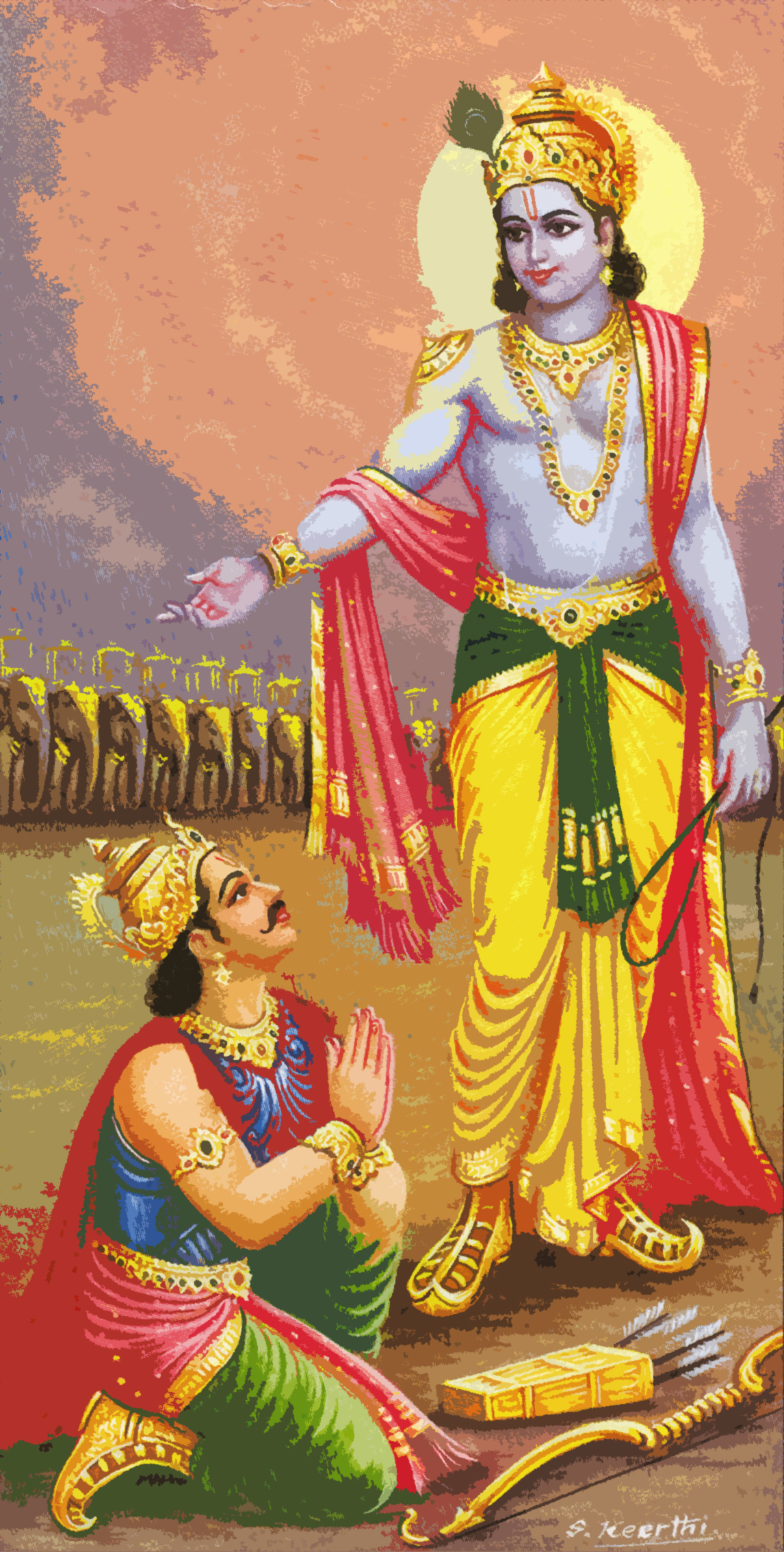
We are on a journey through the Bhagavad Gita to explore Peace of Mind, our theme for this month. Today I love to go further with the spiritual growth of Arjuna who is in a conversation with Krishna in the middle of two armies.
I understand that the prompt for today as in the prompt-list given, debonding, is not a common word in English, so I have given the other word for the same thing, detaching, this episode is about "letting go".

Arjuna is anxious and sad as he sees the two armies in which his dearest friends and family-members are gathered standing against each other. Krishna tells him about life and death, good and evil and so on. And he asks Arjuna to "let go", "you are bound to the Earth Arjuna, bound to your friends and family, but you have to let them go to inherit Atman ... you have to detach from your mind and your ideas, follow your heart ... and you will find the Light".

detached
a last leaf falls
the first snow


© Chèvrefeuille

To become who you want to be means making choices and maybe you have to detach from your ideas, feelings and thoughts. Try to look inside you and try to find what is bordering you for example. To go on your path ... it some times will be a time to detach, take another path. Every path you take is good or great ... it will always bring you were you finally want to come.

This episode is open for your submissions tonight at 7.00 PM (CET) and will remain open until April 15th at noon (CET). Have fun!
!! At 7.00 PM (CET) there will be also a new Time Glass on line !!


Saturday, April 11, 2015

Carpe Diem #704, Wheel of Creation


Dear Haijin, visitors and travelers,

Let us go on with our journey and exploration of the Bhagavad Gita to find (maybe) Peace of Mind, as is the theme for this month. Today our prompt is Wheel of Creation and it's very clear that this prompt is about Creation as it is thought in Hinduism.
In the middle between the two armies Arjuna and Krishna are having a conversation and Krishna explains to Arjuna how the world was created and how it will be created again like an everlasting movement.

The Hindu tradition perceives the existence of cyclical nature of the universe and everything within it. The cosmos follows one cycle within a framework of cycles. It may have been created and reach an end, but it represents only one turn in the perpetual "wheel of time", which revolves infinitely through successive cycles of creation and destruction. Within this cycle of creation and destruction of the universe, the soul (atman) also undergoes its own version of cycle called samsara, the cycle of rebirth in which individual souls are repeatedly reincarnated.

In the beginning there was neither existence nor non- existence; there was no atmosphere, no sky, and no realm beyond the sky. What power was there? Where was that power? Who was that power? Was it finite or infinite?

There was neither death nor immortality. There was nothing to distinguish night from day. There was no wind or breath. God alone breathed by his own energy. Other than God there was nothing.

In the beginning darkness was swathed in darkness. All was liquid and formless. God was clothed in emptiness.

Then fire arose within God; and in the fire arose love. This was the seed of the soul. Sages have found this seed within their hearts; they have discovered that it is the bond between existence and non-existence.

Who really knows what happened? Who can describe it? How were things produced? Where was creation born? When the universe was created, the one became many. Who knows how this occurred?

Did creation happen at God's command, or did it happen without his command? He looks down upon creation from the highest heaven. Only he knows the answer -or perhaps he does not know.


(Rig Veda 10:129.1-7)

Credits: Wheel of Creation (Samsara)

As I read these verses from the Rig Veda I immediately saw the Christian idea of Creation in front of me. It's almost the same. Could it be, as we stated earlier, that Christianity has derived from Hinduism, the oldest known religion? That would be a stunning revelation ... because I have learned that Christianity derived from Judaism? If Christianity really derived from Hinduism, than Hinduism is the Mother of all religions ... is that real?

I don't know that of course, it's hypothetical ... but it can ....

departing
cherry blossom petals fall
without sound

without sound
cherry blossom petals ride
on gusts of wind

on gusts of wind
cherry blossom petals, full circle,
the taste of cherries

the taste of cherries
helping me through the cold winter
Sakura blooms again


© Chèvrefeuille

Well ... I hope you did like this episode and I hope it will inspire you all to write/compose an all new haiku.

This episode is open for your submissions tonight at 7.00 PM (CET) and will remain open until April 14th at noon (CET). I will try to publish our next episode, debonding (or detaching), later on.

Friday, April 10, 2015

Carpe Diem #703, Karma


Dear Haijin, visitors and travelers,

I am a bit late today with publishing our new episode, and I am at work, so this will not become a big post. Today's prompt is karma.The concept of karma first appears strongly in the Bhagavad Gita it is a concept in Hinduism which explains causality through a system where beneficial effects are derived from past beneficial actions and harmful effects from past harmful actions, creating a system of actions and reactions throughout a soul's reincarnated lives forming a cycle of rebirth. The causality is said to be applicable not only to the material world but also to our thoughts, words, actions and actions that others do under our instructions.

Credits: Karma (Dutch website)
cherry blossom blooms
after the long cold night
the circle of life


© Chèvrefeuille

Not as strong as I had hoped, but I do like this haiku ... it feels like 'karma', another year has past and the cherry tree has become older and wiser, but blooms again ... open to a new year of growth.

This episode is NOW OPEN for your submissions and will remain open until April 13th at noon (CET). I will try to publish our next episode, Wheel of Creation, later on.

Carpe Diem Tan Renga Challenge #80, Kala Ramesh's "Howling Wind"


Dear Haijin, visitors and travelers,

It's Friday again and that means .... Tan Renga Challenge Time ... This week I have chosen a haiku by our featured haiku poetess of this month, Kala Ramesh, as our "hokku" for our Tan Renga Challenge. For those who are new here, the goal is to compose/write a two lined second stanza towards the "hokku" through association on the images. words in the "hokku". That two lined stanza follows the syllables count 7-7 (but as you all know already, that's not an obligation at CDHK). Here is the "hokku":

howling wind —
an autumn note within
the bamboo flute
          

© Kala Ramesh

This haiku provides you already with great images as you have read it for the first time. For example you can write your second (two lined) stanza through association on "howling wind" or "bamboo flute".
Credits: bamboo flute
Here is my attempt to write the second stanza. I used the image of the "bamboo flute" and made a connection with our "peace in mind" theme.

howling wind —
an autumn note within
the bamboo flute
                   (Kala Ramesh)

walking through the cherry orchard
I hear the sound of Krishna's flute
                (Chèvrefeuille)

A lovely scene as I may say so. The second stanza makes the Tan Renga complete, but it also uses juxtaposition to make this Tan Renga into a "baransu" poem.

Try to make the Tan Renga complete yourself and share it with us all.

This Tan Renga Challenge is NOW OPEN for your submissions and will remain open until next Friday April 17th at noon (CET). Have fun!

Sunday, April 5, 2015

Carpe Diem #700, Govinda (the bow)


Dear Haijin, visitors and travelers,

Isn't it amazing? This is our 700th episode of our Carpe Diem Haiku Kai, the regular episodes of course. So we have a little celebration ... I have presented you with 700 (regular) episodes in which I challenged you to write an all new haiku inspired on a given prompt. Awesome!

This month we are on a journey to discover the beauty of the Bhagavad Gita and maybe find "peace of mind", as is the central theme this month. Today it's not really a part of the Bhagavad Gita, but more a kind of exchanging thoughts between a few sources. Why? Well ... today our prompt is Govinda (the bow), and it refers to the bow of Arjuna, the Archer, who has the leading role in the Bhagavad Gita.
Maybe you have visited Haiku Shuukan at WP, another part of our Haiku Kai Family. Recently the theme there was "The Way of the Bow", based on a short story by Paulo Coelho. In that short story he describes the path to enlightenment through archery. As the arrow has left the bow ... there is no returning back it will seek its way to the goal. That's how our spiritual growth works ... we are once at a certain point in our lives and then we realize that our life must chance ... this occurs around the age of 20 ...

Maybe you know the novel "Siddhartha" by Hermann Hesse. In that novel Siddhartha and his best friend Govinda are on a journey to discover their path. They were great friends, but after years of searching for the truth their lives depart ... Siddhartha becomes a wealthy merchant and learns "the worldly pleasures" while Govinda is staying at the Buddha's place and becomes a monk. At first Siddhartha is very sad as he and his best friend are split up ... he loses his goal, he had to let go Govinda.

What has this to do with the Bhagavad Gita? All and everything, but also nothing. There is just that name Govinda who hold those different ideas together. There has to be a connection between Hinduism and Buddhism ... the both religions saw the light of life in India and maybe those religions were connected with Christianity, Islam and other religions. All we know is that Hinduism is the oldest religion known. All other religions have grown from Hinduism ... It's just a hypothesis but it's worth thinking it over.

don't hide your light
let it shine bright without regret -
Lotus will bloom again

© Chèvrefeuille


There are similarities in the world religions, there was once the idea of a lot of gods and goddesses, even in the ancient religion of Judaism there was a moment that they thought there were multiple gods ... One way or another it brings us all the ideas for life ... the everlasting battle between good and bad, as we also see in the Bhagavad Gita. There he stands in the middle of two big armies, Arjuna, the Archer. He becomes anxious and let his bow, Govinda, slip from his hands. He doesn't know what to do .... how can he go to battle against an army in which there are friends and family of him?
This is the ultimate inner battle ... and is it a coincidence that that inner battle has been fought by Jesus Christ in the Garden of Gethsemane? No ... it isn't. Maybe you think this is blasphemy, but that's certainly not what I think it is. It's part of the hypothesis that all world religions have grown from Hinduism.

Govinda (the bow), can make the difference. Jesus made the difference by giving his own life to save humankind .... and that's also what is told in the Bhagavad Gita ... Arjuna is the savior of humankind and he is now at that point ... will he choose right? Krishna teaches him about life and death teaches him about Atman, heaven, in which there will be no differences anymore. How wonderful is this idea?

Remember the Tarot month! There was one of the last cards, "The World" in which we see that there will be a New Heaven, a New Jerusalem ... that's the place were we all will come after all ... that New Jerusalem is the same as Atman ...

Credits: Govinda (the bow) slips from Arjuna's hands

This episode wasn't easy to create ... it's triggered by Hamish (see his comment at episode 699) and I thought, no I had to use it for this episode in which we see that Arjuna loses Govinda as he is desperate in the middle of the battle ... Govinda (the bow) cannot be without the hand of the Archer, but also cannot be without the arrow ... the arrow as it has left the bow there is no returning back ... as Arjuna shoots his arrow than the battle will be fought .... at that moment as he looses Govinda (the bow) as is Siddhartha in Hermann Hesse's novel loosing his best friend to the wisdom of Buddha he makes the decision to take another path ... a path that will lead him to salvation ... isn't that what we celebrate today? Easter .....

narcissus bloom
shining their light on our path -
He has risen

(c) Chèvrefeuille

Well .... happy Easter to you all ... and I hope this episode, maybe in a way controversial, but remember this idea exposed here is just a hypothesis. Let this episode inspire you to write an all new haiku ...

This episode is open for your submissions tonight at 7.00 PM (CET) and will remain open until April 8th at noon (CET). I will (try to) publish our new episode, ancestors, later on. For now ... just have fun!


Saturday, April 4, 2015

Carpe Diem #699, depression


Dear Haijin, visitors and travelers,

A few days ago we started our discovery of the Bhagavad Gita and then there were a few other episodes, but today we will continue our discovery of the Bhagavad Gita. As we can recall .... Arjuna stood in the middle of the both armies and had a conversation with Krishna about life and death.
Arjuna becomes sad and depressed as he sees the enemy armies in which his friends, family-members and teachers are gathered. And he becomes anxious ... how can he fight against his best friends and family?

Having thus spoken in the midst of the battlefield, Arjuna, casting away his bow and arrow, sat down on the seat of the chariot with his mind overwhelmed with sorrow.

The Lord takes pity on him and proceeds to enlighten him by various means. He explains to Arjuna the imperishable nature of the Atman, for which there is no past, present and future. The Atman never dies, therefore Arjuna should not grieve. As It transcends the five elements, namely, earth, water, fire, air and ether, It cannot be cut, burnt or dried. It is unchanging and eternal. Everyone experiences conditions like pleasure and pain, heat and cold, due to contact of objects with the senses. The senses carry the sensations through the nerves to the mind. One should be able to withdraw the senses from objects, like the tortoise which withdraws all its limbs within.

eternal circle
lotuses blooming and decaying -
ancient wisdom grows

© Chèvrefeuille


Krishna asserts that only one who has the capacity to be balanced in pleasure and pain alike is fit for immortality. Krishna goes on to tell Arjuna that if he refuses to fight and flees from the battle, people will be justified in condemning such action as unworthy of a warrior.

Having taught Arjuna the immortal nature of the Atman, Lord Krishna turns to the performance of action without expectation of fruit. A man should not concern himself about the fruit of the action, like gain and loss, victory and defeat. These are in the hands of the Lord. He should perform all action with a balanced mind, calmly enduring the pairs of opposites like heat and cold, pleasure and pain, that inevitably manifest during action. Krishna advises Arjuna to fight, free from desire for acquisition of kingdom or preservation of it.

Arjuna is eager to know the characteristics of a man who has a stable mind. Such a person, Krishna tells him, will have no desires at all. Since he is content within, having realized the Self, he is entirely free from desires. The consciousness of the Atman and abandonment of desires are simultaneous experiences. The various qualities of a Sthitaprajna (a stable-minded person) are described by the Lord. He will not be affected by adversity and will have no fear or anger. He will take things as they come, and will not have any likes and dislikes. He will neither hug the world nor hate it. The man of stable mind will have perfect control of the senses. The senses are powerful and draw the mind outwards. One should therefore turn one’s gaze within and realize God who resides in the heart. The Yogi, having achieved a stable mind, remains steadfast even though all sense-objects come to him. He is unmoved and lives a life of eternal peace.

Krishna concludes that the eternal Brahmic state frees one from delusion forever. Even at the end of life, when one departs from this body, one does not lose consciousness of one’s identity with Brahman.

no more delusion
as the Painter finishes His painting -
it is ready


© Chèvrefeuille

As I re-read the above words a kind of joy overwhelms me ... what a joy to know that there will be a time in which we will be free from delusion even at the end of our life as we are leaving our conscious body and become eternal subconsciousness.


Isn't that what we explored during our Tarot month? This scene above could be easily placed in the Great Arcana's Tower card ... in which we have seen that we cannot become as God, but we are already God. Maybe you remember the Tower card ... in which the sky was filled with "yods" the only Hebrew sign that is placed in all words of the Holy Scripture .... therefore we can say God is everywhere around us, in us accompanying us through our whole life.
At the end of our life we may enter the Holy City, becoming Brahman ... and so there is a link between the great religions ... there is a common meaning in all the holy scriptures on Earth and beyond.

Arjuna overcomes his depression as he hears the words of Krishna and his transformation has started.


old pond
lotuses start blooming, growing to the light
water circles


© Chèvrefeuille

This episode is open for your submissions tonight at 7.00 PM (CET) and will remain open until April 7th at noon (CET). I will try to publish our new episode, Gandiva (the bow), later on. For now ... I hope this episode will inspire you to compose an all new haiku.

!! I have published our new Carpe Diem Haiku Kai prompt list already. You can find it in the menu !!

Wednesday, April 1, 2015

Carpe Diem #698, Chariot


Dear Haijin, visitors and travelers,

Welcome at a new episode of Carpe Diem Haiku Kai. This month I have given the theme "Peace of Mind" and it's all about the Bhagavad Gita, that wonderful part of the Mahabharata, in which Arjuna and Krishna are having a conversation about life and death before going into battle.

In the Bhagavad Gita this conversation is given form by verses (as e.g. in the Bible or the Qu'ran). Our first prompt chariot is distilled from the start of the Bhagavad Gita. Arjuna (the Archer) drives his chariot in between the two armies to start the battle. He asks his charioteer (Krishna) why he has to go into battle with the enemy armies in which he (Arjuna) sees relatives, friends and so on. Than the conversation starts:
21-22 In the middle of the two armies, place my chariot, O Krishna, so that I may behold those who stand here, desirous to fight, and know with whom I must fight when the battle begins.
23. For I desire to observe those who are assembled here to fight, wishing to please in battle Duryodhana, the evil-minded.
24. Being thus addressed by Arjuna, Lord Krishna, having stationed that best of chariots, O Dhritarashtra, in the midst of the two armies,
25. In front of Bhishma and Drona and all the rulers of the earth, Krishna said: “O Arjuna, beholdnow all these Kurus gathered together!”
26. Then Arjuna beheld there stationed, grandfathers and fathers, teachers, maternal uncles, brothers, sons, grandsons and friends, too.
27. (He saw) fathers-in-law and friends also in both armies. The son of Kunti—Arjuna—seeing all these kinsmen standing arrayed, spoke thus sorrowfully, filled with deep pity.
28. Arjuna said: "Seeing these, my kinsmen, O Krishna, arrayed, eager to fight,
29. My limbs fail and my mouth is parched up, my body quivers and my hairs stand on end!
30. The (bow) “Gandiva” slips from my hand and my skin burns all over; I am unable even to stand, my mind is reeling, as it were."

Credits: Arjuna drives his chariot between the armies
These are the first verses of the Bhagavad Gita and as you can read in verses 21 and 22 Arjuna asks Krishna to ride his chariot into the middle of the two armies. 

As I was preparing this episode I thought immediately at another episode about Chariot ... maybe you can remember that too ... it was in the Tarot-month (May 2013) and I have decided to re-produce a haiku from that episode here: 

divine guidance
awaiting before going to battle -
the charioteer
© Chèvrefeuille (2013)

Isn't it incredible to see how this haiku fits this new episode in which we started to discover the Bhagavad Gita? Will there be more similarities this month between the Tarot and the Bhagavad Gita? We will see ....

This episode is open for your submissions tonight at 7.00 PM (CET) and will remain open until April 3rd at noon (CET). I will (try to) post our next episode, our first special with a haiku written by Kala Ramesh, our featured haiku-poetess this month, later on. For now ... be inspired ... and remember this prompt is just for your inspiration and there is not an obligation to use the Bhagavad Gita in your submissions. Feel free ... let the prompt, chariot, inspire you ... let your muses speak to you.