Tuesday, February 7, 2017

Carpe Diem #1147 Ise Shrine


Dear Haijin, visitors and travelers,

It is my pleasure to announce that Chèvrefeuille's Publications has created a new exclusive CDHK e-book "Only Footprints" by Candy. Candy was the winner of our 'tribute to Jane' kukai and won the opportunity to create an e-book.
The download link isn't ready now, but that will change later today.

Today we are going further on our journey through Japan, the "Motherland" of Haiku. Today I love to tell you all a little bit more about Ise Shrine. Ise Shrine is one of the most famous shrines of Japan and you sure will remember several haiku poets, e.g. Issa and Basho, which have written haiku in praise of Ise Shrine.

Ise Shrine
The Ise Grand Shrine, located in the city of Ise, Mie Prefecture of Japan, is a Shinto shrine dedicated to the sun goddess Amaterasu. Officially known simply as Jingū, Ise Jingū is a shrine complex composed of a large number of Shinto shrines centered on two main shrines, Naikū and Gekū.
The Inner Shrine, Naikū (also officially known as "Kotai Jingū"), is located in the town of Uji-tachi, south of central Ise, and is dedicated to the worship of Amaterasu, where she is believed to dwell. The shrine buildings are made of solid cypress wood and use no nails but instead joined wood. The Outer Shrine, Gekū (also officially known as "Toyouke Daijingū"), is located about six kilometers from Naikū and dedicated to Toyouke-Ōmikami, the god of agriculture, rice harvest and industry. Besides Naikū and Gekū, there are an additional 123 Shinto shrines in Ise City and the surrounding areas, 91 of them connected to Naikū and 32 to Gekū.
During the Edo period, it is estimated that one out of ten Japanese conducted an Okage Mai-Ri pilgrimage to the shrine. Accordingly, pilgrimage to the shrine flourished in both commercial and religious frequency. Because the shrine is considered sanctuary, no security checkpoints were conducted, as it was considered sacrilege by the faithful. The two main shrines of Ise are joined by a pilgrimage road that passes through the old entertainment district of Furuichi.
The chief priest or priestess of Ise Shrine must come from the Imperial House of Japan and is responsible for watching over the Shrine. The current high priestess of the shrine is Atsuko Ikeda, assisted by former imperial princess Sayako Kuroda.
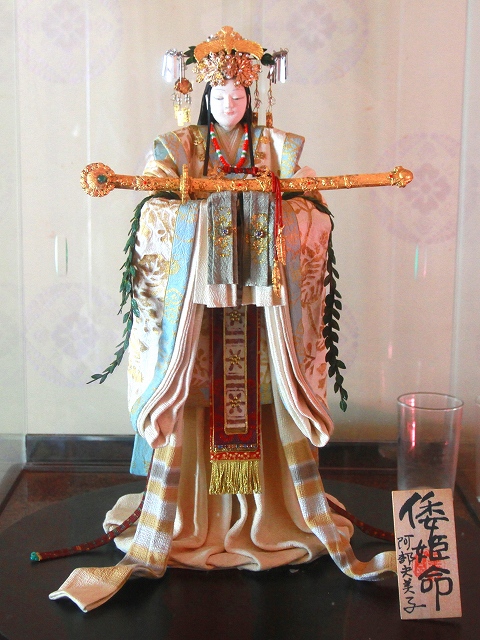
Yamatohime-no-mikoto
According to the Nihon Shoki, around 2000 years ago the divine Yamatohime-no-mikoto, daughter of the Emperor Suinin, set out from Mt. Miwa in modern Nara Prefecture in search of a permanent location to worship the goddess Amaterasu, wandering for 20 years through the regions of Ohmi and Mino. Her search eventually brought her to Ise, in modern Mie Prefecture, where she is said to have established Naikū after hearing the voice of Amaterasu saying "(Ise) is a secluded and pleasant land. In this land I wish to dwell." Before Yamatohime-no-mikoto's journey, Amaterasu had been worshiped at the imperial residence in Yamato, then briefly at Kasanui in the eastern Nara basin. When Princess Yamatohime-no-mikoto arrived at the village of Uji-tachi, she set up fifty bells to designate the area as enshrined for the goddess Amaterasu, which is why the river is called the Isuzu, or "fifty bells".
I ran into a few haiku by Basho about Ise Shrine, he has also made a journey to the Grand Shrine of Ise and (maybe) wrote these haiku:

For holiness,
Everyone has pushed others in the crowd.
The Shrine Removal !

in Ise's shrine cemetery
even more lonely
the moon still is
© Matsuo Basho

The Grand Shrine of Ise is the most important shrine of Shinto, so therefore I will "dive into" Shinto tomorrow.

This episode is NOW OPEN for your submissions and will remain open until February 12th at noon (CET). I will try to publish our new episode, Shinto, later on.

Monday, February 6, 2017

Carpe Diem #1146 Tea Ceremony


Dear Haijin, visitors and travelers,

Mu apologies for being late, but I am on the nightshift. Today I had planned an episode about the tea ceremony and of course I will use that, but in a different way.

Several years ago I wrote a haibun about the Tea Ceremony, it was part of a haiku book I had created in Dutch. That haibun I have tried to translate and that's what I love to share today. I love to challenge you (as in our special feature Kamishibai) to write a haibun or kikobun about the tea ceremony.

The tea ceremony is really awesome to see, but it is even better to experience it and that's what my haibun is about.

0-0-0-0-0-0-0-0-0

KNOCKING ON THE DOOR

I am in classical Japan and Rykyu has invited me for a Tja-no- Joe. My heart beats faster, my mind runs. Finally I'm going to experience the tea ceremony and for sure it will be an experience.

invitation
a hand written calligraphy
for a Tjaji


I walk to Rykyu's home. A beautiful Japanese House surrounded by an even more splendid garden. Breathless, I look around me. ' Wow ', is the only thing I can bring out. I am deeply touched by this intense experience. Tears roll over my cheeks. Slowly I walk on. Enjoying the garden, the beautiful flowers, the rustling of the leaves of the ginkgo tree, the splashing of water.
Rykyu's garden breathes the atmosphere of haiku, it feels like I'm walking around in a haiku. The silk of my traditional kimono feels great on my naked skin. The straw sandals fit perfectly.

I feel the heat and try to cool myself with my fan.
On the porch of Rykyu's house I smell the scent of irises, lilies and honeysuckle. I knock at the door.

knocking on the door  
the host expects his guest –
first day of spring
Rykyu invites me inside. I pull off my sandals and put them next to the door jamb on the veranda under the Honeysuckle. Rykyu's house exudes peace and silence. His house is aesthetically decorated. Every detail, each piece is chosen with love and from the heart. I hear soft music. I see a young woman sitting in the conservatory with a Shakuhachi. The music is illuminating and soothing. Rykyu hands me a Koto. He nods. I hesitate to play the instrument. He encourages me to play. Than …, the heavenly music resonates in perfect harmony with the Shakuhachi. Serenity drops around me, only the music. Through the window I see that the sun changes the color of the sky. The night falls. This peace, this silence … This has to be the ultimate Japanese experience.
The music fades away, a last cord and then … deep silence. Only the wind and the song of cicadas.


sweet summer night
cicadas sing their song
deep is the silence
Rykyu bends and smiles at me. I experience it as a sincere thank you for the music. He beckons me.
I follow him into the garden. Finally I will experience the tea ceremony. We walk through the garden. The fragrances of the evening are overwhelming. I listen to the sounds of nature, the wind, the cicadas, the rustling of the leaves and the splashing of water. We reach a water basin. Rykyu scoops  water and washes his hands. I do the same. This is a moment of reflection, of cleansing and tuning in on the tea ceremony.

wooden spoon--
the cool water
flushes the world away  
full attention
I clean my hands –
the first step
 
We walk on. Rykyu has a beautiful tea house in his garden. Made of bamboo. The door is low and I have to crawl inside. This is equality and respect.
on my haunches
as all the guests
we are equal
In the Tokonama I spot a calligraphed Zen saying:
"Emptiness is not really empty, the spirit of emptiness there is always present “
I praise Rykyu with the choice of it. He bends and smiles.

As I look around, I see all the amenities for the tea ceremony. I am caught by the sight of the tea bowls. They are beautiful, aesthetically pleasing and perfect. They are not perfectly round, but more oval, here and there a little less deep, but ... great.  
And always the silence, deeper and more intense. One with the silence, one with each other, one with nature, one with the universe.
I admire the grace with which Rykyu prepares the tea ceremony. Every gesture, every movement is aesthetically pleasing and steeped in Zen.
cleaning the tea bowls
while the water is cooking
ah! that silence
While Rykyu is preparing the tea ceremony. I am invited by the young woman, who accompanied us, to go outside and admire the garden. The soft light of fire pits turns the garden into a fairy world. Breathtaking. We  walk through the garden. Each step is thought out and aesthetic. This is what excites me so in the  Japanese culture. Everything is thought out, every act you do is aesthetically pleasing and full of Zen. This is what I lack in the West.
in the garden
walking in silence –
Azalea in bloom
When we return in the tea house the calligraphed Zen saying in the Tokonama is replaced by a single Chrysanthemum in a beautiful vase decorated with a Sumi-e painting.
Sumi-e painting "Chrysanthemum" found on Pinterest
Rykyu invites me to come. He cleans the tea bowls, even in this I recognize aesthetics, his gestures, his movements all Zen.  
He puts the powder tea in one of the tea bowls and pours boiling water on the tea. A frothy mass is formed. “This is the “thick tea”, I think.  
bitter taste
the “thick tea” caresses my tongue
we share the bowl
“thick tea” as a source of contact
sharing unconditional love
The tea is drunk from one bowl that we share with each other. I take three sips, make the edge clean and turn the tea bowl three strokes while I have it on my palm. Then I give the tea bowl  to the young woman. She takes the tea bowl  with a bow and take three sips. She also makes the edge clean and turns the bowl three strokes before she gives it back to Rykyu.
Rykyu accepts the bowl with a bow and takes three sips, makes the edge clean and places the bowl in front of him. “Now the “thin tea” will follow”, I think.
“thin tea”
in earthen tea bowls
what a beauty


The tea ceremony is coming to an end. I admire the earthenware tea bowls. At the end of this experience we write a 36-verses renga together, “knocking on the door”.
As I say goodbye I am overwhelmed by emotions. This experience I will never forget.
© Chèvrefeuille
0-0-0-0-0-0-0-0-0-0


Well ... I hope you did like this episode, and I hope that I translated it all in the right way.

This episode is NOW OPEN for your submissions and will remain open until February 11th at noon (CET). I will try to publish our next episode, Ise Shrine, later on.

Sunday, February 5, 2017

Carpe Diem #1145 Emperor


Dear Haijin, visitors and travelers,

Welcome at a new episode of Carpe Diem. This month we are exploring the "Motherland" of haiku, Japan. As we all know Japan has an Emperor. So I love to tell you a little bit more about the Japanese Impire and their Emperor.

The Emperor of Japan is the head of the Imperial Family and is the ceremonial head of state of Japan's system of constitutional monarchy. According to the 1947 constitution, he is "the symbol of the State and of the unity of the people." Historically, he is also the highest authority of the Shinto religion as he and his family are said to be the direct descendants of the sun-goddess Amaterasu, and his importance also lies in dealing with heavenly affairs, including Shinto ritual and rites throughout the nation.
Currently, the Emperor of Japan is the only remaining monarch in the world reigning under the title of "Emperor". The Imperial House of Japan is the oldest continuing hereditary monarchy in the world. In the Kojiki (finished 712) and Nihon Shoki (finished 720), it is said that Japan was founded in 660 BC by Emperor Jimmu. The current Emperor, since 1989, is Akihito. Akihito is the 125th Emperor in line.
Emperor Akihito
As I was preparing this episode I realised that there is a significant similarity with The Emperor from the Great Arcana, as we saw recently in our pilgrimage to Santiago and back in 2013 during our Tarot month.
As is said, the Japanese Emperor is a direct descendant of the Shinto Goddess of the Sun Amaterasu, and is from that a god himself. The Emperor from the Tarot is God and as we recently read here at CDHK, He created the world from God-stuff. Both Emperors have divine roots.
As we read above the Emperor is the highest authority of the Shinto religion, he is the Highpriest and therefore everywhere in his country he has to perform rituals, that makes him more divine than we would think.
Will there be similarities with the Hierophant (or The Pope, Jupiter) of the Great Arcana, let us take a look at that. The Hierophant is similar with Jesus, the Son of God, and that shows us (again) that there is maybe a divine source from which the Emperor came, because he is seen as a descendant of the Sun-Goddess Amaterasu, he is the son of the Sun-Goddess.
All these are just thoughts of course, but it's a great adventure to "dive into" this kind of matter and I like to do that.
A short episode, but a joy to create.
on his throne
in the middle of the world
the Emperor
descendant of the sun and stars
made of God-stuff
© Chèvrefeuille

This episode is NOW OPEN for your submissions and will remain open until February 10th at noon (CET). I will (try to) publish our next episode, Tea Ceremony, later on. 

Saturday, February 4, 2017

Carpe Diem Kukai "Autumn" the results


Dear Haijin, visitors and travelers,

First I have to apologize for being this late with the results of our Autumn kukai of 2016. It totally escaped from my attention through several things, but I hope you will forgive me.

Here are the results of the Autumn kukai:

Our winner of the Autumn kukai is Hamaish "Managua" Gunn with the following haiku, a haiku in the free-style of Santoka Taneda:

we learn
from autumn
to let go


© Hamish Gunn

And our "runner-up" of the Autumn kukai is Sara McNulty with the following haiku in which you can sense the cosiness of an autumn evening. Days become shorter and the evenings become longer:

steaming gold
on chilled October evening
mug of hot cider


© Sara McNulty

CONGRATULATIONS TO BOTH OF YOU!!!


Here are the results:

Haiku 27: 7 points (winner)
Haiku 21: 6 points (runner-up)
Haiku 8 and 12: 5 points
Haiku 7, 25, 29 and 30: 3 points
Haiku 6, 15, 23, 32 and 35: 2 points
Haiku 16, 19 and 24: 1 point
All the other haiku: no points

As you all know the winner of the kukai wins the exclusive right to create a CDHK E-book and is the featured haiku poet next month (March 2017) and the "runner-up" will be portrayed in a Tokubetsudesu episode also in March 2017.

0-0-0-0-0-0-0-0-0-0-0-0-0-0
0-0-0-0-0-0-0-0-0-0-0-0-0-0

I love to invite you all to submit haiku (a maximum of three (3)) for our next kukai. That kukai starts today, February 4th at 10.00 PM (CET) and will run to March 4th at 10.00 PM (CET). This time I have chosen for the following theme:

CHERRY BLOSSOM

You can email your submissions to: carpediemhaikukai@gmail.com Please write Kukai Cherry Blossom in the subject line.

Carpe Diem Namasté, the spiritual way #1 Introduction to a new feature


Dear Haijin, visitors and travelers,

It is my pleasure to present a new special feature here at Carpe Diem Haiku Kai. As you all know, haiku is not only the poetry of nature "an sich", but also the poetry of the spiritual nature. Haiku has its roots in Zen Buddhism, but also in Shinto, the official religion of Japan. In this new feature, Carpe Diem Namasté, the spiritual way, I love to explore that spiritual background of our beloved haiku. I hope to create this new feature every week as the start of the weekend, so it will be published every Friday evening around 10.00 PM (CET).

Namasté, I use it very often here at CDHK and all other parts of our CDHK family, e.g. Facebook, Tumblr and Wordpress, but what does it really mean?
Namasté is a Hindu holy greeting from one human being to another. It's always said with a gesture. The gesture you will maybe know. Both hands against each other fingers pointing to the sky, the Cosmos, to God; you close your eyes and bend your head a little towards your heart. Why do you have to close your eyes? Well ... every being is the same, notwithstanding race, color or physics, we are all the same.

Namasté
Maybe you can remember our Tarot-month back in 2013 (you can download the CDHK e-book Tarot in our library) in one of the episodes of that month, The Emperor, I talk about "God stuff", because before the Creation there was nothing only God and He used "God stuff" to create our world and us, so that means we are all part of God.
Now we can go back to Namasté, because what does it mean? Sometimes it is explained as "I greet the light in you", but I love to use Namasté because of its other meaning. That other meaning is: "The Divine in me bows before the Divine in you". I love that it's more my way of thinking and living. In everyone and everything I see God, Higher Self, Buddha or whatever name you would love use.
Namasté you can compare with the South German greeting "Grüss Gott!"

As you say Namasté you bow your head, in our Western culture we are not used to bowing, but bowing your head has nothing to do with submissiveness, the other is not superior, we are all the same. Bowing means "being equal" and being a part of God, as we all are. Bowing means "we are one", we are equal.
Both hands together, a gesture we all know, because both hands together is equal with praying, it's a very old gesture. Both hands together means also "I bring Sun and Moon together (the right hand means "Sun" and the left hand means "Moon") or "heaven and earth", you can also see this as "as is above, so is below", which we have seen here often at CDHK. It even is a haiku writing technique and we saw it often in our Tarot month.

Namasté
Your hands have a deeper spiritual meaning, they are synonymous with the Cosmos, even all separated fingers do have a meaning:

The thumb: emptiness and insight
The index: air and activity
The middle finger: fire and perception
The annulary: water and sensibility / receptivity
The little finger: earth and form

As you use the Namasté gesture than you bring your hands at the height of your heart, at the heart-chakra, the place were divine love enters. So another meaning of Namasté can be: "I honor the space in you (your heart) where love, truth, light and peace are ruling".

Over all you can say with Namasté "Your mind is not your boss it's your heart that has that authority".

Namasté gesture in words:

- both hands together, fingers pointing upward:
- close your eyes;
- bring your hands to your heart, or as sometimes seen, bring your hands first to your forehead (the Third Eye) and than to your heart.


Namasté
Namasté "I look at you with my inner eye, with my heart, the divine in me bows before the divine in you"

Isn't it wonderful? So much meaning in one gracious gesture? Isn't that what we hope to accomplish with our passion? Our haiku, tanka or other Japanese poetry-form? Haiku needs a little bit of "God stuff", a little bit of "Namasté", a little bit of spirituality.

That's the goal of this new special feature "Carpe Diem Namasté, the spiritual way", try to create haiku, tanka or other Japanese poetry form with a deeper, spiritual, meaning.

This first introductory episode of this new special feature here at Carpe Diem Haiku Kai is NOW OPEN for your submissions. You can submit until Monday February 6th 10.00 PM (CET). I will publish a new episode of "Namasté, the spiritual way" on Friday February 10th around 10.00 PM (CET). Have fun!

Friday, February 3, 2017

Carpe Diem #1144 Samurai


Dear Haijin, visitors and travelers,

Welcome at a new episode of Carpe Diem Haiku Kai, the place to be if you like to write and share haiku and tanka (or other Japanese poetry forms). This month we are on a journey through the land of haiku, Japan. Japan the land of the rising sun and a beautiful, very spiritual, country to live I think.

Yesterday I told you all about Edo, ancient Tokyo, the capital of Japan. Edo was build around Edo Castle. let me tell you a little bit more about Edo Castle before I will face the prompt for today, samurai.

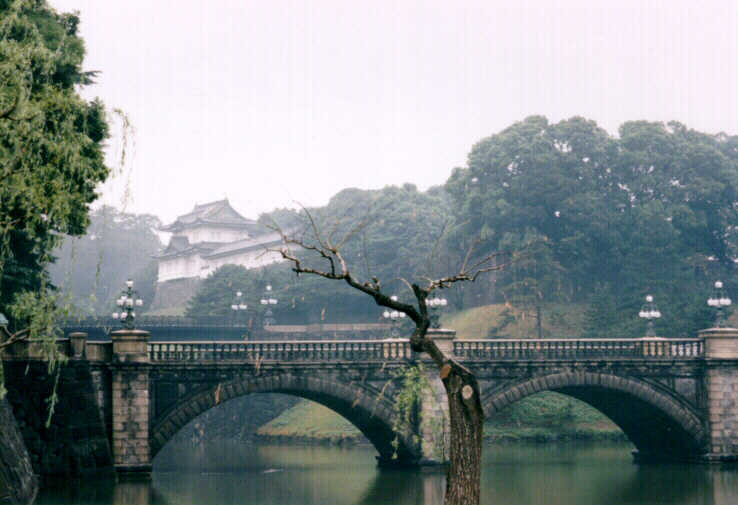
Edo Castle (Edo-jō), also known as Chiyoda Castle (Chiyoda-jō), is a flatland castle that was built in 1457 by Ōta Dōkan. It is today part of the Tokyo Imperial Palace and is located in Chiyoda, Tokyo, then known as Edo, Toshima District, Musashi Province. Tokugawa Ieyasu established the Tokugawa shogunate here. It was the residence of the shogun and location of the shogunate, and also functioned as the military capital during the Edo period of Japanese history. After the resignation of the shogun and the Meiji Restoration, it became the Tokyo Imperial Palace. Some moats, walls and ramparts of the castle survive to this day. However, the grounds were more extensive during the Edo period.

Edo Castle as it must have been in the 17th century
Edo Castle was the military capital during the Edo period and the shogun had an army of samurai to rely on. 

Samurai were the military nobility or "those who serve in close attendance to the nobility," the pronunciation in Japanese changed to saburai. An early reference to the word "samurai" appears in the Kokin Wakashū(905–914), the first imperial anthology of poems, completed in the first part of the 10th century.

By the end of the 12th century, samurai became almost entirely synonymous with bushi, and the word was closely associated with the middle and upper echelons of the warrior class. The samurai followed a set of rules that came to be known as bushido. While they numbered less than 10% of Japan's population samurai teachings can still be found today in both everyday life and in modern Japanese martial arts. 

ancient warriors
between battle and peace
writing haiku 

© Chèvrefeuille

Every samurai had an art next to his military business. That's a real Japanese way of a aesthetic life. A well balanced life ... a hard and a soft side of living and with satisfaction.

Matsuo Basho was the son of a low ranked samurai and for a long time he had the idea to follow in his 'father's footprints'. He even became the page of a high ranked samurai's son, Yoshitada. He (Basho) and Yoshitada became good friends. (Some sources say that they had a relationship). Basho was very sad when his young master and friend died at the age of 22. It was than that Basho said farewell to his idea to become a samurai and started to write haiku to become a well known haiku master.


samurai sword
exposed to the rough weather
washing away the battle 

© Chèvrefeuille

And a last one  inspired on the Boys'  Festival:

striving for success
the young boys play like Samourai
Iris swords in hand

© Chèvrefeuille (from my archive)

I hope I have inspired you to create haiku or tanka. This episode is NOW OPEN for your submissions and will remain open until February 8th at noon (CET). I will try to publish our new episode, Emperor, later on.


Thursday, February 2, 2017

Carpe Diem #1143 Edo, ancient Tokyo


Dear Haijin, visitors and travelers,

First I thought this month will be a "piece of cake" to create, but it's more difficult than I had thought, but ... I will bring this month again with passion, but maybe (again) without prompt-list, because I prepare every episode at the moment I start up my PC every day, so ... don't be angry with me if there will not be a prompt-list this month.

Yesterday (that episode I published earlier today) we arrived at Tokyo, the modern capital of Japan, but Tokyo wasn't always named Tokyo. In the time of Basho, and other great haiku poets, Tokyo was known as Edo. So today we are traveling with the "Tardis" of Dr. Who back into time ... to Edo in the 17th century.

Tardis
Edo ("bay-entrance" or "estuary"), also romanized as Jedo, Yedo or Yeddo, is the former name of Tokyo. It was the seat of power for the Tokugawa shogunate, which ruled Japan from 1603 to 1868. During this period, it grew to become one of the largest cities in the world and home to an urban culture centered on the notion of a "floating world".

From the establishment of the Tokugawa bakufu headquarters at Edo, the town became the 'de facto' capital and center of political power, although Kyoto remained the formal capital of the country. Edo grew from what had been a small, little-known fishing village in 1457 into the largest metropolis in the world with an estimated population of 1,000,000 by 1721.

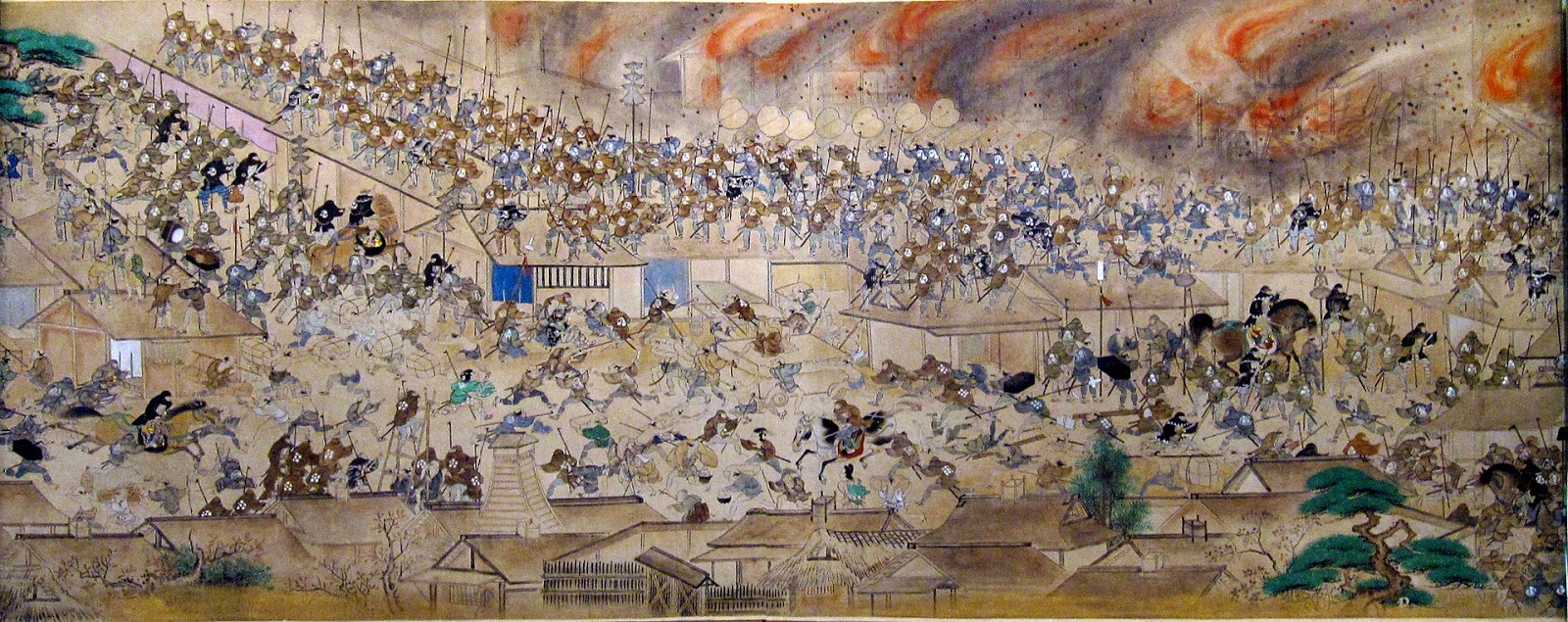
Edo was repeatedly devastated by fires, with the Great Fire of Meireki in 1657 being the most disastrous. An estimated 100,000 people died in the fire. During the Edo period, there were about 100 fires mostly begun by accident and often quickly escalating and spreading through neighborhoods of wooden machiya which were heated with charcoal fires. Between 1600 and 1945, Edo/Tokyo was leveled every 25–50 years or so by fire, earthquakes, or war.

The Great Meireki fire
In 1868, when the shogunate came to an end, the city was renamed Tokyo ("eastern capital"). The emperor moved his residence to Tokyo, making the city the formal capital of Japan:

Maybe you remember the story of Yozakura, Wandering Spirit (which by the way will be continued this month), that in the Great Fire of Meireki his father died. It was his biggest loss after the loss of his mother and it brought him the name of Yozakura, the Wandering Spirit.

feeling alone
lost in the woods around Edo -
just the autumn wind

© Yozakura

After his youth, Basho (my haiku master) moved to Edo to become a poet of renga and, as we all know, he became the most famous haiku master ever. During his time Basho learned to create his haiku as we know them. During his life he visited several times Edo again and wrote several haiku about or in praise of Edo. Here are a few beauties:

tenbin ya kyo¯ edo kakete chiyo no haru

on the scales—
Kyoto and Edo balanced
in this spring of a thousand years

fuji no kaze ya ogi ni nosete edo miyage

wind from Mt. Fuji—
carrying it in my fan,
a souvenir for those in Edo

aki totose kaette edo o sasu kokyo

autumn, ten years:
now I point to Edo
as the old home

© Basho (Tr. David L. Barnhill, taken from Basho's haiku, selected poems by Matsuo Basho)

Edo was formed around the Edo Castle:

Edo Castle
Edo ... a beautiful place to be in ancient Japan, but a town with a devastating history, but also the place were several haiku poets came to fame.

day dreamer
the scent of cherry blossom
walking through Edo


© Chèvrefeuille

Well ... I hope you did like this episode and I hope it will inspire you to create haiku or tanka. By the way the background information on Edo I found at wiki.

This episode is open for your submissions tonight at 7.00 PM (CET) and will remain open until February 7th at noon (CET).