Sunday, December 20, 2015

Carpe Diem Seven Days Before Christmas 2015 #4 presents


Dear Haijin, visitors and travelers,

Every day is a new day and every day for this special feature brings us closer to Christmas. This time of year is wonderful. Everywere you can see Christmas trees and decorations inside and outside, or at the mall. Carolers walking through the Streets and through the neighborhood ... every one is happy and looks forward to the gifts they (maybe) will get.

To me Christmas is the time of gifts and it is a joy to see those faces smile of my kids and grandkids ... I am a rich guy ... and of course it's a joy to create these CD specials ... a kind of gift to you my dear Haijin.

Today's episode is about "presents" and I think this prompt can be really inspiring.

Credits: Christmas gifts
I ran into a nice haiku, I don't know who composed it, but I just had to share this one. I hope the poet of this haiku doesn't mind that I am using it here.

some gifts are useless
but the gifts of the heart
are the greatest ones

And ... that's so true ...


Christmas stockings
hanging above the fireplace
awaiting presents

© Chèvrefeuille
 
This episode of our Seven Days Before Christmas is NOW OPEN for  your submissions and will remain open until December 22nd 10.00 PM (CET). Have fun! 
 

Last Call For Submissions Kukai "Winter"


Dear Haijin, visitors and travelers,

This is the Last Call For Submissions for our Kukai "Winter'. You can submit your haiku (a max. of three) until December 23rd 10.00 PM (CET) to our email-address:

carpediemhaikukai@gmail.com

Please write "kukai winter" in the subject-line.

Namaste,

Chèvrefeuille, your host

Carpe Diem #883 journey through the rough north of Honshu: a rough sea; in one house


Dear Haijin, visitors and travelers,

Again I am to late with publishing this episode, I really hadn't time. First I am in the nightshift and my dad is in hospital after a heart attack, so I have not a lot of time. Today I had planned a nice wellknown haiku by Basho which I have used earlier here at CDHK. We will see ....


++++++++++++++++++++++++++++++++++++++++++++


the rough sea
flowing toward Sado Isle (*)

the River of Heaven

© Basho (Tr. Chèvrefeuille)

 (*) When direct control from mainland Japan started around the 8th century, the island's remoteness meant that it soon became a place of banishment for difficult or inconvenient Japanese figures. Exile was a very serious punishment, second only to the death penalty, and people weren't expected to return.

Exhausted by the labor of crossing many dangerous places by the sea with such horrible names as Children-desert-parents or Parents- desert-children, Dog-denying or Horse-repelling, I went to bed early when I reached the barrier-gate of Ichiburi. The voices of two young women whispering in the next room, however, came creeping into my ears. They were talking to an elderly man, and I gathered from their whispers that they were concubines from Niigata in the province of Echigo, and that the old man, having accompanied them on their way to the IseShrine, was going home the next day with their messages to their relatives and friends.   
Credits: Ise Shrine

I sympathized with them, for as they said themselves among their whispers, their life was such that they had to drift along even as the white froth of waters that beat on the shore, and having been forced to find a new companion each night, they had to renew their pledge of love at every turn, thus proving each time the fatal sinfulness of their nature. I listened to their whispers till fatigue lulled me to sleep. When, on the following morning, I stepped into the road, I met these women again. They approached me and said with some tears in their eyes, 'We are forlorn travelers, complete strangers on this road. Will you be kind enough at least to let us follow you? If you are a priest as your black robe tells us, have mercy on us and help us to learn the great love of our Savior.' 'I am greatly touched by your words,' I said in reply after a moment's thought, 'but we have so many places to stop at on the way that we cannot help you. Go as other travelers go. If you have trust in the Savior, you will never lack His divine protection.' As I stepped away from them, however, my heart was filled with persisting pity.

in the same house
prostitutes, too, slept:
bush clover and moon


© Basho (Tr. David Landis Barnhill)

As I recited this poem to Sora, he immediately put it down on his notebook.

Credits: One of the forty-eight rapids of the Kurobe River

Crossing the so-called forty-eight rapids of the Kurobe River and countless other streams, I came to the village of Nago, where I inquired after the famous wisteria vines of Tako, for I wanted to see them in their early autumn colors though their flowering season was spring. The villagers answered me, however, that they were beyond the mountain in the distance about five miles away along the coastline, completely isolated from human abode, so that not a single fisherman's hut was likely to be found to give me a night's lodging. Terrified by these words, I walked straight into the province of Kaga.
 
++++++++++++++++++++++++++++++++++++++++++++++++
 
As I read this part of Basho's "Narrow Road" I almost feel like I am there at that same moment. As I look at that photo of the Kurobe River than I can hear the sound of the thundering rapids ... awesome. Isn't it awesome that Basho wrote this haibun with such a lot of feeling that the reader can feel the presence of the surroundings where Basho is walking ... that's his strenght of Basho.

I really am a big fan and admirer of Basho and I always like to bring posts about him using his wonderful haiku here at our Haiku Kai.
It will not be an easy task to compose an all new haiku inspired on this part of "Narrow Road", but I have  to give it a try. 
Credits: Sado Island

But first I like to share a haiku by Yozakura (our unknown haiku poet) which he composed inspired on the first haiku of this episode "the rough sea":

an outcast I am
day dreaming along the seashore;
Sado Isle beckons

© Yozakura

dark clouds drifting
waves become higher
a rough sea


© Chèvrefeuille


As I look at this haiku above than I notice a "double entendre" in it, which I hadn't seen earlier as I composed this haiku back in 2012 (short after the start of our Haiku Kai) or even a divine deeper meaning as we have discussed in our HWT episodes.

"Double Entendre": This haiku can mean that there are circumstances which lead to a depression or strong sadness.

"Finding the divine in the common": This haiku can mean that there will Always be a greater power, spirit or God who will care for you notwithstanding the circumstances or situation in which you are.

Isn't that awesome? A haiku which I wrote several years ago ... now looks so different after a few episodes of CD-HWT.
And I just had to share another haiku which I once have written inspired on the "bushclover and moon"- haiku. I think I wrote it as one of the haiku at Haiku Shuukan, but I can't remember that, but this was the haiku, in which you can find also the "double entendre" technique:


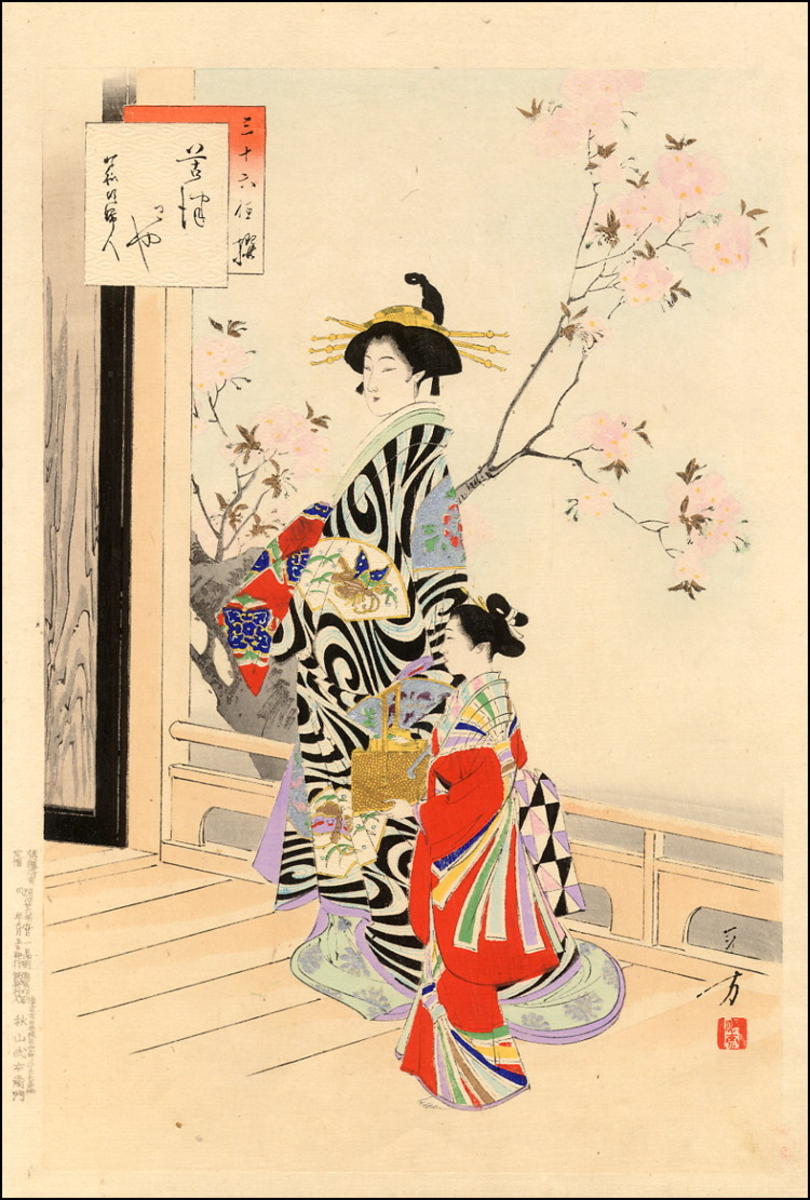
courtesan smiles


courtesan smiles
as she walks over the nude beach
Morning Glories awake

© Chèvrefeuille

It was again a joy to create this episode for you all and I am glad that you all are such gifted poets that every prompt can inspire you.

This episode is NOW OPEN for your submissions and will remain open until December 23rd at noon (CET). I will try to publish our next episode, the scent of early rice; the tomb also shakes, later on.

Saturday, December 19, 2015

Carpe Diem's Seven Days Before Christmas 2015 #3 decorations


Dear Haijin, visitors and travelers,

Seven Days Before Christmas ... we are closing in to Christmas with this third episode of this special "holiday" feature. Christmas is the time of decorating our homes inside and outside so therefore I have chosen for "decorations" as our prompt for this third episode.

I remember that we had an almost the same prompt last year. Of course that's not a problem, because decorations are part of Christmas. I decided to read all the entries for that episode last December 2014 again and I love to share a few entries which were written then.

Yuletide
decorations and lights
ruby-red and green
despite falling snow
the spring sun returns


© Georgia (2014)
lace of frost
blossoming on windowpanes
winter meadow
© Ese

Christmas decorations
assortment of memories
hung on my tree

© Dolores

light of the world
reflects in silver and gold
christmastree clothed

© Chèvrefeuille
This episode is NOW OPEN for your submissions and will remain open until December 21st 10.00 PM (CET). Have fun!
 

Friday, December 18, 2015

Carpe Diem #882 beneath the stars of the deep north: low tide crossing, July


Dear Haijin, visitors and travelers,

Maybe you can remember that we had our first renga-party earlier this year and I love to share here that we will have our second CD Renga party next January. I will keep you posted.
Our first (try-out) number of Carpe Diem's e-zine "Souchou" is almost ready and it will be published before Christmas. I think it has become a wonderful e-zine with a lot of gorgeous posts and poetry. Stay tuned!

Okay back to our episode of today. We are far beyond halfway of Basho's "Narrow Road" and we are already on our route back home, but we have still a long way to go. Today another part of the "Narrow Road" will pass by and in this episode we will read another nice (well known) haiku I think.


++++++++++++++++++++++++++++++++++++++++++++


low tide crossing
the crane’s shank is wetted
with the sea’s coolness


© Basho (Tr. Jane Reichhold)

what delicacy is served
this festival day in Kisagata
that sweet smell

© Sora (tr. Chèvrefeuille)

After lingering in Sakata for several days, I left on a long walk of a hundred and thirty miles to the capital of the province of Kaga. As I looked up at the clouds gathering around the mountains of the Hokuriku road, the thought of the great distance awaiting me almost overwhelmed my heart. Driving myself all the time, however, I entered the province of Echigo through the barrier-gate of Nezu, and arrived at the barrier-gate of Ichiburi in the province of Ecchu. During the nine days I needed for this trip, I could not write very much, what with the heat and moisture, and my old complaint that pestered me immeasurably.

July
ordinarily the sixth night
is not like this


© Basho (Tr. Jane Reichhold)


Credits: Tanabata Festival (July 7th)

A few other haiku about Tanabata Festival (July 7th) written by Basho in a translation by myself. By the way these were not included in “Narrow Road”.

do not even peer
through the leaves of the silk tree
light falls from the stars

Tanabata -
autumn is truly here
as nights begin

© Basho (Tr. Chèvrefeuille)


+++++++++++++++++++++++++++++++++++++++++++++


This wonderful Star festival Tanabata has been featured here often and I think that's awesome, because in my experience this is one of the most famous, but also gorgeous, festivals there is in Japan.

I hope this (short) episode will inspire you to write haiku, tanka or other Japanese poetry form. This episode is NOW OPEN for your submissions and will remain open until December 21st at noon (CET). I will (try to) publish our new episode, a rough sea; in one house, later on. For now ... have fun, be inspired and share your haiku with us all here at Carpe Diem Haiku Kai, the place to be if you like to write and share haiku.


Carpe Diem's Seven Days Before Christmas 2015 #2 Silent Night


Dear Haijin, visitors and travelers,

Yesterday we started with our special feature "Seven Days before Christmas" and today we have our 2nd episode. This time I have chosen for the prompt "Silent Night". I think you will know this classical Christmas Carol and I love to challenge you all to distil haiku from the lyrics of this wonderful Christmas Carol. So you can say this is a special episode of our feature "Carpe Diem Distillation".


Here are the lyrics of "Silent Night" to distill your haiku from:

1. Silent night! Holy night!
All is calm, all is bright,
Round yon Virgin Mother and Child!
Holy Infant, so tender and mild,
Sleep in heavenly peace!

2. Silent night! Holy night!
Shepherds quake at the sight!
Glories stream from Heaven afar,
Heavenly Hosts sing Alleluia!
Christ, the Savior, is born!


3. Silent night! Holy night!
Son of God, love’s pure light
Radiant beams from Thy Holy Face
With the dawn of redeeming grace,
Jesus, Lord, at Thy Birth!


(tr. John Freeman Young ca. 1859)

More about this wonderful Christmas Carol you can find HERE.

And of course I love to share this beauty in a video from You Tube:


I hope you did like this episode and of course I hope it will inspire you as it did me.

silent night
snow falls softly on the graveyard
our Savior is born


© Chèvrefeuille

This episode is NOW OPEN for your submissions and will remain open until December 20th 10.00 PM (CET) ... have a wonderful Christmas time ...

Thursday, December 17, 2015

Carpe Diem #881 following Basho into the deep north: Mount Atsumi; a hot day's sun; Kisagata silk tree


Dear Haijin, visitors and travelers,

We are still following Basho into the deep north. Until now it was a wonderful journey and it will become even more beautiful as you will see.


++++++++++++++++++++++++++++++++++++++++++


Leaving Mount Haguro on the following day, I came to the castle town called Tsuru-ga-oka, where I was received warmly by Nagayama Shigeyuki, a warrior, and composed a book of linked verse with him and Zushi Sakichi who had accompanied me all the way from Mount Haguro. Bidding them farewell, I again descended the River Mogami in a boat and arrived at the port of Sakata, where I was entertained by the physician named En'an Fugyoku.

Mount Atsumi
over to Blowing Beach
to enjoy a cool breeze


© Basho (Tr. Jane Reichhold)

A hot day’s sun
taken into the sea
by the Mogami River


© Basho (Tr. Jane Reichhold)

I had seen since my departure innumerable examples of natural beauty which land and water, mountains and rivers, had produced in one accord, and yet in no way could I suppress the great urge I had in my mind to see the miraculous beauty of Kisagata, a lagoon situated to the northeast of Sakata. I followed a narrow trail for about ten miles, climbing steep hills, descending to rocky shores, or pushing through sandy beaches, but just about the time the dim sun was nearing the horizon, a strong wind arose from the sea, blowing up fine grains of sand, and rain, too, began to spread a grey film of cloud across the sky, so that even Mount Chokai was made invisible. I walked in this state of semi-blindness, picturing all sorts of views to myself, till at last I put up at a fisherman's hut, convinced that if there was so much beauty in the dark rain, much more was promised by fair weather.   
Credits: Kisagata
A clear sky and brilliant sun greeted my eyes on the following morning, and I sailed across the lagoon in an open boat. I first stopped at a tiny island named after the Priest Noin to have a look at his retreat where he had stayed for three years, and then landed on the opposite shore where there was the aged cherry tree which Saigyo honored by writing 'sailing over the waves of blossoms. There was also a mausoleum of the Empress Jingu and the temple named Kanmanjuji. I was a bit surprised to hear of her visit here and left in doubt as to its historical truth, but I sat in a spacious room of the temple to command the entire view of the lagoon. When he hanging screens were rolled up, an extraordinary view unfolded itself before my eyes - Mount Chokai supporting the sky like a pillar in the south with its shadowy reflection in the water, the barrier-gate of Muyamuya just visible in the west, an endless causeway leading as far as Akita in the east, and finally in the north, Shiogoshi, the mouth of the lagoon with waves of the outer ocean breaking against it. Although little more than a mile in width, this lagoon is not the least inferior to Matsushima in charm and grace. There is, however, a remarkable difference between the two. Matsushima is a cheerful, laughing beauty, while the charm of Kisagata is in the beauty of its weeping countenance. It is not only lonely but also penitent, as it were, for some unknown evil. Indeed, it has a striking resemblance to the expression of a troubled mind.

Kisagata silk tree
is a Chinese beauty in the rain
a sleeping flower


© Basho (Tr. Jane Reichhold)

+++++++++++++++++++++++++++++++++++++++++++++
 
Credits: Albizzia julibrissin
Of the "Kisagata" haiku there is also another version, maybe this was the first version:

Here is the variation:

Kisagata ya ami ni Seishi ga nebu no hana

Kisagata rain
with the Chinese beauty asleep
a silk tree in bloom


© Basho (Tr. Jane Reichhold)


I love to tell you a little bit more about this “Kisagata” haiku-set. In this haiku the reference is to Seishi, Xi Shi, a Chinese beauty of the 5th century B.C., who was given as concubine to King Fu Cha. According to legend, the king loved her so much he neglected his duties and lost his kingdom. The play of words comes with nebu (to sleep), which sounds as nemu (silk, mimosa, or parasol tree; Albizzia julibrissin, which has leaves that fold up, as if asleep, at night or when touched) 

silk tree blossoms
in a soothing summer rain
trembling in silence
so fragile,
in a summer breeze


© Chèvrefeuille
This episode is NOW OPEN for your submissions and will remain open until December 20th at noon (CET). I will try to publish our new episode, low tide crossing; July, later on.