Showing posts with label Tengrism. Show all posts

Monday, November 30, 2015

Carpe Diem #869 Tavn Bogd


[...] "We started climbing one of the dunes, and as we proceeded the noise grew more intense and the wind stronger. When we reached the top, we could see the mountains standing out clearly to the south and the gigantic plain stretching out all around us." [...] (The Zahir - Paulo Coelho)

Dear Haijin, visitors and travelers,

It's with sadness and pain in my heart that I am writing the last episode of CDHK for November. 2015 Runs to an end and next month we will go on "the Narrow Road to the Deep North" following in the footsteps of Matsuo Basho. I am looking forward to that wonderful journey.

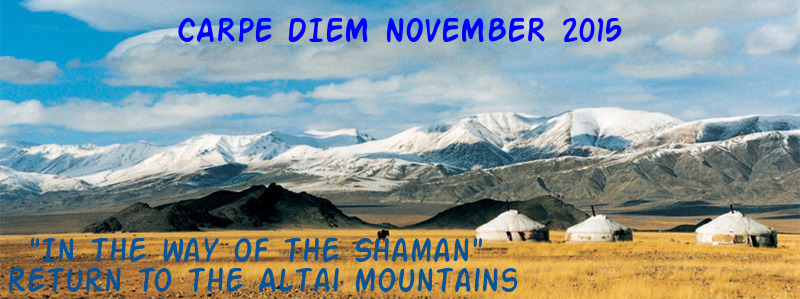
But first ... Tavn Bogd (or the Five Mountains or Five Saints) five snow-capped mountains who are sacred in the Altai .. vistas are gorgeous here and the snow-capped peaks are mirrored in the pools and lakes around them. Must be a real holy experience to sit there taking in the view and the power of the mountains. Listen to the wind over the steppes, listen to the sweet sound of the grasses waving, listen to the birds ... listen to the eagle, king of the skies, and Messenger of the gods.

Credits: Tavn Bogd (Five Mountains)

The Tavn Bogd (lit. "five saints") is a mountain massif in Mongolia, on the border with China and Russia. Its highest peak, the Khüiten Peak (formerly also known as Nairmadal Peak) is the highest point of Mongolia at 4374 meters above sea level. The Tavn Bogd massif is located mostly within the Bayan-Olgii Province of Mongolia; its northern slopes are in Russia's Altai Republic, and western, in China's Burqin County.
Besides the Khüiten Peak, the Tavn Bogd massif includes four other peaks: Nairamdal, Malchin, Bürged (eagle) and Olgii (motherland). 
To inspire you a little bit more I have found a nice video on You Tube about Tavn Bogd:
 
 
Wow ... what a beautiful place ... really a holy place where you can feel the spirit of the Altai Mountains ... must be awesome to walk there and experience the magnificent nature of Mongolia .. the land of shamanism and Tengrism ... I can hear the drums of the shaman to reach his/her trance to be a mediator between the spirit wortld and us.

resonating drums
the five saints ... impressive beauty
spirit world opens


© Chèvrefeuille

Hm ... not a very strong one, but I like the feeling of it ... it's a (real) shaman haiku I think ...

PS. I have published our new prompt-list for December 2015

This episode (a little later than I had planned) is NOW OPEN for your submissions and will remain open until December 3rd at noon (CET). I will (try to) publish our new episode, our first of December, later on.


Friday, November 27, 2015

Carpe Diem #868 Stag Beetle / Flying Deer


Dear Haijin, visitors and travelers,

First this ... as I was preparing the prompt-list for this month I thought that this episode, stag beetle, was the right choice, but after almost three weeks I discovered that the prompt had to be "flying deer", because that's what was meant. So in this episode, it's all about a "flying deer" and not about the (insect) stag beetle.

I love to tell you about a kind of "astral journey" I made while I was preparing November's prompt-list. It felt like I was really there, so it was a wonderful spiritual journey through the land of the Tuvan (people) and the Altai Mountains. I hope I can find the right English words to tell you this story.

[...] "Three days, two canyons and crossing several rivers later my companions and I arrive at the sacred Shevet Uul valley, where the prehistoric humans left signs and carvings behind on the rocks. As I walk on I smell the sweet perfume of thyme. A hare jumps away. There ... I see the first horseman. carved, with a lasso in his hand. A little further I see a primitive image of an Ibex, a kind of mountain goat with long horns, carved in the rocks. Solidified life, everywhere I look. Horsemen and galloping horses, Ibexes, a wild boar and magnificent magical creatures. Than ... my heart misses a heart beat. In front of me tumble a lot of little creatures, monkey like, in a dark universe of solidified magma. I forget to breath ... I see a huge flying deer with antlers of spiraling curls and legs elegantly floating through the skies. This magnificent animal escaping from two reaching hands, is three thousand years ago made by humans from the Bronze Age. The half open mouth is from a goose, symbol of the soul; its flight is pointing to the universe, maybe its a symbol of the transformation of the soul that rises to Heaven after dead.
I visit a Tuvan family and the grandfather of this family tells me about the "magical monkey" who is the creator of all carvings on the rocks in the Shevet Uul valley. No human could have done that, only this mythological creature. And the "flying deer" is one of the deities who are pointing us the way, teach us the way to let go and accept life as it is." [...]


Credits: Flying Deer (petroglyph Altai Mountains, Shevet Uul)

It was an uplifting "astral journey" and it opened my eyes to look to my world from another perspective ... a perspective of unconditional love, love for all and everything ... The "flying deer" is always there just around the corner of my mind and he shows up on moments of sadness, but also on moments of great joy ... and every time again it helps me to remember that I have to take life as it comes.

flying deer
points towards the after-life
true acceptation


© Chèvrefeuille

cry of an eagle
reaches the ears of the flying deer
listen to nature


© Chèvrefeuille

This episode was a joy to create, but it wasn't easy ... NOW OPEN for your submissions and it will remain open until November 30th at noon (CET). I will (try to) publish our new episode, our last CD Special by Ese, our featured haiku poetess, later on.


Monday, November 23, 2015

Carpe Diem #865 torn apart book (reading nature)


[...] "A sense of paradise descends from the skies. And I am aware that I am living through an unforgettable moment in my life; it is the kind of awareness we often have precisely when the magic moment has passed. I am entirely here, without past, without future, entirely focused on the morning, on the music of the horses’ hooves, on the gentleness of the wind caressing my body, on the unexpected grace of contemplating sky, earth, men. I feel a sense of adoration and ecstasy. I am thankful for being alive. I pray quietly, listening to the voice of nature, and understanding that the invisible world always manifests itself in the visible world." [...] (The Zahir - Paulo Coelho)


[...] “What is Tengri?” “The word means ‘sky worship’; it’s a kind of religion without religion. Everyone has passed through here—Buddhists, Hindus, Catholics, Muslims, different sects with their beliefs and superstitions. The nomads became converts to avoid being killed, but they continued and continue to profess the idea that the Divinity is everywhere all the time. You can’t take the Divinity out of nature and put it in a book or between four walls. I have felt so much better since coming back to the steppes, as if I had been in real need of nourishment. Thank you for letting me come with you.” [...] (The Zahir - Paulo Coelho)


Dear Haijin, visitors and travelers,

What a joy ... this month we are exploring the Altai Mountains and their spiritual meaning. In this last week of this month we will even come closer to that spirit. As you have read in the above quotes from The Zahir by Paulo Coelho it's all about reading nature this day. 


Credits: Reading Nature (the Altai Mountains)

I remember an article which I read about a woman exploring the region of the Altai Mountains. She had a Mongolian guide who never used a map or travel-book ... he could read his path, the weather coming and so on ... just by reading nature. Reading nature is one of the most important pillars of what is called Tengrism or 'sky worship’. 
That's truly being one with nature ... to have the ability to read nature's signs. Those signs are all around us. In plain simple words I can say: As I see the buds of the cherry grow ... than I know that spring is coming. Or ... as I see the changing colors of leaves at the end of summer I know that autumn is coming.
Isn't that beautiful? Let me look at our beloved haiku ... what do I see? I see kigo (seasonwords) who are pointing to the season in which the haiku was written ... through those kigo we can read nature ... that makes the haiku not only a Japanese poetry form, but also a poetry form of the Altai Mountains, haiku is part of Tengrism ... look around you .... see the signs of nature and read them ... just read them.

yellow meadow
starts to become green again
spring is coming


© Chèvrefeuille

Awesome ... reading nature is really a spiritual experience ...

This episode is NOW OPEN for your submissions and will remain open until November 26th at noon (CET). I will try to publish our new episode, another Haiku Writing Technique, later on. For now ... have fun!


Saturday, November 21, 2015

Carpe Diem #864 Juniper


[...] As empty as the steppes: I understood now why Esther had decided to come here. It was precisely because everything was empty that the wind brought with it new things, noises I had never heard, people with whom I had never spoken. I recovered my old enthusiasm, because I had freed myself from my personal history; I had destroyed the acomodador and discovered that I was a man capable of blessing others, just as the nomads and shamans of the steppes blessed their fellows. I had discovered that I was much better and much more capable than I myself had thought; age only slows down those who never had the courage to walk at their own pace. [...] (fragment: The Zahir - Paulo Coelho)

Dear Haijin, visitors and travelers,

I can not remember why I have chosen this prompt for today, juniper. I think it's because of the fruits which are used to make strong sake-like wine or gin, but there is something else with juniper ... it has magical powers according to the shamans of the Altai Mountains.

For countless generations, Altai people herded their livestock across what is now known as the Golden Mountains of Altai UNESCO’s World Heritage Site, in Russia’s southern Siberia. They endured many obstacles–from Mongol hordes to Soviet oppression.  Today, they face the new challenge–climate change. Torrential downpours, freezing and thawing splinter the rock and destroy petroglyphs, the millennia-old repository of Altai people’s culture. Permafrost that preserved the remains of Altai ancestors in burial grounds for thousands of years is melting. And unpredictable snowstorms, winter rains, thawing and freezing, decimate herds of sheep and horses on which Altai people still rely heavily.
Local shamans are convinced that only through restoring their reverential relationship with the sacred and spiritual realms can Altai people and the rest of the world restore the balance of the Earth and its climate.
Credits: Shaman and Healer Maria (photo © Gleb Raygorodetsky - NGC)

One of those local shamans is Maria Amanchina, a traditional Altai shaman and healer, she lights a pipe as she sends her prayers with the smoke to the Sky, the Land, and the Spirit of Altai. The “tobacco” in her pipe are needles of the juniper. It is said that the smoke of juniper can clear peoples minds from evil and can restore the health of Mother Nature.

This is closer to Tengrism and shamanism than we were earlier in this month ... we are now entering the last phase of our journey ... the spiritual path of the shaman ...

holy smoke rises
blesses the steppes - the wind
spirit of Altai


© Chèvrefeuille

behind clouds
the cry of an eagle -
holy smokes rises


© Chèvrefeuille

This episode is NOW OPEN for your submissions and will remain open until November 24th at noon (CET). I will (try to) publish our next episode, another beautiful haiku by our featured haiku poetess Ese, later on.


Friday, November 20, 2015

Carpe Diem #863 Black Lake (Khar Us)


[...] “We drive through Almaty, stopping only to fill the tank with gas and buy some food, then we drive on in the direction of a tiny village near an artificial lake constructed by the Soviet regime. I find out where the nomad is staying, but despite telling one of his assistants that I know the man’s grandson, we still have to wait many hours, for there is a large crowd wanting the advice of this man they consider to be a saint.“ [...] (fragment from The Zahir by Paulo Coelho) 
Dear Haijin, visitors and travelers,

Today I have another nice prompt for your inspiration, Black Lake (Khar Us), but I haven't a lot to tell about this lake.

Khar Lake ("black lake") is located in the Khovd aimag (province) in western Mongolia's Great Lakes Depression. It is part of a group of lakes that were once part of a larger prehistoric lake that disappeared 5,000 years ago as the region became drier. 
Credits: Black Lake (Mongolia)

It's a wonderful lake that's for sure as you can see at the image above. A friend of mine visited this lake once and told me that it was the most beautiful, spiritual, mystical and mysterious experience he had ever had. As I look at the above image I can only say ... "this is a place where I once will be to meditate and be in close contact with nature and the spirits of the steppes".

For this episode I have another approach ... maybe you can remember our special feature "Carpe Diem Distillation", in which you had to "distil" a haiku from a longer poem. And for this episode I have a nice poem by a Mongolian poet, L. Olziitogs.

Looking at mountains, I feel I am a mountain.
Looking at mist and haze, I feel I am a cloud.
After the rain has fallen, I feel that I am grass, and
When sparrows start to sing, I remember I am morning.

       I am not a human, that’s for sure.
When stars flare up, I feel I am the darkness
When girls shed their clothes, I remember I am spring
When I smell the desire of everybody in this world,
I realize how my quiet heart is a fish’s.
       I am not a human, that’s for sure.
Under the colorful sky, an immense EMPTINESS
Starting from today I am only…
Black Lake (Mongolia)
Sorry that I am late with publishing, but you can now submit your haiku, tanka or other Japanese poetry form inspired on this episode until November 23rd at noon (CET). I will try to publish our next episode, Juniper, later on.


Thursday, November 19, 2015

Carpe Diem #862 Vistas


[...] “I left Antioch with about two hundred dollars in my pocket,” said the Dutchman, having described mountains, landscapes, exotic tribes, and endless problems in various countries with police patrols. “I needed to find out if I was capable of becoming myself again. Do you know what I mean?” [...] (The Zahir - Paulo Coelho)

Dear Haijin, visitors and travelers,

Today we have a rather strange prompt, vistas (or panoramic views), this prompt isn't specific for the Altai Mountains, but I think vistas must be awesome in these mountains so I decided to use it. To illustrate this idea I quoted from The Zahir above. In that quote a Dutchman tells his story and the main idea of that quote is "becoming myself again". I think that's what the vistas of the Altai Mountains can do. Those vistas are magnificent and beautiful and it gives you the feeling to be truly in contact with nature ... and that's what the shaman is "completely in balance and one with nature".
This "oneness" is also strong in Buddhism, one of the pilars on which haiku has been build.


For this episode of Carpe Diem Haiku Kai I love to challenge you to write an all new haiku inspired on a few images of vistas of the Altai Mountains and try to bring that "complete balance with nature, being one with nature" into your haiku.

Here are the images for your inspiration:
Credits: Altai Mountains

 
Credits: Vistas Altai Mountains


Credits: The Eagle ... one holy king of the sky

All beautiful vistas I think and these images inspired me to write the following haiku:

deep blue sky
an eagle cries ... drum of a shaman
spirits alive

© Chèvrefeuille

eyes wide open
in silent adoration of the mountains
heart lost forever

© Chèvrefeuille

This episode is NOW OPEN for your submissions, and will remain open until November 22nd at noon (CET). I will try to publish our next episode, Black Lake, later on. For now ... have fun!


Sunday, October 26, 2014

Carpe Diem #591, Helpful (May 2014) reprise


Dear Haijin, visitors and travelers,

Let us go on with our journey along memory-lane and see were we are now. Today we have arrived at May 2014 in which we had all prompts about Myth, Legend and Saga. This was the last prompt of May and it was a Folktale which I wrote myself about a Mongolian Shaman. It was really fun to write that folktale and I think you all enjoyed it. You can find that episode HERE.

Our Logo of May 2014, Atlantis

The above folktale was about Maidar, an apprentice of a Mongolian Shaman and I love to share the last paragraph of that folktale here again with the haiku I wrote back in May 2014.

[...] Maidar became a great shaman, even better than his beloved master Batbayar, and returned every year to the mountains to the place were he had lost his master to talk with the Eagle. [...]

whispering leaves
telling all wisdom of the steppes -
cry of an eagle

© Chèvrefeuille


I hope you liked this reprise episode and of course I hope you did read the story again and that it inspired you to write an all new haiku.

This episode will be open for your submissions tonight at 7.00 PM (CET) and will remain open until October 29th at noon (CET). I will publish our next episode, Nights of Summer (June 2014), later on. For now have fun!
!! Our new CD "Time Glass" episode this Monday is almost there !!


Tuesday, January 28, 2014

Carpe Diem #386, Tengri, the Spirit of the Steppes


Dear Haijin, visitors and travelers,


Tengri was the chief deity worshipped by the ruling class of the Central Asian steppe peoples in 6th to 9th centuries (Turkic peoples, Mongols and Hungarians).  It lost its importance when the Uighuric kagans proclaimed Manichaeism the state religion in the 8th century. Tengri was the main god of the Turkic pantheon, controlling the celestial sphere.

The most important contemporary testimony of Tengri worship is found in the Old Turkic Orkhon inscriptions, dated to the early 8th century. Written in the so-called Orkhon script, these inscriptions record an account of the mythological origins of the Turks. The inscription dedicated to Kul Tigin includes the passages (in the translation provided by the Language Committee of Ministry of Culture and Information of the Republic of Kazakhstan): "When the blue sky [Tengri] above and the brown earth below were created, between them a human being was created. Over the human beings, my ancestors Bumin Kagan and Istemi Kagan ruled. They ruled people by Turkish laws, they led them and succeeded" (face 1, line 1); "Tengri creates death. Human beings have all been created in order to die" (face 2, line 9); "You passed away (lit.: 'went flying') until Tengri gives you life again" (face 2, line 14).

Khan Tengri, an important mountain in Tengrism

"Tengrism" is the term for a revival of Central Asian shamanism after the dissolution of the Soviet Union. 
In Tengriism, the meaning of life is seen as living in harmony with the surrounding world. Tengriist believers view their existence as sustained by the eternal blue Sky, Tengri, the fertile Mother-Earth, spirit Eje, and a ruler who is regarded as the holy spirit of the Sky. Heaven, Earth, the spirits of nature and the ancestors provide every need and protect all humans. By living an upright and respectful life, a human being will keep his world in balance and maximize his personal power Wind Horse.
It is said that the Huns of the Northern Caucasus believed in two gods. One is called Tangri han (that is Tengri Khan), who is thought to be identical to the Persian Aspandiat and for whom horses were sacrificed. The other is called Kuar, whose victims are struck down by lightning.
Tengriism is actively practised in Sakha, Buryatia, Tuva and Mongolia in parallel with Tibetan Buddhism and Burkhanism.

Nazar, "The Evil Eye"

Tengrism, is also an theme in one of the novels by Paulo Coelho. In his novel "The Zahir", he's on a quest to find his beloved wife who has left him without letting him know where she is. His wife, in the novel a war-correspondent, has left him to find herself back. He meets Michael, a young charismatic man, who is telling stories about love and performs rituals with a few other friends of him. During the story Paulo and Michael become friends and finally they decide to go on a quest together. Michael returning back to his Mongolian roots taking Paulo with him. As they arrive in Mongolia Paulo learns about Tengrism and finds his beloved wife back somewhere in a village on the steppes.

As we already have find out during our journey with the Trans Siberian Railroad ... Tengrism uses Shaman-rituals and initiations and it also is familiar to Tibetan Buddhism. Buddhism is one of the main backgrounds for haiku and that's why we will soon start our pilgrimage on the Japanese Isle of Shikoku. This pilgrimage is similar with the Hajj of the Muslim. The Muslim have to go to Mecca, a Hajj, once in their lifetime. To Buddhists that's why they go on a pilgrimage along the 88 temples/shrines situated on Shikoku once in a lifetime. It follows the path of the founder of Shingon Buddhism, Kobo Daishi or 'Kukai'.

Shikoku, O-Henro sign

flying high
above Khan Tengri
cry of an eagle


cry of an eagle
resonates through the temples -
Shikoku Island


Shikoku Island
pilgrimage to Enlightenment -
becoming a Henro


Not a strong set I think, but I think it says what the post says in just a few words. With this post we have entered the realm of the Pilgrim ... our first step to become a Henro (Shikoku pilgrim).

This episode will be open for your submissions tonight at 7.00 PM (CET) and it will remain open until January 30th 11.59 AM (CET). I will (try to) publish our next episode, Pilgrim, later on. Have fun, be inspired and be prepared to start our pilgrimage along the 88 temples/shrines in tribute to Kobo Daishi on Shikoku Island.