Dear Haijin, visitors and travelers,
I had planned to make an episode about geometric patterns, and I am going to do that, but another piece of art than I first had chosen. Today I have a wonderful painiting, with a lot of geometric paintings created by Dana Gordon. Let me tell you first a little bit about it:
One of the great challenges for good painters is to make bad pictures. When an artist shared this observation with me, it sounded so wrong, I realized it must be right. Most of us, of course, are simply bad painters. The great challenge for us would be to paint well, if we even paint at all. Even if we know, or think we know, what a painting should look like, we have little ability to summon up the elusive processes and talents to get there.
For good painters, the challenge is not so much how to reach some visual destination, but rather how not to reach it too quickly—or too easily. For good painters, facility can become facile. The shortcuts of the brush can miss the joys of the journey and the discoveries along the way.
Good painters therefore look for ways at redirection. They will put up roadblocks, obstruct their path, make formulas to complicate their progress. And, perhaps most importantly, once they find they can paint in a certain mode too well, they will simply stop doing it—realizing that pictorial success, overly pursued, will ultimately lead to failure.
Dana Gordon is just such an artist who matches painterly intuition with a philosophical awareness of the great history of art in which he takes part. I can think of few painters who are able to write effectively on the legacy of
Camille Pissarro, as Dana has done—or have a history in creating avant-garde film, and sculpture. Dana is one of those creative originals.
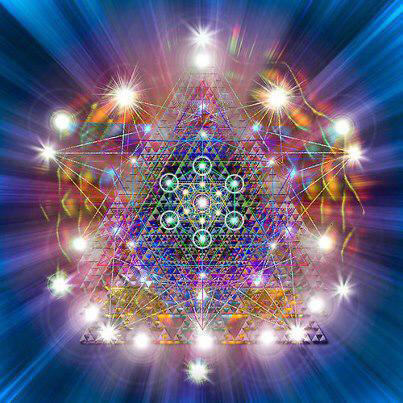
Look at this beautiful painting. I love the geometric patterns which Dana has used, but I also like the colors. this painting is titled "light years" and I think that's a nice title, because of the beauty it is light years away from the beauty of other modern paintings, just because he used these nice colors.
But the title of this episode, is more ... philosophical. At first I thought of the so called "sacred geometry" a philosophy who says that all and everything is the same as we look at the deeper hidden patterns. Maybe you have heard from Drunvalo Melchizedek, an ascended master, who wrote two wonderful books on "sacred geometry" titled "The Flower of Life". Several years ago, I even think back in the last century, I read his books and they were really amazing. Let me give you an idea about "The Flower of Life".
This will be a revelation, but I need a lot of words to explain it. I hope you don't mind.
What is Sacred Geometry?
Sacred geometry involves sacred universal patterns used in the design of everything in our reality, most often seen in architecture, art, and nature. The basic belief is that geometry and mathematical ratios, harmonics and proportion are also found in music, light, cosmology. It is the invisible patterns that animate our physical world much as spiritual traditions believe that the soul animates the body.
Shapes, patterns, and visual compositions have the capacity to seduce our eyes while captivating our imagination. Whether from masterful works of art or in nature, this entrancement can be so emotionally moving and awe-inspiring that people naturally associate it with transcendence, the super-natural, or spiritual. Beneath these patterns are relationships that can be measured, numbered, replicated, and defined. This mathematical yet esoteric realm of inquiry and observation known as sacred geometry will enlighten and mystify you while inviting you to change the way you look at the world.
The Golden Ratio
Also known as Phi, the Golden Mean, or the Golden Section, the Golden Ratio was revered as the mathematical law or representation of beauty by the Greeks. It is the numerical representation of infinity and an unreachable approximation. This begs one to contemplate the possibility of a transcendent number. From the Golden Rectangle comes the Fibonacci Spiral which is seen in flowers, snail shells, pinecones, and other parts of nature. The Golden Rectangle and Fibonacci Spiral are used in the crafting of musical instruments like cellos, violins, and the tones of musical scales are created using these same mathematical formulas. These formulas have been used in design and architecture going back at least 4,000 years and are seen in historic buildings like the Greek Parthenon.
The Flower of Life
Another very powerful symbol that is found all over the world dating back over 6,000 years and up to 10,000 years is the Flower of Life. This symbol is made of evenly-spaced, overlapping circles with six fold symmetry like a hexagon and looks like a flower, hence the name. It can be found in Egypt at the Temple of Osiris; the Forbidden City of China, synagogues in Galilee, Israel; in temples across India; in la Mezquita, Spain; Turkey, Japan and elsewhere. Leonardo da Vinci spent much time playing with and contemplating the Flower of Life’s form and used its mathematical properties in his art. Just by gazing at the symbol, or trying to count the circles will play tricks on your mind, and there is no wonder that people from ancient times to now are enamored with the Flower of Life.
Within the Flower is the Seed
The Seed of Life is a symbol found within the Flower of Life, as well as many other symbols of great significance including Metatrons Cube. These shapes called polygons are defined by having sides of equal length. This includes the cube, tetrahedron, dodecahedron, icosahedron, octahedron and they represent what Plato called the 5 platonic solids. These are visible within the flower of life when straight lines are drawn to connect the center of various circles within it. It is amazing to see all of this symmetry unfold in one succinct pattern which is created by math. Since many traditions believe that circles and curves represent the feminine, while corners and straight lines represent the masculine, this symbol also shows a divine balance of both.
 |
| Sacred Geometry (an overview of all sacred geometric patterns) |
Spirituality and Sacred Geometry
Higher frequencies of energy and awareness are transmitted through sacred geometry. Sacred geometry reveals that there are mathematical, or abstract patterns beneath everything that we see in the physical world. How might this relate to our own personal journey of integrating science and spirituality? Our internal beliefs create patterns that slowly ripple outward from us and manifest into real world experiences. The invisible informs the visible. Sacred geometry is a visualization and metaphor of the connectedness of all life, the interface between abstraction and physical reality. When we change the mathematical formulas, the relationships, we also change physical form. This is the teaching of many mystics. (Source: uplift)
nature
in its simple form
full of light
geometric patterns grow
everything around us
© Chèvrefeuille
Sorry for the length of this episode, but I just had to follow my heart to tell you a little bit more about the sacred geometry, as part of modern art our theme for this month. I hope you enjoyed the read and of course I hope that I have awakened your muse.
This episode is NOW OPEN for your submissions and will remain open until August 14th at noon (CET). I will try to publish our next episode, waves, later on. For now .... have fun!