Tuesday, May 6, 2014

Carpe Diem Ghost Writer May, Celestine of Reading Pleasure


Dear Haijin, visitors and travelers,

Day three of our May 2014 Ghost-Writer week is on. Today Celestine of Reading Pleasure is our Ghost-Writer I will enclose her post after the 'regular' prompt Stone, based on The Stone Cutter a Japanese folktale.

I love to bring already something on for next month (June 2014). In June we will again have a Ghost-Writer week and I am searching for new Ghost-Writers for that month. Our third Ghost-Writer week will be in week 24 (June 9th (pentecost) until June 13th) and maybe you can remember that we will have inspirational music prompts by a young Portugese Composer.

Ok ... back to the now ... here is the story of The Stone Cutter:

The Stonecutter


Once upon a time there lived a stonecutter, who went every day to a great rock in the side of a big mountain and cut out slabs for gravestones or for houses. He understood very well the kinds of stones wanted for the different purposes, and as he was a careful workman he had plenty of customers. For a long time he was quite happy and contented, and asked for nothing better than what he had.
Now in the mountain dwelt a spirit which now and then appeared to men, and helped them in many ways to become rich and prosperous. The stonecutter, however, had never seen this spirit, and only shook his head, with an unbelieving air, when anyone spoke of it. But a time was coming when he learned to change his opinion.
One day the stonecutter carried a gravestone to the house of a rich man, and saw there all sorts of beautiful things, of which he had never even dreamed. Suddenly his daily work seemed to grow harder and heavier, and he said to himself: "Oh, if only I were a rich man, and could sleep in a bed with silken curtains and golden tassels, how happy I should be!"
And a voice answered him: "Your wish is heard; a rich man you shall be!"
At the sound of the voice the stonecutter looked around, but could see nobody. He thought it was all his fancy, and picked up his tools and went home, for he did not feel inclined to do any more work that day. But when he reached the little house where he lived, he stood still with amazement, for instead of his wooden hut was a stately palace filled with splendid furniture, and most splendid of all was the bed, in every respect like the one he had envied. He was nearly beside himself with joy, and in his new life the old one was soon forgotten.

The Stone Cutter

It was now the beginning of summer, and each day the sun blazed more fiercely. One morning the heat was so great that the stonecutter could scarcely breathe, and he determined he would stop at home till the evening. He was rather dull, for he had never learned how to amuse himself, and was peeping through the closed blinds to see what was going on in the street, when a little carriage passed by, drawn by servants dressed in blue and silver. In the carriage sat a prince, and over his head a golden umbrella was held, to protect him from the sun's rays.
"Oh, if I were only a prince!" said the stonecutter to himself, as the carriage vanished around the corner. "Oh, if I were only a prince, and could go in such a carriage and have a golden umbrella held over me, how happy I should be!"
And a prince he was. Before his carriage rode one company of men and another behind it; servants dressed in scarlet and gold bore him along, the coveted umbrella was held over his head, everything his heart could desire was his. But yet it was not enough. He looked around still for something to wish for, and when he saw that in spite of the water he poured on the grass the rays of the sun scorched it, and that in spite of the umbrella held over his head each day his face grew browner and browner, he cried in his anger: "The sun is mightier than I; oh, if I were only the sun!"
And the mountain spirit answered: "Your wish is heard; the sun you shall be."
And the sun he was, and felt himself proud in his power. He shot his beams above and below, on earth and in heaven; he burnt up the grass in the fields and scorched the faces of princes as well as of poorer folk. but in a short time he began to grow tired of his might, for there seemed nothing left for him to do. Discontent once more filled his soul, and when a cloud covered his face, and hid the earth from him, he cried in his anger: "Does the cloud hold captive my rays, and is it mightier than I? Oh, that I were a cloud, and mightier than any!"

Stone Sculptor

And the mountain spirit answered: "Your wish is heard; a cloud you shall be!"
And a cloud he was, and lay between the sun and the earth. He caught the sun's beams and held them, and to his joy the earth grew green again and flowers blossomed. But that was not enough for him, and for days and week he poured forth rain till the rivers overflowed their banks, and the crops of rice stood in water. Towns and villages were destroyed by the power of the rain, only the great rock on the mountainside remained unmoved. The cloud was amazed at the sight, and cried in wonder: "Is the rock, then, mightier than I? Oh, if I were only the rock!"
And the mountain spirit answered; "Your wish is heard; the rock you shall be!"
And the rock he was, and gloried in his power. Proudly he stood, and neither the heat of the sun nor the force of the rain could move him. "This is better than all!" he said to himself. But one day he heard a strange noise at his feet, and when he looked down to see what it could be, he saw a stonecutter driving tools into his surface. Even while he looked a trembling feeling ran all through him, and a great block broke off and fell upon the ground. Then he cried in his wrath: "Is a mere child of earth mightier than a rock? Oh, if I were only a man!"
And the mountain spirit answered: "Your wish is heard. A man once more you shall be!"
And a man he was, and in the sweat of his brow he toiled again at his trade of stone cutting. His bed was hard and his food scanty, but he had learned to be satisfied with it, and did not long to be something or somebody else. And as he never asked for things he did not have, or desired to be greater and mightier than other people, he was happy at last, and never again heard the voice of the mountain spirit.
--------------------------------------------------------------------------------
Source: Andrew Lang, The Crimson Fairy Book (London: Longmans, Green, and Company, 1903), pp. 192-197.


+++++++++++++++++++++++++++++++++++++++++++++++
+++++++++++++++++++++++++++++++++++++++++++++++

And here is the post by Celestine of Reading Pleasure:


CARPE DIEM GHOST WRITER - CELESTINE


I must admit that I was a bit hesitant when Managua nominated me as  Ghost Writer for the CD. I felt I was not up to the task. Besides what on earth was I going to write about? Not even when I learned of the prompt 'Stone', was I at ease. Refusing would have been in poor taste so I had to accept.
When I started blogging two years ago, I had never heard of Haiku. The poetry forms I studied at school, did not include haiku. As a matter of act, most of my friends here have never heard of haiku until I started writing in the form. Thanks to wonderful blogger friends like Kristjaan and Leo of Haiku Heights, I have come to love haiku and to a large extent have evolved in my writing of it though I have a long way to go!


But haiku exist in Ghana and I'm sure we have poets who write in the form. About a few months into my blogging I came to know of Nana Fredua Agyeman of http://nanafreduagyeman.blogspot.com/, a fellow Ghanaian blogger who writes excellent haiku on his blog. Please pay him a visit and sample his work.


Now to the prompt Stone, based on the Japanese folklore, the Stone Cutter. Since I'm sure you would all have heard about or known about this folklore, I won't touch on it but rather, narrate a legend from Ghana about the Mystic Stone of Larabanga (La-ra--ban-ga)


During the British times, there was a road that was laid near the Larabanga Mosque, in the West Gonja region of the country. During the construction of the road, a stone was removed to make way for the road. The next day, the stone was found again on the same place it was displaced from. The stone was again removed from the way and the same thing happened the next day. Later, the officials decided to build the road around the stone and it became the mystic stone. What; do you make of this legend?


Mystic Stone of Larabanga

Larabanga Mosque

Here are a few haiku from Basho himself based on the prompt word.


the autumn wind 
is more white
than stones in a stony mountain


in the utter silence of a temple,
a cicada’s voice alone
penetrates the rocks


over a stone
what is flying
is only clouds


And also a couple of haiku from Ghana courtesy of Nana Fredua Agyeman. Two are about mountains, (well they are sort of stones right?)


fog mountain..
looking for the trees
I see my breath

the morning crowns
the mountain in fog -
almost Christmas


trailing its prey
the mantis sways
with the leaf

And finally my humble offering:


hide and seek
story rides the winds
cast in stone

Not very inspiring.  Let's try this!


buried in earth
the soul of a people
under a stone


Over to you dear Haijin. Be inspired and give of your best, though the prompt is not an easy one. But we always come through with lovely inspirations.


++++++++++++++++++++++++++++++++++++++++++++
++++++++++++++++++++++++++++++++++++++++++++


Well ... I hope that you all like this post and episode of Ghost-Writer written by Celestine. It's open for your submissions tonight at 7.00 PM (CET) and will remain open until May 9th 11.59 AM (CET). I will try to post our next episode of this Ghost Writer week later on today.


Monday, May 5, 2014

Carpe Diem Ghost Writer Week 2, Sky V of Stain


Dear Haijin, visitors and travelers,

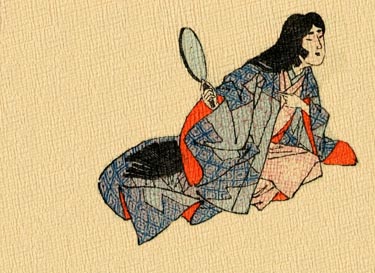
Welcome at day two of our Ghost-Writer week. Today it's up to Sky V. of Stain to post her Ghost-Writer post here. And of course it's possible to use the prompt for today, Mirror, which is referring to Japanese Folktale "The Mirror of Matsuyama". This story is often told on Hinamatsuri (the Girls' Festival) you can find another Carpe Diem post about Hinamatsuri HERE.

Before I share the post by Sky V I love to share our Japanese Folktale for today with you all.

The Mirror of Matsuyama

In ancient days there lived in a remote part of Japan a man and his wife, and they were blessed with a little girl, who was the pet and idol of her parents. On one occasion the man was called away on business in distant Kyoto. Before he went he told his daughter that if she were good and dutiful to her mother he would bring her back a present she would prize very highly. Then the good man took his departure, mother and daughter watching him go.
At last he returned to his home, and after his wife and child had taken off his large hat and sandals he sat down upon the white mats and opened a bamboo basket, watching the eager gaze of his little child. He took out a wonderful doll and a lacquer box of cakes and put them into her outstretched hands. Once more he dived into his basket, and presented his wife with a metal mirror. Its convex surface shone brightly, while upon its back there was a design of pine trees and storks.
The good man's wife had never seen a mirror before, and on gazing into it she was under the impression that another woman looked out upon her as she gazed with growing wonder. Her husband explained the mystery and bade her take great care of the mirror.


Credits: The Mirror of Matsuyama

Not long after this happy homecoming and distribution of presents the woman became very ill. Just before she died she called to her little daughter, and said: "Dear child, when I am dead take every care of your father. You will miss me when I have left you. But take this mirror, and when you feel most lonely look into it and you will always see me." Having said these words she passed away.
In due time the man married again, and his wife was not at all kind to her stepdaughter. But the little one, remembering her mother's words, would retire to a corner and eagerly look into the mirror, where it seemed to her that she saw her dear mother's face, not drawn in pain as she had seen it on her deathbed, but young and beautiful.
One day this child's stepmother chanced to see her crouching in a corner over an object she could not quite see, murmuring to herself. This ignorant woman, who detested the child and believed that her stepdaughter detested her in return, fancied that this little one was performing some strange magical art--perhaps making an image and sticking pins into it. Full of these notions, the stepmother went to her husband and told him that his wicked child was doing her best to kill her by witchcraft.
When the master of the house had listened to this extraordinary recital he went straight to his daughter's room. He took her by surprise, and immediately the girl saw him she slipped the mirror into her sleeve. For the first time her doting father grew angry, and he feared that there was, after all, truth in what his wife had told him, and he repeated her tale forthwith.
When his daughter had heard this unjust accusation she was amazed at her father's words, and she told him that she loved him far too well ever to attempt or wish to kill his wife, who she knew was dear to him.
Credits: Gutenberg project The Mirror of Matsuyama

"What have you hidden in your sleeve?" said her father, only half convinced and still much puzzled.
"The mirror you gave my mother, and which she on her deathbed gave to me. Every time I look into its shining surface I see the face of my dear mother, young and beautiful. When my heart aches--and oh! it has ached so much lately--I take out the mirror, and mother's face, with sweet, kind smile, brings me peace, and helps me to bear hard words and cross looks." Then the man understood and loved his child the more for her filial piety. Even the girl's stepmother, when she knew what had really taken place, was ashamed and asked forgiveness. And this child, who believed she had seen her mother's face in the mirror, forgave, and trouble forever departed from the home.

Source: F. Hadland Davis, Myths and Legends of Japan (London: George G. Harrap, 1917), pp. 196-198.
This story is often told at Hinamatsuri (Girls' Festival), March 3rd, one of the traditional festivals still celebrated in Japan.
++++++++++++++++++++++++++++++++++++++++++++++++++
++++++++++++++++++++++++++++++++++++++++++++++++++

And here is the post by Sky V. of Stain:


Thinking about this post, I had several ideas on my mind but somehow, longing took the lead and stayed there for days. Why longing? Because it gives us wide specter of feelings and colors so everyone can chose for themselves what fits them the best at the moment. 
Spectrum
longing ~ long-ing  [lawng-ing, long-]
noun
·         strong, persistent desire or craving, especially for something unattainable or
    distant: filled with longing for home.

·         an instance of this: a sudden longing to see old friends

adjective

having or characterized by persistent or earnest desire: a longing look.

long -verb (used without object)

·         to have an earnest or strong desire or craving
·         yearn: to long for spring; to long to return home
·         Archaic. to be suitable or fitting
·         Obsolete . to be the possession
·         belong
Synonyms 
·         aspiration
·         desire
·         desirous, yearning
Antonyms

           apathy
 
 “The feelings that hurt most, the emotions that sting most, are those that are absurd – The longing for impossible things, precisely because they are impossible; nostalgia for what never was; the desire for what could have been; regret over not being someone else; dissatisfaction with the world’s existence. All these half-tones of the soul’s consciousness create in us a painful landscape, an eternal sunset of what we are.”  (Fernando Pessoa)

As an inspiration, I will share with you one of my all times favorite poems,  written by French surrealist poet Robert Desnos (4 July 1900 – 8 June 1945)

Mysterious Woman
 
Poem To The Mysterious Woman,

by Robert Desnos

I have dreamed of you so much that you are no longer real.
Is there still time for me to reach your breathing body, to kiss your mouth and make
your dear voice come alive again?

I have dreamed of you so much that my arms, grown used to being crossed on my
chest as I hugged your shadow, would perhaps not bend to the shape of your body.
For faced with the real form of what has haunted me and governed me for so many
days and years, I would surely become a shadow.

O scales of feeling.

I have dreamed of you so much that surely there is no more time for me to wake up.
I sleep on my feet prey to all the forms of life and love, and you, the only one who
counts for me today, I can no more touch your face and lips than touch the lips and
face of some passerby.

I have dreamed of you so much, have walked so much, talked so much, slept so much
with your phantom, that perhaps the only thing left for me is to become a phantom
among phantoms, a shadow a hundred times more shadow than the shadow the
moves and goes on moving, brightly, over the sundial of your life.

As my own response to this theme I will share with you my own poem about longing.

Longing,

by Sky V

(part 1)
Have you ever wished
to run away from your own skin
and find deliverance?
Have you ever felt
this flush in yourself,
a flood of feelings,
your powerlessness and fear
of suddenly opening?
Have you ever felt
an avalanche of mixed
passion and pain,
of mixed
love and contempt,
longing and despair?


Longing
(part 2)
You’ve captured me again.
I feel like my skin is going to crack from the pressure,
as if there’s not enough space for you.
Pulsing in my head,
my eyelids are heavy.
I miss you.
Oh, how I wish to fall asleep in your arms.

I guess that I stepped away of haiku so I will return back with my modestly try to answer my own challenge:
wind takes you away
wild waves return you to shore
storm within my mind
That was all from me. I am going to leave you now with your inspiration, looking forward for your responses. For the end, the beautiful message for you written by Jalāl ad-Dīn Muḥammad Balkh, or Rumi (30 September 1207 – 17 December 1273), a 13th-century Persian Muslim poet, jurist, theologian, and Sufi mystic.


“When I am with you, we stay up all night.
When you’re not here, I can’t go to sleep.
Praise God for those two insomnias!
And the difference between them.”
~ Sky V
http://youtu.be/fLSn29TnFAg

++++++++++++++++++++++++++++++++++++++++++++++++++++
++++++++++++++++++++++++++++++++++++++++++++++++++++

Well I hope this post inspired you to write your own haiku. This post will be open for your submissions tonight at 7.00 PM (CET) and will remain open until May 8th 11.59 AM (CET). I will post our new Ghost-Writer post by Celestine of Reading Pleasure later on today. For now have fun, be inspired and share your haiku with us all here at Carpe Diem Haiku Kai.

Sunday, May 4, 2014

Carpe Diem 2nd Ghost-Writer week, Jen's Tanaga


Dear Haijin, visitors an travelers,

Here it is ... our second Carpe Diem Ghost-Writer week starting with the Ghost-Writer post by Jen of Blog it or lose it. She loves to introduce the Tanaga, a Philipine poetry form, to you all. I will include her post hereafter.
Today I will try to share another Japanese folktale, ''The Two Frogs'', with you. It"s todays prompt, frog, which is referring to that story. Here is that Japanese Folktale:

The Two Frogs

Once upon a time in the country of Japan there lived two frogs, one of whom made his home in a ditch near the town of Osaka, on the sea coast, while the other dwelt in a clear little stream which ran through the city of Kyoto. At such a great distance apart, they had never even heard of each other; but, funnily enough, the idea came into both their heads at once that they should like to see a little of the world, and the frog who lived at Kyoto wanted to visit Osaka, and the frog who lived at Osaka wished to go to Kyoto, where the great Mikado had his palace.
So one fine morning in the spring they both set out along the road that led from Kyoto to Osaka, one from one end and the other from the other. The journey was more tiring than they expected, for they did not know much about traveling, and halfway between the two towns there arose a mountain which had to be climbed. It took them a long time and a great many hops to reach the top, but there they were at last, and what was the surprise of each to see another frog before him!

Credits: The Two Frogs

They looked at each other for a moment without speaking, and then fell into conversation, explaining the cause of their meeting so far from their homes. It was delightful to find that they both felt the same wish--to learn a little more of their native country--and as there was no sort of hurry they stretched themselves out in a cool, damp place, and agreed that they would have a good rest before they parted to go their ways.
"What a pity we are not bigger," said the Osaka frog; "for then we could see both towns from here, and tell if it is worth our while going on."
"Oh, that is easily managed," returned the Kyoto frog. "We have only got to stand up on our hind legs, and hold onto each other, and then we can each look at the town he is traveling to."
This idea pleased the Osaka frog so much that he at once jumped up and put his front paws on the shoulder of his friend, who had risen also. There they both stood, stretching themselves as high as they could, and holding each other tightly, so that they might not fall down. The Kyoto frog turned his nose towards Osaka, and the Osaka frog turned his nose towards Kyoto; but the foolish things forgot that when they stood up their great eyes lay in the backs of their heads, and that though their noses might point to the places to which they wanted to go, their eyes beheld the places from which they had come.

Credits: The Two Frogs (woodblock)

"Dear me!" cried the Osaka frog, "Kyoto is exactly like Osaka. It is certainly not worth such a long journey. I shall go home!"
"If I had had any idea that Osaka was only a copy of Kyoto I should never have traveled all this way," exclaimed the frog from Kyoto, and as he spoke he took his hands from his friend's shoulders, and they both fell down on the grass. Then they took a polite farewell of each other, and set off for home again, and to the end of their lives they believed that Osaka and Kyoto, which are as different to look at as two towns can be, were as alike as two peas.

Source: Andrew Lang, The Violet Fairy Book (London: Longmans, Green and Co., 1901), pp. 125-126.

Jen interpreted this story with the following Tanaga:

Reeg, he said, looking backward;
blindly, his partner agreed.
Follow your flippers forward -
you can’t know till you've journeyed.


amber eyes above the pond,
disc-like ears underwater —
just like frogs, we live longer
immersed but looking beyond 

++++++++++++++++++++++++++++++++++++++++++++
++++++++++++++++++++++++++++++++++++++++++++


This is Jen's post about ''Tanaga''.

Tanaga

Today I’d like to introduce you to the Tanaga, an ancient Filipino poem. While several of the Tanaga’s features might feel strange to everyone in Carpe Diem Haiku Kai, I hope you will give the poem a chance. Why? Because the Tanaga has been dying out in its native language, Tagalog. Several cultural groups encourage Tanagas written in English in an attempt to reach new audiences and keep the form alive.
Some sources call the Tanaga a “Filipino Haiku”, but that isn’t quite accurate.  Like an English haiku, the Tanaga counts syllables.  Unlike the haiku, the pattern is four lines of 7 syllables each (7-7-7-7).
The biggest difference is that the Tanaga rhymes; it has a pattern of AABB.  In addition, ancient Tanagas were handed down through oral history and contain advice for living (1).

Here is an example of a Tanaga in archaic Tagalog (1):

Catitibay ca tolos
sacaling datnang agos!
aco’I momonting lomot
sa iyo,I popolopot.


            Friars Juan de Noceda and Pedro de Sanlucar, 1754.

Oh be resilient you Stake
should the waters be coming!
I shall cower as the moss
to you I shall be clinging."


            Translation by Jardine Davies

I mentioned that Tanagas are reaching new audiences. As you might expect, new audiences bring changes. Today you will see Tanagas with titles and with new rhyming patterns (for example, AABB, ABAB, ABBA, AAAB, BAAA, and so on). Life advice (morals, ethics, proverbs) may or may not be present (1).
Why would I encourage a rhyming poem at Carpe Diem?  First of all, it is sad to think of a dying poetic form. Second, even though Tanagas and haiku are different, we can use our expanding “haiku toolboxes” to great effect.  (Thank you, Kristjaan, for your constant work in showing us new tools!)  We can use our skills in sharing those crisp ripple-of-water-in-the-pond moments – and add a bit of advice or a lesson at the end.

Source: Wikipedia Paintings

Here is a Tanaga I wrote to accompany a painting by Piet Mondrian.

The peaceful river reflects
green banks that the grass protects
and where trees their strength renew:
may I reflect green life, too! 


A bit amateur, I will admit … but I think it’s a good start.
For this installment of Carpe Diem Haiku Kai, please use Kristjaan’s prompt, frog, as the inspiration for your Tanaga.

Additional Resources


+++++++++++++++++++++++++++++++++++++++++++++++++++

+++++++++++++++++++++++++++++++++++++++++++++++++++

Well ... I hope you did like this first Ghost-Writer post of this week's Carpe Diem Ghost-Writer and that it will inspire you to write a haiku or maybe you will compose a Tanaga ... it's up to you now ... enjoy it and have fun.
This episode is open for your submissions tonight at 7.00 PM (CET) and will remain open until May 7th 11.59 AM (CET). I will try to post our new ghost-writer post later on today. That will be the post by Sky V of Stain and our planned prompt is mirror.


Saturday, May 3, 2014

Carpe Diem Special #90, Jack Kerouac's "glow worm"


Dear Haijin, visitors and travelers,

What a joy to prepare our first CD-Special, with a new logo, of this CD-month. This month our featured haiku-poet is Jack Kerouac (1922-1969), a modern time American haiku-poet. I had heard about him, but had never read a haiku composed by him. So this month will be a revelation to me ... and maybe to you also.

Jean-Louis "Jack" Kérouac is recognized for his method of spontaneous prose. Thematically, his work covers topics such as Catholic spirituality, jazz, promiscuity, Buddhism, drugs, poverty, and travel. He became an underground celebrity and a progenitor of the hippie movement, although he remained antagonistic toward some of its politically radical elements.
In 1969, at age 47, Kerouac died from internal bleeding due to long-term alcohol abuse. Since his death Kerouac's literary prestige has grown and several previously unseen works have been published. All of his books are in print today.


Jack Kerouac (1922-1969)

Kerouac once said:

[...] "I propose that the 'Western Haiku' simply say a lot in three short lines in any Western language. Above all, a Haiku must be very simple and free of all poetic trickery and make a little picture . . ." [...]

The goal of CD-Special is to write a haiku in the same sense, tone and spirit as the given haiku by our featured haijin. I have a nice haiku to share with our haiku-family.

Here is our first Special haiku by Jack Kerouac:

glow worm
sleeping on this flower -
your light's on


© Jack Kerouac

A beauty I think. Will not be an easy task to write a new one ...

Here is my attempt:

'Look! Those strange lights?'
the child says full of surprise
'a cloud of fireflies!'


© Chèvrefeuille

A Cloud of Fireflies
Fireflies, wonderful creatures caught in the imagination of a child ... wisps ...

This episode will be open for your submissions tonight at 7.00 PM (CET) and will remain open until May 6th 11.59 AM (CET). I will try to publish our new episode, frog, later on today. For now have fun, be inspired and share your haiku in the spirit of Jack Kerouac with us all here at Carpe Diem Haiku Kai.


Friday, May 2, 2014

Carpe Diem #463, Turtle


Dear Haijin, visitors and travelers,

Today another nice folktale from the 'mother-land' of haiku, Japan. Another folktale with a dragon in it. In Japanese folktales dragons are shapeshifters so they can be every animal and even human.
Japanese culture has great respect for the intelligence of animals. In Japanese myth, animals are so intelligent that they often play elaborate tricks on humans. Animals are also considered to have magical or godlike powers. One such magical ability is shape shifting (obake お化け) to human form. Raccoons, foxes, snakes, badgers, wolves, cats, spiders and dogs are all thought to have this ability. The purpose of animal shape shifting is inevitably to play a prank on humans.
This folktale is titled: Otohime: Beware of Gifts From a Dragon Princess

Otohime is one of the beautiful daughters of Ryujin the dragon king (which we saw in our yesterday's post). Her main claim to fame is that she is the grandmother of Japan's first Emperor — Emperor Jimmu (Japan's first 15 Emperors are presumed to be mythical).
Urashima Taro

[...] Otohime appears in Urashima Taro, one of Japan's best known myths. Urashima Taro was a young fisherman who saved a small turtle from torture at the hands of a gang of children. It turned out that the turtle was Otohime (daughter of the dragon god).
He is rewarded with a visit to the dragon king's palace under the sea. He spends 3 days at the palace with the beautiful Princess Otohime (who has shape shifted to human form).
When it's time for the fisherman to return home, Otohime gives him a small box. She says the box will protect him but that he should never open it.
When the fisherman returns to his village he finds that 300 years has passed. His family, friends and everyone he ever knew is gone. Desperate, he opens the box and instantly becomes an old man.
[...]
Urashima Taro opens the gift-box

What a sad story ... it's about trust and love, but also about playing a prank on humans. It's about curiosity ... Urashima opens the box he got from Otohime notwithstanding what she had said and the result ... well you have read that.
children playing
in the backyard of the old mansion -
turtle flees away

turtle flees away
seeking shelter for the rain
beneath the Azalea
(c) Chèvrefeuille
Wish you all luck and a lot of joy with this prompt ... this episode is open for your submissions tonight at 7.00 PM (CET) and will remain open until May 5th 11.59 AM (CET). I will try to post our new episode, our first CD-Special by Jack Kerouac (1922-1969), later on today. For now .. have fun!

Carpe Diem's Tan Renga Challenge #33, Kuheli's "the lotus bloomed"


Dear Haijin, visitors and travelers,

Another week has gone by and we are already in our first days of May and on our way through the rich history of Legends, Myths, Saga and Folktales, but we have also our weekly Tan Renga Challenge.

This week's Tan Renga is started with a haiku written/composed by Kuheli of Kajori, Only One Life which she wrote in response on our Tagore Distillation. As I read her haiku I was in awe and fell in love with this wonderful haiku. I am glad that Kuheli gave me permission to use her haiku for our Tan Renga Challenge.

The goal of the Tan Renga Challenge is to write/compose a second stanza (7-7) towards a given haiku (first stanza 5-7-5) as a completion or continuation of the scene which is painted in the first stanza. As you know I am not of the straight rules so your second stanza don't has to be 7-7 syllables, but if you will use that rule ... well feel free ....

Credits: Lotus Flower

the Lotus bloomed
before the summer breath
and now I wake up


© Kuheli

A beauty don't you think so too? Well ... the challenge is on ... write a second stanza (of two lines) towards this haiku and complete or continuate the haiku and it's scenery.

Here is my attempt to write a second stanza towards this haiku by Kuheli:

the Lotus bloomed
before the summer breath
and now I wake up
            (Kuheli)

deep down inside of my heart
I realise that life is short
              (Chèvrefeuille)

Hm ... I am not completely satisfied with this completion ... I used the Lotus for my inspiration to write that second stanza ... a Lotus is such a spiritual flower, it's life is short, to short is our life to learn all and everything what the Lotus learns us.

This Tan Renga Challenge is NOW OPEN for your submissions and will remain open until May 9th 11.59 AM (CET). For now have fun, be inpsired and share your completed Tan Renga with us all here at our Haiku Kai. !! I hope you all like our new logo for the Tan Renga Challenge !!

Thursday, May 1, 2014

Carpe Diem #462, Crystal


Dear Haijin, visitors and travelers,

We had a great start of our new Carpe Diem Haiku Kai month and today (2/5) we will go on with our 'journey' along Myths, Legends, Saga and Folktales in the 'mother-land' of Haiku, Japan. Today our prompt is Crystal and I have found another nice story titled: Ryujin: How to Steal Jewels From a Dragon God.

Ryujin is a Japanese dragon god who lives in the sea. He makes frequent appearances in Japanese myth (as do his many beautiful daughters).

[...] In one story, Ryujin steals priceless jewels from a prince (the tide jewels). The prince embarks on a journey to recover the jewels when he meets a beautiful pearl diver (ama) on the beach. They marry and have a son. The pearl diver becomes a princess (Princess Tamatori).
Princess Tamatori finds a way to take the jewels back from the dragon king. She plays music to lull him to sleep. When the dragon king discovers the jewels gone he pursues her. She cuts her breast to hide the jewels inside. The blood from this action cloud the waters enough to aid her escape.
She dies but successfully recovers the jewels for her new family.
[...]


Ryujin pursues Tamatori
A wonderful story ... and a great woodblock-print ... And here is my attempt to compose a haiku towards it.

ama on the beach
gives her most beautiful smile -
pearls for a dragon god


(c) Chèvrefeuille

Crystal Sunlight

crystal clear sunlight
reflects all colors in the mirror -
shadow of a dragon


(c) Chèvrefeuille

What a joy to share these with you all. I hope you are inspired to compose and share your haiku with us all here at our Haiku Kai.

This episode is open for your submissions tonight at 7.00 PM (CET) and will remain open until May 4th 11.59 AM (CET). I will try to post our next episode, Turtle, later on today. For now ... have fun!!