Friday, February 12, 2016

Carpe Diem #917 direction


Dear Haijin, visitors and travelers,

Last Sunday my wife and I were on an adventure. We took the bike to explore a view new districts in our hometown. Nice new buildings, awesome mansions and a lot of "new" nature, like parks and ponds. After a while we entered a district with all expensive villas and than we were lost ... We had to ask the way out of this district.

Introduction

Today's post is about "direction" and Hamish has written a nice essay about it. As I told above my sense of direction is not great. Of course I can find my way out in the districts I know, but as in the above example new districts is something else. After visiting these new districts a few times I will for sure find my way out, but it takes some time to adjust to those new districts.

lost in time
overwhelmed by the beauty
of the sunset

© Chèvrefeuille

Sunset with Reeds

Hamish on Direction

Some of us have it, some of us don't. Magnetoception (or magnetoreception) is the ability to detect the direction one is facing based on the Earth's magnetic field. Directional awareness is most commonly observed in birds. It has also been observed in insects such as bees. Although there is no dispute that this sense exists in many avians (it is essential to the navigational abilities of migratory birds), it is not a well-understood phenomenon. One study has found that cattle make use of magnetoception, as they tend to align themselves in a north-south direction. Magnetotactic bacteria build miniature magnets inside themselves and use them to determine their orientation relative to the Earth's magnetic field. The question of how useful magnetoception may be to human beings is subject of ongoing research.
Scientists have made sense of why some of us have no sense of direction, and have pinpointed signals in the human brain that determine how good we are at navigating. This inbuilt compass tells us which way we are facing and works out which way to turn to go where we want. And in those with a poor sense of direction, the signals are fuzzier.
London cab drivers who have memorized London's 25,000 streets and landmarks have a very well-developed sense of direction. Only around half of trainees finally make the grade as London taxi drivers by passing a London map Knowledge test. Study of these cab drivers showed they seem to have a type of “homing signal” has been thought to exist for many years, but until then remained purely speculation. The results of the research provided evidence to support the idea that our internal “compass” readjusts as we move through an environment. If you get lost after taking too many turns, this may be because your brain could not keep up and failed to adjust your facing and goal directions.
How can you show sense of direction in a haiku? How about walking towards the sunset, or sunrise, or facing northwards for a reason. Explore your sense of direction through your haiku today!

My response

Direction ... is it possible to catch that in a haiku or a tanka? As I think of "undou" (movement), one of the Haiku Writing Techniques, than I think direction can be caught in a haiku or tanka too. So I have given it a try ... and came up with these tanka:


a whispered prayer -
pilgrims on their way to Santiago
walking the Path of God
reaching out to their deepest thoughts
seeking the Light

seeking the Light
while chanting psalms or mantras
pilgrims on their way
enjoying Mother Earth's beauty -
a whispered prayer

© Chèvrefeuille
 
Camino Sign Pointing the Way to Santiogo Di Compostela

This episode is open for your submissions tonight at 7.00 PM (CET) and will remain open until February 15th at noon (CET). I will (try to) publish our new episode, Pain, later on. For now ... have fun!
 

Thursday, February 11, 2016

Carpe Diem #916 Temperature (Warmth/ Coolness)


Dear Haijin, visitors and travelers,

From a sunny The Netherlands I welcome you all at a new episode of Carpe Diem. This month we are sharpening our senses through the essays written by Hamish Managua Gunn (a.k.a. Pirate) and this day that will be Temperature (Warmth/ Coolness), but first this:

Our "Time" kukai is running to its end and this is the final call for submissions. You can email your haiku (a max of three, new and never published earlier haiku) for this "Time" kukai to our emailaddress: carpediemhaikukai@gmail.com Please write "kukai Time" in the subject line. You can email your haiku until February 14th 10.00 PM (CET).

Introduction

Today it's all about temperature warmth/coolness and Hamish has written another nice post in which he refers also to that famous "frogpond" haiku by (my master) Matsuo Basho:

old pond
frog jumps
splash!

© Basho (Tr. Chèvrefeuille)

A free-style way of translation, but I love it. In this haiku you (maybe) can see and feel "temperature" because of it's first and third line. Why? Let me try to explain that idea to you.
In the first line "old pond" I associate old with "cold" and the third line "splash!" with "warmth". I think it's not necessary to explain that further.


In his essay following Hamish tells you all more about "temperature (warmth / coolness)" in his own special way.

Hamish on temperature (warmth / coolness)

We all feel temperature in a slightly different way, even though the temperature itself is consistent. That shows us how we are all a little bit different - or have experienced different pasts, live in different cultures, or simply express ourselves differently, even subconsciously. In Northern Scotland, 25°C would be described as a heat wave, but in South Sudan it might be seen as nice and cool.

With temperature also comes changes in pressure. We can easily feel pressure we realize it is there, but sometimes changes in weather and air pressure can cause headaches or pains in some people. Pressure detection uses a system consisting of three appendages of vertebrae transferring changes in shape of the tiny gas bladder to the middle ear. This can also be used to regulate the buoyancy of fish. Fish and amphibians also perceive pressure through water current detection, and both are also sensitive to low-frequency vibrations. In mammals  receptor hair cells are used for vestibular sense and hearing and are used primarily for navigation, hunting, and schooling. The receptors of the electrical sense are modified hair cells in the lateral line system.

Cuttlefish can also perceive the polarization of light, and bees use polarized light direction/detection to orient themselves, especially on cloudy days. Most people can learn to roughly detect large areas of polarization by an effect called Haidinger's brush, however this is considered an entopic phenomenon rather than a separate sense. Spiders detect mechanical strain in the exoskeleton, providing information on force and vibrations. Electro location allows dolphins, porpoises, whales and monotremes (such as the platypus) to locate prey based on electrical signals generated by contracting muscle, showing that the senses of pressure and temperature are senses using a multifold of skills and abilities with the different animals in our ecosystem. 


How can you illustrate this through a haiku? Pick an animal covered in the text and see if you can make us relate to the pressure or electric vibrations they feel, either consciously or by instinct. This might be a spider on a web, or a dolphin swimming through the sea or jumping, or Basho's simple frog...

My response

Temperature ... what to do with this theme in a haiku bringing it together with nature? That will not be easy, but of course I tried it and this is what came up:

dolphins' song
climbs the late evening breeze
waves gently roll


© Chèvrefeuille

this summer night
lying on the beach with my love
the cool breeze


© Chèvrefeuille

Two nice haiku if I may say so ... that first haiku means a lot to me and in the depths of this haiku you can read that we once were part of the sea and conquered the earth. It's part of the Nommos mythology that we rose from the waters.

Dogon Tribe mythology; Nommos
This episode is open for your submissions tonight at 7.00 PM (CET) and will remain open until February 14th at noon (CET). I will (try to) publish our new episode, Direction, later on. Have fun!


Wednesday, February 10, 2016

Carpe Diem #915 Melody


Dear Haijin, visitors and travelers,

Welcome at a new episode of Carpe Diem. We are discovering the beauty of our senses this month and today Hamish loves to share a very short essay about melody.

A few weeks ago I challenged you with a nice piece of music and today Hamish will do the same. Here is his post:

A sense of melody is similar to a sense of nature, or of the art of conversation. It is the ability to create or recognize song and rhythm. For this prompt the best way to help you form a melodious haiku is to offer you some music that can help inspire.
Perhaps the best way to talk about melody is not to go on and on with sentences, but perhaps to provide you with a song, in a similar way to the prompt, Remember This Music we had a few weeks ago. Here, though, only the melody, sound of singing and images will be you inspiration for your haiku.
He shared the following music video by eivǿr:


I hope you will become inspired through this wonderful music in which the love for Mother is the theme. The video is in the language of the Faroer Islands and here are the lyrics and the English translation:


Lyrics:

Mín móðir hon er sum ein drotning
Hon er sum tað vakrasta lag
Mín móðir hon er sum ein blóma
Hon er sum eitt livandi træ
Mín móðir er heim mítt kæra
Mín móðir mítt tryggasta stað
Mín móðir er bjartasta glæman
Hon lýsir mær døkkan veg
Min móðir er sterkasta hondin
Trygt heim aftur leiðir hon meg
Mín móðir hjá tær eg standi
Í hjartanum goymi eg teg

English translation:

My Mother is a Queen
Like the Finest Song
My Mother is a Flower
She is a Living Tree
My mother is My Home
My Safe Place
She is the Brightest Light
Lights my Dark Path
She is strong and leads me home safely
I stand by her and keep her in my heart

Credits: Faroer Islands

Have fun with this episode and is NOW OPEN for your submissions. This episode remains open until February 13th at noon (CET). I will (try to) publish our new episode, Temperature Warmth/ Coolness), later on.

Tuesday, February 9, 2016

Carpe Diem Tokubetsudesu #69 An Essay About Real Love


Dear Haijin, visitors and travelers,

As you all know this month it's all about "the senses". Hamish takes us by the hand with his wonderful essays about the diversity of senses to shake our senses a little bit or "anata no kankakuwo migaku". Today I love to share an essay about "real love", with you.
Next Sunday it's Valentine's Day, the day of year to celebrate real love. Last Sunday I was reading The Zahir by Paulo Coelho. Part of his novel "triggered" me to write this essay for you. I love to share that part here with you all.

[...] “All men and all women are connected by an energy which many people call love, but which is, in fact, the raw material from which the universe was built. This energy cannot be manipulated, it leads us gently forward, it contains all we have to learn in this life. If we try to make it go in the direction we want, we end up desperate, frustrated, disillusioned, because that energy is free and wild.
We could spend the rest of our life saying that we love such a person or thing, when the truth is that we are merely suffering because, instead of accepting love’s strength, we are trying to diminish it so that it fits the world in which we imagine we live”. [...]
 (Source: The Zahir by Paulo Coelho).

lotus flowers
rising from the depths of the pond
everlasting love

everlasting love
like a river flows onwards
uncertain of its goal

uncertain of its goal
rising from the depths of the pond
lotus flowers


© Chèvrefeuille

Credits: rising from the depths of the pond

Paulo Coelho has written a lot of novels and in almost every novel of him one of the themes is love or real love. What does love mean?

I think love is a strong sense, but each of us will respond on love in a different way. Love is not only something you have for a person, but it can also be for art, literature, nature and as I speak for myself ... haiku, maybe my love for haiku is even more stronger than the love for my wife, children and grandchildren. For sure my love for haiku is very strong, but my love for my wife (and I have a lot of love to give) is everlasting and unconditional.
It's true that haiku and my wife are competing for my attention. My wife has nothing, really nothing with haiku and she says that often, but I love her with whole my heart. She is my "real love".

Maybe you know "Manuscript found in Accra" another wonderful novel by Paulo Coelho. In that novel he says the following:

[...] "Love changes, love heals. Love is just a word until we decide that she can take possession of us.
Love is just a word until someone gives meaning to it". [...]
 (Source: Manuscript found in Accra - Paulo Coelho)


Haiku is love, a love that grabs you by the throat and takes you into an adventure to discover the beauty of our world in all her beautiful details and bring that into the tine form of haiku that shows us a scene, a moment that lasts only one heart beat.


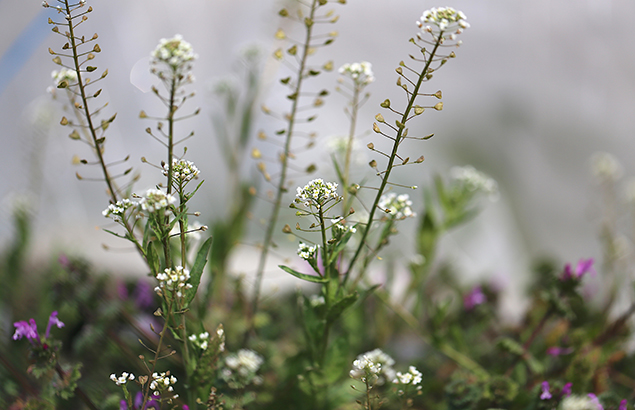
Credits: Shepherd's Purse (nazuna)

For example the beauty of nature in detail this haiku by Basho:


yoku mireba nazuna hana saku kakine kana

looking closely:
a shepherd's purse blossoming
beneath the hedge


© Matsuo Basho (Tr. Barnhill)

And this one inspired on the above beauty by Basho:

shepherd’s purse
trembles in the summer breeze -
bees seek for honey

© Chèvrefeuille

I discovered haiku in the late Eighties and I was caught immediately by its beauty. I fell in love with haiku, addicted to the beauty of nature, addicted to love. Haiku, however, wasn't my first love ... my first love was classical music especially the music by J.S.Bach. I played the organ and studied all the works of Bach. Through his music I learned to appreciate beauty.
Later I discovered painting and photographing. While I was busy learning to become a better painter and photographer I ran into haiku ... Haiku at that time gave me the opportunity to train my writing skills, to say more with less words.


What has "real love" to do with haiku? Let me tell you something about love in haiku.
As you all know tanka is more the poetry for love, but in my opinion, haiku is also about love. Love in haiku is universal and that means "haiku transcends everything even the love between people. Haiku is love and we can find that idea in the wonderful spiritual roots of haiku, Zen Buddhism.


Zen is love (real love) of the universe. Without this love, joy is uncertain, pain is inevitable, all is meaningless. Othello says:

[...] "When I love thee not, chaos is come again". [...]

The love must be complete, - not that it aims at the universe as a whole, but that the personality as a whole is to be concentrated on the thing; the thing is to be suffused with the personality. Then we have the state, described abstractly by Dr. Suzuki in the following words:

[...] "When an object is picked up, everything else, One and All, comes along with it, not in the way of suggestion, but all-inclusively, in the sense that the object is complete in itself". [...]


The relation of love to poetry may be easy to make out, but that to Zen is much more difficult. Look at it like this ... If we are without self-love, greediness, without desire of gain, of happiness, of life itself, all this energy must overflow somewhere. It overflows into all things, including oneself, so that now no actions are selfish or unselfish, good or bad, but are like the sunshine or the rain, but with mind instead of mindlessness.
We say that we see the beauty of the fine drops of rain, the glittering of the leaves in the sun, the stars in their calm, - but what we really see is the mind of man, our own mind, in all these things. Through our activity and cooperation, these inanimate things acquire mind and affection. The waves drown the shipwrecked sailor regretfully, the sun scorches the weary traveler with remorse.

This kind of love, then, is not the means, the first step, but the end and aim and consummation of our pilgrimage here (on this world). It is expressed in quite other ways than altruism and self-denial. It is effortless and continuous, unconscious and nameless, but we feel it and know it ourselves and others as the health of the soul.

Mountain Persimmons
mountain persimmons;
the mother is eating
the astringent parts


© Issa (Tr. R.H.Blyth)

Zen cannot change a man's inborn character. Nothing can do this. It cannot turn a cold, selfish heart into a warm loving one. What it does do is to change the direction of the inner energy, to bring out all the latent power, to show things to be interesting that were not noticed at all (as in the above haiku by Basho), or thought to be meaningless or repulsive.

shutting the great temple gate,
creak! it goes:
an autumn evening


© Shiki (Tr. R.H.Blyth)


it walked with me
as I walked,
the scarecrow in the distance


© San-in (Tr. R.H.Blyth)


Just as Zen is love, haiku may be called love poems. Haiku are an expression of the joy of our reunion with things from we have been parted by self-consciousness, so strong and tender in the sexual act, more diffused, yet equally powerful and delicate in our poetic moments.


Credits: Joy

As you all (maybe) know I have written (and published) two novels. Both were successful and in both novels I used my ideas about love. In my second novel ("Never to Return" or "Nooit meer Terug".) I used my ideas about love for the spiritual teachings of the main character. I love to share a quote from that novel here.


[...] "Unconditional love is neverending. Unconditional love is bound together with the Collective Consciousness which binds together every living creature with the Universe. Unconditional love makes us one." [...]

We are all haiku poets and the love for haiku makes us one.

"Real Love" is in my opinion the only base for haiku. Without real love, for all and everything, creating haiku is not possible.
As I discovered haiku I fell in love ... in love with that universal beauty that binds all artists (poets, musicians, painters, sculptors and more) together.


a little verse
lighted a fire in my heart

addicted to love

© Chèvrefeuille


Have a wonderful loving Valentine's Day !

The goal of this Tokubetsudesu epsiode is to sit back, meditate and contemplate on love and let your muse inspire you to create a haiku full of love and passion.


This Tokubetsudesu episode is NOW OPEN for your submissions and will remain open until February 12th at noon (CET). I will (try to) publish our next episode, Melody, later on.
 

Monday, February 8, 2016

Carpe Diem Special #196 Hamish Gunn's 2nd "on the street corner"


Dear Haijin, visitors and travelers,

It's my pleasure to bring you an all new CD Special with haiku written by Hamish Managua Gunn, the winner of our "winter"- kukai. Hamish emailed me a series of haiku to choose from and the haiku which I love to share here did remind me at our "Narrow Road"-month last December and it brought a haiku in mind by Basho. This haiku is very known, because of a certain controversy in it.

The haiku by Basho is from his haibun "Narrow Road", so I will also share the prose around it here with you:

The voices of two young women whispering in the next room, however, came creeping into my ears. They were talking to an elderly man, and I gathered from their whispers that they were concubines from Niigata in the province of Echigo, and that the old man, having accompanied them on their way to the Ise Shrine, was going home the next day with their messages to their relatives and friends.  


Ise Shrine

I sympathized with them, for as they said themselves among their whispers, their life was such that they had to drift along even as the white froth of waters that beat on the shore, and having been forced to find a new companion each night, they had to renew their pledge of love at every turn, thus proving each time the fatal sinfulness of their nature. I listened to their whispers till fatigue lulled me to sleep. When, on the following morning, I stepped into the road, I met these women again. They approached me and said with some tears in their eyes, 'We are forlorn travelers, complete strangers on this road. Will you be kind enough at least to let us follow you? If you are a priest as your black robe tells us, have mercy on us and help us to learn the great love of our Savior.' 'I am greatly touched by your words,' I said in reply after a moment's thought, 'but we have so many places to stop at on the way that we cannot help you. Go as other travelers go. If you have trust in the Savior, you will never lack His divine protection.' As I stepped away from them, however, my heart was filled with persisting pity.

in the same house
prostitutes, too, slept:
bush clover and moon

© Basho (Tr. David Landis Barnhill)


Courtesan and her maid

Hamish emailed me a few haiku in which the theme (or leading character) is a prostitute and his haiku are very nice and real beauties.


the prostitute
on the street corner
never looks at the stars

the lonely prostitute
makes dolls
for the street children


for a while
the prostitute blows bubbles
a little girl again

© Hamish Managua Gunn

These haiku describe the prostitute in three very different scenes.  

As I was preparing this episode I ran into another translation of the haiku by Basho ...

hitotsuya ni yuujo mo netari hagi to tsuki

courtesan and monk,
sleeping  under one roof together,
moon in a field of clover

© Basho (Tr. Chèvrefeuille)


Red Light District
Here is another haiku created by me some time ago and maybe you know this one from our weekly haiku meme Haiku Shuukan.

the day has gone
the night belongs to them -
red light district

© Chèvrefeuille

Well .... enough inspiration I would say.

This CD-Special is NOW OPEN for your submissions and will remain open until February 11th at noon (CET). I will (try to) publish our next episode, a new Tokubetsudesu episode, later on. For now ... have fun!


Sunday, February 7, 2016

Carpe Diem #914 Time


Dear Haijin, visitors and travelers,

I say it often "lack of time", "time is not at my side" and more likely. In this episode we will look at "time" as part of the senses.

Introduction

Maybe you can remember that we had a month with quotes from Khalil Gibran's "Sand and Foam". In one of the episodes I spoke about "time". As I was preparing this episode another nice piece of poetry came in mind, also by Khalil Gibran. I love to share that poem here with you all.

And an astronomer said, "Master, what of Time?"
And he answered:
You would measure time the measureless and the immeasurable.
You would adjust your conduct and even direct the course of your spirit according to hours and seasons.
Of time you would make a stream upon whose bank you would sit and watch its flowing.
Yet the timeless in you is aware of life's timelessness,
And knows that yesterday is but today's memory and tomorrow is today's dream.
And that that which sings and contemplates in you is still dwelling within the bounds of that first moment which scattered the stars into space.
Who among you does not feel that his power to love is boundless?
And yet who does not feel that very love, though boundless, encompassed within the centre of his being, and moving not form love thought to love thought, nor from love deeds to other love deeds? And is not time even as love is, undivided and paceless?
But if in you thought you must measure time into seasons, let each season encircle all the other seasons,
And let today embrace the past with remembrance and the future with longing.


© Khalil Gibran

Time

changing tides
my restlessness has gone
time is at my side

© Chèvrefeuille


Hamish on time

Sense of time is said to be the most cultural of all senses. A Brazilian's sense of time is completely different from say, a Swiss's sense of time, and in fact closer to the culture of the Qatari, for example. Some of us always arrive early, and have an innate sense of what time it is. Others do not have a good sense of time, and anyway come from a culture where the notion of time is not given the same values.

Maybe say it is never too late, for example, while the saying in Switzerland is it is never too early. If you invite a Finnish person to your house at say 6:00 pm, he or she is likely to turn up at 5:30 pm, a dire insult for the French, who make a point of being half an hour late, which is altogether too optimistic for a Brazilian or Gulf Arab.

While the Swiss or Finnish may have a well-developed notion or sense of time, other nations place emphasis on developing other senses in society, like the tactile sense among people of the Mediterranean. In fact most Europeans like to arrive on time, even if not all their trains do. The Japanese are also innate time-keepers, though Thai people are much more approximate, and do not have the same sense  of time as their Asian counterparts.

The goal is to bring "time" as a sense into your haiku or try to create a haiku (tanka or other Japanese poetry form) in which you try to catch "time".

Credits: Strings of Time

My response

Time ... to me isn't that important. I live with the day and (of course) I am on time at work, but that's all to say about me according to time. Time isn't always at my side, but that's my problem and not that of others.
I often feel ashamed as I am not on time with publishing the episodes here at CDHK, but ... well that's me.

I am a wanderer, a vagabond, a nomad ... time is not important to me ... when the first sunbeams caress the earth I rise from my bed ... the day goes by ... and as the sky becomes dark and the stars are visible in their deep blue background of the universe ... it's time to go to sleep. That's my day.

I have tried to catch that in a haiku, not a new one, but I think it fits the idea of time very well.

wandering along the sea
in the footprints left an oyster
shimmering of a pearl

© Chèvrefeuille

And ... I just had to write an all new one:

first sunlight
the whole day birds praise
'til the night falls


© Chèvrefeuille

strings of time
pulling every day again
becoming grey


© Chèvrefeuille

(inspired on the above image)

Take your time ... meditate on time ... feel time, see time, hear time, taste time and ... touch time in your haiku.

This episode is open for your submissions tonight at 7.00 PM (CET) and will remain open until February 10th at noon (CET). I will (try to) publish our next episode, a new CD Special by Hamish, our featured haiku poet, later on.


Saturday, February 6, 2016

Carpe Diem #913 spirituality


Dear Haijin, visitors and travelers,

First this: Our 6th Carpe Diem Haiku Kai kukai "time" is already on, but there are not enough submissions yet. You can submit your haiku (a maximum of three unpublished haiku) inspired on the theme "time" until February 14th 10.00 PM (CET) to our email-address: carpediemhaikukai@gmail.com please write kukai time in the subject line. I am looking forward to all of your beautiful haiku.

Secondly: As you all know I am already busy with creating the first real issue of our own e-zine "Souchou". This issue will be published around March 21st, spring. However it is not necessary to submit haiku, tanka,other Japanese poetry forms or an essay themed "spring". If you want to be published in this new issue of Souchou than you can email your submissions to our special "souchou" email-address: carpediemhaikukaisouchou@gmail.com please write "spring issue Souchou" in the subject line.

Third: Our second renga-party is on a roll and I have read wonderful links/stanza already. It looks like we are doing it again with each other. So be alert if it is your turn to write a stanza. Our renga-party is still highlighted in the left of our Kai.

Fourth: I hope to publish a new CDHK e-book soon in which I have gathered all the episodes of our second series of Haiku Wruiting Techniques. I will keep you all posted.

Okay ... that were the "household communications" for today, sorry for being prolixed. Back to our CDHK episode of today.

Credits: spirituality

Introduction

This month we are sharpening our senses together with Hamish and I love to tell you first why I did choose for a nice photo of a Japanese Garden for our CDHK logo of February. We are talking about senses this month and in every Japanese garden you will find "triggers" for all of your senses. That's why I choose for this logo.

Today's episode is about "spirituality". Spirituality is one of the pillars on which I built Carpe Diem Haiku Kai, because it's my belief that haiku (and all other Japanese poetry) are based on spirituality. As we all know haiku is partly built on Zen Buddhism and (every) haiku can be seen as a koan.

Let me tell you all something more about this idea of "koan":

The popular western understanding sees kōan as referring to an unanswerable question or a meaningless statement. However, in Zen practice, a kōan is not meaningless, and not a riddle or a puzzle. Teachers do expect students to present an appropriate response when asked about a kōan.

Koans are also understood as pointers to an unmediated "Pure Consciousness", devoid of cognitive activity. Victor Hori*, Associate Professor, Japanese Religion at McGill University Montreal Quebec, criticizes this understanding:

[A] pure consciousness without concepts, if there could be such a thing, would be a booming, buzzing confusion, a sensory field of flashes of light, unidentifiable sounds, ambiguous shapes, color patches without significance. This is not the consciousness of the enlightened Zen master.

According to Hori, a central theme of many koans is the 'identity of opposites':

[K]oan after koan explores the theme of nonduality. Hakuin's well-known koan, "Two hands clap and there is a sound, what is the sound of one hand?" is clearly about two and one. The koan asks, you know what duality is, now what is nonduality? In "What is your original face before your mother and father were born?" the phrase "father and mother" alludes to duality. This is obvious to someone versed in the Chinese tradition, where so much philosophical thought is presented in the imagery of paired opposites. The phrase "your original face" alludes to the original nonduality.

Comparable statements are: "Look at the flower and the flower also looks"; "Guest and host interchange".

* Victor Sōgen Hori received his doctoral degree in philosophy from Stanford University in 1976 and that same year was ordained a Zen monk. After devoting the next thirteen years to training the Rinzai Zen headquarters temple of Daitoku-ji in Kyoto, he returned to Canada to begin academic life. He has taught in the Faculty of Religious Studies since 1993 and is a member of the Centre for East Asian Research and the Centre for Medicine Ethics and Law. Professor Hori’s research topics include Asian religion and culture, the teaching of Buddhist philosophy, and the kōans of the Zen masters.

As I look back into the history of CDHK than I see and read a lot of spirituality, not only in the posts, but also in the responses on the posts. I think spirituality was strong present in our "Tarot Month" back in May 2013. In that month we explored the divine in the Tarot, which is seen as an occult practice. We discovered that month that the Tarot is more than occult .... it's divine and full of spirituality.

We also had several posts about, for example: pilgrimages and shamanism, in which we discovered the spiritual layers in haiku and we learnt to bring that spirituality into our haiku and that's also the goal of this episode.

universal experience
walking on the path of wisdom
finding the truth


© Chèvrefeuille (2013)


Credits: spirituality

Hamish on Spirituality:

Spirituality means something different to everyone. Often quite a few of us get in touch with their spiritual side through private prayer, yoga, meditation, quiet reflection, or even long walks.

Research shows that even skeptics can't stifle the sense that there is something greater than the concrete world we see. As the brain processes sensory experiences, we naturally look for patterns, and then seek out meaning in those patterns.

Spirituality says that even if you think you're limited and small, it simply isn't so. You are greater and more powerful than you have ever imagined. A great and divine light exists inside of you. This same light is also in everyone you know and in everyone you will ever know in the future. You may think you're limited to just your physical body and state of affairs — including your gender, race, family, job, and status in life — but spirituality comes in and says "there is more than this."

When you're filled with spiritual energy, you feel great inspiration. Allowing yourself to be filled with inspiration translates into love, joy, wisdom, peacefulness, and service. The study of spirituality goes deeply into the heart of every matter. Perhaps the best way to think about a spiritual approach to the world is to contrast it with the more common materialistic world — what can be seen, heard, tasted, touched, or smelled.

Shaman (Altai Mountains)

In contrast, the spiritual way is to see beyond mere outer appearances and the five senses to an intuitive perception of the causes behind outer conditions. Someone with a spiritual approach may change and uplift their world by first transforming and improving his or her own vision. Accordingly, one of the main teachings of spirituality is to look within and find what you seek within yourself. As one becomes more spiritual, animalistic aggressions of fighting and trying to control the beliefs of other people can be cast off like an old set of clothes that no longer fits. Loving and respecting all doesn't mean agreeing with all doctrines. This goes for any teachings encountered along one's path.

A spiritual haiku is seen also in shaman haiku. Today though, show spirituality with your haiku through your description (of nature).

Here are a few shaman-haiku which Hamish published earlier here at CDHK:

scent of falling leaves
-sense of fading dreams
suddenly, a ladybug!

the liquid sunset
touches the sea
I touch the sea, too

© Hamish Managua Gunn

My response

As you all know, you could have read it above, but certainly all over Carpe Diem Haiku Kai, I am a very spiritual being and that's why I started creating haiku, because haiku is in my belief the poetry of spirituality. 

lying down on my back
watching the deep blue night sky -
feeling my spirit

feeling my spirit
wishing to be free forever
like an eagle

like an eagle
free and high in the blue sky
my Inner Path


© Chèvrefeuille


Honeysuckle (or Chèvrefeuille)

And another haiku which I found in my (rich) archive:

scent of Honeysuckle
the smell of dew on her flowers
Holy incense


© Chèvrefeuille (2012)

I was on a roll with this episode, sorry ... it became "to long". This episode is open for your submissions tonight at 7.00 PM (CET) and will remain open until February 9th at noon (CET). I will (try to) publish our next episode, Time, later on. For now ... have fun!