Wednesday, January 4, 2017

Carpe Diem #1117 First steps to Santiago


Dear Haijin, visitors and travelers,

What a joy ... finally we are on our way to Santiago. We have registered at the home of Mme Lourdes and now we are on our way like real peregrino's, pilgrims to Santiago. To start this episode with I have a part of the story we are reading "The Pilgrimage" to inspire you and with that part of the text I enclose a photo from the Pyrenees, because I love to challenge you to create a haiku, tanka or other Japanese poetry form inspired by the piece of text and the photo. So a kind of CD Imagination with a slight piece of CD Distillation (both are features here at CDHK).

[...] "I left the small city, passing through the wall at the Spanish Gate. In the past, the city had been on the preferred route for the Roman invaders, and through that gate had also passed the armies of Charlemagne and Napoleon. I walked along, hearing the band music in the distance, and suddenly, in the ruins of a village not far from the city, I was overwhelmed by emotion, and my eyes filled with tears; there in the ruins, the full impact of the fact that I was walking the Strange Road to Santiago finally hit me.
The view of the Pyrenees surrounding the valley, lit by the morning sun and intensified by the sound of the music, gave me the sensation that I was returning to something primitive, something that had been forgotten by most other human beings, something that I was unable to identify. But it was a strange and powerful feeling, and I decided to quicken my pace and arrive as soon as possible at the place where Mme Lourdes had said my guide would be waiting for me.

Without stopping, I took off my shirt and put it in my knapsack. The straps cut into my bare shoulders a bit, but at least my old sneakers were broken in enough that they caused me no discomfort. After almost forty minutes, at a curve in the road that circled around a gigantic rock, I came upon an old abandoned well. There, sitting on the ground, was a man of about fifty; he had black hair and the look of a gypsy, and he was searching for something in his knapsack.
‘Hola,’ I said in Spanish, with the same timidity that I show whenever I meet someone new. ‘You must be waiting for me. My name is Paulo." [...]
(Source: The Pilgrimage by Paulo Coelho)

© photo

Well .... it's up to you now ... I wasn't inspired, so maybe you can help me to find the inspiration.

This episode is open for your submissions tonight at 7.00 PM (CET) and will remain open until January 9th at noon (CET). I will post our next episode later on.


Carpe Diem Universal Jane #10 New Year's Day


Dear Haijin, visitors and travelers,

It is my pleasure to give you a new episode of our tribute feature "Universal Jane". Jane Reichhold's spirit is still dwelling here arpound at CDHK and I cherish that. I have only warm memories of her and I love to share her poetry here for al long time.
On January 18th I will start our first Theme Week in honor of Jane Reichhold, if she would be alive than she would have become 80 years of age and I think we can celebrate her 80th birtday with a wonderful week.

This week, I am glad to have find time, I have a nice series of haiku by Jane to inspire you. These haiku are extracted from the online version of her "Dictionary of Haiku" and are all chosen from the New Year's part of that dictionary.


last day of the year
walking a country lane
to the end of it

filling
the glass with candlelight
champagne


New Year's snow
a radiance in dark pines
white full moon


© Jane Reichhold

Three wonderful haiku in which Jane shares "the path" from the "old" year to the "new" year. All three are in a way my favorite, but that second haiku is by far my favorite. I have tried to create my own poem inspired on that second haiku ... but it wasn't that easy as I thought, so I love to share a tanka here from my archives.

candles  
champagne and chocolates
your sweet perfume
becoming one with each other
in front of the fireplace

© Chèvrefeuille

I hope you did like this episode and I hope that the haiku by Jane will bring the inspiration you need. Let us awaken our muses in honor of Jane.

This episode is NOW OPEN for your submissions and will remain open until January 9th at noon (CET). 


Carpe Diem #1116 Saint James Scallops


Dear Haijin, visitors and travelers,

Welcome at this belated episode of our Carpe Diem Haiku Kai. As you maybe have noticed I have a slight problem with the lay-out of our Kai. Both side-columns have mysteriously disappeared. I don't know what the problem is, but I have already emailed the "blogger / blogspot" - crew. So I hope they will find the problem. If not then I think I will go to another blogging space such as WP. We will see.

Okay ... this month we are on a pilgrimage to Santiago De Compostela while reading Paulo Coelho's "The Pilgrimage". After arriving at Saint-Jean-Pied-de-Port we were informed about the history of this pilgrimage route and now we will encounter the one who will help us on our way, not our guide, but Mme Lourdes, an old woman who walked the Road to Santiago herself several times ... and she is part of one of the orders of the Tradition, a kind of spiritual society.


A Peregrino, as the pilgrims to Santiago are called
Why a pilgrimage? Sometimes because you want to do it yourself, just for fun, just as a kind of holiday, but in this month we will be "peregrino's" to grow spiritual and we are doing that together with Paulo Coelho. So let us take a look at a part of his novel "The Pilgrimage" in which we will met Mme Lourdes.


‘You must be another pilgrim to Santiago,’ she said, without preamble. ‘I need to enter your name in the register of those who walk the Road.’ I gave her my name, and she wanted to know if I had
brought ‘the Scallops.’ She was referring to the shells adopted as a symbol by pilgrims to the tomb of the apostle; they served as a means of identification for the pilgrims when they met.
Before leaving for Spain, I had made a pilgrimage to a place in Brazil called Aparecida do Norte. There, I had purchased an image of Our Lady of the Visitation, mounted on three scallop shells. I took it from my knapsack and offered it to Mme Lourdes.
‘Pretty but not very practical,’ she said, handing it back to me. ‘It could break during your pilgrimage.’
‘It’s not going to break. And I am going to leave it at the tomb of the apostle.’


scallops
identifying a goal

© Chèvrefeuille

Mme Lourdes appeared not to have much time for me. She gave me a small card that would help me to get lodging at the monasteries along the Road, stamped it with the seal of Saint-Jean-Pied-de-Port to indicate that I had started the pilgrimage there, and said that I could leave with God’s blessing.
‘But where is my guide?’ I asked.
‘What guide?’ she answered, a bit surprised but also with a gleam in her eye.
I realized that I had forgotten something very important. In my eagerness to arrive and be attended to, I had neglected to say the Ancient Word – a kind of password that identifies those who belong to the orders of the Tradition. I immediately corrected my mistake and said
the word to her. In response, Mme Lourdes quickly snatched from my hands the card she had given me a few moments earlier.
‘You won’t be needing this,’ she said, as she moved a pile of old newspapers that were sitting on top of a cardboard box. ‘Your road and your stopping places will depend on decisions made by your guide.’
Mme Lourdes took a hat and a cape from the box. They seemed to be very old but well preserved. She asked me to stand in the middle of the room, and she began silently to pray. Then she placed the cape on my shoulders and the hat on my head. I could see that scallop shells had been sewn onto both the hat and the shoulders of the cape. Without interrupting her prayers, the old woman
seized a shepherd’s crook from the corner of the room and made me take it in my right hand. A small water gourd hung from the crook. There I stood: dressed in Bermuda shorts and a T-shirt that read ‘I LOVE NY,’ covered by the medieval garb of the pilgrims to Compostela.

Traditonal clothing of a peregrino
The old woman approached me and stopped only a foot away. Then, in a kind of trance, placing the palms of her hands on my head, she said, ‘May the apostle San Tiago be with you, and may he show you the only thing that you need to discover; may you walk neither too slowly nor too fast but always according to the laws and the requirements of the Road; may you obey the one who is your guide, even though he may issue an order that is homicidal, blasphemous, or senseless. You must swear total obedience to your guide’.
I so swore.
‘The Spirit of the ancient pilgrims of the Tradition must be with you during your journey. The hat will protect you from the sun and from evil thoughts; the cape will protect you from the rain and from evil words; the gourd will protect you from enemies and from evil deeds. May the blessing of God, of San Tiago, and of the Virgin Mary be with you through all of your nights and days. Amen.’
‘Leave Pied-de-Port by following this street to the city gates at the end of the wall,’ she told me. ‘And when you get to Santiago de Compostela, say a Hail Mary for me. I have walked the Road so many times that now I content myself with reading in other pilgrims’ eyes the excitement that I still feel; I just can’t put it into practice anymore because of my age. Tell that to San Tiago. And
tell him also that any time now I will join him, following a different road that’s more direct and less exhausting.’
I left the small city. (Source: The Pilgrimage by Paulo Coelho)

a new path I seek through the mountains flowers on my hat

© Chèvrefeuille

In this part of The Pilgrimage I was triggered by the deeper meaning of the hat and cape well preserved and the modern clothing of Paulo (Bermuda and T-shirt). Because in that scene I see what this pilgrimage is going to do with him, but also with us I think. Through the ancient works of St. James and by walking the Road to Santiago we will learn that the old, ancient values, still are existing in our modern times. Through the spiritual growth we will learn that all is one. There is not only the past, the present of the future, it is all here right now and while we are walking to Santiago De Compostela we will see that and maybe we can find our way back to the base of our existence as haiku poets.

A wonderful adventire has started and we are on our way ...

This episode is NOW OPEN for your submissions and will remain open until January 9th at noon (CET). I will publish our new episode later on.


Tuesday, January 3, 2017

The first delay of 2017


Dear Haijin, visitors and travelers,

I had hoped to publish on time, but it will not going to happen today. I have some difficulties with CDHK's lay-out and have to find what the problem is. I hope to publish tomorrow.

My excuses for the inconvenience.

Namaste,

Chèvrefeuille, your host

Carpe Diem #1115 Buñuel's The Milky Way; The Road To Santiago


Dear Haijin, visitors and travelers,

As you know we are on a Pilgrimage to Santiago De Compostela, together with the Brazilian author Paulo Coelho, one of my favorite authors. Paulo Coelho has written a lot of wonderful novels in which you can find how his spirituality has evolved. The Pilgrimage is a beautiful story and while we are on our way to Santiago De Compostela we are reading this wonderful novel.

We are almost on our way, but before we really start to walk the road to Santiago, I love to tell you a little bit more about the history of this Pilgrimage, as is written in The Pilgrimage.

Buñuel’s The Milky Way
Just as the Muslin tradition requires that all members of the faith, at least once in their life, make the same pilgrimage that Muhammad made from Mecca to Medina, so Christians in the first millennium considered three routes to be sacred. Each of them offered a series of blessings and indulgences to those who traveled its length. The first led to the tomb of Saint Peter in Rome; its travelers, who were called wanderers, took the cross as their symbol. The second led to the Holy Sepulcher of Christ in Jerusalem; those who took this road were called Palmists, since they had as their symbol the palm branches with which Jesus was greeted when he entered that city. There was a third road, which led to the mortal remains of the apostle, San Tiago – Saint James in English, Jacques in French, Giacomo in Italian, Jacob in Latin. He was buried at a place on the Iberian peninsula where, one night, a shepherd had seen a brilliant star above a field. The legend says that not only San Tiago but also the Virgin Mary went there shortly after the death of Christ, carrying the word of the Evangelist and exhorting the people to convert. The site came to be known as Compostela – the star field – and there a city had arisen that drew travelers from every part of the Christian world. These travelers were called pilgrims, and their symbol was the scallop shell.


Scallop Shell (symbol of the pilgrims on the road to Santiago
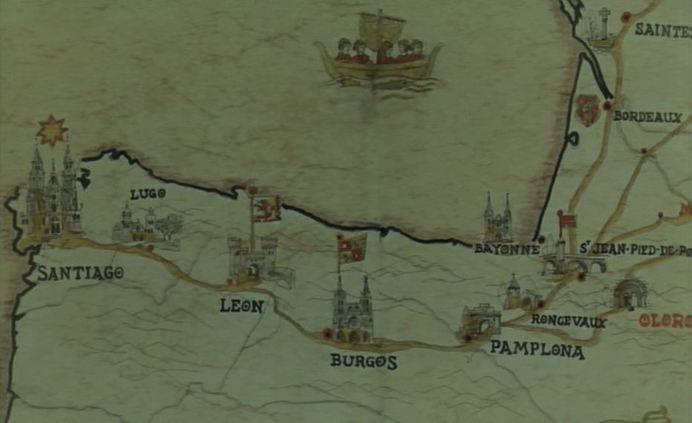
At the height of its fame, during the fourteenth century, the Milky Way – another name for the third road, since at night the pilgrims plotted their course using this galaxy – was traveled each year by more than a million people from every corner of Europe. Even today, mystics, devotees, and researchers traverse on foot the seven hundred kilometers that separate the French city of Saint-Jean-Pied-de-Port from the cathedral of Santiago de Compostela in Spain.
Thanks to the French priest, Aymeric Picaud, who walked to Compostela in 1123, the route followed by the pilgrims today is exactly the same as the medieval path taken by Charlemagne, Saint Francis of Assisi, Isabella of Castile, and, most recently, by Pope John XXIII.
Picaud wrote five books about his experience. They were presented as the work of Pope Calixtus II – a devotee of San Tiago – and they were later known as the Codex Calixtinus. In Book Five of the codex, Picaud identified the natural features, fountains, hospitals, shelters, and cities found along the road. A special society – ‘Les Amis de Saint-Jacques’ – was formed with the charge of maintaining all of the natural markings on the route and helping to guide the pilgrims, using Picaud’s annotations.

Cathedral Of St. James, the goal of the Road to Santiago
Also in the twelfth century, Spain began to capitalize on the legend of San Tiago as the country fought against the Moors who had invaded the peninsula. Several militant religious orders were established along the Road to Santiago, and the apostle’s ashes became a powerful symbol in the fight against the Muslims. The Muslims, in turn, claimed that they had with them one of Muhammad’s arms and took that as their guiding symbol. By the time Spain had regained control of the country, the militant orders had become so strong that they posed a threat to the nobility, and the Catholic kings had to intervene directly to prevent the orders from mounting an insurgency. As a result, the Road to Santiago was gradually forgotten, and were it not for sporadic artistic manifestations – in paintings such as Buñuel’s The Milky Way and Juan Manoel Serrat’s  Wanderer – no one today would remember that millions of the people who would one day settle the New World had passed along that route.

Buñuel's "Milky Way" painting above shows the Road to Santiago De Compostela, this is probably the ancient route as is mentioned in the Codex Calixtinus by Picaud.

haiga by Chèvrefeuille
Now we know a little bit more about the background of the Road to Santiago as is described by Paulo Coelho in "The Pilgrimage". And with this background we can finally go on our way to Santiago ourselves, so ... be prepared ... because tomorrow we will start our pilgrimage ...

a whispered prayer -
pilgrims on their way to Santiago
walking the Path of God
reaching out to their deepest thoughts
seeking the Light
seeking the Light
while chanting psalms or mantras
pilgrims on their way
enjoying Mother Earth's beauty -
a whispered prayer
© Chèvrefeuille

I hope you did like this episode, my excuses for being late with publishing, but I am on the nightshift, and I hope it will inspire you to create haiku, tanka or an other Japanese poetry form.

This episode is NOW OPEN for your submissions and will remain open until January 8th at noon (CET). I will publish our next episode in which we will really start our pilgrimage to Santiago, later on.

Monday, January 2, 2017

Carpe Diem #1114 Arrival (at Saint-Jean-Pied-de-Port)


Dear Haijin, visitors and travelers,

Yesterday we started with the prologue of our pilgrimage and today we are really starting to walk the road to Santiago De Compostela.
Back in the early Middle Ages, Oviedo was the starting point of the Road to Santiago, but most pilgrims started (and still start nowadays) in the Pyrenees in a little village called Saint-Jean-Pied-de-Port. This is the place were our guide, Paulo Coelho (through his novel The Pilgrimage), starts his pilgrimage to recover and regain the power and the light of his sword which he lost at the start of this novel.

[...] "You’re supposed to go to France and, at Saint-Jean-Pied-de-Port, seek out Mme Lourdes. She is going to put you in touch with someone who will guide you along the Road to Santiago."[...]
 

[...] "She ... kissed me desperately. She looked at me for some time without saying a word. This suddenly made me realize that now I was actually in Spain and that there was no going back. In spite of the knowledge that there were many ways in which I could fail, I had taken the first step. I hugged her passionately, trying to convey all the love I felt for her at that moment. And while she was still in my arms, I prayed to everything and everyone I believed in, imploring that I be given the strength to return to her with the sword." [...] (source: The Pilgrimage by Paulo Coelho)


Sometimes in our lives we are on a turning point, this is that turning point for Paulo Coelho, here he starts his journey to explore his Higher Self. Sometimes we need other people to start this change, sometimes it's a personal choice. In this month we will read "The Pilgrimage" and it wasn't really Paulo's own choice, he was ordered to do so by his Master, his teacher in the ancient Tradition of RAM, but maybe ... it was his own choice through his actions during the prologue of yesterday. His subconscious "played" him. Deep in his heart he knew already that he would be to greedy. His Master also knew.
His wife's role in this story is also clear, she has to motivate him to go on exploring the path, the way, to his Higher Self ... than and only than she can (and will) return his sword to him. She is now the keeper of his sword and he has to walk the road to Santiago to deserve it (the sword) back.
 
This brought a tanka in mind which I shared with you last year (2016):
 
lotus flowers
rising from the depths of the pond
everlasting love
like a river flows onwards
uncertain of its goal


© Chèvrefeuille

I think "The Pilgrimage" has a deeper meaning and I hope to discover that deeper meaning together with you here at Carpe Diem.

This episode is NOW OPEN for your submissions and will remain open until January 7th at noon (CET). I will try to publish our new episode, later on.

Sunday, January 1, 2017

Carpe Diem #1113 The Pilgrimage starts --- the prologue


Dear Haijin, visitors and travelers,

First ... I wish you all a wonderful new year full of love, light and inspiration. Second ... welcome at a new month of adventure, a new month of Carpe Diem. This month we will walk the road to Santiago De Compostela, one of the most famous pilgrimages of the world I think. Back in 2015 we walked this road partially, but this month I hope to inspire you while we are reading "The Pilgrimage" of Paulo Coelho and as we walk the road to Santiago I hope to share with you wonderful haiku and tanka.

Let's start this month full with the spirituality of "The Pilgrimage":

Today it is January 1st, a new year has started and i hope this year will be great. A new year, new light, new beginnings, new loves, all will be new.

[...] "The Master approached me and placed my new sword on the earth that now covered the grave of my ancient one. All of us spread our arms wide, and the Master, invoking his power, created a strange light that surrounded us; it did not illuminate, but it was clearly visible, and it caused the figures of those who were there to take on a color that was different from the yellowish tinge cast by the fire." [...] (Quote from "The Pilgrimage" by Paulo Coelho.)
 
Mysterious Sword

At the start of this wonderful novel by Paulo Coelho, he (Paulo himself) burries his old sword, his old light. He has grown spiritual and is now ready to grow to a higher level of consciousness. Therefore he needs a new sword ..., but he is to hasty, to greedy and his master gives him a lesson and a new task.
 
[...] "Because of your avidity, you will now have to seek again for your sword. And because of your pride, you will have to seek it among simple people. Because of your fascination with miracles, you will have to struggle to recapture what was about to be given to you so generously." [...] (Quote from "The Pilgrimage")  
 

a new light
an other year has started
nothing changed

© Chèvrefeuille

Well ... this is the start of a new month full of adventures together with Paulo Coelho as we walk the road to Santiago De Compostela.

PS. I haven't created the prompt-list for this month, so I cannot tell you the titleof our new episode. This episode, however, is NOW OPEN for your submissions and will remain open until January 6th at noon (CET). Have fun!