Tuesday, February 6, 2018

Carpe Diem #1364 Tian Shan Mountains (Northern route)


Dear Haijin, visitors and travelers,

What a beautiful month this is. I am intrigued by the Silk Road and that goes a way back. I remember that I once had a school project about the Silk Road and now I am creating a whole month about this historical trading route. Today I have however a short episode, because of lack of time. Therefore I have chosen to challenge you to create haiku, tanka or other Japanese poetry form inspired on a wonderful image of the Tian Shan Mountains.

The Tian Shan, also known as the Tengri Tagh, meaning the Mountains of Heaven or the Heavenly Mountain, is a large system of mountain ranges located in Central Asia. The highest peak in the Tian Shan is Jengish Chokusu, at 7,439 metres (24,406 ft) high. Its lowest point is the Turpan Depression, which sits at 154 m (505 ft) below sea level.
Tian Shan is sacred in Tengrism, and its second-highest peak is known as Khan Tengri which may be translated as "Lord of the Spirits".

And let me give you a (very) brief description of Tengrism too. Tengrists view their existence as sustained by the eternal blue sky (Tengri), the fertile mother-earth spirit (Eje) and a ruler regarded as the holy spirit of the sky. Heaven, earth, spirits of nature and ancestors provide for every need and protect all humans. By living an upright, respectful life, a human will keep his world in balance and perfect his personal Wind Horse, or spirit.

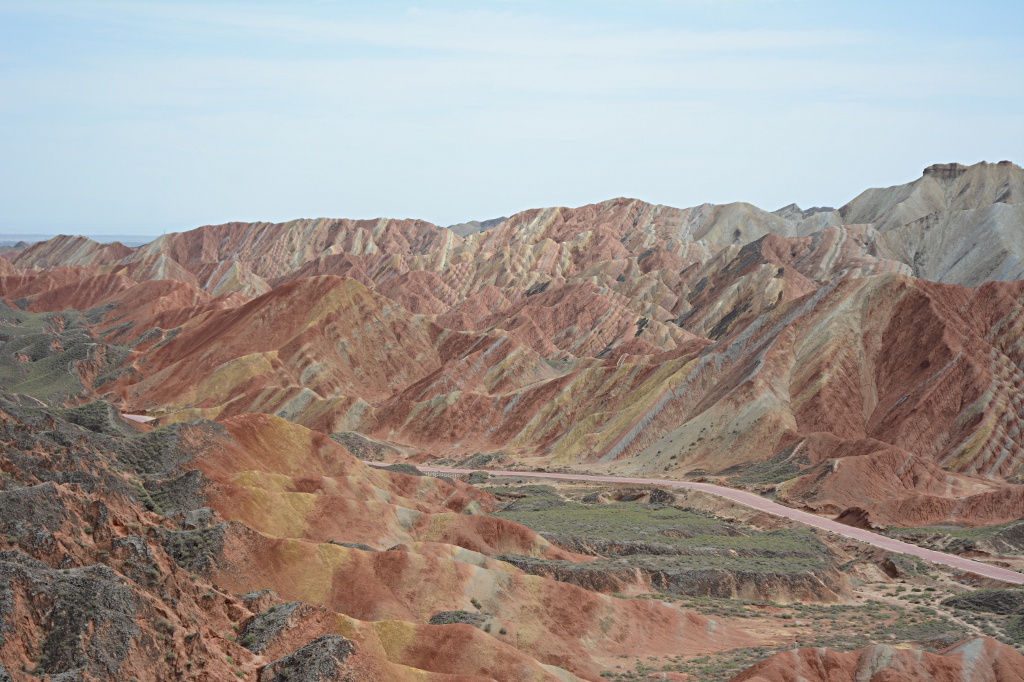
Tian Shan Mountains (image found on Pinterest)
For today's episode I challenge you to use the above photo from Tian Shan for your inspiration. I wasn't inspired today ... so no poem created by me, but you never know ...

This episode is NOW OPEN for your submissions and will remain open until February 13th at noon (CET). I will try to publish our next episode, Silk, later on. For now ... be inspired and share your Japanese poetry with us all here at our Kai.


Monday, February 5, 2018

Carpe Diem #1363 Taklamakan Desert (the "Sea of Death")(Northern route)


Dear Haijin, visitors and travelers,

Welcome at a new episode of our wonderful Kai. This month we are traveling back in time while we are "trodding" along the ancient Silk Road. We are following the Northern Route that brings us along the Taklamakan Desert and later this month as we are returning home we will also take the Southern Route, also along the Taklamakan Desert.

The Taklamakan Desert is a very important issue this month, so I love to tell you little bit more about this Desert.

The Taklamakan Desert was once inhabited as excavations have proven

The Taklamakan Desert is one of largest shifting sand deserts in the world. It is intensely dry and located farther from an ocean than any other desert. Hemmed between China’s Kunlun and Tian Shan Mountains, this Chinese desert sprawls across an area of 100,000 square miles (270,000 square kilometres) and 85 percent of the total area consists of mobile sand dunes. The Taklamakan Desert has no permanent population, and few travelers brave crossing it due to its inhospitable terrain. This infamous expanse is often referred to as the "sea of death" or the "place of no return."

The Taklamakan Desert is distinguished by its constantly moving sand dunes. Its vast sea of gold sand is whipped into crescent-shaped sand dunes, some of which soar to 800 to 1,650 feet tall when winds reach hurricane force. Camels are the only animals able to tackle these monstrous dunes -- the way their feet splay outwards stops them from sinking into the sand.
The Taklamakan Desert supports small populations of animals like wild Bactrian camels, Asian wild asses, wolves, foxes, gazelles and wild boars. Camels, in particular, can tolerate the dryness of the desert area, and they are able to seal their slit-like nostrils closed, keeping out sand and dust.
Bactrian Camel

The Taklamakan Desert is almost devoid of vegetation. Tamarisk, nitre bushes and reeds are the only types of greenery found in the depressions between the dunes; however, plant life is much richer along the edges of the desert area. 
Locals recount tales that ancient cities filled with treasure lie lost and buried beneath the unknown depths of the Taklamakan Desert. In the late 1980s, an archaeological dig unearthed mummies in this remote region, some dating back to over 4,000 years. The mummies found show the wide range of peoples who have passed through the Chinese region; many exhibit Caucasoid features, and many were wearing European twill fabrics.
 The interest in these mummies exists largely because of their extraordinarily well-preserved state. One of the most famous mummies unearthed from the Taklamakan Desert is that of "Cherchen Man." He had reddish brown hair, a long nose, full lips and a ginger beard.

Cherchen Man
The trails that border the Taklamakan Desert once formed parts of the Silk Road, the trading routes of the past that are still being used in the early 21st century.

There is no water on the Taklamakan Desert and it was hazardous to cross. "Takla Makan" means "go in and you'll never come out". Merchant caravans on the Silk Road would stop for relief at the thriving oasis towns. The key oasis towns, watered by rainfall from the mountains, were Kashgar, Marin, Niya, Yarkand, and Khotan (Hetian) to the south, Kuqa and Turfan in the north, and Loulan and Dunhuang in the east. Now many, such as Marin and Gaochang are ruined cities in sparsely inhabited dusty spots with poor roads and minimal transportation.
 
caravan
 
[...] "A goal stood before Siddhartha, a single goal: to become empty, empty of thirst, empty of wishing, empty of dreams, empty of joy and sorrow. Dead to himself, not to be a self any more, to find tranquility with an emptied heard, to be open to miracles in unselfish thoughts, that was his goal. Once all of my self was overcome and had died, once every desire and every urge was silent in the heart, then the ultimate part of me had to awake, the innermost of my being, which is no longer myself, the great secret.
Silently, Siddhartha exposed himself to burning rays of the sun directly above, glowing with pain, glowing with thirst, and stood there, until he neither felt any pain nor thirst any more. Silently, he stood there in the rainy season, from his hair the water was dripping over freezing shoulders, over freezing hips and legs, and the penitent stood there, until he could not feel the cold in his shoulders and legs any more, until they were silent, until they were quiet. Silently, he cowered in the thorny bushes, blood dripped from the burning skin, from festering wounds dripped pus, and Siddhartha stayed rigidly, stayed motionless, until no blood flowed any more, until nothing stung any more, until nothing burned any more." [...]
(Source: Siddhartha by Hermann Hesse)

The above fragment from "Siddhartha" could have been easilyt placed in this surroundings. in the Taklamakan Desert. In the Taklamakan Desert the weather conditions are as extreme as above described in the fragment.

Maybe Taklamakan Desert is a place to become empty, empty of thirst, empty of wishing, empty of dreams, empty of joy and sorrow. but as I read the information and look at the images than to me it's a place that I would love to visit ... it seems awesome.

sand dunes
protecting fragile life
from the sun


© Chèvrefeuille

Not a very strong haiku, but I think I have caught the essence of the Taklamakan Desert.

This episode is open for your submissions tonight at 7:00 PM (CET) and will remain open until February 12th at noon (CET). I will try to publish our new episode, Tian Shan Mountains (Northern route), later on. For now ... have fun!

Sunday, February 4, 2018

Carpe Diem #1362 Gansu (Northern route)


Dear Haijin, visitors and travelers,

I hope you all have had a wonderful weekend and that you all will have new energy for a new week full of the beauty of the ancient Silk Road. This month we are on a journey "Along The Silk Road" and especially we are following the Northern and Southern Route. That means we especially are following the "Silk Road" through China and "around" the Taklamakan Desert. While we are on this journey we are reading a wonderful "esoteric" novel written by Hermann Hesse, Siddhartha, in which we are following a young Brahman son who is on a journey to find himself, his inner peace, to become enlightened. Why are we reading this novel? Well Buddhism entered China along the "Silk Road", so Siddhartha is a nice novel to read while on our journey.

Samanas in the forests
[...] " The first light of day shone into the room. The Brahman saw that Siddhartha was trembling softly in his knees. In Siddhartha's face he saw no trembling, his eyes were fixed on a distant spot. Then his father realized that even now Siddhartha no longer dwelt with him in his home, that he had already left him.
The Father touched Siddhartha's shoulder. "You will," he spoke, "go into the forest and be a Samana. When you'll have found blissfulness in the forest, then come back and teach me to be blissful. If you'll find disappointment, then return and let us once again make offerings to the gods together. Go now and kiss your mother, tell her where you are going to. But for me it is time to go to the river and to perform the first ablution."
He took his hand from the shoulder of his son and went outside. Siddhartha wavered to the side, as he tried to walk. He put his limbs back under control, bowed to his father, and went to his mother to do as his father had said." [...]
(Source: Siddhartha by Hermann Hesse)


And so started Siddhartha's journey ... his first step was going to his father to ask his permission to leave his home to become a Samana.
For us there is no need to ask permission to leave the home for our journey along the Silk Road, but we are on our way. Today we arrive at Gansu. Let me tell you a little bit about Gansu in the time of the Silk Road.
Panorama shot Daxia River Valley
In imperial times, Gansu was an important strategic outpost and communications link for the Chinese empire, as the Hexi Corridor runs along the "neck" of the province. Hexi Corridor or Gansu Corridor refers to the historical route in Gansu province of China. As part of the Northern Silk Road running northwest from the bank of the Yellow River, it was the most important route from North China to the Tarim Basin and Central Asia for traders and the military. The corridor is a string of oases along the northern edge of the Tibetan Plateau. To the south is the high and desolate Tibetan Plateau and to the north, the Gobi Desert and the grasslands of Outer Mongolia. At the west end the route splits in three, going either north of the Tian Shan or south on either side of the Tarim Basin. At the east end are mountains around Lanzhou before one reaches the Wei River valley and China proper.
Hexi Corridor
 
The Han dynasty extended the Great Wall across this corridor, building the strategic Yumenguan (Jade Gate Pass, near Dunhuang) and Yangguan fort towns along it. Remains of the wall and the towns can be found there. The Ming dynasty built the Jiayuguan outpost in Gansu. To the west of Yumenguan and the Qilian Mountains, at the northwestern end of the province, the Yuezhi, Wusun, and other nomadic tribes dwelt, occasionally figuring in regional imperial Chinese geopolitics.
By the Qingshui treaty, concluded in 823 between the Tibetan Empire and the Tang dynasty, China lost much of western Gansu province for a significant period.
After the fall of the Uyghur Empire, an Uyghur state was established in parts of Gansu that lasted from 848 to 1036 AD. During that time, many of Gansu's residents were converted to Islam.
Along the Silk Road, Gansu was an economically important province, as well as a cultural transmission path. Temples and Buddhist grottoes such as those at Mogao Caves ('Caves of the Thousand Buddhas') and Maijishan Caves contain artistically and historically revealing murals.

Magoa Caves (Caves of the Thousand Buddhas)
Buddhism entered China along the Silk Road. Some say Buddhism came to China by the maritime route, but after scientific researches by several scientists, the over all conclusion was that Buddhism came along the Silk Road.

Did Samanas live along the Silk Road? Maybe at the places were traders stopped, the caravanserais, but I don't know that for sure. Could it be that Siddhartha was along the Silk Road while he was with the Samanas. Personally I think that wasn't possible, but in Siddhartha's later journey we will see a connection with the Silk Road. 

above the valley
hidden in his cave
Buddha meditates

without listening to the traders
beneath his feet


© Chèvrefeuille
Pff ... that wasn't easy. It was for sure not an easy task to create a haiku or tanka inspired on this episode, but I think my tanka fits the episode in a way.
This episode is open for your submissions tonight at 7:00 PM (CET) and will remain open until February 11th at noon (CET). I will try to publish our new episode, Taklamakan Desert (Northern route), later on. For now .... Be inspired
Carpe Diem Extra February 4th 2018 One Last Leaf by Isabel Caves


Dear Haijin, visitors and travelers,

It is with great pleasure that I announce that our new exclusive CDHK E-Book "One Last Leaf by Isabel Caves" is now available for download. You can find the "link" at the right side of our Kai.

Isabel was the "winner" of our "Departure" kukai with the following haiku:

departing
on the autumn breeze
one last leaf


© Isabel Caves

Cover of "One Last Leaf"
In "One Last Leaf" Isabel shares 30 of her haiku. She gathered them all by herself and together with Chèvrefeuille's Publications and your host she created this new exclusive CDHK E-book.

We hope that you will like the read. And please ... feel free to share your thoughts about "One Last Leaf" with us all here at our Haiku Kai.

Namasté,

Chèvrefeuille, your host


Saturday, February 3, 2018

Carpe Diem Extra February 3rd 2018 The Judging starts


Dear Haijin, visitors and travelers,

Our first Troiku Kukai was a great success. There were 22 contestants which delivered the same amount of Troiku. This first Troiku Kukai we also have to Judge .. so that's why I publish this CDHK Extra episode.

The Troiku was based on the following haiku by Claire Vogel Camargo:

no spring sprouts
in the herb garden
his heart attack


© Claire Vogel Camargo
I have read wonderful Troiku inspired on this haiku and I am so glad that I have seen a lot of new names ... Of course I hope to see those new names more often here at Carpe Diem Haiku Kai, but we will see.
You can find the Troiku Kukai above in the menu "Carpe Diem's Kukai" or by clicking HERE
 
The judging of this 1st edition of our CDHK Troiku kukai goes the same as all other kukai. So you may give 3 points to the best Troiku; 2 points to the 2nd best Troiku and 1 point to the 3rd best Troiku. Of course you can not give points to your own Troiku.
The "winner" of the Troiku Kukai wins the opportunity to create his / her own exclusive Carpe Diem Haiku Kai E-book and the "runner-up" will be featured in a special episode at Carpe Diem Haiku Kai.
The judging starts NOW. Please send your judging results to our emailaddress:
Please write "Judging Troiku Kukai" in the subject line.
You can send us your judging results until February 24th 10:00 PM (CET).
 

Friday, February 2, 2018

Carpe Diem Weekend-Meditation #18 Yugen, a new feature


!! Open for your submissions next Sunday February 4th at 7:00 PM (CET) !!

Dear Haijin, visitors and travelers,

Welcome at a new Carpe Diem Weekend Meditation. For this weekend-meditation I have created a whole new feature ... Yūgen. And maybe you can remember yūgen from our 2nd series of Haiku Writing Techniques.
Yūgen is usually defined as "mystery" and "unknowable depth". Somehow yūgen has avoided the controversy of Wabi and Sabi. But since deciding which haiku exemplifies this quality is a judgmental decision, there is rarely consent over which verse has it and which does not. One could say a woman's face half-hidden behind a fan has yūgen. The same face half-covered with pink goo while getting a facial, however, does not. But still, haiku poets do use the atmosphere as defined by yūgen to make their words be a good haiku by forcing their readers to think and to delve into the everyday sacredness of common things.

Here is an example of a "yūgen-haiku" by Jane Reichhold:

a swinging gate
on both sides flowers
open - close
 

© Jane Reichhold

Yūgen may be, among generally recondite Japanese aesthetic ideas, the most ineffable. The term is first found in Chinese philosophical texts, where it has the meaning of “dark,” or “mysterious.”


Kamo no Chōmei  offers the following as a characterization of yūgen: “It is like an autumn evening under a colorless expanse of silent sky. Somehow, as if for some reason that we should be able to recall, tears well uncontrollably.”

Another characterization helpfully mentions the importance of the imagination: “When looking at autumn mountains through mist, the view may be indistinct yet have great depth. Although few autumn leaves may be visible through the mist, the view is alluring. The limitless vista created in imagination far surpasses anything one can see more clearly”. 

Yūgen does not, as has sometimes been supposed, have to do with some other world beyond this one,
but rather with the depth of the world we live in, as experienced through cultivated imagination.


In "Basho, The Complete Haiku" Jane Reichhold gives us an example of a haiku by Basho in which he used yūgen and I love to share that haiku here with you all: 

souvenir paintings
what kind of a brush first drew
the image of Buddha


© Basho (Tr. Jane Reichhold)

So ... yūgen as defined "mystery" and "unknowable depth" is not a well-known (or often used) haiku writing techniques, but in a way I am attracted to this technique. I think that in the most haiku shared here at Carpe Diem Haiku Kai we can find yūgen, but that's just my humble opinion.

I think we have to explore this, because I belief that haiku needs yūgen, needs "mystery" and "unknowable depth". So let us focus on that.


I have given it a try ... I just had to, because how could I expect it from you, as I didn’t tried it myself to catch "mystery" ... yūgen ... "unknowable depth" in a haiku? So here is my "yūgen-haiku" and a tanka examples from my archives: 

empty bowl
thrown away in the sink
faint scent of tea


from a treetop
emptiness dropped down
in a cicada shell
the soothing sound of spring rain
makes the silence stronger


© Chèvrefeuille


Well ... I think the goal is clear for this new weekend-meditation feature "yūgen". Try to create a "yūgen-haiku". No theme for this weekend-meditation, just try to use the "yūgen" haiku writing technique.

This weekend-meditation is open for your submissions next Sunday February 4th at 7:00 PM (CET) and will remain open until February 11th at noon (CET). Have fun! And ... have a great weekend.
 

Thursday, February 1, 2018

Carpe Diem #1361 Chang'an (Northern Route)


[...] "After the usual time of the exercise in meditation had passed, Govinda rose. The evening had come, it was time to perform the evening's ablution. He called Siddhartha's name. Siddhartha did not answer. Siddhartha sat there lost in thought, his eyes were rigidly focused towards a very distant target, the tip of his tongue was protruding a little between the teeth, he seemed not to breathe. Thus sat he, wrapped up in contemplation, thinking Om, his soul sent after the Brahman as an arrow." [...]
(Source: Siddhartha by Hermann Hesse)

Dear Haijin, visitors and travelers,

After doing my morning excercise, the greeting of the sun, a yoga-salutation, I decided to create this new episode. After my meditation I thought that we are going to follow the Chinese "Silk Road" around the "Taklamakan Desert". The Chinese had a "northern route" and a "southern route" and those "trails" we will follow the upcoming days. We will visit places along those "trails" and I hope to tell you something about those places. Today we will start at Chang'an (nowadays Xi'an) for our first halting place (or caravanserai).

the first day
after salutating the early morning light
birds point the way

© Chèvrefeuille


The northern route started at Chang'an (now called Xi'an), an ancient capital of China that was moved further east during the Later Han to Luoyang. The route was defined around the 1st century BCE when Han Wudi put an end to harassment by nomadic tribes.

The northern route travelled northwest through the Chinese province of Gansu from Shaanxi Province and split into three further routes, two of them following the mountain ranges to the north and south of the Taklamakan Desert to rejoin at Kashgar, and the other going north of the Tian Shan mountains through Turpan, Talgar, and Almaty (in what is now southeast Kazakhstan). The routes split again west of Kashgar, with a southern branch heading down the Alai Valley towards Termez (in modern Uzbekistan) and Balkh (Afghanistan), while the other travelled through Kokand in the Fergana Valley (in present-day eastern Uzbekistan) and then west across the Karakum Desert. Both routes joined the main southern route before reaching ancient Merv, Turkmenistan. Another branch of the northern route turned northwest past the Aral Sea and north of the Caspian Sea, then and on to the Black Sea.

Chang'an Great Wild Goose Pagoda

Along this part of the Silk Road many goods were brought to China for example, dates, saffron powder, sandelwood, glass bottles and myrrh. In return the Chinese brought porcelain and silk brocade back along the Silk Road to the countries of origine of the trading goods as there were India and Persia.

In a way you can see this whole structure of trading trails as the Internet nowadays. Maybe you can say that the Internet is our modern Silk Road, but that's not always very clear, because there has been a time (and maybe it's still so) that the "modern silk road" was used for trading / smuggling drugs and weapons. That kind of "modern silk road" doesn't exist anymore on the easy to "travel" Internet as we use daily. That "modern silk road" is now hidden on the so called "deep web" or "dark web", the criminal part of the Internet. That part of the Internet I am not familiar with and I hope to stay far from that part this month.

Let me tell you a little bit more about Chang'an:

Chang'an was an ancient capital of more than ten dynasties in Chinese history, today known as Xi'an. Chang'an means "Perpetual Peace" in Classical Chinese since it was a capital that was repeatedly used by new Chinese rulers. During the short-lived Xin dynasty, the city was renamed "Constant Peace"; yet after its fall in AD 23, the old name was restored. By the time of the Ming dynasty, a new walled city named Xi'an, meaning "Western Peace", was built at the Sui and Tang Dynasty city's site, which has remained its name to the present day.

Chang'an had been settled since Neolithic times, during which the Yangshao Culture was established in Banpo in the city's suburb. Also in the northern vicinity of the modern Xi'an, Qin Shi Huang of the Qin dynasty held his imperial court, and constructed his massive mausoleum guarded by the famed Terracotta Army.

The Terracotta Army (wikimedia-image)

From its capital at Xianyang, the Qin dynasty ruled a larger area than either of the preceding dynasties. The imperial city of Chang'an during the Han dynasty was located northwest of today's Xi'an. During the Tang dynasty, the area to be known as Chang'an included the area inside the Ming Xi'an fortification, plus some small areas to its east and west, and a major part of its southern suburbs. The Tang Chang'an hence, was 8 times the size of the Ming Xi'an, which was reconstructed upon the premise of the former imperial quarter of the Sui and Tang city. During its heyday, Chang'an was one of the largest and most populous cities in the world. Around AD 750, Chang'an was called a "million people's city".

The Han dynasty, as metioned above, is also the "founder" of the "Silk Road". They created it to open the Chinese borders to the outside world for trading purposes ... Without the establishing of the Silk Road by the Han dynasty, there wouldn't be a "Silk Road".

entering the city
the sweet perfume of spices
mouth watering

© Chèvrefeuille

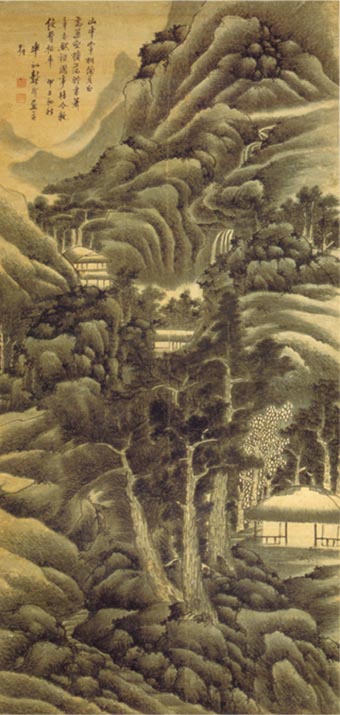
Nature around Chang'an (painting by unknown Chinese painter)

high above the silk road
pine woods stretch against the mountains
breath taking

© Chèvrefeuille

A wonderful start of this journey Along The Silk Road I think ... I hope I have inspired you to create Japanese poetry and of course hope to see you again tomorrow. For now ... have a nice day full of inspiration.

This episode is open for your submissions tonight at 7:00 PM (CET) and will remain open until February 8th at noon (CET). I will try to publish oiur new episode, a new weekend meditation, later on.