Saturday, September 7, 2019

Carpe Diem Weekend Meditation #101 Photoshopping Haiku "Criket Silence"


!! Open for your submissions next Sunday September 8th at 7:00 PM (CEST) !!

Dear Haijin, visitors and travelers,

Welcome at our new (belated) weekend meditation. This weekend I love to challenge you to "photoshop" haiku. Let me give you all the "short" explanation of "photo-shopping haiku":

Photo-shopping sounds awfull but, I think it's possible to "photo-shop" haiku and tanka too. Just a little change can make the difference between a good haiku (or tanka) and an excellent haiku (or tanka).


I love to make photos, but I am not a photographer that likes color. I am more of the black and white and sepia photos, because in my opinion the photos are more beautiful ... more vintage.
Maybe it's because of my age (56 yrs) or of my melancholic mind I don't know, but I do know that we can re-make "photo-shop" a haiku (or tanka) into a vintage one just by retouching of a small part. So this new feature, that I first titled "vintage haiku", I have "re-titled" into "photo-shopping haiku".

Let me give you an example:

autumn has come
visiting my ear on
a pillow of wind

© Basho (Tr. Jane Reichhold)

As I start "photo-shopping" this haiku by my master, Matsuo Basho, than I think 'I can bring more softness, tranquility, into it by changing a small part of this haiku into:

whispering into my ear
on a pillow of wind

In this example I only let the first line un-touched:

autumn has come
whispering into my ear
on a pillow of wind

© Chèvrefeuille

I think this "small" re-touch makes this haiku more soft, lovely and tranquil.

I think, no I know that you all understand the goal of this "photo-shopping haiku", try to create a "better" version of a given haiku. Maybe you only change a few words or maybe you think this haiku becomes "better" as "re-make" it into a tanka. You are free in the choices you make.


Autumn Silence

This weekend I love to challenge you to "photo-shop" an autumn haiku created by Jane Reichhold and taken from her online version of "A Dictionary of Haiku".

cricket silence
between scraping sounds
autumn begins

© Jane Reichhold (Source: A Dictionary of Haiku; Section Autumn, subsection Celestial)

A wonderful haiku by our beloved Jane, she is still missed. "Photo-shop" her haiku to honor her.

This weekend meditation is open for your submissions next Sunday September 8th at 7:00 PM (CEST) and will remain open until September 15th at noon (CEST). Have a great weekend full of inspiration.


Thursday, September 5, 2019

Carpe Diem #1740 Munchner Jakobsweg


Dear Haijin, visitors and travelers,

Yesterday I told you that I hadn't time to create our new episode, so here it is. By the way I will not catch up the delayed post, but will give you this episode instead. (This week we have four regular episodes).

This month we are traveling around the world searching for pilgrimage-routes as an act of devotion. We have seen already a few beauties and today I hope to inspire you through a not so well know short pilgrims-route in Germany. Today we will take our walk on the so called "Munchner Jakobsweg".

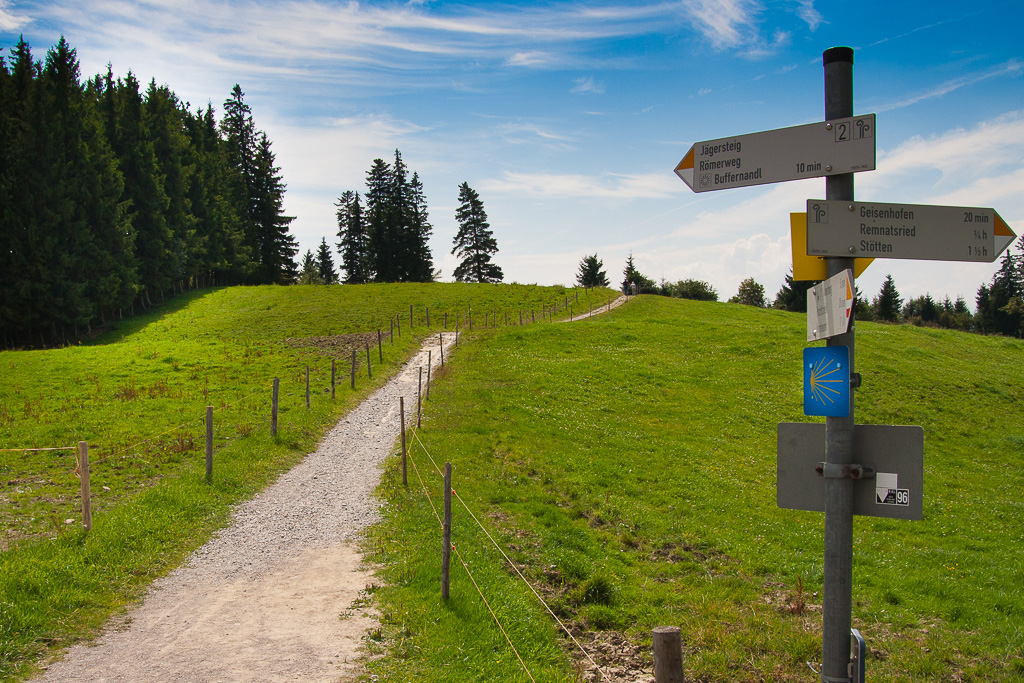
The "Munchner Jakobsweg" is not just one route, but there are several, all starting in another place. The "real" "Munchner Jakobsweg however starts in Munchen (or if traveled back) from Lindau. The "Munchner Jakobsweg" is the german start to wander to Santiago De Compostela. Along the Munchner Jakobsweg you will also see the signs with St. Jakobs Shells as we (maybe) know from our pilgrimage to Santiago earlier here at CDHK.

Direction Sign somewhere along Munchner Jakobsweg

Thousands of travelers from the east of Europe had to travel through Germany to reach Spain. There are many “feeder” routes heading west through the country to get you towards France and Switzerland, then on to your final stop.

Unlike some other scenic routes in Germany, the St. James’ Way doesn’t follow one single but several routes taken by St. James. Legend tells that his remains were brought by ship and buried in Northern Spain — so, this route more follows the “followers.”

One of the most famous (and beautiful) routes travels through South Germany, through Swabia in Bavaria, ending at Lake Constance at the Swiss border (then continuing on through Austria, Swiss, and France).

Along this portion of the Way of St. James, you’ll find abbeys, monasteries, churches, castles, festivals, gorgeous natural countryside, other scenic routes, and the friendliest people. Jakobus, as he’s also called in German, would have been proud to travel along such a route; and you’re going to love it.

Sounds like a wonderful pilgrims route to me.

again on my way
walking to Santiago

to find myself

© Chèvrefeuille

This episode is NOW OPEN for your submissions and will remain open until September 12th at noon (CEST). I hope to publish our new weekend-meditation later on. For now ... be inspired and have fun!


Wednesday, September 4, 2019

Delayed post

Dear Haijin, visitors and travelers,

During circumstances i haven't time to publish our new episode. Sorry for the inconvenience.

Namasté,

Chèvrefeuille, your host.

Tuesday, September 3, 2019

Carpe Diem #1739 St Cuthbert's Way (Scotland)


Dear Haijin, visitors and travelers,

Welcome at a new episode in this month full of the diversity of pilgrimages around the world. Today I have chosen a pilgrimage in Scotland. This pilgrimage route was established in the late nineties.

St. Chuthbert's Way (Scotland):

Bridging the national border between Scotland and England, this inspiring 100km (62.5 miles) cross-border route links Melrose in the Scottish Borders, where St. Cuthbert started his religious life in 650AD, with Holy Island off the Northumberland Coast, his eventual resting place and his original pilgrimage shrine. Although inspired by St. Cuthbert, this is far more than a pilgrimage route.


St. Cuthbert's Way (Scotland)

Look at the above photo made somewhere along St. Cuthbert's Way ... isn't it wonderful? St. Cuthbert's Way ends on "Holy Island" and I remember that we have had a prompt about "Holy Island" at my personal weblog "Chèvrefeuille's Haiku blog". So I revisited that episode to share a redone cascading haiku into tanka:

painted on rocks
the devote Buddhist monk
Holy Isle
the Kagyan Tradition
painted on rocks

© Chèvrefeuille (2012)

Maybe a little bit strange but on "Holy Island" you can find a Buddhistic Monastery. To read the post on my personal weblog you can click HERE or HERE.

This episode is NOW OPEN and will remain open until September 10th at noon (CEST). I will try to publish our new episode later on. For now ... be inspired and have fun!


Monday, September 2, 2019

Carpe Diem #1738 Camino de Fatima (Portugal)


Dear Haijin, visitors and travelers,

We are on our way ... a full month of all kinds of pilgrimages all around the world ... an act of devotion ...

A pilgrimage is a journey or search of moral or spiritual significance. Typically, it is a journey to a shrine or other location of importance to a person's beliefs and faith, although sometimes it can be a metaphorical journey into someone's own beliefs.

Many religions attach spiritual importance to particular places: the place of birth or death of founders or saints, or to the place of their "calling" or spiritual awakening, or of their connection (visual or verbal) with the divine, to locations where miracles were performed or witnessed, or locations where a deity is said to live or be "housed", or any site that is seen to have special spiritual powers. Such sites may be commemorated with shrines or temples that devotees are encouraged to visit for their own spiritual benefit: to be healed or have questions answered or to achieve some other spiritual benefit. (source)

Camino de Fatima (Portugal)

Today I have a not so well known pilgrimage ... Camino de Fatima, Portugal. The story has been told often, but I wasn't aware that there was also a pilgrimage named "Camino de Fatima". Let me tell you a little back ground on the story of Fatima.

The story of a famous miracle in Fátima, Portugal, began in May 1917, when three children (ages 7, 9, and 10) claimed to have encountered the Virgin Mary on their way home from tending a flock of sheep. The oldest girl, Lucia, was the only one to speak to her, and Mary told the children that she would reappear to them on the thirteenth day of the next six months. She then vanished.

The children soon told their parents, and while some in the village didn't believe their tale, others did — and told more people. As the weeks and months passed, more and more of the faithful made pilgrimages to Fátima, where the children claimed to receive Mary's visits. Still no one else saw the Virgin Mary; instead, the gathered adults would stand riveted as Lucia took the lead and began to describe her visions.

Camino de Fatima (Portugal)

It was Mary's final appearance, on Oct. 13, 1917, that became the most famous. In his book "Looking for a Miracle," Joe Nickell states that "an estimated 70,000 people were in attendance at the site, anticipating the Virgin's final visit and with many fully expecting that she would work a great miracle. As before, the figure appeared, and again only to the children. Identifying herself as 'the Lady of the Rosary,' she urged repentance and the building of a chapel at the site. After predicting an end to [World War I] and giving the children certain undisclosed visions, the lady lifted her hands to the sky. Thereupon Lucia exclaimed, 'The sun!' As everyone gazed upward, and saw that a silvery disc had emerged from behind clouds, they experienced what is known [as] a 'sun miracle'."

Not everyone reported the same thing; some present claimed they saw the sun dance around the heavens; others said the sun zoomed toward Earth in a zigzag motion that caused them to fear that it might collide with our planet (or, more likely, burn it up). Some people reported seeing brilliant colors spin out of the sun in a psychedelic, pinwheel pattern, and thousands of others present didn't see anything unusual at all.

This story was the mean reason that the Camino de Fatima was introduced to the world.

wonder, o wonder
Mother Mary shows her face
the sun rises


© Chèvrefeuille

This episode is NOW OPEN for your submissions and will remain open until September 9th at noon (CEST). I will try to publish our new episode later on. For now ... be inspired and have fun!


Sunday, September 1, 2019

Carpe Diem #1737 Introduction to a month full of devotion ... Adam's Peak -- Sri Lanka

Adam’s Peak viewed from a distaance. Photograph by Rehman Abubakr, 

Dear Haijin, visitors and travelers,

I hope you all have had a wonderful inspirational weekend. I had a busy weekend, because I had to work, but that didn't withhold me from creating this new episode, the first of September 2019.

A new month full of wonderful prompts titled "An Act Of Devotion" ... this title points towards the theme I have chosen for this month ... pilgrimages ... Here at CDHK we have walked several pilgramges and this month we will go on new pilgrimages ... not always long once but also short ones, like the pilgrimage of today: Adam's Peak -- Sri Lanka. (Our new logo shows Adam's Peak)

Pilgrimage is act of devotion. In many religions, these sacred walks are prescribed, even considered a must in one’s lifetime, and followers from all of world’s major faiths make holy pilgrimages.
For most, non-believers are accepted or even welcome. Pilgrimage travel can be a meaningful, moving experience in which travelers can enrich their understanding of a local culture and broaden their understanding of the wide range of spiritual beliefs in our beautiful world.


Adam's Peak -- Sri Lanka

Let me tell you a little bit more about Adam's Peak:

The 2243m conical mountain of Adam’s Peak, in Sri Lanka, is also known as Sri Pada, which translates as ‘Sacred Foot’. It has been a pilgrimage site for over 1000 years.

This name, and the mountain’s religious significance, derives from the foot shaped rock formation situated near the summit. Buddhists believe it’s the footprint of Buddha; Hindus that it’s the footprint of Shiva; Muslims and Christians that it’s the footprint of Adam (of Adam and Eve) as he descended to Earth from the Garden of Eden.

The route is beautiful, passing temples, shrines and monuments along the way, all the while walking through lush forest, with waterfalls cascading down mountain faces around you. The solitude of the experience adds a poignancy to it. The steps beneath your feet are worn from the footsteps of a thousand years of religious devotion; it is hard to ignore the spiritual significance of this fact. (source)

Adam's footprint
brings the Creator towards the Earth
Buddha as His companion


© Chèvrefeuille

This episode is NOW OPEN for your submissions and will remain open until September 8th at noon (CEST). I will try to publish our new episode later on. For now .... have fun!


Friday, August 30, 2019

Carpe Diem Weekend Meditation #100 Crossroads ... Indian Summer

Season Logo CDHK Weekend Meditation

!! Open for your submissions next Sunday September 1st at 7:00 PM (CEST) !!

Dear Haijin, visitors and travelers,

Welcome at the first weekend meditation of Autumn 2019. As you all know next Sunday starts the meteorological autumn, so time for a new logo for this special feature. On the above image you can see the holy mountain "Fuji no Yama" in an autumn setting.

This weekend I love to challenge you to create a Troiku with your "fusion-haiku" created from two given haiku themed "Indian Summer".

Here are the two haiku to use for your "fusion-ku" and the Troiku created with it:

after a warm day
a thin layer of fresh fallen snow
covers the garden

Indian Summer
inbetween seasons
roses bloom again

© Chèvrefeuille

Indian Summer

A nice weekend meditation I think. I wish you all a wonderful weekend and I am looking forward to all your wonderful submissions.

This weekend meditation is open for your submissions next Sunday September 1st at 7:00 PM (CEST) and will remain open until September 8th at noon (CEST). Have a great weekend!