Tuesday, October 20, 2015

Carpe Diem #841 Gion Matsuri


Dear Haijin, visitors and travelers,

As you could have read ... I hadn't time to create this new episode on time, so I love to apologize again for the delay. I will try to publish the following episodes on time. At the moment I am in the nightshift and maybe I have time to create a few episodes and schedule them, but I can not guarantee that ... well I will do the best I can.

Today's episode is about Gion Matsuri another wonderful Japanese Festival. The Gion Festival (Gion Matsuri) takes place annually in Kyoto and is one of the most famous festivals in Japan. It goes for the entire month of July and is crowned by a parade, the Yamaboko Junkō on July 17 and July 24. It takes its name from Kyoto's Gion district.

Kyoto's downtown area is reserved for pedestrian traffic on the three nights leading up to the massive parade. These nights are known as yoiyama on July 16 and July 23, yoiyoiyama on July 15 and July 22, and yoiyoiyoiyama on July 14 and July 21. The streets are lined with night stalls selling food such as yakitori (barbecued chicken skewers), taiyaki, takoyaki, okonomiyaki, traditional Japanese sweets, and many other culinary delights. Many girls dressed in yukata (summer kimono) walk around the area, carrying with them traditional purses and paper fans.
Credits: Gion Matsuri
 
During the yoiyama evenings leading up to the parade, some private houses in the old kimono merchant district open their entryways to the public, exhibiting valuable family heirlooms, in a custom known as the Byōbu Matsuri, or Folding Screen Festival. This is a precious opportunity to visit and observe traditional Japanese residences of Kyoto.
 
This festival originated as part of a purification ritual (goryo-e) to appease the gods thought to cause fire, floods and earthquakes. In 869, the people were suffering from plague and pestilence which was attributed to the rampaging deity Gozu Tennō. Emperor Seiwa ordered that the people pray to the god of the Yasaka Shrine, Susanoo-no-mikoto. Sixty-six stylized and decorated halberds, one for each province in old Japan, were prepared and erected at Shinsen-en, a garden, along with the portable shrines (mikoshi) from Yasaka Shrine.

This practice was repeated wherever an outbreak occurred. In 970, it was decreed an annual event and has since seldom been broken. Over time the increasingly powerful and influential merchant class made the festival more elaborate and, by the Edo period (1603–1868), used the parade to brandish their wealth.
 
In 1533, the Ashikaga shogunate halted all religious events, but the people protested, stating that they could do without the rituals, but not the procession. This marks the progression into the festival's current form. Smaller floats that were lost or damaged over the centuries have been restored, and the weavers of the Nishijin area offer new tapestries to replace destroyed ones. When not in use, the floats and regalia are kept in special storehouses throughout the central merchant district of Kyoto in the care of the local people.

Credits: Gion Matsuri 1920
 
This festival also serves as an important setting in Yasunari Kawabata's novel, The Old Capital which he describes, along with the Festival of Ages and the Aoi Festival, as "the 'three great festivals' of the old capital."

Gion Matsuri
celebrating redemption
of Gozu Tenno's wrath


© Chèvrefeuille
Not a very strong one, but it gives the essence of this wonderful festival.

This episode is NOW OPEN for your submissions and will remain open until October 23rd at noon (CET). I will (try to) publish our new episode, a new episode of CD's Haiku Writing Techniques, later on. For now ... have fun!


Monday, October 19, 2015

Carpe Diem Extra 38 - 2015 Delay of new episode


Dear Haijin, visitors and travelers,

During circumstances I haven't time to publish our new episode on time. I will (try to) publish our new episode tomorrow around 6.00 AM (CET). My apologies for this delay.

in the twilight
mist creeps over the fields -
stars twinkle

© Chèvrefeuille

Namaste,

Chèvrefeuille, your host.

Sunday, October 18, 2015

Carpe Diem #840 Hokkaido Shrine Festival


Dear Haijin, visitors and travelers,

Greetings from a greyish The Netherlands. It's raining here since three days and this will last for the upcoming days too I think. What a joy it is to create this new episode, the new festive and colorful, episode as I look outside to the greyish weather.

Today we have a very unique Festival. It's a festival especially celebrated in Sapporo (Japan) in the Hokkaido Shrine, this is a shinto shrine. Let me first tell you a little bit more about this beautiful shinto shrine and after that I will tell you something more about the Hokkaido Shrine Festival.

Hokkaido Shrine (Sapporo Japan)

The Hokkaidō Shrine (Hokkaidō Jingū) is a Shinto shrine located in Sapporo, Japan. Sited in Maruyama Park, Chūō-ku, Sapporo, the Hokkaido Shrine enshrines four kami including the soul of the Emperor Meiji. A number of contributors of the Exploration in Hokkaidō such as Mamiya Rinzō are also enshrined.
In 1869, by an order of the Emperor Meiji, a ceremony to enshrine three kami (Shinto deities); Ōkunitama, Ōkuninushi, and Sukunahikona, was held in Tokyo. They were enshrined as the three deities of the Hokkaido reclamation (Kaitaku Sanjin), and they were later moved to Sapporo by officers in the Kaitakushi, the previous government of Hokkaidō prefecture.
An interim building of the shrine for three kami was constructed in 1870 in Sapporo, although its location was different from the current point where the Hokkaidō Shrine stands. In 1871, the shrine was erected to the current place and named as the "Sapporo Shrine" (Sapporo Jinja), and on September 14 an inaugural ceremony was held.
From 1889 through 1946, Sapporo-jinja was officially designated one of the Kanpei-taisha, meaning that it stood in the first rank of government supported shrines.
The soul of the Emperor Meiji was newly enshrined to the shrine in 1964, and the building was officially renamed to the current "Hokkaido Shrine".

The area of the Hokkaido Shrine is 180,000 m², and is adjacent to Maruyama Park. During the season which cherry blossoms in the area bloom, the shrine is crowded with people enjoying Hanami. Many people also visit the shrine during Japanese New Year to go Hatsumōde. 
From June 14 to 16 in every year, the Main festival of Hokkaido Shrine, also called "Sapporo Festival" (Sapporo Matsuri), is held, and the line of people bearing Mikoshi parades down the street which leads to the shrine. It also manages a Scouting activities.
Mikoshi
The Sapporo Matsuri is a Japan festival. Hokkaido Shrine is one of the most famous Japanese temples in Hokkaido and holds a celebration every year from June 14th to June 16th. During the day time you can see groups of people carrying a portable shrine (mikoshi) , chanting and grunting in the main downtown areas of Odori and Sapporo. The men take turns parading the portable shrine around town wearing Heian era costumes, usually with no trousers!
In the evening there is a festival with many Japan food stalls, horror shows and some carnival games, such as “hit the coconuts”. The festival is held in the beautiful Nakajima Park, a short subway ride from Sapporo Station. This is the busiest festival ever, busier than any music festival because the pathways in Nakajima Park are very narrow so it gets very congested very quickly. It gets much better once you get past the paths and into the open ground area with all the carnival shows and games.
Everyone comes to this festival dressed up like going out for a night on the town, so the festival is probably a good opportunity to meet some attractive people. It’s a great atmosphere because it's usually mid-week and everyone is excited to have something to do after work or school. Also the beautiful surroundings of Nakajima park add to it. It is even possible to row boats in the lake, which is usually packed with couples.

A very nice and bright festival this is I think ... would be awesome to attend it, but ... well keep on dreaming. Here is a You Tube video about this Hokkaido Shrine Festival:
 

Well ... I am a bit late with this episode, but I hope it was worth the waiting.

This episode is NOW OPEN for your submissions and will remain open until October 21st at noon (CET). I will (try to) publish our new episode, Gion Matsuri, later on. For now ... have fun!

Saturday, October 17, 2015

Carpe Diem Special #175 Cor van den Heuvel's "reading a mystery"


Dear Haijin, visistors and travelers,

What a joy to bring you another wonderful haiku by Cor van den Heuvel (1931 - ). In an earlier CD Special I shared a "baseball" - haiku written by him and this time I love to share the following beauty:

reading a mystery
a cool breeze comes through
the beach roses

© Cor van den Heuvel

I have tried to see this scene in front of me. I see a man or a woman enjoying the summer heat on a beach somewhere. Maybe it's late afternoon and the heat has tempered a little bit, but still it is warm. So he/she decides to seek the shade, he/she finds that shade in the dunes surrounded by beach roses.
"Reading the mystery" sounds great. Is it a novel or is the person in this haiku someone who is looking around to find someone, maybe the person is trying to find a mate.
As I look to this haiku from my own view and experience than I would go for that second idea. I love mystery and I love to find out such a mystery.

Another haiku by Cor van den Heuvel brought me also that idea of mystery, but in another way.

through the small holes
in the mailbox
sunlight on the blue stamp

© Cor van den Heuvel

This haiku is awesome, but it looks somewhat paradoxical, because of the scene given. I don't know the American mailboxes, so maybe it's possible, but to me this looks really strange. How can someone see the sunlight on the stamp while the postal is inside the mailbox?
It's a mystery ... so maybe this whole episode is themed mystery or mysterious ...

mysterious fields
hidden in mists and greyness -
the cry of an owl
 

the cry of an owl
resonates through the night
mysterious fields
© Chèvrefeuille

Or this one:

a new day rises
in the mystery of the dawn
the sound of rain


© Chèvrefeuille
Well ... now it is up to you to write/compose an all new haiku in the same sense, tone and spirit as the one given.

This episode is open for your submissions tonight at 7.00 PM (CET) and will remain open until October 20th at noon (CET). I will (try to) publish our new episode, Hokkaido Shrine Festival, later on. For now ... have fun!


Friday, October 16, 2015

Carpe Diem #839 Kodomo No Hi (Children's Day, former Boys Day)


Dear Haijin, visitors and travelers,

First I love to thank you all for voting for our "peace of mind" kukai submissions. I will gather the points and I hope to announce our winner next week.

Kodomo No Hi (Children's Day, former Boys Day) or Tango (Boys' Day or Boys' Festival). This  festival is always on the 5th day of the 5th moon in the lunar calendar which was used in classical Japan. When Japan started to use the Western calendar this day would have been on the 5th of June, but Boys' Day however is still at hand on 5th May, so you would say it's for Spring, but that's not true. Boys' Festival was one the first Summer festivals, so it's a kigo for early Summer.
On this day Japanese families celebrate Tango-no-Sekku, the Boys' Festival. With its special customs and observances, it is Japan's way of celebrating the healthy growth and development of her young boys.

If one travels through Japan from the latter half of April to early May, one sees nearly everywhere huge, gay-colored Koi-Nobori, carp-like streamers made of paper or cloth, which fill with wind and seem to swim in the air. Together with long red and white ribbons, the carp are hoisted on a bamboo pole, mounted by a pair of gilded pinwheels, high above the rooftops. A carp is flown for each son in the family, a very large one for the eldest, the others ranging down in size.
The carp has become the symbol of the Boys' Festival because the Japanese consider it the most spirited of fish, so full of energy and power that it can fight its way up swift-running streams and cascades. Because of its strength and determination to overcome all obstacles, it stands for courage and the ability to attain high goals. The carp is an appropriate symbol to encourage manliness and the overcoming of life's difficulties leading to consequent success.

Koi-Nobori

There are several legends around this Boy’s Festival which I love to share one of here:
This legend traces the origin of the Boys' Festival to Tokimune Hojo's victory over them invading Mongols on May 5, 1282. As a result, Samurai families erected the flags and streamers in celebration of the victory. Others believe that the unification of the country by the Ashikaga Shogun in the 14th century had been celebrated in this fashion on every May 5 until the interior decorations came to be emphasized.

displayed helmet
the young boy's father
a samurai

© Chèvrefeuille

In the modern observance of Tango-no-Sekku, a display is arranged in the tokonoma, or alcove, in the guest rooms of Japanese houses. Among the decorations are a miniature helmet, suits of armor, a sword, a bow and arrow, silk banners bearing the family crest and the warrior dolls which represent Kintaro, a Herculean boy who grew up to be a general; Shoki, an ancient Chinese general believed to protect people from devils; and Momotaro, the Japanese David the Giant killer.

boys playing
samurai battles
with Irises

© Chèvrefeuille


Japanese Iris (Shobu)

Shobu, the Japanese iris, the long narrow leaf of which is somewhat like a sword in shape, has always been closely associated with the Boys' Festival. The iris leaf is prominent in the observance of Tango-no-Sekku because the sound of the word Shobu, although written with different characters, implies striving for success.

striving for success
the young boys play like Samurai
Iris swords in hand

© Chèvrefeuille

A lovely Festival I think as Japan has many. I hope you enjoyed the read and I hope that you all are inspired to write haiku. Have fun, be inspired and creative ... share your haiku with us here on Carpe Diem, the place to be if you like writing and sharing haiku.

This episode is a “reprise” episode, we had this Japanese Festival earlier in June 2013. So I have taken the choice to “re-produce” that same episode here another time. Not because of laziness, but because I haven’t time enough to create an all new episode.

This episode is NOW OPEN for your submissions and will remain open until October 19th at noon (CET). I will try to publish our next episode, another CD Special, later on.


Thursday, October 15, 2015

Carpe Diem #838 Inuyama Festival


Dear Haijin, visitors and travelers,

If you haven't voted yet for our "peace of mind" kukai submitted haiku than please feel free to do so before 10.00 PM (CET). You can send your votes to carpediemhaikukai@gmail.com

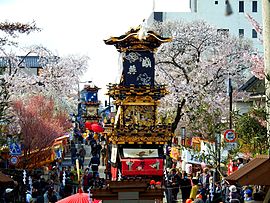
Today we have another wonderful Japanese Festival to attend. It is, as I look at several photos of this festival, really an awesome festival to attend. So please come with me to the Inuyama Festival in the Japanese Castle town of Inuyama.

The Inuyama Matsuri is held at the beginning of April in the city of Inuyama in Aichi Prefecture. 
Coinciding with the blooming of the cherry blossoms, the festival features processions of three leveled ‘dashi’ – traditional wheeled floats.

Credits: Inuyama Festival (Dashi)
The beginning of Inuyama festival

Inuyama festival was originally an event of the Haritsuna shrine, where Inuyama’s genius is enshrined. This became an annual event in 1635, by the chief retainer Hayatonosho Masatora Naruse’s order.

The highlight of Inuyama festival is a parade by 13 floats. Every float has very gorgeous three layered construction, Japanese automaton (or Karakuri puppets) and some of these can be seen only here in Inuyama.

All of these 13 floats are designated as Aichi prefectural tangible folk assets. The parade of floats itself is not that rare in Japan and can be seen all over Japan and floats are called in different ways. Hoko, Dashi, Yatai, Danjiri are examples of them and in Inuyama, floats are called Yama.

Credits: Haritsuna Shrine (were Inuyama Festival once was started)

parade of floats
under the blooming cherry trees
sound of Taiko drums

© Chèvrefeuille

With this haiku I have tried to bring that sweet Haiku Writing Technique of earlier this week "sense switching" and I think I succeeded. (What follows is a short video about Inuyama Festival, enjoy).


I hope you did like this episode on Inuyama Festival and I hope it will inspire you all to write an all new haiku (or tanka).

This episode is NOW OPEN for your submissions and will remain open until October 18th at noon (CET). I will (try to) publish our new episode, Kodomo No Hi (Children's Day, former Boys Day), later on. Have fun!

Wednesday, October 14, 2015

Carpe Diem Special #174 Michael Dylan Welch's "a little taller"


Dear Haijin, visitors and travelers,

We are almost halfway this anniversary month and I hope you all do like this month. Today I have another nice haiku written by Michael Dylan Welch to inspire you, but first I have to tell you something else.
The judging of our "peace of mind" kukai is almost closing. You can email your votes for three haiku submitted until October 15th 10.00 PM (CET), so you have a little bit more as 24 hours time to email your votes.

Ok ... back to this CD Special with a haiku by one of our featured haiku poets this month, Michael Dylan Welch. I have a few other obligations so this episode will be really short ... how short? Well .. I will only give you the haiku for your inspiration and that is it for this CD Special.

Here is the haiku by Michael Dylan Welch to inspire you to write an all new haiku, tanka or another Japanese poetry form:

pull of tonight's moon—
the harbor lighthouse
a little taller


© Michael Dylan Welch


Credits: Harvest Moon above the Chicago Harbor Light
I hope that this haiku will inspire you ... here is a haiku from my archives which fits the scene and the sense, tone and spirit of the haiku given:

guidance
over the harbor
a lightflash


© Chèvrefeuille

Michael Dylan Welch has been writing haiku since 1976, when he first learned about the genre in a high school English class. He joined the Haiku Society of America in 1988, and has been an officer of the society numerous times. Michael cofounded the Haiku North America conference in 1991, and the American Haiku Archives in 1996. He also founded the Tanka Society of America in 2000 (serving as its president for five years), and National Haiku Writing Month (NaHaiWriMo) in 2010. Michael's latest books are True Colour, Becoming a Haiku Poet, and Fire in the Treetops. He recently completed a two-year term as poet laureate of Redmond, Washington, where he also curates two poetry readings. His own poetry, essays, and reviews have appeared in hundreds of journals and anthologies in at least twenty-one languages. Michael's personal website, devoted mostly to haiku, is www.graceguts.com, and you can visit the NaHaiWriMo website at www.nahaiwrimo.com.

This CD Special is NOW OPEN for your submissions and will remain open until October 17th at noon (CET). I will try to publish our new episode, Inuyama Festival, later on. For now ... be inspired and share your haiku, tanka or other Japanese poetry form with us all. Have fun!