Showing posts with label Pi-ku. Show all posts

Monday, May 30, 2022

Carpe Diem Haiku Kai #1362; Summer Is Almost Here


Dear Haijin, visitors and travelers,

Welcome at a new episode of our wonderful Haiku Kai, the place to be if you like to create Haiku, Tanka or other Japanese poetry form. Today I love to challenge you to create a so called "Pi-Ku". Maybe you know that there is an international day about Pi, that mathematical phormula that is known as the Greek letter "Pi" or 3,14. That international day was on March (3rd month) 14th ... so that explains why it is called "Pi-day".

A "Pi-Ku" has three lines (as every haiku has), but you have to follow another series of syllables. A "Pi-Ku" follows the next rule:

1st line: 3 syllables
2nd line: 1 syllable
3rd line: 4 syllables


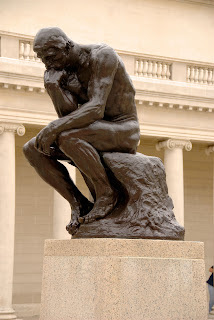
Let me give you an example from my archives (Nov 2012) inspired on the above image of Rodin's The Thinker:

the Thinker
lone
no more thoughts

© Chèvrefeuille (2012)

It is not really my "cup of tea? But it looks like a nice challenge.

So for this episode the challenge is to create a "Pi-Ku" on the theme "Almost Summer". 

This episode is NOW OPEN for your submissions and will remain open until Friday June 3rd 10:00 PM (CEST). You can add your submission to the linking widget hidden in our logo below.


Saturday, February 10, 2018

Carpe Diem Weekend-Meditation #19 Out Of The Box #2 Tau-ku


!!! Open for your submissions next Sunday February 11th at 7:00 PM (CET) !!!

Dear Haijin, visitors and travelers,

Welcome at this new Carpe Diem Weekend-Meditation. This weekend I have chosen for our new weekend-meditation feature "Out Of The Box". In this feature I challenge you to think out of the box of Japanese poetry forms. And this week I have chosen for the challenging Tau-ku.

Maybe you know the "pi-ku", a very short poem in which you have to use the mathematical number "pi" (3.14) . In the "pi-ku" the first line counts three syllables, the second line 1 syllable and the third line 4 syllables. Let me give you an example from my archives:


The Thinker - Augustin Rodin

The Thinker
alone
no more thoughts 

© Chèvrefeuille

A nice form don't you think so too? Well ... Tau-ku is almost the same however it works with the mathematical number "tau" or 6.28 which gives you the following syllables count: the first line has 6 syllables, the second line has 2 syllables and the third line has 8 syllables. Sounds easy ...


Here is an example of a "tau-ku" created by Geraldine (My Poetic Path), you can find her weblog HERE:

Within the bright green leaves.
Treasures!
A bounty of pastel petals.


© Geraldine

A nice "tau-ku" I would say. So here is the challenge, create a "tau-ku" as described above. Just have fun with this nice form, and think out of the box.

Have great weekend!

This episode is open for your submissions next Sunday February 11th at 7:00 PM (CET) and will remain open until Sunday February 18th at noon (CET). Have fun!


Monday, December 18, 2017

Carpe Diem #1329 rebirth


Dear Haijin, visitors and travelers,

I hope you all have your preparations made for the holidays and that your homes are decorated with the beauty of Christmas. We aren't ready yet, but ... well we have time enough.

This will not be a very long episode, not of lack of time, but because this quote speaks for it self. Today I have a ... difficult quote I think, but I also think you can work with it. Today's quote is extracted from Paulo Coelho's "The Fifth Mountain".

Let me give you a brief overview of this novel:

The story is based on the account of Elijah from the Hebrew Bible (1 Kings chapters 17-19). The focus is on Elijah's time in Zarephath (in this book named Akbar). Much has been added to the simple Bible story by Coelho, including Elijah witnessing the sacking of Akbar by the Assyrians, Elijah's journey up the Fifth Mountain itself (said to be the dwelling place of Baal), and Elijah's falling in love with the widow to whom God sent him.
For a considerable portion of the story Elijah is very compliant, obeying everything God's angels say. Eventually he realizes that his destiny is not being chosen by him but by God and ultimately he decides to abide by his own desires and will.

The Fifth Mountain (cover)
I am not that familiar with the story of Elijah, but as I read this novel, a while ago, that part of the Bible started to become alive and I think Coelho has created a really nice story inspired on the life of the Hebrew prophet Elijah. In this novel there are several wonderful spiritual lines to learn from and to become inspired.

Here is the quote for your inspiration:

[...] "The ashes of the dead ... will become the plants that are reborn in the spring.” [...] (Source: The Fifth Mountain by Paulo Coelho)

Isn't that a wonderful idea? I ran through my archives to find a few haiku that fit this theme "rebirth":

smoke rises
from the pyre
to Heaven

her spirit departs
with the dying of her pyre -
smoke rises to the sky

several lives
once lived and re-lived -
Lotus blooms again
reaching for a new day
cherished by the sun

And I found a nice "pi-ku":

the sun rises
the heat
already tangible
mist
spirals above the stream
another day starts in mysterious ways 

© Chèvrefeuille  

Well I hope you did like this post. This episode is open for your submissions tonight at 7:00 PM (CET) and will remain open until December 25th at noon (CET). I will try to publish our new episode later on. For now ... have fun!

Tuesday, March 15, 2016

Carpe Diem Tokubetsudesu #73 pi-ku another nice poetry form (reprise)


Dear Haijin, visitors and travelers,

Welcome at a new episode of our weekly feature Carpe Diem Tokubetsudesu. This week I love to challenge you to write a so called "pi-ku" as a kind of tribute to "Pi-day" which was on March 14. Why is this day called "Pi-day"? Because of the numbers of this date 3.14, which is the value of "Pi".

I remember that we have done this earlier in one of our episodes of "Carpe Diem Little Ones" that special feature about other little poetry  forms like haiku. I will give you an example of a pi-ku.

the sun rises
the heat
already tangible

© Chèvrefeuille

I sought the Internet for all the digits of Pi and I found the next (short) value: 3,14159 26535 89793 23846 ... and the digits go on and on, everlasting ...

Let us try to make a Pi-ku with the above digits in red (3,14159) the lines of the Pi-ku and the syllables-count would become the following:

1st line 3 syllables; 2nd line 1 syllable; 3rd line 4 syllables; 4th line 1 syllable; 5th line 5 syllables and the 6th line would be 9 syllables. To me this sounds great and will be for sure a challenge. So let me try to make my Pi-ku longer with those new lines and their syllables-count:

the sun rises
the heat
already tangible
mist
spirals above the stream
another day starts in mysterious ways


© Chèvrefeuille
 

Sunrise
Isn't it a wonderful (extended) pi-ku?

As you all know next week we will have our second Theme Week here at Carpe Diem Haiku Kai. Last month the theme was "The Tibetan Book of Living and Dying" and in our second Theme Week we will "Color Our Life". I can hear you all think "coloring my life?" Yes ... we are going to explore the spiritual meaning of the colors of the rainbow.

At the start of Carpe Diem, back in 2012, I had also a week about the colors of the rainbow and in our next Theme Week "Color Your Life" we will have a reprise week (so to say). By the way ... at the end of this 2nd edition of Carpe Diem Theme Week I will create a new e-book (as I did last month for the Theme Week) in which I will gather all the episodes and all of your submissions.

Logo of our 2nd Carpe Diem Theme Week "Color Your Life"
yûmomiji tani zankô no kie kakaru

evening's fall colors -
the rainbow in the valley
fades away

© Issa 

I am looking forward to this new Theme Week, it will be a busy week, that's for sure, because I have to create two posts every day that week, but I enjoy it very much ... so I cannot wait until it is next week.

For closure a last message; The voting for our "Time"-kukai has closed. I will count the votes and I hope to publish the results later this week. Be patient.
I am busy with the creation of an anthology in which I have gathered all the submitted haiku for the "Winter"- en "Time"-kukai. I will give you the title already for this new CDHK e-book: "Melting To Nothingness" and it is taken from the following haiku by Nimi Arora:

a moments rest
melting to nothingness
snowflakes sigh

© Nimi Arora

Weel ... it has become another nice episode I would say. This Tokubetsudesu episode is NOW OPEN for your submissions and will remain open until March 18th at noon (CET). 


Sunday, April 6, 2014

Carpe Diem #440, Ghost-Writer Jules


Dear Haijin, visitors and travelers,

Here it is ... finally ... our first Ghost-Writer week. I hope this week will inspire you all to write wonderful haiku and maybe this week will make you enthousiastic to be a Ghost-Writer yourself for Carpe Diem ... if you would like to be Ghost-Writer for May 2014 than let me know and I will see what I can do for you. As all is going well than I hope to do a new Ghost-Writer week in week 19 (May 5th - 11th) ... Oke ... here it is our first Ghost Writer, Jules of Jules Gems and Stuff. Enjoy the read and share your haiku, senryu, tanka, kyoka or haibun with our haiku-family here at Carpe Diem Haiku Kai. 

++++++++++++++++++++++++++++++++++++++++++++++++
++++++++++++++++++++++++++++++++++++++++++++++++


Ghost Writer for Haiku Kai: Jules (JulesPaige because words are like Jewels on a Page)

While I only have informal training in the art of haiku I enjoy the challenge of short forms to speak volumes. The haibun, while a good bit of prose can have haiku throughout or just as an ending summation. Though I have only been blogging for about two or three years, I have been experimenting with words for four decades (plus). And one of the things I enjoy doing is mixing short forms, I am a rebel that way. Some of my favorite short forms I have shared on my daily WordPress site on the following pages which explains these forms:
You can find more about these poetry-forms at:

While I know there are many more short forms I encourage you too, to mix haiku with other short forms and share the 'how to’s' and your verse with us. I offer these examples:

Mirror Elfje Sandwiches  a haiku

Water
even lakes
constantly moves, flowing
tugged by the moon
change

returning to start -
looking to go home again
and yet we cannot…

change
tugged by the moon
moments ever changing
forward motion
tears

©JP/davh


Mixed short forms: Elfje Trio, haiku (three lines) and a three words

A Month of Goodbyes #6

I
Am the
Pink rubber ball
Smacked on the curb
Childhood

Childhood
Those days
Youthful carefree summers
Spent playing without fear
Melted

Melted
Memories flutter
Responsibilities grew – rose
To meet the sky
Good-bye

bounce, resiliency
adapt, mature, run the race
until breath ceases

…auf wiedersehen, adieu…

©JP/davh


haiku series with an Elfje closure:

Elegant Equations

careful devotion
dedication to our truths
the ones we were taught

they mattered then, when
in our younger days, counting
was part of the rule

then considered pure
though a borrowed form, haiku
brought us calming peace

and still now to us
in our counted days, matter;
ink in our souls runs

staccato and smooth
as our pastoral thoughts flow -
counting moons and stars…

practitioners preach
reaching new audiences
with calm devotion

counting our blessings
narrowing distances
with our own haiku

~~~

Counting
ever so
gently with ease
every syllable that matters -
seventeen

(c) JP/davh
+++++++++++++++++++++++++++++++++++++++++++++++
+++++++++++++++++++++++++++++++++++++++++++++++
 

This episode is open for your submissions tonight at 7.00 PM (CET) and will remain open until April 9th 11.59 AM (CET). I will post our new Ghost-Writer episode written by Managua, later on today. For now ... have fun and be inspired.

Saturday, August 24, 2013

Carpe Diem's Little Ones #3,


Dear Haijin, visitors and travelers,

Another new week lays ahead of us and I love to share a new episode of Carpe Diem's "Little Ones" with you all. This feature is meant to be for short poetry forms different or related to haiku. So today I would like to introduce another short form of poetry to you SIJO an ancient Korean short poetry form.

Sijo share a common history with haiku and other Japanese forms. Sijo is a modern term for a Korean style of lyrical poetry, originally called tanga (literally, "short song"). The sijo strongly resembles Japanese haiku in having a strong foundation in nature in a short profound structure. Bucolic, metaphysical and astronomical themes are often explored. The lines average 14-16 syllables, for a total of 44-46. There is a pause in the middle of each line, so in English they are sometimes printed in six lines instead of three. Most poets follow these guidelines very closely although there are longer examples. Either narrative or thematic, this lyric verse introduces a situation or problem in line 1, development (called a turn) in line 2, and a strong conclusion beginning with a surprise (a twist) in line 3, which resolves tensions or questions raised by the other lines and provides a memorable ending. An example by Kwon Homun (1532-1587): :

"The wind is pure and clear,
the moon is pure and bright.

The bamboo grove within the pines
is pure of worldly cares:

But a lute and piles of scrolls
can make it purer still"


Credits: Bamboo Groove

Another example by Yi Saek (1328-1396):

"the white snow has left the valleys 
where the clouds are lowering

Is it true that somewhere
the plum tress have happily blossomed?

I stand here alone in the dusk 
and do not know where to go"


Credits: Plum Trees

Korean poetry can be traced at least as far back as King Yuri's Song of Yellow Birds (17BC), but its roots are in still earlier Chinese quatrains. Sijo, Korea's favorite poetic genre, is often traced to Confucian monks of the eleventh century, but its roots, too, are in those earlier forms. Its greatest flowering occurred in the 16th and 17th centuries. 
Sijo is, first and foremost, a song. This lyric pattern gained popularity in royal courts as a vehicle for religious or philosophic expression, but a parallel tradition arose among the 'common' folk. Sijo were sung or chanted with musical accompaniment, and still are. In fact, the word originally referred only to the music, but it has come to be identified with the lyric as well.
The poet should not lose sight of three basic characteristics that make the sijo unique: its structure, its musical/rhythmic elements, and the twist which begins the final line. For best results, poets follow these and other guidelines very closely. (sources: Wonder Haiku Worlds and Asian Poetry, the Sijo

My first attempt to write a Sijo I love to share here with you all.

Cherry trees blossoming 
for the very first time

spreading their branches,
reaching for the sun

thunderstorms raging,
fragile blossoms scattered

Well ... I think I am gonna like this new poetry form from the Far East. What do you think about this Sijo?


This episode of Carpe Diem's "Little Ones" will stay on 'till September 8th 11.59 AM (CET). The goal for this episode is to write a Sijo, but you also may share another short poetry-form e.g. Pi-ku or Acrostic haiku. Just have fun, be inspired and share your "Little One" with our haiku community.


Sunday, August 11, 2013

Carpe Diem's "Little Ones" #2


Dear Haijin, visitors and travelers,

Several days ago I introduced to you a new feature "Little Ones" and I think it was a success, because Pi-ku and One-line haiku are great to create. So I thought .... maybe we can do another "Little Ones"-episode. So here it is ...
The goal of this new feature is to look behind the haiku and try something new e.g. a Pi-ku, based on the mathematical number 'pi' 3,14, in which every number correspondents wit the syllables of the sentences of the Pi-ku. So the 1st line has three syllables, the 2nd has one and the 3rd has 4th syllables. And if you will bring up more numbers of 'pi' then those numbers also stand for the syllables.

early spring breeze
rain
first narcissus

Another "little one" could be an acrostic haiku. What is an acrostic haiku? The first characters of the three lines are making one word for example SUN

Sweet memories
Under the old appletree
Newly weds


Isn't it a wonderful way to write haiku? You've to look past the lines to make an acrostic haiku, so you've to think it over ... and over ... not an easy form I think. Another acrostic one ... this time with ONE

Only eyes for you
Naked she lays down on the beach
Everlasting love


Not a strong one, but ... it's an example. I am not so familiar with three character words in English.

Another "little one" is the Naisaiku, maybe you know that form, because I have introduced it earlier in the history of Carpe Diem. It's a wonderful 'artistic' (and artificial) form which I enjoy to write.
As you maybe know ... the first and the third line of a haiku can be interchanged. I will give you an example:

lonely flower
my companion
for one night


When we interchange the first and third line the haiku becomes as follows:

for one night
my companion
lonely flower


Now we are gonna make this a Naisaiku:


lonely flower
my companion
for one night
lonely flower
for one night
my companion
lonely flower


This Naisaiku is titled "lonely flower", because of the use of the first line for the 'moment interchanging'. You can make also a Naisaiku with the 2nd and 3rd line as title. Let us give it a try.


lonely flower
my companion
for one night
my companion
for one night
my companion
lonely flower


And with the 3rd line as title it becomes:


lonely flower
my companion
for one night
for one night
for one night
my companion
lonely flower


Well ... do you like this Naisaiku? Just try it with one of your own haiku and make your first Naisaiku ever.
I hope you liked this new episode of "Little Ones" and maybe you are inspired to try a "little one" such as a Pi-ku or Naisaiku, but of course you may use all other forms of "little ones", as e.g. One-Line haiku or teh Acrostic haiku.

This episode of Carpe Diem's "Little Ones" will stay on 'till August 25th 11.59 AM (CET). Have fun, be inspired and share your "little one" with us all here on Carpe Diem.


Thursday, July 25, 2013

Carpe Diem's Little Ones #1


Dear Haijin, visitors and travelers,

I recieved a question of Maggie Grace and she asked me if it was possible to make a new feature on Carpe Diem about one liners and other shorter verses then haiku. So I love to introduce a new feature ... (drum-roll) I give you ... CARPE DIEM LITTLE ONES ... As the name says it's all about little ones ... shorter forms of haiku. E.g Pi-ku, One-Line haiku (Monoku) or the Modern way of haiku.

What's a Pi-ku?

Pi-ku is a haiku form based on the mathematical number Pi, it's value is 3,14 this value is seen in the three lines: 1st = 3 syllables; 2nd = 1 syllable and 3rd = 4 syllables. I will give an example:

the sun rises
the heat
already tangible


Several days ago I published a Carpe Diem Freestyle episode in which I shared another Pi-ku. Bjorn of Rudberg's Writings stated in a comment on that episode "maybe it's possible to use more digits of the Pi number".
First I thought ... that isn't possible, but I think it's worth a try. So I sought on the Internet for all the digits of Pi and I came with the next (short) value: 3,14159 26535 89793 23846 ... and the digits go on and on, everlasting ...

Let us try to make a Pi-ku with the above digits in red (3,14159) the lines of the Pi-ku and the syllables-count would become the following:

1st line 3 syllables; 2nd line 1 syllable; 3rd line 4 syllables; 4th line 1 syllable; 5th line 5 syllables and the 6th line would be 9 syllables. To me this sounds great and will be for sure a challenge. So let me try to make my Pi-ku longer with those new lines and their syllables-count:

the sun rises
the heat
already tangible
mist
spirals above the stream
another day starts in mysterious ways


I like this way of making the Pi-ku a longer poem, maybe you, my dear friends, can make an even longer Pi-ku ... just have to try it.


Modern haiku?


Modern haiku are not so different from the haiku, but the syllables count isn't important in that modern form and the lay-out of a verse looks sometimes different, more playfull. For example this one by (c) Bill Pauly :

divorce -
        she
            nueters her dog


Or e.g. this one by (c) Emily Romano :

cowboyyellonghornery

Another example of a modern haiku:

gonggoinggone   in

(c) Peter Yovu

Not really my style, but it is very funny to play with haiku and the form. For the One-Line haiku you can read the Carpe Diem Lecture .

Of course there will be other forms of haiku, maybe you know another one, well ... share it with us all here on Carpe Diem. There are so much other ways to write haiku. As you all know I am a big fan of Basho's Kanshicho-style in which the syllables count isn't anymore a rule. That style is more in the line of the Western haiku form.

This new feature is bi-weekly online and this is our first episode. This episode will be online 'til August 8th 11.59 AM (CET) and I will post our new episode of 'Little Ones' later on that day around 8.00 PM (CET).
Well ... have fun with this new feature and I am looking forward to all of your wonderful posts.

Namaste